‘Even after the world war France has, from a cultural point of view, preserved its dominant status. To draw attention to oneself in Paris in a particular cultural area is, to a large extent, to draw to oneself the attention of the whole of cultural Europe.’Footnote 1 That Paris was the centre of the Western cultural universe has been a long-standing idea. The sentiment expressed in this 1929 memorandum is therefore important not so much for its content, as for who wrote it: the Czechoslovak ambassador to Paris, Štefan Osuský, who served in that capacity from 1921 to 1939, when Czechoslovakia was occupied by Nazi Germany and transformed into the Protectorate of Bohemia and Moravia. During his tenure as ambassador, Osuský oversaw or took part in practically all important affairs related to Czechoslovakia and France, even attending meetings of the League of Nations in Geneva with Czechoslovak foreign minister Edvard Beneš. Osuský was very much aware of the importance of France to Czechoslovak politics. Elsewhere in that same memo he detailed the significance of maintaining good relations with France with regard to the League of Nations, the progress of the reparations process, and especially the promotion of Czechoslovak interests in European politics. On this last issue, Osuský pointed out that ‘the leading role that France occupies in world politics induced many European countries to devote an exceptional amount of attention to Paris from the point of view of propaganda’. Therefore, Osuský concludes, the undertakings of the embassy in promoting Czechoslovak interests are ‘extraordinarily critical’.Footnote 2
A good relationship with France would then be of great benefit in attempting to influence political dealings in one’s favour. Osuský, and through him the Czechoslovak government, aggressively cultivated this relationship through events, organised in part or wholly through the embassy, aimed at promoting Czechoslovak-French cultural exchange and friendship. Czech choruses and orchestras engaged in regular tours of a myriad of European countries, including France; one such visit in 1919 featured Czech musicians playing instrumental compositions by Smetana, Antonín Dvořák, Vítězslav Novák, Josef Suk, Otakar Ostrčil and others for a room full of delegates from the Versailles peace conference.Footnote 3 In the second half of 1928 alone, the Czech embassy in Paris reported on three lectures there and in Biarritz devoted to Czech topics, three Czech films given in a variety of French cities (one film accompanied by its own lecture series), four concerts of music by Czech composers, participation in two different visual art exhibitions, and the publication of a French-language ‘Artistic Guide to Prague’.Footnote 4
Perhaps the most important of these events during the interwar period, however, was the Parisian premiere of Smetana’s opera Prodaná nevěsta (The Bartered Bride), on 26 October 1928 at the Opéra Comique. Attempts had been made to get The Bartered Bride to Paris as early as 1869, just three years after its premiere in Prague; indeed, Smetana himself revised the opera specifically for this purpose, adding new choruses and ballet music with an eye towards French tastes. That performance, however, did not come to pass. Despite the occasional efforts of important political figures such as Reichsrat member František Ladislav Rieger and Princess Pauline von Metternich throughout the remainder of the nineteenth century and into the twentieth, no performances of the opera materialised in Paris until 1928.Footnote 5
Discussions for this production began as early as 1925, and were of interest to the Ministry of Foreign Affairs in Prague and the Czechoslovak embassy in Paris from the very first stages.Footnote 6 The premiere ultimately took the form of a gala event to mark the tenth anniversary celebrations for the foundation of Czechoslovakia, on 28 October 1918, in the wake of the First World War. In addition, the premiere itself was broadcast over the radio to cities across Europe, including Marseille, Lyon, Berlin, Prague, Vienna, Warsaw and Zagreb.Footnote 7 Attendees included Ambassador Osuský; his wife and major supporter of the premiere, Pavla Osuská; the president of France, Gaston Doumergue; the French ministers of Education, War, the Interior and Labour; members of the First World War Reparations Commission; and a wide range of literary, musical and social luminaries. In a statement that neatly encapsulates the cultural and diplomatic import of the evening, the French newspaper Le Radical quipped, ‘after such a happy event of allied art, a question comes to mind: when will the directors of the Opéra Comique reside at the palace of the League of Nations?’Footnote 8
The Paris premiere of The Bartered Bride therefore allows for a detailed examination of two interconnected issues: the status of Smetana’s opera as a political, ideological and national symbol for the nascent Czechoslovak republic, on the one hand, and the cultural and political relationship between the two nations on the other. Indeed, Prague critics frequently described Paris as the final jewel in the crown of The Bartered Bride, in 1928 indisputably both the most famous and the most performed opera in the Czech lands. For their part, French critics saw Czechoslovakia as a friendly neighbour; they supported the production in part because they considered it a long-delayed presentation of a classic work. Yet Smetana’s opera was also another exotic work to be incorporated into the ambit of French nationalist self-imaginings, proving Paris’s status as the cosmopolitan, universal and cultural capital of the Western world, in spite of the First World War.Footnote 9
The gala premiere event thus presented the final consecration of The Bartered Bride as a symbol for the nation abroad in the confluence of two distinct nationalist discourses: Czech insistence on Smetana as the font of all Czech music and French determination to be the final arbiter of all that was important in operatic culture. Earlier performances of the opera in foreign cities – St Petersburg (1871), Zagreb (1873), Vienna (1892), Berlin (1893), Bern (1894), London (1895), Milan (1905), New York (1909) and Barcelona (1924), among others – had varying effects on the reputation of the opera in international circles, but cumulatively added to the reputation of the opera and its composer (Vienna was especially important in accelerating dissemination of the opera on Western stages).Footnote 10 Nevertheless, while chauvinist nationalist discourses, both at the time and later, would occasionally discount the weight placed on the Paris premiere, it was precisely individuals like Osuský – by concurring with the idea of Paris as the last word in operatic relevance – who dominated Czech appreciations of their Parisian moment. Smetana, as The Bartered Bride’s creator, was thus confirmed as Czechoslovakia’s foremost composer, one apostrophised as the musical equivalent to the ‘president-liberator’ of his country, Tomáš Garrigue Masaryk, president of the First Czechoslovak Republic.Footnote 11 The combination of The Bartered Bride’s premiere with the celebration of the tenth anniversary of Czechoslovak statehood, moreover, cemented the importance of the event for the legacy of the opera and its composer.
As to the relationship between France and Czechoslovakia in the interwar period, Czechoslovakia was politically concerned with Hungarian animosity to Czechoslovak gains from Versailles, her alliance with Romania and Yugoslavia (the so-called Little Entente) geared towards containing Hungary, and the progress of the reparations process. France could guarantee or provide support in many of these areas, and the Locarno treaties, signed in late 1925, were ostensibly a concrete step in this direction. The main body of the agreements, signed by France, Great Britain, German, Belgium and Italy, guaranteed Germany’s western borders and provided a path for that country’s eventual accession to the League of Nations. However, in a move that caused some concern in Czechoslovakia, Germany’s eastern borders were not guaranteed, though Germany and Czechoslovakia did conclude a treaty of arbitration in case of disputes. Czechoslovakia nevertheless needed France to support its regional security concerns, and France wanted Czechoslovakia to act as a buffer, in concert with the ‘Little Entente’, towards Soviet Russia and given the potential for German resurgence. As a result, France and Czechoslovakia concluded a separate treaty, not technically part of the main Locarno accords but included as a separate appendix that reaffirmed their mutual guarantees of security.Footnote 12 Both countries touted the success of Locarno, whatever its actual practical outcomes, and reiterated the importance of their alliance to their respective domestic publics.
The political situation thus mirrored the cultural one: despite their relatively incommensurate levels of political and cultural power in Europe, both nations needed each other, and the gala premiere represented an opportunity for France and Czechoslovakia to offer each other something that would lead to closer ties. The celebration of the tenth anniversary of the foundation of Czechoslovakia, as a result, took on an outsize importance, symbolising not just an expression of Czechoslovak-French amity, but also the promise of national self-determination and the integrity of the post-Versailles European order. In this way the premiere resonated with greater European feelings of a ‘spirit of Locarno’, a utopian faith in international diplomacy and good will between nations that lasted roughly from the signing of the Locarno treaties to the early 1930s.Footnote 13 While Czechoslovakia – wary of Hungarian demands on its territory and the looming spectre of an Anschluss – may not have exulted quite so much in the ‘spirit of Locarno’ as did Western European countries such as France, it nevertheless supported the larger cause of international democracy and peaceful diplomacy.
Using newly uncovered archival materials including political reports, diplomatic cables, letters, interviews and newspaper articles, in this article I aim to place the gala premiere of The Bartered Bride in Paris in its social, cultural and political context. In so doing I hope not only to expand understandings of Czech music history and Czechoslovak-French relations in the interwar period, but also to contribute to larger discussions about cultural diplomacy in Europe. Specifically, I offer here an example of what I term cultural reciprocity: an instance of sharing musical and cultural capital with the goal of strengthening political and social ties. In contrast to such events as the orchestral tours of the Cold War, which could be understood as promoting mutual understanding through appeals to the ‘universal’ nature of symphonic music, the Paris premiere engaged a dual form of musical diplomacy. On the one hand, appeals to the universality of Smetana’s music were present throughout the reception of the event, but on the other hand, the gala was also celebrated as a profoundly national affair.Footnote 14 This is in large part thanks to the representational capacities of opera and the status of The Bartered Bride in particular: in 1927, at the occasion of its thousandth performance at the National Theatre in Prague, it had been hailed as ‘a part of [the Czech] national soul. Embodied here are the ideal characteristics of our people: faithfulness, intelligence, objectivity, and healthy joyfulness.’Footnote 15 Another writer from Prague, reacting to the radio broadcast from Paris in 1928, was more direct, simply calling it ‘our most national [nejnárodnější] work’.Footnote 16
An understanding of The Bartered Bride as the embodiment of national characteristics served not only French tastes for an easily packaged and exoticised musical style, but also supported the idea of a nation-state possessing a unitary language, culture and temperament, underscoring Czechoslovakia’s assertions of its own right to exist as a state. This interpretation allowed the opera and the gala to be described in the language of mutual support and cooperation, broadcasting a diplomatic and musical message of alliance – functioning, in other words, as a kind of operatic Locarno.
As an exchange between two rather different nation-states, the Paris Bartered Bride gala benefits from adopting an analytical framework influenced by ideas of transnational history.Footnote 17 Opera has long been studied as a transnational emissary: common practice tonality, a shared musico-dramatic language and the gradual codification of an operatic canon within Europe facilitated the use of the medium as an effective means of communication across national and linguistic boundaries, and ever more so in the later nineteenth century and into the twentieth. In this sense, then, the emphasis on The Bartered Bride’s national particularity and its symbolic status are not diminished by a transnational reading but rather confirmed, in that it served as an effective means for propaganda and communication that was legible across Europe and its various nations. As other scholars including Gundula Kreuzer and Tamsin Alexander have shown, operatic exchange could serve both to explore the limits and overlaps of national identity and to declare affinities between national groups for political reasons.Footnote 18 I too follow this thread, but my discussion of Czech and French reactions to this work in addition shows the ways in which a transnational approach nevertheless relies upon relatively stable (if still imagined and contingent) concepts of nations and their cultures. There was no question in the minds of French or Czech critics that The Bartered Bride was a national opera, presented to a different nation in a cosmopolitan framework of reception. Indeed, its transfer from the Prague National Theatre stage to that of the Opéra Comique showcased the ways in which specific national discursive contexts could mould reception into different shapes, while maintaining mutual intelligibility.
Smetana’s legend
The Bartered Bride had its premiere on 30 May 1866 at Prague’s Provisional Theatre. It was revised a number of times before arriving at its final version in 1870, with several major musical numbers added and all spoken dialogue turned into recitative. The opera quickly developed into a favourite within the Czech lands and became indelibly associated with Smetana’s name; the first of many celebratory jubilee performances, the one hundredth, took place in 1882, with the composer in attendance. On the other hand, The Bartered Bride’s librettist Karel Sabina was all but forgotten, in part because his name was suppressed by theatre authorities and publishers after his activities as a police informer for the Austro-Hungarian imperial authorities came to light.Footnote 19
While the Austro-Hungarian, German and Czech surroundings of Bohemia were the most immediate contexts for Smetana’s works, his operas were not nearly as autochthonous as subsequent discourses were to suggest. Influences from the wider European operatic context are evident in The Bartered Bride and in Smetana’s other operas, especially Italian and French characteristics. In his tenure as conductor of the Provisional Theatre’s opera company in Prague, Smetana made a point of programming works within the tradition of French grand opera, even though the forces required for such performances far outstripped the cramped theatre’s capacity. The Bartered Bride’s choral episodes and ballet numbers, while not explicitly following from the style of French grand opéra or opéra comique, no doubt benefited from Smetana’s familiarity with that tradition; arias such as the heroine Mařenka’s Act III number ‘Ó jaký žal!’ clearly show a connection to the Italian tradition as well. Several through-composed duets and scenes, on the other hand, betray Smetana’s interest in Wagner’s conception of music drama.Footnote 20
Yet for all these possible influences, the main thread of reception of The Bartered Bride has focused from the very beginning on the work’s essential ‘Czechness’, and a few characteristics of the opera were indeed self-consciously created and subsequently understood as Czech.Footnote 21 One is the setting: a village in the Czech countryside. Furthermore, the dances included in the opera make reference to historically Czech genres: the polka, the furiant and the skočná. Finally, two of the most famous numbers in the opera, which eventually grew into mythic metonyms for the work as a whole, were cast as evoking nationalist tropes. Both numbers concern the relationship of the central couple, Jeník and Mařenka. The Act III sextet, ‘Rozmysli si, Mařenko’, was described by one critic as sufficient to conjure the entire opera in the mind of a Czech listener. The through-composed Act I duet, ‘Jako matka požehnáním – Věrné milování’, meanwhile engages several different musical moods before culminating in a calm, lilting section where the couple promises to be faithful to each other. The Czech words for this phrase – ‘zůstaneme věrni sobě’ – have roots in the fifteenth-century Hussite movement, a revolutionary sect of Protestants. Their reformist actions provoked the ire of the pope, who sent several crusades against them, all of which were soundly defeated by the uprising’s peasant armies. In the nineteenth century, this movement became linked to a larger quest for Czech nationhood; Hussite symbols, including these words, were integral to that quest.
Such was the history of these words and the popularising power of Smetana’s opera that the phrase ‘zůstaneme věrni’ would later appear in the funeral oration for President Masaryk when he died in 1937, introducing an intertextual resonance that reinforced the quasi-mythological status of the Hussites and of the foundations of Czech opera. Both medieval history and operatic culture thus contributed to the importance of Masaryk’s image as ‘president-liberator’, a process that had already begun while he was alive.Footnote 22 His status as one of – if not the – most famous citizen of his country, already well assured by the time of the Paris gala, would mean that he was a key figure through which foreigners came to appreciate Czechoslovakia and its music.
Throughout the nineteenth century and into the twentieth, Smetana’s legend grew. After his death in a Prague mental institution, he quickly became a martyr for leftist political factions, both domestically and among those Czechs serving in the Austro-Hungarian parliament in Vienna. Among those who took up Smetana’s cause was a young musicologist and aesthetician named Zdeněk Nejedlý. His name would become ineluctably associated with Smetana’s as a tireless and dogmatic advocate of the composer’s music. Nejedlý cast Smetana as the most important of all Czech musicians for three reasons. First, the composer’s ‘progressive’ Lisztian-Wagerian musical orientation enabled him to write operas whose modernism and allegiance to the Czech homeland were beyond question. Second, by comparison with the material success and international cosmopolitanism of Antonín Dvořák, Smetana ‘was a thousand times the more potent artist [of the two] since he never sold off his art, in which nationality was a basic element, in return for a little success abroad’.Footnote 23 Finally, Smetana’s hostile treatment at the hands of theatre administrators opposed to his political views as well as his eventual deafness and commitment to a mental institution engendered a certain amount of emotional defensiveness, which went hand in hand with appeals to artistic authenticity.
Nejedlý vehemently fought for the recognition of Smetana as the forebear and prime example of all Czech operatic composition, to whom later composers had to genuflect and who was to serve as their inspiration. His argument relied on upholding Smetana’s genius as drawing from folk cultures and incorporating them to serve as didactic examples. Smetana’s operas, by improving on their original sources, sublated these folk materials, resulting in an even purer example of national culture and therefore perfect point of origin for a national operatic tradition. This history, placing Smetana as the protean forebear of Czech music, led Nejedlý to appoint a line of succession, which included the composers Zdeněk Fibich, Josef Bohuslav Foerster and Otakar Ostrčil, while explicitly excluding Dvořák and his students. That these names are little known today, even in the Czech Republic, speaks to Nejedlý’s inability to shape musical and musicological practice in the long term, though the repercussions of his efforts can, to an extent, still be felt to this day. In short, for Nejedlý and his acolytes, any significant Czech music had to follow in some fashion from Smetana and reject foreign models and their influences.
The practical upshot of Nejedlý’s dominance in the musicological and critical discourses of Prague was that a whole generation of musicians, especially those who lived through the end of the Austro-Hungarian Empire and the founding of the First Czechoslovak Republic either positioned themselves for Smetana and an ever more out-of-date musical style or for Dvořák, whose international reputation allied him, in the eyes of many Czech critics, with a musical modernism they lacked the tools to understand.Footnote 24 This ideological bind and the musical conservatism that resulted from it informed many of the Czech reviews of the Paris premiere of The Bartered Bride.
Brian Locke has argued that Prague musical circles retrenched to a much more conservative aesthetic stance after an initial burst of enthusiasm for cosmopolitan European modernism after Czechoslovakia’s independence in 1918.Footnote 25 Locke focuses mainly on the response to the 1924 International Festival for Contemporary Music, held in May of that year in Prague, and though he notes that the centennial of Smetana’s birth in 1824 was being celebrated almost concurrently with the festival, there is little comment on the centenary aside from a passage on the furore that erupted around a new, modernist production of The Bartered Bride in 1923. The centennial celebration of Smetana, however, with its appeals to conservative Czech imagery and nationalist myths, was a deeply influential means of asserting his primacy in Czech music practice and tradition at this time. Adoring references to unspoilt origins like the village setting of The Bartered Bride and the sacralisation of Smetana as a Hussite-esque national hero – both common rhetorical strategies in articles celebrating the composer’s centennial – took on an unavoidably conservative character, especially in the face of modern developments represented by abstract stagings of Smetana’s operas and the International Society for Contemporary Music (ISCM).Footnote 26 While Nejedlý, having taken his polemical attacks to an extreme, was somewhat isolated from the mainstream of Czech music criticism by the time of the Paris premiere, the extent to which his hero-worship of Smetana pervaded Czech musicological circles, partially through his students, cannot be overestimated.Footnote 27 The legend of Smetana promoted by this group shaped the canonical importance of the work for the Czechs and the French alike.
France and the music of ‘The republic on the shores of the Vltava’
Boleslav Vomáčka, a composer and editor of the Czechoslovak music journal Listy hudební matice, wrote an essay in 1927 on the occasion of The Bartered Bride’s thousandth performance at the National Theatre in Prague. While it engaged in a fair amount of hyperbolic celebration, the article nonetheless reveals the importance placed on the work from a Czech perspective a year before the Paris premiere.Footnote 28 He begins by marvelling that ‘in the whole of the operatic literature there are few works as fortunate as The Bartered Bride … it seems as though some unknown genius were directing her fortunes along the paths of the greatest fame and success’.Footnote 29 He looks forward specifically to when ‘in the foreseeable future [The Bartered Bride] will ring out even in inaccessible Paris and surely in other further foreign settings afterwards’.Footnote 30 This emphasis on the uniqueness and elite status of Paris was significant given the impending production there, because the City of Light was seen as offering the final stamp of approval the opera needed to be an incontrovertible international success. Moreover, it places the city above even the ‘greatest domains of worldliness’ represented by Germany and America, where the work had already been performed.Footnote 31 In reflecting on the opera’s continued success in other countries, Vomáčka gets to the central question of what the work means:
What causes this growing popularity of The Bartered Bride? In foreign lands it is certainly above all her purely musical beauties and her folksy simplicity, wonderfully and masterfully expressed … Throughout this [opera there is a] warm simplicity of action and a musicality that speaks to the heart. It is folksiness in the broadest sense of the word, art that each heart and spirit capable of direct perception understands, but it is folksiness also in the highest sense of the word because it is expressed perfectly through its artistic form.Footnote 32
This view of the work would find resonance not only with some Czech critics, who felt similarly about The Bartered Bride’s representational capability and its ‘purely musical beauties’, but also with French critics getting to experience the opera for the first time.
Vomáčka’s article also performs a balancing act by asserting both the ‘universal’ appeal of Smetana’s pure music and the nationalist appeal of its purported folk-music sources. Smetana, for his part, was insistent that his music never relied on quotations or even imitations of folk song, yet commentators like Vomáčka repeatedly tied the composer to folk song as a means of boosting his nationally representative capabilities.Footnote 33 This was standard practice: while nationalist symbols were frequently drawn from the traditions of the peasant Volk and treated as coterminous with these cultures, the ‘basic deception’ of such nationalism was that it proceeded structurally through the ‘imposition of a high culture on society’.Footnote 34 This imposition functioned by borrowing, adapting and appropriating elements of folk cultures as it simultaneously claimed to be defending these cultures in their pure, unadulterated forms. Vomáčka claimed precisely this cultural role for The Bartered Bride in his celebratory passage, which played directly into newspaper discussions about the use of the opera as a diplomatic tool. His appeal to the allure of folksiness, moreover, underlay the opera’s spread among international opera houses and its exceptional success in Paris. Yet his concurrent insistence on the work’s universality would also mirror that of other critics – most of whom were Czech.Footnote 35
Vomáčka’s journal, founded in 1921, printed regular features on music in Paris, in keeping with standard practice in music journals of the time. Readers of this journal would have been introduced to many important names in modern French music, including Les Six, Albert Roussel, Charles Koechlin and Maurice Ravel. Bohuslav Martinů, who lived in Paris throughout the 1920s and 1930s, contributed several articles not only about Parisian musical life but also relating his thoughts on the contemporary situation in Czechoslovakia, coloured by his experiences as an expatriate.Footnote 36 In 1924, the journal began covering the appearance of Czech music in concerts abroad, and Paris regularly made appearances in this section as well. The influential singer Jane Bathori was mentioned as an interpreter of the art songs, operatic arias and folk songs of Czech composers, suggesting that Czech music was gaining notice in some of the more progressive artistic circles of interwar Paris.Footnote 37 French audiences had, moreover, ample opportunities to read about Czech music and Smetana: volumes included Albert Soubies’s Histoire de la musique: Bohême (1898), William Ritter’s biography, Smetana (1907), and Henri Hantich’s La musique tchèque (1908). Hantich himself was involved in the unsuccessful efforts to perform The Bartered Bride in Paris in 1907.Footnote 38
Czech enthusiasm for performances of their music in France was equally evident. A new round of speculation about a Paris premiere of The Bartered Bride appeared in Listy hudební matice as early as October of 1926. In April 1927, the journal reported that the eventual conductor of the French production, Louis Masson, had visited Prague, that a new French translation of the libretto had recently been completed and that a premiere was likely imminent. Despite a pessimistic tone overall, the unsigned passage displayed a somewhat guarded enthusiasm about the latest prospect of a Parisian premiere:
There is also the best intention to stage The Bartered Bride [at the Opéra Comique] not as some kind of one-time celebration with a charitable purpose, but rather as a classic work that must enter the repertory of French opera. And here the theatre must decide for itself on the most convenient date for the performance and when it will have sufficient time for the proper preparation and staging, as well as access to the best and most favourable artists.Footnote 39
While this statement could be read as gently chiding the French for not staging such a ‘classic’ work earlier, ultimately the passage is quite deferential towards the authority of the Opéra Comique’s administration. This kind of tone was adopted in many quarters in the Czech press. Other figures, however, expressed their annoyance with the French delay in staging The Bartered Bride much more pointedly.
Czech excitement would finally find its outlet over a year later, with the October 1928 premiere. The level of anticipation was high, as we can see from an article published in the cultural supplement released with the 28 October national anniversary edition of the widely circulated Czech daily Národní listy. Though published two days after the gala premiere, it would likely have been written a few days prior to the performance, because of the need to print a huge multi-supplement edition of the newspaper for the national anniversary day. Antonín Šilhan, a powerful critic in Prague music circles, noted how ‘foreign lands are turning their attention with increased intensity to Czech music’, thereby preparing The Bartered Bride to stand for all Czech music. He continues, ‘In the tenth year of the Czech [Bohemian] republic, we will finally perhaps see fulfilled that which several generations pursued strenuously for over a full half-century: The Bartered Bride in Paris.’Footnote 40 The celebratory and elevated tone accorded to Smetana’s work is emphasised by the fact that this is the only opera Šilhan explicitly mentions in the article. He also never actually names Smetana as its composer, indicating that knowledge of the opera’s history and importance among his readers was assumed.
French anticipation of the premiere, meanwhile, seemed to have also reached something of a fever pitch. Documents from the Czech embassy in Paris note that from 1 to 26 October 1928 alone, 130 small notices and 95 longer articles about The Bartered Bride were printed in French newspapers.Footnote 41 The following passage by Lucien Bourguès from the 20 October 1928 issue of L’Europe nouvelle was typical for the majority of these anticipatory articles:
The Bartered Bride, which the Opéra Comique has chosen to celebrate the tenth anniversary of the definitive liberty of Bohemia and French-Czech friendship, is without a doubt Smetana’s most typical work. He has there embodied the joyful good humour which is the cardinal virtue of his people; he has there glorified peasant life, which at that happy time had not yet lost any of its moving poetry; he has there managed, perhaps better than on any other occasion, the difficult fusion of the ‘national’ and the ‘universal’, which alone ensures staying power and great renown.Footnote 42
A number of key points emerge here. The emphasis on French-Czech friendship is pervasive throughout both the advance notices and the reviews. Many French and Czech critics saw the performance of the opera as a symbol of their respective countries’ alliance, especially since the opera was being sung by French singers in their own language. Louis Schneider at Le Gaulois remarked that the interpretation of the quintessential picture of Czech peasant life by the best artists of the government-supported theatre ‘symbolically shows the close links which unify France and the republic on the shores of the Vltana [sic]’.Footnote 43 An anonymous Czech critic for Nová doba echoed this in almost exactly the same words, stating that the performance of a Czech opera on a Parisian stage constituted ‘a symbol of close ties existing between the Czechoslovak Republic and France, ties that will be further strengthened through this cultural action’.Footnote 44 This particular review goes even a little further by arguing for the importance of the gala performance itself in the advancement of Czechoslovak-French relations.
Bourguès’s article also reiterates a trope beloved of Czech and French critics alike, that the work embodied an essential Czechness. His statement recalls Vomáčka’s formulation and sets up Smetana and his opera as the ideal national symbols of Czechoslovakia. The glorification of an atemporal, golden age of peasantry hints at the exoticism that pervades other articles from the French press, but the critic here was more complimentary with his assertion that Smetana had managed to fuse the national and the universal.
An anonymous critic for Le Monde illustré, writing on 20 October 1928, was more direct, stating that ‘notably in the patriotic and national music of Smetana, The Bartered Bride is eminently symbolic of everything of this spirit and of its poetic sentiment, of vibrant enthusiasm, of rough vigour, of spiritual mischievousness’.Footnote 45 This statement betrays the usually tacit negative connotations associated with outside othering of Czech music, which characterised both music and composer as naive, impulsive and rustic. At the same time, multiple commentators from both Paris and Prague, including the anonymous writer from Le Monde illustré, compared Smetana to Mozart and Rossini, placing him among a canonic pantheon of composers. Occasional comparisons to Glinka and the Mighty Five, while at first glance seeming to contradict comparisons to the likes of Mozart, were in fact the opposite side of the same coin.Footnote 46 The intertwining of the canonical and exotic would appear again in reception after the gala, and is perhaps best summarised by Michael Beckerman’s quip that ‘Dvořák [or, in this case, Smetana] was invited to the Great Composers party on the condition that he arrive in national dress’.Footnote 47 Nevertheless, the characterisation of The Bartered Bride and Smetana as quintessentially Czech aided their roles as diplomatic emissaries. The reduction of the opera to, and its commodification as, the perfect Czech national symbol made it easier for French audiences to form an idea as to the character of a nation that, despite the fame of its statesmen like Masaryk, was still terra incognita to many in Western Europe; while Prague may have been a fairly popular tourist destination, knowledge of the country as a whole was decidedly more limited.
The essentialising of The Bartered Bride as a perfect Czech symbol was further confirmed by Pavla Osuská, the wife of the Czech ambassador to Paris, though she displayed a somewhat more nuanced approach. Three separate interviews with her were published by three different French newspapers – Comoedia, La Liberté and Paris soir – on the same day, 22 October 1928, suggesting a coordinated publicity campaign on the part of the embassy.Footnote 48 In these interviews, Osuská commented not only on the ways in which the opera exhibited Czech characteristics, but also on the performance of the opera in other countries, the importance of a Paris production for the Czechs, and the ways in which Smetana and The Bartered Bride had served the cause of Czech independence from the Austro-Hungarian Empire. This last point unites the threads under investigation here: the canonisation and institutionalisation of Smetana and The Bartered Bride, on the one hand, and their use in the cultural diplomacy between France and Czechoslovakia, on the other.
Osuská stressed Smetana’s role as creator of a national musical style in her interview with Paris soir, though her explanation of his role was of a far less bellicose hue than other statements that would appear in reviews after the premiere. She claimed that the creation of national music was a result of living under domination by a foreign power, with the arts being the only outlet for the expression of national consciousness. Smetana could in this way be seen as helping the cause of Czech independence. ‘But’, she says, ‘when we say that [Smetana] created our national music, we must understand that he created our modern musical art by putting it [folk music] in harmony with universal musical art.’ ‘In sum, madam, if I understand you correctly’, the interviewer continues, ‘Smetana is your Chopin.’ ‘Exactly. What Chopin, for example, did for the mazurka, the Polish national dance, Smetana did for the polka, the Czechoslovak national dance.’Footnote 49 This interview thereby not only confirms Smetana as the careful and skilled creator of Czech national music, but also links him explicitly to Chopin, whose influence and fame in France had long before reached mythical proportions. Osuská and the interviewer’s dialogue claims a musical universalism for both French music, mediated by Chopin, and Czech music, mediated by Smetana, implicitly placing them on the same level of artistic excellence. In much the same way, Smetana could be ‘understood’ in Paris in terms of musical ‘universality’, as Chopin was. Not only would this be advantageous for Smetana’s reputation in the French context, but it also provides a connection between French and Czech musical cultures as a basis for mutual understanding.
The links between France and Czechoslovakia were also being celebrated beyond the press. The embassy sent out official invitations for the tenth anniversary gala to various important figures on the French political and social scene as well as to Czech expatriates living in France. A large number of the responses to these invitations were preserved, many of them addressed directly to the ambassador and his wife. Most of the letters express support for Czechoslovakia and the anniversary, and a few wax rhapsodically about the gala’s benefits for Czechoslovak-French relations. One typical note, after thanking the ambassador and his wife in glowing terms, expressed enthusiasm to be a part of ‘a quite symbolic event, which officially consecrates the friendship that unifies the great nations of Czechoslovakia and France’.Footnote 50 Another letter confirmed the prevailing view of The Bartered Bride as intimately tied to the struggle for Czech independence from Austria-Hungary, though it evidently came from personal experience: ‘The Bartered Bride awakens for me the times when I would conspire with my Czech brothers and friends for the independence and liberty of their beloved homeland.’Footnote 51
The composer Vincent d’Indy received an invitation and responded in similar fashion, but also explicitly linked the anniversary of the republic to the figure of Masaryk, indicating the extent to which knowledge of the Czech lands was most often filtered through its elder statesmen. He went on to describe himself and his wife as ‘old friends’ of the nation.Footnote 52 The embassy also sent a number of formal invitations to various French newspapers and journals, including Le Journal, Le Journal des débats, The Paris Times, Le Petit Parisien and Le Quotidien, indicating that Prague and its representatives hoped to improve upon the already considerable press coverage being afforded to the premiere. Even accounting for the celebratory and occasionally hyperbolic character of these letters, the correspondence reveals not only the scope of the Czech embassy’s publicity campaign but also the extent to which ideas about Smetana, The Bartered Bride and their central role in serving the cause of Czechoslovak-French relations were already ingrained in public opinion.
Prague and Paris respond
To use the expression of an American newspaper report, ‘Tout-Paris’ celebrated the long-awaited premiere of The Bartered Bride at the anniversary gala. The French translation gave the opera a new sound and an elevated linguistic cachet; in the words of one Czech critic regarding this translation, ‘the vocal culture and softness of French speech gave Smetana’s melodies a natural, sonorous beauty’.Footnote 53 The French soprano Germaine Féraldy was particularly praised for her interpretation of Mařenka. The press in both countries published detailed lists of the diplomats and cultural celebrities in attendance; bankers and admirals rubbed shoulders with the president of France and ambassadors from most of Europe. The Parisian musical establishment was represented by, among others, d’Indy and his fellow composers Gustave Charpentier and Arthur Honegger.Footnote 54
In a move that would turn out to be of historical importance, the gala performance was also broadcast across Europe, from France to Croatia. According to the newspaper Národní politika, it was the very first simultaneous broadcast from Western to Central Europe. The performance was transmitted across the entire French radio network, to Berlin, Vienna, the rest of the Austrian radio network, all four Czechoslovak radio stations, Warsaw and Zagreb – more than twenty stations in total, which Národní listy reported to be almost half of all the European stations at that time.Footnote 55 Most Czech reports estimated the listening audience at anywhere between two and four million listeners.Footnote 56 The newspaper České slovo reported that loudspeakers were placed on the streets of Prague, and ‘entire crowds stood before [them], scarcely breathing due to suspense and attention’.Footnote 57 Similar public scenes were reported in Brno, and evidently Czechs with their own radio sets invited relatives and neighbours to come and hear the broadcast.Footnote 58 Many periodicals commented on the technical challenges presented by such an ambitious broadcast and were duly amazed by the success of the transmission, which was reported to have been quite clear, with only minor disturbances.
The programme book that accompanied the gala performance also helped to consecrate the occasion by offering essays by three experts: a collaborator on the libretto’s translation, Daniel Muller; the distinguished French musicologist Julien Tiersot, who had published a book on Smetana and Czech music two years prior to the premiere; and the French Minister of Education, Édouard Herriot. Together, the three essays cover practically every trope discussed here and no doubt served as models for some of the subsequent reviews. Among other topics, the essays touched on Smetana’s unimpeachable Czechness, the lofty and quasi-revolutionary goal of his music, his similarities to Rossini, Mozart and other canonised Western composers, and the performance’s benefits for Czechoslovak-French amity.Footnote 59 Tiersot’s contextualising essay in particular overlapped with the Nejedlý circle’s view of the composer: he termed Smetana the master of the harmonic interpretation of national genius, destined to arise from the Czech soil, and then went on to proclaim the eternal freshness of Smetana’s music.
Yet there were differences of emphasis: Nejedlý, on the one hand, posited the immortality of Smetana’s music as necessary to the future of Czech composition, a decidedly domestic goal; Tiersot, on the other, saw this immortality as motivation for the presentation of the opera to French audiences, who had not yet had the opportunity to experience it, aside from the occasional appearance of the overture on concert programmes. Thus despite almost identical hagiographic formulations of the composer, they were rooted in very different ideologies: an insistence on Czech national specificity, and an appeal to French cosmopolitan tastes. In a way, then, this speaks to the transnational appreciation for a commodified version of Smetana and The Bartered Bride. While it clearly moved freely across national boundaries, the composer and his opera were interpreted differently based on the observer and the context in which they found themselves.
A myriad of different Czech newspapers from across the political spectrum reported not only on the gala performance itself but also on the open dress rehearsal and the radio broadcast. They followed up with longer reviews in subsequent days. Czech reviewers were mostly enthusiastic about the Opéra Comique’s production, though they occasionally had certain reservations. An anonymous critic for České slovo was fully convinced by the orchestra and singers heard over the radio, stating that their performance ‘indicated that the spirit of Smetana’s opera had been perfectly understood. We genuinely had the impression that the opera was being broadcast from our National Theatre.’Footnote 60 The reviewer for the Czech music journal Tempo, Silvestr Hippman, was somewhat more equivocal in his praise. He reported that the Paris performance ‘constituted overall a faithful image of Smetana’s opera and reached an artistic level above the average’ but, at the same time, kept emphasising that the Opéra Comique could never completely master the music and drama because the performers were not Czech.Footnote 61 This strategy offered him control over which people he considered to have true access to Smetana’s legacy:
It is possible to say that The Bartered Bride at the Opéra Comique truly lives in its staging. This is of the utmost importance if we consider that the opera has to gain the interest of a foreign nation. It is necessary for this nation to give priority to the score as clearly as possible, because it does not have historical relationships with the work as we do, to whom the words [of the Act III sextet] ‘Rozmysli si, Mařenko’ suffice to recall an image of Homeric concision.Footnote 62
Domestic relationships with The Bartered Bride are placed above French ones and given a positive cast in part through the reference to Homer, equating Smetana with the Greek poet and positing thorough knowledge of the opera in Czech minds. Reading between the lines, then, it would appear that despite French commitment and faithfulness to the work, French musicians could never reach the same level as a Czech production. Hippman’s reference to the words from the Act III sextet is all the more intriguing as the premiere in Paris was sung in French, not Czech. This linguistic sleight-of-hand is yet another way in which Hippman reserves Smetana’s full legacy for Czech performers and audiences alone. This is not to say that Hippman was opposed to the spread of the work through the various opera houses of Europe; rather, Hippman’s romanticised emphasis on the music’s physiological resonance with his countrymen seems to be more a nationalist caution against overvaluing the French performance.
Hippman’s measured praise, published about three weeks after the Paris premiere, contrasts sharply with the effusiveness of Národní listy’s main review of the opera by Miloslava Sísová, a Czech writer and artist living in Paris. For Sísová, writing the day after the gala, ‘no foreign composer has had such a festive and wonderful premiere as Paris prepared – although somewhat delayed – for our Bride!’Footnote 63 She noted a kind of Gallic clarity in the Paris production, stating that the directors had given The Bartered Bride as a ‘classic comic opera’. She approved of this, comparing the opera to dramatic works whose ‘classic’ credibility is beyond question:
The directors did not concern themselves with realism or so-called ‘historical truth’, just as any director cannot maintain Molièrian or Shakespearian realism if he wants to serve and understand Molière or Shakespeare. And in that, the Parisian Bartered Bride exhibits the essence of French design: it is more balanced, clearer, more logical and more level-headed than our performances and especially German ones.Footnote 64
Sísová’s discursive strategy is both classicising and canonising, as it calls on narratives of the universal genius and the inherent aesthetic qualities of their works. Yet it is precisely this genius that allowed different nations and artists to create successful new productions through proper adaptation. Along these lines, she approved of the characteristically French values she saw in the Paris production, even as she acknowledged that visitors coming from Prague expecting a ‘photograph of a Czech performance’ would be disappointed – in her eyes, this was a positive aspect of the production. Sísová’s swipe at German versions reflected not only the post-First World War abhorrence of German influence but also the marked preference on the part of the Czechs at the time for all things French.Footnote 65 Indeed, the translation of the opera’s text into French likely made the classicising comparison with Molière all the more possible.
Bohuslav Martinů tried – like Hippman – to reserve a certain amount of jurisdiction over the ownership of the opera through his knowledge of Czech operatic life. He was careful to distinguish between Czech and French traditions, though he approved of the latter, as we can see in the following extract:
I can assure you that the Paris Bartered Bride is absolutely full of life and sincere. It is not in our tradition, but it lives its own life. I like this new Parisian tradition because it is simple, natural, logical, springing from that which is written in the notes and text.Footnote 66
The same terms of ‘Frenchness’ that Sísová advances are reflected in Martinů’s review, with one telling addition. For him, all the simplicity and naturalness of the French Bartered Bride springs from the musicians’ fidelity to the score, a strikingly contemporary – even modernist – way of interpreting music. Such a statement places Martinů’s conception of the Paris Bartered Bride in line with avant-garde musical aesthetics current in the French capital, bringing Smetana’s work into the same conversation as that of Les Six and Stravinsky. While Martinů admires this French aesthetic, however, he also notes its contextual specificity when he continues:
I cannot demand that a French orchestra plays ‘Czechly’ because it can never attain that warmth of the strings like our orchestra [at the National Theatre in Prague]. But the true life on the stage convinces me. Mařenka in Paris is different than with us, but she is beautiful in her simplicity.Footnote 67
Here we see the composer attempting to assert discursive control over the artistic execution of Smetana’s opera. While the French orchestra brings The Bartered Bride to life through simplicity and logic, it can never match the warmth of Prague’s interpretation. French performance practice brings out the work’s unique quality, however, independent of Czech traditions. In this way, Martinů advances the idea of The Bartered Bride as a work capable of standing on its own, unbound to a specifically Czech context, given that the French could create their own successful interpretation of the opera: a Czech work without a Czech performance.
A number of other Czech critics echoed the theme shared in the articles by Hippman, Sísová and Martinů: that The Bartered Bride’s worth was located in the music itself. An anonymous writer for the weekly journal Přítomnost wondered the day before the premiere why it took so long for The Bartered Bride to finally make it onto the Parisian stage:
Perhaps the political moment subconsciously played a role here; before the war the whole of Bohemia was a political unknown [politické X] in France … But to praise Paris to the skies for playing The Bartered Bride? For something that happened in a wide array of German cities, not to mention other countries? We would have too little awareness of the worth of Smetana’s music if we were to see in the staging of The Bartered Bride an excessively great favour from France, where we can speak of – delayed self-evidence.Footnote 68
The writer argues forcefully for the value of The Bartered Bride on its own, dismissing the idea that Smetana’s opera needed the Parisian premiere as a marker of its worth. The mention of the political situation between the two countries is also rather more explicit than in other reviews, which were on the whole much more focused on celebrating the success of the premiere and its the political benefits, rather than criticising France for its delay in staging the opera.
The critic at Přítomnost was not alone in this, however. Another anonymous critic, this time for the journal Česká hudba, was even more explicit in his or her disdain for the political trappings of the gala premiere. In an article sarcastically entitled ‘Proč bychom se těšili’ – ‘Why should we rejoice’, a nod to the opening chorus of The Bartered Bride, ‘Why should we not rejoice?’ – the critic stated that he or she ‘was not glad to see that it was precisely Czech diplomats who brought about this performance. Everywhere else The Bartered Bride was mounted out of respect for the work, only here did it have to wait for the intervention of diplomats.’ The performance thus was, the reviewer says, the result of naive propaganda rather than a ‘pious act towards Smetana’s genius’.Footnote 69 These political motivations for the production distracted from a ‘true’ appreciation of the work’s musical values. The critic goes on to disparage Paris and politicians quite directly:
Happily, however, the world did not wait for Paris and long ago accepted the opera as a work in the international repertoire, and so the political claqueurs and fans of Paris and Prague arrived late … we only maintain that for us this victory is not a musical event. That would have been the case twenty or thirty years ago; today it is only a political event – a diplomatic success, and that is precisely what is unattractive and undignified.Footnote 70
Overall, the critic argues strongly for the quality of the music alone, which puts them in the same category as other Czech reviewers like Hippman and Martinů. Nevertheless, this article confirms the highly politicised character of the premiere and gala, though in a negative rather than a positive way.
A more positive spin on the political import of the gala was instead offered by a writer for the right-wing daily Venkov. In a passage that displays a much more Realpolitik approach to cultural diplomacy, he stated, ‘Beneath the national coat of arms a quite different world now opens itself to our art than before, and Czech art is beginning to expand where it could not reach earlier. The recent performance of The Bartered Bride in Paris is proof of exactly this: do you think that its melodies would sound along the Seine without the support of a state alliance?’Footnote 71 State support was only possible because of Czechoslovakia’s independence, and the fact that the state was a primary supporter of the premiere in turn served to glorify the new Czechoslovak nation. Alliance, too, seems to signify here the connection of both The Bartered Bride and Czechoslovakia as well as French-Czechoslovak political relationships; the slippage betrays the extent to which these two bonds were conceived of as intertwined.
French reviewers, however, tended to situate The Bartered Bride in a different context. In general, the political aspects of the gala premiere were celebrated joyously and explicitly, especially in regard to the figure of Smetana. In many reviews, he appears to take on the role of composer-liberator to go alongside Masaryk as president-liberator. French affection towards the young Czechoslovak Republic was nonetheless laced with a certain amount of exoticism, as was already evident in the previews leading up the gala. For Jean Chantavoine of Le Ménestrel, writing after the gala, The Bartered Bride reveals a very specific picture of the Czech lands:
By contrast, those listeners, who know little of Bohemia save the wild sumptuousness of Prague, risk finding the quaint images of The Bartered Bride unequal to their memory and to their expectations: this is not the superb Hradčin, it is a comely peasant hut.Footnote 72
In this way Chantavoine deliberately locates the opera in a backward peasantry, though one nevertheless connected to Prague’s imposing castle. This statement betrays a kind of double exoticism; while the romanticisation of rustic peasants may be unsurprising, the characterisation of the capital city as sumptuously wild places the entire country at a distance, recalling primitivist descriptions of Russia and its music. Chantavoine adroitly combines both nationalist and exoticist tropes when he discusses the choruses of The Bartered Bride and their dance-music inflections. He relies mainly on characterisations of Czech folk music as naive and impulsive, unable to attain true development:
The dance is an almost instinctive entertainment for the rustics of Bohemia; the dance-like character of the choruses gives them a cachet of local truth for the compatriots of Smetana … [It is a] living music, moreover, alert, fresh, of an impulsive melodic invention, though rather short, and which quickly, over the course of development, descends into formulas and repetition.Footnote 73
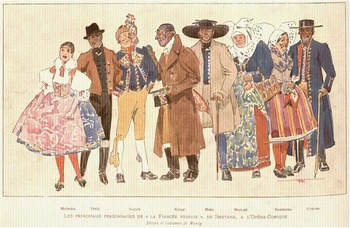
This passage and the review as a whole thus performs a typically essentialist casting of The Bartered Bride as embodying Czech national character, a view espoused both by Czech writers such as Vomáčka and by French writers such as Bourguès. On the one hand, this meant that the opera, and by extension the Czechs themselves, were constructed as an ineluctably nationalist unit peripheral to a larger mainstream that valued intellectual ‘development’ over the evolutionarily inferior repetition of dance. On the other hand, this kind of essentialist condensation of ‘Czechness’ into the musical representation of one particular opera made The Bartered Bride an ideal means of communicating Czech character quickly and easily to a wider audience, whether it be diplomats or the French public: unthreatening and friendly, worthy of being an ally, if perhaps a little backwards. This attitude was evident in illustrations that accompanied coverage of the premiere. Take, for example, the drawing of the cast of the opera, published in L’Illustration in Figure 1 Footnote .
Joseph Wenig’s costumes for the The Bartered Bride at the Opéra Comique, as reproduced in L’Illustration.74

Not all of the French reviewers were necessarily in agreement about the opera’s nationalist character, however. Henry Malherbe, in his review for Le Temps, was pleasantly surprised by one aria and the ‘secret quality of Czech genius in its tender melancholy and adventurous grace’. The question of nationally marked musical material and its operatic expression, however, was another matter:
Folk song in Bohemia does not have a clearly circumscribed national character. The styles of Western and Eastern folklore have in turn weighed on its development. It is impossible for Smetana to acquire a trenchant originality even when he uses national rhythms.Footnote 75
Since folk song – which, Malherbe contends, underlay most of Smetana’s opera – was too adulterated by Western influences to be sufficiently original, the opera itself would inevitably fall short. Such rhetoric betrayed French exoticist conceptions of difference, resonating with descriptions of Russian music, jazz and further musical Others. In the case of The Bartered Bride, however, an insufficiently different, undeveloped or primitive national folk character disqualified the work as nationalist in the traditional cultural sense. Malherbe, however, used another route to establish the opera’s Czechness by characterising Smetana himself as nationalist in an explicitly political way. According to Malherbe, Smetana was
the campaigner for independence, the composer of a conspiracy, the prophetic musician of Czech deliverance, [and] the precursor to the sacred political spark … The notes of his melodies aligned themselves on the staves as though they were rows of insurgents. He brandished his scores as though they were flags.Footnote 76
The use of such blatantly militarist language brings Smetana and The Bartered Bride into the nationalist fold, but in a very different way from Chantavoine’s celebration of the opera’s folk character. Moreover, it aligns Smetana, accurately or not, with the successful struggle for Czech freedom that occasioned the gala celebrations of independence ten years later. This discursive strategy was carried to an extreme by Camille Mauclair in his homage to Smetana, published the day of the premiere:
Bohemia’s tearing from the claws of the two-headed eagle [Austria] has become the prosperity of Czechoslovakia. The political wisdom and energy of a Masaryk and of a Benès [sic], the sword of a Milan Stefanik [sic], the Hoche of his country, the sacrifice of thousands of legionnaires on the fronts of Champagne and Galicia, have all freed this chivalrous nation which has always loved us so faithfully and which has always celebrated our artists in its capital of a hundred spires. It is [Bohemia] that today invites us to know and honour [Smetana], the great unfortunate labourer of Bohemia’s musical Renaissance.Footnote 77
This rather grandiose passage implicitly places Smetana on the same level as the liberators of Czechoslovakia: President Masaryk, Foreign Minister and Chief Diplomat Edvard Beneš, General and Minister of War Milan Štefánik and the literal foot soldiers of the Czech lands who gave their lives in the First World War. Mauclair also references the trope of Smetana as a tragic hero, unappreciated in his own time, which was the narrative favoured and propagated by Nejedlý and his circle. The dramatic undertones of this view of Smetana add further import to the occasion of the anniversary gala. While Smetana would not live to see the independence of his homeland, the passage intimates, he was, through his music, nonetheless still very much a part of the struggle commemorated by the premiere. (And this assertion was not without some merit – on 29 October 1918, the day after the declaration of Czechoslovak independence, the National Theatre in Prague had staged an impromptu celebratory performance of The Bartered Bride.)
Despite the presence of such nationalist and exoticist discourses, however, French critics simultaneously described the opera in classicising terms, akin in some ways to Czech responses. The reviewer from Le Courrier musical was ambivalent about the nationalism of the opera, and while positing that it had nothing in common with the skyscraper modernity of the 1920s, he cast its musical characteristics as ‘derived from the traditional form of the old comic opera of Mozart, Dalayrac and Boieldieu’.Footnote 78 This classicising language was typical of several French reviewers and resonates in harmony with the opinions of both Sísová and Martinů. Daniel Muller, one of the translators of the libretto, wrote an article for La Revue musicale, published in advance of the premiere, that described the overture’s music as evoking a ‘lightheartedness [that is] a little rustic, a little savage, a little wild even for our Latin taste, but sincere and communicative’.Footnote 79 For Muller the overture contained the seeds of the whole opera, and while at first Muller seemed to espouse a fairly typical essentialist/nationalist reading, he concluded his text by calling Smetana ‘a musician of the soul, in the same manner as a Mozart, a Beethoven, or a Wagner’.Footnote 80 He thereby followed the thread among writers who wrote that Smetana had managed to combine both the national – ‘rustic’ and ‘savage’ lightheartedness – and the universal, though of course the definition of ‘universal’ in this context was entirely German. This was probably in part due to his reliance on the untexted, ‘absolute’ overture, but at the same time it adds another layer to the cosmopolitan compositional milieu to which Smetana, in the reception of the gala event, had ascended.
The Bride and the state
As is evident from the myriad of articles and responses quoted above, French and Czech treatment of Smetana and The Bartered Bride at this premiere took on a rather complicated character. From one angle, the composer and his music were othered in a fairly typical manner by the French, if more rarely by the Czechs, and used as nationalist stand-ins for Czech culture as a whole, which itself both confirmed canonic characterisations of Smetana and aided diplomatic comprehensibility. From another angle, the opera was treated as a revered classic by both Czech and French writers, which granted legitimacy and artistic authority to the gala performance; the revered tone accorded to the opera, however, only exacerbated certain Czech resentments over the delay of the premiere. The latter approach also had its own diplomatic benefit. The credibility conferred by the constant comparisons to composers such as Mozart, Rossini and Beethoven further solidified the canonic importance of Smetana – now possessing unimpeachable credentials in terms both of nationalist fervour and of compositional genius. With such bona fides, Smetana and The Bartered Bride could serve as effective emissaries for the Czech lands when called upon.
Yet writers from France and Czechoslovakia differed in significant ways in how they characterised the opera’s importance. French reviewers seemed to be split as to whether they considered The Bartered Bride folkloric enough to do the work of cultural nationalism by standing in for Czech music as a whole. Failure to accept Smetana’s high operatic art as accurate folk culture meant that conferring canonic privilege via markers of musical nationalism would not work. Explicitly political nationalism, however, wherein Smetana was treated as a quasi-insurrectionist hero, still allowed for the opera to be elevated to the pantheon of operatic masterpieces on those terms – revolutionary fatigues instead of national costume, as it were. Even when French reviewers ‘classicised’ The Bartered Bride in other reviews, placing it on the same level as works by Mozart and Dalayrac, they nevertheless engaged exoticising language to do so. These critics thus ensured a canonical place for the opera in the minds of the French public, on the condition that it be viewed through a nationalist lens.
For their part, Czech reviewers such as Hippman, Sísová and Martinů claimed a specifically Czech provenance for The Bartered Bride, but they were much more occupied with casting it as a universal work through appeals to the inherent quality of the score.Footnote 81 It was first and foremost the score that allowed the French to create such a discriminating performance of the work, which would thereby validate the opera’s universal and canonical status. The ‘classicising’ that the Czechs engaged in de-emphasised nationalist tropes to place the opera in an international canon of master works. While nationalist imaginings certainly existed in the Czech context, local critics seem to have accepted The Bartered Bride as part of their artistic heritage, from where it could or could not be instrumentalised for the purposes of nationalist agitation. The Bartered Bride emerged, as did so many musical works, as a convenient means of reinforcing multiple national (self-)identifications. The same piece and the same performance of a ‘classic’ work could be turned to the confirmation of vastly different but not necessarily oppositional ideologies, in much the same way that elevation of Smetana himself could both serve Czech nationalist aims and help to satisfy the requirements for French cosmopolitan acceptance.
Despite occasional underlying differences, however, both the French and the Czechs were united in their overall veneration of Smetana. The Bartered Bride seems to have enjoyed a kind of diplomatic immunity: not a single article, letter or note suggested that some other opera would have been better suited to celebrate the tenth anniversary of the founding of the First Czechoslovak Republic in Paris. In this regard in particular, the gala event, broadcast throughout Europe, was perhaps the zenith of the opera’s importance to the cause of Czechoslovak cultural diplomacy, as well as nigh-indisputable confirmation of Smetana’s legacy as the epitome of Czech music.
At the same time, the Paris premiere of The Bartered Bride was an important moment for showing Europe that Czechoslovakia, despite its youth and small size, was enjoying an especially warm relationship with France, one of the great powers of Europe. Moreover, through the gala, France was affirming Czechoslovakia’s claims to having a deep and sophisticated musical culture, especially for a nation-state only ten years old. To return to Ambassador Osuský’s words, Paris was immensely important for propaganda and the advancement of national interests. The embassy was decidedly pleased with the results of the premiere. It had engaged in a concerted, multi-pronged effort to promote Smetana and The Bartered Bride as the authorised and ‘authentic’ representatives of Czechoslovakia and to sell its importance to French audiences, and by its own account succeeded spectacularly.
In its summary of official activities during the second half of 1928, the embassy sent to Prague not only twenty-one pages detailing the press coverage of the gala performance, but also stated that the opera’s ‘introduction to Paris was unequivocally the most appropriate celebration possible of the tenth anniversary of the republic’.Footnote 82 In addition to the success of the celebrations themselves, the report highlights the renewal of old relationships and the many new ones established between embassy figures and individuals (mostly journalists) in Paris as a result of the premiere. A cable by the Czech chargé d’affaires, Vincent Ibl, sent to Prague in January of 1929, made an even stronger claim, emphasising the great benefit that the performance and its radio broadcast had particularly on mutual relations between France and Czechoslovakia:
The introduction of The Bartered Bride onto the Parisian stage of the Opéra Comique in October 1928 signified a sizeable event in Czech-French cultural relations. It was a great achievement of publicity from a Czechoslovak point of view, which to a large extent likewise benefitted French affairs in Czechoslovakia. The simultaneous radio transmissions of The Bartered Bride from Paris to Czechoslovakia, all of Central Europe, and throughout the entirety of France on 26 October and 16 December 1928 very effectively strengthened mutual relations between France and Czechoslovakia, not to mention that the performance of Smetana’s opera in Paris had, by itself, already strengthened the sympathies of the widest strata of Czechoslovak society toward France.Footnote 83
Not only was The Bartered Bride a powerful tool of cultural diplomacy, but it was also cast as a counterweight to balance the otherwise asymmetrical relationship between the two nations. From the Czech embassy’s point of view, the Opéra Comique production was responsible for a significant strengthening of French-Czech ties. Moreover, because of the opera’s broadcast across Europe, the Parisian Bartered Bride would have been disseminated to the widest possible audience as a symbol of alliance. As a tool of cultural diplomacy, the opera seems to have scored a great success in the arena of public opinion.
But did the symbolic power of this message of artistic alliance lead to any concrete results beyond a plethora of newspaper articles? For Ibl, the voluminous press coverage was itself an unexpected and very welcome benefit of the gala; commenting on the unusually large response, he stated later in his report that ‘it turns out that Czechoslovakia has an array of the most devoted friends in the French press’.Footnote 84 Aside from the advantages for Czechoslovak representation in France, the Paris premiere of The Bartered Bride paid cultural dividends as well. In a concrete example of cultural reciprocity, the Paris cast was invited to perform in Prague. They presented the opera in French at the National Theatre in May and June of 1929, less than a year after the Paris gala.
The reviews for that event again centred on the strengthening of Czechoslovak-French relations. Zdeněk Nejedlý, however, complained in characteristically polemical fashion that the French were the most musically limited of all nations, that Paris had not added and could not add anything to The Bartered Bride, and went so far as to term the French performance in Prague ‘a black day at the National Theatre’.Footnote 85 Yet if disagreements about who truly had access to Smetana’s legacy were thereby shown to be alive and well, his canonic status was, at least for the Czechs, only strengthened by this French-Czechoslovak artistic alliance. While The Bartered Bride enjoyed some success at the Opéra Comique after its sensational premiere – it was played seventeen times before the end of 1928 – it disappeared from the repertoire after 1932.Footnote 86
Nationalist cultural practices and discourses, encapsulated by the Czech and French press’s accounts of Smetana and The Bartered Bride before and after the gala and exploited by the embassy, had a decisive effect on the transnational diplomatic circulation of the composer and his opera. Ultimately, however, they could not help but be reduced to an essentialised symbol of an ill-defined yet broadly legible Czech identity. This leads to a broader question: what was the status of the music of Czech composers in the transnational context of musical Europe? If the commodified, essentialist Paris version of The Bartered Bride was a prime way European listeners came to know of Czech music, other works and composers would be hard-pressed to escape similar characterisations because of Smetana’s centrality and fame. Czechoslovakia’s most famous opera, certainly, was confined by the nationalist ideologies that had given rise to the Czechoslovak state. This made it an integral part of the exercise of state diplomatic power in the interwar community of European nations.
There is a rather portentous coincidence at the heart of the Paris premiere of The Bartered Bride: this operatic Locarno fell almost exactly between two events of historic importance. One was the end of the First World War in 1918, which led to the foundation of the First Czechoslovak Republic and, eventually, the League of Nations. The other was the Munich Agreement of 1938, whereby the Czechoslovak Sudetenland was, in an ironic twist, ceded to Hitler by the signatories of the Locarno treaties, excepting Belgium – Germany, Italy, France and Great Britain. Czechoslovakia, abandoned by its allies, was powerless to stop this seizure of territory and the country’s eventual absorption into the Third Reich as the Protectorate of Bohemia and Moravia. The Paris Bartered Bride, coming between such momentous events, was a bright symbol of the post-First World War faith in international cooperation and diplomacy that resulted in the Paris Peace Conference, the League of Nations and the ‘spirit of Locarno’. But much like the Locarno treaties themselves, this premiere and the French-Czechoslovak alliance it supposedly strengthened ultimately did little to aid Czechoslovakia as it attempted to survive in the growing darkness of Europe.