Over the past millennium, there have been several attempts to change the writing systems of several Indian languages. Success was achieved in the north and north-west of the subcontinent with the invasion and subsequent conquest of the region by Muslim warriors from Afghanistan and Central Asia. The Perso-Arabic script was adopted as the writing system of several major languages, including Hindavi (which later became Urdu), Kashmiri and Punjabi. We also see the introduction of the roman script by Christian missionaries, especially by the Portuguese in the sixteenth century, to write several of the local languages, a process that was later enhanced by the establishment of British presence in India.
This article will discuss two attempts at the romanisation of Indian languages in the twentieth century, one in pre-independence India and the second in Pakistan before the Bangladesh war of 1971. By way of background, an overview of the status of writing in the subcontinent will be presented in the second section, followed by a discussion of various earlier attempts in India to change writing systems, relating mainly to the situation in Bengal, which has one language and one script used by two large religious groups – Muslims and Hindus (in modern-day Bangladesh and West Bengal, respectively). The fourth section will look at the language/script policy of the Indian National Congress in pre-independence days, and attempts to introduce romanisation, especially the work of the Bengali linguist S. K. Chatterji. The penultimate section deals with attempts to change the writing system in East Pakistan, i.e. East Bengal, to (a) the Perso-Arabic script, and (b) the roman script.
In all cases, the attempt to romanise any of the Indian scripts failed at the national – official – level, although Indian languages do have a conventional transliteration. Reasons for the failure will be presented, in the final section, in terms of İlker Aytürk's model (see this issue), which proposes factors that may allow – or may not lead to – the implementation of romanisation.
The status of writing in India
If we examine attempts at romanisation in India, we have to look initially at the traditional Indian attitude towards writing in general. The Hindu sacred texts, the Vedas, composed some time in the second millennium bce are essentially oral texts. They were composed in Sanskrit, the classical Indian language. As the religious language among Hindus and as a lingua franca among Indians, Sanskrit has had its ups and downs.Footnote 1 As a spoken language, it was superseded by the prakrits which eventually became the north Indian languages of today, e.g. Hindi, Marathi, Bengali. Sanskrit was also considered the sacred language among the Hindus of southern India, who spoke unrelated Dravidian languages, e.g. Telugu, Tamil.
Though Sanskrit gradually became incomprehensible to most Hindus, in religious ritual – reading the Vedas in the temples – what was, and is, important is pronouncing the texts correctly. It is enunciating the mantras in the proper way that is of supreme importance, even though the Brahman priest may not be able to understand the text that he is reciting by heart.
While the basic Hindu texts had been put into writing over the centuries in Sanskrit and had been translated into contemporary Indian languages, the Vedas and other religious texts were systematically printed only in the nineteenth century through the work of the German philologist Max Müller (1823–1900), who early on in his career in 1845 moved to England. He translated the Vedas, the Upanishads and other Hindu texts.Footnote 2 The fact that a foreigner was the first one to put the Hindu sacred texts into print reflects Indian attitudes to the written word. As Coburn notes:
there has never been a happy marriage between the holy words of India, composed, and transmitted orally, and the writing process.Footnote 3
Even scribes, members of a privileged class in many cultures, were considered to be of a low caste in India.
This does not mean that the Indians did not write. One important classical Sanskrit text, explaining how to recite the mantras, was written in the middle of the first millennium bce by Panini. The Ashtadhyayi (“eight chapters”) is perhaps the world's first grammar book but its wider influence was felt outside India only in the nineteenth and twentieth centuries. The script used was Devanagari, which is used today for Sanskrit and for several north Indian (Indo-European) languages (Hindi, the official language of India, and regional languages such as Marathi, Nepali, and Konkani).
Sanskrit's status as a language used in communication changed over the years. Its decline after its heyday in 1000 ce led to the gradual development of vernacular languages and of other writing systems. This occurred not only among Indo-European languages, but among the Dravidian languages too. Kannada script, for example, is found in inscriptions from 750ce, and a Kannada version of the Indian epic Mahabharata was written 950ce.
Despite the emphasis on the oral transmission of texts, there were two major changes in the area of literacy on the Indian subcontinent. From the establishment of the Delhi Sultanate in the twelfth century lower caste Indians especially, but not exclusively, were converting to Islam, which does not recognise any such social divisions.Footnote 4 Islam is a religion based on the sacredness of a text, the Qur'an; this is not an oral text such as the Vedas but a text that was handed down in a written form in Arabic.Footnote 5 Islam is based on this written text. Scribes had quite a different status in Islam. However, though there were readers of the Qur'an, many of the people who taught Islam, who led the prayers and gave sermons may have been illiterate. So, despite its primarily written form, the sacred text was learned by heart.
Thus, between twenty to twenty five per cent of the population of the Indian subcontinent eventually converted to a religion which was based on a written text. The emphasis on a written as opposed to a oral text is even more important for the religion that is a syncretism of Islam and Hinduism – the Sikh religion. Its holy book, the Guru Granth Sahib, is treated with reverence. It is read during the day and ceremonially put away overnight in the Golden Temple in Amritsar in the Punjab.
The other cultural influence dependant upon writing, which was not only imported from abroad but whose members were and conspicuously remained foreigners, was that of the English. Arriving firstly under the auspices of the East India Company in the seventeenth century, it slowly spread its influence until it achieved widespread control of India by the second half of the eighteenth century. The nineteenth century saw the introduction of English as an official language side by side with the vernacular languages, casting aside, through Law XXIX of 1837, Persian, which had been one of the court languages. The presence of English has continued, of course, to the present day.
In addition to the Indian scripts, whether Devanagari, Bengali, Gujarati, on Punjabi (Gurmukhi) as scripts of Indo-European languages, and Malayalam, Kannada, Telugu and Tamil as scripts of Dravidian languages, we now have the Perso-Arabic script, introduced by the early Muslim invaders, with which to write Persian, and the Roman script used to write English, French, in the areas such as Pondicherry where French colonialisation took place, and Portuguese. The Perso-Arabic script was extended to indigenous ‘Muslim’ Indian languages such as Urdu, as well as Kashmiri, (Muslim) Punjabi and Sindhi. The Roman script, however, was not introduced by the English but by the first Europeans to sojourn in the sub-continent, the Portuguese. They set up small enclaves in India, the main one being a small territory in Goa. The first printing press in Asia was brought to Goa by the Portuguese in 1556. Konkani, the regional language of Goa, is still today written among the dwindling Christian population of GoaFootnote 6 in roman script, although Devanagari is gradually taking over even among Christians. In other areas where there is a small Konkani-speaking population, in Karnataka and in Kerala, the Kannada and the Malayalam scripts are used respectively to write Konkani.
Bengal
Apart from romanising the Konkani language among Goan Christians, there have been attempts to change the script of Bengali. This attempted change was not originally from the Bengali script to the roman script – this only became a possibility in the twentieth century – but from the indigenous Bengali script, which was well established by the fifteenth century when eastern Bengal became Muslim, to the Perso-Arabic script. The religious division of Bengal needs a brief explanation. The eastern part of Bengal became Muslim, while the western part remained Hindu. This is a strange paradox, since geographically it was the west that would have been directly influenced by the various Muslim powers in the west, first the Delhi Sultanate and then the Mughal Empire. However, the Islamisation of east Bengal did not take place through conquest only; there were also peaceful conversions through Sufis and other mystics. East Bengal is more rural and poorer than west Bengal. East Bengalis belonged to lower castes in the Hindu social hierarchy, and one way to avoid lowly status was to convert to a religion without social castes. At first, it was Buddhism, and then came Islam. Initial contact with Muslims was in the twelfth century, but it took two hundred years or so before Bengal became a Muslim province. But, by the time east Bengal had become Muslim, the Bengali script was well established. Although Persian became the official language of administration in Muslim kingdoms over India, including Bengal, the Bengali language was used in all other spheres of life. Evidence of this includes the Isa Khan cannons from 1575 (which are now in Dhaka Museum in the Bangladesh capital) which have a Bengali, rather than Persian, text on them, even though they were a gift to the local Muslim Bengali leader. Moreover, Persian folktales and poetry were translated into Bengali and written in Bengali script.
Since a large proportion of the Bengali-speaking population was Muslim, there were attempts to change the Bengali script to the Perso-Arabic script among Muslims. There are some extant eighteenth-century manuscripts from Chittagong in east Bengal in which Bengali is written in the Perso-Arabic script.Footnote 7 There were later attempts during the time when East Bengal was part of Pakistan (see below). But by end of the eighteenth century (1778), the first printing press had been set up in Calcutta by Charles Williams; this established the printed Bengali script for all Bengali readers – Hindu and Muslim alike.
There are other examples of the same language being written in more than one script. Obviously, the Konkani case in Goa (mentioned above), where Hindus write the language in Devanagari while some Christians may still write the language in Roman, is one such example.Footnote 8 But a far more widespread one is that of Hindi and Urdu. Linguistically, they are the same language, but with dialectal differences, sometimes as geographical dialects and at other times as religious dialects.Footnote 9 Hindi uses the Devanagari script, and Urdu uses the Perso-Arabic script. Another example but on the European scene is the official language of Yugoslavia before its break-up – Serbo-Croat. It was argued that it was one language, written in two scripts: Serbian in Cyrillic and Croatian in Roman because of religious differences (Orthodox v. Catholic). Since the demise of Yugoslavia, several ‘new’ languages have been established, e.g. Bosnian.
The Bengali Muslim population was divided into at least two groups: ashraf (high born) and atrap (low born). The ashraf were the elite and the ulema, claiming to be of Middle Eastern or Central Asian origin. They spoke Urdu and Persian (as the official language). The atrap were the rural, often illiterate, masses. A third group emerged in the twentieth century, western-educated Bengali Muslims. By the early twentieth century, the ashraf and other Urdu speakers in Bengal tried to force Urdu on the Bengali population. The use of the Bengali script among Bengali Muslims was said to cause the alienation of Bengali Muslims from the Muslim world. According to the Bengali newspaper Naba-Nur in 1903, there were groups that “desire to create a single mother-tongue for Muslims throughout the whole of India by forcibly conferring upon Urdu the status of the mother-tongue of Bengali Muslims”.Footnote 10 In 1916, the Bengali newspaper Al-Eslam published an article that claimed that according to fatwas, “the Bengali language is the language of Hindus and consequently undeserving of our respect”. On the other hand, the same newspaper in 1917 described the urban, aristocratic section of the Muslim population as a group “who become absolutely infatuated the moment they see that twisted script”, viz. the Perso-Arabic script.Footnote 11
Pre-independence India
After early attempts at romanising Indian languages by the Portuguese, e.g. Konkani in Goa (see above), more extensive attempts at romanising Indian languages may be said to have began with the work of William Jones towards the end of the eighteenth century. Romanisation was used not only for native Indian languages as such but also other so-called Oriental languages such as Persian and Arabic. In the early 1830s a debate raged in the India Gazette and other Calcutta newspapers for and against the adoption of the Roman script in educational institutions and educational projects among native Indians. The debate ostensibly evolved around the proposed publication of a dictionary Thompson's School Dictionary of English and Hindustani, a far cheaper dictionary for Indians to buy than the ones then available. Moreover, the Hindustani presented in the dictionary was a more colloquial language than the often learned, Persianised Hindustani in other publications. Lastly, the Hindustani was presented in Roman, and not in the Perso-Arabic script nor in Devanagari.
The pro-Roman faction, part of the Anglicist camp, was championed by Charles Trevelyan, and was opposed by James Prinsep, a renowned Orientalist scholar, among others. The various articles and comments were collected and published in 1834. After surveying the spread of the Roman script from Latin “within the limits of the little territory of Latium”, Trevelyan looked the then current situation in which the Roman script was used to express “all the languages of Europe, America, Australia, and part of Africa and Asia”.Footnote 12 “The Roman script”, continued Trevelyan, “will eventually become universal throughout the East and will contribute in a higher degree to hasten the period when India will possess a national literature of her own equal to any other in the world”.Footnote 13 Furthermore, Trevelyan believed that “the adoption of the Roman character in India will lead to the gradual disuse of the Nagree [ie Devanagari] and Persian and Arabic ones, and we shall thus have three characters less than we had before”.Footnote 14
These and other arguments deployed by Trevelyan are similar to those used by Thomas Macaulay – secretary of the Committee of Public Instruction – in his famous Minute on Education in 1835, in which he spoke condescendingly of Indian culture:
I am quite ready to take the Oriental learning at the valuation of the Orientalists themselves. I have never found one among them who could deny that a single shelf of a good European library was worth the whole native literature of India and Arabia. The intrinsic superiority of the Western literature is, indeed, fully admitted by those members of the Committee who support the Oriental plan of education.Footnote 15
But Macaulay's principal aim was to teach English to those Indians who could work for the English administration in India:
We must at present do our best to form a class who may be interpreters between us and the millions whom we govern; a class of persons, Indian in blood and colour, but English in taste, in opinions, in morals, and in intellect.Footnote 16
Trevelyan's romanisation system, presented in the same 1834 publication,Footnote 17 was used in subsequent publications, e.g. Tolbort's romanisation of the Persian translation of an Urdu translation of Daniel Defoe's Robinson Crusoe.Footnote 18 Examples of his romanisation include the dot below graphemes representing retroflex consonants, e.g. “the hard palatial d”Footnote 19 written as <ḍ>, and the use of <h> to represent aspirated consonants, cf. <k> and <kh>. At that time the affricate /ʧ/ was presented by <ch> as in English. However, nowadays the grapheme <c> is used exclusively for this consonant (/k/ is always represented by <k>), while the aspirated affricate is written <ch>.Footnote 20 With some small changes, this system is more or less that used today in writing personal and place names in India, Pakistan and Sri Lanka.
The Congress's Proposed Linguistic ProvincesFootnote 21

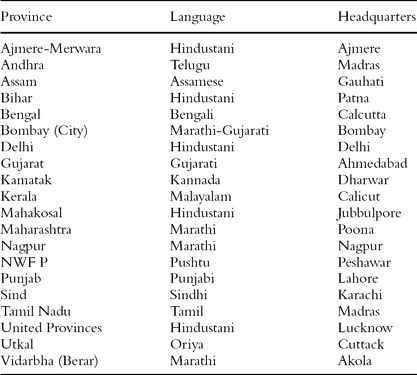
In the two to three decades before independence, there were discussions at various meetings of the Indian National Congress, as well as those of other organisations, on the issue of the national language and national script of an eventually independent India. This relates primarily to the period before the Lahore Conference of 1940 when the idea of a Muslim state of Pakistan was placed firmly on the agenda. In 1920 at its meeting in Nagpur, the Indian National Congress decided in principle to adopt a federal system of linguistic provinces on independence, with the country divided into provinces (later ‘states’) based on the dominant language in the area.Footnote 22 The table above presents the proposed provinces and the provincial language.
However, in discussions concerning scripts, it was realised that while Indian Hindus would support the use of Devanagari, this move would be opposed by Muslims. A compromise solution would have been the adoption of the roman script to write Indian languages, that is the romanisation of the Indian scripts. To gain Muslim support for writing Urdu and other ‘Muslim’ languages in roman, attention was drawn to the 1928 reform in Turkey, where the Perso-Arabic script was replaced almost overnight by Roman, and to the writing of Malay – forms of which were to become the national languages of Malaysia and Indonesia – in Roman.Footnote 23
Singh has suggested that there are two options for language planning.Footnote 24 The first is zero option, that is to say: “time will tell”. An example of this is post-apartheid South Africa, with its eleven official languages and the inevitable status of English as a lingua franca. The second option is homogenisation – an attempt to make one language, and one script, official. Mahatma Gandhi in the 1930s made a stand on Hindustani (spoken Hindi/Urdu) as the official language and Devanagari as the official script.
As for attempts at romanisation during this period, we turn to Saniti Kumar Chatterji, a Bengali linguist educated at the University of London and the Sorbonne, who published his A Roman Alphabet for India in 1935. He cites two examples of meetings and conferences at which proposals were put forward to adopt Roman as the national script. At the All-Parties Conference in Calcutta in 1927 (under the auspices of the Indian National Congress), a Sindhi and Bengali proposal to write Hindustani in Roman was rejected, and at the All-Bengal University and College Teachers Conference held in Faridpur in 1934, a proposal to write Bengali and other Indian vernaculars in Roman was likewise rejected by a thirty two to twenty five vote.
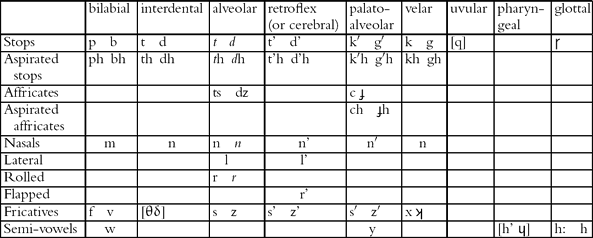
However, although Chatterji argued that Hindustani should be the national language, he saw problems relating to the choice of the Devanagari writing system. These problems he labelled sentimental and primarily religious. Hindi and the Devanagari script would be rejected both by Muslims and by Dravidian language speakers in the south. He proposed, then, a form of the roman script as the all-Indian script. It was based on the twenty-six letters of the English alphabet, but with the addition of graphemes and diacritics to cover all phonemes of the Indian languages.
Let us look at the table of consonants first:
Roman consonantsFootnote 25

The problems in adopting such a script are obvious at first glance. Firstly, there is a distinction between the Italic and Roman fonts. We see that italicised <d, t, n, r> should be distinguished from <d, t, n, r> to indicate alveolar consonants.Footnote 26 He proposed upside down versions of <f>, <h>, and <k> (viz ɟ, ɥ, ʞ), the International Phonetic Alphabet symbols <θ> and <δ> for Arabic words, and Chatterji's own invention, the long <r> for the glottal stop: <ɼ>.Footnote 27 Moreover, he proposed what he called “indicators”,Footnote 28 what we tend to call diacritics, for example, <:> for length as with glottal <h:>, <’> for retroflex consonants, and <ʹ> for palatalisation, cf. <s’> and <sʹ>.
There are of course fewer vowels, but these may also be problematic. Chatterji presents the following table of Indian vowels in roman script:
Chatterji's Roman Alphabet for Indian languages – vowelsFootnote 29

in which we see the ash <æ>, open <ɔ>, and IPA symbols <ə> for the shewa, and <ɯ> and <ʌ> for unrounded back vowels. These thirteen vowel graphemes would have to be extended to indicate lengthening and nasalisation. To represent vowel lengthening, Chatterji suggests the colon (:), which is, of course, used in the International Phonetic Alphabet for this very purpose. To indicate nasalisation, it would have been natural to use the tilde (˜), but, as he put it, this “will not always be available in Indian presses”. So, he suggests a preceding single inverted comma (’), the same symbol used to indicate retroflex consonants except that in the latter case, the inverted comma would follow the consonant, not precede it. A nasalised /e/, for example, would be represented as <’e>. Diphthongs, where they exist, would presumably have been indicated by digraphs.
The impracticality of Chatterji's undertaking is obvious. He presents graphemic distinctions that are made on the basis of fonts (Roman v. Italic), inverted graphemes that are found only in the International Phonetic Alphabet (e.g. <ɟ>), and diacritic distinctions that are difficult to maintain, viz. the distinction between <’> and <ʹ>. These distinctions may be maintained using modern computer word processes, but they would be very difficult to distinguish in writing. Needless to say, this proposal was not accepted at all. A far simpler method of transliteration is used in any case (see above, and note 20), which expects some knowledge of Indian phonology on the part of the user.
After independence in 1947, there were attempts to establish Hindi in the Devanagari script as the national language, now that a considerable proportion of the Muslim population had moved to Pakistan. As Daswani argues, the use of one script would unify the country.Footnote 30 Part XVII of the 1950 Constitution, which deals with languages, states, for example, that “The official language of the Union shall be Hindi in Devanagari script”. However, pressure was put on Prime Minister Nehru to set up states based on linguistic criteria, as originally decided on in 1920. In the wake of the fast to death of Sri Potti Sriramulu, a follower of Gandhi, in Madras in 1952, it was decided to break up Madras province into a much smaller Tamil-speaking state – Tamil Nadu, and the state of Andhra Pradesh, a Telugu-speaking state.Footnote 31 However, to say that the population of an entire state speaks one specific language is misleading. The capital of Andhra Pradesh, Hyderabad, for example, has a considerable Urdu-speaking population. By 1956, the linguistic-based make-up of the states of the Indian Union was more or less settled.Footnote 32 The question of the romanisation of Indian languages was no longer mooted. But the growing use of English has led to a widespread use of the Roman script in the public sphere to write Indian languages, especially in advertising.Footnote 33
Pakistan 1947–1971
So, independent India chose to be multilingual, with Hindi as its national language, while English was given the function – albeit semi-official – of link language and other major languages the role of regional languages. Pakistan, on the other hand, set up after the partition of the British Raj in 1947, seems a classical case of Benedict Anderson's imagined community,Footnote 34 invented by its founders as the state of the Muslims of the subcontinent. In order to sustain the idea of a Muslim state, a Muslim national language was deemed necessary, and that was Urdu. As Anderson wrote: “Much the most important thing about language is its capacity for generating imagined communities, building in effect particular solidarities”.Footnote 35
However, this decision ignored the sociolinguistic situation on the ground. In the newly declared state of Pakistan, only 3% of the population (mostly Delhi-born refugees) could speak Urdu, while Punjabi was the principal vernacular of West Pakistan. The language of East Pakistan (or East Bengal) – Bengali – was ignored, which was a fatal stand, since Bengali was the language of the largest group in Pakistan. This linguistic, cultural and political conflict eventually led to the 1971 war, to the dismantling of Pakistan and to the establishment of Bangladesh.
The Pakistani founder and leader, Muhammad Ali Jinnah, insisted on Urdu as the national language, even though he personally could speak it very haltingly.Footnote 36 Visiting East Pakistan in March 1948, shortly before he died, Jinnah told the Bengalis:
the State language of Pakistan is going to be Urdu and no other language. Anyone who tries to mislead you is really the enemy of Pakistan.
A committee, set up in 1949 by the East Bengal (i.e. East Pakistan) provisional government to reform the structure of Bengali, proposed in its report
1) that the Sanskritisation of the [Bengali] language be avoided as far as possible by the use of simple phraseology and easy construction in vogue in the speech of East Bengal;Footnote 37
2) that the expressions and sentiments of Muslim writers should strictly conform to the Islamic theology;
3) that all the Sanskrit principles having no direct and important role to play in the principles of Bengali grammar, be omitted and only genuine Bengali principles existing in the language and envisaged in this report be found out and established as principles of Bengali grammar;
4) that the unintelligible Sanskrit grammar imported to Bengali grammar, which made the confusion worse, be substituted by the simple non-technical terms of Bengali language.Footnote 38
In the debate concerning the inclusion of Bengali as one of the state languages in the Pakistani Constituent Assembly on April 10, 1952, one of the Punjabi delegates, Sardar Shaukat Hayat Khan, used the stick-and-carrot principle:
Let us go and help the Bengali culture to grow and if necessary, if you think and I am sure the people in East Bengal and people in West Pakistan may agree that we may try to have a common script so that Urdu and Bengali languages can be understood and read easily by the people of West Pakistan and East Pakistan. . . . Let us have this Quranic script which is understood by both the people in East Bengal and people in West Pakistan. This may be the common script of the two languages.Footnote 39
The language conflict came to a climax on 21 February 1952, when four students were killed by police at a pro-Bengali demonstration in Dhaka. This day became to be known as Martyrs’ (Shahid) Day, and in 1999, it was declared by UNESCO to be Mother Language Day.
As for the Bengali script, any suggestion of change was often regarded by Bengali intellectuals as a plot against the language. The immediate threat came from quarters that argued that a Muslim language, ie. a language spoken by a considerable number of Muslims as Bengali is, should be written in the Perso-Arabic script. On 7 February 1949, the central Pakistan education advisory board “strongly recommended the Arabic script as the only script for all Pakistani languages”.Footnote 40 As a result, from 1950, twenty centres were set up in East Bengal to give primary education to adults in the Perso-Arabic script. Moreover, the Pakistani government allotted money to prepare reference books to teach the conversion of the Bengali script to Arabic.Footnote 41 In their constant endeavours to “subvert” Bengali demands,Footnote 42 a leading minister in the Pakistani government – and a Bengali – Fazlur Rehman stated that “in order to maintain integrity of Pakistan and to establish a strong and meaningful relation between the people of the two wings there should be a similarity in the scripts of all languages of Pakistan”.Footnote 43
Strangely enough, calls for the romanisation of written Bengali were made in the 1950s in East Pakistan (modern Bangladesh) in the middle of the language conflict between the Pakistani government, on the one hand, and local Bengali intellectuals and students, on the other. While the 1958 Pakistan coup – one of many – brought an end to any constitutional guarantee of the Bengali language, the new ruler, General Ayub Khan, circulated “a proposal to replace the Bengali script by the Roman script”.Footnote 44 It was even proposed that the Roman script be introduced for all of Pakistan's languages, and that Urdu and Bengali be brought closer linguistically; the government's aim was an all-Pakistan language like Bhasa Indonesia. One argument used in favour of such a change related to the familiarity of the literate population of Bengal (East Pakistan) with the Roman script through their learning and knowing English; the script – if used for Bengali – does not have to be learned anew.
On Martyrs’ Day on 21 February 1961, at a Dhaka University commemorative meeting in honour of the students killed nine years previously, it was reportedFootnote 45 that on one of the banners on the wall was written: ‘Writing Bengali in Roman script will not be tolerated’. A resolution to the same effect was passed on the same day by the Bengali Academy at a symposium held in the Curzon Hall in Dhaka. The symposium, says the same report, “was rounded off by a cultural programme featuring some Bengali songs eulogising the Bengali language and the [Martyrs’] Day”. Another report stated that on the same Shahid Day, “[a] direct reaffirmation of the popular demand for more positive identification of Bengali as State language of Pakistan and outright rejection of the proposal for adoption of the Roman Script were the main feature”.Footnote 46 The appearance of these slogans may be seen in light of Ayub Khan's thoughts about the romanisation of all Pakistani languages.
But apart from attempts earlier before independence by Chatterji and other attempts by various organisations, which tended to be rejected, as we have seen, there is no record of a further attempt to put forward such a proposal in Pakistan. It may be suggested that these slogans rejecting English could have served as a counterweight to the Pakistani government's insistence that Urdu and only Urdu was the country's national language, but we have no record of such a stand either. The reports cited above may not have been in the press but may apparently have come from Pakistani police reports.Footnote 47 But these police reports do not answer the question as to why the demonstrators on Martyr's Day decided to display such banners if there was no serious proposal to adopt the Roman script. We may be talking here of a Pakistani secret police ploy to discredit the demonstrators. Not only did the demonstrators seem to reject the Perso-Arabic script in which to write Bengali, but they also rejected a suggestion that Bengali should be written not in one of the Indian scripts but in Roman – the script of the previous colonial power, although no apparent attempt was made in this direction by the Bengalis themselves.
Mamoon and Ray maintain that Ayub Khan's proposal may be conceived as a ‘spin’ to manipulate public opinion as far as the Bengali language and script are concerned.Footnote 48 A less devious interpretation comes from Sirajul Islam.Footnote 49 Proposals to unify the scripts of Pakistani languages (principally Perso-Arabic for Urdu and Punjabi in the West and for Bengali in the East) were made once in a while, but often “these proposals were always desultory and came from the very small group of integrationists”.Footnote 50 But Bengali students took these proposals seriously, hence their reaction to the romanisation of Bengali on Shahid Day. Any suggestion to change the script was often considered by Bengali intellectuals as sacrilege, even after the Pakistani Constitution of 1956 stated unequivocally in Article 214(1) that ‘The State language of Pakistan shall be Urdu and Bengali’ [emphasis added].
The unification of Pakistani scripts was of course controversial. Complaints were voiced in the past that if Bengali Muslims speak Bengali, it should be a Muslim language, “more Islamic (and less Brahmanic Hindu) in literary content”, without Sanskrit influence and with numerous Persian, Arabic and Urdu lexical items.Footnote 51 There was constant pressure on Bengali and the Bengalis. What this pressure implies was that all that is needed is a common script to attain the desired communication between West and East Pakistan. We may compare this ideal situation with that of Western Europe, which has been using the same script – Roman – for well over one thousand years, but that has not prevented wars and other conflicts among the various countries on the continent.
Moves against anything touching on all-Bengali culture were put into effect. In 1961, on the centenary of the birth of the Bengali poet and writer, and Nobel Prize winner, Rabindranath Tagore, the Pakistani authorities prevented any celebrations, and, furthermore, cut off the import of books and films from West Bengal.Footnote 52 In 1969 demonstrations against Ayub Khan brought him down, and two years later, war broke out in East Pakistan, and with the help of India, the Muslim Bengalis declared the establishment of independent Bangladesh, the Constitution of which stated in Part 1 section 3 that ‘The state language of the Republic is Bangla [Bengali]’.
Conclusion
Here, I shall refer only to the all-Indian pre-independence situation, and not specifically to that of Pakistan to prevent a diffuse conclusion, for the British Raj and modern Pakistan have different types of regime, and different recent histories as far language and script are concerned. Aytürk has proposed two sets of factors that may explain success and failure in the implementation of romanisation (see this issue). Firstly, the technical-infrastructural factors, relating to the local scripts, the roman alphabet, and their compatibility. In our case, apart from one sub-factor relating to the level of literacy (see below), the roman alphabet has proved to be compatible. The conventional roman transliteration of Indian languages is used widely over the entire area, and outside the area, too, wherever something Indian (or Pakistani) is referred to. It is true that the conventional transliteration does not unambiguously show certain features without some explanation “in the footnotes”, e.g. retroflex consonants may be indicated by the use of upper-case consonant graphemes or by doubling the consonant grapheme, but this does not prevent the widespread use of this transliteration even in academic circles, where one of the key-stones is accuracy.
As for the literacy rate, although among many sectors of, especially, the rural population the level of literacy is fairly low, the urban communities do have a relatively high literacy rate, and because of education policies, at a fairly young age, pupils meet the Roman alphabet as it is used in English. It is not the case that “large segments of the society”, in Aytürk's words, will be upset at a change, but these segments of the population are able to read both in the local Indian script, be it Devanagari, Eastern Nagari (Bengali), Gurmukhi (Punjabi), or Arabic (Urdu), etc., and in Roman (English).
Secondly, as to the political and cultural factors that may prevent romanisation that are proposed by Aytürk, even the segments of the population that could actively oppose romanisation – those that hold traditional beliefs in that sacred texts will not be read and understood by the literate population if the Roman alphabet is introduced – should not be relevant to the Indian Hindu population as a whole for reasons given above in the section on “The status of writing in India”. By way of comparison, this would not be the case for the sacred written text in Judaism and Islam. Any attempt to romanise Hebrew and Arabic would be met with harsh opposition because of the religious and emotional reaction such a change would produce.
However, religious and cultural aspects cannot be ignored when explaining why romanisation did not succeed, for as Aytürk puts it, one of the relevant factors is “the availability of foundational texts in the rival script, wherein the religious or national identity of the speech community is anchored”. The fact that Indian scripts have been around for hundreds of years (and some for thousands of years) and works of culture have been written in the various languages with the respective scripts would eventually counter attempts to change the script. Moreover, politically, India is a multilingual country. The choice of one script as the sole script would be likely lead to a political crisis, just as the choice of one language – Urdu – in independent Pakistan was one of the factors that led to the eventual break-up of the country. So, in India, while the Devanagari script does appear on public buildings all over the country as the script in which Hindi – the national language – is written, it is not usually used in private commercial enterprises in those states where Hindi is not a local spoken language, e.g. Tamil Nadu. What may be said, however, is that the Roman script does appear in many businesses, whether as English or as a romanised version of the local Indian language.