Introduction
Globally, the frequency of natural disasters has been increasing in the last quarter century, with the majority resulting from weather, climate extremes, and water-related hazards.Reference Hogan and Burstein 1 While there have been more than 3.4 million lives lost in this period, the death rates are decreasing while the number of people affected is increasing.Reference Burkle 2 For example, the death rate per one million people from 1900 to 1989 was 94 per annum compared to five per annum between 1990 and 2006 (a decrease of 95%).Reference Goklany 3 During 2002 through 2011, the annual average number of deaths from disasters was 107,000, while the number affected was 68 million: one death per 635 people affected.Reference Guha-Sapir, Hoyois and Below 4 This ratio highlights the need for disaster-management systems to focus resources on assisting those affected, both directly and indirectly, by a disaster.
Following a disaster, public health activities have focused traditionally on communicable diseases, however, the actual risk is low, particularly in developed countries.Reference Watson, Gayer and Connolly 5 Furthermore, population aging and an increase in life expectancy have contributed to a “disease transition” from communicable diseases to noncommunicable disease (NCDs). 6 This transition has imposed major burdens on health care resources as they are more dependent on immediate access to, and availability of, essential public health infrastructure (PHI), and are costly to treat, both of which have implications for disaster management.Reference Connell and Lea 7 , Reference Murray, Vos and Lozano 8
Noncommunicable diseases are an increasing challenge across the globe. 9 Across Australia, NCDs (or chronic diseases) cause 88% of the burden of disease, 91% of all deaths, and cost 87% of recurrent health expenditure. 10 In Queensland, Australia, the bulk of ill health, disability, and premature death arise from NCDs. 11 Common NCDs in Queensland are cancer, cardiovascular disease, chronic respiratory diseases, diabetes, and renal diseases. 10 Noncommunicable diseases are responsible for 39% of premature deaths (before 75 years of age). 10 Naturally occurring disasters are a feature of the climate and landscape in Queensland, and this threat is predicted to increase with climate extremes expected to make weather events such as cyclones and floods more frequent. 12 , Reference McMichael, Woodruff and Hales 13 There is a need for more research on NCDs within the disaster-management space to prepare for future events.
People with NCDs need access to good PHI and require long-term medication, life-support devices, and close case follow-up. 6 Public health infrastructure can include staff, medications, equipment, services, housing, water, food, waste, sanitation, and power/energy to run essential life-sustaining equipment.Reference Baker, Potter and Jones 14 - 16 When PHI is destroyed, rendered inaccessible, or damaged, access to chronic care treatment and medication may be severely jeopardized, all of which can exacerbate NCDs and their immediate and sustained quality-of-care outcomes, as well as their mortality and morbidity.Reference Jung, Shehab and Rohr-Allegrini 17 , Reference Little, Stone and Stone 18
To help address these risks, this research explored the impact of Severe Tropical Cyclone Yasi (STC Yasi) on PHI and management systems of NCDs. Linkages with other worldwide tropical cyclone literature were explored to identify if there have been similar impacts. This provided a process of validation to better understand the impact of disasters and also determine if the findings could be extrapolated for future crises.
Methodology
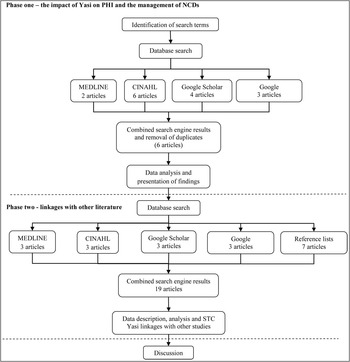
The data were collected and analyzed through two phases. The databases searched were MEDLINE (Medline Industries, Inc; Mundelein, Illinois USA), CINAHL (EBSCO; Ipswich, Massachusetts USA), Google Scholar (Google, Inc; Mountain View, California USA), and Google. The first phase focused on identifying, reviewing, and analyzing literature discussing the impact of STC Yasi on PHI and the management of NCDs (Figure 1). The second phase identified potential links with non-STC Yasi studies by analyzing the impact of other worldwide tropical cyclones (including hurricanes and typhoons) on NCDs (Figure 1). The second phase included nonsevere tropical cyclones due to the limited peer-reviewed research into this research area.
Research Methodology. Abbreviations: NCD, noncommunicable disease; PHI, public health infrastructure.

A 2-phase process was selected, as this provided the best mechanism for comparing a disaster which resulted in Australia's largest hospital evacuation with other weather events across the world. Also, this method provided a process of validation and determination if the findings could be extrapolated to other similar disasters.
Phase One: The Impact of STC Yasi on PHI and the Management of NCDs
MEDLINE, CINAHL, Google Scholar, and Google databases were searched in May 2013. The date range was January 26, 2011 through May 2, 2013. Initially, the search combined the terms “cyclone Yasi,” “public health infrastructure,” and “noncommunicable diseases.” This search found no relevant articles. The search was then expanded to include the most common NCDs in Queensland, Australia, (cancer, cardiovascular disease, chronic respiratory diseases, diabetes, and renal diseases) and the term “chronic disease.” 11 Searches were conducted without the phrase “public health infrastructure.” An article was considered valid if the inclusion criteria were achieved; these included: literature meeting the search terms and events a week prior to STC Yasi and four weeks after (or the acute phase). 19 Abstracts that did not include STC Yasi and NCDs were excluded.
The data analysis followed the process for a qualitative case study outlined by Creswell.Reference Creswell 20 This included data collection and organization, data description, data classification, and an interpretation of the findings. Each process is described in the following:
-
1. Data collection: the databases were searched using the search terms of “cancer;” “cardiovascular disease;” “chronic respiratory diseases;” “diabetes;” “renal diseases;” or “chronic disease” and “cyclone Yasi.” Selected articles were analyzed by hand.Reference Hayes 21 Key phrases, ideas, and concepts were identified.
-
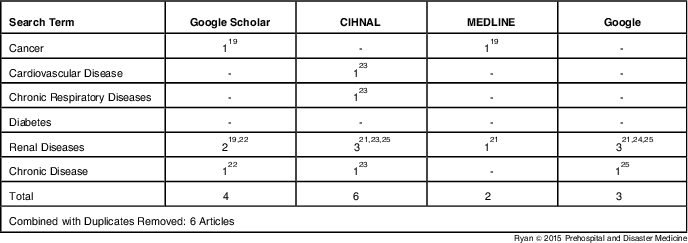
2. Data description: a description of the data was established based on the key phrases, ideas, and concepts identified during data collection. The data were coded based on the common NCDs in Queensland (Table 1).Reference Murray, Vos and Lozano 8
Table 1Search Results for Phase One

-
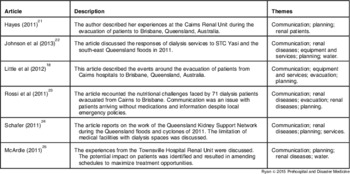
3. Data classification and interpretation of the findings: the data were classified through an aggregation of individual descriptions and themes to create an overall case description. The data were then reduced to a set of themes, which were classified, described, and used to interpret the findings (Table 2). The interpretation was used to understand what could be learned and inform Phase Two of the research.
Table 2Description of STC Yasi Literature
Abbreviation: STC Yasi, Severe Tropical Cyclone Yasi.


Phase Two: Linkages with Other Literature
To ensure consistency with Phase One, a database search was also conducted using the MEDLINE, CINAHL, Google Scholar, and Google databases. The search occurred on July 5, 2013 and included the terms “cyclone,” “hurricane,” or “typhoon,” and NCDs subject to the research in Phase One (cancer, cardiovascular disease, chronic respiratory disease, diabetes, and renal diseases), with no time limits applied to the search. A search was also undertaken using the term “chronic disease” to maximize literature identified. Initially, the term “public health infrastructure” was omitted to provide consistency with the method used for STC Yasi. This strategy was effective in most databases; however, a test search for “cancer” in MEDLINE resulted in 1,600 articles. Therefore, the term “public health infrastructure” was applied to the search in the MEDLINE database.
An article was considered valid if the inclusion criteria were achieved. This included: literature (abstracts) meeting the search terms and events the week prior to a cyclone and four weeks after; 19 however, literature referring to STC Yasi was excluded as they were already searched. No other geographical, time, or language limits were applied. Reference lists were also reviewed to identify relevant literature. The selected literature was then analyzed and compared with the themes from Phase One.
Results
Phase One: The Impact of STC Yasi on the Management of NCDs
Data Collection
The search strategy identified six relevant documents (Table 1). The CIHNAL database was the most effective in identifying relevant articles (n = 6). The most common search term across all databases was “renal diseases” (n = 5). After a removal of duplicates, six articles (literature) were found. No variations in the disease definitions were identified.
Data Description
A matrix was developed to provide an individual case description for each article and to identify the key themes (Table 2). Four of the articles focused on the evacuation of patients from Cairns to Brisbane (Queensland, Australia). One article discussed the experiences of the Townsville Hospital Renal Dialysis Unit (Queensland, Australia), and another focused on the work of the Queensland Kidney Support Network (Australia). The need for a staging area for patients prior to an evacuation and the challenges in meeting nutritional needs were also discussed. Other issues included the transfer of patient information, maintaining patient care, and communicating specific disaster information to people with a chronic disease. The themes of communication, equipment and services, evacuation, medication, planning, renal diseases/dialysis, and access to water for dialysis emerged from the literature.
Data Classification and Interpretation of Findings
The data gathered were classified into the themes that emerged during the description process. Each theme was analyzed across the articles and then used to interpret the findings and understand the results.
An overview of the themes is provided in the following:
-
1. Communication: challenges were identified during the transfer of patient information from Cairns to Brisbane. Telecommunications systems were unable to cope with the situation. E-mail was the most efficient and effective means of communication. In the future, communication systems need to be refined to ensure patient information can be transferred easily and coordinated.Reference Little, Stone and Stone 18 , Reference Hayes 21 - Reference McArdle 25
-
2. Equipment and services: the evacuation of patients from Cairns to Brisbane created challenges for maintaining services (including staff levels) and equipment (eg, oxygen and medications). No planning had been undertaken for an evacuation of this type or the operation of a temporary emergency shelter. Adequate staffing was also an issue as people affected by the cyclone were asked to work. In the future, additional staff should be sourced from outside the area subject to the disaster and equipment prepositioned.Reference Little, Stone and Stone 18 , Reference Johnson, Hayes, Gray, Hawley, Hole and Mantha 22 , Reference Schafer 24
-
3. Evacuation: the greatest impact was on the evacuation of patients from Cairns to Brisbane. This was the largest hospital evacuation in Australia's history, and it posed a number challenges, particularly the transfer of patient information (communication). For evacuations in the future, there needs to be adequate and exercised plans, effective communication systems, and a casualty clearing post for patients awaiting transfer. Patients also need to be prepared for a one week transfer.Reference Little, Stone and Stone 18 , Reference Hayes 21
-
4. Planning: there was inconsistency in disaster plans. For example, the Cairns Renal Unit had a disaster plan which identified the need to retrieve patients from the Aboriginal and Torres Strait Islander community near Cairns. However, another hospital and health service's disaster plan did not provide such guidance. This created a number of risks, particularly as priorities were identified during the event. This experience highlighted the need for disaster plans to be developed in consultation (including with patients), regularly reviewed, exercised, and relevant for the entire health system.Reference Hayes 21 - Reference McArdle 25
-
5. Renal diseases/dialysis: renal diseases were identified as the main illness of concern before and after STC Yasi. This was due to the need to maintain treatment for high-need dialysis patients. The level and quality of planning, preparedness, and response varied across Queensland. In the future, disaster plans should focus consistently on patient hazards such as missed dialysis sessions and diet. Also, an assessment of renal facilities (including water treatment systems) after a disaster and before reopening should be a priority.Reference Hayes 21 , Reference Rossi, Young, Martin, Douglas and Campbell 23 - Reference McArdle 25
-
6. Water: access to safe water was vital for dialysis and hydrating patients. For example, the Townsville Renal Unit began planning to evacuate due to a city-wide power outage, which reduced town water supplies to emergency levels. This risk was averted when power was restored rapidly. However, this issue highlighted the need to maintain access to safe water supplies for patients requiring dialysis and hydration.Reference Johnson, Hayes, Gray, Hawley, Hole and Mantha 22 , Reference McArdle 25
Phase Two: Linkages with Other Studies (Peer Reviewed and Theoretical)
Data Collection
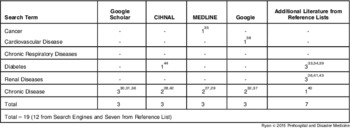
There were 19 articles identified, 12 using the search terms and seven from the reference lists of the selected articles (Table 3). The most frequent search term was “chronic disease” (n = 10). No variations in the disease definitions were identified.
Search Results for Phase Two

Data Description, Classification, and Linkages with STC Yasi
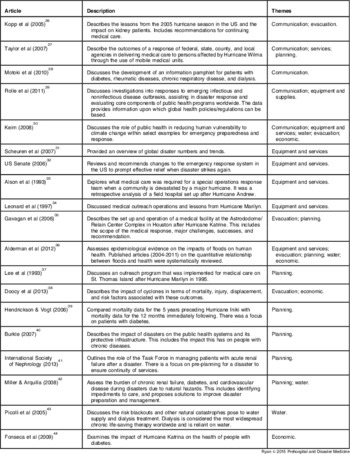
A matrix was developed to provide an individual case description for each article and to identify the key themes (Table 4). The analysis found a number of linkages with the themes identified from STC Yasi. The linkages included communication, equipment and services, evacuation, planning, and water. However, an additional issue emerged, the economic impact a disaster may have on people with NCDs and the health system.
Description of Literature from Other Studies

The data gathered were classified into the themes that emerged during the data description process. Each theme was analyzed across the articles and then used to interpret the findings and to understand the results. An overview of the themes is provided in the following:
-
1. Communication: during the response to Hurricane Katrina (USA; 2005), communication was a significant issue. This resulted in staff being unable to contact patients and misinformation.Reference Kopp, Ball and Cohen 26 This was also an issue during Hurricane Wilma (Florida USA; 2005).Reference Taylor, Stokes and Bajuscak 27 To address this issue in the future, it has been recommended that communication strategies be targeted at patients with diabetes, rheumatic diseases, chronic respiratory diseases, and renal diseases.Reference Motoki, Mori and Kaji 28 A common link was the need to ensure that patient information was transferred and coordinated. An additional issue was the need for specific communication strategies between hospitals, public health officials, and for different NCDs.Reference Kopp, Ball and Cohen 26 , Reference Motoki, Mori and Kaji 28 , Reference Rolle, Pearson and Nsubuga 29 Health communications can also raise public awareness of evacuation routes, flood zones, and community response plans.Reference Keim 30
-
2. Equipment and services: Hurricane Katrina destroyed health infrastructure and, in some cases, resulted in treatment interruption for four to six weeks.Reference Scheuren, de Waroux, Below, Guha Sapir and Ponserre 31 Also, medical supplies were tailored for people with life-threatening conditions; however, many patients suffered chronic diseases. 32 As a result, many pharmaceuticals were exhausted within one day of initiating operations. 32 This situation was not unique: following Hurricane Andrew (Florida USA; 1992), insulin supplies were also exhausted within one day; insulin-loaded syringes were among the most needed supplies following Hurricane Marilyn (US Virgin Islands) in 1993; and Hurricane Wilma in 2005 shut down health and social services (including home-based and elderly services) for 1.7 million people.Reference Taylor, Stokes and Bajuscak 27 , Reference Alson, Alexander, Leonard and Stringer 33 , Reference Leonard, Spangler and Stringer 34 Overall, in the future, there is a need to have a ready supply of medicine, personal protective equipment, and power generators for maintaining health services.Reference Rolle, Pearson and Nsubuga 29 , Reference Keim 30 , Reference Gavagan, Smart and Palacio 35
-
3. Evacuation: the management of NCDs at evacuation shelters was a significant issue after Hurricane Katrina. For example, at the Astrodome/Reliant Center Complex in Houston (Texas USA), the majority of clinic visits were for chronic disease or medication refills.Reference Gavagan, Smart and Palacio 35 , Reference Alderman, Turner and Tong 36 Another issue was the lack of a dialysis patient database, and therefore no accurate estimate of the number of patients expected.Reference Kopp, Ball and Cohen 26 Generally, during disasters, evacuation of special populations, such as those in hospitals, schools, prisons, and nursing homes, as well as migrants, tourists, and people with disabilities, can create the need for a major public health intervention.Reference Keim 30 , Reference Gavagan, Smart and Palacio 35 - Reference Lee, Fonseca and Brett 37
-
4. Planning: cyclones often exacerbate NCDs and rarely result in an outbreak of communicable diseases.Reference Doocy, Dick, Daniels and Kirsch 38 For example, after Hurricane Iniki (Hawaii USA) in 1992, diabetes-related deaths increased 161% when comparing mortality data for the five years preceding with mortality data for the 12 months immediately following the hurricane.Reference Hendrickson and Vogt 39 One year after Hurricane Katrina, there was a 47% increase in mortality (attributed to NCDs).Reference Burkle 40 Input from relevant specialists should be sought in the future.Reference Alderman, Turner and Tong 36 For example, the Renal Disaster Relief Task Force (RDRTF; Belgium) has been formed to respond to a range of disasters, including Hurricane Katrina. 41 However, the response to the needs of diabetic and cardiac patients has been less rigorous.Reference Miller and Arquilla 42 Another need is the inclusion of mobile medical clinics in disaster preparedness, planning, and response in the future.Reference Taylor, Stokes and Bajuscak 27 , Reference Alderman, Turner and Tong 36
-
5. Water: during disasters, water shortages have been reported to affect a wide range of hospital services, including food preparation, environmental control, toilet availability, housekeeping, laundry, infection control, and dialysis.Reference Keim 30 This risk increased when infrastructure was heavily impacted, populations were displaced, and water supply systems were damaged, leading to the contamination of drinking water facilities.Reference Alderman, Turner and Tong 36 Highlighting the importance was the quantity of safe water required for dialysis (up to 120 L for a standard 4-hour treatment, or 360 L per week).Reference Miller and Arquilla 42 - Reference Fonseca, Smith and Kuhadiya 44 Therefore, if the water supply is compromised in the future, alternative options are required. This may include equipping dialysis centers with emergency plans for obtaining water.Reference Miller and Arquilla 42 , Reference Piccoli, Pacitti and Mangiarotti 43 These recommendations are consistent with the findings for STC Yasi.
-
6. Economics: cyclones and other meteorological hazards have been affecting an increasing number of people and have caused large economic losses.Reference Keim 30 , Reference Alderman, Turner and Tong 36 , Reference Doocy, Dick, Daniels and Kirsch 38 For example, the economic impact of Hurricane Katrina on diabetes public patients was estimated at a US $5,243 increase over their lifetime, followed by Veterans Affairs patients at US $3,907, and privately insured patients at US $2,270.Reference Fonseca, Smith and Kuhadiya 44 This increase can be attributed to costs of diabetes-related complications due to the treatment disruptions.Reference Fonseca, Smith and Kuhadiya 44
Comparing Results
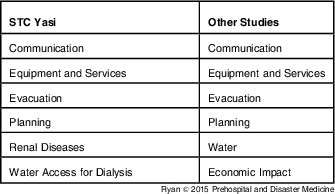
The results showed that the effects of STC Yasi on PHI, particularly with respect to NCDs, were not significantly different from published experiences with other similar events in economically similar populations (Table 5).
Comparison Between STC Yasi and Other Studies

Abbreviation: STC Yasi, Severe Tropical Cyclone Yasi.
The common themes for STC Yasi and other similar events were communication, equipment and services, evacuation, planning, and water (particularly for dialysis patients). A theme across the other studies, which was not identified from STC Yasi literature, was the economic impact of disasters. Although other studies identified in the data collection (Table 3) were categorized as renal diseases, the analysis identified that the issues raised cut across all diseases. For this reason, the other studies section did not have a specific theme for renal diseases.
Discussion
This study emphasizes the growing importance of the indirect consequences of disasters, whether from war, conflict, or large-scale natural disasters, which over time may dominate preventable mortality and morbidity rates. As such, there were two outcomes of interest. The first was to identify the impact of tropical cyclones on PHI and chronic disease. The second outcome of interest was to identify if there are trends across similar world events. The research demonstrated cyclones can impact PHI and chronic disease, as well as a trend between the impact of STC Yasi and other similar world events on PHI and the management of NCDs.
A tropical cyclone (including a hurricane and typhoon) can negatively impact PHI, for instance, equipment (oxygen, syringes, and medications), services (treatment and care), and water supplies, and can affect treatment and management of NCDs.Reference Little, Stone and Stone 18 , Reference Johnson, Hayes, Gray, Hawley, Hole and Mantha 22 , Reference Schafer 24 , Reference Motoki, Mori and Kaji 28 , Reference Rolle, Pearson and Nsubuga 29 , 41 , Reference Miller and Arquilla 42 Although the impact of STC Yasi was not significant on PHI due to the location of landfall (a low-populated area between Cairns and Townsville), there were a number of lessons that can be extrapolated.Reference Little, Stone and Stone 18
This review showed that the effects of STC Yasi on PHI, particularly with respect to NCDs, were not different from published experiences with other similar events in economically similar populations.
Communication to people with a NCD should be enhanced. Particularly, around patient information, needs (eg, nutrition), expectations, awareness of evacuation plans before an event, and the risks associated with missed treatment (eg, dialysis). This could be achieved through fact sheets and discussions at the time of consultation or treatment in a disaster-prone area.Reference Little, Stone and Stone 18 , Reference Hayes 21 - Reference Keim 30
Systems used for communication need to be enhanced to ensure sufficient patient information is transferred during an evacuation and services between different agencies are coordinated.Reference Little, Stone and Stone 18 , Reference Hayes 21 - Reference McArdle 25 This could include exercises and training to ensure all parties are familiar with, and use, disaster-management systems.Reference Hayes 21 - Reference McArdle 25
This research has provided a lesson for disaster planning. A severe tropical cyclone impacting a densely populated area could/would destroy PHI and result in an interruption to treatment regimes.Reference Motoki, Mori and Kaji 28 Therefore, disaster-planning activities need to reflect this possibility. Also, there needs to be renal dialysis disaster planning at the local hospital and health service level.Reference Hayes 21 - Reference McArdle 25 , Reference Taylor, Stokes and Bajuscak 27 , Reference Alderman, Turner and Tong 36 , Reference Miller and Arquilla 42 The planning should be based on current arrangements and how they can be maintained/increased using existing systems.
Access to safe water supplies is vital, particularly for dialysis treatment. It is important to ensure plans are in-place to sustain water supplies. This may include storage of additional water or arrangements with other facilities.Reference Johnson, Hayes, Gray, Hawley, Hole and Mantha 22 , Reference McArdle 25 , Reference Keim 30 , Reference Alderman, Turner and Tong 36 , 41 , Reference Miller and Arquilla 42
For evacuations, there needs to be adequate and exercised plans, access to sufficient equipment (eg, medications and oxygen), and a casualty clearing post for patients awaiting transfer. Also, evacuation patients need to be prepared for a one week transfer. This will reduce the risks associated with insufficient medication and allow expectations of people with NCDs to be managed.Reference Little, Stone and Stone 18 , Reference Hayes 21 - Reference Rossi, Young, Martin, Douglas and Campbell 23 , Reference Kopp, Ball and Cohen 26 , Reference Keim 30 , Reference Gavagan, Smart and Palacio 35 , Reference Alderman, Turner and Tong 36 , Reference Hendrickson and Vogt 39
Additional staff should be sought from outside the area subject to the disaster to help those affected (eg, extra physicians, nurses, and other health professionals). This could be addressed through workforce planning and familiarization of work processes in different areas. Also, there needs to be prompt assessment of renal facilities before reopening after disaster. This includes structural assessments and evaluations of power and water treatment systems.Reference Little, Stone and Stone 18 , Reference Johnson, Hayes, Gray, Hawley, Hole and Mantha 22 , Reference Schafer 24
An interesting omission from articles was patient perspectives. This information needs to be sought because the findings of such research will ultimately inform structures from the bottom up for improving disaster knowledge, planning, policy, and practice.
There is also a need to explore the cost implications of disasters on people with NCDs and health systems. Although cost burdens were only identified for diabetics affected by Hurricane Katrina, this finding provides evidence that disaster planning needs to focus on NCDs.Reference Hendrickson and Vogt 39 If this does not occur, there could be considerable financial implications for individuals, the community, and health systems.Reference Keim 30 , Reference Alderman, Turner and Tong 36 , Reference Doocy, Dick, Daniels and Kirsch 38 , Reference Fonseca, Smith and Kuhadiya 44
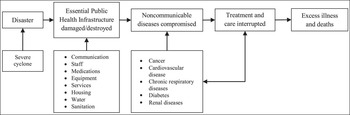
The findings have been used to conceptualize this relationship in Figure 2. This conceptual framework provides a platform for understanding the relationship between a disaster, PHI, and NCDs. It reflects the themes identified in the literature with communications now included as an essential PHI. Disaster planners can use the framework to understand and identify areas for improvement and tailor plans accordingly. This could include enhancing PHI, such as ensuring access to safe water for dialysis patients through establishing alternative options and focusing on priority NCDs. This information could then be used to develop strategies for maintaining treatment and care after a disaster.
Conceptual Framework: The Impact of a Severe Cyclone on Public Health Infrastructure and Noncommunicable Diseases.

A particular focus on PHI to address NCDs in the disaster setting is a novel idea. However, this research and the conceptual framework presented provide the platform for better tailoring of disaster plans, policy, and practice. Few researchers in the area of disasters have addressed this issue.Reference Scheuren, de Waroux, Below, Guha Sapir and Ponserre 31 Further studies should aim at identifying the true burden of natural disasters on NCDs and the relationship with PHI to inform disaster-management systems.Reference Motoki, Mori and Kaji 28
Limitations
This research was influenced by the lead author's studies and work in public health and disaster management at local, state, national, and international levels. This experience could also influence the themes identified in the literature. However, all efforts have been made to prevent this from occurring by objectively analyzing the literature. The selection of STC Yasi, and a comparison to other similar disasters (hurricanes and typhoons), was based on the size and the severity of the tropical cyclone, existing research, and discussions with health professionals, disaster officers, and other people affected by disasters.
As with any literature review, there was a risk of missing data and lack of essential information related to non-peer-reviewed data. This potential highlights possible bias and reduces confidence that saturation of themes has been reached. To minimize this impact, a methodical literature review process was undertaken to research the issue.
Other limitations include the search terms and research methodology. The search terms were limited to cyclone, typhoon, hurricane, cancer, cardiovascular disease, chronic respiratory diseases, diabetes, and renal diseases. Also, comparison studies were restricted to mainly hurricanes in USA (mainland and Hawaii), restricting the research to two health systems in developed countries.
Conclusion
This review showed that the effects of STC Yasi on PHI, particularly with respect to NCDs, were not different from published experiences with other similar events in economically similar populations. The research showed a tropical cyclone (including a hurricane and typhoon) can break down PHI, for instance, equipment (oxygen, syringes, and medications), services (treatment and care), and water supplies that affect treatment and management of NCDs. The comparison between STC Yasi and worldwide tropical cyclones found the challenges faced were closely linked. These include communication, equipment and services, evacuation, medication, planning, and water supplies. Additional issues emerged and include the need to seek patient perspectives through communication, consider the financial implications for people with NCDs, and the importance of disaster planning and management to encompass the entire health system spectrum.
This research provides an insight for disaster planners to address concerns of people with NCDs. While further research is needed, it provides an understanding of areas for improvement, enhancing protective public health infrastructure, development of strategies for maintaining treatment, and alternative care options such as maintaining safe water for dialysis patients.
Acknowledgements
The research is supported by: The Toowoomba Hospital Foundation/Cunningham Centre, Queensland, Australia; The Australian Centre for Health Service Innovation (Queensland, Australia); Cairns and Hinterland Hospital and Health Service, the Department of Health, Queensland, Australia; and the Doctoral Cohort Program, James Cook University, Queensland, Australia.