Technological progress has long been recognized as a crucial source of economic growth. Although most technological advances are incremental, a few general purpose technologies (GPTs), such as steam engines and information technology (IT), have leapfrogged existing technologies and modes of manufacturing and had a large impact on the entire economy. These important technologies were often characterized by three distinct features. They advanced rapidly, were adopted by a wide range of sectors and households, and spurred inventions and innovations in the downstream sectors.Footnote 1
Given the revolutionary role of GPTs, a number of studies have focused on identifying and assessing their effects.Footnote 2 However, limited attention is paid to how the knowledge behind a GPT is diffused across a wide range of industries. We also lack a good understanding of the dynamics between the core sector that incubates a GPT and the application sector that adopts the new technology. For example, is there a division of labor between these two sectors, allowing them to develop independently and to be geographically divorced?
Electrical technology exhibits many characteristics of a GPT. It has revolutionized the mode of manufacturing in numerous industries as well as transformed our daily life.Footnote 3 We therefore explore the introduction of electrical technology in the United States during the late nineteenth century and identify factors that were crucial for the electrical technology to be integrated into “crossover” inventions and improvements to machinery or equipment used by downstream sectors and households.Footnote 4 The first factor we examine is “interindustry” knowledge spillovers that flow through face-to-face interactions between members in different industries. Physical proximity to individuals in the “core” industry where the GPT is invented allows those in downstream industries to acquire the new technical knowledge and apply it to their own fields. Likewise, those in the core industry may learn about potential applications of the new technology in other fields.Footnote 5 A second factor is learning-by-using. Personal experience with electricity (or equipments embedded with the electrical technology) may foster crossover inventive activity. Hence, individuals who reside in areas where the GPT is introduced relatively early and therefore have access to the GPT initially would have an advantage in creating crossover inventions over others residing where it is introduced much later.Footnote 6
It is also important to address the roles played by other broad factors that encourage all types of inventive activity (not just those factors particularly applicable to the electrical technology): education and a favorable economic environment for invention in general. Education directly and indirectly influences the transfer of new GPT knowledge and the generation of crossover inventions. Schools may offer curriculum in the field of a GPT (in this case, electrical engineering) as well as courses in fields complementary to the new technology, such as chemistry, physics, and other types of engineering. Individuals trained or educated in these complementary fields may have an advantage in understanding and using the newly developed technology. On the other hand, market institutions and economic conditions that help inventors extract returns from their inventive efforts, like a well-designed patent system and intermediaries that facilitate technology trade, may be required in the generation of crossover inventions.Footnote 7
To examine these issues, we construct a unique data set from U.S. patent records, census manuscripts, city directories, newspaper obituaries, as well as family and local histories. The data set contains detailed biographical information about crossover inventors and the inventions they made over their career. Such micro-level information provides us a sense of where the crossover inventions were clustered as well as how an inventor acquired the knowledge of the electrical technology and applied it to create crossover inventions.
The impact of interindustry spillovers, although positive, appears to have been small. Regions where interindustry spillovers were expected to be prevalent did not observe a correspondingly high level of crossover inventive activity. Nor did such spillovers considerably shorten the time for an inventor to create his first crossover invention or raise the number of inventions he created. The evidence also reveals that learning-by-using was of little importance. In contrast, conditions conducive to inventive activity in general and human capital formation played a critical role. Not only did they enhance the population's ability in creating crossover inventions, but they raised the speed and productivity of inventors at making such inventions substantially.
Empirical Strategies
We can trace the spillover inventions from electrical technology relatively easily because their descriptions are likely to include the words “electric” and “electro.” Furthermore, by exploring the electrical technology in the United States during the late nineteenth century, we benefit from the rich biographical information in U.S. historical records. More importantly, the electrical technology posits a unique advantage in assessing the effects of the factors of interests, especially interindustry spillovers. During the early development of the electrical industry, the location of core electrical inventive activity was very different from that of inventive activity in other industries and from that of core electrical manufacturing.Footnote 8 This allows us to gauge the relative influence of the factors, by comparing geographic distribution of crossover inventions with that of these factors.
Our geographical analysis relies on the following premises. If interindustry spillovers play a crucial role in the generation of crossover inventions, we would expect the geographic pattern of crossover inventions to mirror that of core inventions. In areas where core inventors and inventions are clustered, inventors in other fields would have more opportunities to interact face-to-face with individuals in the core field.Footnote 9 Similar concepts can apply to other factors. For example, areas where conditions conducive to inventive activity in general are more prevalent should exhibit more inventions overall, as inventors exploit such a favorable environment. If these conditions are central to crossover inventive activity, we would expect crossover inventions to appear more frequently in places where inventive activity of all types is intense.
We also explore the effects of these factors at an individual level by evaluating the impact of education, training, and residence in areas with more core GPT activity on the time to invention and the number of inventions. The individual approach helps us better distinguish the inventive process by allowing us to treat differently situations where one hundred inventors are each granted one patent over their lifetime from ones in which a single inventor patents one hundred times. Moreover, it allows us to draw inferences about the factors that affect an inventor's ability to create crossover inventions while controlling for other changes during his lifetime, such as migration. Such an individual investigation, nonetheless, suffers from sample selection, as it excludes those who did not create any crossover inventions. Consequently, unlike its geographic analysis counterpart, the individual analysis does not completely reveal how the factors can affect the entire population's ability in developing crossover inventions.
DATA
To gauge inventive activity in electricity, we construct cross-sections of utility patents employing electrical technology that were granted in 1890 and 1910 by the United States Patent and Trademark Office (USPTO) from the LexisNexis database.Footnote 10 To identify whether a patent employed electricity, we use “electr” as the search key word on the patent grant documents. Such a key word captures the terms electric, electro, and electrode that characterize inventions embedded with electrical technology. A total of 3,414 patents are identified as using electricity or integrating the electrical technology.Footnote 11 We then read through the patent grant documents of all these patents, and classify 457 patents as crossover inventions in 1890 and 856 in 1910.Footnote 12 See the notes to Table 1 for more details. Of these 1,313 crossover patents, 1,120 were granted to U.S. residents.
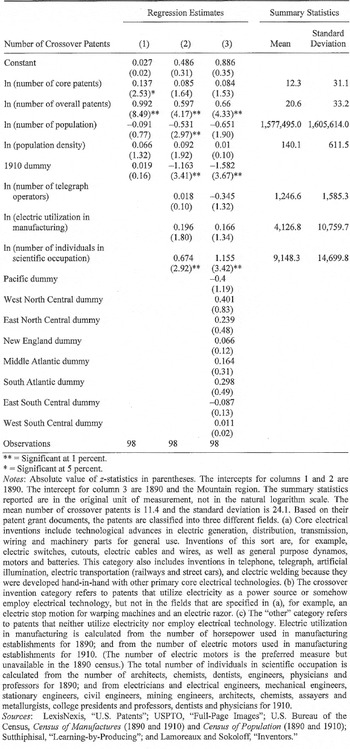
Negative Binomial Regressions of Number of Crossover Patents In the States in 1890 and 1910

** = Significant at 1 percent.
* * = Significant at 5 percent.
Notes:
Absolute value of z-statistics in parentheses. The intercepts for columns 1 and 2 are 1890. The intercept for column 3 are 1890 and the Mountain region. The summary statistics reported are in the original unit of measurement, not in the natural logarithm scale. The mean number of crossover patents is 11.4 and the standard deviation is 24.1. Based on their patent grant documents, the patents are classified into three different fields. (a) Core electrical inventions include technological advances in electric generation, distribution, transmission, wiring and machinery parts for general use. Inventions of this sort are, for example, electric switches, cutouts, electric cables and wires, as well as general purpose dynamos, motors and batteries. This category also includes inventions in telephone, telegraph, artificial illumination, electric transportation (railways and street cars), and electric welding because they were developed hand-in-hand with other primary core electrical technologies. (b) The crossover invention category refers to patents that utilize electricity as a power source or somehow employ electrical technology, but not in the fields that are specified in (a), for example, an electric stop motion for warping machines and an electric razor. (c) The “other” category refers to patents that neither utilize electricity nor employ electrical technology. Electric utilization in manufacturing is calculated from the number of horsepower used in manufacturing establishments for 1890; and from the number of electric motors used in manufacturing establishments for 1910. (The number of electric motors is the preferred measure but unavailable in the 1890 census.) The total number of individuals in scientific occupation is calculated from the number of architects, chemists, dentists, engineers, physicians and professors for 1890; and from electricians and electrical engineers, mechanical engineers, stationary engineers, civil engineers, mining engineers, architects, chemists, assayers and metallurgists, college presidents and professors, dentists and physicians for 1910.
Sources:
LexisNexis, “U.S. Patents”; USPTO, “Full-Page Images”; U.S. Bureau of the Census, Census of Manufactures (1890 and 1910) and Census of Population (1890 and 1910); Sutthiphisal, “Learning-by-Producing”; and Lamoreaux and Sokoloff, “Inventors.”
For the U.S.-based crossover inventions, we obtain the name and address of patentees and their assignees (at issue) from the patent records. We then use the inventor name search inquiry in LexisNexis to collect information for all patents each patentee received over his career (over 19,000 patents in total).Footnote 13 This information is combined with biographical information of each inventor from manuscripts of the U.S. Decennial Population Census in 1850–1880 and 1900–1930; city directories; newspaper obituaries; and family and local histories. The information is used to identify his educational and occupational background when receiving his first crossover patent.Footnote 14 The new evidence is supplemented with data on core electrical inventions and overall inventive activity from data sets compiled by Kenneth L. Sokoloff, Naomi R. Lamoureaux, and Dhanoos Sutthiphisal for other papers.Footnote 15
GEOGRAPHIC ANALYSIS
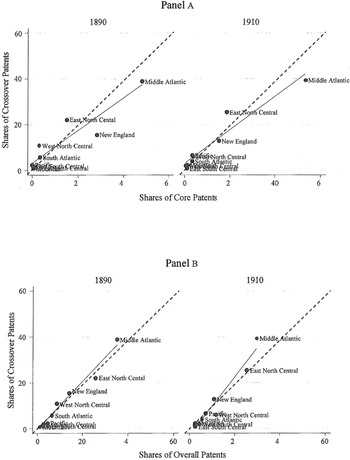
If geographic access to core inventive activity was a key component of crossover inventive activity, we would expect to see a very tight geographical correlation between the regional shares of the two types of invention. However, panel A of Figure 1 shows an imperfect match between the regional shares of crossover and core inventions. For both sample years, 1890 and 1910, the best fit lines are not aligned along the 45 degree line. More importantly, they appear to have a slope less than one, suggesting that an increase in the share of core inventions did not bring about a comparable increase in the share of crossover inventions. In contrast, panel B of Figure 1 reveals that the regional pattern for crossover inventions better matches the regional pattern of all inventions. All the data points are much better aligned along the 45 degree line.
Regional Shares of Crossover, Core electrical, and Overall Patents, 1890 and 1910

We apply regression analysis to further examine these geographic patterns. As many areas, such as Kentucky, generated zero to few crossover inventions and only a handful, for example, New York and Ohio, accounted for a very large share of crossover inventions in the country, we employ a negative binomial specification:Footnote 16

where cross it is state i's number of crossover patents in year t; pop it denotes the state's population, to control for the possibility that states with larger population may generate more inventions; d it is the population density to control for amenities that are often lacking or of poorer quality in underpopulated areas, such as public libraries. To measure the importance of interindustry spillovers from core inventions, we include cross it, the number of core electrical patents. To measure the impact of conditions that helped promote general inventive activity, we include overal it, the number of all patents.Footnote 17
The positive and statistically significant coefficient of core inventions (0.137) in Table 1 column 1 implies that if a state were to increase its number of core electrical inventions by 1 percent, its rate of crossover inventions would rise by 0.01 x [exp(0.137) – 1] or roughly 0.15 percent. This relationship is much weaker than the one with all inventive activity. The coefficient for overall patents is 0.992, which implies that a 1 percent increase in the number of all inventions would increase the state's rate of having crossover invention by 1.7 percent.
We can go beyond a reliance on regional comparisons by adding two explanatory variables in column 2 of Table 1 to capture the impact of learning-by-using: the logarithm of state i's electric utilization in manufacturing establishments and the logarithm of the state's number of telegraph operators. To assess what role scientific human capital played, we also include the natural log of the state's total number of individuals who held occupation in scientific fields. The addition of the new variables reduces the size of the coefficients of the core patent and all patent variables, but the coefficient for all inventions (0.597) is still much larger than for core inventions (0.085).
There is strong evidence that supports the importance of scientific human capital. The coefficient with respect to individuals who held a scientific occupation (0.674) suggests that a 1 percent increase in the number of such residents would lead to a 0.96 percent increase in the rate of having crossover invention.Footnote 18 In contrast, learning-by-using appeared to have played a limited role. The coefficient on electric utilization in manufacturing was 0.196, which implies a 1 percent increase would have increased crossover inventive activity by 0.21 percent.
To control for unmeasured differences across regions that were the same for states within the same region, we add regional dummies in our regression. The regression results are reported in column 3. On the whole, the patterns are comparable to those found in column 2.Footnote 19
INDIVIDUAL ANALYSIS
We now turn our attention to individuals who created crossover inventions and examine how their inventive career evolved over time. If interindustry spillovers were important, a significant number of inventors would have started their inventive career in the core electrical field and later applied their knowledge to crossover inventive activity. We would expect them to account for a great number of crossover inventions. Inventors would also tend to switch their inventive activity back and forth in different fields as they learned about opportunities in industries in which they had no work experience.
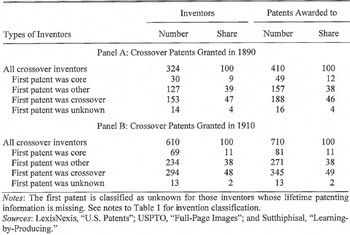
However, Table 2 reveals that interindustry spillovers did not play a pivotal role in the inventive activity of individuals who made crossover inventions. Only 9 percent of crossover inventors in 1890 and 11 percent in 1910 had started their inventive career as core electrical inventors. These inventors, though slightly more productive at creating crossover inventions than others, contributed only a small portion of crossover patents, 12 percent in 1890 and 11 percent in 1910. In contrast, the majority of crossover patents were made by individuals who began their career directly with a crossover patent or a patent that did not have any electrical technology embedded.Footnote 20
CROSSOVER INVENTORS AND INVENTIONS (IN THE SAMPLED YEARS) BY TYPES OF INVENTORS

Notes:
The first patent is classified as unknown for those inventors whose lifetime patenting information is missing. See notes to Table 1 for invention classification.
Sources:
LexisNexis, “U.S. Patents”; USPTO, “Full-Page Images”; and Sutthiphisal, “Learning-by-Producing.”
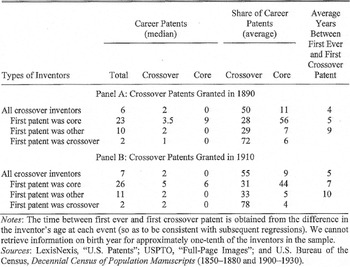
The inventors described by Table 3 seldom switched back and forth between core and crossover inventions. In 1890 a median crossover inventor whose first patent was in the core electrical field generated a total of 23 patents over his lifetime but less than 4 were crossover patents. Similarly, those who did not begin their career in the core electrical industry hardly ever applied their acquired electrical knowledge to carry out inventions in the core field. Less than 7 percent of their inventions were in the core electrical field.Footnote 21
LIFETIME PATENTING BEHAVIORS OF CROSSOVER INVENTORS

Notes:
The time between first ever and first crossover patent is obtained from the difference in the inventor's age at each event (so as to be consistent with subsequent regressions). We cannot retrieve information on birth year for approximately one-tenth of the inventors in the sample.
Sources:
LexisNexis, “U.S. Patents”; USPTO, “Full-Page Images”; and U.S. Bureau of the Census, Decennial Census of Population Manuscripts (1850–1880 and 1900–1930).
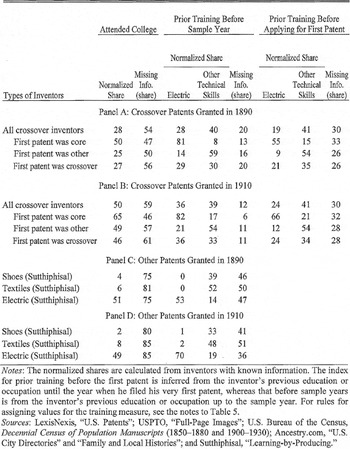
As reported in Table 4, a relatively high proportion of crossover inventors, 28 percent in 1890 and 50 percent in 1910, had some college education. This proportion was similar to the proportion of core electrical inventors with some college training in 1910 (49 percent) and substantially higher than for shoe and textile inventors.
EDUCATIONAL AND TRAINING BACKGROUND OF CROSSOVER AND OTHER INVENTORS

Notes:
The normalized shares are calculated from inventors with known information. The index for prior training before the first patent is inferred from the inventor's previous education or occupation until the year when he filed his very first patent, whereas that before sample years is from the inventor's previous education or occupation up to the sample year. For rules for assigning values for the training measure, see the notes to Table 5.
Sources:
LexisNexis, “U.S. Patents”; USPTO, “Full-Page Images”; U.S. Bureau of the Census, Decennial Census of Population Manuscripts (1850–1880 and 1900–1930); Ancestry.com, “U.S. City Directories” and “Family and Local Histories”; and Sutthiphisal, “Learning-by-Producing.”
Crossover inventors were also distinguished by their advanced training in schools or on the job. In 1890, 28 percent of crossover inventors had some training in the electrical field and another 40 percent were in other technical fields, such as chemistry and physics. In contrast, less than 40 percent of shoe inventors and about 50 percent of textile inventors were trained in these other technical fields. Virtually none of the shoe and textile inventors received training in the core electrical field. The same patterns persisted in 1910.
Many crossover inventors, however, did not rely on direct training in electrical technology. Less than 25 percent of the crossover inventors had received training or had worked in the electrical field before they applied for their very first patent. On the other hand, 41 percent (in both years) had been trained or had work experience as engineers, machinists, and professionals in other sciences. For example, Byron A. Brooks, a typewriter pioneer, was a professor of mathematics before receiving his first patent. A number of his inventions employed electrical technology. The findings suggest that training in other fields provided technical foundations and principles which were scientifically close or complementary to the electrical field, making it easier for one to absorb such a newly emerging technology.
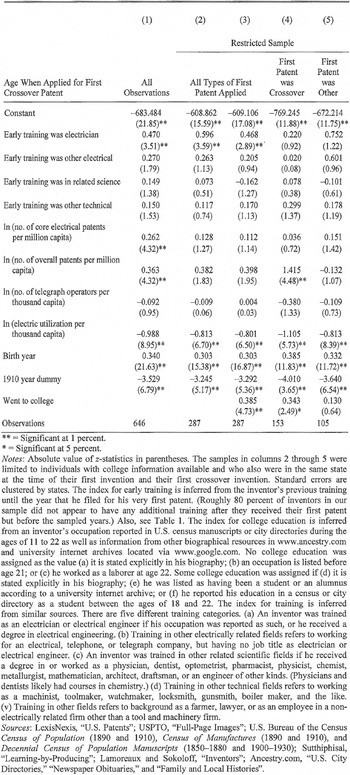
To show how training and exposure to electrical activity influenced the age at which inventors created their first crossover invention, we estimate a Weibull hazard model on the sample of individual inventors.Footnote 22 The estimation results are displayed in Table 5. Column 1 contains all crossover inventors for whom we are able to infer training information. Because relocation makes it difficult to determine whether an inventor benefited from factors prevalent in his current or prior residence, we restrict the analysis in columns 2 and 3 to inventors who remained at the same state of residence between their first patent and their first crossover patent.Footnote 23
RESULTS FROM HAZARD MODEL REGRESSIONS OF AGE AT FIRST CROSSOVER INVENTION

** = Significant at 1 percent.
* = Significant at 5 percent.
Notes:
Absolute value of z-statistics in parentheses. The samples in columns 2 through 5 were limited to individuals with college information available and who also were in the same state at the time of their first invention and their first crossover invention. Standard errors are clustered by states. The index for early training is inferred from the inventor's previous training until the year that he filed for his very first patent. (Roughly 80 percent of inventors in our sample did not appear to have any additional training after they received their first patent but before the sampled years.) Also, see Table 1. The index for college education is inferred from an inventor's occupation reported in U.S. census manuscripts or city directories during the ages of 11 to 22 as well as information from other biographical resources in www.ancestry.com and university internet archives located via www.google.com. No college education was assigned as the value (a) it is stated explicitly in his biography; (b) an occupation is listed before age 21; or (c) he worked as a laborer at age 22. Some college education was assigned if (d) it is stated explicitly in his biography; (e) he was listed as having been a student or an alumnus according to a university internet archive; or (f) he reported his education in a census or city directory as a student between the ages of 18 and 22. The index for training is inferred from similar sources. There are five different training categories. (a) An inventor was trained as an electrician or electrical engineer if his occupation was reported as such, or he received a degree in electrical engineering. (b) Training in other electrically related fields refers to working for an electrical, telephone, or telegraph company, but having no job title as electrician or electrical engineer. (c) An inventor was trained in other related scientific fields if he received a degree in or worked as a physician, dentist, optometrist, pharmacist, physicist, chemist, metallurgist, mathematician, architect, draftsman, or an engineer of other kinds. (Physicians and dentists likely had courses in chemistry.) (d) Training in other technical fields refers to working as a machinist, toolmaker, watchmaker, locksmith, gunsmith, boiler maker, and the like. (v) Training in other fields refers to background as a farmer, lawyer, or as an employee in a non-electrically related firm other than a tool and machinery firm.
Sources:
LexisNexis, “U.S. Patents”; USPTO, “Full-Page Images”; U.S. Bureau of the Census Census of Population (1890 and 1910), Census of Manufactures (1890 and 1910), and Decennial Census of Population Manuscripts (1850–1880 and 1900–1930); Sutthiphisal, “Learning-by-Producing”; Lamoreaux and Sokoloff, “Inventors”; Ancestry.com, “U.S. City Directories,” “Newspaper Obituaries,” and “Family and Local Histories”.
The results reveal that training was important. Prior training in the electrical field raised an inventor's immediate probability of coming up with his first crossover patent 1.6 times (roughly equal to exp(0.47)), relative to someone without any scientific and technical training. College education also helped accelerate the onset of an inventor's first crossover patent. The coefficient in column 3 suggests that the first crossover patent was obtained about 1.5 times sooner for someone who had gone to college.
The positive coefficient on the log of the number of core electrical patents per million capita reported in columns 1–3 indicates some benefits arising from interindustry spillovers. As in the state-level regressions, however, the role of interindustry spillovers was less important than conditions that promoted invention in general, since columns 1–3 all report a larger coefficient on overall patenting.Footnote 24 The results in these three columns also suggest that learning-by-using was not a contributing factor in crossover inventive activity, as the coefficients on the number of telegraph operators and electric utilization are small (or even negative).Footnote 25
We then explore the possibility that inventors with different inventive background, particularly in their early inventive career, benefited from the factors differently.Footnote 26 Column 4 investigates inventors who started out directly as crossover inventors. This is the largest group of inventors and they created nearly half of the crossover inventions in the sample (see Table 2). The results suggest that conditions conducive to inventive activity in general and college education played important roles for such inventors because their inventive activity was most strongly influenced by the number of overall inventions in the state and by their access to college education.
In contrast, column 5 studies those who began their inventive career by making inventions in fields that did not involve the electrical technology. For these inventors, prior training in the electrical field and interindustry spillovers were more important, although the relationship is imprecisely estimated. The finding that these factors had asymmetric effects across different types of inventors is not surprising. Exposure to conditions conducive to inventive activity would be critical for those who had never invented but were embarking on making crossover inventions. Furthermore, college education (in any field) probably allowed people who had never invented anything to learn about the new technology and carry out crossover inventions. Those who had invented in other fields would be more likely to incorporate the electrical technology in their inventions if they had received training in the electrical field or interacted with individuals possessing electrical knowledge.Footnote 27
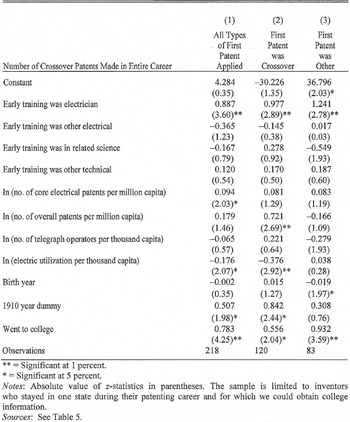
We next examine how different factors affected the inventor's ability to generate multiple crossover inventions over his entire career. We apply a negative binomial regression model with the same set of covariates as before, but the total number of crossover patents received by an inventor over his whole life becomes the dependent variable. The regression results on inventors who lived in the same state of residence over their career are reported in Table 6.Footnote 28 Receiving the most advanced training in the electrical technology and attending college increased an inventor's productivity substantially, as all three columns have positive and statistically significant coefficients on “early training as electrician” and “went to college.” According to the coefficients in column 1, crossover inventors with prior training as electricians had exp(0.887) or 2.43 times the productivity of inventors who did not have any scientific or technical training. Similarly, college educated inventors were 2.19 times more productive than inventors who did not attend college. The regression also reveals that conditions conducive to all types of inventive activity were important. However, such conditions may be only instrumental to those who started their inventive career with crossover inventions. Column 2, which examines inventors who started their inventive career with a crossover invention, shows a sizable, positive, and statistically significant coefficient on overall patenting (0.721). The same coefficient in column 3 for inventors whose first invention did not utilize the electrical technology, was insignificant and negative. On the other hand, inter-industry spillovers and learning-by-using had limited effects. All three columns display a positive but relatively small coefficient on the log of the number of core electrical patents. Likewise, the coefficients on the two measures of electric utilization were either small or negative.
NEGATIVE BINOMIAL REGRESSIONS OF NUMBER OF CROSSOVER PATENTS IN CAREER

** = Significant at 1 percent.
* = Significant at 5 percent.
Notes:
Absolute value of z-statistics in parentheses. The sample is limited to inventors who stayed in one state during their patenting career and for which we could obtain college information.
Sources:
See Table 5.
In brief, the individual analysis lends further support to the findings from the state-level analysis that human capital and an environment promoting all types of inventions were important factors. The individual analysis goes one step further in identifying various forms of human capital and how they affected inventors with different inventive background. For those who started out inventing in other fields (neither core nor crossover inventions), direct training in the electrical technology greatly influenced the likelihood and frequency that they would switch to making crossover inventions. However, many crossover inventors who did not hold a job title as electrician or electrical engineer appeared able to learn about the technology through attending college regardless of the field they studied in college.
CONCLUSION
Using the electrical technology as a case study, we provide an in-depth account of the process that governs how an important technological discovery spreads from its incubation sector into inventive activity in other industries, and helps the technology's potential as a GPT materialize. Knowledge about possible applications had a larger impact on inventive activity in downstream industries than knowledge about the GPT. Electrical crossover inventions were largely carried out by inventors who were distinctly different from those who contributed to technology advancement in the electrical industries. Many of these inventors had little relationship with the core sector and had not worked directly in the electrical industry. Crossover inventors were like all inventors in that they benefited a great deal from relatively high levels of human capital and resided in areas abundant with favorable conditions conducive to all kinds of inventive activity.
Even though interindustry spillovers and learning-by-using often function as ways to transmit intimate technical knowledge among the technologically creative, our findings suggest that these two mechanisms are not necessary conditions for crossover inventions. The disclosure requirements for patents and the markets for technology allowed inventors with limited experience with electricity but high levels of human capital to produce a significant number of crossover inventions. The experience from the electrical technology also implies that there may be a division of “creative” labor between the core and application sectors in the diffusion of GPTs. Inventors in the core sector likely specialize in making the GPT more standardized, “modular,” or “plug-and-play,” while an ever increasing number of downstream sectors broaden the spectrum of its uses. Such a finding appears to echo the conjecture proposed in the GPT literature that the core and application sectors exhibit an innovational complementarity relationship.Footnote 29
These results suggest that the role of knowledge spillovers (at least between industries) may be overstated, whereas investment in human capital may be underappreciated in the knowledge diffusion literature. Also, if the experience of the introduction of electrical technology can be generalized to the spread of modern GPTs such as IT, the recent policies of developing countries, such as China and Malaysia, that try to attract high-tech firms or their R&D facilities may not bring about increased rates of inventions unless they have first established a favorable environment for inventive activity in general and accumulate sufficient levels of general human capital.