Introduction
Family firms (FFs) hold a prominent position in the global economy and are renowned for their resilience and operational effectiveness (Chen & Liu, Reference Chen and Liu2022; Schulze & Gedajlovic, Reference Schulze and Gedajlovic2010). Meanwhile, an increasing number of researchers started to focus on the innovation of enterprises (Brown, Fazzari, & Petersen, Reference Brown, Fazzari and Petersen2009; Cohen, Diether, & Malloy, Reference Cohen, Diether and Malloy2013; Prabhu, Chandy, & Ellis, Reference Prabhu, Chandy and Ellis2005) as the capacity of enterprises to innovate plays a pivotal role in fostering long-term economic growth and sustaining core competitiveness (Cohen & Levinthal, Reference Cohen and Levinthal1989; Nordhaus, Reference Nordhaus1969; Tomizawa, Zhao, Bassellier, & Ahlstrom, Reference Tomizawa, Zhao, Bassellier and Ahlstrom2020). The existing research on innovation in FFs has yielded divergent viewpoints. Some suggest that the inherent characteristics of FFs inhibit innovation (Chen & Liu, Reference Chen and Liu2022; Zellweger, Reference Zellweger2007), while others argue that FFs' focus on preserving family legacy fosters an environment conducive to long-term innovation (Gómez-Mejía, Haynes, Núñez-Nickel, Jacobson, & Moyano-Fuentes, Reference Gómez-Mejía, Haynes, Núñez-Nickel, Jacobson and Moyano-Fuentes2007). Although the innovative behavior of FFs has attracted academic attention, most research highlights differences without comprehensively addressing the heterogeneity of innovation within FFs, particularly how family dynamics during intergenerational succession affect innovation and strategic changes (Calabrò, Vecchiarini, Gast, Campopiano, De Massis, & Kraus, Reference Calabrò, Vecchiarini, Gast, Campopiano, De Massis and Kraus2019; Erdogan, Rondi, & De Massis, Reference Erdogan, Rondi and De Massis2020).
In this article, we investigate the impact of family dynamics on FFs innovation decoupling based on the socioemotional wealth (SEW) theory, which emphasizes that the motivation of FFs is not always financial goals but sometimes even conflicts (Gómez-Mejía, Cruz, Berrone, & De Castro, Reference Gómez-Mejía, Cruz, Berrone and De Castro2011). Longstanding research has shown noneconomic, family-centric motives of FFs, such as maintaining a solid reputation for family members and businesses (Berrone, Cruz & Gómez-Mejía, Reference Berrone, Cruz and Gómez-Mejía2012; Gómez-Mejía et al., Reference Gómez-Mejía, Haynes, Núñez-Nickel, Jacobson and Moyano-Fuentes2007). However, the priority of SEW varies among family members and periods (Miller & Le Breton-Miller, Reference Miller and Le Breton-Miller2014). For instance, parents tend to focus more on the essence of innovation and strive to leave more long-term economic assets for the successor (Gu, Lu, & Chung, Reference Gu, Lu and Chung2019). In contrast, successors are more concerned about control over the firms, securing the support of corporate executives, and ensuring secure cash flow rather than facing resistance after completing the succession (Gu et al., Reference Gu, Lu and Chung2019). Therefore, the needs of different generations in fulfilling their emotional endowments vary, and ‘innovation decoupling’ may occur during intergenerational succession.
Based on the conceptual framework of corporate social responsibility decoupling proposed by Marquis and Qian (Reference Marquis and Qian2014), ‘decoupling’ is defined as symbolically responding to stakeholder demands without enacting substantive changes, which can pose risks to the corporate long-term development and weaken the firm's authentic management practices and corporate image. This concept aligns with the ‘decoupling’ introduced by Meyer and Rowan (Reference Meyer and Rowan1977), suggesting that organizations symbolically respond to innovation demands without making substantive changes. For instance, Volkswagen symbolically promoted its eco-friendly vehicle innovation to satisfy regulators and public expectations. However, in reality, the company did not conduct substantive innovation to upgrade its environmental technology. Instead, to meet their symbolic innovation disclosure, Volkswagen chose the innovation decoupling strategy by installing software to cheat on emissions tests, allowing the vehicles to emit pollutants far above legal limits during regular use (BBC, 2015). Accordingly, by combining the two dimensions of symbolic disclosure and substantive change in innovation, we introduce the term ‘innovation decoupling’ to encapsulate the disparity between these two aspects, which refers to prioritizing symbolic disclosure of innovation over making substantive changes of innovation, thereby highlighting the critical difference between form and substance in organizational innovation activities.
Drawing from the different forms of SEW that represent controlling owners' distinct affective needs (Gu et al., Reference Gu, Lu and Chung2019), we propose that family dynamics during intergenerational succession increase the innovation decoupling by the focal FF. Our fundamental rationale is that parents driven by broad SEW and the desire for family dynasty perpetuation and transgenerational sustainability prioritize substantive changes of innovation to enhance the enterprise's long-term development and provide sufficient resilience for successors (Le Breton-Miller, Miller, & Steier, Reference Le Breton-Miller, Miller and Steier2004) while successors hold focused SEW view during the succession process as they are primarily concerned with secure cash flows and dominant control and influence in a very short time (Naldi, Cennamo, Corbetta, & Gomez-Mejia, Reference Naldi, Cennamo, Corbetta and Gomez-Mejia2013). Therefore, symbolic disclosures of innovation are more efficient and effective than substantive changes, which carry uncertain outcomes and internal resistance (Lubatkin, Schulze, Ling, & Dino, Reference Lubatkin, Schulze, Ling and Dino2005). We further hypothesize that the positive relationship between family dynamics and innovation decoupling will be weakened when the FF is influenced by the family affective endowment, particularly when it bears the family name. In such cases, the enduring prosperity and prestige of the family become more pronounced and cherished (Beck, Reference Beck2016). Additionally, such a positive relationship would be weaker for successors with ascribed bureaucratic connections, who have established political connections before joining FFs and, as a result, gained more resources and legitimacy (Zhang, Marquis, & Qiao, Reference Zhang, Marquis and Qiao2016).
Nowhere are our hypotheses more clearly borne out than in emerging economies like China. China is known for its vibrancy of FFs and entrepreneurship (Armanios, Eesley, Li, & Eisenhardt, Reference Armanios, Eesley, Li and Eisenhardt2017), a context that provides substantial interorganizational variations to attest to our hypotheses. As such, we have extracted the whole population of Chinese listed FFs from the Family Business Database, a sub-database of the China Stock Market Accounting Research (CSMAR) database, and followed their behaviors during the recent decade (2012–2021) to comprehensively capture the dynamics of the business landscape in China. We measured substantive changes of innovation (Substance) by the number of invention patents applied for by the FF while employing a machine learning (ML) approach to measure the symbolic disclosure of innovation (Symbol) within enterprises based on their annual financial reports. The results are fully consistent with our propositions.
Overall, we make three major contributions. First, we have supplemented existing literature on FFs and innovation by providing evidence that intergenerational succession, one of the most critical family dynamics in FFs, could affect corporate heterogeneity in their innovation. While previous studies mainly use the measure only from the perspective of substantive changes of innovation (Bellstam, Bhagat, & Cookson, Reference Bellstam, Bhagat and Cookson2021; Choi, Menon, & Tabakovic, Reference Choi, Menon and Tabakovic2021), we indicate the presence of an ‘innovation decoupling’ phenomenon stemming from the disparity between symbolic disclosures and substantive changes of innovation during the succession process. Second, based on the aspects from SEW (Cennamo, Berrone, Cruz, & Gomez-Mejia, Reference Cennamo, Berrone, Cruz and Gomez-Mejia2012; Gómez-Mejía et al., Reference Gómez-Mejía, Haynes, Núñez-Nickel, Jacobson and Moyano-Fuentes2007, Reference Gómez-Mejía, Cruz, Berrone and De Castro2011), we contribute to SEW theory by strengthening the understanding of SEW dynamics during the FFs' lifecycle from the aspect of inheriting. While prior studies mainly show the descending SEW of successors (Stockmans, Lybaert, & Voordeckers, Reference Stockmans, Lybaert and Voordeckers2010), we prove that several factors can also strengthen their embedding in broad SEW. Specifically, we document that FF influenced by the family affective endowment and successors who have ascribed bureaucratic connections are less likely to engage in innovative decoupling (Beck, Reference Beck2016; Cadieux, Lorrain, & Hugron, Reference Cadieux, Lorrain and Hugron2002), which shed light on the calculation of successors between personal interests and long-term family values. Third, we showcase that firms' annual reports can be a valuable data source to capture innovation decoupling. In particular, we have shown that integrating techniques such as natural language processing (NLP) and ML can generate fine-grained data that help represent symbolic disclosure of innovation in firms.
Theoretical Background and Hypotheses Development
Literature Review
Family firm innovation decoupling
Decoupling denotes that firms only superficially abide by institutional pressure without actually implementing the practices (Boxenbaum & Jonsson, Reference Boxenbaum and Jonsson2017). In general, decoupling is deemed as the strategy conducted after balancing the benefits of subjecting to institutional pressure and the costs of practical efficiency-seeking activities (Meyer & Rowan, Reference Meyer and Rowan1977; Oliver, Reference Oliver1991). So far, there are several studies investigating the decoupling strategy from the perspective of internationalization (Xu, Shi, Zhao, & Chen, Reference Xu, Shi, Zhao and Chen2024), digital transition (Liu, Zhou, & Li, Reference Liu, Zhou and Li2023), and CSR (Marquis & Qian, Reference Marquis and Qian2014). However, this phenomenon may also arise in other aspects, especially innovation, since innovation strategy is also deemed as a significant resource of institutional pressure with huge costs to conduct actions.
Innovation behavior and capability constitute fundamental pillars for the sustained growth of enterprises, serving as crucial catalysts for long-term development (Ahlstrom, Reference Ahlstrom2010; Ferreira, Fernandes, & Ferreira, Reference Ferreira, Fernandes and Ferreira2019). Innovation not only drives internal growth but also creates significant value for the firm's stakeholders by enhancing profitability (Lin, Liu, & Manso, Reference Lin, Liu and Manso2021), fostering customer loyalty and strengthening market competitiveness (Cho & Pucik, Reference Cho and Pucik2005; Cusumano, Kahl, & Suarez, Reference Cusumano, Kahl and Suarez2015), establishing a more stable supply chain (Cao & Zhang, Reference Cao and Zhang2011), and help companies receive policy support, tax breaks, and other benefits from government (Stuart & Wang, Reference Stuart and Wang2016). However, conducting innovation is not without costs. For instance, huge investment and failure risk of innovation, such as the decreasing incumbent advantages and comparative core legacy of FFs (Brown et al., Reference Brown, Fazzari and Petersen2009; Erdogan et al., Reference Erdogan, Rondi and De Massis2020; Ferreira et al., Reference Ferreira, Fernandes and Ferreira2019), and threats to family control induced by innovation investments.
China provides a promising context for investigating innovation decoupling strategies. China's government upholds the central role of innovation in the development and has integrated industrial policies to enhance high-tech sector competitiveness by encouraging innovation-related financing, tax incentives, and effective management of R&D funds (Liu, Simon, Sun, & Cao, Reference Liu, Simon, Sun and Cao2011). The capital market participants, in turn, value innovation as it is seen as a fundamental pillar for the sustained growth of enterprises (Choi, Lee, & Williams, Reference Choi, Lee and Williams2011). As a result, conveying innovative information could strengthen corporate legitimacy by catering to the expectations of external stakeholders (Blanco, Guillamón-Saorín, & Guiral, Reference Blanco, Guillamón-Saorín and Guiral2013). Thus, regarding the huge costs of substantive innovation, firms have the motivation to manipulate symbolic disclosure of innovation which has comparatively lower costs. Then, it is important for us to know the factors influencing corporate innovation strategy.
Previous studies mainly focus on the effect of FFs' innovation ability. First, family control could accelerate innovation by broadening family members' decision-making (Zahra, Reference Zahra2003). However, with more family members engaging in management, decreasing nonfamily controllers could induce the innovation to descend (Chen, Wu, Liao, & Chen, Reference Chen, Wu, Liao and Chen2022; Hoskisson, Hitt, Johnson, & Grossman, Reference Hoskisson, Hitt, Johnson and Grossman2002). Corporate resources also have an effect. For instance, with smaller firm sizes, FFs are more easily to adapt to innovative reform (Gudmundson, Tower, & Hartman, Reference Gudmundson, Tower and Hartman2003; Love & Roper, Reference Love and Roper2015). Nevertheless, competition for resources dampens the efficiency of innovation (Xu, Chan, Xie, Chen, & Agarwal, Reference Xu, Chan, Xie, Chen and Agarwal2023).
Overall, though the previous studies have investigated many factors influencing FFs innovation strategy, they still leave the gap. First, we aim to explore the underlying drivers of innovation within firms, moving beyond a sole focus on FFs' static characteristics to delve deeper into the effect of FFs dynamics on their innovation, particularly during the intergenerational succession process. Second, many previous studies overlooked the innovation decoupling strategy. Third, they mainly focus on corporate ability instead of controllers' attitude to innovation strategy, which actually has the most profound effect on innovation choice. Thus, we primarily focus on the effect of intergenerational succession, which is crucial to an FF's long-term development and lifespan and significantly impacts changes in family dynamics, on innovation strategy. Meanwhile, we employ the SEW theory to explore the diverse incentives of different generations to innovation. Then, we introduce the significance of succession and SEW theory.
Family succession
Existing studies on the intergenerational succession of FFs encompass various factors, such as choosing successors or professional managers (Gedajlovic, Lubatkin, & Schulze, Reference Gedajlovic, Lubatkin and Schulze2004; Stewart & Hitt, Reference Stewart and Hitt2012), succession planning (Eddleston, Kellermanns, Floyd, Crittenden, & Crittenden, Reference Eddleston, Kellermanns, Floyd, Crittenden and Crittenden2013), and external influences (Carney, Gedajlovic, & Strike, Reference Carney, Gedajlovic and Strike2014). Different FFs exhibit diverse heterogeneities (Chua, Chrisman, Steier, & Rau, Reference Chua, Chrisman, Steier and Rau2012), particularly regarding CEO behavior and preferences. During the process of intergenerational succession in FFs, the transition of CEOs can lead to significant changes in the enterprise's development due to differing motivations and preferences between successive entrepreneurial generations (Cennamo et al., Reference Cennamo, Berrone, Cruz and Gomez-Mejia2012; Gómez-Mejía et al., Reference Gómez-Mejía, Haynes, Núñez-Nickel, Jacobson and Moyano-Fuentes2007; Miller & Le Breton-Miller, Reference Miller and Le Breton-Miller2014). The appointment of a new CEO plays a pivotal role in establishing long-term developmental objectives for the company, especially in allocating resources to incentivize and oversee or incentivize company achievement (Burgelman, Reference Burgelman1991; Hambrick & Mason, Reference Hambrick and Mason1984).
However, we are yet to be certain about the changes of innovation strategy's incentives in the FFs during the succession process. That is, successors need to moderate their emotions in developing the long-term interests for the FF and enable stable succession in the short term. Under these circumstances, examining whether and how the family dynamic affects innovation decoupling would directly implicate the attitude changes between different generations derived from the family's emotional perspective.
Socioemotional wealth theory
Recent research on FFs emphasizes the role of two distinct aspects of SEW in explaining the strategic decisions of controlling owners (e.g., Gu et al., Reference Gu, Lu and Chung2019; Miller & Le Breton-Miller, Reference Miller and Le Breton-Miller2014): broad SEW and focused SEW. SEW is defined as ‘the non-financial aspects of the company that satisfy the family's emotional needs’ (Gómez-Mejía et al., Reference Gómez-Mejía, Haynes, Núñez-Nickel, Jacobson and Moyano-Fuentes2007: 106), often overlooking the complex variations among FFs, such as family control and influence, family renewal through succession, fulfillment of belonging and intimacy needs, and social capital (Gu et al., Reference Gu, Lu and Chung2019). Different forms of SEW represent the varying emotional needs of controlling owners. Specifically, broad SEW prioritizes the interests of the family as a whole, including the persistence of the family dynasty, protection of family reputation, maintenance of intergenerational sustainability, and safeguarding family social capital (Arregle, Hitt, Sirmon, & Very, Reference Arregle, Hitt, Sirmon and Very2007; Berrone, Cruz, Gomez-Mejia, & Larraza-Kintana, Reference Berrone, Cruz, Gomez-Mejia and Larraza-Kintana2010). To achieve broad SEW goals, controlling owners may pursue long-term growth strategies (Gedajlovic, Carney, Chrisman, & Kellermanns, Reference Gedajlovic, Carney, Chrisman and Kellermanns2012). For example, to preserve the family legacy across generations, controlling owners might exhibit a high degree of corporate social responsibility (Berrone et al., Reference Berrone, Cruz, Gomez-Mejia and Larraza-Kintana2010). In contrast, focused SEW may include family members securing their personal careers at the core of business management and achieving stable cash flow for the FF to maintain personal dominant control and influence (Naldi et al., Reference Naldi, Cennamo, Corbetta and Gomez-Mejia2013). When focused SEW is the first order in decision-making, family members controlling the business may adopt conservative investment approaches, avoiding decisions that may increase cash flow pressure and are unlikely to yield returns in the short term, for instance, business diversification and internationalization (Anderson & Reeb, Reference Anderson and Reeb2003; Gómez-Mejía, Makri, & Kintana, Reference Gómez-Mejía, Makri and Kintana2010; Sharma, Chrisman, & Chua, Reference Sharma, Chrisman and Chua1997). Table 1 summarizes the main differences between broad SEW and focused SEW.
Main differences between broad SEW and focused SEW

Note: SEW, socioemotional wealth.
Source: Adapted from Gu et al. (Reference Gu, Lu and Chung2019).
Different family members and generations may possess varying degrees of SEW or focus on various aspects of SEW, leading to conflicting priorities and motivations (Gómez-Mejía et al., Reference Gómez-Mejía, Cruz, Berrone and De Castro2011). The founding generation's strong emotional attachment to the FF increases the importance of dynasty succession in decisions related to diversification, for whom the FF is not only an economic source to support descendants but also the culmination of their life's work (Gu et al., Reference Gu, Lu and Chung2019). Thus, they are more likely to be motivated by a strong desire and obligation to maintain the FF, mitigate the potential losses on the FF during the succession, and may prefer strategies that minimize potential family conflicts and ensure smooth succession (Ansari, Goergen, & Mira, Reference Ansari, Goergen and Mira2014). In contrast, successor-generation controlling shareholders typically follow a path designed by the founders and ascend relatively young to power (Chung & Luo, Reference Chung and Luo2008a). They often lack close ties and respect with existing business stakeholders (Le Breton-Miller, Miller, & Lester, Reference Le Breton-Miller, Miller and Lester2011) while also facing ongoing power struggles among siblings and other family members (Schulze, Lubatkin, & Dino, Reference Schulze, Lubatkin and Dino2003). Due to intergenerational differences in adopting SEW, internal motivations and management strategies in FFs may differ.
In terms of innovation attitudes, a phenomenon of ‘decoupling’ may occur, where firms symbolically respond to stakeholder demands without making substantive changes (Marquis & Qian, Reference Marquis and Qian2014). For the parent generation, their priority is creating long-term wealth, ensuring sustainable dynasty succession, and establishing a robust and resilient business to pass on to their descendants (Gu et al., Reference Gu, Lu and Chung2019), which prompts them to pursue substantive innovation supporting the persistence of FF, consistent with using ‘generational investment strategy’ to ‘create patient capital’ (Sirmon & Hitt, Reference Sirmon and Hitt2003: 343). Regardless of the degree of symbolic innovation disclosure, they are more inclined toward substantive innovation investments at this stage. However, facing the succession process always intriguing the descending corporate performance, the successor generation is more likely to focus on securing stable cash flows to maintain business stability and fully control the FF (Gu et al., Reference Gu, Lu and Chung2019). Thus, they prefer to engage in more symbolic innovation disclosures with lower costs but a higher possibility of keeping control (Miller, Le Breton-Miller, & Lester, Reference Miller, Le Breton-Miller and Lester2011) rather than invest in substantive innovation, imposing higher stress on corporate cash flow.
However, the family affective endowment, particularly when the FF bears the family name, can significantly influence the FF's future trajectory and performance (Kashmiri & Mahajan, Reference Kashmiri and Mahajan2010). Prior studies show that firms with the family name have better performance and compliance behavior due to higher reputation costs (Belenzon, Chatterji, & Daley, Reference Belenzon, Chatterji and Daley2017), which means controllers in such FFs prefer to maintain the family's honor. On such conditions, the costs for successors to imply focused SEW increase so much that their willingness to mitigate the imbalance between symbolic disclosure of innovation and substantive innovation rises broadly. In addition, political connections also play a crucial role in corporate political strategies in developed and emerging economies (Hillman, Reference Hillman2005; Hillman, Zardkoohi, & Bierman, Reference Hillman, Zardkoohi and Bierman1999; Peng & Luo, Reference Peng and Luo2000). During intergenerational succession, a successor's work experience with government agencies and public institutions before entering FF management can significantly impact the company's future development. The political connections that executives establish before entering the business sector are defined as ascribed bureaucratic connections (Zhang et al., Reference Zhang, Marquis and Qiao2016), and successors with such connections often have more vital legitimacy (Jiang, Jia, Bai, & Bruton, Reference Jiang, Jia, Bai and Bruton2021), giving them greater control over the company post-succession. These political resources can be transformed into economic resources to promote long-term development and innovation in the firm.
Hypotheses Development
We hypothesize that FFs undergoing family dynamic changes are more likely to experience innovation decoupling due to different generations having varying degrees of emotional SEW or focusing on different SEW aspects. First, parents' beliefs often reflect a strong emotional attachment to the business, hoping their children can inherit and develop a more robust FF legacy. They also expect the business to succeed more under their leadership and commitment (Saleem, Barbera, de Jong, & Hoffmann, Reference Saleem, Barbera, de Jong and Hoffmann2024). Thus, the parent generation, driven by broad SEW, desires to create more wealth for the next generation (Gómez-Mejía et al., Reference Gómez-Mejía, Cruz, Berrone and De Castro2011) and may pursue long-term growth strategies (Gedajlovic et al., Reference Gedajlovic, Carney, Chrisman and Kellermanns2012), prioritize substantive innovation over symbolic disclosure, which leads to less innovation decoupling. For instance, the parent generation may promote substantive innovation by introducing advanced technologies and organizational restructuring, increasing R&D investment that enhances the firm's market competitiveness and consolidates the FFs' leadership position in the industry (Diaz-Moriana, Clinton, Kammerlander, Lumpkin, & Craig, Reference Diaz-Moriana, Clinton, Kammerlander, Lumpkin and Craig2020). Furthermore, even if their symbolic disclosures of innovation are high, the parent generation tends to focus on the long-term benefits and reduce the potential pressure on the heir to fulfill the unfinished innovation commitments of their parents brought by actual actions, reducing the occurrence of innovation decoupling also. Overall, their emphasis on substantive changes stems from their expectations of long-term economic returns and enhanced core competitiveness, providing future generations with a more stable business environment and better economic prospects (Miller & Le Breton-Miller, Reference Miller and Le Breton-Miller2014).
Second, successors, who are deemed as suffering from doubts and competition from both inside and outside the company during intergenerational succession, are more likely to be driven by focused SEW to gain more support from the family and the firm. Thus, they focus primarily on maintaining the business's stability and gaining full control over the FF (De Clercq & Belausteguigoitia, Reference De Clercq and Belausteguigoitia2015; Le Breton-Miller et al., Reference Le Breton-Miller, Miller and Steier2004). Thus, after FFs undergo succession, new successors are reluctant to conduct substantive innovation leaving the FF out of their control (Chen et al., Reference Chen, Wu, Liao and Chen2022). Besides, as the direct consequence of a highly centralized management style adopted to personally engage in key decision-making to ensure business stability (Chung & Luo, Reference Chung and Luo2008b; Kim, Kandemir, & Cavusgil, Reference Kim, Kandemir and Cavusgil2004), the constraints of nonfamily managers, who are deemed as possessing more specialized knowledge and diverse skills, increasing the risk-taking of FFs (Du, Ma, & Li, Reference Du, Ma and Li2022), and driving substantive product innovation (Hoskisson et al., Reference Hoskisson, Hitt, Johnson and Grossman2002), to participate in decision-making may hamper their actual contributions to the innovation (Bertrand & Schoar, Reference Bertrand and Schoar2006). Thus, when excessive centralization occurs within the family intrigued by focused SEW, the incentives and ability for FFs to increase diversity and complexity of innovation decrease significantly. Successors may choose innovations that do not fundamentally change business operations, talking more about innovation in annual financial statements instead of actual investment and consequently leading to more innovation decoupling. For instance, a similar situation arose in South Korea's Samsung Group. When the new successor, Jay Y. Lee, faced internal opposition within the company during his early tenure, he preferred maintaining the existing business model rather than introducing riskier emerging technologies.
Moreover, substantive innovation depends on persistent and substantial capital investment. However, new successors often avoid external financing to support innovation plans, as external financing after succession (such as debt or equity financing), which might weaken the family's control over the firm (Morck, Wolfenzon, & Yeung, Reference Morck, Wolfenzon and Yeung2005). For example, FFs often fear the bankruptcy risks posed by high leverage, especially in unstable external market environments. Concerned about external investor interference, controlling families prefer internal financing or maintaining existing cash flows (Wu, Xu, Song, & Liu, Reference Wu, Xu, Song and Liu2024), which leads to insufficient substantive innovation investment. Additionally, new successors retain control over the firm through internal capital markets within the group (e.g., pyramid structures), reducing reliance on external capital and limiting the flexible use of funds (Gómez-Mejía et al., Reference Gómez-Mejía, Makri and Kintana2010). In an unstable environment, increased external capital attempting invasion and regulatory supervision mechanisms raise the risks of supporting innovation through internal resource transfers (Morck et al., Reference Morck, Wolfenzon and Yeung2005), further reducing FF innovation investments and increasing innovation decoupling. Taiwan's Formosa Plastics Group used a pyramid structure to control several subsidiaries within the family. However, as external market intermediaries and regulatory agencies grew, Formosa's innovation projects gradually diminished, shifting more toward symbolic emphasis on the importance of innovation to address external scrutiny.
Hypothesis 1 (H1): Family dynamics during intergenerational succession increase the innovation decoupling of an FF.
It should be noted that the differences in SEW across generations may be further mitigated by other FF characteristics. Among these characteristics, we believe that the family affective endowment, particularly when the FF bears the family name, as a unique feature that conveys family identity and perpetuates the family dynasty (Kashmiri & Mahajan, Reference Kashmiri and Mahajan2010, Reference Kashmiri and Mahajan2014; Song, Liang, Wang, & Chen, Reference Song, Liang, Wang and Chen2017), may moderate the effect of family dynamics on innovation decoupling. In other words, FFs that undergo intergenerational succession and bear their family names as their corporate identity are more likely to reduce innovation decoupling because they prioritize the firm's reputation and FFs' long-term development.
First, when an FF is named after its family, it becomes more difficult to separate the family from the business, which binds inheritors' interests tightly with the family's reputation. Then, successors feel a stronger responsibility to ensure that their innovative behavior does not damage the family's reputation (Dyer & Whetten, Reference Dyer and Whetten2006). The outcomes of the company's actions, whether positive or negative, affect both the company and its family members (Beck, Reference Beck2016). For example, in Dell's case, the family-run business explicitly tells its audience it is an FF, highlighting the founding family as a critical aspect. This approach undoubtedly places the family behind the business in the spotlight, making the company's reputation closely intertwined with the family's reputation, which also increases the external supervision because stakeholders recognize that the firm's reputation is inseparably linked to the family's and the individual's reputation (Gu et al., Reference Gu, Lu and Chung2019). Out of concern for personal and corporate reputations, strategic decision-makers in such companies are more focused on customer relationships and corporate image (Kashmiri & Mahajan, Reference Kashmiri and Mahajan2010). Successors are more likely to maintain the corporate reputation and regulate their innovation behavior by balancing symbolic disclosures with substantive changes of innovation, which weakens the occurrence of innovation decoupling caused by family dynamics.
Second, family naming could help successors gain a stable cash flow from steady sales income by enhancing consumers' perceptions of FFs' long-term commitment and customer focus, which mitigates the incentives of successors to embed focused SEW and relieves the constraints of internal innovation resources. By naming the business after the family names, the firm can convey its personality and tacit knowledge to stakeholders, a function that cannot be replicated by its products or services (Keller, Reference Keller2012). Although FFs are often seen as the opposite of flexibility, innovation, and efficiency (Krappe, Goutas, & von Schlippe, Reference Krappe, Goutas and von Schlippe2011), they are also frequently viewed as trustworthy (Taguiri & Davis, Reference Tagiuri and Davis1996), customer-focused, and quality-driven (Cooper, Upton, & Seaman, Reference Cooper, Upton and Seaman2005; Sundaramurthy & Kreiner, Reference Sundaramurthy and Kreiner2008). So consumers' perceptions of the company's image further influence their evaluation and purchase decisions. For example, Beck and Kenning (Reference Beck and Kenning2015) examined the advantages of the family image in promoting innovative products. When a retailer demonstrates its FF identity, consumers are more likely to see it as reliable, making them more open to adopting its new products. In other words, the FF image not only helps secure more stable cash flows but also makes consumers more accepting of substantial innovative changes, further weakening the occurrence of innovation decoupling caused by family dynamics.
Therefore, successors in family-named firms are more inclined to display a stronger tendency toward the broad dimensions of SEW, avoiding damage to the company's reputation and further reinforcing the goal of pursuing long-term growth strategies. Moreover, the brand image brought about by family naming helps stabilize cash flow and mitigate the instability during intergenerational succession. Thus,
Hypothesis 2 (H2) : Family affective endowment negatively moderates the positive relationship between family dynamics and innovation decoupling. Specifically, this relationship is weakened by FFs bearing their family names as their corporate identity.
At the same time, when FFs' successors possess ascribed bureaucratic connections, the instability and lack of control that FFs face due to the family dynamic during succession may be weakened. That is, FFs that experience intergenerational succession and whose successors have ascribed bureaucratic connections are more likely to reduce innovation decoupling because they have access to more resources and legitimacy (Jiang et al., Reference Jiang, Jia, Bai and Bruton2021).
In sociology, individuals' ascribed attributes stem from background conditions or personal history, such as family origin (Zhang et al., Reference Zhang, Marquis and Qiao2016). In our study's context, ascribed bureaucratic connections refer to successors' early careers as officials in government agencies or employees in public institutions. First, previous political work experience provides them with unique insights and knowledge about the government bureaucracy and its operations (Hillman, Reference Hillman2005). This experience is difficult and costly for firms to obtain due to its complexity (Hillman et al., Reference Hillman, Zardkoohi and Bierman1999). Moreover, it could reduce corporate compliance costs by allocating attention across government policies concisely. As a result, successors with ascribed bureaucratic connections have a keener sense of government policy and resource allocations (Jiang et al., Reference Jiang, Jia, Bai and Bruton2021). For instance, they may secure priority government loans or tax reductions. The acquisition of these resources helps consolidate the firm's market position and strongly supports substantial innovation within the FF. Such successors are typically capable of effectively converting the firm's political resources into economic ones to promote long-term business development and innovation (Stuart & Wang, Reference Stuart and Wang2016) rather than relying merely on symbolic disclosures of innovation to appease external scrutiny, thus alleviating the innovation decoupling.
Second, ascribed bureaucratic connections enable successors to consolidate their control in the FFs. Given the significant role of government in economic and social activities, these relatively stable connections cultivated over extended periods (El Nayal, Van Oosterhout, & van Essen, Reference El Nayal, Van Oosterhout and van Essen2021) are the signal to family members and relevant stakeholders that they are deeply embedded in the government (Zhang et al., Reference Zhang, Marquis and Qiao2016), and have the capability to meet their expectations (Bozer, Levin, & Santora, Reference Bozer, Levin and Santora2017), which effectively increases their legitimacy during the power transition. Due to this embedded relationship, successors are seen as capable of smoothly guiding the FF through the transition of succession. Thus, they do not need to worry excessively about being unable to control the company fully and can focus more on promoting substantial innovation within the firm, effectively preventing innovation decoupling.
For the above reasons, compared to successors without ascribed bureaucratic connections, successors with such connections are more likely to gain political capital, enabling corporate control and stability by obtaining private information about government policies and enhancing communication with current local government leaders. Therefore,
Hypothesis 3 (H3): Ascribed bureaucratic connections negatively moderate the positive relationship between family dynamics and innovation decoupling. Specifically, this relationship is weakened when successors' early careers as officials in government agencies or employees in public institutions.
The conceptual model is summarized in Figure 1.
Conceptual model

Methods
The foundation for developing our example begins with all publicly traded firms in China's A-share market from 2012 to 2021, with this study only focusing on FFs. The selection of China as the locus of our study is intentional, given its status as a quintessential emerging economy characterized by the prominence of robust FFs and a thriving entrepreneurial ethos (Armanios et al., Reference Armanios, Eesley, Li and Eisenhardt2017; Liu, Qian, & Au, Reference Liu, Qian and Au2023). Our study employed data sourced from two prominent databases, specifically the China Securities Market and Accounting Research (CSMAR) and the Chinese Research Data Services Platform (CNRDS). Throughout the data compilation phase, we rigorously applied filtering criteria, resulting in the exclusion of the following: (1) financial institutions, (2) firms subjected to special regulatory actions due to financial irregularities, and (3) companies lacking essential variables. Instances of incomplete or questionable data within the selected FFs prompted a meticulous cross-checking between the two aforementioned databases to rectify data gaps. Additionally, we meticulously designed and deployed a Python web crawler to retrieve annual reports from the cninfo and Sina Finance platforms.
Dependent Variable
Innovation decoupling
In this study, we focus on the phenomenon of innovation decoupling within FFs, suggesting that these firms emphasize the symbolic disclosures of their innovation efforts (Symbol) more than the substantive changes (Substance). Drawing on the work of Marquis and Qian (Reference Marquis and Qian2014), we dissect the symbolic disclosures and substantive changes of innovation activities in FFs to examine the construct of innovation decoupling (refer to Figure 2 for the variable construction flowchart).
Innovation decoupling construction flowchart

For FF's symbolic disclosures of innovation activities, we applied a text-based measure from each FF's annual reports. As a mandatory and regular disclosure of information by listed firms, the annual report is an important way for firms to announce their business status and development plans, and symbolizes their attitude and image to the outside world. Several recent studies have extracted data regarding a firm's adoption of AI technology and information technology from their publicly disclosed texts, including annual reports (Xue, Cao, Feng, Gu, & Zhang, Reference Xue, Cao, Feng, Gu and Zhang2022).
In this study, we leveraged Latent Dirichlet Allocation (LDA) model, one of the most robust methods in topic modeling, to a corpus of FFs' annual reports (Bellstam et al., Reference Bellstam, Bhagat and Cookson2021; Choi et al., Reference Choi, Menon and Tabakovic2021). The LDA algorithm serves as a topic modeling approach that reveals inherent themes in a document collection while capturing vital content within the texts. Simultaneously, the LDA algorithm serves as an unsupervised ML method, autonomously extracting topics without the need for human labeled data (Hu, Reference Hu2021). This eliminates biases from human annotators, enabling researchers to unveil concealed thematic patterns in vast text data such as annual reports.
In line with the approach taken by Bellstam et al. (Reference Bellstam, Bhagat and Cookson2021) and Choi et al. (Reference Choi, Menon and Tabakovic2021), we followed a series of standard preprocessing steps before conducting our topic modeling analysis. Firstly, we segmented each annual report of the FFs into words, removing nonalphabetical elements like insignificant punctuation and special characters. Next, we eliminated common ‘stop words’ that lack contextual significance in text, using a list provided by Baidu, China's largest search engine (Pu, Liu, Chen, Qiu, & Cheng, Reference Pu, Liu, Chen, Qiu and Cheng2022). As a final step in the text cleaning phase, we applied a frequency-based filter to remove less impactful words. This step not only reduced computational costs but also had a negligible impact on the analytical outcomes, especially for large textual corpora (Denny & Spirling, Reference Denny and Spirling2018). We used a specific threshold criterion, removing words that appeared in over 60% of documents and those appearing in less than 5% of documents.
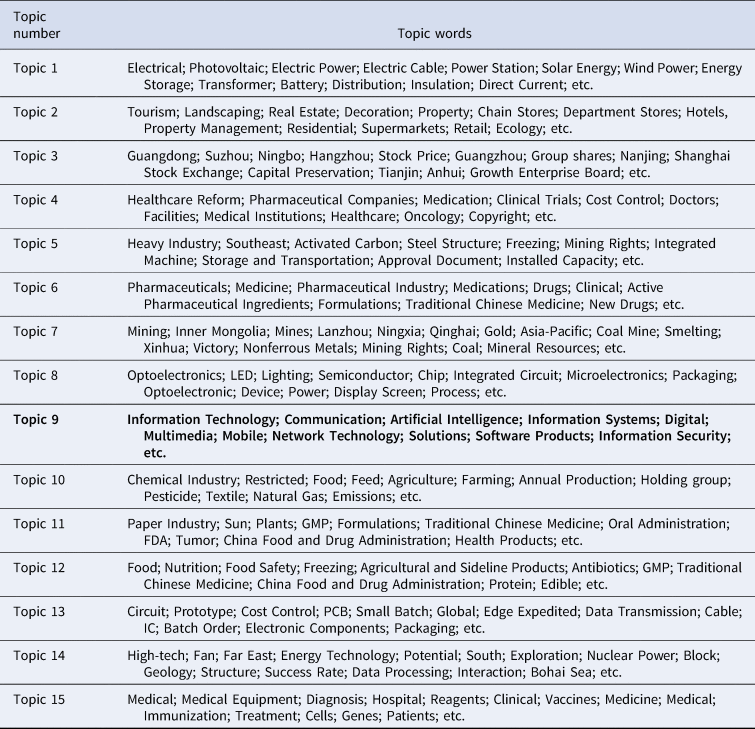
After text cleaning, we generated a vectorized representation of the complete compendium of annual reports using the TF-IDF (Term Frequency–Inverse Document Frequency) algorithm, an extensively employed technique for text analysis (Furman & Teodoridis, Reference Furman and Teodoridis2020). Afterwards, we employed the LDA technique to the compilation of annual reports and configured the topic count to 15 (in accordance with Bellstam et al. (Reference Bellstam, Bhagat and Cookson2021)). The resultant LDA model unearthed an assorted array of topics within the annual reports of FFs (see Table 2 for a summarized view of the topic-associated words). Most importantly, the resultant LDA model produced a document-topic matrix representing the probability distribution of topics within each document and the subsequent step involved identifying the topic that most aptly embodies innovation across these 15 topics.
Topic-associated words

Note: The words highlighted in bold in Topic 9 indicate that their distribution was most closely related to the ‘innovative’ concept.
Based on the keywords associated with the topics, we selected the topic whose distribution of words were most closely related to ‘innovative’ concept (i.e., Topic 9 in Table 2). Specifically, we represented keywords for all topics as vectors using a pre-trained Word2Vec model, a key technology in NLP for text extraction and computation (Wang, Li, & Singh, Reference Wang, Li and Singh2018). Next, we measured the cosine similarity between these vectors and a vector representing ‘innovation’. Cosine similarity is a widely used metric for assessing semantic similarity among texts (Burtch, He, Hong, & Lee, Reference Burtch, He, Hong and Lee2022). Choosing the topic with the highest cosine similarity meant selecting the most relevant topic related to innovation. Figure 3 summarizes these cosine similarity calculations, including bootstrapped 95% confidence intervals for both the innovation topic and the average of the other topics. Using this method, we found that the innovation topic had significantly stronger ties to the concept of innovation compared with the other topics. Figure 4 presents the distribution of words for this topic in the form of a word cloud, highlighting common terms like ‘Information technology’, ‘Artificial intelligence’, and ‘Digital’. The loadings associated with this selected topic represent FF's Symbol of innovative activities.
Selecting the Innovation Topic–Cosine similarity comparison

Selected topic words: Word cloud

For FF's substantive changes of innovation activities (Substance), we employed the number of patent applications, a metric that holds significant prominence as a gauge of innovation efforts (Piperopoulos, Wu, & Wang, Reference Piperopoulos, Wu and Wang2018; Wu, Wang, Hong, Piperopoulos, & Zhuo, Reference Wu, Wang, Hong, Piperopoulos and Zhuo2016). We then calculated the Innovation decoupling of FFs as follows:

where IndYrAvg Symbol,t and IndYrAvg Substance,t are the mean (the FF's Symbol and Substance of innovation activities) of all firms in the sector that firm i belongs to in year t. Following prior leads (Choudhury, Allen, & Endres, Reference Choudhury, Allen and Endres2021), we also applied the ‘Min–Max’ scores approach to normalize of Symbol i,t − IndYrAvg Symbol,t andSubstance i,t − IndYrAvg Substance,t, ensuring that these two values are scaled to a range between 0 and 1, which can help in avoiding negative values, thus these two values are comparable, for example, symbolic disclosures of innovation activities are shown in Formula (2):

Independent Variable and Moderators
Family dynamics
As noted earlier, family dynamics encompass significant shifts within a family, frequently involving structural adjustments in the family framework and modified associations (including hierarchies) among its members (Aldrich & Cliff, Reference Aldrich and Cliff2003). Following prior research (Churchill & Hatten, Reference Churchill and Hatten1987; Longenecker & Schoen, Reference Longenecker and Schoen1978), we measure family dynamics through family members' involvement in corporate management (serving as chairman or CEO), using an algebraic notation. Specifically, 1 signifies the involvement of second-generation members in corporate management, implying the emergence of family dynamics, and 0 denotes the inaugural controlling individual acting as chairperson or CEO, with no engagement of second-generation members in business administration.
Family affective endowment
Drawing from prior literature (Gallucci, Santulli, & Calabrò, Reference Gallucci, Santulli and Calabrò2015; Kashmiri & Mahajan, Reference Kashmiri and Mahajan2010), we evaluate family affective endowment by examining whether the firm incorporates comprehensive details regarding the founder's family within the firm's name. In other words, if the firm name contains information related to the founder or the family, it takes the value of 1; otherwise, it takes the value 0. We compared firm naming with founder and family information and hand-screened family-named firms.Footnote 1
Ascribed bureaucratic connection
We follow the literature in defining ascribed bureaucratic connection as a successor having previously worked for the government agencies and public institutions before joining the FF (Zhang et al., Reference Zhang, Marquis and Qiao2016). Specifically, Chinese listed companies are required to publicly disclose the resumes of senior management personnel in their financial reports (Jiang et al., Reference Jiang, Jia, Bai and Bruton2021). We utilized the disclosed resumes of senior management personnel from the CSMAR database and manually coded the resumes of all company successors to construct a measure of personal experience. If a successor had worked in (1) the Chinese government, or (2) once held membership in the People's Congress (PC) or the Chinese People's Political Consultative Conference (CPPCC), or (3) large state-owned enterprises before joining the FF, they are coded as 1; otherwise, they are coded as 0.
Control Variables
In order to accurately ascertain the relationship between family dynamics and innovation decoupling, we accounted for a range of potential factors that could cause confusion. It is observed that the firm's innovation behavior is significantly influenced by factors like age and size (Becheikh, Landry, & Amara, Reference Becheikh, Landry and Amara2006; Santamaría & Surroca, Reference Santamaria and Surroca2011). To address this, we included controls for both firm age (number of years, took logarithmic transformation) and firm size (total assets). Previous research also emphasizes the pivotal roles of firms' performance and risk preferences in shaping their innovation endeavors (Nieto, Santamaria, & Fernandez, Reference Nieto, Santamaria and Fernandez2015; Wu et al., Reference Wu, Wang, Hong, Piperopoulos and Zhuo2016). Building on this perspective, we introduced controls for firms' performance using return on assets (the ratio of net income over total assets) and growth (the growth rate of operating revenue), while risk levels were considered through equity multiplier (total assets divided by total shareholders' equity) and acid test ratio (the ratio of quick assets to current liabilities). Moreover, we acknowledged the crucial impact of slack resources and financial resources on shaping innovation efforts (Liu, Qian, Lu, & Shu, Reference Liu, Qian, Lu and Shu2023; Liu & Wang, Reference Liu and Wang2023). We integrated net profit to capture firms' slack resources and utilized the asset liability ratio (total liabilities divided by total assets) to reflect the firm's capacity to generate internal funds and its borrowing capability. To encompass the extent of innovation efforts made by a firm, we also factored in R&D expenditures of FFs.
The firm's governance structure also plays a vital role in fostering innovation (Morck, Shleifer, & Vishny, Reference Morck, Shleifer and Vishny1988; Pan, Weng, Xu, & Chan, Reference Pan, Weng, Xu and Chan2018; Shleifer & Vishny, Reference Shleifer and Vishny1997). Following this logic, family ownership was quantified based on the family's cash flow rights, represented by the ownership proportion of a publicly listed company held collectively by all family members in control. This summation involves multiplying ownership shares along the control hierarchy of those in charge. In addition to family ownership, other governance factors were considered (Liu, Ahlstrom, & Zhang, Reference Liu, Ahlstrom and Zhang2024; Liu & Wang, Reference Liu and Wang2023). CEO education was included as a binary variable, where individuals with MBA or EMBA degrees were assigned a value of 1, while others were assigned a value of 0. Board composition, specifically the proportion of family members on the board, was also taken into account. Additionally, CEO duality (when the CEO also holds the chairman position) is denoted by a dummy variable, specifically, 1 signifies a unified chairman and CEO role, while 0 indicates separation of the roles.
Globalization is another aspect that holds significance for the process of innovation, as firms must consistently innovate to maintain their competitiveness in global markets (Galende & De La Fuente, Reference Galende and De La Fuente2003; Veugelers & Cassiman, Reference Veugelers and Cassiman1999; Wang, Liu, Delios, & Qian, Reference Wang, Liu, Delios and Qian2023). As such, we took into account export intensity (the proportion of the firm's sales in foreign markets compared to total sales) and foreign investor proportion (the amount of foreign equity in a company's capital) as indicators of the challenges a company encounters from the global market (Nieto et al., Reference Nieto, Santamaria and Fernandez2015). Furthermore, to gauge the firm's relative market influence in relation to its competitors within its industry (Borenstein, Bushnell, Kahn, & Stoft, Reference Borenstein, Bushnell, Kahn and Stoft1995; Tirole, Reference Tirole1988), we incorporated the Herfindahl–Hirschman Index of operating income for the industry. This index accounts for industry concentration, which could also have a connection to the innovation efforts of FFs.
Finally, we included year and industry fixed effects in the model to control for any unobserved effects caused by the time and industry characteristics (Liu, Qian, Lu, & Shu, Reference Liu, Qian, Lu and Shu2023; Liu & Wang, Reference Liu and Wang2022). Specifically, our analysis encompassed a diverse range of industries, including 16 industries represented within our sample. By including these fixed effects in the model, we aimed to minimize potential biases and enhance the reliability of our findings regarding the relationship between family dynamics and innovation decoupling across different time periods and industries.
Model Selection
Given that the dataset in this study has both a time series dimension (10 years) and a cross-sectional dimension (1,941 FFs), we employ panel data techniques. Our sample thus comprises 9,293 data points (firm-year). The advantage of panel datasets is their large sample size, which provides abundant information for parameter estimation, and allows for the observation and categorization of organizational phenomena in a way that facilitates the identification and empirical documentation of processes (Kimberly, Reference Kimberly1976). However, panel data can have both static and dynamic structures. Since company behavior may exhibit dynamic characteristics, and our innovation decoupling is for period t+1, while family dynamics are for period t. Furthermore, according to prior research (Qian, Li, Li, & Qian, Reference Qian, Li, Li and Qian2008), the estimation of panel data equations depends on the assumptions made regarding the model's intercept and slope, the results indicate that our study is a variable intercept model.Footnote 2 Consequently, we utilize a dynamic model to verify the relationship between generational succession and innovation decoupling, where lagged dependent variables are used as explanatory variables (Arellano & Bond, Reference Arellano and Bond1991).
The model of the relationship between innovation decoupling and the main explanatory variables takes the following form:

In the model, the subscripts i and t represent the firm and time, respectively; α is the public constant; λ, β 1, β 2, and β 3 are the coefficients of the independent variables and the interacting variables; PRE j(j = 1, 2, …, 18) represents 18 predetermined control variables; ω j is their corresponding public coefficient; η i is the year and industry fixed effects, and $\varepsilon _{i, t}$ is the error term for the i th cross-sectional unit. After the model has been determined, it is equally important to ascertain the proper estimation method for the model. We also have to confirm whether this dynamic variable intercept model has fixed effect (FE) or random effect (RE) characteristics or specifications. We performed a Hausman test to compare differences between fixed and random effects. The test results reject the null hypothesis that there is no systematic difference between the two effects (p = 0), arguing for the use of fixed effects rather than random effects. Since the model contains various sources of unobserved heterogeneity, the high-dimensional fixed effects (HDFE) estimator is used (Correia, Reference Correia2023). This approach has been used in other studies with similar data structures (e.g., Garrido, Giachetti, & Maicas, Reference Garrido, Giachetti and Maicas2023; Jarosiewicz & Ross, Reference Jarosiewicz and Ross2023).
Results
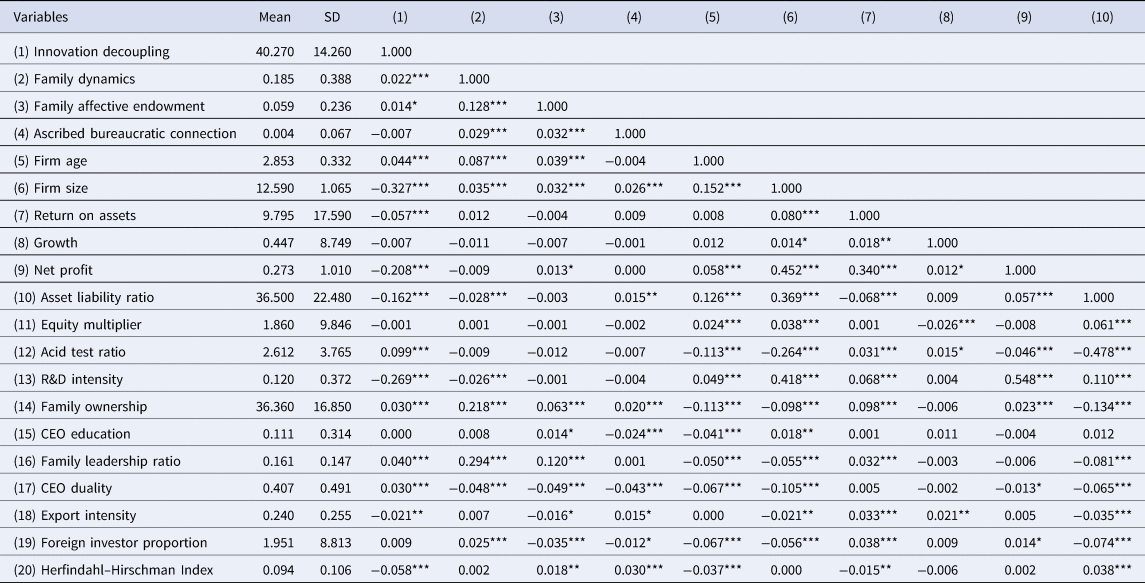
Tables 3 and 4 present descriptive statistics and correlations for independent and control variables (excluding industry and year dummies). While some correlations are statistically significant, the highest VIF value is 2.63, with an average of 1.34, indicating no issues of multicollinearity in our models. Additionally, all interaction terms were created after mean-centering the individual terms, further mitigating potential multicollinearity concerns.
Descriptive statistics

Note: *p< 0.1, **p < 0.05, ***p < 0.01.
Descriptive statistics (continued)

Note: *p < 0.1, **p < 0.05, ***p < 0.01.
Table 5 reports the regression results. We included all the control variables in Model 1 and then introduced family dynamics in Model 2, family affective endowment and ascribed bureaucratic connections in Models 3 and 4, respectively, and finally a robustness test in Model 5.
Regression results

Note: Standard errors in parentheses. *p < 0.1, **p < 0.05, ***p < 0.01.
Model 2 tests H1 that innovation decoupling increases with a greater level of family dynamics. As expected, we found that the coefficient of family dynamics is positive and significant (β = 0.145, p < 0.05), lending full support to the hypothesis. That is, comparison between FFs with intergenerational succession and those without intergenerational succession would lead to a 0.145 increase in innovation decoupling.
As shown in Model 3, we found supporting evidence for H2 such that the family affective endowment weakens the baseline relationship (β = −0.543, p < 0.01). The effect size is economically significant given that innovation decoupling decreases by 0.543 for firms that bear the family name, if allowing for the influences of family ownership. Figure 5 captures the significant weakening effect caused by the family affective endowment. This implies that FFs are more inclined to prioritize substantive changes over symbolic disclosures, attributed to the influence of family reputation.
The moderating effect of family affective endowment

Model 4 tests H3 that the ascribed bureaucratic connection weakens the baseline relationship. We found that the coefficient of the interaction term between family dynamics and ascribed bureaucratic connections is negative and significant (β = −3.709, p < 0.01), providing full support to H3. That is, considering the effects of family dynamics, FFs where successor having previously worked for the government or large state-owned enterprises before joining the FF reduction of 3.709 in innovation decoupling. Figure 6 further corroborates the effects of ascribed bureaucratic connections. This moderating effect is more likely to occur when there are higher levels of ascribed bureaucratic connections in FFs compared to lower levels of ascribed bureaucratic connections.
The moderating effect of ascribed bureaucratic connections

Model 5 serves as a preliminary robustness check including all interaction terms. The results confirmed our previous findings.
Robustness Tests
To ensure the robustness of our findings, we conducted a batch of robustness checks. First, we applied the generalized method of moments (GMMs) to test our model because it overcomes the endogeneity issue of the regressors and does not require a complete specification of the probability distribution of the data; that is, it addresses the problems of autocorrelation in time-series estimates and heteroscedasticity in cross-sectional estimates (Qian et al., Reference Qian, Li, Li and Qian2008; Wintoki, Linck, & Netter, Reference Wintoki, Linck and Netter2012). Furthermore, the GMM estimation method includes systematic GMM and difference GMM; we choose the systematic GMM estimation method instead of the difference GMM which may lead to information loss due to differencing, resulting in weak instruments, and the less precise estimation result. Since the GMM estimator uses instrumental variables to estimate parameters, we first examined the validity of the instrumental variables (Arellano & Bond, Reference Arellano and Bond1991). As shown in the results of Model 1 in Table 6, the p-values of the Hansen-J test for over-identifying restrictions in the GMM estimation model are greater than the 0.1 level, indicating that we accept the null hypothesis, and the instrumental variables chosen in the model are valid. Furthermore, the p-values of the second-order serial correlation test (AR (2)) of GMM estimation in Table 6 are also greater than the 0.10 level, suggesting that the error term does not exhibit second-order serial correlation. Overall, the systemic GMM estimation result confirms our prediction, with the results indicating a positive and highly significant relationship between family dynamics and innovation decoupling. This result further supports H1.
Robustness results

Note: Standard errors in parentheses. *p < 0.1, **p < 0.05, ***p < 0.01.
Second, we replaced the independent variable of family dynamics with the algebraic representation of the generational succession of the actual controlling members (Churchill & Hatten, Reference Churchill and Hatten1987; Longenecker & Schoen, Reference Longenecker and Schoen1978). As shown in Model 2 in Table 6, the regression result remains qualitatively similar.
Third, in the process of family dynamics, there exists a scenario within enterprises where the older generation ‘withdraws but remains involved’. This entails the second generation assuming key positions such as the Chairman while the first generation remains the actual controlling entity of the business (Calabrò et al., Reference Calabrò, Vecchiarini, Gast, Campopiano, De Massis and Kraus2019). To address this situation, we employ a dummy variable, namely ‘family members' involvement in corporate management’ (serving as Chairman or CEO), for measurement purposes (Churchill & Hatten, Reference Churchill and Hatten1987; Longenecker & Schoen, Reference Longenecker and Schoen1978). Specifically, a value of 1 indicates that the second generation assumes key positions such as Chairman while the first generation remains the actual controlling entity, whereas a value of 0 signifies the absence of second-generation individuals in such core positions. The regression result remains qualitatively similar in Model 3 in Table 6.
Fourth, following previous research (Bellstam et al., Reference Bellstam, Bhagat and Cookson2021), we configure the LDA model with 10 topics to create the innovation decoupling metric. Given that LDA necessitates the researcher's specification of latent topic count, it is crucial to demonstrate that our findings remain independent of this decision. With the adoption of the 10-topic LDA approach, we identify a comparably similar topic (refer to Table 8 and Figure 7 for related words and word cloud). The resulting regression outcome (displayed as Model 4 in Table 6) remains robust under this alternative measure.
Selected topic words in the 10-LDA model: Word cloud

Fifth, we further elevated the count of topics within the LDA model to 50 and selected a suitable topic (see Table 8 and Figure 8 for related words and word cloud). As shown in Model 5 in Table 7, the results remain qualitatively similar. It is evident that the findings in the article remain uninfluenced by the selection of topic count (Table 8).
Topic words

Selected topic words in the 50-LDA model: Word cloud

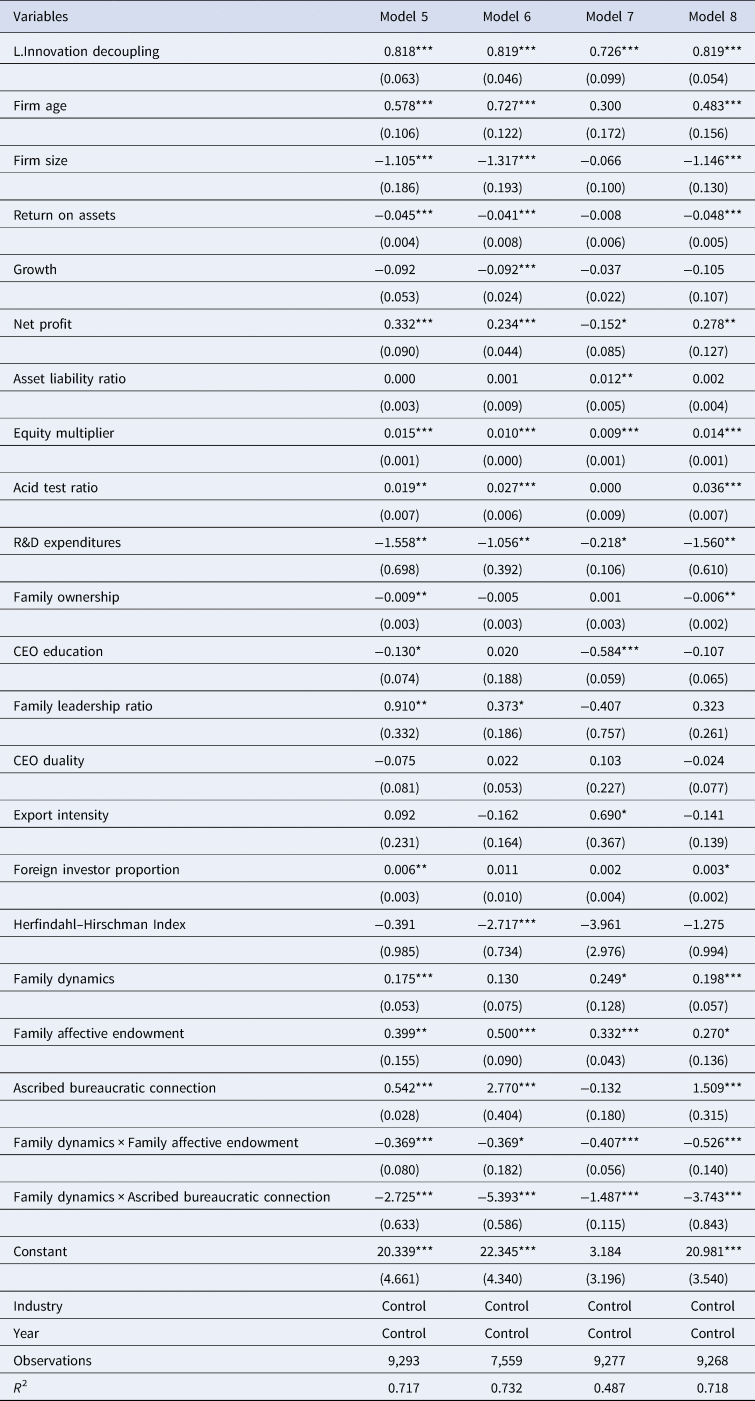
Robustness results

Note: Standard errors in parentheses. *p < 0.1, **p < 0.05, ***p < 0.01.
Sixth, aligning with previous research (e.g., Bellstam et al., Reference Bellstam, Bhagat and Cookson2021; Xue et al., Reference Xue, Cao, Feng, Gu and Zhang2022), we replaced the dependent variable with a dictionary-based count of innovation-related terms in FF's annual reports. To ensure objectivity and precision, we employed word embedding, an ML technique that automates text exploration and term identification (Le & Mikolov, Reference Le and Mikolov2014). Specifically, we used the Tencent AI Lab Word Embedding Model (TALWEM), a Chinese word embedding model developed by Song, Shi, Li, and Zhang (Reference Song, Shi, Li and Zhang2018). This model encompasses a vast vocabulary of over 8 million Chinese words and idiomatic expressions, each represented in 200 dimensions. Training data came from diverse sources, including online platforms, printed materials, blogs, social media, news articles, novels, and content from Wikipedia and Baidu Baike (China's equivalent to Wikipedia). Starting with the Chinese term for ‘innovation’ in TALWEM, we identified a pool of related words and selected the top 50 terms based on their correlation scores. Figure 9 illustrates the trend of innovation-related terminology in FF's annual reports from 2011 to 2021, with the vertical axis representing the average count of innovation terms. The figure clearly shows a consistent upward trend in the mentions of innovation over these years. Next, we quantified the prevalence of innovation-related terms in FF's annual reports to compute the symbolic disclosures of the FF's innovation activities. The subsequent computational processes for the dependent variable followed the guidelines outlined in Section ‘Dependent variable’. The regression results, as shown in Model 6 in Table 7, confirm the robustness of our hypothesized effects.
Mean innovation term of annual reports, 2011–2021

Seventh, in the equation with innovation decoupling as the dependent variable, we tested for a one-year lagged effect of symbolic disclosures (Symbol) on substantive changes (Substance) behavior. It is reasonable to assume that companies react immediately to symbolic disclosures of innovation activities by engaging in taking substantive changes behavior. However, we also consider the possibility that, in some cases, there is a delay in mobilizing the necessary resources for innovation investments. Therefore, the Innovation decoupling of FFs can be calculated as Innovation $decoupling_{i, t}{\rm} = ( Symbol_{i, t}-IndYrAvg_{Symbol, t}) {\rm /}( {Substance_{i, t + 1}-IndYrAvg_{Substance, t + 1}} )$ . The choice of lagged periods was informed by previous research, indicating that the significant lag for engaging in innovation behavior falls between zero and one year (Artz, Norman, Hatfield, & Cardinal, Reference Artz, Norman, Hatfield and Cardinal2010; Un, Cuervo-Cazurra, & Asakawa, Reference Un, Cuervo-Cazurra and Asakawa2010). By lagging the innovation activities, we aim to capture the temporal dynamics and potential time lags inherent in the innovation process. As demonstrated in Model 7 in Table 7, the results remain qualitatively similar.
Eighth, we took a propensity score matching (PSM) approach by utilizing the -psmatch2- command in Stata to control for any unobserved influencers (Rosenbaum & Rubin, Reference Rosenbaum and Rubin1983). As shown in Model 8 in Table 7, we found the average treatment effect is positive and significant (t = 2.15). Additionally, the predicted value of the result remains qualitatively similar.
Discussion
Although innovation is the foundation for the long-term development of firms and a key catalyst for sustained growth, previous innovation literature has largely overlooked the unique SEW needs faced by FFs during intergenerational succession in transitioning economies. Different family members and generations may prioritize different aspects of SEW, which can lead to variations in innovation priorities and motivations. This divergence may result in a phenomenon known as ‘innovation decoupling’, where organizations symbolically respond to innovation demands without enacting substantive change (Meyer & Rowan, Reference Meyer and Rowan1977). Based on various forms of SEW perspectives, this study tracked a sample of Chinese FFs over the past decade, revealing that family dynamics during intergenerational succession significantly increase the occurrence of innovation decoupling.
We found that, compared to the founding generation, successors are less sensitive to the need to provide family assets and generate wealth for family members during the dynastic succession process. Instead, they focus more on maintaining a highly centralized management style (Chung & Luo, Reference Chung and Luo2008b; Kim et al., Reference Kim, Kandemir and Cavusgil2004) and reducing dependency on external capital (Morck et al., Reference Morck, Wolfenzon and Yeung2005; Wu et al., Reference Wu, Xu, Song and Liu2024) to guide FFs smoothly through the transition. We further emphasize that the emotional tendencies of SEW evolve with the influence of family affective endowment and the characteristics of successors with ascribed bureaucratic connections. Specifically, family affective endowment, especially when the family name is tied to the firm's identity, intensifies the pursuit of long-term growth strategies, increases secure and stable cash flow, and reduces the occurrence of innovation decoupling. Moreover, successors with ascribed bureaucratic connections can effectively convert political resources into economic resources to drive long-term development and innovation. This effectively enhances their legitimacy during the power transition process, helping to focus on substantive changes of innovation, thereby avoiding innovation decoupling. Overall, this study introduces the logic of FF research into the field of innovation, offering several important theoretical and practical implications.
Theoretical Contributions
This study contributes to a deeper understanding of the innovation decision-making of FFs in transitioning economies. In the context of FFs in transitioning nations, we particularly point out that family dynamics, such as the power transition during intergenerational succession, lead different generations to have varied emotions, which affects their innovation priorities and motivations. This differs from previous literature, which emphasizes that FFs value innovation investments (Erdogan et al., Reference Erdogan, Rondi and De Massis2020) or that FFs may adhere too rigidly to established corporate strategies when facing innovation opportunities (Calabrò et al., Reference Calabrò, Vecchiarini, Gast, Campopiano, De Massis and Kraus2019; Duran, Kammerlander, Van Essen, & Zellweger, Reference Duran, Kammerlander, Van Essen and Zellweger2016). Due to the different SEW priorities across generations, innovation decoupling may occur. Thus, we contribute a different emotional perspective to the research on FF innovation, expanding beyond the single-angled discussions on innovation. Future research can further explore the specific implications of innovation decoupling in various research contexts.
Second, this study highlights the importance of family affective endowment and ascribed bureaucratic connections in the dynamic change of SEW adaptation and the innovation decision-making of FFs. Intergenerational succession, family affective endowment, and ascribed bureaucratic connections collectively define the family identity of a firm, influencing the emotional inclinations of SEW and innovation choices. Our findings suggest that the succession transition process may induce the dynamics of SEW adaptation, which means the successors are less likely to conduct substantive innovation. Furthermore, our results underscore the necessity of focusing on company identity characteristics and political connections during family dynamics in corporate governance research. Additionally, this study directly responds to the growing calls for research on FF heterogeneity (Liu, Zhou, & Li, Reference Liu, Zhou and Li2023; Wu et al., Reference Wu, Xu, Song and Liu2024), highlighting the interaction effects between intergenerational succession, family affective endowment, and ascribed bureaucratic connections. While this complexity may help explain the inconsistent findings in previous research on innovation decisions (Calabrò et al., Reference Calabrò, Vecchiarini, Gast, Campopiano, De Massis and Kraus2019; Erdogan et al., Reference Erdogan, Rondi and De Massis2020), further exploration of the relationships among various family aspects may help resolve other debates in FF innovation decision-making.
Third, we demonstrate that annual report data can serve as a valuable source for capturing firms' symbolic disclosures. Unlike Bellstam et al. (Reference Bellstam, Bhagat and Cookson2021), who focused on word frequency in annual reports to capture disclosure, we show that by integrating advanced computer and internet technologies, finely detailed and reliable data can be used to measure the importance of innovation disclosure. Our approach helps alleviate concerns about measurement accuracy and precision, providing an efficient pathway for process-based research testing, which can serve as a reference template for future studies.
Managerial Contributions
Our research reveals that different SEW tendencies should be a priority for FF management. Family leaders should be mindful of the innovation dilemmas successors face during power transitions. This can be addressed by establishing regular communication mechanisms and implementing clear innovation performance metrics. Additionally, strengthening the identity of the successor and helping them integrate into the corporate culture, while reinforcing government relations prior to succession, can enhance the firm's legitimacy and influence in both the market and policymaking spheres. These actions not only reduce the likelihood of innovation decoupling but also promote substantive contributions to innovation by successors. Moreover, we hope that our findings will alert policymakers to support FFs during power transitions, promoting long-term economic development and enhancing regional innovation capabilities.
Limitations and Future Research Directions
Our study certainly has limitations, but they also point out directions for future research extensions. First, while China is a representative research context, to ensure the generalizability of our findings, they should be re-tested in other institutional environments. Replicating our study in other transitioning economies and even developed economies to verify whether the different SEW affective tendencies universally influence FF innovation decisions (such as the occurrence of innovation decoupling) is a promising research avenue.
Second, due to data availability, our study focuses solely on large listed FFs. However, we speculate that nonlisted FFs may exhibit similar patterns, and potentially stronger effects, as they may face more severe innovation decoupling challenges. Expanding the scope of research, if possible, would deepen our understanding of the dynamics of FFs in terms of intergenerational succession effects and the interplay between symbolic disclosure and substantive changes of innovation, thus contributing more knowledge to the field of FF innovation decision-making.
Third, sudden mega-events can have profound impacts. Factors such as the COVID-19 pandemic may introduce significant changes to the business landscape. Although this is beyond the scope of our current research, future studies could explore the impacts of such events on the relationship between business biases and subsequent decision-making.
Conclusion
Although FF may adopt different innovation decision-making behaviors, this study further indicates that family dynamics during intergenerational succession lead to an increase in innovation decoupling, meaning that successors emphasize the symbolic disclosures of their innovation efforts (Symbol) more than the substantive changes (Substance). However, this influence declined under the impact of family affective endowment, particularly when the FF identifies with the family name, as well as when successors have ascribed bureaucratic connections who have established political connections before joining FFs. This study links the characteristics of FFs under changing family dynamics to the innovation literature from various perspectives of SEW. One important point we want to emphasize is that the validity of any theory or practice must consider the influence of the organizational dynamic context.
Acknowledgments
We thank editors and two anonymous reviewers for their valuable comments throughout the review process. We also gratefully appreciate helpful comments from participants in the Workshop at Xiamen University for a Special Issue, ‘Family Dynamics and Entrepreneurship: Interaction between Changes in Families and Changes in Entrepreneurial Activities in China’, of the Management and Organization Review. The work described was funded by the China Scholarship Council (202306310106).
Data availability statement
The data supporting this study's findings are available from the author [Q. Wu] upon reasonable request.
Qi Wu (winckqi@stu.xmu.edu.cn) is a PhD candidate in the Department of Management Science at Xiamen University. He received his master's degree in software engineering from Hunan University. His research interests are in international business, innovation, and family firms. He has published widely in peer-reviewed academic journals including Accounting and Finance and IEEE Transactions on Industrial Informatics. His papers were accepted at prominent conferences such as the 2023 SMS Conference, AOM Conference, and IACMR Conference.
Yuqing Wang (yuqingwang@ruc.edu.cn) is a PhD candidate in the Department of Marketing at Renmin University of China. He earned both his undergraduate and graduate degrees in commerce from the University of New South Wales. His primary research areas include consumer welfare and green consumption. His papers have been accepted at prominent conferences, including the 2024 ISMS.
Hualin Chu (hualinchu@stu.xmu.edu.cn) is a PhD candidate in the Department of Accounting at Xiamen University. She was born in Shandong province in 1998 and received her bachelor's degree from Ocean University of China. Her research interests focus on government and nonprofit accounting, the impact of political factors on corporate information disclosure, and corporate strategies of multinational firms. She has presented papers at conferences, including the 2023 IACMR conference and several other major accounting conferences in China.
Junhang Chen (chenjunhang@stu.xmu.edu.cn) is a joint PhD student in information systems at Xiamen University and City University of Hong Kong. His research focuses on (1) business analytics leveraging AI and Big Data; (2) multi-source multi-modal data mining (i.e., text, images, videos); (3) interaction and mechanism between human and AI, and then how to improve Human–AI collaboration. His research appears in leading conferences such as CSWIM and CSAMSE.