For over a century, the transitional period of adolescence has been referred to as a time of “storm and stress” (Arnett, Reference Arnett1999; Hall, Reference Hall1904). One reason that adolescent storm and stress occurs for many adolescents is that this developmental period is perceived as particularly difficult, often due to conflict with parents and mood disruptions (Arnett, Reference Arnett1999; Buchanan et al., Reference Buchanan, Eccles, Flanagan, Midgley, Feldlaufer and Harold1990). In addition, adolescence is characterized by significant changes in an individual's personality traits, hormones, and disinhibited behaviors (Arnett, Reference Arnett1999; Hopwood et al., Reference Hopwood, Donnellan, Blonigen, Krueger and McGue2011; Romeo, Reference Romeo2005; Spear, Reference Spear2000). Given all of these developmental changes, it is no surprise that there is also an increased incidence of mental disorders in adolescence (Costello, Mustillo, Erkanli, Keeler, & Angold, Reference Costello, Mustillo, Erkanli, Keeler and Angold2003; Paus, Keshavan, & Giedd, Reference Paus, Keshavan and Giedd2008). Because adolescence is a developmental period of increased vulnerabilities (Andersen, Reference Andersen2003; Dahl, Reference Dahl2004) and may serve as an opportune time for interventions (Romeo & McEwen, Reference Romeo and McEwen2006), it is particularly important to study the intermediate processes that may be involved in the later development of psychopathology in adolescents.
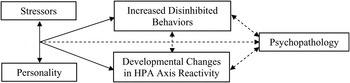
In this context, we examined the unique and interactive effects between individual (e.g., personality traits) and environmental (e.g., psychosocial stress) variables on outcomes at multiple levels of analysis (e.g., physiology, behavior) as a way of gaining a better understanding of how these developmental changes are related to adolescent psychopathology (Cicchetti, Reference Cicchetti1993; Cicchetti & Rogosch, Reference Cicchetti and Rogosch2002; Rutter & Sroufe, Reference Rutter and Sroufe2000). As shown in our conceptual model in Figure 1, we propose that the interaction between stress and personality traits influences changes in disinhibited behaviors and hypothalamic–pituitary–adrenal (HPA) axis reactivity, which are likely intermediate processes involved in the later development of psychopathology.Footnote 1 To begin to understand the utility of our conceptual model, our study investigated two of these pathways to the intermediate outcomes. Our first goal was to examine the interactions between psychosocial stress exposure and personality (negative emotionality and constraint, traits that have been commonly associated with greater psychopathology) on both behavioral impulsivity and risk taking (as indexed through laboratory tasks). Our second goal was to examine the interactions between psychosocial stress exposure and personality on HPA axis reactivity (as indexed by salivary cortisol, a hormone released in response to stress).
Conceptual model depicting environmental and individual factors on behavior and neuroendocrine development during adolescence, as precursors to psychopathology. The present research examined the interactions between psychosocial stress and the personality traits of negative emotionality and constraint on two facets of disinhibition (as indexed by impulsivity and risk-taking tasks) and HPA axis reactivity (as indexed by salivary cortisol) in an adolescent sample. The pathways depicted in solid lines are the focus of the current investigation, and the pathways depicted in dotted lines are hypothesized relationships not tested in the current study.

In the subsequent sections, we first establish the importance of studying stress and personality as risk factors for later psychopathology. We then define disinhibited behaviors and delineate how personality and stress are related to two of its facets: impulsivity and risk taking. Next, we explain the neuroendocrine responses to stress and establish how personality and stress may moderate cortisol reactivity in particular. Finally, we discuss how stress and personality may interact to affect behavioral impulsivity and risk taking as well as cortisol reactivity in adolescents.
Stress and Personality as Risk Factors for Psychopathology
During stressful situations, individuals alter their physiology and behavior to maintain homeostasis and cope with the demands of the stressor (Dorn & Chrousos, Reference Dorn and Chrousos1993). Individual differences in the cognitive, physiological, and behavioral responses to stressors have been implicated in the development of almost all forms of psychopathology (Esch, Stefano, Fricchione, & Benson, Reference Esch, Stefano, Fricchione and Benson2002; Ge, Conger, & Elder, Reference Ge, Conger and Elder2001; Goodyer, Reference Goodyer2002; Grant et al., Reference Grant, Compas, Stuchlmacher, Thurn, McMahon and Halpert2003; McEwen & Stellar, Reference McEwen and Stellar1993; Seiffge-Krenke, Reference Seiffge-Krenke2000; Turner & Lloyd, Reference Turner and Lloyd2004). Adolescents are particularly susceptible to stressors because they interpret events as being more stressful than do children and adults (Spear, Reference Spear2000). Given that all adolescents are exposed to varying degrees of stressors but not all adolescents develop mental disorders, stress appears to be a common but not sufficient factor for the development of psychopathology. Indeed, knowledge about individual-level factors (e.g., personality) is vital to understanding how an individual will respond to and perceive stressors (McEwen & Stellar, Reference McEwen and Stellar1993; Vollrath, Reference Vollrath2001).
In the last few decades, there has been an explosion of research on trait models of personality (see Goldberg, Reference Goldberg1993). Though there is a lack of consensus on the exact number of factors (e.g., three: Tellegen & Waller, Reference Tellegen, Waller, Boyle, Matthews and Saklofske2008; five: Costa & McCrae, Reference Costa and McCrae1985), there is a high amount of overlap between trait models. Similar to stress, at least two personality traits have shown a consistent relationship with psychopathology: constraint, which is also called conscientiousness in some models, and negative emotionality, also referred to as neuroticism. Constraint consistently demonstrates negative associations with externalizing disorders (Ge & Conger, Reference Ge and Conger1999; Krueger, Caspi, Moffitt, Silva, & McGee, Reference Krueger, Caspi, Moffitt, Silva and McGee1996; Krueger et al., Reference Krueger, Hicks, Patrick, Carlson, Iacono and McGue2002; Krueger, McGue, & Iacono, Reference Krueger, McGue and Iacono2001; Sher & Trull, Reference Sher and Trull1994; Taylor, Reeves, James, & Bobadilla, Reference Taylor, Reeves, James and Bobadilla2006), and negative emotionality consistently demonstrates positive associations with all forms of psychopathology (Krueger, Reference Krueger2005). However, simply being high or low on a certain personality trait does not automatically engender risk for psychopathology; rather, specific personality traits may increase or decrease the probability that certain life events (e.g., stress) will lead to psychopathology.
Furthermore, many models emphasize that the interaction between stress and personality produces intermediate processes that are associated with the later development of psychopathology. Two such processes that have been related to various forms of psychopathology are increased disinhibited behaviors and changes in neuroendocrine functioning. Although adolescence is characterized by hormonal changes and increased impulsive and risk-taking behaviors (Spear, Reference Spear2000; Trimpop, Kerr, & Kirkcaldy, Reference Trimpop, Kerr and Kirkcaldy1998), explanations for these developmental changes that include environmental factors and personality traits have not been fully elucidated.
Facets of Disinhibition, Personality, and Stressors
Impulsivity and risk taking
The inhibition to disinhibition continuum has been characterized as a generalized vulnerability for psychopathology throughout the lifespan (Hirshfeld-Becker et al., Reference Hirshfeld-Becker, Biederman, Calltharp, Rosenbaum, Faraone and Rosenbaum2003; Nigg, Reference Nigg2000; Young, Stallings, Corley, Krauter, & Hewitt, Reference Young, Stallings, Corley, Krauter and Hewitt2000). For example, extreme inhibition has been related to anxiety (Albano, Chorpita, & Barlow, Reference Albano, Chorpita, Barlow, Mash and Barkley1996) and mood disorders (Segal, Reference Segal, Sarason, Pierce and Sarason1996). The opposite pole, disinhibition, has been shown to be a particularly strong risk factor for many problematic behaviors in children and adolescents, such as conduct problems (Caspi, Moffitt, Newman, & Silva, Reference Caspi, Moffitt, Newman and Silva1996; Vitacco & Rogers, Reference Vitacco and Rogers2001), substance use disorders (Iacono, Carlson, Taylor, Elkins, & McGue, Reference Iacono, Carlson, Taylor, Elkins and McGue1999; Tarter et al., Reference Tarter, Kirisci, Mezzich, Cornelius, Pajer and Vanyukov2003; von Diemen, Bassani, Fuchs, Szobot, & Pechansky, Reference von Diemen, Bassani, Fuchs, Szobot and Pechansky2008), and attention-deficit/hyperactivity disorder (Young et al., Reference Young, Stallings, Corley, Krauter and Hewitt2000).
Disinhibition can be understood from various perspectives (Nigg, Reference Nigg2000) and conceptualized into different processes or facets (e.g., impulsivity, sensation seeking, risk taking; Anderson, Smith, & Fischer, Reference Anderson, Smith and Fischer2003; Dindo, McDade-Montez, Sharma, Watson, & Clark, Reference Dindo, McDade-Montez, Sharma, Watson and Clark2009; Leeman, Grant, & Potenza, Reference Leeman, Grant and Potenza2009) that do not necessarily load on a higher order disinhibition factor. For example, impulsivity is characterized by responding on the spur of the moment in an unplanned manner (King, Tenney, Rossi, Colamussi, & Burdick, Reference King, Tenney, Rossi, Colamussi and Burdick2003; Kreek, Nielson, Butelman, & LaForge, Reference Kreek, Nielson, Butelman and LaForge2005; Moeller, Barratt, Dougherty, Schmitz, & Swann, Reference Moeller, Barratt, Dougherty, Schmitz and Swann2001) and is commonly assessed with a variety of laboratory measures, such as the go/no-go (GNG) task (Nigg, Reference Nigg2000). Risk taking is characterized by a trade-off between short-term gains and potential long-term costs (Baumeister & Scher, Reference Baumeister and Scher1988) and can be assessed with laboratory tasks that require participants to evaluate relative risk versus reward (Kreek et al., Reference Kreek, Nielson, Butelman and LaForge2005; Nigg, Reference Nigg2000), such as the Balloon Analogue Risk Task (BART; Lejuez et al., Reference Lejuez, Read, Kahler, Richards, Ramsey and Stuart2002).
There are multiple reasons why it is important to study facets of disinhibition in adolescents. First, the developmental period of adolescence is characterized by impulsive and risk-taking behaviors, as adolescents exhibit increased disinhibited behaviors compared to both preadolescents and adults (Spear, Reference Spear2000; Steinberg, Reference Steinberg2008). Second, the maturation of inhibitory processes is usually not complete until adulthood (Paus et al., Reference Paus, Keshavan and Giedd2008), which may leave adolescents more prone to engaging in impulsive and risk-taking behaviors than individuals in other stages of development. Third, although increases in disinhibited behaviors during adolescence are likely developmentally normative (Steinberg, Reference Steinberg2008), there is a large amount of individual variability in the type and degree of impulsive and risk-taking behaviors that adolescents exhibit (Arnett, Reference Arnett1992, Reference Arnett1999). Fourth, as stated previously, disinhibition is considered an antecedent of psychopathology and various problematic behaviors, particularly during the developmental period of adolescence (e.g., Barkley, Reference Barkley1997; Caspi et al., Reference Caspi, Moffitt, Newman and Silva1996; Tarter et al., Reference Tarter, Kirisci, Mezzich, Cornelius, Pajer and Vanyukov2003; Vitacco & Rogers, Reference Vitacco and Rogers2001). Therefore, it is vital to identify predictors of disinhibited behaviors during this developmental period so that we can better identify at-risk youth for prevention and treatment efforts.
Personality and stress correlates of disinhibited behaviors
Across personality and temperament models, there are at least two traits that are related to disinhibited behaviors: constraint and negative emotionality. According to Nigg (Reference Nigg2000), impulsive behavior is a function of the personality trait of constraint. Individuals high in constraint tend to exhibit planful control, whereas individuals low in constraint tend to act on impulse (Nigg, Reference Nigg2000; Tellegen & Waller, Reference Tellegen, Waller, Boyle, Matthews and Saklofske2008); hence, constraint has been negatively associated with impulsive behaviors (e.g., promiscuous sexual behavior; McGue, Slutske, & Iacono, Reference McGue, Slutske and Iacono1999; Taylor & Iacono, Reference Taylor and Iacono2007; for a review, see Bogg & Roberts, Reference Bogg and Roberts2004).
In contrast, risk taking is proposed to be a function of negative emotionality (Nigg, Reference Nigg2000). Individuals high in negative emotionality have a propensity to experience negative affect (e.g., worry, anxiety, fearfulness; Watson, Reference Watson2000), and research has shown that these individuals tend to exhibit behavioral inhibition in novel situations (Kagan, Reznick, & Snidman, Reference Kagan, Reznick and Snidman1988). For example, individuals high in negative emotionality have enhanced sensitivity to punishment cues and negative feedback (e.g., Hajcak, McDonald, & Simons, Reference Hajcak, McDonald and Simons2004), which may lead them to be overly inhibited and likely to develop internalizing forms of psychopathology. Other work suggests that individuals high in negative emotionality choose short-term rewards under periods of stress as an immediate coping strategy to regulate their negative affect, despite potential long-term punishment (Baumeister & Scher, Reference Baumeister and Scher1988; Cooper, Wood, Orcutt, & Albino, Reference Cooper, Wood, Orcutt and Albino2003). To be specific, negative emotionality has been associated with engaging in risky behaviors during periods of stress (e.g., gambling; Anestis, Selby, & Joiner, Reference Anestis, Selby and Joiner2007; Billieux, Rochat, Rebetez, & Van der Linden, Reference Billieux, Rochat, Rebetez and Van der Linden2008; Fischer & Smith, Reference Fischer and Smith2008; Fischer, Smith, Annus, & Hendricks, Reference Fischer, Smith, Annus and Hendricks2007), which is why it is necessary to obtain contextual information when determining how personality traits, such as negative emotionality, will affect risk-taking behaviors. Finally, even though the specificity of the relationship between personality and facets of disinhibition has been proposed (e.g., Nigg, Reference Nigg2000), it is likely that negative emotionality and constraint are both related to impulsive and risk-taking behaviors.
One contextual factor that has been hypothesized to play a role in the manifestation of disinhibited behaviors is stress, because the behavioral responses depend on how an individual interprets and reacts to a stressor (McEwen & Stellar, Reference McEwen and Stellar1993). Given that the general action of the stress response is to enact defensive mobilization, these behavioral responses can be manifested in three emergency action tendencies: fight, flight, and freeze (Gray & McNaughton, Reference Gray and McNaughton2000; Jarvik & Russell, Reference Jarvik and Russell1979). Fight and flight responses represent action tendencies that increase the likelihood of behavioral responses characterized by minimal planning via rapid response deployment (i.e., impulsivity). In some situations, these behavioral responses may be adaptive in promoting survival; however, these behavioral responses may be disadvantageous in other situations. For example, stress exposure and associated negative affect have been associated with disinhibited behaviors such as gambling (Lightsey & Hulsey, Reference Lightsey and Hulsey2002), overeating (Tice, Bratslavsky, & Baumeister, Reference Tice, Bratslavsky and Baumeister2001), excessive drinking (Richman & Flaherty, Reference Richman and Flaherty1990), and aggressive behaviors (Verona & Kilmer, Reference Verona and Kilmer2007).
Freezing is a state in which active behaviors are inhibited (Carder & Cheng, Reference Carder and Cheng1976). Freezing responses have been extensively documented in animals (Gallup & Maser, Reference Gallup, Maser, Maser and Seligman1977) and reported by humans (Schmidt, Richey, Zvolensky, & Maner, Reference Schmidt, Richey, Zvolensky and Maner2008) during exposure to acute stress. Though researchers typically conceptualize the freezing response as brief in duration, freezing behavior can last from a few seconds to many hours, depending on the circumstances (Gallup, Reference Gallup1977). In addition, freezing can have residual effects on psychological factors such as vigilance. For instance, freezing has been associated with increased responsivity to stimuli and self-regulation against competing behavioral impulses (Marks, Reference Marks1987).
Because acute stress can both increase (fight and flight) and decrease (freeze) disinhibited behaviors, it is possible that different facets of disinhibition may be differentially affected by stress. For example, there is work suggesting that impulsivity is increased under acute stress because acute stress decreases an individual's capacity to inhibit behavior, as cognitive control systems are taxed (Barkley, Reference Barkley1997; Muraven & Baumeister, Reference Muraven and Baumeister2000). In contrast, other work has shown that risk taking is decreased under acute stress, as acute stress increases vigilance and attentional focus to threat (Charmandari, Tsigos, & Chrousos, Reference Charmandari, Tsigos and Chrousos2005; Lang, Reference Lang2000). It is surprising that no work has examined whether different facets of disinhibition are differentially affected by acute stress. Moreover, it is likely that the effects stress has on disinhibited behaviors are further influenced by multiple factors (e.g., individual differences, context).
HPA Axis Functioning, Stressors, and Personality
HPA axis functioning
The HPA axis is a major component of the neuroendocrine system that is involved in regulating the stress response and supporting normal physiological functioning (Kudielka & Kirschbaum, Reference Kudielka and Kirschbaum2005; McEwen & Stellar, Reference McEwen and Stellar1993). Upon encountering a stressor, the HPA axis is activated via projections from central nervous system structures (like the amygdala and hippocampus) to the hypothalamus, pituitary gland, and adrenal glands. The HPA axis is regulated by peripheral processes in that glucocorticoids (like the stress hormone cortisol) feed back on the hypothalamus and pituitary gland to inhibit further HPA activation (Herman, Reference Herman2012; Nelson, Reference Nelson2011). Because cortisol is the end product of the HPA axis, it is often used as an index of general stress levels when examining the neuroendocrine stress response (Brannon & Feist, Reference Brannon and Feist2004).
Given that the HPA axis plays a critical role in the stress response, and because stress exposure is involved in the development of psychopathology (Gunnar, Wewerka, Frenn, Long, & Griggs, Reference Gunnar, Wewerka, Frenn, Long and Griggs2009), it is not surprising that abnormalities in HPA axis activity have been associated with numerous mental disorders and problematic behaviors (Bale, Reference Bale2006; Chrousos & Gold, Reference Chrousos and Gold1992; Dorn & Chrousos, Reference Dorn and Chrousos1993; Holsboer, Reference Holsboer1989; Raison & Miller, Reference Raison and Miller2003; Stansbury & Gunnar, Reference Stansbury and Gunnar1994; Stratakis & Chrousos, Reference Stratakis and Chrousos1995; Tsigos & Chrousos, Reference Tsigos and Chrousos1994, Reference Tsigos and Chrousos2002). Although HPA axis reactivity can be adaptive in that it alters the physiology of the individual in order to maintain homeostasis in response to threat, neuroendocrine responses to stress that are characterized by abnormalities in HPA axis activity, either via hyperactivity or hypoactivity of the HPA axis, can be maladaptive (McEwen & Stellar, Reference McEwen and Stellar1993). For example, both excessive and blunted cortisol reactivity have been linked to psychopathology (Goodyer, Park, Netherton, & Herbert, Reference Goodyer, Park, Netherton and Herbert2001; Johnson, Kamilaris, Chrousos, & Gold, Reference Johnson, Kamilaris, Chrousos and Gold1992; Lovallo, Reference Lovallo2006).
Similar to disinhibition, it is important to understand the mechanisms that contribute to the magnitude and direction of aberrant HPA axis reactivity, particularly in youth. First, the developmental period of adolescence has been associated with heightened stress-induced HPA axis activity (Gunnar et al., Reference Gunnar, Wewerka, Frenn, Long and Griggs2009), which further supports defining adolescence as a stressful life stage (Buchanan et al., Reference Buchanan, Eccles, Flanagan, Midgley, Feldlaufer and Harold1990; Dorn & Chrousos, Reference Dorn and Chrousos1993; Spear, Reference Spear2000). Second, adolescents are particularly susceptible to stressors because they are more physiologically reactive to stressors than are children and adults (Graber, Petersen, & Brooks-Gunn, Reference Graber, Petersen, Brooks-Gunn, Graber, Brooks-Gunn and Petersen1996; Lupien, McEwen, Gunnar, & Heim, Reference Lupien, McEwen, Gunnar and Heim2009). Third, in addition to stress exposure, factors such as pubertal development (Romeo, Reference Romeo2005; Spear, Reference Spear2000) and psychological characteristics (Gaab, Sonderegger, Scherrer, & Ehlert, Reference Gaab, Sonderegger, Scherrer and Ehlert2006; Miller, Chen, & Zhou, Reference Miller, Chen and Zhou2007) have been shown to affect HPA axis functioning. Given the dramatic changes in neuroendocrine functioning that occur during adolescence (Romeo, Reference Romeo2005; Romeo & McEwen, Reference Romeo and McEwen2006), understanding various factors (e.g., Personality × Stress) that impact HPA axis functioning in adolescents may shed light on the mechanisms that are involved in abnormalities in HPA axis activity and the later development of psychopathology.
Personality and stress correlates of cortisol reactivity
One psychological characteristic that has been studied numerous times with regard to HPA axis functioning, particularly with cortisol, is personality (e.g., Kirschbaum, Bartussek, & Strasburger, Reference Kirschbaum, Bartussek and Strasburger1992; Pruessner et al., Reference Pruessner, Gaab, Hellhammer, Lintz, Schommer and Kirschbaum1997). Previous research has often focused on diurnal cortisol patterns (e.g., Hauner et al., Reference Hauner, Adam, Mineka, Doane, DeSantis and Zinbarg2008), basal cortisol (e.g., LeBlanc & Ducharme, Reference LeBlanc and Ducharme2005), and pharmacological challenge paradigms (e.g., Netter, Hennig, & Roed, Reference Netter, Hennig and Roed1996), and the results of these studies have been mixed. For example, negative emotionality has been both positively associated (Miller, Cohen, Rabin, Skoner, & Doyle, Reference Miller, Cohen, Rabin, Skoner and Doyle1999) and negatively associated (LeBlanc & Ducharme, Reference LeBlanc and Ducharme2005) with basal cortisol concentrations, with a similar pattern of results for trait constraint (e.g., King, Jones, Scheuer, Curtis, & Zarcone, Reference King, Jones, Scheuer, Curtis and Zarcone1990; Van Bokhoven et al., Reference Van Bokhoven, Van Goozen, Van Engeland, Schaal, Arseneault and Seguin2005). One possible explanation to account for these inconsistent associations is that differences in the time of cortisol collection may impact results due to the diurnal variation of cortisol (Alink et al., Reference Alink, van Ijzendoorn, Bakermans-Kranenburg, Mesman, Juffer and Koot2008; Hansen, Garde, & Persson, Reference Hansen, Garde and Persson2008). In addition, there are several other sources of variability (e.g., food intake, recent exercise, menstrual cycle phase, age) that can impact the measurement of cortisol (Alink et al., Reference Alink, van Ijzendoorn, Bakermans-Kranenburg, Mesman, Juffer and Koot2008; Hansen et al., Reference Hansen, Garde and Persson2008). Another explanation is that when examining individual differences in HPA axis functioning, it is preferable to measure stress-induced cortisol reactivity rather than basal cortisol, as the former is a more precise and direct measure of stress reactivity (cf. O'Leary, Loney, & Eckel, Reference O'Leary, Loney and Eckel2007). Studies that examine diurnal cortisol patterns, basal cortisol concentrations, and cortisol responses to pharmacological challenges do not target the psychosocial nature of stress, which makes it difficult to examine how psychological processes like personality traits account for variability in cortisol. Thus, given that psychosocial stressors depend on an individual's appraisal of the stressor (McEwen & Stellar, Reference McEwen and Stellar1993; Sapolsky, Reference Sapolsky2004), examining the interaction between stress and personality on cortisol will allow more room for personality traits to be expressed.
Stress–Personality Interactions on Impulsivity and Risk Taking
Most personality perspectives emphasize the consistency of traits over time and across situations (Epstein, Reference Epstein1983; Kenrick & Funder, Reference Kenrick and Funder1988). For example, the relationship between trait constraint and impulsivity should be relatively consistent across situations, given that personality traits are viewed as general tendencies toward behavioral outcomes (Pytlik Zillig, Hemenover, & Dienstbier, Reference Pytlik Zillig, Hemenover and Dienstbier2002). In contrast, “powerful” situations may produce behavioral outcomes regardless of personality traits (Block, Reference Block1968; Haney, Banks, & Zimbardo, Reference Haney, Banks and Zimbardo1973; Milgram, Reference Milgram1963), meaning that the relationship between a personality trait and an outcome may be weaker under stressful compared to neutral conditions; for instance, the relationship between trait constraint and impulsive behaviors may be lessened during periods of stress.
Although traditionally these trait-consistent and state-dependent perspectives have been presented as competing theories (e.g., McCrae & Costa, Reference McCrae and Costa1994; Mischel, Reference Mischel2004), there have been recent attempts to demonstrate that these perspectives can be used in a complementary manner (Moeller, Robinson, & Bresin, Reference Moeller, Robinson and Bresin2010). That is, interactions between traits and situations may lead traits to be more predictive in certain situations, or situations to be more predictive at certain levels of a trait (Mischel & Shoda, Reference Mischel and Shoda1995). In the case of impulsive behavior, constraint may have a stronger relationship to impulsivity under neutral compared to stressful conditions. This hypothesis is based on research that has shown that individuals low in constraint perceive stressful tasks as more stressful than individuals high in constraint (Penley & Tomaka, Reference Penley and Tomaka2002), possibly because low-constraint individuals are less prepared to deal with stressors. Therefore, it may be that stressors have larger effects on individuals low in constraint because they may be less well equipped to cope with stress (O'Connor & O'Connor, Reference O'Connor and O'Connor2004; Watson & Hubbard, Reference Watson and Hubbard1996). The relationship between negative emotionality and risk taking may also be decreased under stress. However, given that individuals high in negative emotionality are not only more reactive to stressful events (Bolger & Schilling, Reference Bolger and Schilling2006) but also more likely to engage in risky behaviors when stressed (e.g., Anestis et al., Reference Anestis, Selby and Joiner2007), stressful conditions may be more predictive of increased risk taking for individuals high in negative emotionality. To our knowledge, no study has applied these hypotheses to adolescent samples.
Stress–Personality Interactions on Cortisol Reactivity
Similar to the trait-consistent/state-dependent dichotomy, individuals both differ in their response to identical stressors (Boyce & Ellis, Reference Boyce and Ellis2005; Chan, Reference Chan1977; McEwen & Stellar, Reference McEwen and Stellar1993) and differ in their physiological reactivity to different stressors (Carroll, Reference Carroll1992; Sapolsky, Reference Sapolsky1994). It is therefore likely that personality traits play a role in both interpersonal and intrapersonal variability in cortisol reactivity. Although there is a large body of literature on personality correlates of cortisol, relatively few studies have focused on the interactions between psychosocial stress and the traits of negative emotionality and constraint in predicting cortisol reactivity in the same experiment (see these notable exceptions: Bibbey, Carroll, Roseboom, Phillips, & de Rooij, Reference Bibbey, Carroll, Roseboom, Phillips and de Rooij2013; Kirschbaum, Bartussek, et al., Reference Kirschbaum, Bartussek and Strasburger1992; Oswald et al., Reference Oswald, Zandi, Nestadt, Potash, Kalaydjian and Wand2006; Pruessner et al., Reference Pruessner, Gaab, Hellhammer, Lintz, Schommer and Kirschbaum1997). Moreover, the studies that have examined the relationships between negative emotionality and constraint and cortisol reactivity to a psychosocial stressor have produced inconsistent associations (e.g., Kirschbaum, Bartussek, et al., Reference Kirschbaum, Bartussek and Strasburger1992; Schommer, Kudielka, Hellhammer, & Kirschbaum, Reference Schommer, Kudielka, Hellhammer and Kirschbaum1999). Similar to findings with regard to basal cortisol, negative emotionality has been both positively (Houtman & Bakker, Reference Houtman and Bakker1991) and negatively associated (Bibbey et al., Reference Bibbey, Carroll, Roseboom, Phillips and de Rooij2013; Oswald et al., Reference Oswald, Zandi, Nestadt, Potash, Kalaydjian and Wand2006) with cortisol reactivity in adults. Although relatively few studies have examined the relationship between constraint and cortisol reactivity to a psychosocial stressor, one study demonstrated that a self-reported trait related to low constraint was positively correlated with cortisol reactivity in adults (Hirvikoski, Lindholm, Nordenström, Nordström, & Lajic, Reference Hirvikoski, Lindholm, Nordenström, Nordström and Lajic2009); however, it should be acknowledged that most studies have reported no association between constraint and cortisol reactivity (e.g., Kirschbaum, Bartussek, et al., Reference Kirschbaum, Bartussek and Strasburger1992; Oswald et al., Reference Oswald, Zandi, Nestadt, Potash, Kalaydjian and Wand2006; Wirtz et al., Reference Wirtz, Elsenbruch, Emini, Rüdisüli, Groessbauer and Ehlert2007).
It is important to note that the majority of existing studies that have examined the interactions between psychosocial stress and the traits of negative emotionality and constraint have been conducted in adult samples. Cortisol reactivity has been shown to vary by age (Kudielka, Buske-Kirschbaum, Hellhammer, & Kirschbaum, Reference Kudielka, Buske-Kirschbaum, Hellhammer and Kirschbaum2004), as an individual's stress responsiveness changes dramatically throughout the course of his/her lifespan (Romeo, Reference Romeo2005; Romeo & McEwen, Reference Romeo and McEwen2006); thus, it is difficult to extend previous findings to adolescents. Moreover, previous research has shown that negative emotionality decreases while constraint increases during the transition from adolescence to adulthood (Hopwood et al., Reference Hopwood, Donnellan, Blonigen, Krueger and McGue2011). Therefore, it is possible that personality–environment interactions have different effects on cortisol reactivity for adolescents and adults.
The Present Study
Adolescence is a period of increased vulnerabilities for the development of mental disorders (Andersen, Reference Andersen2003; Dahl, Reference Dahl2004; Paus et al., Reference Paus, Keshavan and Giedd2008), partially due to increased disinhibited behaviors and reactivity of the HPA axis (Arnett, Reference Arnett1999; Graber et al., Reference Graber, Petersen, Brooks-Gunn, Graber, Brooks-Gunn and Petersen1996; Lupien et al., Reference Lupien, McEwen, Gunnar and Heim2009; Romeo, Reference Romeo2005; Spear, Reference Spear2000). Investigations of facets of disinhibition and cortisol reactivity as a function of the interactions between psychosocial stress and personality in adolescents may provide a clearer understanding of developmental changes in behavioral and neuroendocrine processes that may precede the onset of psychopathology during adolescence. Therefore, the present research examines two of the pathways depicted in our conceptual model (see Figure 1). First, we examined the interactions between psychosocial stress and the personality traits of constraint and negative emotionality on impulsive and risk-taking behaviors. Second, we examined the interactions between psychosocial stress and the personality traits of constraint and negative emotionality on cortisol reactivity (measured at the same time of day across participants and controlling for other possible sources of variability, such as food intake, recent exercise, menstrual cycle phase, age, and time of day). Thus, we investigated personality and stress factors that influence three intermediate processes (impulsivity, risk taking, and cortisol reactivity) that have been implicated in the later development of adolescent psychopathology.
Based on the above analysis, we had multiple predictions. First, we predicted that constraint would interact with psychosocial stress to predict impulsivity and that negative emotionality would interact with psychosocial stress to predict risk taking. In both cases, we predicted that the relationship between personality and both facets of disinhibition would be attenuated under periods of stress relative to neutral conditions, consistent with state-dependent models of behavior (e.g., Block, Reference Block1968). Given the overlap between facets of disinhibition (i.e., impulsivity and risk taking), we also explored the relationships between negative emotionality and impulsivity and between constraint and risk taking. Second, we predicted that the effects of psychosocial stress would depend on the level of personality trait. For constraint and impulsivity, previous research has shown that individuals low in constraint are more affected by psychosocial stress because they may be less prepared to deal with stressors (O'Connor & O'Connor, Reference O'Connor and O'Connor2004; Watson & Hubbard, Reference Watson and Hubbard1996). Therefore, we expected that adolescents low in constraint would show a larger decrease in impulsivity during periods of stress compared to no stress. For negative emotionality and risk taking, we predicted that individuals high in negative emotionality would be more affected by psychosocial stress, in that they would show a larger increase in risk taking during periods of stress compared to no-stress. Third, because previous research has been unclear regarding negative emotionality's and constraint's relationships to cortisol reactivity, it was not possible to formulate clear hypotheses regarding the direction of the expected associations between personality traits and cortisol reactivity in response to a psychosocial stressor among adolescents; therefore, these analyses were considered exploratory.
Method
Participants
Participants consisted of 88 adolescents (55 males; 62.5%) ranging in age from 14 to 19 (M = 16.1, SD = 1.64), although the majority (n = 79; 89.7%) were between 14 and 18 years of age.Footnote 2 Parents identified 58 adolescents as European American (65.9%), 21 as African American or biracial (23.9%), and the remainder (n = 9; 10.2%) as Hispanic or other ethnicity. The sample was diverse in terms of income level, with parent-reported gross income as follows: $0–$30,000 (n = 16; 18.2%), $30,001–$45,000 (n = 12; 13.6%), $45,001–$60,000 (n = 9; 10.2%), $60,001–$75,000 (n = 16; 18.2%), and more than $75,001 (n = 30; 34.1%). Five families (5.7%) did not respond to this question.
Recruitment involved two waves. Fifty of the adolescents and respective parents or guardians (hereafter referred to as “parents”) in the first recruitment wave had participated in a previous study in our laboratory (see Javdani, Sadeh, & Verona, Reference Javdani, Sadeh and Verona2011, for further details on this recruitment wave). Of these participants, 20 reported a history of mental health treatment, while the other 30 youth reported no treatment history. The second recruitment wave involved 38 adolescent participants and respective parents recruited anew from the same community (but not from treatment centers) through advertisements or fliers asking for youth to participate in a study on decision making.Footnote 3 Youth with psychotic symptoms or a pervasive developmental disorder (e.g., autism, mental retardation) determined from phone screenings with parents (composing <1% of the recruitment sample) from either wave were excluded from participating. In addition, females needed to be postmenarche in order to be eligible for the study (see below).
Procedure
Families were paid $25 for participating in the study, and adolescents could earn up to an additional $5 depending on choices they made during one of the computer tasks (see below). Adolescent participants were asked to avoid ingesting any type of food or caffeine and to abstain from vigorous exercise for at least two hours before the start of the experiment to help reduce the biological variability of hormone concentrations (Hansen et al., Reference Hansen, Garde and Persson2008). They were also asked to abstain from alcohol intake for at least 12 hr before the research appointment. In addition, female participants were scheduled for their appointments during the first three days of their menstrual period, after the onset of menstrual flow (i.e., within the early follicular phase of the menstrual cycle). This procedure allowed us to control for the effects of birth control medication and menstrual cycle phase on hormone concentrations in female participants (Pajer et al., Reference Pajer, Tabbah, Gardner, Rubin, Czambel and Wang2006).
Participation took place during a single session that lasted between 1.5 and 2 hr, and only one participant was tested during each session. Due to the diurnal variation of cortisol (Hansen et al., Reference Hansen, Garde and Persson2008) and research suggesting a delayed circadian phase in adolescents (Crowley, Acebo, & Carskadon, Reference Crowley, Acebo and Carskadon2007), participants were instructed to arrive at the laboratory at 6:00 p.m. on the day of the experiment. After obtaining informed assent or consent from the adolescent (depending on whether the youth was under or over age 18) and informed consent from the adolescent's parent, adolescents completed a battery of questionnaires (described below), including a personality measure and a demographic information sheet (e.g., age, current medication use). Please refer to Table 1, which details study procedures.
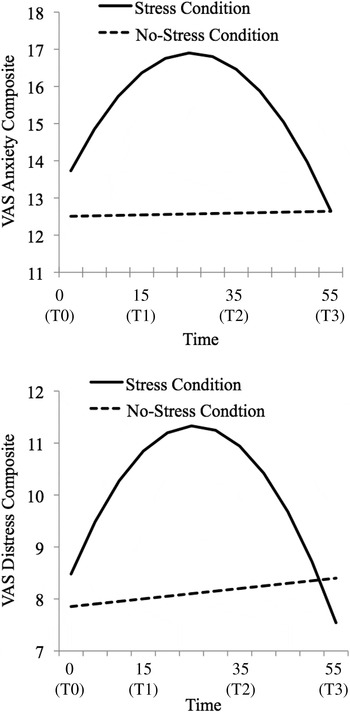
Estimated growth curves for mood manipulation checks on Visual Analog Scale (VAS) anxiety and distress composites by stress group.

Study procedures and time points

Note: The laboratory experience was the same across both stress groups to make them comparable, with the exception of the psychosocial stressor. The VAS and saliva samples were taken in conjunction 20 min apart; thus, the time frame of mood assessments and cortisol collections was similar. T0, T1, T2, T3, Times 0–3, MPQ-SF, Multidimensional Personality Questionnaire—Simplified Wording Form; VAS, Visual Analog Scale; TSST-C, Trier Social Stress Test for Children; GNG, go/no-go; BART-Y, Balloon Analogue Risk Task—Youth Version.
Stress manipulation
Participants were matched on gender, ethnicity, and relative age (e.g., within 1 or 2 years) before being assigned to a stress or no-stress condition. The participants were not told about their assignment until after the battery of questionnaires and baseline measures (T0) were obtained. The psychosocial stressor used in this study was an adaptation of the Trier Social Stress Test for Children (TSST-C; Buske-Kirschbaum et al., Reference Buske-Kirschbaum, Jobst, Wustmans, Kirschbaum, Rauh and Hellhammer1997; Kirschbaum, Pirke, & Hellhammer, Reference Kirschbaum, Pirke and Hellhammer1993). The TSST-C has consistently been demonstrated as valid and reliably capable of inducing physiological stress responses in children (Kudielka et al., Reference Kudielka, Buske-Kirschbaum, Hellhammer and Kirschbaum2004). The stress condition consisted of a 5-min preparation period, 5-min public speaking task, and a 5-min mental arithmetic task. During the preparation portion of the TSST-C, participants received the beginning of a story and were told that they would be audio recorded while telling their version of the ending of the story out loud in front of two judges, who would be judging their story based on stories from previous participants (Buske-Kirschbaum et al., Reference Buske-Kirschbaum, Jobst, Wustmans, Kirschbaum, Rauh and Hellhammer1997). Judges were undergraduate students of the same gender as the participant, who were instructed to remain neutral, passive, and not provide feedback to the participants throughout the task. Participants in the no-stress condition were asked to read a neutral passage from the text of three popular adolescent books (The Rescue, by Kathryn Lasky; The Tenth City, by Patrick Carman; Finest Kind, by Lea Wait) that was provided to them by the experimenter for three 5-min intervals. The experimenter told the participants in the no-stress condition that they could read at their leisure and would not be tested on the material in any way.
Impulsivity task
Given that impulsivity can be conceptualized as the inability to suppress prepotent/automatic/prepared responses, we used a GNG task. Youth completed a 10-min computerized GNG task in which participants were instructed to respond as quickly and accurately as possible by responding to a target stimulus consisting of the letter X and to refrain from responding to a more rarely occurring nontarget stimulus consisting of the letter K. As described by Groom and colleagues (Reference Groom, Bates, Jackson, Calton, Liddle and Hollis2008), both stimuli were randomly presented on a computer monitor with duration of 250 ms and a randomly jittered interstimulus interval of between 1.5 and 2.5 s. There were 304 GNG trials in total with 80% of the trials consisting of “go” trials. The GNG task consisted of a short practice session and four experimental blocks of 2.5 min with a short rest period between blocks. Participant impulsivity was indicated by high amounts of commission errors (false alarms; Krishnan-Sarin et al., Reference Krishnan-Sarin, Reynolds, Duhig, Smith, Liss and McFetridge2007). The dependent measure for this task was the sum of commission errors in Blocks 1 and 2 only, because many studies have suggested that monotony contributes to hypovigilance in later blocks (e.g., Thiffault & Bergeron, Reference Thiffault and Bergeron2003).
Risk-taking task
The youth version of the BART (BART-Y; Lejuez et al., Reference Lejuez, Aklin, Daughters, Zvolensky, Kahler and Gwadz2007) is a computer-based measure that assesses risk-taking propensity. Risk behavior on the BART-Y is correlated with real-world risk behavior and measures of risk-taking propensity (e.g., impulsivity and sensation seeking; Lejuez, Aklin, Zvolensky, & Pedulla, Reference Lejuez, Aklin, Zvolensky and Pedulla2003). In this task, participants were instructed to inflate a computer-generated balloon to earn points, but the explosion threshold (which was paired with an aversive popping noise) varied across each of the 30 balloons. Participants were told that the more points they earned during the task, the more money they would receive, which would be determined by the position of the permanent bank's prize meter at the end of the task. However, if the balloon exploded before the points were transferred to the permanent bank, all of the points stored in the temporary bank would be lost; participants moved on to the next balloon after a point transfer or after a balloon exploded (for more information, see Lejuez et al., Reference Lejuez, Aklin, Daughters, Zvolensky, Kahler and Gwadz2007). The average number of pumps taken on balloons that did not explode (i.e., the adjusted number of pumps across balloons) was used in analyses as the index of risk-taking behavior, consistent with previous work (Lejuez et al., Reference Lejuez, Read, Kahler, Richards, Ramsey and Stuart2002). Participants were paid between $1 and $5 for their performance on the BART-Y, depending on the final position of the prize meter, on top of the standard $25 compensation for the family's participation. It is important to note that the task order of the GNG and BART-Y was held constant across participants, a limitation we revisit in the Discussion.
Debriefing
At the end of the experiment, participants were thoroughly debriefed and given the opportunity to ask questions and discuss the psychosocial stressor. Each adolescent was told that the judges were required to look neutral and that the judges were not actually evaluating their performance. All procedures were approved by the university's Institutional Review Board.
Assessment of cortisol reactivity
Saliva samples were collected using sampling tubes (DRG Sali-Tubes, DRG International, Inc, Mountainside, NJ) and were stored at –20 °C until assayed. Samples were thawed and centrifuged at 4 °C at 2700 rpm for 7 min to separate the mucins. One hundred microliter samples of the supernatant were then assayed for cortisol concentrations (ng/mL) in duplicate using an enzyme-linked immunosorbent assay purchased from DRG International, Inc. (Mountainside, NJ). Samples were assayed in an endocrinology laboratory at the university. The average intra- and interassay coefficients of variation were 7.46 and 10.83, respectively, which are satisfactory coefficients of variation values (Nicolson, Reference Nicolson, Luecken and Gallo2008).
Four saliva samples were obtained from participants: (a) immediately before the TSST-C or control reading task (T0; baseline), (b) 15 min after the start of the TSST-C or control reading task, which coincided with when participants finished the TSST-C or control reading task (T1; +15 min), (c) 35 min after the start of the TSST-C or control reading task, which coincided with when participants finished the GNG task (T2; +35 min), and (d) 55 min after the start of the TSST-C or control reading task, which coincided with when participants completed the BART-Y (T3; +55 min).Footnote 4 Given that cortisol has been demonstrated to enter saliva approximately 15–20 min after a potential stressor is perceived, each salivary sample measured cortisol concentrations from approximately 15–20 min before collection (Stansbury & Gunnar, Reference Stansbury and Gunnar1994).
Cortisol values were log transformed to obtain a normal distribution. Cortisol reactivity was operationalized as percentage change in cortisol from each sample collected after the TSST-C or control reading task (T1, T2, and T3) to baseline (T0) and was calculated by the following formula: ([cortisol at T1, T2, or T3 – baseline cortisol]/baseline cortisol) × 100 (Scarpa & Luscher, Reference Scarpa and Luscher2002). Percentage change scores were used in analyses to control for individual differences in baseline cortisol; therefore, cortisol reactivity was standardized across participants (Scarpa & Luscher, Reference Scarpa and Luscher2002).
Instruments
Multidimensional Personality Questionnaire, Simplified-Wording Form (MPQ-SF)
To assess negative emotionality and constraint, we administered the original 155-item set of the MPQ-SF (Patrick, Kramer, Tellegen, Verona, & Kaemmer, Reference Patrick, Kramer, Tellegen, Verona and Kaemmer2013), which was developed for initial validation for youth and those with lower reading levels (see Javdani, Finy, & Verona, in press; Patrick et al., Reference Patrick, Kramer, Tellegen, Verona and Kaemmer2013). Negative emotionality (composed of the primary traits of aggression, stress reaction, and alienation) assesses tendencies toward distress, anxiety, irritability, aggression, hostility, and estrangement from/suspicion of others, and constraint (composed of the primary traits of control, harm avoidance, and traditionalism) assesses impulsivity, thrill seeking/fearlessness, and conformity to social norms. To limit the number of analyses conducted, we only used the two higher order dimensions of negative emotionality (α = 0.85) and constraint (α = 0.81) in analyses.
In addition to the primary scales, three validity scales (variable response inconsistency, true response inconsistency, and unlikely virtues) were also administered to measure lack of consistency in responding (variable response inconsistency and true response inconsistency) and socially desirable responding (unlikely virtues). Two participants were excluded from analyses involving negative emotionality and constraint due to aberrant scores on the validity scales established for the MPQ Brief Form (Patrick, Curtin, & Tellegen, Reference Patrick, Curtin and Tellegen2002). However, because exclusionary criteria for the validity scales of the MPQ-SF in adolescents have not yet been established, analyses involving negative emotionality and constraint were also reconducted with these two participants included. The results of our analyses did not substantively change with or without removal of these two participants. In addition to removing these two participants from analyses involving personality traits, one participant did not complete the MPQ-SF; therefore, our final sample for the MPQ-SF analyses consisted of 85 participants.
Visual Analog Scale (VAS)
The VAS is a self-rated mood scale consisting of nine words (i.e., tiredness, anxiety, confusion, sadness, anger, tension, relaxation, frustration, nervousness; Aitken, Reference Aitken1969). Participants were asked to rate how they were currently feeling on a Likert scale of 1 to 10. Following the same procedures as the saliva collections, the VAS was administered before (T0; baseline) and immediately after (T1; +15 min) the TSST-C or control reading task, with further mood assessments taken between the disinhibition tasks (T2; +35 min) and at the end of the experiment (T3; +55 min). Because the VAS and saliva samples were taken in conjunction, the time frame of mood assessments and hormone collections was similar (see Table 1).
Given the number of mood ratings assessed by the VAS, a principal components analysis with Promax rotation was conducted (using baseline VAS ratings) to concisely operationalize mood changes in the experiment. Two components were extracted (eigenvalues = 3.5 and 1.6). The first factor, termed VAS Distress Composite, explained 39% of the variance and comprised ratings on confusion, sadness, anger, and frustration. The second factor, termed VAS Anxiety Composite, explained 17% of the variance and comprised ratings on anxiety, tension, relaxation (reverse scored), nervousness, and tiredness.
Data analysis
First, a stress manipulation check was conducted by analyzing mood responses to the psychosocial stressor across time. Due to the nested nature of the data (i.e., multiple observations nested within participants), we used multilevel modeling (MLM; Singer & Willett, Reference Singer and Willett2003), which was conducted using SAS 9.3 with the settings recommended by Singer (Reference Singer1998). We ran two separate models. In both models, the Level 1 (within-person) predictors were the linear effect of time (coded as minutes from baseline: 0, 15, 35, 55) and quadratic effect of time (time2: 0, 225, 1,225, 3,025), and the Level 2 (between-person) predictor was stress group (coded: no-stress condition = 0; stress condition = 1). Of more importance, the Stress Group × Time and Stress Group × Time2 cross-level interactions were used in the prediction of both VAS mood composite scores (in separate analyses). All effects were treated as fixed, with the exception of the intercept (which was treated as random).
Second, to examine the two facets of disinhibition as a function of psychosocial stress and personality, we used separate linear regressions to examine impulsivity and risk taking as a function of stress group, negative emotionality, and constraint. Negative emotionality and constraint were both entered into the same model to control for their overlap (r = −.18, p = .11). Because there are age differences in disinhibition (e.g., Steinberg, Reference Steinberg2004; Steinberg et al., Reference Steinberg, Albert, Cauffman, Banich, Graham and Woolard2008; Williams, Ponesse, Schachar, Logan, & Tannock, Reference Williams, Ponesse, Schachar, Logan and Tannock1999), age (mean centered) was included as a covariate in analyses in Step 1, followed by the main effects of stress group, negative emotionality, and constraint in Step 2, and the interactions between stress group and both negative emotionality and constraint in Step 3.
Third, to examine cortisol reactivity as a function of psychosocial stress and personality, we also used MLM as described above. To be consistent with the regression analyses, we included both personality traits in the same model. In this model, the Level 1 predictors were time and time2, and the Level 2 predictors were stress group, negative emotionality, constraint, and the three two-way interactions (e.g., Stress Group × Constraint). Of more interest were the six two-way (e.g., Constraint × Time) and four three-way (e.g., Stress Group × Constraint × Time) cross-level interactions. Due to gender differences in cortisol reactivity to acute stress (e.g., Kirschbaum, Wust, & Hellhammer, Reference Kirschbaum, Wust and Hellhammer1992; Kudielka & Kirschbaum, Reference Kudielka and Kirschbaum2005), gender (coded: female = 1, male = –1) was also included as a covariate.
Results
Descriptive statistics
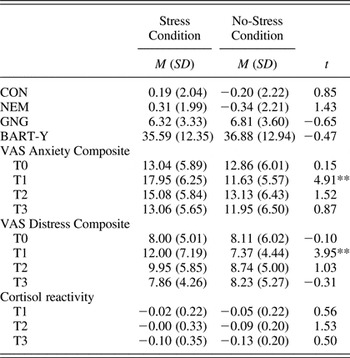
Descriptive information comparing participants in the stress and no-stress conditions on study variables is presented in Table 2. There were no mean differences on baseline variables of interest between the stress and no-stress conditions. Correlational analyses revealed that trait constraint was marginally correlated with the BART-Y (r = –.21, p = .06), which is not surprising given that harm avoidance is one of the subscales of constraint. With the exception of intercorrelations between the cortisol reactivity variables across the three percentage change scores (rs = .76–.82), there were no other significant correlations between primary variables (ps > .05).
Means of study variables by stress group

Note: CON, Constraint; NEM, negative emotionality; GNG, go/no-go; BART-Y, Balloon Analogue Risk Task—Youth Version; VAS, Visual Analog Scale.
**p < .001.
Mood manipulation checks
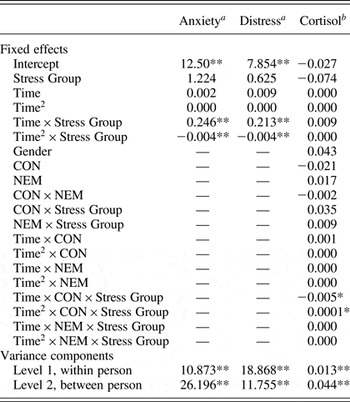
The results for the MLM analyses for the mood manipulation checks using the VAS dimensions are displayed in Table 3.Footnote 5 Unstandardized regression coefficients are reported because there is no agreed upon way to calculate standardized coefficients for MLM (Raudenbush & Bryk, Reference Raudenbush and Bryk2002). For the VAS Anxiety Composite, none of the main effects was significant; however, the Time × Stress Group, F (1, 258) = 15.68, p < .001, and Time2 × Stress Group, F (1, 258) = 19.24, p < .001, interactions were significant. As shown in the estimated growth curve (see top panel of Figure 2), these interactions indicated that for the stress condition, there were significant linear and quadratic effects of time. However, there were no linear or quadratic effects of time for the no-stress condition. These results were conceptually replicated with the VAS Distress Composite (see bottom panel of Figure 2). Similar to the results above, there were no significant main effects for stress group or time, but both interactions were significant: Time × Stress Group, F (1, 260) = 10.97, p = .001, and Time2 × Stress Group, F (1, 260) = 15.24, p = .001. In summary, adolescents in the stress condition reported more anxiety and more distress following the TSST-C than no-stress adolescents reported after the control reading task, with both anxiety and distress reduced to almost baseline levels by the end of the experiment. These results suggest that our stress manipulation was effective.
Unstandardized regression coefficients and variance components for multilevel modeling for mood scores and cortisol reactivity

Note: CON, Constraint; NEM, negative emotionality.
a N = 88.
b N = 85.
*p < .05. **p < .001.
Personality traits and stress effects on disinhibition tasks
Impulsivity task (GNG)
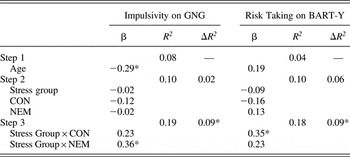
As shown in Table 4, regression analyses revealed no significant main effects of stress group, negative emotionality, or constraint on the sum of commission errors (all ps > .05). Contrary to our hypotheses, analyses revealed a significant interaction between stress group and negative emotionality (p = .01) on impulsivity. However, there was a nonsignificant interaction between stress group and constraint (p = .08) on impulsivity. These results demonstrate that the correlation of trait negative emotionality with impulsivity differed significantly between the two stress groups.
Linear regression analyses of impulsivity and risk taking as a function of stress group, CON, and NEM

Note: CON, Constraint; NEM, negative emotionality; GNG, go/no-go; BART-Y, Balloon Analogue Risk Task—Youth Version. N = 85.
*p < .05.
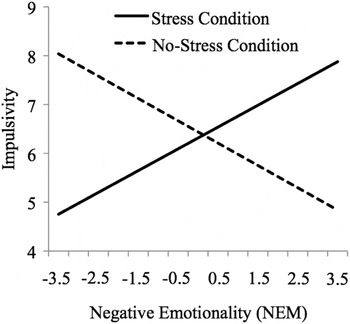
We interpreted the Stress Group × Negative Emotionality interaction in two different ways. First, we examined the relationship between negative emotionality and impulsivity separately within each stress group. As shown in Figure 3, the regression lines reflected a crossover interaction; the follow-up tests indicated that negative emotionality was associated with less impulsivity during the GNG among adolescents who were in the no-stress condition (β = –0.42, p = .01) but related to a nonsignificant increase in impulsivity in the stress condition (β = 0.26, p = .11). Second, we used the regression equation to estimate impulsivity for youth low (–1 SD) versus high (+1 SD) in negative emotionality for both the stress and no-stress conditions (Aiken & West, Reference Aiken and West1991). These simple slopes did not differ from 0 for adolescents low (β = –0.26, p = .09) and high (β = 0.23, p = .13) in negative emotionality. Taken together, these results suggest that negative emotionality may be protective against behaving impulsively under nonstressful conditions in adolescents, but this protection is absent under stress. This supports our hypothesis that personality traits predict behavior under neutral conditions but not under stressful conditions that act as a powerful situation.
Psychosocial stress moderating the relationship between negative emotionality (NEM) and impulsivity on the go/no-go (GNG).

Because our hypotheses concerning constraint were specific to impulsivity, we also followed-up the marginal Stress Group × Constraint interaction to be thorough. The only significant follow-up test revealed that constraint was associated with less impulsivity in the no-stress condition (β = –0.35, p = .02; all other ps > .05).
Risk-taking task (BART-Y)
There were no significant main effects of stress group, negative emotionality, or constraint on risk taking during the BART-Y (all ps > .05; see Table 4). However, inconsistent with our hypotheses, analyses revealed a significant interaction between stress group and constraint (p = .01) but not between stress group and negative emotionality (p = .10), on risk taking. These results demonstrate that the correlation of trait constraint with risk taking differed significantly between the two stress groups.
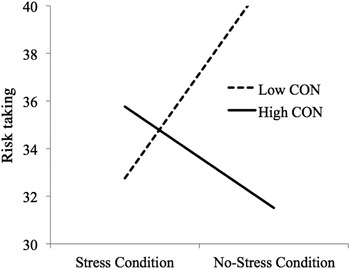
Similar to the follow-up analyses for the Stress Group × Negative Emotionality interaction above, we first examined the simple effect of constraint on risk taking within each stress group. Follow-up regressions indicated that constraint evidenced a significant negative association with risk taking during the BART-Y among adolescents in the no-stress condition (β = –0.40, p = .01) but not among adolescents in the stress condition (β = 0.11, p = .49).
We also used the regression equation to estimate risk taking for adolescents low (–1 SD) versus high (+1 SD) in constraint for both the stress and no-stress conditions (see Figure 4). The estimated means revealed that for low-constraint adolescents, stress group significantly predicted risk taking (β = –0.33, p = .03); however, there was no significant relationship for high-constraint adolescents (β = 0.16, p = .29). These results indicate that stress exposure predicted less risk taking only for adolescents with low constraint (but not for adolescents with high constraint). Therefore, not only did psychosocial stress moderate the relationship between constraint and risk taking but also constraint moderated the relationship between stress and risk taking.
Constraint (CON) moderating the relationship between psychosocial stress and risk taking on the Balloon Analogue Risk Task–Youth Version (BART-Y). Constraint was dichotomized in the graph for interpretation purposes, but continuous scores were used in the analyses.

Personality traits and stress effects on cortisol reactivity
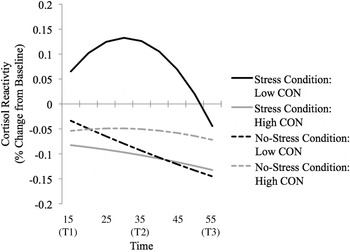
MLM analyses conducted on cortisol reactivity revealed no linear or quadratic Time × Negative Emotionality × Stress Group interactions (all ps > .05); however, there were significant Time × Constraint × Stress Group, F (1, 156) = 4.44, p = .04, and Time2 × Constraint × Stress Group, F (1, 156) = 4.22, p = .04, interactions. The estimated growth curves based on the regression output for all participants are displayed in Figure 5. We again followed up significant interactions in two ways. First, we examined the Time (and Time2) × Personality interactions separately by stress group. These tests indicated that the Time × Constraint and Time2 × Constraint interactions were not significant for either stress group (all ps > .05). Hence, stress did not serve as a moderator of the relationship between constraint and cortisol reactivity.
Estimated growth curves for cortisol reactivity as a function of time, stress group, and constraint (CON). Constraint was dichotomized in the graph for interpretation purposes, but continuous scores were used in the analyses.

Second, we used simple slopes analyses (Preacher, Curran, & Bauer, Reference Preacher, Curran and Bauer2006) to examine the Time (and Time2) × Stress Group interactions at low (–1 SD) and high (+1 SD) levels of constraint. These follow-ups indicated that for low levels of constraint, the Time × Stress Group, F (1, 156) = 6.86, p = .01, and Time2 × Stress Group, F (1, 156) = 5.44, p = .02, interactions were significant: there was a linear increase (B = 0.017, p = .01) and quadratic decrease (B = –0.0002, p = .01) in cortisol reactivity across time only for youth with low constraint in the stress condition (but not for adolescents with low constraint in the no-stress condition; linear: B = 0.00, p = .98; quadratic: B = 0.00, p = .94). In other words, adolescents with low constraint exhibited an increase in cortisol reactivity following the psychosocial stressor that decreased by the end of the experiment. However, for adolescents with high levels (+1 SD) of constraint, there were no Time × Stress Group, F (1, 156) = 0.05, p = .82, or Time2 × Stress Group, F (1, 156) = 0.09, p = .76, interactions, which indicates that youth with high constraint did not have a significant cortisol response during the experiment, regardless of stress group.Footnote 6
Discussion
The focus of the current study was to investigate individual and environmental factors that influence disinhibited behaviors and cortisol reactivity in adolescents as a way of understanding precursors to psychopathology during this stage of development. We examined two facets of disinhibition (as indexed by computerized tasks of impulsivity and risk taking) and HPA axis reactivity (as indexed by salivary cortisol) as a function of psychosocial stress and personality in adolescents. Counter to our predictions, negative emotionality interacted with psychosocial stress to predict impulsivity, and constraint interacted with psychosocial stress to predict risk taking. For cortisol reactivity, results demonstrated that constraint, and not negative emotionality, interacted with psychosocial stress to predict cortisol reactivity. Low-constraint adolescents in the stress condition exhibited greater cortisol reactivity compared to high-constraint adolescents. Taken together, these results may have important implications for the understanding of some of the individual, environmental, neuroendocrine, and behavioral processes that are involved in the later development of psychopathology in youth.
Negative emotionality, stress, and impulsivity
The results for negative emotionality are generally consistent with our predictions, given previous research, with the notable exception that negative emotionality was related to impulsivity and not to risk taking. Consistent with the idea that negative emotionality is related to worry and punishment sensitivity (Hajcak et al., Reference Hajcak, McDonald and Simons2004; Trapnell & Campbell, Reference Trapnell and Campbell1999; Watson & Clark, Reference Watson and Clark1984), negative emotionality was associated with less impulsivity during the GNG task among adolescents in the no-stress condition. These results may be explained by worry and punishment sensitivity leading individuals with high negative emotionality to exhibit cautious and thoughtful behavior (i.e., less impulsive behavior) in nonstressful situations. Therefore, negative emotionality could protect against behaving impulsively under no-stress environments, as negative emotionality may be beneficial to cognitive and behavioral performance (Tamir, Reference Tamir2005).
Consistent with state-dependent models of behavior (e.g., Block, Reference Block1968), the negative relationship between negative emotionality and impulsivity was attenuated for adolescents in the stress condition; in fact, this relationship presented a positive, albeit nonsignificant, trend. Because we did find strong evidence for a crossover interaction, an alternative explanation to account for this pattern of results may be that we simply did not have enough power to detect significant results for the other follow-up tests. Furthermore, upon closer inspection, our results are somewhat in line with the combination of state-dependent and trait-consistent perspectives. Although some of these follow-up tests were not statistically significant, the marginal increase in impulsivity among high-negative emotionality adolescents in the stress condition is consistent with previous research showing that individuals high in negative emotionality engage in disinhibited behaviors under periods of stress (Anestis et al., Reference Anestis, Selby and Joiner2007; Verona, Patrick, & Lang, Reference Verona, Patrick and Lang2002). Moreover, among low-negative emotionality adolescents there was a marginal decrease in impulsivity when comparing the stress condition to the no-stress condition. Taken together, these findings suggest that negative emotionality may be associated with different behavioral manifestations depending on context. One implication of these results is that it may be advantageous for impulsive youth to receive stress management training to help buffer the negative effects of stress (i.e., mimic the protective effects of negative emotionality under nonstressful conditions).
Constraint, stress, and risk taking
We again found evidence for the utility of combining state-dependent and trait-consistent models with regard to risk taking. There was a negative relationship between constraint and risk taking in the no-stress condition, which was absent in the stress condition. Moreover, the behavior of low-constraint adolescents in the stress condition was less risky than that of low-constraint adolescents in the no-stress condition, while there was no effect of stress group for adolescents high in constraint. In other words, although low constraint was, as one would expect, a risk factor for risky behavior under no stress, acute stress seemed to remove this liability of low constraint (i.e., protect low-constraint youth from engaging in risk-taking behaviors). In sum, individuals high in constraint were characterized by more trait-consistent behavior, whereas individuals low in constraint were characterized by more state-dependent behavior.
These results may be understood in terms of constraint and preparedness. High-constraint individuals are generally more vigilant and planful (Tellegen & Waller, Reference Tellegen, Waller, Boyle, Matthews and Saklofske2008). Therefore, stressors may have less of an impact on high-constraint individuals' already-cautious behavior, which would explain why these participants were relatively unaffected by the psychosocial stressor used in this study. Stressors may have more of an impact on low-constraint individuals, as these individuals may be less prepared when stressors arise (O'Connor & O'Conner, Reference O'Connor and O'Connor2004; Watson & Hubbard, Reference Watson and Hubbard1996). Therefore, low-constraint individuals may be more reactive to stress. For example, these individuals may attend more to threat when stressors arise (as a possible survival mechanism), which may lead to less risky behaviors (via enhanced weight to threat over reward). This explanation is consistent with other studies that have shown that individuals' behavior tends to be less risky after an unexpected event (Demaree, Burns, Dedonno, Agarwala, & Everhart, Reference Demaree, Burns, Dedonno, Agarwala and Everhart2012).
The results for low constraint can also be interpreted in the context of the freezing literature, as stress can decrease disinhibited behaviors by increasing caution and vigilant watchfulness of threat (Dandeneau, Baldwin, Baccus, Sakellaropoulo, & Pruessner, Reference Dandeneau, Baldwin, Baccus, Sakellaropoulo and Pruessner2007; Marks, Reference Marks1987). In the BART-Y, threat is apparent in at least two ways. First, there is the threat of not gaining money if the participant makes too many risky decisions. Second, each time the balloon explodes, the participant is subjected to an aversive popping noise. In contrast, there is no threat in the GNG task, which may explain why these results are specific to the BART-Y. If it is the case that increased attention to threat mediates the relationship between stress exposure and risk taking, one possible clinical implication would be to train low-constraint adolescents to increase attention to threat via cognitive bias modification paradigms (e.g., Hallion & Ruscio, Reference Hallion and Ruscio2011).
Disinhibition–personality taxonomies
There are multiple reasons why the relationships between the disinhibition tasks and personality traits were inconsistent with our predictions and Nigg's (Reference Nigg2000) disinhibition taxonomy. For example, we measured personality using single measures (e.g., negative emotionality as assessed by the MPQ-SF) and behavior as one moment in time (e.g., one GNG task). It is possible that looking at common variance across multiple operationalizations of personality and impulsive/risk-taking behaviors would better conform to previous theories. Along these lines, research in other literature (e.g., executive function; Miyake & Friedman, Reference Miyake and Friedman2012) has used latent variable modeling (e.g., confirmatory factor analysis) to extract shared variance across measurement types. Though there are such studies exploring the latent structure of self-report measures of disinhibition (e.g., Whiteside & Lynam, Reference Whiteside and Lynam2001; Wright et al., Reference Wright, Thomas, Hopwood, Markon, Pincus and Krueger2012), there are few studies identifying a latent structure across both behavioral and self-report measures (for a notable exception, see Reynolds, Penfold, & Patak, Reference Reynolds, Penfold and Patak2008). It may be that more specific measures are needed to directly tap into aspects of personality and disinhibition proposed by Nigg (Reference Nigg2000). However, there is danger in making only methodological arguments when results do not fit with previous theories, as theories essentially become unfalsifiable (LeBel & Peters, Reference LeBel and Peters2011). Therefore, another possibility is that Nigg's (Reference Nigg2000) disinhibition taxonomy needs to be revised.
Personality, stress, and cortisol reactivity
There was no significant interaction involving negative emotionality and psychosocial stress on cortisol reactivity, which was somewhat unexpected given the conceptual relevance of stress reactivity to negative emotionality (Tellegen & Waller, Reference Tellegen, Waller, Boyle, Matthews and Saklofske2008). However, this result is not surprising given the mixed associations between negative emotionality and cortisol reactivity in the extant literature (e.g., Houtman & Bakker, Reference Houtman and Bakker1991; Oswald et al., Reference Oswald, Zandi, Nestadt, Potash, Kalaydjian and Wand2006). With regard to constraint, the results were in line with the framework that personality moderates the relationship between psychosocial stress and cortisol reactivity. Consistent with the above discourse that low-constraint adolescents may be more reactive to stress (and thus more vigilant and less risky under stressful conditions; Dandeneau et al., Reference Dandeneau, Baldwin, Baccus, Sakellaropoulo and Pruessner2007; Marks, Reference Marks1987), low constraint was associated with greater cortisol reactivity for adolescents in the stress condition. It is interesting that adolescents with high constraint did not exhibit the typical cortisol response that would be expected in response to the psychosocial stressor. Because several studies have shown that cortisol reactivity reflects the mobilization of resources (e.g., Tops & Boksem, Reference Tops and Boksem2011; Tops, Boksem, Wester, Lorist, & Meijman, Reference Tops, Boksem, Wester, Lorist and Meijman2006), one explanation as to why low- and high-constraint participants exhibited different cortisol reactivity patterns is that individuals low in constraint may mobilize greater resources (e.g., increased cognitive control, heightened attention to threat) than high-constraint individuals in stressful situations. These results in an adolescent sample support other studies that have shown that self-reported impulsivity (which is similar to low constraint) is positively correlated with cortisol reactivity in adults (Fishbein, Lozovsky, & Jaffe, Reference Fishbein, Lozovsky and Jaffe1989; Hirvikoski et al., Reference Hirvikoski, Lindholm, Nordenström, Nordström and Lajic2009). Further, this is consistent with theory and research suggesting that greater cortisol reactivity plays a role in the inhibition of risky behaviors (Halpern, Campbell, Agnew, Thompson, & Udry, Reference Halpern, Campbell, Agnew, Thompson and Udry2002; Lighthall, Mather, & Gorlick, Reference Lighthall, Mather and Gorlick2009; Zuckerman, Reference Zuckerman1994; Reference Zuckerman1995), which may explain why low-constraint adolescents exhibited more cautious behavior (less risk taking) in the stress relative to no-stress condition (as noted above). In addition, these findings support studies from the freezing literature that have shown HPA reactivity to be associated with increased freezing behavior during stressful situations (e.g., Núñez, Ferré, Escorihuela, Tobeña, & Fernández-Teruel, Reference Núñez, Ferré, Escorihuela, Tobeña and Fernández-Teruel1997). Because we only examined cortisol reactivity and none of the other HPA axis hormones (e.g., adrenocorticotropin hormone), it will be beneficial in future research to examine the interaction between stress and personality on different stress hormones and other physiological stress systems.
Limitations and strengths
There are several limitations to the present study. We did not counterbalance the disinhibition tasks, so it is possible that the results from the impulsivity and risk-taking tasks are simply an artifact of the order in which participants completed these tasks (e.g., psychosocial stress interacted with the GNG task to influence risk taking). Another possible limitation to the lack of task counterbalancing is that the effects of the stressor may have dissipated by the time the BART-Y started. Though this is a potential issue, there are multiple reasons to assume that this effect is minimal. For example, a large body of work has demonstrated that, although the subjective experience of stress is often brief, physiological stress responses are often much longer in duration (Campbell & Ehlert, Reference Campbell and Ehlert2012; Watson, Reference Watson2000). Meta-analytic work suggests that salivary cortisol peaks between 21 and 41 min poststressor (Dickerson & Kemeny, Reference Dickerson and Kemeny2004), which coincides with the timing of the two behavioral tasks. Moreover, considering that cortisol may not return to baseline until up to 60 min after the end of the stressor (Dickerson & Kemeny, Reference Dickerson and Kemeny2004), it is likely that the participants in the stress condition were physiologically aroused during the BART-Y, even if they were not reporting subjective distress/anxiety. Finally, there is also a large literature indicating that residual physiological stress responses have effects on individuals' emotional responses and behaviors, even outside of conscious awareness (Schachter & Singer, Reference Schachter and Singer1962; Zillmann & Bryant, Reference Zillmann and Bryant1974). Therefore, it is likely that the physiological effects of the psychosocial stressor were still active during the BART-Y. Nevertheless, future studies should explore the temporal ordering of disinhibition tasks.
Second, we used an acute psychosocial stressor in our study, so our results cannot be extended to severe and chronic stressors, which are typically those most associated with later psychopathology. Third, a measure of pubertal development was not collected during the experiment. Because cortisol concentrations have been shown to be associated with pubertal stage (Kiess et al., Reference Kiess, Meidert, Dressendörfer, Schriever, Kessler and König1995), it may have been useful to include pubertal stage in analyses. Nevertheless, we attempted to control for pubertal stage by requiring all female participants to be post-menarche, and we matched all participants on relative age (e.g., within 1 and 2 years) before assigning them to stress group.
The present study is also characterized by several strengths. First, participants were a diverse group of adolescents with regard to gender and ethnicity; however, it cannot be assumed that the findings will generalize to younger children or adults. Second, in contrast to using one basal cortisol sample in analyses, we collected salivary cortisol concentrations at four time points to assess changes in cortisol reactivity during the experiment. Third, we controlled for multiple sources of variability (i.e., food intake, recent exercise, menstrual cycle phase, age, time of day) that can impact the measurement of cortisol (Alink et al., Reference Alink, van Ijzendoorn, Bakermans-Kranenburg, Mesman, Juffer and Koot2008; Hansen et al., Reference Hansen, Garde and Persson2008). Fourth, with a few notable exceptions (e.g., Böhnke, Bertsch, Kruk, & Naumann, Reference Böhnke, Bertsch, Kruk and Naumann2010; Gerra et al., Reference Gerra, Zaimovic, Avanzini, Chittolini, Giucastro and Caccavari1997), much of the prior research has relied on self- and observer-reports of disinhibited behaviors, whereas we assessed two facets of disinhibition using impulsivity and risk-taking laboratory tasks. Fifth, because personality has been shown to influence the types of stressors to which individuals are exposed (e.g., Bolger & Zuckerman, Reference Bolger and Zuckerman1995), we were able to tease apart the effects of personality and stress by using both a standardized stressor and a standardized control group across participants.
Conclusions
To our knowledge, the present study is the first to examine the interactions between psychosocial stress exposure and the personality traits of negative emotionality and constraint on impulsive and risk-taking behaviors and salivary cortisol reactivity in adolescents. Given the increased incidence of mental disorders in adolescence (Costello et al., Reference Costello, Mustillo, Erkanli, Keeler and Angold2003; Krueger, Caspi, & Moffitt, Reference Krueger, Caspi and Moffitt2000; Paus et al., Reference Paus, Keshavan and Giedd2008; Young et al., Reference Young, Friedman, Miyake, Willcutt, Corley and Haberstick2009), our results are particularly important because they contribute to our understanding of relationships between individual, environmental, neuroendocrine, and behavioral processes that may be involved in the later development of psychopathology. However, to further understand the utility of our conceptual model, longitudinal studies on future psychopathology are needed that take into account the influence of environmental and individual factors on changes in behavior and neuroendocrine development, which are in flux during adolescence (Hopwood et al., Reference Hopwood, Donnellan, Blonigen, Krueger and McGue2011; Romeo, Reference Romeo2005; Young et al., Reference Young, Friedman, Miyake, Willcutt, Corley and Haberstick2009). Thus, adolescence represents a critical stage for applying interventions for problematic behaviors and psychopathology. Because these results are novel and require replication, future studies should continue to examine the behavioral and neuroendocrine correlates of stress exposure and personality to further elucidate how these factors are related to developmental psychopathology.