


1 Introduction
Categories of strict polynomial functors have been kept in great consideration in the last twenty years, since Friedlander and Suslin first introduced them [Reference Friedlander and Suslin8], and showed how they give access to computing cohomology in the category of schemes. More recently, the category
 $\mathcal {P}$
saw its super (=
 $\mathbb {Z}/2\mathbb {Z} $
-graded) equivalent
 come up in the paper of Axtell [Reference Axtell1], giving rise to updated questions and computations. It was an interest of the author to compute spaces of the form
 , with A and B generic additive superfunctors, in relation to the bare cohomology of F and G. We managed to find a formula [Reference Giordano9, Theorem 4.16] in the case where one of the two is also additive. A generalisation for all
 $F,G \in \mathcal {P}$
is conjectured at the very end of the same paper. The particular cases of Frobenius twist superfunctors
 $A=B=\textbf {I} _0^{(r)}$
and
 $A=\textbf {I} _0^{(r)}, B=\textbf {I} _1^{(r)}$
, on which we restrict our attention in this paper, give graded isomorphisms natural in
 $F,G$
.
Conjecture 1.1. For
 $\ell \in \{0,1\}$
, there is an isomorphism of graded super spaces

Here,
 $\mathbf {E_{r,\ell }}$
stands for the graded space
 and
 $G_{\mathbf {E_{r,\ell }}}$
denotes the parametrised functor
 $G(\mathbf {E_{r,\ell }}\otimes -)$
. As explained in detail in [Reference Giordano9], the functor
 $G_{\mathbf {E_{r,\ell }}}$
bears a nonnegative
 $\mathbb {Z}$
-grading, and the right side of the latter isomorphism is graded by means of the total degree. In the classical (=ungraded) context, it was first proved by Touzé [Reference Touzé11] and then in complete generality by Chałupnik [Reference Chałupnik3] that there exists a natural graded isomorphism
 $\mathrm {Ext}_{\mathcal {P}}^*(F^{(r)}, G^{(r)}) \simeq \mathrm {Ext}^*_{\mathcal {P}}(F,G_{E_r})$
, where
 $E_r = \mathrm {Ext}_{\mathcal {P}}^*(I^{(r)},I^{(r)})$
. Such a result inspires our conjecture. The main technique used by Touzé, which we also use, is based on the so-called twisting spectral sequence. The generalisation is far from being immediate, because of some different behaviours of super Frobenius twists: for example, the twisting map
 $I_0^{(r)} \to I_0^{(r+1)}$
does not induce an injection at the
 $\mathrm {Ext}$
level as it used to do in the classical context, which was a key argument for Touzé’s twisting spectral sequence. Anyway, the desired isomorphism is true in low degrees for both parity twists (Theorems 5.1 and 7.1). This result, already interesting in itself, has an important consequence at the level of the generic cohomology
 $H_{\mathrm {gen}}^*(F,G)$
of F and G. This concept was introduced in [Reference Cline, Parshall and Scott4, Reference Cline, Parshall and Scott5] to capture the fact that, given g a semisimple algebraic group and V a rational g-module, then the cohomology group
 $H^n(g, V^{(r)})$
of the twisted module
 $V^{(r)}$
becomes stable for r big enough. Such a value is precisely called an nth generic cohomology
 $H_{\mathrm {gen}}^n(g,V)$
of the g-module V. Since cohomology of functors is a very powerful tool for encoding the cohomology of algebraic groups (which was the intuition of Friedlander and Suslin), it is natural to extend this concept to a category of functors. We generalise it to the context of strict polynomial superfunctors, setting the classical generic cohomology
 $H_{\mathrm {gen}}^*(F,G)$
to be the colimit of the diagram
 $\{ \mathrm {Ext}^*_{\mathcal {P}}(F^{(r)}, G^{(r)}) \}_{r \geq 1}$
and the super generic cohomology
 ${\mathbf{H}}_{\mathrm {gen}}^*(F,G)$
to be the colimit of
 , both diagrams being taken along the twisting maps on
 $\mathrm {Ext}$
. Quite surprisingly, the super one does not have any more content than the classical one.
Theorem 1.2. There exists a natural isomorphism as in Conjecture 1.1 in degrees
 $* < 2p^r$
.
Corollary 1.3. For all
 $F,G \in \mathcal {P}$
, the super and classical generic cohomologies of F and G are isomorphic:
 $H_{\mathrm {gen}}^*(F,G) \simeq {\mathbf{H}}_{\mathrm {gen}}^{\: *}(F,G)$
.
The paper has the following structure. We start in Section 2 by describing our objects of interest (strict polynomial superfunctors) as well as their basic properties and known computations. In Section 3, we make a right adjoint computation that is necessary for the study of the two twisting spectral sequences, which are worked out in Sections 4–6 to prove the announced results (Theorem 5.1 and Corollary 6.1, respectively). The last section provides (with less details) other useful results towards the conjecture: in particular, we prove the collapsing of a consistent part of the twisting spectral sequences (Theorems 7.16 and 7.17).
Theorem 1.4. Let
 $F,G \in \mathcal {P}_d$
and
 $r\ge 1$
. Then, for
 $\ell \in \{0,1\}$
, the superspace
 is concentrated in superdegree
 $0$
. Moreover, it contains a graded subspace isomorphic to
 $$ \begin{align*} \mathrm{Ext}_{\mathcal{P}}^*(F^{(r)}, G^{(r)}) \oplus \bigoplus_{k\ge 1} \mathrm{Ext}_{\mathcal{P}}^{* < 2p^r}(F^{(r)}, G^{(r)})_{[(2k-\ell)dp^r]}, \end{align*} $$
where the brackets
 $[-]$
denote a shift of cohomological degree.
Despite being itself a partial result, an interesting object such as a ‘universal class’
 $c_G$
arises in its proof. By this term, we mean a specific cohomology class giving access to the whole structure of cohomology groups: Friedlander and Suslin used in fact universal classes in [Reference Friedlander and Suslin8] to prove their main result, that is, the finite generation of the comohology of a rational
 $GL_n$
-module. A wide use of these classes is also made by other authors, such as Touzé [Reference Touzé12] and Van Der Kallen [Reference van der Kallen, Campbell and Wehlau14]. The author is convinced that such objects have at least as much interest in the super context and could be taken as a starting point for a better comprehension of superfunctors and supergroup cohomology.
2 Strict polynomial superfunctors
We start by recollecting the basic properties of our main objects, for which the reader may also consult [Reference Drupieski6, Section 2] or [Reference Drupieski and Kujawa7, Section 2]. Throughout the paper,
 $\Bbbk $
is a field of characteristic
 $p>2$
and all algebraic structures are defined over
 $k$
.
2.1 Super vector spaces and superalgebras
Definition 2.1. A super vector space is a
 $\mathbb {Z}/2\mathbb {Z} $
-graded vector space. In words, it is a vector space V together with a decomposition
 $V = V_0 \oplus V_1$
. The subspace
 $V_0$
(respectively
 $V_1$
) is called the even part of V (respectively the odd part).
In particular, homogeneous vectors bear a degree: we denote it by
 $\overline {v} \: \in \{ 0, 1 \}$
. As a convention, in any formula involving degrees, the appearing vectors are supposed to be homogeneous by default. The operations between degrees are always to be considered modulo
 $2$
.
The superdimension of V is the pair
 $\mathrm {sdim}(V) = (\dim (V_0), \dim (V_1))$
. Clearly, V is finite-dimensional (as a pure space) if and only if
 $V_0$
and
 $V_1$
are. In this case, if
 $\mathrm {sdim}(V)=(m,n)$
, it can be identified by
 $\Bbbk ^{m|n} := \Bbbk ^m \oplus \Bbbk ^n$
.
Let
 $V=V_0 \oplus V_1$
and
 $W=W_0 \oplus W_1$
be two super vector spaces. We can perform the usual algebraic operations by specifying the even and odd part of the new object: for the direct sum, we pose
 $$ \begin{align*} \begin{aligned} (V\oplus W)_0 =& \: V_0 \oplus W_0, \\ (V\oplus W)_1 =& \: V_1 \oplus W_1 \\ \end{aligned} \end{align*} $$
and for the tensor product,
 $$ \begin{align*} \begin{aligned} (V\otimes W)_0 =& \: (V_0 \otimes W_0) \oplus (V_1 \otimes W_1), \\ (V\otimes W)_1 =& \: (V_0 \otimes W_1) \oplus (V_1 \otimes W_0). \\ \end{aligned} \end{align*} $$
This determines, in particular, the super structure on the dual space
 ${V^\vee = (V_0)^\vee \oplus (V_1)^\vee }$
and on the space of linear morphisms by the isomorphism
 $\mathrm {Hom}(V,W) \simeq V^\vee \otimes W$
. (We use
 $V^\vee $
as a notation for the linear dual, instead of the more common
 $V^*$
. The reason is that, to avoid any confusion, asterisks are reserved to denote the degree of
 $\mathbb {Z}$
-graded objects (such as
 $\mathrm {Ext}^*$
) that are there all along the way.)
Remark 2.2. This definition of
 $\mathrm {Hom}(V,W)$
is equivalent to the following, more visual one: a morphism
 $\varphi \mid V \to W$
is even if it preserves the homogeneous subspaces (
 $\varphi (V_i) \subset W_i$
for
 $i=0,1$
) and is odd if it swaps them (
 $\varphi (V_i) \subset W_{i+1}$
for
 $i=0,1$
). By the properties of direct sums, every linear morphism
 $V \to W$
decomposes uniquely as the sum of an even and an odd one.
It is natural for our purposes to rephrase this structure in a categorical way. Finite-dimensional vector spaces together with linear morphisms form a well-known category
 $\mathcal {V}$
that is enriched over
 $\mathcal {V}$
(or linear, as we say from now). (One can obviously make the same statement about spaces of any dimension. We speak about finite-dimensional ones just to avoid setting notation we do not use, since in our following definitions, only finite-dimensional spaces are considered.) That is because the
 $\mathrm {Hom}$
-spaces happen to be themselves vector spaces and the composition law is bilinear. In total analogy, by our definitions and remarks, we can state that finite-dimensional super vector spaces and their linear morphisms form a category denoted
 that is also enriched over itself (or superlinear).
Definition 2.3. A superalgebra is a super vector space A that bears a unit map
 ${\Bbbk \to A}$
and an associative, linear even map
 $A \otimes A \to A$
.
A supercoalgebra is a super vector space A that bears a counit map
 $A \to \Bbbk $
and a coassociative, linear even map
 $A \to A \otimes A$
.
By the definitions, demanding the superalgebra product to be even is equivalent to imposing the intuitive formula on degrees
 $\overline {v \cdot w} \: = \overline {v} \:+\overline {w} \:$
. Clearly, the even part of a superalgebra is an algebra in the usual sense. The dual assertions are valid for a supercoalgebra.
Example 2.4. The most natural example is the tensor power superalgebra
 ${\textbf {T} ^*(V) = \bigoplus _{d\ge 0} V^{\otimes d}}$
, with the product given as the usual concatenation of tensors. Each
 $\textbf {T} ^d$
bears an action of the symmetric group
 $\Sigma _d$
, determined by transpositions
 $(i, \: i+1)$
in the following way:
 $$ \begin{align*}(i, \: i+1) \cdot (v_1 \otimes \cdots \otimes v_d) = (-1)^{\overline{v_i} \: \overline{v_{i+1}} \:} (v_1 \otimes \cdots \otimes v_{i+1} \otimes v_i \otimes \cdots\otimes v_d),\end{align*} $$
which is in accord with the general Koszul sign convention that the exchange of two symbols
 $a,b$
comes with the sign
 $(-1)^{\overline {a} \:\overline {b} \:}$
. Other important superalgebras are provided then by the coinvariants of this action
 $\textbf {S} ^*(V) = \bigoplus _{d\ge 0} \textbf {S} ^d(V)$
, called super symmetric powers, and the invariants
 $\boldsymbol {\Gamma } ^*(V) = \bigoplus _{d\ge 0} \boldsymbol {\Gamma } ^d(V)$
called super divided powers. The bold letters recall that this is the generalisation of classical symmetric and divided powers (noted
 $S^d$
and
 $\Gamma ^d$
) to the super context. For later use, we remark on the existence of a natural isomorphism
 $$ \begin{align} \boldsymbol{\Gamma} ^d(\mathrm{Hom}(V,W)) \simeq \mathrm{Hom}_{\Bbbk \Sigma_d}(V^{\otimes d}, W^{\otimes d}), \end{align} $$
where
 $\mathrm {Hom}_{\Bbbk \Sigma _d}$
denotes the space of
 $\Sigma _d$
-invariant morphisms.
Remark 2.5. As algebras, we have
 $\textbf {S} ^*(V) \simeq S^*(V_0) \otimes \Lambda ^*(V_1)$
and
 $\boldsymbol {\Gamma } ^*(V) \simeq \Gamma ^*(V_0) \otimes \Lambda ^*(V_1)$
.
The notion of (co)commutativity involves
 $\mathbb {Z}/2\mathbb {Z} $
-degrees. In addition, one has to be cautious when dealing with a graded superalgebra
 $A^* = \bigoplus _{n\ge 0} A^n$
. The
 $\mathbb {Z}$
-degree of an element is denoted by
 $|\cdot |$
, that is,
 $|a|=n$
for all
 $a \in A^n$
.
Definition 2.6 (Commutativity).
-
• A superalgebra A is commutative if
 $ab = (-1)^{\overline {a} \:\overline {b} \:} ba$
for all homogeneneous elements
$a,b \in A$
.
-
• A graded-superalgebra
$A^*$
is graded-commutative if
$ab = (-1)^{\overline {a} \:\overline {b} \: + |a||b|} ba$
for all bihomogeneous elements
$a,b \in A^*$
.


The same distinction is made by duality about cocommutativity and graded- cocommutativity. Note that a graded super(co)algebra can possibly just be (co)commutative, meaning that the
 $\mathbb {Z}$
-degrees do not come into play when permuting factors.
Example 2.7.
-
•
$\textbf {S} ^*(V)$
and
$\boldsymbol {\Gamma } ^*(V)$
are bicommutative bialgebras. -
• If
$V_0$
is a purely even space,
$S^*(V_0)$
and
$\Gamma ^*(V_0)$
are bicommutative (and purely even as spaces). -
• If
$V_1$
is a purely odd space,
$S^*(V_1)$
and
$\Gamma ^*(V_1)$
are graded-bicommutative.


Definition 2.8. Let A be a superalgebra. A left A-supermodule is a super vector space V together with a left action
 $A \otimes V \to V$
that is even as a linear map.
Left A-supermodules, respectively modules, with their morphisms form a category that we denote as
 $A-\textsf {smod}$
, respectively
 $A-\textsf {mod}$
.
2.2 Superfunctors
The classical notion of strict polynomial functor (see [Reference Friedlander and Suslin8]) is that of a functor
 $F\mid\mathcal {V} \to \mathcal {V}$
such that the structure map
 $\mathrm {Hom}(V,W) \to \mathrm {Hom}(F(V),F(W))$
is a polynomial map between vector spaces. Clear examples can be the tensor power
 $\otimes ^d$
or the symmetric power
 $S^d$
, both d-homogeneous in this sense. There is a primary interest in dealing with linear maps rather than polynomial. For all vector spaces
 $A,B$
, the space of polynomial maps
 $\mathrm{Hom}_{pol}(A,B)$
can be identified as follows:
 $$ \begin{align*} \mathrm{Hom}_{pol}(A,B) \simeq S^*(A^\vee) \otimes B \simeq \Gamma^*(A)^\vee \otimes B \simeq \mathrm{Hom}(\Gamma^*(A), B). \end{align*} $$
Hence, given a functor
 $F\mid \mathcal {V} \to \mathcal {V}$
, a polynomial structure on it is equivalent to the data of a natural linear map
 $\Gamma ^*(\mathrm {Hom}(V,W)) \to \mathrm {Hom}(F(V), F(W))$
. This motivates the definition in the super context.
Notation 2.9. For all
 $d \ge 0$
, the category
 is defined as the one with the same objects as
 and morphisms

with the composition law induced by the isomorphism (2-1). We finally set  .
Definition 2.10. A strict polynomial superfunctor is a linear even functor  . For
 $d\ge 0$
, its component
 is called d-homogeneous.
The category of d-homogeneous polynomial superfunctors with natural morphisms is noted  (in analogy with the classical one
 $\mathcal {P}_d$
). By construction, a strict polynomial superfunctor is the finite sum of its homogeneous subfunctors. In other words, the category
 of all polynomial superfunctors is the sum of all the
 s. Such a category is stable under the intuitive operations on functors: given
 and
 , one has
 (generally nonhomogeneous),
 and
 .
Notation 2.11. The category  is
 $\Bbbk $
-superlinear (that is,
 -enriched). This means that
 $\mathrm {Hom}$
spaces have themselves a structure of super vector spaces. Coherently with the general notation for a super vector space, we write the even and odd part as
 and
 .
Example 2.12. The
 $\textbf {S} ^d$
and
 $\boldsymbol {\Gamma } ^d$
defined here are d-homogeneous examples. More generally, given a super vector space V, the superfunctors
 $- \otimes V$
and
 $\mathrm {Hom}(V,-)$
are polynomial of degree one. One can then compose and define
 $\textbf {S} ^d_V := \textbf {S} \circ (V \otimes -)$
and
 .
Definition 2.13 (Kuhn dual).
The Kuhn dual of a superfunctor  is the superfunctor (again d-homogeneous) defined on objects by
 $$ \begin{align*} F^\#(V) := F(V^\vee)^\vee, \end{align*} $$
where
 $-^\vee $
denotes again the linear dual.
Example 2.14.
 $\boldsymbol {\Gamma } ^{d,V}$
and
 $\textbf {S} ^d_V$
are the Kuhn duals of each other.
An important role is played in  by the super divided powers
 $\boldsymbol {\Gamma } ^d$
, in the sense of the two following standard results.
Theorem 2.15 (Yoneda lemma).
There exists an isomorphism of graded spaces, natural with respect to  and
 :

Corollary 2.16. For all  , the object
 $\boldsymbol {\Gamma } ^{d,V}$
is projective in
 . Moreover, the collection
 forms a set of projective generators in
 . In particular, their Kuhn duals
 $\textbf {S} ^d_V$
form a set of injective cogenerators.
The superfunctors
 $\boldsymbol {\Gamma } ^d$
and
 $\textbf {S} ^d$
play thus the same role as that played by
 $\Gamma ^d$
and
 $S^d$
in
 $\mathcal {P}_d$
. Nearly any cohomological computation we do on a generic functor
 $F \in \mathcal {P}_d$
is likely to pass through the specific case
 $F=\Gamma ^{d,V}$
or
 $F=S^d_V$
. In the classical context, we sometimes use another set of projective generators. Set
 $$ \begin{align*} \Lambda(n,d) := \bigg\{\lambda = (\lambda_1, \ldots, \lambda_n) \mid \lambda_i \geq 0, \; \; \sum_i \lambda_i = d \bigg\} \end{align*} $$
and, for a fixed
 $\lambda \in \Lambda (n,d)$
,
 $$ \begin{align*} \Gamma^\lambda := \Gamma^{\lambda_1} \otimes \cdots \otimes \Gamma^{\lambda_n}. \end{align*} $$
The exponential property of
 $\Gamma ^*$
gives a decomposition (not natural in V)
 $$ \begin{align*} \Gamma^{d,V} \simeq \bigoplus\limits_{\lambda \in \Lambda(\dim(V),d)} \Gamma^\lambda , \end{align*} $$
which implies in particular that
 $\{\Gamma ^\lambda \}_{\lambda \in \Lambda (n,d) }$
is another set of projective generators of
 $\mathcal {P}$
. In the same manner, we define the
 $S^\lambda $
.
We now recall the main concept of the paper. The rth Frobenius twist of a super space V is defined by
 $V^{(r)} := V \otimes _\varphi \Bbbk $
, where
 $\varphi \mid \Bbbk \rightarrow \Bbbk $
is the
 $p^r$
th power map. If
 ${f\mid V \rightarrow W}$
is a linear morphism, then so is
 $f^{(r)} := f \otimes _\varphi 1 \mid V^{(r)} \rightarrow W^{(r)}$
. The formula
 ${V \mapsto V^{(r)}}$
determines a superfunctor that is a strict polynomial of degree
 $p^r$
and denoted by
 $\textbf {I} ^{(r)}$
. It admits two important subfunctors, whose existence a priori is not trivial at all (see [Reference Drupieski6, Section 2.7] or [Reference Giordano9, Section 3]).
Proposition 2.17. There exist subfunctors of
 $\textbf {I} ^{(r)}$
defined by
 $$ \begin{align*} \textbf{I} _0^{(r)} \mid V \longmapsto V_0^{(r)}, \end{align*} $$
 $$ \begin{align*} \textbf{I} _1^{(r)} \mid V \longmapsto V_1^{(r)}, \end{align*} $$
such that, moreover,
 $\textbf {I} ^{(r)} = \textbf {I} _0^{(r)} \oplus \textbf {I} _1^{(r)}$
.
The operation we want to perform now is ‘twisting’ a polynomial superfunctor, that is, precomposing it by a twist. This can be made in more than one fashion. For example, if  , one can define
 $F \circ \textbf {I} ^{(r)}$
and its subfunctors
 $F \circ \textbf {I} _0^{(r)}, F \circ \textbf {I} _1^{(r)}$
. However, thanks to special properties of the twist, it also makes sense to precompose a classical functor
 $F \in \mathcal {P}$
by
 $\textbf {I} _0^{(r)}$
or
 $\textbf {I} _1^{(r)}$
to obtain a superfunctor [Reference Giordano9, Corollary 3.8], which we denote by
 $F_0^{(r)}$
and
 $F_1^{(r)}$
, respectively. This last way of twisting is the one we are concerned with throughout the paper, starting with Conjecture 1.1.
We now recall some fundamental notions on
 $\mathrm {Ext}$
in the category
 . If
 $\mathcal {C}$
is a superlinear category, define
 $\mathcal {C}^-$
as the category with the same objects and with composition corrected by a Koszul sign:
 $$ \begin{align*} \varphi \circ^- \psi := (-1)^{\overline{\varphi} \:\overline{\psi} \:} \varphi \circ \psi. \end{align*} $$
The Kuhn dual (Definition 2.13) yields then an equivalence of categories  .
Definition 2.18 (Parity change functor).
 $\boldsymbol {\Pi } $
is the
 $1$
-homogeneous polynomial superfunctor defined by
 $$ \begin{align*} \boldsymbol{\Pi} (V_0 \oplus V_1) := V_1 \oplus V_0, \end{align*} $$
 $$ \begin{align*} \boldsymbol{\Pi} f = (-1)^{\overline{f} \:}f .\end{align*} $$
In other words,
 $\boldsymbol {\Pi } V$
is the same ungraded space as V but its homogeneous parts are swapped. Clearly,
 $\boldsymbol {\Pi } \circ \boldsymbol {\Pi } $
is the identity functor.
Proposition 2.19. There are even isomorphisms:


Proof. The first isomorphisms are given simply by seeing an even (odd) transformation
 $\boldsymbol {\Pi } A \to B$
as an odd (even) one
 $A \to B$
. For the second ones, send a transformation
 $T = \{T_V\}_V$
onto
 $T_{\boldsymbol {\Pi } V}$
.
2.3 Ext spaces
We now recall how to compute
 $\mathrm {Ext}$
spaces in
 . Note that this category is not abelian. To bypass this obstruction, given a superlinear category
 $\mathcal {C}$
, define
 $\mathcal {C}_{ev}$
to have the same objects but only even morphisms, that is,
 $\mathrm {Hom}_{\mathcal {C}_{ev}}(C,D) := \mathrm {Hom}_{\mathcal {C}}(C,D)_0$
. This last category is then abelian.
Definition 2.20. Given  , for all
 $n \ge 0$
, define
 as the nth right derived functor of

where
 $\mathfrak {svec}$
denotes the category of super vector spaces (possibly infinite-dimensional).
Proposition 2.21. There is a super graded isomorphism, natural in
 $F,G$
:

Proof. Follows immediately by the already mentioned equivalence of categories  .
Proposition 2.22. There are isomorphisms of graded super vector spaces:


Proof. Pre- and postcomposition by
 $\boldsymbol {\Pi } $
are both exact, injective-preserving operations; hence, it suffices to establish the isomorphisms at the
 $\mathrm {Hom}$
level. This is done in Proposition 2.19.
Keeping these isomorphisms in mind, we can compute our
 $\mathrm {Ext}$
spaces in
 provided we compose by
 $\boldsymbol {\Pi } $
when necessary. Combining both compositions, we can consider the following definition.
Definition 2.23. Let
 $F^\Pi := \boldsymbol {\Pi } \circ F \circ \boldsymbol {\Pi } $
be the conjugate of a superfunctor F. Proposition 2.22 implies, in particular, the existence of an operation
 , which is referred to as conjugation of extensions.
Since
 $\boldsymbol {\Pi } \circ \boldsymbol {\Pi } = \mathrm {Id}$
, it is an involution. For the next proposition, to be concise, for
 $d\ge 0$
, we denote
 $\boldsymbol {\Pi } ^d = \boldsymbol {\Pi } \circ \cdots \circ \boldsymbol {\Pi } $
composed d times. This is equal to
 $\boldsymbol {\Pi } $
if d is odd, the identity if d is even.
Proposition 2.24 [Reference Giordano10, Proposition 2.2.6].
For all
 $F \in \mathcal {P}_d$
, there are isomorphisms:
 $$ \begin{align*} \begin{aligned} F_0^{(r)} \circ \boldsymbol{\Pi} \simeq \boldsymbol{\Pi} ^d \circ F_1^{(r)}, \\ F_1^{(r)} \circ \boldsymbol{\Pi} \simeq \boldsymbol{\Pi} ^d \circ F_0^{(r)}. \end{aligned} \end{align*} $$
Combining this with Proposition 2.22 and Definition 2.23, we obtain the following corollary.
Corollary 2.25. For all
 $F,G \in \mathcal {P}$
, the conjugation map
 $c \to c^\Pi $
induces graded isomorphisms of super vector spaces:

For this reason, all the computations on spaces of the form  that we perform in this paper have an automatic mirroring into spaces like
 .
Definition 2.26 (Products on
$\mathrm {Ext}$
).

Let  . The map

induced at the cocycle level by the usual composition of morphisms, is called the Yoneda product of extensions. Suppose now that A (respectively C) is an element of  (hence, by definition, graded by polynomial degree) and equipped with a natural multiplication map (respectively comultiplication map): we say that it has the structure of a
 -algebra (respectively
 -coalgebra). This yields another map

called the cup product.
In this paper, the cup product is typically performed over
 $\textbf {S} ^*_V$
or
 $\boldsymbol {\Gamma } ^{*,V}$
, which both have the structure of
 -bialgebras. This product is commutative up to a sign, which is decided by (co)commutativity of C and A in the following way. Set
 $\varepsilon (A)=0$
if the
 -algebra A is commutative,
 $\varepsilon (A)=1$
if A is graded-commutative; do this analogously for the cocommutativity of the
 -coalgebra C.
Proposition 2.27 [Reference Drupieski6, Lemma 3.4.1].
Let A be a  -algebra, C be a
 -coalgebra. For any pair of extensions
 and
 , we have the following formula:
 $$ \begin{align*} e \cup f = (-1)^{\overline{e} \:\overline{f} \: + st + \varepsilon(C)\cdot ij + \varepsilon(A)\cdot ij} \; \; (f \cup e) .\end{align*} $$
2.4 Known Ext computations
Notation 2.28.

The Yoneda product makes
 $\boldsymbol {E_{r,0}}^*$
into a graded superalgebra and
 $\boldsymbol {E_{r,1}}^*$
into a graded
 $\boldsymbol {E_{r,0}}^*$
-supermodule.
Theorem 2.29 [Reference Drupieski6, Theorem 4.7.1].
We have the following descriptions.
-
• As super vector spaces,
$$ \begin{align*} (\mathbf{E_{r,0}})^s \simeq \begin{cases} \Bbbk, & s \text{ even}, \\ 0, & s\text{ odd}, \end{cases} \end{align*} $$
$$ \begin{align*} (\mathbf{E_{r,1}})^s \simeq \begin{cases} \Bbbk, & s \ge p^r\text{ odd}, \\ 0 & \text{otherwise}. \end{cases} \end{align*} $$
-
•
$\mathbf {E_{r,0}}$
is the commutative graded superalgebra generated by even elements
$\{e_{1,r}, \ldots , e_{r,r} \}$
, with
$\deg (e_{i,r})=2p^{i-1}$
, subject to relations
$e_{1,r}^p=\cdots =e_{r-1,r}^p=0$
. -
•
$\mathbf {E_{r,1}}$
is freely generated as an
$\mathbf {E_{r,0}}$
-supermodule by one even generator
$c_r$
of degree
$p^r$
.


The following super analogue of [Reference Friedlander and Suslin8, Proposition 5.2] is a useful tool for
 $\mathrm {Ext}$
computations involving twisted symmetric powers—see [Reference Giordano10, Section 2.2.3] for a detailed proof.
Theorem 2.30. Let
 $F,G$
be strict polynomial superfunctors of degrees
 $s,t$
, respectively, such that
 $s+t = p^r d$
. Then, for
 $\ell \in \{0,1\}$
:
-
•
if
$s,t$
are not divisible by
$p^r$
; -
• if
$s=p^r s'$
and
$t=p^r t'$
, there is a graded isomorphism induced by the tensor product of extensions and multiplication on
$S^*$
.
 if


Corollary 2.31. Let
 $\ell \in \{0,1\}$
and
 $X \in \{\Gamma ^{d,V}, S^d_V\}$
. The tensor product of extensions and multiplication on
 $S^*$
induce a graded isomorphism

3 The right adjoint of Frobenius precomposition
In this section, we focus on the even Frobenius twist superfunctor
 $\textbf {I} _0^{(r)}$
. As said in the previous section, precomposition yields for every
 $d \geq 0$
an exact functor

We want to determine a formula for its right adjoint. To do so, we are going to make use of the theorems that realise  and
 $\mathcal {P}$
as categories of supermodules. For positive integers
 $m,n$
, let
 $S(n, {d}) \simeq \Gamma ^d(\mathrm {End}(\Bbbk ^n))$
be the Schur algebra [Reference Friedlander and Suslin8, Section 3] and
 $S(m|n, {d}) \simeq \boldsymbol {\Gamma } ^d(\mathrm {End}(\Bbbk ^{m|n}))$
be the Schur superalgebra [Reference Axtell1, Section 3.2]. If
 , then by functoriality,
 $F(\Bbbk ^{m|n} )$
is a left
 $S(m|n, {d})$
-supermodule via
 $$ \begin{align*}\begin{gathered} S(m|n, {d}) \otimes F(\Bbbk^{m|n} ) \longrightarrow F(\Bbbk^{m|n} ) \\ \varphi \otimes v \longmapsto (F\varphi)(v) \end{gathered}\end{align*} $$
and analogously, if
 $F \in \mathcal {P}_d$
, then
 $F(\Bbbk ^n)$
is a left
 $S(n, {d})$
-module. Moreover, if
 , then
 $T_{\Bbbk ^{m|n} }$
is an
 $S(m|n, {d})$
-equivariant map. Analogously, if
 $T \in \mathrm {Hom}_{\mathcal {P}}(F,G)$
, then
 $T_{\Bbbk ^n}$
is
 $S(n, {d})$
-equivariant. So, evaluation at
 $\Bbbk ^{m|n} $
and
 $\Bbbk ^n$
defines functors

 $$ \begin{align*}\mathcal{P}_d \longrightarrow S(n, {d})-\textsf{mod}, \end{align*} $$
which are equivalences under mild hypotheses on
 $m,n$
.
Theorem 3.1 [Reference Axtell1, Theorem 4.2], [Reference Friedlander and Suslin8, Theorem 3.2].
Let
 $m,n,d$
be positive integers such that
 $m,n \geq d$
. Then, evaluation at
 $\Bbbk ^{m|n} $
yields an equivalence of categories
 , a quasi-inverse being provided by
 $M \longmapsto \boldsymbol {\Gamma } ^{d, \Bbbk ^{m|n} } \otimes _{S(m|n, {d})} M$
. In the classical counterpart, evaluation at
 $\Bbbk ^n$
yields an equivalence
 $\mathcal {P}_d \simeq S(n, {d})-\textsf{mod}$
, with quasi-inverse provided by
 $M \longmapsto \Gamma ^{d, \Bbbk ^n} \otimes _{S(n, {d})} M$
.
Working in a category of (super)modules is very convenient when it comes to computing adjoints. From now on, fix
 $m,n \geq dp^r$
. The functor (3-1) corresponds via the equivalence of Theorem 3.1 to the functor
 $$ \begin{align*} S(n, {d})-\textsf{mod} \longrightarrow S(m|n, {dp^r})-\textsf{smod}, \end{align*} $$
 $$ \begin{align*}M \longmapsto \Gamma^{d,\Bbbk^n} (\Bbbk^{m (r)}) \bigotimes_{S(n, {d})} M,\end{align*} $$
whose right adjoint is given by a well-known general formula
 $$ \begin{align*} S(m|n, {dp^r})-\textsf{smod} \longrightarrow S(n, {d})-\textsf{mod} ,\end{align*} $$
 $$ \begin{align*}N \longmapsto \mathrm{Hom}_{S(m|n, {dp^r})}(\Gamma^{d,\Bbbk^n} (\Bbbk^{m (r)}), N) .\end{align*} $$
Going back up again through the equivalence of Theorem 3.1, we arrive at an expression for the right adjoint of (3-1):

This last formula is quite weighty, but we can simplify it. Indeed, Theorem 3.1 says in particular that for any functor
 $H \in \mathcal {P}_d$
with
 $d \leq n$
, the canonical map
 $$\begin{align*}\Gamma^{d,\Bbbk^n} \bigotimes_{S(n, {d})} H(\Bbbk^n) \longrightarrow H \end{align*}$$
is an isomorphism of functors. Moreover, by the same theorem, the evaluation functor is fully faithful. Thanks to these two facts, we can rewrite

which gives the computation we wanted.
Proposition 3.2. The right adjoint of the precomposition functor (3-1) is given by

the right
 $\mathrm {Hom}$
space being seen as a functor in the variable
 $-$
.
Remark 3.3. To define a classical polynomial functor, the latter space in the formula of Proposition 3.2 is to be seen as a classical vector space by forgetting the
 $\mathbb {Z}/2\mathbb {Z} $
-grading.
3.1 Parametrised functors
Let
 $E^*$
be a finite-dimensional
 $\mathbb {Z}$
-graded vector space and
 $F \in \mathcal {P}$
. We define
 $F(E^*)$
in this way:
-
•
$F(E^*):=F(E)$
as an ungraded vector space; -
• to insert the grading, let the multiplicative group
$\mathbb {G}_m$
act on
$E^*$
with weight i on
$E^i$
. Then, by functoriality, there is an action of
$\mathbb {G}_m$
on
$F(E^*)$
and the latter decomposes into its weight spaces by semisimplicity. We let then
$F(E^*)^i$
be the ith weight space with respect to this action.


For an infinite-dimensional space
 $E^*$
, we define
 $F(E^*)$
as the colimit
 $\mathop {colim}_{H \subset E} F(H)$
over the finite-dimensional subspaces
 $H \subset E^*$
.
Remark 3.4. If
 $E^*$
is a purely even or purely odd
 $\mathbb {Z}$
-graded superspace, the parametrisation is defined in the same way by considering it as a nonsuper space. This is the case in particular for
 $\boldsymbol {E_{r,0}}$
and
 $\boldsymbol {E_{r,1}}$
.
Remark 3.5. Fix
 $F=S^d$
and
 $E^* = \bigoplus _{i=0}^n \Bbbk e_i$
with
 $\deg (e_i) = \varepsilon _i$
. Then, we have the exponential decomposition
 $S^d(E^*) = \bigoplus _{\lambda \in \Lambda (n+1,\: d)} S^\lambda $
. Set the degree of a composition to be
 $|\lambda | := \sum _{i=0}^n \varepsilon _i \lambda _i$
. Then, the
 $\mathbb {Z}$
-grading on
 $S^d(E^*)$
is induced by the degree of compositions:
 $$ \begin{align*}S^d(E^*)^i = \bigoplus_{|\lambda|=i} S^\lambda .\end{align*} $$
Definition 3.6. For
 $F \in \mathcal {P}_d$
and
 $E^*$
a
 $\mathbb {Z}$
-graded space, the parametrised functor
 $F_E \in \mathcal {P}_d^{\mathbb {Z}}$
is defined object-wise by
 $F_E(V) := F(E^* \otimes V)$
.
4 The spectral sequence
As announced in the introduction, we are going to compute the cohomology groups  by means of a twisting spectral sequence. It is worth mentioning that such work can be generalised, with a relatively small effort, in order to compute
 for any pair of additives
 . This is a consequence of the following classification theorem.
Theorem 4.1 [Reference Giordano9, Theorem 3.5].
Let  be an additive polynomial superfunctor, homogeneous of degree
 $d>1$
. Then,
 $d=p^r$
for some
 $r>0$
and there is an isomorphism of superfunctors
 $$ \begin{align*} A \simeq (\textbf{I} _0^{(r)})^{\oplus a} \oplus (\textbf{I} _1^{(r)})^{\oplus b} \oplus (\boldsymbol{\Pi} \circ \textbf{I} _0^{(r)})^{\oplus c} \oplus (\boldsymbol{\Pi} \circ \textbf{I} _1^{(r)})^{\oplus d} \end{align*} $$
for uniquely determined positive integers
 $a,b,c,d$
.
In words, by simply summing copies of Frobenius twists and their parity shifts, we exhaust the additive polynomial superfunctors of degree
 $>1$
. This gives us remarkable control over them, making it relatively easy to generalise twist-related into additive-related theory. In particular, it makes sense to precompose a classical functor
 $F \in \mathcal {P}$
with an additive
 . Although, in this paper, we focus on the cases
 $A=B=\textbf {I} _0^{(r)}$
and
 $A=\textbf {I} _0^{(r)}, B=\textbf {I} _1^{(r)}$
, the reader can keep in mind that all the technical results appearing throughout the section are true for general A and B, and that global statements and proofs can be found in [Reference Giordano10].
We now start settling the machinery.
Proposition 4.2. Let
 $\mathcal {A}, \mathcal {B}$
be abelian
 $\Bbbk $
-linear categories with enough projectives and injectives, and let
 $c_0, \: c \mid \mathcal {A} \rightarrow \mathcal {B}$
be two
 $\Bbbk $
-linear functors with
 $c_0$
exact. Denote by
 $\rho _0$
the right adjoint of
 $c_0$
and by
 $\textbf {R}^* \rho _0$
its right derived functor. Then, for all
 $F,G \in \mathcal {A}$
, there is a cohomological spectral sequence
 $$ \begin{align} E_2^{s,t} = \mathrm{Ext}_{\mathcal{A}} ^s (F, \textbf{R}^t \rho_0 (cG)) \Rightarrow \mathrm{Ext}^{s+t}_{\mathcal{B}}(c_0F, cG). \end{align} $$
Proof. Let
 $P_*$
be a projective resolution of F and
 $J^*$
an injective coresolution of
 $cG$
. Consider the bicomplex
 $E_0^{s,t} := \mathrm {Hom}_{\mathcal {B}} (c_0P_s, J^t)$
and the spectral sequence arising from
 $E_0$
by the filtration on the columns (as in [Reference Weibel15, Definition 5.6.1]). Since
 $c_0$
is exact, the homology of its totalisation computes
 $\mathrm {Ext}^*_{\mathcal {B}}(c_0F,cG)$
, which is then the abutment of the spectral sequence. Now, by adjunction, we have that
 $\mathrm {Hom}_{\mathcal {B}} (c_0P_s, J^t) \simeq \mathrm {Hom}_{\mathcal {A}}(P_s, \rho _0 J^t)$
, so the first page is isomorphic to
 $\mathrm {Hom}_{\mathcal {A}}(P_s, \textbf {R}^t\rho _0 (cG))$
. As a consequence, the second page identifies with
 $\mathrm {Ext}^s_{\mathcal {A}}(F, \textbf {R}^t\rho _0 (cG))$
.
We have then a first quadrant spectral sequence with differentials going right-downwards. Since the
 $\mathrm {Ext}$
-groups are, by hypothesis,
 $\Bbbk $
-vector spaces, its collapsing is controlled by the following criterion.
Proposition 4.3. Suppose that
 $\mathrm {Ext}^i_{\mathcal {B}}(c_0 F, c G)$
is finite-dimensional for all i. Then, the spectral sequence (4-1) collapses at the second page if and only if there is a graded isomorphism (not necessarily natural) with respect to total degree on the right side,
 $$ \begin{align*} \mathrm{Ext}^*_{\mathcal{B}}(c_0F, cG) \simeq \mathrm{Ext}_{\mathcal{A}} ^* (F, \textbf{R}^* \rho_0 (cG)) .\end{align*} $$
Remark 4.4. When  , the criterion of Proposition 4.3 applies in the same way even if
 is
 $\Bbbk $
-superlinear (and not abelian). That is because the
 $\mathrm {Ext}$
in
 are computed by passing to the abelian subcategory
 , as explained in Section 2.3.
We are now ready to apply this machinery to our context. Let
 $d \ge 0$
and
 ${r \ge 1}$
be fixed until the end. Choose
 $\mathcal {A} = \mathcal {P}_d$
,
 ,
 $F,G \in \mathcal {P}$
,
 $c_0 = - \circ \textbf {I} _0^{(r)}$
(the precomposition functor (3-1)) and
 $c = - \circ \textbf {I} _\ell ^{(r)}$
for
 $\ell \in \{0,1\}$
. Then, Proposition 4.2 gives rise to two spectral sequences

Notation 4.5. In what follows, we use the (already introduced) symbol
 $\ell $
to denote either
 $0$
or
 $1$
whenever a compact statement holds for both.
As a consequence of Proposition 3.2,
 $\textbf {R}^* \rho _0 (G_\ell ^{(r)})$
is the graded polynomial functor defined by
 . We prove in Lemma 4.9 that it is isomorphic to the parametrised functor
 $G_{\boldsymbol {E_{r,\ell }}}$
(recall Notation 2.28 and Section 3.1). Thus, thanks to Proposition 4.3, we can state our conjecture.
Conjecture 4.6. For all
 $F,G \in \mathcal {P}$
, the spectral sequences (4-2) collapse at the second page. In particular, there are graded isomorphisms (a priori not natural)

We start by inspecting Conjecture 4.6 with the choice
 $G=S^d_V$
. In this case, Conjecture 4.6 is revealed to be true. Consider the map

induced by cup product, and thus natural in V and W.
Proposition 4.7. The map (4-3) factors into an isomorphism of graded functors, natural in V:
 $$ \begin{align*} \textbf{R}^* \rho_0 ((S^d_V)_\ell^{(r)}) \simeq (S^d_V)_{\boldsymbol{E_{r,\ell}}}. \end{align*} $$
Proof. Let us first prove that (4-3) factors through
 $S^d(\boldsymbol {E_{r,\ell }}\otimes V \otimes W)$
. Since the parameters
 $V,W$
do not affect the cup product, this part of the proof will essentially be the same if we suppose
 $V=W=\Bbbk $
. It is also enough to treat the case
 ${d=2}$
. With these assumptions, we have to prove that for all pair
 , we have
 $e \cup f = f \cup e \:$
. (With no sign: note that we are taking
 $S^d$
, not
 $\textbf {S} ^d$
, and everything here lives in even superdegree.) Recall that
 $\overline {e} \:=\overline {f} \:=0$
because both
 $\boldsymbol {E_{r,0}}$
and
 $\boldsymbol {E_{r,1}}$
are purely even spaces. We have then the following two cases.
-
•
$\ell =0$
: then,
$s,t$
are necessarily even (because
$\boldsymbol {E_{r,0}}$
is concentrated in even cohomological degrees). In the notation of Proposition 2.27, we have
$i=j=1$
and
$\varepsilon (S^{*(r)}_0)=\varepsilon (\Gamma ^{*(r)}_0)=0$
, remembering Example 2.7. Hence, by the proposition, we conclude
$e \cup f = f \cup e$
. -
•
$\ell =1$
: here,
$\varepsilon (\Gamma ^{*(r)}_0)=0$
and
$\varepsilon (S^{*(r)}_1)=1$
again by Example 2.7. In contrast,
$s,t$
are odd because
$\boldsymbol {E_{r,1}}$
is concentrated in odd cohomological degrees. Hence, there are two negative signs in the formula of Proposition 2.27 that cancel, giving
${e \cup f = f \cup e}$
.


This proves the desired factorisation over
 $S^d(\boldsymbol {E_{r,\ell }})$
. Now, we show that the factorised map is an isomorphism. By a little abuse, we still call it
 $\eta = \eta _{V,W,\ell }$
. The case
 $V=W=\Bbbk $
is positively answered by [Reference Drupieski and Kujawa7, Theorem 5.1.2]. For the general case, we use the decomposition
 $S^d_V = \bigoplus _\lambda S^\lambda $
, with
 $\lambda $
ranging through the compositions of d in
 $\dim (V)$
parts (see Section 2.2). We start by supposing that only
 $W=\Bbbk $
. We can then factor
 $\eta $
through the composition

where the first vertical arrow is an isomorphism by the previous step and the second one by Corollary 2.31. The case
 $W=\Bbbk $
is then exhausted. By another use of Corollary 2.31, we deduce immediately that
 $\eta ^{\otimes \dim (W)}$
induces an isomorphism

for all compositions
 $\lambda \in \Lambda (\dim (W), d)$
. Finally then, for general
 $V,W$
, we can repeat the same decomposition argument on W and factor
 $\eta $
through the sum of morphisms (4-4) over
 $\lambda \in \Lambda (\dim (W), d)$
. Each one being an isomorphism, the conclusion follows.
Denote by t the grading on the parametrised functor
 $(S^d_V)_{\boldsymbol {E_{r,\ell }}}$
. Thanks to Proposition 4.7, the second pages of (4-2) for
 $G=S^d_V$
become


and, since
 $S^d_{V \otimes \boldsymbol {E_{r,\ell }}}$
is injective in each (
 $\mathbb {Z}$
-)degree, they are both concentrated in a single column and collapse at the second page. This proves Conjecture 4.6 when G is an injective cogenerator. As a consequence, there exists a graded isomorphism

which is in fact natural in F and V, since in a sequence with just one row, there is no filtration obstructing naturality. This proves Conjecture 1.1 when the right functor is injective (or, by duality, when the left functor is projective). Using the Yoneda lemma, we can state this result in a stronger way. For detailed proofs, see [Reference Giordano10, Section 4.2].
Theorem 4.8. There is a graded isomorphism, natural in all variables

with the following additional properties:
-
• if
$F=\Gamma ^{d,W}$
, it coincides with the cup product map of Proposition 4.7; -
• if
$F=S^d_W$
, it coincides with the cup product map induced by the-bialgebra structure on
$S^d_W$
and factored over
$\Gamma ^d$
.


 -bialgebra structure on


We use this isomorphism to prove the general identification for
 $\textbf {R}^* \rho _0 (-_\ell ^{(r)})$
.
Lemma 4.9. There is a natural graded isomorphism of functors
 $$ \begin{align*}\textbf{R}^* \rho_0 (G_\ell^{(r)}) \simeq G_{\boldsymbol{E_{r,\ell}}} .\end{align*} $$
Proof. Dualise, swap twists with Proposition 2.22 if needed and use (4-6) to get

natural in either variable, which gives the result.
We can then write the twisting spectral sequences in their final form. By a slight abuse of notation, we keep calling them with the same names.
Proposition 4.10 (Twisting spectral sequences).
For all
 $F,G \in \mathcal {P}_d, \: \ell \in \{0,1\}$
, there is a pair of first quadrant spectral sequences


Thanks to this, we are already able to spot a class of functor pairs for which Conjecture 4.6 is true.
Corollary 4.11. Let
 $F,G \in \mathcal {P}$
be such that F is
 $G_{\boldsymbol {E_{r,\ell }}}$
-acyclic. Then, there is a graded isomorphism, natural in
 $F,G$
:

Example 4.12. Let
 $\lambda $
be a partition of d. Consider the Schur functor
 $S_{\lambda }$
and the Weyl functor
 $W_\lambda $
, which are the Kuhn duals of each other. It is known—see for example [Reference Chałupnik2] or [Reference Touzé13, Example 4.8]—that
 $S_\lambda $
is
 $(W_\mu )_V$
-acyclic for all vector spaces V and for any pair of partitions
 $\lambda , \mu $
. Then, by Corollary 4.11, we can compute:

5 Proof of the conjecture in low degrees
Throughout the rest of the paper,
 $F,G$
are two fixed strict polynomial functors of degree d. To simplify our notation, we drop the subscripts from
 $\mathcal {P}$
and
 . In this section, we are going to focus on the even spectral sequence (4-7):

and prove the first part of Theorem 1.2. That is a low-degree version of Conjecture 4.6, which, in exchange, gains naturality.
Theorem 5.1. For all
 $n \le 2p^r+1$
, there is an isomorphism

which is moreover natural in
 $F,G$
if
 $n < 2p^r$
.
We obtain this as a consequence of the two following properties of
 $\boldsymbol {II}^{*,*}$
:
-
• all the elements in the strip
$\{\boldsymbol {II}_2^{*,t}, \: t < 2p^r \} \subset \boldsymbol {II}_2^{*,*}$
survive; -
• in total degrees
$<2p^r$
, the filtration on the abutment splits naturally.


As anticipated in the introduction, the idea is to compare the spectral sequence with the classical one of the same type. More precisely, this sequence is given for all
 $F,G \in \mathcal {P}$
by Proposition 4.2 applied to the classical groundset:
 $$ \begin{align*} II_2^{s,t} := \mathrm{Ext}_{\mathcal{P}} ^s (F, (G_{E_r})^t ) \Rightarrow \mathrm{Ext}^{s+t}_{\mathcal{P}}(F^{(r)}, G^{(r)}), \end{align*} $$
where
 $E_r := \mathrm {Ext}_{\mathcal {P}}^*(I^{(r)}, I^{(r)})$
is the classical Yoneda algebra. It is known that this sequence collapses [Reference Touzé12, Corollary 5], but there is a stronger result that the reader can find, for example, in [Reference Chałupnik3, Corollary 3.7].
Theorem 5.2. There is a graded natural isomorphism
 $$ \begin{align*}\mathrm{Ext}_{\mathcal{P}}^*(F^{(r)}, G^{(r)}) \simeq \mathrm{Ext}_{\mathcal{P}}^*(F, G_{E_r}), \end{align*} $$
where the grading on the right side is given by the total degree.
To compare
 $\boldsymbol {II}^{*,*}$
and
 $II^{*,*}$
, we make use of a restriction morphism. Set
 and
 the functor that forgets the
 $\mathbb {Z}/2\mathbb {Z} $
-grading.
Definition 5.3. If  , define
 $res_0 F := u \circ F \circ i_0.$
This operation defines an exact functor

In words, restricting a superfunctor means just to evaluate it on purely even spaces and consider the result as an ungraded space. It is clear that
 $res_0$
maps
 onto
 $\mathcal {P}_d$
.
Lemma 5.4.
-
(1) For all
. -
(2) For all
$F \in \mathcal {P}, \; \; res_0(F_0^{(r)}) = F^{(r)}.$
-
(3) For all
,
$res_0(G\otimes H) \simeq res_0(G) \otimes res_0(H)$
.
 .

 ,

Proof. For (1), evaluate on
 $V \in \mathcal {V}$
to have
 $$ \begin{align*}(res_0(G_0^{(r)})) \: (V) = G_0^{(r)} (V \oplus 0) = G(V^{(r)} \oplus 0) = (res_0 G)(V^{(r)}) = (res_0G)^{(r)} (V).\end{align*} $$
The verification for (2) is analogous, while (3) is immediate from the definition of tensor of two functors.
Being an exact functor,
 $res_0$
induces a morphism
 for all
 . In the following proposition, we make
 $res_0$
into a morphism between our two spectral sequences. To make no confusion, note by
 $\pi _r$
the particular restriction
 $res_0 \mid \boldsymbol {E_{r,0}} \rightarrow E_r$
. Note that, as a map of graded spaces, it is the projection on the first
 $2p^r-1$
degrees.
Proposition 5.5. There exists a morphism of spectral sequences
 $\boldsymbol {II}^{*,*} \rightarrow II^{*,*}$
that identifies:
-
• to
$G(\pi _r)_* \mid \mathrm{Ext}_{\mathcal {P}}^*(F, G_{\boldsymbol {E_{r,0}}}) \rightarrow \mathrm {Ext}_{\mathcal {P}}^*(F, G_{E_r})$
on the second pages and -
• to
$res_0$
on the abutments.


Proof. We have to manipulate the explicit construction of our spectral sequences, namely the one made in general in the proof of Proposition 4.2 and its classical counterpart. Let
 $J^* \hookleftarrow G_0^{(r)}$
be an injective coresolution and
 $P_* \twoheadrightarrow F$
be a projective resolution. Then, the spectral sequence
 $\boldsymbol {II}^{*,*}$
is induced by the bicomplex
 . (For convenience, we do not pass immediately to the right adjoint
 $\rho _0$
as we did in the proof of Proposition 4.2.) We proceed to define our restriction morphism of spectral sequences. Take
 $K^* \hookleftarrow G^{(r)}$
an injective coresolution in
 $\mathcal {P}$
. Since
 $res_0(J^*)$
is a (not injective) resolution of
 $G^{(r)}$
, there exists a morphism of complexes
 $res_0(J^*) \rightarrow K^*$
lifting the identity. Define the restriction morphism at the page zero by the composite

Note that the right-most bicomplex gives rise to
 $II^{*,*}$
. The morphism (5-1) identifies with the restriction of extensions between the abutments
 and between the first pages

Now, by (4-5), there is an isomorphism

by which we compute the second page. In the classical case, there is an analogous isomorphism
 $\mathrm {Ext}^*_{\mathcal {P}}(P_s^{(r)}, G^{(r)}) \simeq \mathrm {Hom}_{\mathcal {P}}(P_s, G_{E_{r}})$
. Hence, to conclude, we have to verify that (5-2) identifies via (5-3) to the induced morphism
 $G(\pi _r)_* \mid \mathrm {Hom}_{\mathcal {P}}(P_s, (G_{\boldsymbol {E_{r,0}}})^t) \rightarrow \mathrm {Hom}_{\mathcal {P}}(P_s, (G_{E_r})^t)$
. It suffices to do that for G injective, so by Corollary 2.31, we can suppose
 $P_s:=\Gamma ^d$
and
 $G:=S^d_V$
. In that case, by Proposition 4.7, an isomorphism
 , as well as its classical analogue, is provided explicitly by cup product
 $e_1 \cdot \cdots \cdot e_d \longmapsto e_1 \cup \cdots \cup e_d$
(we push elements of V inside the extensions of
 $\boldsymbol {E_{r,0}}$
). Lemma 5.4(3) implies that
 $res_0$
commutes with the cup product, and hence, the restriction morphism on the first pages identifies with
 $S^d_V(\boldsymbol {E_{r,0}}) \rightarrow S^d_V(E_r)$
induced by
 $\pi _r$
.
The restriction morphism gives us a good tool to compare the two sequences. Since
 $II^{*,*}$
collapses at the second page, we have that
 $G(\pi _r)_* \circ \delta = 0$
for any differential
 $\delta $
at any page of
 $\boldsymbol {II}^{*,*}$
. What we want to study is then the kernel of
 $G(\pi _r)_*$
. Let us make some definitions. Consider the set of infinite compositions of the integer d:
 $$ \begin{align*} \Lambda(\infty,d) = \bigg\{\lambda=(\lambda_i)_{i \in \mathbb{N}} \mid \lambda_i \geq 0, \: \sum_{i \geq 0} \lambda_i = d \bigg\} \end{align*} $$
and define the weight of
 $\lambda $
to be
 $|\lambda | := \sum _{i \geq 0} 2 i \lambda _i$
(this makes sense because
 $\lambda $
can only have finitely many nonzero components). In this sense, there is a graded decomposition
 $$ \begin{align*}G_{\boldsymbol{E_{r,0}}} = \bigoplus_{\lambda \in \Lambda(\infty,d)} G^\lambda .\end{align*} $$
Now, say that
 $\lambda $
is n-bounded if it is nonzero only in components
 $\lambda _i$
for
 $i < n$
. Then,
 $$ \begin{align*}G(\pi_r)\vert_{G^\lambda} = \begin{cases} \text{isomorphism on the image} & \text{if }\lambda \text{ is } p^r\text{-bounded}, \\ 0 & \text{otherwise}, \end{cases} \end{align*} $$
and thus, the same holds for the push forward
 $G(\pi _r)_*$
. The property of being bounded is partially controlled by the weight.
Lemma 5.6. If
 $|\lambda |<2n$
, then
 $\lambda $
is n-bounded.
Proof. The non-n-bounded composition with minimal weight is given by (
 ${d-1, 0, \ldots ,0, 1, 0, \ldots )}$
with
 $1$
in place n. Its weight is
 $2n$
, which proves the assertion.
Corollary 5.7. If
 $t<2p^r$
, the restriction of
 $res_0 \mid (G_{\boldsymbol {E_{r,0}}})^t \rightarrow (G_{E_r})^t$
is an isomorphism.
Proof.
 $(G_{\boldsymbol {E_{r,0}}})^t = \bigoplus _{|\lambda |=t}G^\lambda $
, so the hypothesis implies that all the compositions
 $\lambda $
in the sum have weight
 $< 2p^r$
. By Lemma 5.6, they are all
 $p^r$
-bounded, and hence, the restriction of
 $res_0$
is an isomorphism on its image. However, the image is the sum of the
 $G^{\lambda }$
with
 $\lambda p^r$
-bounded, which coincides with
 $(G_{E_r})^t.$
Proposition 5.8. The elements lying in the strip
 $\{\boldsymbol {II}_2^{*,t}, \: t < 2p^r \}$
survive.
Proof.
 is sent by
 $G(\pi _r)_*$
onto
 . Recall that the differentials in the latter sequence are all zero as a consequence of [Reference Touzé12, Corollary 5]. Therefore, if
 $\partial $
is any differential landing somewhere in the strip
 ${T_r := \{\boldsymbol {II}_2^{*,t} \mid t < 2p^r\} \subset \boldsymbol {II}_2^{*,*}}$
, then
 $G(\pi _r)_* \circ \partial = 0$
. In force of Corollary 5.7,
 $G(\pi _r)_*$
is an isomorphism on
 $T_r$
, which forces
 $\partial =0$
. In particular—recall that our differentials go right-downwards—nonzero differentials can neither land nor depart from
 $T_r$
. This means that all the elements in the strip survive.
We are now ready to prove the theorem that we announced at the beginning of the section.
Proof of Theorem 5.1.
By Corollary 5.7, the morphism
 $$ \begin{align*}G(\pi_r)_* \mid \mathrm{Ext}^*_{\mathcal{P}}(F, (G_{\boldsymbol{E_{r,0}}})^t) \rightarrow \mathrm{Ext}^*_{\mathcal{P}}(F, (G_{E_r})^t) \end{align*} $$
is an isomorphism for all
 $t < 2p^r$
. By Proposition 5.5, it comes from a spectral sequence morphism which identifies with
 between the abutments, so the latter is also an isomorphism in degrees
 $* < 2p^r$
. Consequently, in such degrees, we have a chain of natural isomorphisms

where the second one comes from Theorem 5.2 and the last one is
 $G(\pi _r)_*$
. We then have the desired natural isomorphism in degrees
 $* < 2p^r$
.
To complete the proof, we must deal with degrees
 $* = 2p^r, 2p^r + 1$
. Looking at the second page of
 $\boldsymbol {II}^{*,*}$
, we observe that all differentials departing from the line
 $t=2p^r$
fall into the critical strip
 $\{\boldsymbol {II}_2^{*,t}, t < 2p^r \}$
, and thus vanish by Proposition 5.8. In particular, the terms
 $\boldsymbol {II}_2^{0,2p^r}$
and
 $\boldsymbol {II}_2^{1,2p^r}$
survive, since in a first-quadrant sequence, they can receive no nontrivial differential either. Moreover,
 $\boldsymbol {II}_2^{0,2p^r+1} = 0$
because
 $\boldsymbol {II}_2^{*,*}$
vanishes in odd strips. This forces the sequence to collapse in degrees
 $2p^r$
and
 $2p^r+1$
as well.
6 Consequences for the generic cohomology
Define the generic cohomology of
 $F,G \in \mathcal {P}$
by
 $$ \begin{align*} H_{\mathrm{gen}}^*(F,G) := \mathrm{colim}_{r\geq 1} \: \mathrm{Ext}^*_{\mathcal{P}}(F^{(r)}, G^{(r)}), \end{align*} $$

the diagrams being taken along with the respective twisting maps between
 $\mathrm {Ext}$
-groups.
Corollary 6.1. For all
 $F,G \in \mathcal {P}$
, there is a natural isomorphism
 $$ \begin{align*} {\mathbf{H}}_{\mathrm{gen}}^{\: *}(F,G) \simeq H_{\mathrm{gen}}^*(F,G) .\end{align*} $$
Proof. By Theorem 5.1 and Corollary 5.7, it follows that
 $res_0$
induces an isomorphism
 for all
 $t < 2p^r$
. This implies the assertion on the colimits, provided that we show that
 $res_0$
commutes with the twisting maps. In words, for all
 $r\geq 1$
, the diagram

must commute. This is an immediate consequence of Lemma 5.4(1).
7 A further step towards the conjecture
To get more information from the family of twisting spectral sequences, we start by studying the odd sequence (4-8):

which turns out to have similar collapsing properties as (4-7). In particular, it provides the existence of isomorphisms similar to those in Theorem 5.1.
Theorem 7.1. For all
 $F,G \in \mathcal {P}_d$
and for all
 $n \leq (d+2)p^r + 1$
, there is an isomorphism

that is natural in
 $F,G$
if
 $n < (d+2)p^r$
.
Recall (Theorem 2.29) that
 $\boldsymbol {E_{r,1}}^*$
is isomorphic to the free
 $\boldsymbol {E_{r,0}}^*$
-supermodule with one even generator
 $c_r$
placed in degree
 $p^r$
. In other words, the map
 $$ \begin{align*}c_r \cdot - \mid \boldsymbol{E_{r,0}} \longrightarrow \boldsymbol{E_{r,1}}[-p^r] \end{align*} $$
is an isomorphism of super vector spaces. One can thus think of
 $\boldsymbol {E_{r,1}}$
as a shift of
 $\boldsymbol {E_{r,0}}$
via a Yoneda product. The idea is to generalise this shifting isomorphism and retrieve it on the spectral sequence
 $\overline {\boldsymbol {II}\rule {0pt}{2mm}}^{*,*}$
. We start with an easy fact.
Lemma 7.2. Let
 $G \in \mathcal {P}_d$
. Then, the functor
 $G_{\boldsymbol {E_{r,1}}}$
is only nonzero in degrees greater than or equal to
 $dp^r$
, and
 $(G_{\boldsymbol {E_{r,1}}})^{dp^r} = G$
.
Proof. Let
 $\lambda $
be a composition in
 $\Lambda (\infty , d)$
and
 $G^\lambda \subset G_{\boldsymbol {E_{r,1}}}$
the corresponding subfunctor. By the explicit structure of
 $\boldsymbol {E_{r,1}}$
, we see that
 $G^\lambda $
is in degree
 $$ \begin{align*} \sum_{k \geq 0} (p^r + 2k) \lambda_k = dp^r + \sum_k 2k \lambda_k, \end{align*} $$
which is in particular at least
 $dp^r.$
The last statement comes from the fact that the only composition of weight
 $dp^r$
is
 $\lambda = (d, 0, 0, \ldots )$
and
 $G^{(d,0,0,\ldots )}=G$
.
The following proposition gives, apart from an interesting vanishing result, the existence of a new fundamental object.
Proposition 7.3. Let
 $F,G \in \mathcal {P}_d$
. Then:
-
(1)
for all
$n < dp^r$
; -
(2) there is an isomorphism, natural in
$F,G$
, (7-1) -
(3) for all G, there exists a unique nonzero class in
corresponding to the identity
$\mathrm {Id}_G$
via (7-1).
 for all


 corresponding to the identity

Proof. Lemma 7.2 implies that the lower horizontal strip
 $t < dp^r$
of the second page of
 $\overline {\boldsymbol {II}\rule {0pt}{2mm}}^{*,*}$
is identically zero, which implies a fortiori its collapsing in total degrees
 $< dp^r$
; hence, the first point. As a consequence,
 $\overline {\boldsymbol {II}\rule {0pt}{2mm}}_2^{0,dp^r} = \mathrm {Hom}_{\mathcal {P}}(F, (G_{\boldsymbol {E_{r,1}}})^{dp^r}) = \mathrm {Hom}_{\mathcal {P}}(F,G)$
is the only nonzero term of total degree
 $dp^r$
and survives. By these reasons, we have the desired natural isomorphism
 . The last point follows immediately.
Definition 7.4. For all G, we denote by
 $c_G$
the class introduced in point (3) of Proposition 7.3.
The definition, despite being implicit, gives already some good properties of
 $c_G$
(see [Reference Giordano10, Lemma 4.3.15] for the proof).
Lemma 7.5.
-
(1)
$c_{G \oplus H} = c_G + c_H$
for all polynomial functors
$G,H$
. -
(2) For all natural transformations
$T \in \mathrm {Hom}_{\mathcal {P}}(G,H)$
, the following identity holds:
$$ \begin{align*}T_1^{(r)} \cdot c_G = c_H \cdot T_0^{(r)} .\end{align*} $$
-
(3) The class
satisfies the following relation: where
$$ \begin{align*} c_{S^d_V} \cdot m_{S_0} = m_{S_1} \cdot (1_V \otimes c_r)^{\times d}, \end{align*} $$
$m_{S_\ell }$
denotes the multiplication map
$(V \otimes \textbf {I} _\ell ^{(r)})^{\otimes d} \to (S^d_V)_\ell ^{(r)}$
.
-
(4)
$c_{Id}$
is equal to
$c_r$
(the generating class of
$\boldsymbol {E_{r,1}}$
as an
$\boldsymbol {E_{r,0}}$
-supermodule).


 satisfies the following relation:


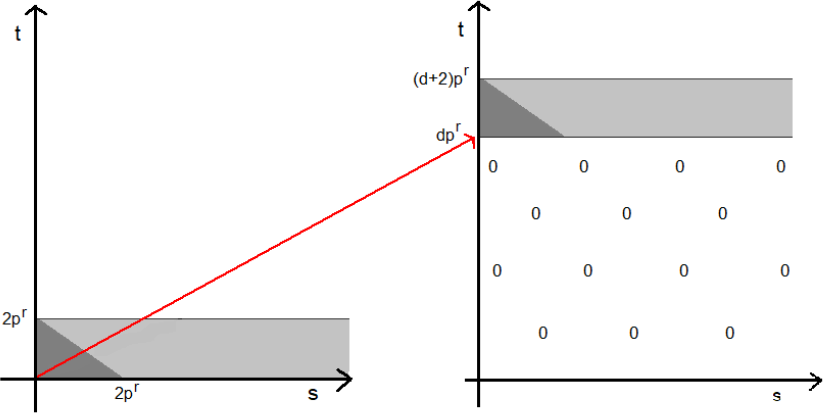
We use this class to construct a morphism between the spectral sequence (4-8) and the already treated one (4-7). A useful picture of this morphism is given in Figure 1. The proof, which is essentially an expansion of that of Proposition 5.5, can be found in [Reference Giordano10, Proposition 4.3.16].
The morphism
 $\varphi ^{*,*}$
of Proposition 7.6.

Proposition 7.6. There is a morphism of spectral sequences
 $\varphi ^{*,*} \mid \boldsymbol {II}^{*,*} \rightarrow \overline {\boldsymbol {II}\rule {0pt}{2mm}}^{*,*}$
of bidegree
 $(0,dp^r)$
(with
 $d=\deg F = \deg G$
) that identifies:
-
• with
$G(c_r \cdot -)_* \mid \mathrm {Ext}_{\mathcal {P}}^*(F, G_{\boldsymbol {E_{r,0}}}) \rightarrow \mathrm {Ext}_{\mathcal {P}}^*(F, G_{\boldsymbol {E_{r,1}}})$
on the second pages; -
• with the Yoneda product by
$c_G$
on the abutments.


Thanks to the morphism and to the particular structure of the right-hand spectral sequence, we are able to prove the first announced result of this section.
Proof of Theorem 7.1.
Since
 $G(c_r \cdot -)$
is an isomorphism of degree
 $dp^r$
and since the first
 $dp^r-1$
lines of
 $\overline { \boldsymbol {II}\rule {0pt}{2mm}}_2^{*,*}$
are zero by Lemma 7.3, it follows that
 $\varphi ^{*,*}$
yields an isomorphism of bidegree
 $(0, dp^r)$
on the second pages, and hence a natural isomorphism on the abutments

The result follows then by this and by Theorem 5.1.
We now make some sort of iteration process out of Proposition 7.6. Recalling Definition 2.23, we dispose of the conjugate extension  . Via conjugation, one can repeat the procedure of the proposition to construct a morphism of spectral sequences
 $\overline {\boldsymbol {II}\rule {0pt}{2mm}}^{*,*} \to \boldsymbol {II}^{*,*}$
, again of bidegree
 $(0,dp^r)$
, which identifies with
 $G(c_r^\Pi \cdot -)$
at the level of second pages and to
 $c_G^\Pi \cdot -$
on the abutments. In particular, by composition, one obtains an endomorphism of
 $\boldsymbol {II}^{*,*}$
of bidegree
 $(0,2dp^r)$
.
Proposition 7.7. There is a morphism of spectral sequences
 $\psi ^{*,*} \mid \boldsymbol {II}^{*,*} \to \boldsymbol {II}^{*,*}$
of bidegree
 $(0, 2dp^r)$
, which identifies:
-
• with
$G((e_r)^p \cdot -) \mid \mathrm {Ext}_{\mathcal {P}}^*(F, G_{\boldsymbol {E_{r,0}}}) \rightarrow \mathrm {Ext}_{\mathcal {P}}^*(F, G_{\boldsymbol {E_{r,0}}})$
on the second pages; -
• with the Yoneda product by
$c_G^\Pi \cdot c_G$
on the abutments.


Proof. The only thing left to prove is the identification on the second pages. That follows by the relations on  [Reference Drupieski6, Theorem 4.7.1], which say in particular that
 $c_r^\Pi \cdot c_r = (e_r)^p$
is nonzero and generates
 $\boldsymbol {E_{r,0}}^{2p^r}$
.
Unfortunately,
 $G((e_r)^p \cdot -)$
, and consequently
 $\psi ^{*,*}$
, is not an isomorphism. This is because, while
 $c_r \cdot - \mid \boldsymbol {E_{r,0}} \to \boldsymbol {E_{r,1}}[-p^r]$
is an isomorphism,
 $c_r^\Pi \cdot - \mid \boldsymbol {E_{r,1}} \to \boldsymbol {E_{r,0}}[-p^r]$
is not: classes of degree less than
 $2p^r$
do not figure in the image. In particular, Yoneda product with
 $(e_r)^p$
is not an isomorphism of
 $\boldsymbol {E_{r,0}}$
on itself. Such a loss of information can only get worse as d gets bigger. For example,
 $(S^d_{\boldsymbol {E_{r,0}}})^0$
is equal to one copy of
 $S^d$
—corresponding to the composition
 $(d,0,\ldots )$
—while
 $(S^d_{\boldsymbol {E_{r,0}}})^{2dp^r}$
contains at least a copy of
 $S^d$
and a copy of
 $S^{d-1} \otimes S^1$
—corresponding respectively to compositions
 $(0,\ldots , d, 0, \ldots )$
with d in the
 $p^r$
th position and
 $(d-1, 0, \ldots , 1, \ldots )$
with
 $1$
in the
 $dp^r$
th position. Anyway, the good news is that
 $\psi ^{*,*}$
is still injective. We want then to identify its image.
Definition 7.8. Let
 $\lambda \in \Lambda (\infty , d)$
and m be an integer. The associated m-shifted composition is defined as
 $$ \begin{align*} (\lambda_{[m]})_i := \begin{cases} \lambda_{i-m} & \text{if } i \geq m, \\ 0 & \text{otherwise}. \end{cases} \end{align*} $$
It is immediate to check that
 $\lambda _{[m]} \in \Lambda (\infty ,d)$
and that
 $|\lambda _{[m]}| = |\lambda | + 2dm$
.
Proposition 7.9. The morphism
 $\psi ^{*,*}$
of Proposition 7.7 is an isomorphism on its image, which coincides (as a vector space) with
 $$ \begin{align*} Im(\psi) = \bigoplus_{\lambda \in \Lambda(\infty,d)} \mathrm{Ext}_{\mathcal{P}}^*(F, G^{\lambda_{[p^r]}}). \end{align*} $$
Proof. Since
 $(e_r)^p \cdot -\mid \boldsymbol {E_{r,0}} \to \boldsymbol {E_{r,0}}$
is an isomorphism on its image, so is
 $G (- \cdot ~(e_r)^p)$
. It is now immediate to see that the latter sends
 $G^\lambda $
onto
 $G^{\lambda _{[p^r]}}$
.
Corollary 7.10. All the elements of the form
 $$ \begin{align*} \mathrm{Ext}_{\mathcal{P}}^s(F, G^{\lambda_{[p^r]}}) \quad \textrm{with } s+|\lambda| \leq 2p^r+1 \end{align*} $$
survive in
 $\boldsymbol {II}_2^{*,*}$
.
Proof. The map
 $\psi $
sends the critical strip
 $T_r := \{\boldsymbol {II}_2^{*,t}, t < 2p^r \}$
onto the strip
 $\{2dp^r \leq t < 2(d+1)p^r\}$
, more precisely, onto the subspace
 $$ \begin{align*} A := \{ \mathrm{Ext}_{\mathcal{P}}^s(F, G^{\lambda_{[p^r]}}) \mid \; |\lambda|<2p^r, \: s \geq 0 \}. \end{align*} $$
If a differential
 $\partial $
departs from A, then it can be precomposed by
 $\psi $
and
 $\partial \circ \psi = 0$
, since the differentials in
 $T_r$
are zero. We conclude that no nonzero differential departs from A. Now, let
 $A'$
be the subspace of A containing only the elements of total degree
 $< 2(d+1)p^r$
. Explicitly, this means that
 $$ \begin{align*} s + |\lambda_{[p^r]}| < 2(d+1)p^r, \end{align*} $$
which, since
 $|\lambda _{[p^r]}| = |\lambda | + 2dp^r$
, means that
 $$ \begin{align*} A' = \{ \mathrm{Ext}_{\mathcal{P}}^s(F, G^{\lambda_{[p^r]}}) \mid s + |\lambda| < 2p^r \}. \end{align*} $$
For geometric reasons, differentials landing on
 $A'$
must come from the second quadrant, and thus are trivially zero. Resuming, we have proved that no differential departs from or lands on
 $A'$
. This shows the surviving of all elements of the asserted form, for
 $s+|\lambda | < 2p^r$
. Now, consider
 $$ \begin{align*}A" = \{ \mathrm{Ext}_{\mathcal{P}}^s(F, G^{\lambda_{[p^r]}}) \mid s + |\lambda| = 2p^r \textrm{ or } 2p^r +1\}. \end{align*} $$
As in the proof of Theorem 5.1, they receive no nontrivial differential for geometrical reasons, and thus, they survive as well.
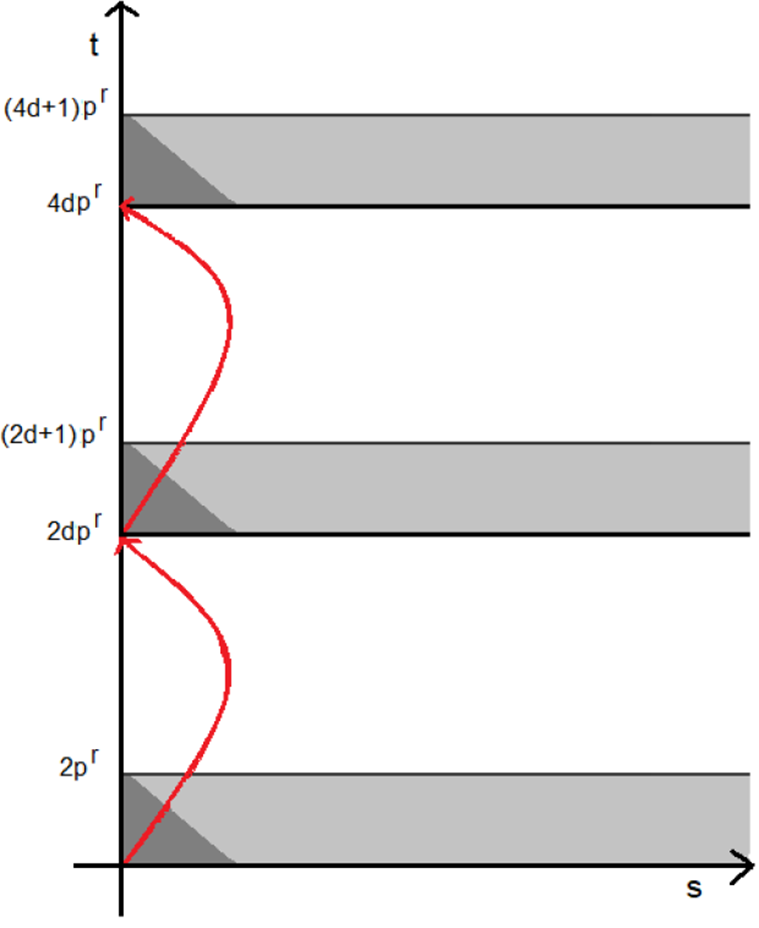
By applying
 $\psi $
ad libitum (as depicted in Figure 2), one can make induction on the previous result and get the following proposition.
The endomorphism of Proposition 7.7 and its iterations.

Proposition 7.11. For all
 $k \geq 1$
, the elements of the form
 $$ \begin{align*} \mathrm{Ext}_{\mathcal{P}}^s(F, G^{\lambda_{[kp^r]}}) \quad \textrm{with } s+|\lambda| \leq 2p^r+1 \end{align*} $$
survive in
 $\boldsymbol {II}_2^{*,*}$
.
Visually, what we have proved to survive is the lowest strip
 $\{t < 2p^r\}$
and infinite copies of the leftmost flag
 $\{s+t \leq 2p^r+1\}$
. Namely, there is one copy for each
 $k \geq 1$
, each one living in the strip
 $\{2dkp^r \leq t \leq 2(kd+1)p^r +1 \}$
. Now, we want to gather such a family of surviving elements to state a weak version of Conjecture 4.6. We do that in the following (quite heavy) proposition, which we next translate in a more readable and suggestive theorem.
Proposition 7.12. Let
 $F,G \in \mathcal {P}_d$
. For a composition
 $\lambda \in \Lambda (\infty , d)$
, denote by
 $G^\lambda $
the correspondent weight space of
 $G_{\boldsymbol {E_{r,0}}}$
. Then, there is an inclusion

Proof. The first summand comes from Theorem 5.1 and the second ones are the surviving elements of Proposition 7.11.
Notation 7.13 (Cohomological shifting).
Let
 $V^*$
be a
 $\mathbb {Z}$
-graded vector space and n an integer. The n-shifted space
 $(V_{[n]})^*$
is defined by
 $(V_{[n]})^i := V^{i-n}$
.
Notation 7.14. Set for briefness
 $\mathrm {Ext}_{\mathcal {P}}^{< 2p^r}(-,-) := \bigoplus \limits _{0 \le s < 2p^r} \mathrm {Ext}_{\mathcal {P}}^s(-,-)$
.
Definition 7.15. For all
 $G \in \mathcal {P}$
, set
 $\varepsilon _G := c_G^\Pi \cdot c_G \in \mathrm {Ext}^{2dp^r}(G_0^{(r)}, G_0^{(r)})$
, where
 $c_G$
is the class of Definition 7.4.
Theorem 7.16. Let
 $F,G \in \mathcal {P}_d$
. The map
 $\sum _{k \geq 0} (\varepsilon _G)^k \cdot \; res_0^{-1}$
induces an even graded natural inclusion

where the left-hand side is placed in superdegree
 $0$
.
Proof. Let us look at Proposition 7.12 and pick only the summands of the right-hand side such that
 $t < 2p^r$
and
 $s + |\lambda |<2p^r$
. By Theorem 5.2, the first one is naturally isomorphic to
 $\mathrm {Ext}_{\mathcal {P}}^*(F^{(r)}, G^{(r)})$
. By the proof of Theorem 5.1, the latter is included in
 via
 $res_0^{-1}$
. The second terms are just shiftings of this one via
 $\psi ^{*,*}$
, which is a natural injection in force of Proposition 7.9. By Proposition 7.7,
 $\psi ^{*,*}$
identifies here with
 $\varepsilon _G \cdot -$
. Therefore, each k-summand is isomorphic to a copy of
 $\mathrm {Ext}_{\mathcal {P}}^{< 2p^r}(F^{(r)}, G^{(r)})$
shifted by
 $2kdp^r$
, and is included in
 via
 $res_0^{-1}$
composed with
 $ (\varepsilon _G)^k \cdot -$
. The result follows.
With an application of (7-2), we immediately get the analogous result for twists of different parity.
Theorem 7.17. Let
 $F,G \in \mathcal {P}_d$
. Then, there is an even graded natural inclusion

where the right-hand side is in superdegree
 $0$
and the brackets
 $[-]$
denote a shift of cohomological degree.
7.1 An open question
One might wonder if the extension
 $\varepsilon _G := c_G^\Pi \cdot c_G$
writes always as a pth power. This is the case for
 $G = \mathrm {Id}$
, as pointed out in Lemma 7.5. We can show that the answer is positive for any G injective. Let us consider first the case
 $G=\otimes ^d$
. Indeed, thanks to Theorem 4.8, we can deduce that

which implies in particular that  is generated by the extensions
 ${\{\sigma _* (c_r^{\times d}), \sigma \in \Sigma _d \}}$
. Therefore,
 $c_{\otimes ^d}$
is by construction a multiple of
 $c_r^{\times d}$
. Applying Lemma 7.5(2)–(3) on the multiplication map
 $\otimes ^d \to S^d$
, one sees that, in fact,
 $c_{\otimes ^d} = c_r^{\times d}$
. Inverting the tensor product and Yoneda product via [Reference Giordano10, Lemma 1.6.11], one concludes that
 $e_{\otimes ^d} := c_{\otimes ^d}^\Pi \cdot c_{\otimes ^d} = (c_r^\Pi )^{\times d} \cdot c_r^{\times d} = \pm \: (c_r^\Pi \cdot c_r)^{\times d} = \pm \: ((e_r)^p)^{\times d} = (\pm e_r^{\times d})^p$
. So
 $e_{\otimes ^d}$
admits a pth root. (This brings a minus sign if and only if
 $d \equiv 2,3\ (\mod 4)$
.) Let us now prove the case
 $G=S^d_V$
. Since adding a parameter is harmless, we suppose
 $V=\Bbbk $
to simplify notation. From the previous discussion and Lemma 7.5, we can deduce an implicit relation
 $e_{S^d} \cdot m_{S_0} = m_{S_0} \cdot (e_r^{\times d})^p$
. Moreover, the functor
 is exact as a consequence of Theorem 4.8. Therefore, we have an exact sequence

where the second map is
 $\sum \limits _{\sigma \in \Sigma _d} \mathrm {Ext}^*(\sigma - \mathrm {Id}, \otimes _0^{d(r)})$
. Since
 $e_r^{\times d}$
is manifestly in its kernel, by exactness, there exists
 such that
 $e_r^{\times d} = e^{\prime }_r \cdot m_{S_0}$
. In particular, by the previous relation,
 $$ \begin{align*} e_{S^d} \cdot m_{S_0} = m_{S_0} \cdot (e_r^{\times d})^p = m_{S_0} \cdot (e^{\prime}_r \cdot m_{S_0})^p = (m_{S_0} \cdot e^{\prime}_r)^p \cdot m_{S_0}, \end{align*} $$
where the last equality is simply associativity of the Yoneda product. Note now that
 $m_{S_0} \cdot e^{\prime }_r$
is an element of
 . By exactness of the short sequence, that implies
 $e_{S^d} = (m_{S_0} \cdot e^{\prime }_r)^p$
, that is, we have found a pth root of
 $e_{S^d}$
. In particular, since the class
 $\varepsilon _G$
is additive with respect to G, we can conclude that
 $\varepsilon _G$
is a pth power whenever G is injective. However, we do not know if the same holds for noninjective G. The general existence of such a
 $2dp^{r-1}$
-extension would lead to a consistent improvement of Theorem 7.16. In a slightly different and more ambitious perspective, it might also provide a ‘universal class’ similar to those used by Chałupnik [Reference Chałupnik3] to construct by hand an isomorphism
 .
Acknowledgements
The author is grateful to his former PhD supervisor Antoine Touzé for the precious assistance he provided throughout this research work.