Introduction
I originally set out to apply to the Trinity some recent work I've done on the metaphysics of relations, building on Michael Loux's constituent ontology. I also intended to bring to bear work by both Kit Fine and Nicholas Asher on ‘qua’ objects. Before actually writing the article, though, I decided to re-read Thomas Aquinas's treatments of the Trinity, especially in the Summa Theologiae. I found that St Thomas had already said (at least, as I interpret him) most of what I had intended to say. Consequently, one could read this article as an interpretation and elaboration of Aquinas's account of the Trinity.
This convergence of my original thoughts with Aquinas's is perhaps not so surprising, since I had intended from the start to approach the problem of the Trinity from the point of view of a Strong Doctrine of Divine Simplicity (SDDS), of which Aquinas is the paradigmatic defender and exponent. It may be that there is only one possible pass through this theological mountain range, a pass that Aquinas has reconnoitered. And of course Aquinas's account was itself inspired by Augustine's, who shared the SDDS orientation.
Having said all this, I'm not going to offer this article as an interpretation of Aquinas or Augustine, although others are welcome to use it or parts of it for that purpose. I am simply going to try to develop and defend the best account of the Trinity that is consistent with the SDDS in contemporary language. And, to be precise, there is one important respect in which I differ markedly from the Augustinian–Thomistic account, and that is in my explanation for the defining characteristic of the Spirit, the Third Person of the Trinity. My account of the First and Second Persons, as you will see, follows the Augustinian–Thomistic line very closely.
My hope is to shed light on the sense in which God comprises one being but three distinct persons, without making use of any novel or non-standard account of strict (Leibnizian or Kripkean) identity. I also hope to explain why there are exactly three persons (neither less nor more), what distinguishes each person from the others, and why the Incarnation necessarily involved the Second Person (on this last point I also part company with St Thomas, who thought that any of the divine Persons could have taken part in the Incarnation).
In the first section below, I lay out the metaphysical framework that I will assume in this article: a strong doctrine of divine simplicity, a constituent ontology, and an Aristotelian–Thomistic account of intentionality. I argue in the second section that God's nature is relational in character: that to be God is to understand and to love, and for God understanding and loving are the same thing. I then introduce in the third section the notion of a qua-object, building on recent work by Kit Fine and Nicholas Asher. I propose that the three Persons are each qua-objects. In the following section I introduce the notion of real distinction, arguing that each of the three Persons is really distinct from the others, but that none of them is really distinct from the divine nature. This justifies our speaking of three Persons but only one God.
I then distinguish my account from competing theories of the Trinity in the fifth section of the article. I take up the differences between the Second and Third Persons in the following section, attempting to answer the question of why the Second Person became incarnate in Christ. In the penultimate section I consider whether there are any creatures with a trinitarian structure.
Framework assumptions
My most important starting point is, as I've said, the strong doctrine of divine simplicity (SDDS). I have several reasons for starting there. First, the SDDS accurately represents the sort of divine being whose existence one can infer from the best version of the cosmological or First Cause argument, since strong simplicity provides an elegant account of why there should be exactly one exception to the principle of sufficient reason (or of universal causality). Second, I prefer to work, where possible, within the Augustinian and Thomistic tradition. And, finally, the SDDS provides the resources for a neat solution to the conundrums of the Trinity and the Incarnation.
This third point is somewhat surprising, even ironic. It has often seemed that the SDDS is simply inconsistent with the Trinity (see Hughes (Reference Hughes1989) ). In any case, it might be thought paradoxical in the extreme to suppose that the best strategy for accounting for the plurality of Persons in the Godhead is one that relies on the absolute simplicity of divine being. Nonetheless, this paradoxical supposition is exactly what I will defend.
The SDDS is committed to the following claims:
S1. God is identical to His nature, which is either a universal or a trope.
S2. God is not the subject of accidents (either proper or contingent). His internal character is completely fixed by His nature.
S3. God is identical to His one and only action.
S4. God has no proper parts.
S5. God is identical to His own existence, which is (in some sense) the one and only instance of pure or absolute existence (Existence itself).
The most difficult of these to understand and to defend is thesis S5. Even though I am in fact convinced that S5 is correct, I won't need to appeal to it in this article. So, for present purposes, theses S1–S4 suffice to characterize the SDDS.
I am not here going to try to give a defence of the SDDS against objections like those of Plantinga's (Plantinga (Reference Plantinga1980) ). For present purposes, defences such as those of Valicella (God as a self-instantiating universal), Wolterstorff, Oppy, Pruss, or Brower (God as a trope-like truthmaker) would be adequate (Valicella (Reference Vallicella1992), Wolterstorff (Reference Wolterstorff1991), Brower (Reference Brower2008), Oppy (Reference Oppy2003), Pruss (Reference Pruss2003), Idem (Reference Pruss and Kvanvig2008) ). In my own view, since God's nature or essence is instantiable only by God, there is no need in His case for an individuating element, and so no reason why a property (whether a universal or a trope) cannot constitute by itself a concrete, particular substance, complete with causal power.
God is intrinsically invariant across times and across possible worlds (S2). Not only is God identical to his nature, he is also identical to his action (S3). That is, God performs a single action and that action is God. God's actual action is, consequently, a necessary being – it is, however, only contingently an action that includes creating a world, etc.Footnote 1
On the one hand, adopting the SDDS would seem to make accounting for the Trinity in an orthodox (non-modalist, non-Sabellian) way especially difficult, as Hughes (Reference Hughes1989) has argued.
On the other hand, by locating God in an extreme and exotic region of logical space, it might help to resolve what otherwise would be insoluble paradoxes. This is the hand that will in fact win out.
In addition to the SDDS, I will also rely on some form of moderate realism and on a constituent ontology, in Michael Loux's sense (Loux (Reference Loux2006) ). This sort of moderately realist constituent ontology comes in at least two versions:
1. Realist version. Universals are real things, really distinct from particulars. Particulars are bundles of universals plus some individuating element or elements (signate matter, haecceities, or bare particulars).
2. Nominalist version. Essences are particular things, really distinct from the essences of other particulars, but two numerically distinct essences can stand together in relations of ‘less than numerical’ identity (to use Scotus's terminology).
My own current preferences are for the second version. However, this isn't a very strong preference, and for the purposes of this article, either version or interpretation of moderate realism will do.
The constituent ontologist is committed to the idea that the relation of exemplification or formal causation can be identified with mereological participation: to instantiate a universal (on the realist version) or a trope (on the nominalist version) is simply to include the universal or trope as an immediate part (a part that is not a proper part of any other proper part); to be informed by an essence is simply to include that essence as an immediate part.Footnote 2
A Thomistic moderate realism includes an account of intentionality, as outlined in Aquinas's De Ente et Essentia (On Being and Essence).Footnote 3 According to this Thomistic theory of intentionality, the mind is able to think about and to understand essences of external objects by including essences as immediate proper parts of mental acts. This is in sharp contrast to the representationalism that has dominated the theory of intentionality since Ockham. Our mental acts do not include mere representations of the natures of things: instead, they include forms (i.e. individual essences) that actually share those intended natures. The relation between the internal vehicle of intentionality and its external object is either identity (the very same universal existing in both the mind and in the things that exemplify them) or conspecificity (the individual essences contained by the mind are conspecific with the individual essences of external things). I have offered a defence of such an account of intentionality in a recent article (Koons (Reference Koons2017) ).
The divine nature is relational
As Augustine and Aquinas recognized, the divine nature is inherently relational (STh I Q28, A2). This is in fact what makes the Trinity possible. If the divine nature were non-relational, no distinction between divine Persons would be possible.
In particular, the divine nature is an intentional relation: namely, perfect knowledge and perfect love. Given the SDDS, these are (in God's case) the very same relation.
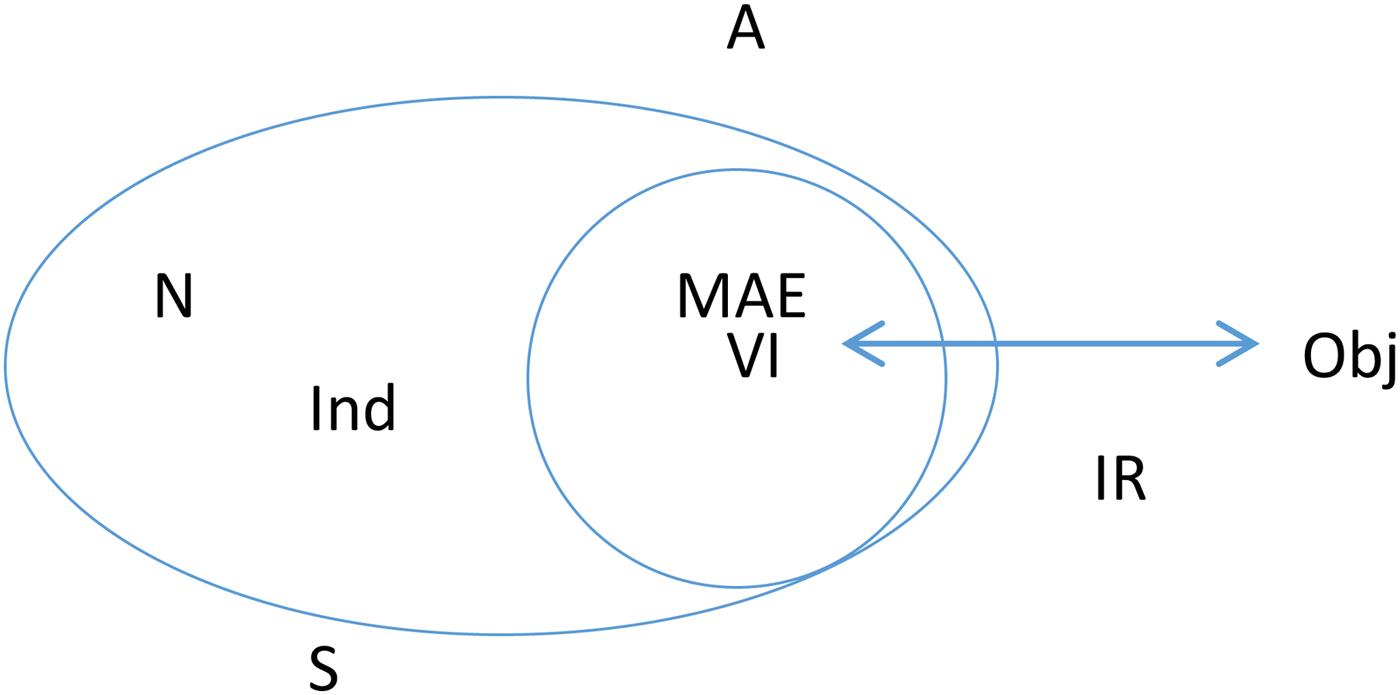
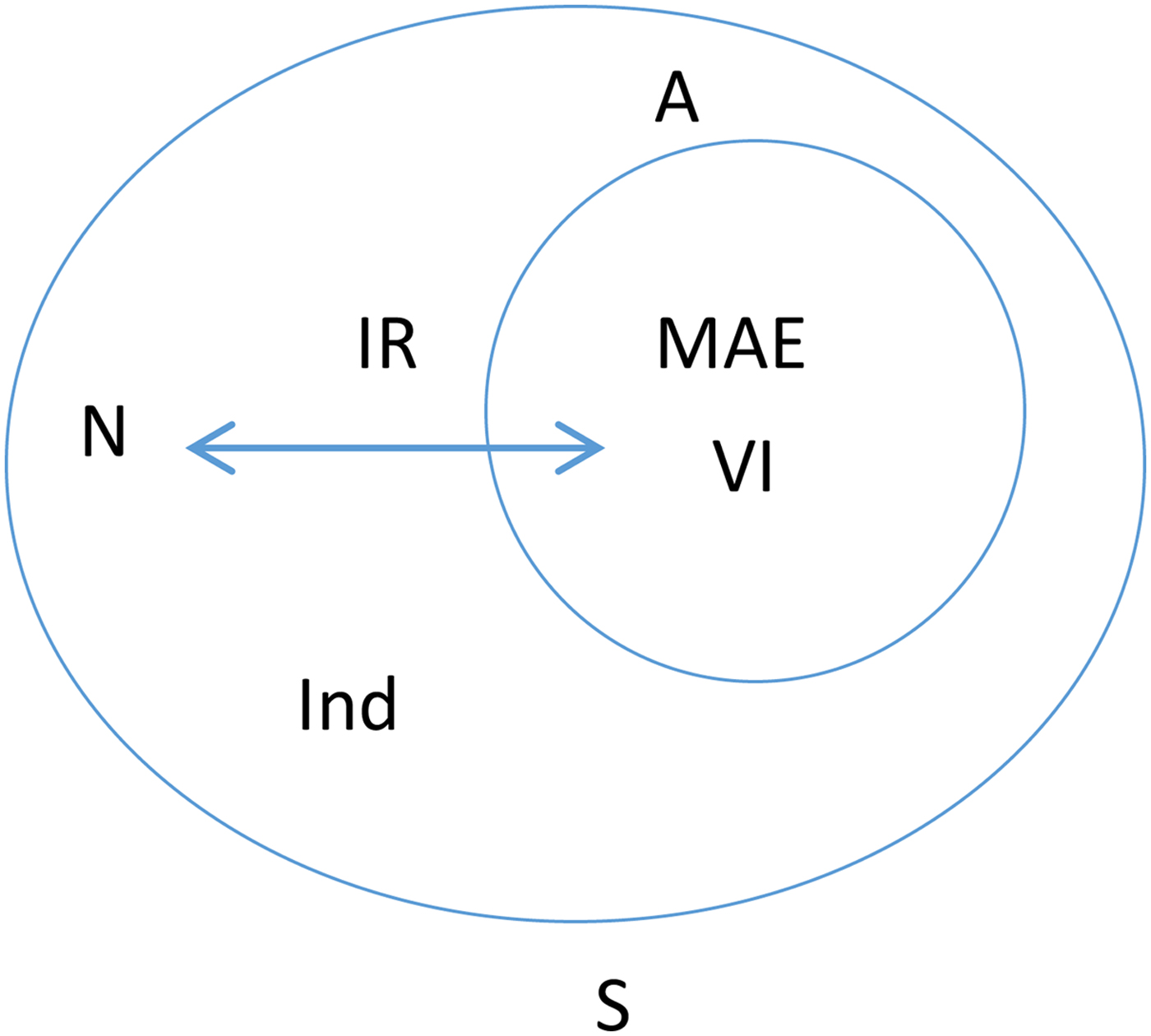
The first thing to recognize is that understanding is an internal relation between the mind and its external object, in G. E. Moore's sense. That is, the mental act and its object have intrinsic characters that are sufficient to ground the existence of the intentional relation of understanding. To represent this fact, we will have to dig into the internal structure of the mental act A. The act A must have its own nature or essence (MAE) and an internal vehicle of intentionality (VI), which is (in Thomistic terms) an intelligible species. This internal vehicle of representation will then be connected with the external object of understanding by the relation of identity (if each is identical to a single universal) or that of conspecificity (if each is a trope or individual essence). This relation of identity or conspecificity (being of the same species) is represented on these diagrams by a double-headed arrow.
To take a specific example: suppose that a human being succeeds in thinking about trees. This will involve a mental act A that contains an intelligible species of the tree-kind, which is the vehicle of intentionality (VI). The tree-ish intelligible species in the human act is of the very same kind as the natures of individual trees in the world. Nonetheless, the mental act A does not contain a substantial tree, since a tree requires the combination of a tree-nature with an appropriate individuator (a parcel of appropriate matter). On the Aristotelian–Thomistic account, all acts of understanding are veridical. Error is possible only when concepts are combined in propositional judgements (a mode of thought not currently under discussion).
The human being (a Thomistic substance) is represented in Figure 1 as composed by a nature, an individuator (for St Thomas, a package of spatially delimited prime matter), and a concurrent mental action, A. The mental action in turn is composed of its own accidental nature or essence (MAE) and the concept of vehicle of intentionality (VI). An intentional relation (IR) stands between that concept and its object (Obj), in this case external to the human being.
S = [N + Ind + A],
A = [MAE + VI],
IR = [VI + Obj]
MAE: essence of the mental act A
IR: intentional relation between A and its object
VI: internal vehicle of intentionality (intelligible species)
Understanding as an internal relation.

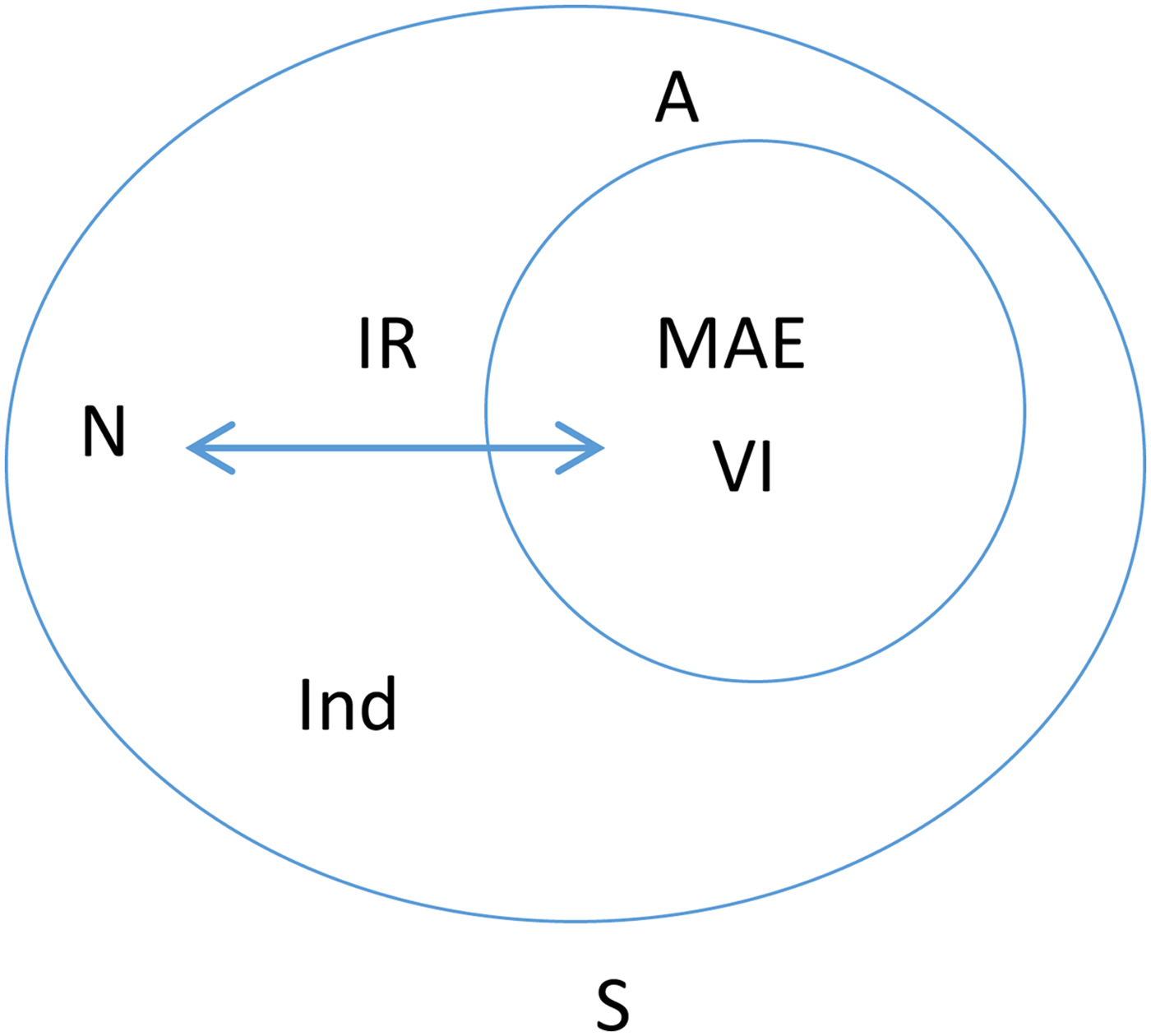
What happens when the mental act of understanding has something internal to the substance as its object? Suppose, for example, that the substance S comes to understand its own nature, N. In that case, we would have something like Figure 2. The only difference is that the vehicle of intentionality is now directed to a new object: in this case, an object internal to the human subject (in fact, the subject's own nature).
Understanding one's own nature.
In Figure 2, the internal vehicle of intentionality (VI) is conspecific with the thinker's own nature (on Aquinas's Aristotelian account of intentionality). The presence of the essence of the mental act MAE prevents VI from being the nature of a second thinking subject: instead, the species VI results only in the intentional existence of that nature (in S’s thought). Alternatively, if we were to adopt a non-Aristotelian account of mental representation, VI would be merely an internal representation of the nature N.
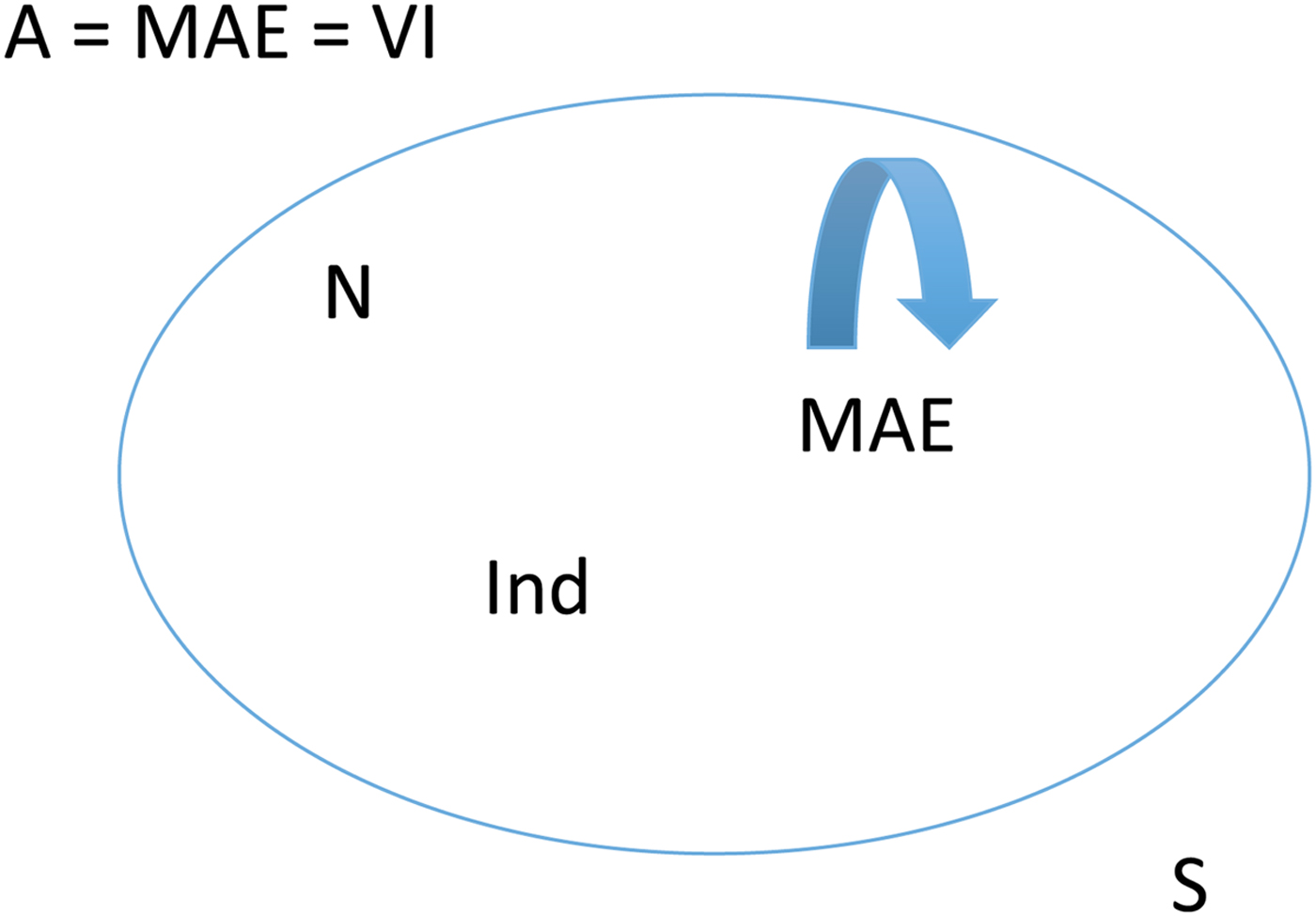
We can take the reflexivity to a greater extreme by considering an act of understanding that is directed towards its own nature or essence: an act of understanding reflexive understanding itself. This would seem to be at least in principle possible, whether or not human beings can actually achieve such a self-referential act of understanding. In Figure 3, the mental action has no separate vehicle of intentionality, since its own nature acts both as the vehicle and as the object of the intentional relation (represented by the reflexive arrow). The human being S continues to have his or her own nature N and own individuator Ind.
A = MAE = VI
Fully reflexive act of understanding.

In Figure 3, the distinctions between the act of understanding, its essence, its object, and its internal vehicle of intentionality have all collapsed into a single entity. The act can be simply identified with its essence, and that essence is both the internal vehicle of intentionality and the ultimate object of understanding. The MAE occurring in Figure 3 is self-referential by virtue of the fact that it is an immediate proper part of the whole substance – it is not combined with another nature as its intentional object. The essence MAE in such a case occurs within a thinking subject, as the essence of one of the subject's mental acts, but it is not combined with another essence or universal as its internal vehicle of intentionality. The essence MAE is the common essence of all acts of understanding, whether their intentional object is the essence MAE itself or some other essence.Footnote 4
Now, let's start moving up the Chain of Being from human beings to God. Suppose, for example, that we consider angelic self-knowledge (following St Thomas's account of angels). In that case, we would get something exactly like Figure 3, except that we can delete the individuator Ind (in Thomistic terms, the individual's signate matter) since each angelic nature is self-individuating. We still get, however, a clear distinction between the nature of the angelic substance and the nature of the angelic act of understanding, since no angel is identical to its own act of understanding. Instead, any act of understanding is an accident of the angel.
However, this distinction between substance and action disappears in the case of God, according to S3. God is identical to His own act of understanding, and the divine nature is identical to the nature of that act. Consequently, in the case of God's self-understanding, there is no distinct vehicle of intentionality that could be distinguished from God's own nature by virtue of its location within the distinct act of understanding. Thus, N and VI collapse together.
So, somewhat unsurprisingly, our representation of the relational fact of God's self-understanding is remarkably simple:
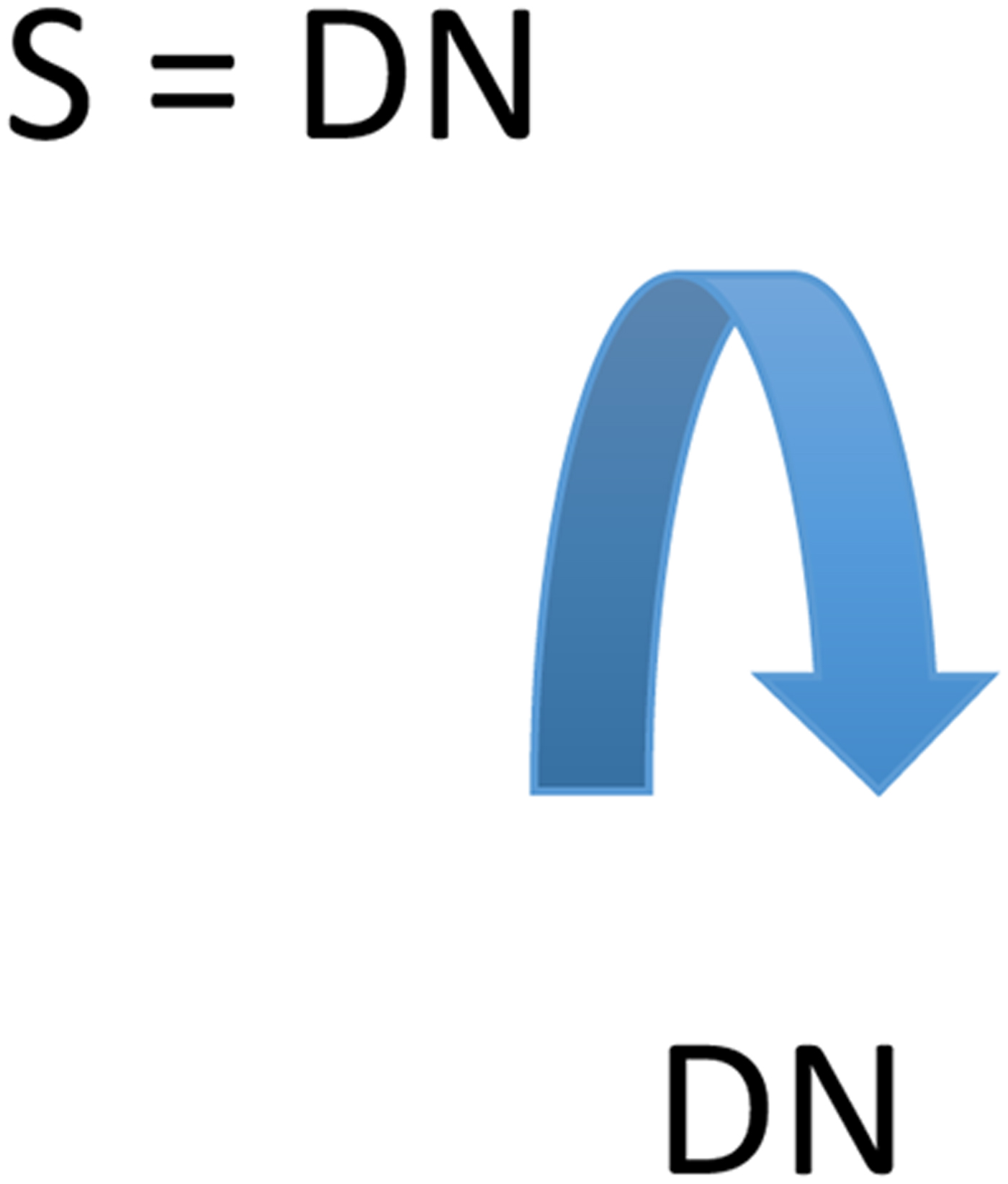
S = DN
So, in the case of God the divine essence is both mereologically simple and mereologically lonely or isolated (unencompassed by larger wholes). This simple divine essence is the truthmaker for the proposition that God knows (in a uniquely divine way) God: that is, that the divine nature stands in the divine–nature relation to the divine nature itself. We have a relational truth of the form RRR (i.e. relation R stands in the R relation to itself) that is realized by the simple truthmaker represented in figure 4. The circular arrow is added only for illustrative purposes: it doesn't represent a second element of the fact. Instead, it simply marks the fact that DN is relational and self-relating.
Divine self-understanding.

The divine nature plays three distinct roles within this simple fact: those of relator, relation, and relatee. One might guess that those three roles correspond to the three Persons, but not so. We have in fact four things to account for: the three divine Persons and the divine nature itself. The divine nature (and not any of the Person) is the relation itself. I will explain in the next section how we can obtain the missing fourth element.
One initial worry: typically, knowledge or understanding is not a real relation – that is, it is not real in the object known. In other words, intentional relations like knowledge typically involve a real modification of the knower but not of the object known. However, this fact does not hold in the case of self-awareness. Self-awareness is obviously a modification of the thing known (which is identical in this case to the knower).
In addition, the relation between a knower and the internal vehicle of intentionality (like a concept or mental representation) is always a real relation, real in both relata. Because of God's perfect knowledge, the intentional vehicle (intentio intellecta) of His knowledge is identical to His own nature. So, God's knowledge of Himself is a real relation, in respect both of the knower and of the known.
How does God know or understand other things? He understands all things through understanding Himself: Summa Theologiae I Q14, A5, A6, and A11. He knows possible things by knowing His own power, and He knows contingent things by knowing His own contingent will (as creator, sustainer, and permitter of all contingent states of affairs).
The three divine persons as relational qua-objects
Since God's simple nature is a binary relation, it can serve simultaneously as the truthmaker for God's possessing three distinct relational properties: that of knowing God, that of being known by God, and that of both knowing and being known by God. These three relational properties, in turn, give rise to three qua-objects (in Kit Fine's sense: Fine (1982), Idem (1985)):
Father = God qua knower (of God)
Son = God qua known (by God)
Spirit = God qua both knower of God and known by God
Fine introduces such ‘qua’ objects as part of a solution to the paradox of coincident objects, like a statue and its constituent lump of bronze. We can distinguish meaningfully between the statue qua statue and the statue qua lump: the latter, but not the former, can survive squashing. Such qua-objects have also found a place within contemporary formal semantics (see Asher (Reference Asher2006) for a survey). The location of ‘qua’ or ‘as’ is not a philosopher's (or a theologian's) invention. It belongs to natural language. We can distinguish, for example, between what Barack Obama does qua President (veto bills) and what he does qua father (direct his daughter's education).
Admittedly, an account of the Trinity in terms of such qua-objects sounds subjectivistic or anthropocentric, as though I were identifying the Persons with three distinct ways we have of thinking about God. However, I will dispel those worries in due course. The crucial point is this: these ‘qua’ distinctions are meant to correspond to distinct modes of divine self-understanding, not to distinctions within our understanding of God.
Any additional relational or semi-relational aspects of God, such as God qua knower or known, God qua knower or kumquat, or God qua not non-knower, would be wholly grounded in one or more of these three aspects.
Non-relational intrinsic aspects of God do not correspond to beings that are in any way distinct from God (or the divine nature) simpliciter, since God is not the subject of any accidents. So, God qua omniscient is simply identical to God simpliciter. It is not any sense a distinct qua-object. Similarly for God qua omnipotent, God qua existing, God qua just, and so on. From God's perspective, these are all simply the same thing – they do not even differ hyper-intensionally (that is, the terms are inter-substitutable in all contexts created by divine intentionality).
Extrinsic aspects of God, like God qua creator of the world or God qua friend of Abraham, do represent distinct qua-objects, but they all differ very radically from God simpliciter, in that all of them are merely contingent in their existence.
Let's call a qua-object a hypostatic qua-object when it is qua-object founded on God that meets the following conditions:
1. Like God, it is a necessary being. (So, no extrinsic qua-objects are hypostatic.)
2. It is not strictly identical to God simpliciter. (So, no qua-objects defined in terms of any of the monadic divine attributes are hypostatic.)
3. It is not wholly grounded in a logical or conceptual way on any other divine qua-object or objects. So, it must be fully determinate (non-general, non-disjunctive, and non-negative) in its definition.
My main claim is that, as a matter of metaphysical necessity, there are exactly three hypostatic qua-objects (namely, Father, Son, and Spirit, as defined above). This is because there are only two intrinsic, relational properties of God (knowing and being known), and these give rise (on purely logical grounds) to only three non-disjunctive combinations.
Why do we not get further hypostatic qua-objects, such as God qua lover, and God qua beloved? Given the SDDS, divine love and divine knowledge are the very same relation. Moreover, God knows that these are all the same. So, God qua lover is identical to God qua knower, and so on.
Given the SDDS, why isn't it the case that God qua knower and God qua known are also simply identical? It's true that the divine nature consists only of a single relation, but that relation really has a direction to it. It is in its essence non-symmetric. Hence, even from God's perspective, God qua knower of God and God qua known by God are distinct qua-entities. Moreover, the two relational properties, knowing God and being known by God, are not even extensionally equivalent. God understands many things that do not understand Him.
Now, we do not want to say that God qua-known-by-God does not know God, nor do we want to say that God-qua-knower-of-God is not known by God. Each of the three hypostatic qua-objects is fully divine and so possesses all of the normal attributes of God, is the agent of all the normal actions of God, and is the patient of all the normal passions of God (in particular, His state of being known and being loved by Himself).
We can, however, use qua-clauses to distinguish among divine actions and passions, just as qua clauses can qualify ordinary action verbs. For example, we can say that Obama speaks-qua-President or that Obama speaks-qua-private-citizen. Or that Obama is admired-qua-President or is admired-qua-father.
Similarly, we can distinguish: God knows-qua-knower and God knows-qua-known. Or, God creates-qua-knower and God creates-qua-known. God, that is the divine nature simpliciter, does all of these things, however qualified, but each of the divine Persons does only some of them.
In my treatment of qua-clauses, I follow Asher (Reference Asher2006). Asher takes qua-modified noun phrases as picking out intentional objects consisting of tropes or accidents, metaphysical parts of the base object. In the case of God, there are no metaphysical parts. However, there are three distinct divine intrinsic, non-disjunctive, relational properties, and we can take the qua-objects to refer to these.
Semantically, there are four distinct sets of properties associated with the divine nature and with each of the three persons. We can further divide these properties into properties expressed by three classes of predicates:
1. Normal, unqualified predicates.
2. Normal, qualified predicates.
3. Non-normal or higher-order predicates.
The first class includes everything that can be said of God apart from any use of qua-clauses and apart from any language (like talk of Persons or qua-objects) that depends on the use of qua-clauses. So, the first class includes predicates like: ‘is divine’, ‘is eternal’, ‘is the first cause’, ‘is absolutely simple’, ‘is omnipotent’, ‘is perfectly loving’, ‘is omniscient’, ‘created the world’, ‘will judge all souls’, etc.
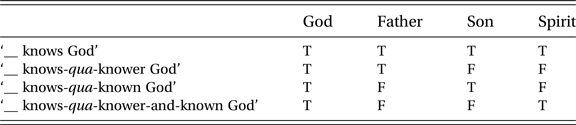
The second class corresponds to one-place predicates of the first class with the addition of one of the three personal qualifications: i.e. qua knower, qua known, or qua knower-and-known (i.e. as Father, as Son, and as Holy Spirit). Each predicate in the second class is true of God simpliciter and of exactly one of the three persons. For example, is omniscient qua knower is true both of the divine nature and of the Father, but not of the Son or the Spirit. Similarly, loves qua known is true of the divine nature and of the Son, but not of the Father or Spirit.
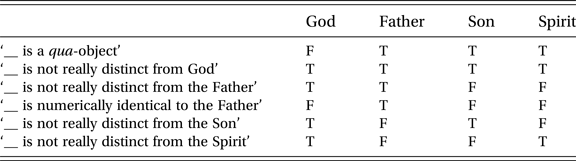
The third class includes such predicates as ‘is a qua-object founded on the divine nature’ or ‘is identical to the divine nature simpliciter’. This third class includes some predicates that are false of the divine nature, others that are true of the divine nature but true of the each of the divine Persons, and every other such permutation of application-conditions. See Table 1:
Qua-actions

Thanks to the second and third class of predicates and Leibniz's law (the indiscernibility of identical things), we can conclude that each of the divine Persons is numerically distinct from the others and from the divine nature. Hence, there are four distinct entities, each of which is divine. How then can I avoid the charge of tetratheism?
Real distinctness and the lack thereof
In ordinary cases, it is very plausible to say that qua-objects founded on a common base are not really distinct from each other or from their base, even if we want to assert that they are numerically distinct entities. Real distinctness is a stronger condition than mere numerical distinctness, and lack of real distinctness is a weaker condition than strict identity.
Lack of real distinction corresponds to Aquinas's notion of identitas secundum rem. Contra Hughes (Hughes (Reference Hughes1989), 218–220), this is not the same as simple identity: it is a logically weaker relation.
I do want to affirm that each of the three Persons is not really distinct from the divine nature, and that is my main line of defence against tetratheism. To say that there is one God is to say that there is one entity such that every divine being is not really distinct from it.
Monotheism: There is one and only one thing such that no divine being is really distinct from it.
However, I do not want to go on to assert that none of the three Persons is really distinct from the others. In fact, I claim that each divine Person is really distinct from the others. Thus, I claim that lack of real distinctness is not an equivalence relation: it is reflexive and symmetric, but not transitive or Euclidean.Footnote 5
So, what do I mean by a real distinction? Unlike Scotus, Ockham, Descartes, or Hume, I do not take real distinction to entail possible separation. Here is a complete axiomatization of the relation I have in mind (Table 2):
A1. Nothing is really distinct from itself.
A2. Any two entities that are not qua-objects are really distinct if and only if they are not identical.
A3. Any qua-object q is really distinct from any object that is neither a qua-object nor identical to q’s ultimate base.
A4. No qua-object is really distinct from its base, or from the base of its base, etc.
A5. Any two qua-objects with really distinct bases are also really distinct.
A6. Two qua-objects with the same ultimate base are really distinct if and only if they are numerically distinct and the distinction between them is intrinsic to their ultimate base.
A7. All qua-objects are well-founded: separated by a finite number of qua-clauses from some ultimate base that is not a qua-object.
My basic idea is that the sixth axiom is necessary and sufficient to distinguish my account from modalism or Sabellianism. What's objectionable about modalism is that it makes the distinction among the divine Persons extrinsic to the divine nature.
Real Distinction

What do I mean by the distinction between qua-objects’ being intrinsic to the base? Or, in this case, intrinsic to the divine nature?
Intrinsic distinction
The distinction between q 1 and q 2 (with a common base b) is intrinsic to that base if and only if there is some relation R such that Rq 1q 2, R metaphysically entails the numerical distinctness of its relata (i.e. R is, with metaphysical necessity, irreflexive), and the fact that Rq 1q 2 is intrinsic to the base b.
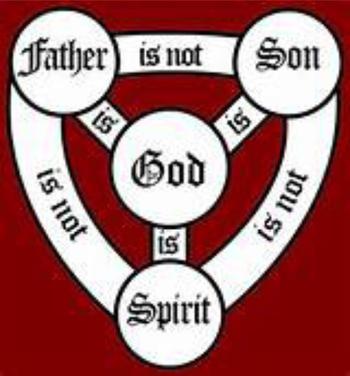
In the case of the Trinity, this intrinsic property is Love. Love is the intrinsic property of the divine nature, but love (in the sense of agape or caritas) is a kind of relationship, a friendship (STh II.II Q23.A1). Aquinas explains there that mere well-wishing is not sufficient for charity: there must also exist a relation of mutual communication. This relationship of love metaphysically entails the numerical distinctness of the three divine persons and thereby, thanks to axiom A6, it also entails their real distinctness. Hence, each divine person is really distinct from the others, but not really distinct from its base. This fits perfectly the classical diagram of the Trinity, which I remember well from my childhood (Figure 5):
Traditional diagram.

But can't one love oneself, just as one can understand oneself? No, not if love is understood in the sense of charity (caritas), which Aquinas identifies as a form of friendship. One can have good will towards both oneself and others, but the bond of charity (two persons each giving to and receiving from the other) can exist only between distinct persons.
The relation of divine love is a qualified version of the divine nature. Specifically, the relation of divine love is the disjunction of six conjunctions:
Divine love = (λx)(λy)[ (x knows-qua-knower y) & (y knows-qua-known x) ∨
(x knows-qua-knower y) & (y knows-qua-knower-and-known x) ∨
(x knows-qua-known y) & (y knows-qua-knower-and-known x) ∨
(x knows-qua-known y) & (y knows-qua-knower x) ∨
(x knows-qua-knower-and-known y) & (y knows-qua-knower x) ∨
(x knows-qua-knower-and-known y) & (y knows-qua-known x) ]
This formula ensures that divine love is both irreflexive and symmetric.
Real distinctions among qua substantial objects are not limited to the Trinity, but they may be limited to qua-objects whose base is conscious or is a mind. Consider, for example, Adam qua sentient and Adam qua rational. The corresponding intrinsic property of Adam would be something like his capacity for induction, abduction, and abstraction. The process of abstraction requires the distinctness of Adam's sensory and rational aspects, since abstraction takes information from one aspect as input and provides new conceptual resources for the other aspect.
Similarly, there is a real distinction between Eve qua seeing and Eve qua hearing (or smelling, tasting, etc.). The intrinsic property would be the common sense (in Aristotle's sense, in De Anima, Book III), i.e. Eve's capacity to combine information about the existence and primary qualities of objects based on information from two or more distinct sense modalities.
If Freud is correct, then we will find a real distinction between, say, Sigmund qua conscious but un-self-conscious vs Sigmund qua self-conscious. In this case, the intrinsic property would be something like repression. Repression requires a conflict between the two aspects (the so-called conscious and unconscious minds). Similarly, the id, ego, and superego would be plausible cases of really distinct qua-objects based on the human psyche.Footnote 6
There is a crucial difference in each of these cases from the case of the Divine Persons: each of the divine Persons constitutes a complete person, in the sense that each one satisfies all of the simple predicates true of the complete and undivided divine nature. This is not so in the case of human beings, because our cognitive faculties are so imperfect and abstractive. Neither Sigmund qua conscious-of-self nor Sigmund qua conscious-of-other-things-but-unconscious-of-self constitutes anything close to a complete, functioning human being. Similarly, neither Adam qua sentient nor Adam qua rational could stand alone as a substance.
There is one possible case of really distinct qua-objects that may arise outside the realm of conscious beings, the case of actions and passions, as discussed by Aquinas in Summa Theologiae I.Q28.A3 ad 3 (with reference to Aristotle's Physics, Book III, 202b20). Actions and passions are plausibly qua-objects, based on some change in the patient: change qua exercise of agent's active power on patient (the action) vs change qua alteration of patient as a result of the exercise of agent's active power (the passion). The action and passion stand together in a causal-priority relation: the action prior to the passion. Yet, both have the same base – the alteration in the patient. The action and passion are really distinct from each other, since the causal relation between them is intrinsic to the change. This intrinsic causal relation entails the numerical distinctness of the action and the passion. The key difference in this case from that of the Trinity is this: the base change, the action, and the passion are all in the category of accident, not substance.
Objection
Won't the divine Persons be really distinct from the divine nature? If so, the result is the loss of monotheism, because I would no longer be able to claim that there is one God such that no other god is really distinct from it. We will have in fact four really distinct deities. In particular, if the relation of love logically entails the real distinctness of the relational qua-objects from each other, won't it necessarily also entail the real distinctness of each Person from the divine nature? After all, they can't all be strictly identical to the divine nature while distinct from each other.
In a word, no. The reality of divine love entails only that the Persons are really distinct from each other: it doesn't entail that any one of Them is really distinct from the divine nature (each is in fact only numerically and not really distinct from the nature). The relation of Love requires (given axiom A6) that its relata be really distinct from each other, but no divine qua-object can be really distinct from its base (the divine nature). Hence, the divine nature cannot love or be loved by any of the divine Persons.
Another objection
As Christopher Hughes has argued (Hughes (Reference Hughes1989), 237–238), how can the three Persons be really distinct from each other without being really distinct from the base? Lack of real distinction is an identity-like relation: how can such an identity-like relation not be Euclidean?
As the reader may verify for herself, it is in any case very difficult to come up with any kind of identity relation that is non-Euclidean: any relations I can think of which confer a limited kind of indiscernibility, such as Lewis’ identity-at-time-t, or being of the very same matter and the very same form, are Euclidean. So Aquinas’ account of the Trinity does not by any means cease to be logically problematic if we suppose (contextually) that identity secundum rem is an identitylike relation weaker than identity. (ibid., 237 n. 31)
Hughes's objection depends on a non sequitur: just because a relation is like identity in some respects does not mean that it must be like identity in all respects. Each qua-object has an intimate relation with its base that it does not share with any of its fellow qua-objects. In the case of the Trinity, each divine Person shares with the divine nature not only all of the simple divine attributes and actions, but also all of the actions and passions that are qualified by its own qualifying property. That is, God qua known shares with the divine nature all actions and passions of the form Fs-qua-known. It is only with respect to actions and passions that are qualified in other ways (Fs-qua-knower or Fs-qua-knower-and-known) that God qua known differs from the divine nature. In contrast, any two divine Persons differ from one another with respect to all such qualified actions and passions, so a deeper distinction holds in that case. This deeper distinction is needed in order for us to speak of the Persons’ loving each other, given the impossibility of reflexive self-love.
Differences from other accounts
I will distinguish my account from three others: the Brower–Rea composition model (Brower & Rea (Reference Brower and Rea2005) ), modalism, and social trinitarianism.
The Brower–Rea composition model (Brower & Rea (Reference Brower and Rea2005) )
Both accounts in effect rely on qua-objects. For example, Brower and Rea identify the Father with God qua Father (i.e. God qua subject of paternity), just as we can identify artefacts like statues with qua-objects. The statue of Venus is simply the marble qua Venus-shaped, but the pillar could be the very same marble qua roof-supporter. Of course, from the perspective of the SDDS, all such cases of composition will be bad analogies for the Trinity.
My account differs from that of Brower and Rea in that, on my account, the relation that distinguishes the three Persons is identical to the divine essence. The divine essence is itself relational. In contrast, Brower and Rea require the addition of three really distinct properties (paternity, sonhood, and spirituality) to the divine substance as three different intrinsic qualities. In place of three intrinsic qualities, I rely on three distinct relational properties definable in terms of the one binary divine relation.
On the Brower-Rea account, there is something incomplete about the divine nature. We don't yet have a complete divine being until that so-called ‘divine’ nature is supplemented by one of the three personal properties (paternity, sonship, or spirituality). Therefore, the ‘divine’ nature is only a proto-divine substrate, and we have three different ways of being divine, corresponding to the three Persons. The three Persons have a common substrate, but substrate is incomplete and only proto-divine. No divine entity results until we add one of the three personal attributes. Thus, the charge of tritheism seems inescapable, since each Person is divine in His own unique and incomparable way.
In contrast, on my account each of the three Persons is divine in the same way – simply by being a divine qua-object, and the divine nature is complete and fully divine in itself.
Moreover, Brower and Rea cannot explain in what sense the divine nature is predicable of God or of each of the Three Persons. For them, the divine nature is analogous to matter and not to form, and each of the Divine Persons realizes a distinct form of that matter. As Alexander Pruss (Reference Pruss, McCall and Rea2009) observes, the analogy should run the other way: the Persons are analogous to matter as individuator and the divine nature to an essential form. The divine nature is fully predicable of my relational qua-objects, since they are relata of the intentional relation that is that divine nature.
In addition, Brower and Rea cannot explain why there are exactly three person-constituting properties. In contrast, the Augustinian–Thomistic tradition (to which my account belongs) offers a principled explanation of the number of divine Persons in terms of the relationality of the divine nature. Finally, Brower and Rea offer no explanation of what differentiates each of the personal properties (paternity, sonhood, or spirituality) from the others. These personal properties cannot pertain to the powers, dispositions, or character of the three divine Persons, since each is omniscient, omnipotent, and omnibenevolent. Therefore, the personal properties must be something purely qualitative and causally inert. What is then surprising is that the divine nature would be in need of supplementation by such pure qualities in order to constitute complete persons. How could the mere addition of such qualities convert a sub-personal substrate into a divine Person?
Modalism
My account is not a form of modalism or Sabellianism. The distinction between the three Persons is real and intrinsic to the divine nature. It is a distinction that is necessary and does not in any way depend on how we (contingent creatures) think about God, or how God has chosen to reveal Himself or relate Himself to us.
Social trinitarianism
My account is also not a version of social trinitarianism, since on my view the divine nature is a divine entity in its own right – it is not merely predicated of the three distinct Persons. None of the divine Persons is really distinct from that divine nature.
In addition, I have a logical explanation for the existence of exactly three Persons. Social trinitarians either have no explanation at all or must appeal to three as the optimal number of divine Persons. However, appealing to optimality makes the existence of the Second and Third Persons a matter of divine choice (even if necessarily determined and not free or contingent choice). This raises the spectre of a kind of crypto-Arianism, with the Second and Third Persons’ being dangerously close to mere creatures.
The Second and Third Persons
The Incarnation of the Second Person, not the First or Third
The assumption of the human nature by God does not affect the divine nature intrinsically, although it does affect Christ's human nature intrinsically. Hence, it is not qua knower that God is incarnate in human nature but rather qua-known-by-God-as-incarnate. So, it is qua Son, and not qua Father or Spirit, that God is human. Here I part company with St Thomas, who held that any of the three Persons could potentially have been incarnate (STh III, Q40, A5, 6).
The union of the divine nature and Christ's human nature is something created and contingent. It is the result of a divine choice. All three divine Persons can be correctly counted as the initiators of that choice, but it is only insofar as this choice is known by God that the unity between the two natures can exist. Hence, it is God-qua-known, qua-object of the divine self-understanding, that functions as the ultimate subject of the human acts and attributes of Christ.
We should distinguish between the hypostatic union of the divine nature with the human nature of Christ and the personal identity of the second Person of the Trinity and the man Jesus of Nazareth. The first is a simple property of the divine nature, but it is an extrinsic property, making no intrinsic difference to that nature. The divine nature – and thereby each of the three Persons – is in a state of hypostatic union with the human nature of Christ. However, the personal identity with the second person of the Trinity is a qua-property of God: it is God-qua-known who is identical to the person of Christ. Hence, only the second Person of the Trinity enjoys this fact of personal identity: the Person of Christ is not identical to the Father or to the Spirit or to the divine nature as such.
The procession of the Spirit, and the association of Spirit and love
I identify the Spirit with God qua-knower-and-known. This associates the Spirit with love, because love requires distinction and similarity between the divine Persons, a distinction and similarity that the Spirit incorporates in His very definition.
The Father and the Son love each other – love depends upon the differentiation of two persons, who can then love one another as an expression of their similarity. It is the real distinction between the Persons that enables the divine nature to count as a relation of love (and not just of knowledge). The Spirit is, therefore, God qua-lover-and-beloved: He incorporates the fullness of divine love within His defining property.
Objection
Is there a danger here of an infinite progression? Can't we distinguish between God the Father qua lover-of-the-Son and God the Father qua-lover-of-the-Spirit? Can't we construct similar higher-order qua-objects, generating an infinite hierarchy of Persons?
No: since divine love is symmetrical while divine knowledge is non-symmetric, the truthmaker for any claim about divine love requires a pair of distinct divine Persons. The existence of three distinct Persons ensures the existence of three distinct unordered pairs of distinct Persons: {Father, Son}, {Father, Spirit}, and {Son, Spirit}, as well as one triple {Father, Son, Spirit}. Consequently, we can distinguish God qua Father-loving-the-Son and God qua Son-loving-the-Spirit, but this is simply to distinguish the two pairs {Father, Son} and {Son, Spirit}. No infinite progression threatens, nor any Persons beyond the original three.
Further objection
Couldn't we generate an infinite progression by ramifying the qua-clauses? For example, can't we distinguish God qua Father qua Son (i.e. God qua knower qua known) from God qua Father qua Spirit? And won't we also distinguish each from the Father simpliciter? Can't we generate an infinite number of distinct, hypostatic qua-objects by compounding the qua clauses without limit?
Any ramified or high-order qualification of divine action will necessarily be identical to one of the three basic qua-actions: that is, to
(i) knowing qua-knower,
(ii) knowing qua-known, and
(iii) knowing qua-knower-and-known,
or in other words, to knowing-qua-Father, knowing-qua-Son, and knowing-qua-Spirit.
Consider, for example:
(1) God knows qua-knower-qua-known.
This action is logically impossible, since the properties that are true of God qua knower are incompatible with the properties that are true of God qua known. In contrast, consider case (2):
(2) God knows qua-known-qua-known.
Case (2) is identical (and, given God's omniscience, hyper-intensionally equivalent) to case (3):
(3) God knows qua-known.
In general: Collapse of ramified divine qua-actions
C1. It is possible for God to know-qua-F-qua-G . . .-qua-H only if F = G = . . . = H.
C2. For God to know qua-F-qua-F . . . -qua-F is for God to know qua-F (where F, G, . . . , H range over the three Personal qualifications).
Thus, there are only three possible divine qua-actions, and so only three Persons, each one characterized by one of the three actions.
A final objection
Why doesn't human knowledge give rise to a trinity of persons within each human being? Similarly, why aren't angels trinitarian in structure? For example, can't we distinguish President Obama qua self-knower vs President Obama qua-known-by-self?
We certainly can recognize these two really distinct qua-objects, both based on President Obama. However, neither is a complete human being or a person. The second especially (Obama qua known-by-Obama) is radically abstract and incomplete.
What about angels? Could it be that Gabriel qua self-knower and Gabriel qua known-by-self are two really distinct and complete persons?
I'm not sure that this would be a devastating consequence, if it did indeed follow. Do we really know that angels aren't trinitarian in structure? Would it be so terrible if they were? Is there anything heretical in the idea?
Nonetheless, I doubt that such generation or procession of persons does occur in angelic understanding. There is for angels a distinction between the act of being and the act of understanding. It is not the case that for angels to be is to understand. But in God's case there is no such distinction possible. Therefore, God's essence qua understood-by-God comprises all that God's essence is. This is why both the divine Word and the divine Spirit subsist as fully divine.
Reply to Objection 1. ‘To be’ and ‘to understand’ are not the same in us. Hence that which in us has intellectual being, does not belong to our nature. But in God ‘to be’ and ‘to understand’ are one and the same: hence the Word of God is not an accident in Him, or an effect of His; but belongs to His very nature. And therefore it must needs be something subsistent; for whatever is in the nature of God subsists; and so Damascene says (De Fide Orth. i, 18) that ‘the Word of God is substantial and has a hypostatic being; but other words [as our own] are activities if the soul.’ (STh I, Q34 a2)
For an angel, to be and to understand are not the same – acts of understanding are accidental to the angel's being (even if proper accidents). Consequently, as we saw in Figures 2 and 3 above, an angel's act of understanding must either have its own substantial nature or the nature of its act of understanding as its object. In neither case do we get more than one complete angelic person. At most we could get an accident that is trinitarian, not a substance.
Conclusion
My account depends on some quite controversial assumptions: a strong doctrine of divine simplicity, a constituent ontology, a Thomistic realist account of intentionality, and the thesis that the divine nature is relational, in particular, that it is an intentional relation. But the resulting view has many advantages: a clear explanation of how the three Persons are distinct and yet there is only one God, an explanation of why there must be exactly three Persons, and the avoidance of modalism. For orthodox Christians, these advantages should make the controversial assumptions more palatable. So long as the assumptions are merely controversial and not logically incoherent, the account succeeds in demonstrating the logical consistency of orthodox trinitarianism.