Introduction
Surgical pulmonary valve replacement is commonly required for patients with CHD who underwent repair of lesions that affect the right ventricular outflow tract or who required native pulmonary valve explant (e.g. Ross procedure) for repair of other lesions. Reference Crago, Winlaw and Farajikhah1 Bioprosthetic heart valves are typically used for their decreased thrombogenicity and lack of need for lifelong anticoagulation, but they are less durable than mechanical heart valves. Reference David2,Reference Chen, Chen and Chang3 Short-term anticoagulation is often used in bioprosthetic heart valves to improve valve longevity by preventing early micro and macro thrombus formation during endothelisation to prevent valve dysfunction. Reference Payne, Burns and Glatz4–Reference Kalra, Raza and Jafry6 While valve failure requiring replacement is often used as an outcome, clinically significant valve dysfunction, defined by moderate or greater regurgitation or stenosis on echocardiography, or hypo-attenuated leaflet thickening or hypo-attenuation affecting motion on high-resolution CT angiography, can be markers for impending valve failure. Reference Garcia, Fukui and Dworak7
Current adult guidelines suggest oral anticoagulants may be beneficial in adults for the first 3 months following bioprosthetic heart valve implantation, but much of this data relates to valves in the aortic position. Reference Egbe, Connolly and Miranda8,Reference Otto, Nishimura and Bonow9 In addition, while data are emerging for direct oral anticoagulant use in bioprosthetic heart valves, the only currently recommended oral anticoagulant after valvular surgery is a vitamin K antagonist. Reference Magro and Uva5,Reference Kalra, Raza and Jafry6,Reference ElBardissi, DiBardino and Chen10–Reference Guimarães, Lopes, de Barros, etal and Investigators15 Use of anticoagulation for preserving bioprosthetic heart valve function in the pulmonary position still lacks standard guideline recommendations in adults and, given the paucity of data, there is no uniform approach in paediatrics. Reference Egbe, Connolly and Miranda8,Reference Otto, Nishimura and Bonow9
Currently, the only Food and Drug Administration-approved indications for the use of direct oral anticoagulants in paediatric patients are treatment of venous thromboembolism (VTE) and Fontan-associated thromboprophylaxis. Reference Mérie, Køber and Skov Olsen13,Reference Kostyunin, Yuzhalin and Rezvova16,Reference Sjoberg, Whiting, Curry, Lavery and Larmarange17 Direct oral anticoagulants use for bioprosthetic heart valve thromboprophylaxis is currently off-label, thus, dosing is not well defined. The primary objective of this study was to evaluate the safety of using short-term direct oral anticoagulant thromboprophylaxis in paediatric patients undergoing surgical pulmonary valve replacement.
Methods
Study design and patient selection
This was a single-centre, retrospective study of patients admitted to Children’s Healthcare of Atlanta from January 1, 2020, to July 31, 2024. This study was approved by the institutional review board at Children’s Healthcare of Atlanta. Patients were included in this study if they were less than 18 years old, underwent surgical pulmonary valve replacement, and received a direct oral anticoagulant for short-term anticoagulation in addition to lifelong low-dose aspirin therapy (standard of care) post heart valve insertion for thromboprophylaxis.
The primary safety endpoint was a composite safety score comprising major bleeding, clinically relevant non-major bleeding, bleeding-related readmission within 90 days, and medication discontinuation prior to 90 days. Secondary endpoints included the individual components of the composite safety score with the addition of valve thrombosis within 6 months, valve complication requiring re-intervention within 6 months, and length of stay (LOS). Valve complications were defined as valve dysfunction (moderate or greater stenosis or regurgitation) or valve re-intervention. Major bleeding and clinically relevant non-major bleeding were defined according to the International Society on Thrombosis and Haemostasis. Reference Fasulo, Biguzzi and Abbattista18 Major bleeding includes a fall in haemoglobin ≥2 g/dL, or transfusion of ≥2 units packed red blood cells (PRBC) or whole blood, or occurs in a critical location (intracranial, intraspinal, intraocular, retroperitoneal, intraarticular, or pericardial), or causes death. Clinically relevant non-major bleeding includes any bleed that does not meet criteria for major bleeding and requires any surgical or medical intervention to treat bleeding.
Anticoagulation strategy
All patients were prescribed aspirin dosed 3–5 mg/kg/dose once daily with a maximum of 81 mg/dose as standard of care. Additionally, patients were prescribed a direct oral anticoagulant for 3 months after surgical pulmonary valve replacement. Rivaroxaban was used for patients <35 kg and dosed according to the EINSTEIN-Jr phase 3 trial. Apixaban was used for patients ≥35 kg and was dosed according to the trial titled apixaban for prevention of thromboembolism in pediatric heart disease (SAXOPHONE), in which results are not yet fully published (Supplemental material). Reference Payne, Burns and Glatz4,Reference Male, Lensing and Palumbo19 Dosing mimicked therapeutic dosing for VTE. During the study period, the direct oral anticoagulant was initiated once deemed safe and appropriate by the primary cardiothoracic surgeon.
Statistical analysis
The relationships between baseline characteristics and an adverse event were first assessed using descriptive statistics with median (Q1, Q3) for continuous variables and counts with percentages for categorical variables. Continuous data were compared using Wilcoxon rank-sum tests, and categorical data were compared using Chi-squared or Fisher’s exact tests for counts less than 5. Characteristics identified as a significant risk factor (p < 0.05) for an adverse outcome were additionally assessed using bivariate logistic regression. Results were presented as odds ratios and 95% confidence intervals. To assess the robustness of regression estimates, a sensitivity analysis was completed to determine the impact of influential observations identified using Cook’s distance and to examine potential bias from a small sample size using a Firth penalised likelihood logistic regression (Cook 1982, Firth 1993). All tests were two-sided, excluded unknown values, and p-values <0.05 were considered significant. Analyses were completed in R, version 4.4.0 (R Foundation) from March 2024 to November 2024 and used packages gtsummary and ggstatsplot. Reference Sjoberg, Whiting, Curry, Lavery and Larmarange17,Reference Patil20
Results
Thirty-four patients were identified as having received a direct oral anticoagulant with aspirin following surgical pulmonary valve replacement, of which 20 were males (59%) with a median age of 14 years (IQR: 11, 15) and weight of 45 kg (IQR: 35, 55). The most common underlying diagnosis was pulmonary atresia with ventricular septal defect (9/34, 26%) followed by double outlet right ventricle (13/34, 38%) (Table 1).
Baseline demographics by patients with at least one adverse eventFootnote ***

ToF= tetralogy of Fallot; PA/VSD= pulmonary atresia with a ventricular septal defect; VSD= ventricular septal defect; DORV=double outlet right ventricle; DOAC = direct oral anticoagulant.
* Median (Q1, Q3); n (%).
** Wilcoxon rank-sum test; Fisher’s exact test.
*** Adverse event defined as patients with at least one of the following outcomes: major bleeding, minor bleeding, 90-day readmission for bleeding, or medication discontinuation.
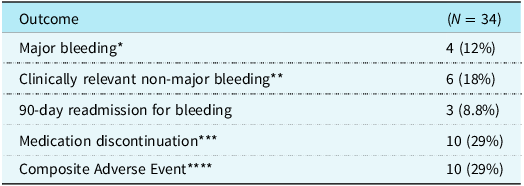
Ten patients met the composite endpoint (10/34, 29%), with 4 patients experiencing major bleeding (4/34, 12%), 6 experiencing clinically relevant non-major bleeding (6/34, 18%), and 3 patients being readmitted within 90 days of surgical pulmonary valve replacement for bleeding (3/34, 8.8%) resulting in 10 patients discontinuing medication early (10/34, 29%) (Table 2). Lower weight was identified as a significant risk factor for adverse event development (adverse event [median (IQR)], 37 kg (20, 47); no adverse event, 51 kg (39, 66); p = 0.04) (Figure 1). Sensitivity analyses resulted in similar effect sizes for both the logistic regression excluding influential observations (OR, 0.94; 95% CI, 0.88–0.99; p = 0.039) and the Firth penalised maximum likelihood logistic regression (OR, 0.96; 95% CI, 0.92–1.00; p = 0.037) (Figure 2, Table 3)
Boxplot of weight by adverse outcome.

Logistic regression of weight and composite adverse outcome.

Adverse outcomes

* Major bleeding defined as: fall in haemoglobin >2 g/dL or transfusion of >2 units PRBC or whole blood or occurs in a critical location (i.e. intracranial, intraspinal, intraocular, retroperitoneal, intraarticular, or pericardial) or causes death.
** Minor bleeding defined as: does not meet criteria for major bleeding and requires surgical or medical intervention to treat.
*** Medication discontinuation defined as: discontinuation of DOAC prior to 3 months not related to cost, insurance, or access to medication.
**** Adverse Event defined as patients with at least one of the following outcomes: major bleeding, minor bleeding, 90-day readmission for bleeding, or medication discontinuation.
Summary analysis of logistic regression model of weight and adverse outcome

Ten patients experienced bleeding (29%), with the most common type of bleeding being epistaxis (40%). Of the 4 major bleeding events, 3 were haematomas requiring re-exploration and 1 was epistaxis requiring ear, nose, throat intervention. Of the 6 clinically relevant non-major bleeding patients, 4 resulted in medication discontinuation and 2 required intranasal oxymetazoline hydrochloride and nasal packing for bleeding cessation. In addition, there was 1 patient who experienced haemoptysis, 1 patient who experienced a superficial bleed, and 1 patient who developed an unprovoked haematoma at the surgical site, not requiring intervention (Table 4). There was no difference between the type of direct oral anticoagulant and incidence of major bleeding, with 2 patients being on rivaroxaban and 2 patients being on apixaban (2/12 versus 2/22; p = 0.6) or direct oral anticoagulant type and risk of meeting the composite endpoint (4/12 versus 6/22; p = 0.71). The median LOS was 4 days (IQR 3, 6), and no patients experienced valve thrombosis or valve complications requiring re-intervention within 6 months of placement.
Bleeding events patient descriptors

ASA= aspirin; BID= twice daily; CRNMB= clinically relevant non-major bleed; DOAC= direct oral anticoagulant; NSAID= non-steroidal anti-inflammatory; POD= post-operative day; Wt= weight.
Discussion
In paediatric patients undergoing surgical pulmonary valve replacement treated with a direct oral anticoagulant for short-term anticoagulation in addition to low-dose aspirin for short-term thromboprophylaxis, we observed an overall bleeding rate of 29%, which is higher than reported bleeding rates in other similar cohorts. Reference Reed, Sleeper and Roy21 However, this bleeding rate was predominately driven by clinically relevant non-major bleeding events, of which the majority were epistaxis. No patients experienced bleeding-related mortality or required valve re-intervention within 6 months of surgical pulmonary valve replacement.
The incidence of overall post-operative bleeding in paediatric patients undergoing surgical pulmonary valve replacement is not well described but is generally thought to be lower than in adults. Guimarães et al. reported a total bleeding rate with rivaroxaban in adults undergoing surgical bioprosthetic valve replacement of 14%, with a major bleeding rate of 1.4%. Reference Guimarães, Lopes, de Barros, etal and Investigators15 Additionally, short-term anticoagulation in adults with warfarin has shown to concur a major bleeding rate of 1.6 to 5.4%. Reference Patel, Mahaffey and Garg22–Reference Granger, Alexander and McMurray24 Reed et al. recently published their experience with 130 paediatric patients receiving short-term anticoagulation after undergoing surgical pulmonary valve replacement predominately using warfarin (111/130), and reported an overall bleeding rate that was higher than the propensity matched cohort not receiving anticoagulation (13.9% versus 5%; p = 0.005), but an early major bleeding rate that was similar (3.1% versus 2%; p = 0.59), respectively. Reference Reed, Sleeper and Roy21 Majority of the included patients receiving warfarin therapy targeted an INR goal of ≤ 2 (72%) which likely resulted in a lower level of anticoagulation compared to our patients receiving direct oral anticoagulant doses extrapolated from therapeutic VTE dosing. Additionally, only 17 of the 130 anticoagulated patients received a direct oral anticoagulant, with all receiving apixaban without specified dosing regimens. Reference Reed, Sleeper and Roy21 We observed an overall bleeding rate of 29% with 18% being classified as clinically relevant non-major bleeding. Despite a lack of well reported bleeding rates in paediatric patients undergoing surgical pulmonary valve replacement, our bleeding rates were generally higher than reported in the literature, even in patients with short-term anticoagulation with warfarin. Some patient factors including transient hypoalbuminaemia and hyporeactive platelets after cardiothoracic surgery may have played a role leading to a higher bleeding rate. Reference Berbel-Franco, Lopez-Delgado and Putzu25,Reference Sebastian and Ahmed26 Hypoalbuminaemia may promote elevated serum concentrations of highly protein-bound direct oral anticoagulants, while hyporeactive platelets could increase the risk of post-operative bleeding. Direct oral anticoagulant dosing and patient-specific post-operative factors should be studied further.
Optimal timing of anticoagulation for surgical pulmonary valve replacement thromboprophylaxis is largely unknown. Benefit of inhibiting micro-emboli formation during endothelisation must be weighed with the risk of early post-operative bleeding. Reexploration after paediatric surgical pulmonary valve replacement due to haematoma is a known complication, and has been reported to range from 0.7% in non-anticoagulated patients to 3.7% in anticoagulated patients. Reference McKenzie, Khan and Dietzman27,Reference Batlivala, Emani, Mayer and McElhinney28 We observed 3 haematomas requiring re-exploration (9%), accounting for 75% of our major bleeding events. Additionally, all our patients who experienced a bleeding event had their direct oral anticoagulant started within the first 7 days post-operatively, with 6 of the bleeds occurring within the first 7 days post-operatively. Reed et al., the largest paediatric study evaluating anticoagulation after surgical pulmonary valve replacement, did not describe their practices for timing of anticoagulation initiation post-operatively. Reference Reed, Sleeper and Roy21 Thus, perhaps initiation after 1 week post-operatively would be reasonable to minimise bleeding events and lower the rates of re-exploration.
Dosing strategies for direct oral anticoagulants in paediatric patients, outside of VTE treatment, are poorly described. The largest study of paediatric patients receiving anticoagulation after surgical pulmonary valve replacement predominately used warfarin, with majority using a target INR of < 2. Reference Reed, Sleeper and Roy21 The direct oral anticoagulant dosing strategy we utilised, as it mimicked VTE therapeutic dosing, likely provided a higher level of anticoagulation compared to the study from Reed et al., and could have contributed to the elevated rates of bleeding we observed. Reference Reed, Sleeper and Roy21 Additionally, we found that lower weight was associated with an increased risk of meeting the primary composite endpoint. This further highlights the need for investigation into dosing strategies in paediatric patients requiring anticoagulation for non-VTE-related indications. Although direct oral anticoagulants simplify administration and allow minimal monitoring, the degree of anticoagulation they confer relative to warfarin and pharmacodynamic profile in the post-surgical setting should be evaluated further.
Limitations
Some limitations of this study include the inherent limitations of a retrospective chart review, such as missing data points due to a lack of documentation in the electronic medical record. This study has a small sample size and was completed at a single institution, thus significantly decreasing the generalisability of our findings. It is also possible for the documenters and evaluators to have been more likely to look for bleeding events due to the heightened awareness of using direct oral anticoagulants off-label in paediatrics. The lack of standardisation in the timing of direct oral anticoagulant therapy initiation likely confounded the bleeding results. Direct oral anticoagulant dosing recommendations and adverse event rates for non-VTE indications are limited. Furthermore, this study was not designed to evaluate the efficacy of direct oral anticoagulant use on bioprosthetic heart valve durability but rather to focus on the safety of short-term anticoagulation with direct oral anticoagulants after surgical pulmonary valve replacement.
Conclusion
In paediatric patients undergoing surgical pulmonary valve replacement, we observed a higher overall bleeding rate, driven predominately by clinically relevant non-major bleeding events, than other studies using short-term anticoagulation with traditional agents such as warfarin. No patients experienced post-operative bleeding-related mortality. Data are emerging for expanded indications for direct oral anticoagulants for paediatric patients; however, studies for post-operative use are sparse. Additional studies should be aimed at evaluating dosing and safety of direct oral anticoagulants in children during the post-operative period with an emphasis on paediatric patient-specific post-operative factors.
Supplementary material
The supplementary material for this article can be found at https://doi.org/10.1017/S1047951125101194.
Acknowledgement
None.
Disclosure
No authors have any disclosures, conflicts of interest, and sources of funding to report
Ethical statement
The authors assert that all procedures contributing to this work comply with the ethical standards of the relevant national guidelines on human experimentation and have been approved by the appropriate committees at our institution.