In November 1936, the governor general in Dakar, Marcel de Coppet, received a letter denouncing the conduct of one of his senior European officers, a territorial chief of security. It was not unusual for the head of French West Africa to hear complaints about his administrators; even though this missive concerned one of his top officials, it certainly was not the first time he had read these kinds of accusations. But this petition had not been written by the vocal and politicized railway workers of Senegal-Niger, students of William Ponty, or members of a local branch of the Human Rights League.Footnote 1 Rather it was signed by ‘the policemen of the commune mixte of Lomé’, the very staff in charge of the enforcement of colonial order. It reads: ‘Our dear daddy, … we beg you to find in our letter a description of the atrocious suffering inflicted upon us by our police superintendent Cœurdevey Julien and to which we beg you to give all your attention.’ This letter was to trigger one of the most dramatic episodes of Togolese police history.Footnote 2
The Lomean policemen asked the governor general to release them from the authority of the police superintendent, who had been the head of the Togolese security forces for three years. They enumerated their grievances on two handwritten pages. They included arguments related to the personality of their superior: he was, they claimed, ‘lazy’, spent ‘all his hours on duty drinking’, and was ‘shameful of character’ and ‘of barbaric malice and viciousness’. They also listed factual arguments: he was, they averred, a bad manager who beat his policemen, unfairly dismissed some of his subordinates, and cheated all of them. The letter denounced the misconduct of the superintendent, under which the entire population of the city was suffering, and finally argued that the image of France as a whole had been damaged by this corrupt and incompetent chief of police. At the end of the plea, the policemen asked the governor general to take action against him.
This letter – and the scandal that it caused – does not fit into the conventional narrative of police history. In much of the literature to date, police forces have been portrayed as a passive apparatus in the hands of state elites. The theories of the last fifty years have depicted police forces successively as instruments of imperialism (Fanon),Footnote 3 of modernization (Huntington)Footnote 4, of the European bourgeoisie (Ahire),Footnote 5 or of postcolonial governments (Chabal).Footnote 6 Undoubtedly, this literature makes the valid point that the police institution is a cornerstone of state power. It is also true that, because of their strategic position at the core of the state, policemen have probably always been very closely monitored by state officials. However, the emphasis on the police as an instrument of state power has often blinded researchers to the question of policemen's agency and to the historical changes in police institutions.
This lack of understanding of police history would be less consequential if it simply remained in the realm of scholarly theories. However, such views continue to shape current policy debates in international institutions on the reform of the security sector in Africa, as these institutions systematically underplay the agency of police professionals.Footnote 7 More recent research on policing in anthropology and history has challenged the conventional view of police forces. In their path-breaking studies, anthropologists such as Jan Beek (Ghana), Tessa Diphoorn (South Africa), Mirco Göpfert (Niger), or Oliver Owen (Nigeria) have explored the many ways in which policemen deal with risks and opportunities in their everyday work.Footnote 8 Using extensive fieldwork in police stations, they show the many tactics (case selection, informal arrangements, corruption, clientelism, moonlighting, etc.) used by policemen to enhance their careers as well as shape the state order on a daily basis. Fresh historical analyses have also called into question the presumption that the colonial African police were more docile than today's force. Following the pioneer work of David Killingray,Footnote 9 historians like Timothy Stapleton (Zimbabwe) or William Berridge (Sudan) have revealed the strategies used by colonial African policemen to defend their interests, ranging from informal rumours to major strikes.Footnote 10 Following these authors' lead, this article suggests that the question of policemen's agency offers an important heuristic point of entry into the history of police reforms.Footnote 11
I argue that even though the colonial state kept a very close watch on its policemen, they still had space not only for individual but also for collective agency. The scope of this agency depended heavily on the politics of colonial order. Thus, every shift in security policies reframed policemen's agency, foreclosing certain options, and opening new ones. In fact, the medium of the police protest of 1936 in Lomé tells us as much about the transformations that had occurred in the police of West Africa in the interwar period as does its subject matter. For the first time, to our knowledge, Togolese policemen collectively demanded better working conditions and this in the form of a written plea to the very highest authority of French West Africa (FWA). Up to this date, the professional identity of men in uniform had been negotiated in the confined setting of military camps, and was produced by the immediate logic of military discipline and everyday resistance. The forms of protest had sometimes been individual (tardiness, refusal to obey orders, desertion), sometimes collective (protest, collective desertion, armed rebellion), but had never included written protests to the highest levels of the colonial administration. For the first time as well, prominent members of the urban elite joined in the defence of professional police interests. As such, this event reflected the profound transformations taking place in the colonial law and order policies and practice during the 1930s. It prefigured the emergence in the 1950s of the politically conscious and unionized police forces that claimed rights to collective bargaining.Footnote 12
The police held an intermediary position within the colonial state, somewhere between the military and bureaucratic personnel. Thus, their history helps us to link two different bodies of work, namely the important history of colonial soldiers on the one hand,Footnote 13 and the growing historiography on African bureaucrats on the other.Footnote 14 From the first years of colonization to the early 1930s, colonial police forces in the French empire had been organized according to military rules and discipline. Togolese police agents were trained, disciplined, and promoted in military camps located at the peripheries of cities. The main aim of camp organization was to keep colonial police agents at a distance from both village chiefs and urban elites. Thus, camps were meant to prevent the merging of policemen's interests with those of other colonial intermediaries. In the early 1930s, however, the French administration responded to demographic growth and urbanization with the creation of an urban police service, the Service de Police et de Sûreté. For the first time, the police recruited literate Africans from the urban elite. However, as I will show, this police reform immediately opened new windows of opportunity and created more leeway for African policemen. Very soon, the administration was confronted with unprecedented alliances between police agents and urban notables. As a result, the 1930s marked a turn in colonial policing that redefined the role of the police officer while enhancing his political awareness and agency.
THE LOGIC OF MILITARY CAMPS
When France received a mandate over the Togolese territory from the League of Nations in 1922, Governor Bonnecarrère was confronted with problems very similar in nature to those of his German predecessors: he had very limited European staff, minimal financial resources, and insufficient knowledge of the administrated population. Although he depended very much on his African staff, he was anxious about their loyalty. Soldiers in particular were difficult to hire, difficult to monitor, and difficult to keep. Desertions remained common.
On paper, Togo's mandated status meant several specifications in the administration of the territory: it forbade the conscription of soldiers as Tirailleurs, the use of forced labour, and corporal punishment. On the ground, however, the control of the League of Nations was weak, and these rules were often not observed.Footnote 15 The French administration promptly reactivated the police system based on military policing inherited from the German period. The same police stations, the same communication lines, and the same logistics were used. Moreover, the French administration rehired former soldiers of the German police force (the Polizeitruppe, 1885–1914). As early as September 1914, just one week after entering Bassari, a young French administrator was alarmed to discover that policemen deserting the German troop posed a potential threat to the new colonial order, since they frequently deserted along with their rifles. But he also recorded that many African veterans from the German troop were willing to find work opportunities in the new administration. ‘This could be a resource for our Black army’, he wrote.Footnote 16 Following his advice, within a few months the French administration replaced the majority of its Tirailleurs with those local recruits who had deserted the German Polizeitruppe.Footnote 17
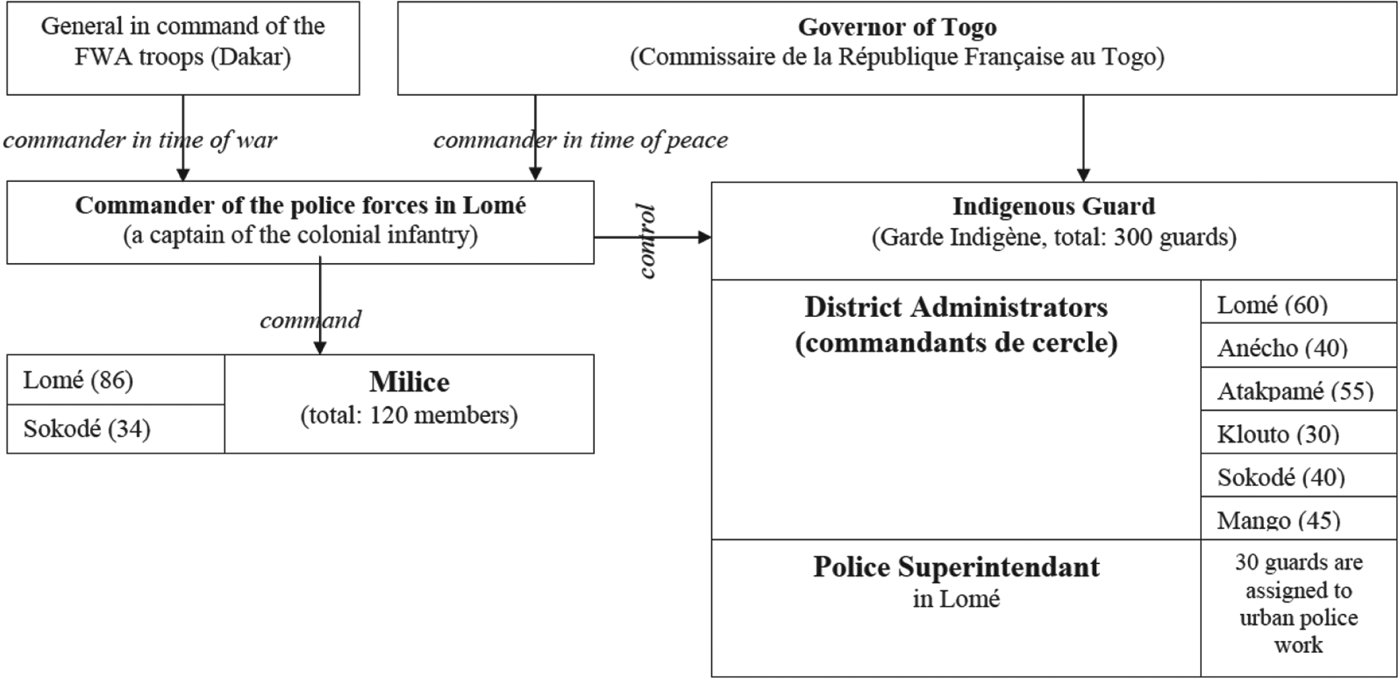
In the 1920s, the French administration established a police force (Forces de police du Territoire) based on two pillars: the Native Guard (Garde Indigène, created in 1920) and the Milice (created in 1928). These would remain the central institutions of law enforcement until the Second World War. Since the mandate of the League of Nations forbade France to maintain military troops in Togo, the company of Tirailleurs was dissolved in 1925. However, most of its members were simply rehired as guards. While the Guard was commanded by district officers (commandants de cercle), each in charge of a single platoon, the Milice was centralized in Lomé and Sokodé, and answered directly to the commander of the police force. Although theoretically distinct, most of the time these two institutions functioned together: recruitment, training, payment, rank, and promotion as well as everyday work were similar in practice and often even jointly organized. Combined, the institutions consisted of between 420 to 500 men depending on the year (for a population of almost 800,000 inhabitants).Footnote 18
The Forces de Police du Togo, 1928.Footnote 19

Soon after his nomination, Governor Bonnecarrère told his senior officers how he understood police work organization: ‘The regional guard should be a kind of gendarmerie, in which the esprit de corps will be maintained by strict discipline and attractive material benefits.’Footnote 20 By ‘material benefits’, he did not mean wages, which remained well below those of government employees, teachers, clerks, or interpreters throughout the period, but rather the substantial advantages (housing, security, medical services, education, access to water and food, etc.) of living in the camps. The military camps defined a geographic place as well as a social space in which ‘esprit de corps’, ‘discipline’, and ‘material benefits’ were considered intimately linked. Thus, the camp confined the specific professional field of men in uniform by separating them both from the authority of customary chiefs and from the influence of the coastal bourgeoisie.Footnote 21 The logic of the camps was a hybrid one, both civilian (in the sense that it was applied by civil administrators and enforced civil police tasks) and military (since military disciplinary regulations were imposed, modelled on those of the companies of Tirailleurs).
Most camps used by the French administration had been established by its German forerunner, but in the course of the 1920s the camps' control over the lives of the guards was reinforced. In the eyes of French administrators, the advantages of the camps were manifold: the commandants de cercle saw the camps as a means to keep an eye on their guards and limit their local autonomy (abuse of power, extortion, tardiness, consumption of alcohol, refusal to obey orders, desertion, rebellion),Footnote 22 whilst the governor saw the central camp in Lomé as a means of reining in the French commandants de cercle, those ‘rois de la brousse’.Footnote 23
The camp was first and foremost a place of work organization. All members of the police force depended, for their enrolment, training, orders, and remuneration, on one of the camps located on city peripheries. About two fifths of the company (this figure depended on the year) resided in Lomé,Footnote 24 while the rest was attached to the camps of Sokodé, Atakpamé Klouto, and Mango.Footnote 25 After their recruitment, all members of the Native Guard and the Milice were trained in the camps of Lomé or Sokodé for a period of three to six months.Footnote 26 The instruction mostly consisted of physical education and military training: basic orders, weapons manipulation, military nomenclature and uniform wearing, marching, shooting, alignment and formation, combat, tactical moves, etc.Footnote 27
Sport was an important component of military training. A stadium was built next to each camp, where athletics, football, basketball, and cross-country were practiced. These activities were supposed to establish camp values, group discipline, and personal hygiene, and to ensure the dissemination of these to the rest of the colonized society.Footnote 28 Troop instructors were at the same time school sport instructors. Conversely, teachers came to the camps to give guards French lessons in the evenings. A school was built in the camps, both for the guards and for their families.Footnote 29
After their instruction, guards were assigned either to Lomé or to the cercles. The range of tasks assigned to them was wide and depended on both the specificities of the cercle and on the personality of the commanding officer. They were employed as escorts, to guard and transfer prisoners, to enforce forced labour and taxes, as messengers, etc. The commandants de cercle tended to make extensive use of them, including for private services. As late as 1942, a decree reminded both European and African employees that ‘it is forbidden for administrators, officers and NCOs to use guards for their personal service’.Footnote 30
During their tour of duty, guards were stationed in police stations and villages and were therefore scattered all over the cercle's territory. The distribution of the platoon of Mango, the farthest cercle from Lomé, gives an idea of the geographical dispersion of the guards. In December 1932, of a squad of 35 guards, only ten were working in Mango and staying at the camp.Footnote 31 The remaining 25 were distributed throughout the cercle: two guards were posted in smaller police stations (Dapango, 55 kilometres from Mango, and Kandi, 67 kilometres from Mango), while the rest were posted in a village or on a road to supervise forced labour and prisoners (in Nabouldgou, Bogou, Kantadi Laré, Tinébau, Baoulé, Souté, Tchanago, Kakété, and Yendi), at distances ranging from a few to seventy kilometres from the district's main office.Footnote 32 This scattering of the guards was regularly perceived by central authorities to be the main cause of their indiscipline.
CONTROLLING THE GUARDS
Throughout the 1920s and 1930s, the central administration attempted to improve control over the guards by reinforcing the power of the camp. Progressively, the actions of commandants de cercle were increasingly controlled by Lomé, first through the codification of the responsibilities and duties of guards, and second through more frequent inspections and visits by the commandant des forces de police to the cercles. At the same time, the life and work of the guards were codified, and name and discipline registers had to be sent to Lomé. The guards and non-commissioned officers (NCOs) had to come to the central camp in Lomé for periodical reinstruction, and the rotation of guards became more frequent. The extension of the road and train networks facilitated this process of centralization and resulted in the reinforcement of the camp.
The camp was thus seen as the essential remedy to the excesses committed by the guards ‘en brousse’. A report from 1937 is emblematic of this thinking, both in its form and its content. It is a report sent by an inspecteur des affaires administratives to the governor, dealing with an incident in a village near Missahoe.Footnote 33 A group of drunken guards had terrorized the village and a shot had accidentally gone off. Before the 1930s, such a minor incident, with no casualties, would probably not have been reported, let alone investigated. But in the context of the Front Populaire and the aftermath of the crisis of the early 1930s, the French empire increased bureaucratic control at all levels of administration. Inspection visits from Paris to Lomé became more frequent, as did those from Lomé into the cercles. The inspector made explicit his will to make an example out of this incident and to learn lessons from it for policy making. He noted that the guards were sometimes left alone in ‘the bush’ for several weeks in a row without supervision:Footnote 34
It would be preferable that the guards not be on mission for a full month. During such a long period of time, they are often alone in a village and lose their sense of discipline, hierarchy and good behaviour. Their tasks [in the bush] should not exceed one week and exceptionally fifteen days.Footnote 35
The report therefore advocated not leaving the guards in the bush too long, and to gather them every Sunday in the main town in order ‘to regain control and give them a little military attitude’. He recommended organizing three-month training courses every two or three years, which would eventually be implemented later on by the governor. Finally, the report was a plea to the administration to strengthen the power of the camp and to toughen the use of bureaucratic standards and tools.Footnote 36
A key argument for the reinforcement of the camp was that it enabled the administration not only to monitor the guards, but also to keep an eye on the guards' family members as well. The rule stated that ‘the legitimate wives of the guards and their children can live with them in camps and barracks’.Footnote 37 Officially, the presence of wives and children in military camps was presented as a favour to the guards, which, in a sense, it was, but it was also much more than that. Families were instrumental in ensuring the smooth running of the logistics of the camps, and they offered the administration several opportunities to influence the guards' behaviour. Thus, the logic of the camp was a circular logic, in that controlling the guards justified accommodating their families, and, in turn, the presence of the families in the camps justified the intervention of the administration in their private sphere. The police commander once clearly stated in a letter to the governor: ‘Since the wives of guards are living in the camp, it is also my duty to intervene, in the interest of discipline, in their way of life.’Footnote 38
The point here is not to offer a description of family life or the production of military gendered identity, but to keep in mind the specific strategy used by the administration to control the guards.Footnote 39 ‘Sex, domesticity and discipline’, as Timothy Parsons puts it, were closely interwoven in this policy.Footnote 40 Thus, the agency of members of the security forces took specific forms, in which family members played a strategic role.Footnote 41 In Togo, there were always more women and children than men living in military camps. A rough estimate based on a list of camp inhabitants in Sokodé shows that, for each guard, at least six family members were also present.Footnote 42 Moreover, there were also a considerable number of visitors: parents and friends of the guards and officers could stay in the camp for a while.Footnote 43 Domestic staff, the bar keeper of the taproom, the workers and prisoner labourers also stayed in the camp or could come for specific tasks. The presence of civilians in the camp to provide water, to cook, and to clean was not so much a favour to the guards as the sine qua non condition for the maintenance of the troops. Encouraging guards' families to live with them was also a means to limit desertions, which for decades had remained the main problem faced by administrators.Footnote 44
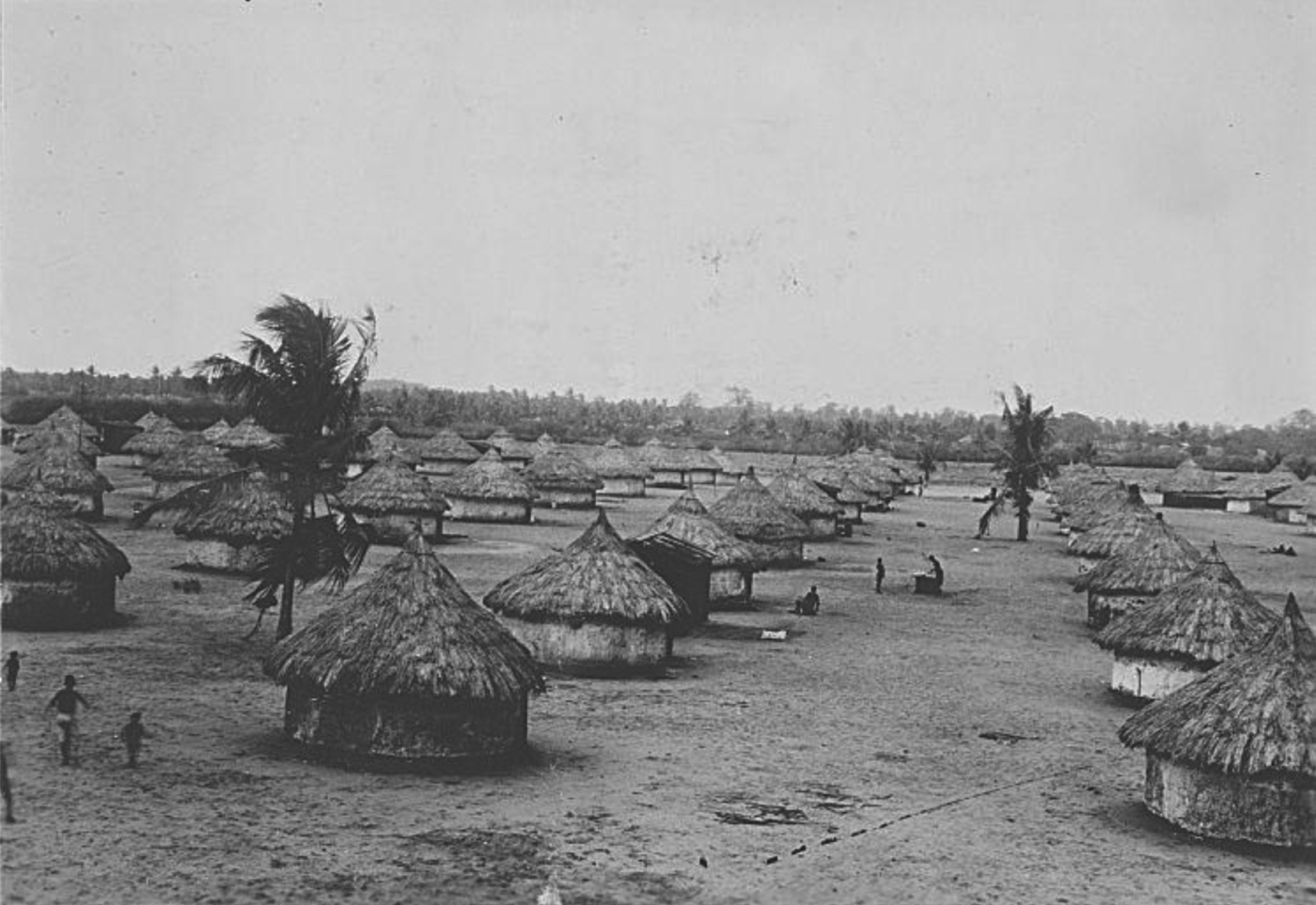
The camp provided material advantages: round huts with thatched roofs for the guards and their families, rectangular boxes for officers.Footnote 45 During the 1930s, the Lomé camp was progressively equipped with pumps for drinking water, laundries, and showers. Food provision was the responsibility of the guards' families, but the administration sometimes purchased large reserves of corn or meat to keep the prices low. In some places, fields next to the camp were dedicated to growing corn.Footnote 46 The camps were gradually electrified, starting with the commander's office and the school, then the rest of the camp.Footnote 48 They were regularly visited by colonial medical officers for vaccinations and trypanosomiasis testing. A hospital was built at the camp in Lomé and placed under the direction of a nurse. Midwives made monthly visits to families, which led to reduced infant mortality. A nursery and a small school completed the medical services offered to guards and their families.Footnote 49
The camp was therefore a paradoxical space and the matrix of policemen's professional identity. On the one hand, the camp marked the power of a protected social group, situated in proximity to the power of the commandant de cercle and entitled to important symbolic and material benefits (free housing, health care, tax exemptions, etc.). In some respect, the guards had a comfortable ‘chez’, as one says in Togo: a place to live and to fulfil the material needs of the family.
On the other hand, however, the camp secluded the guards from urban life. Their life was under the permanent control of their officers and superiors. The ‘chez’ was not a true ‘chez’: it was not the guards' property. More importantly, as can be seen in the picture of the Lomé camp (see Fig. 2), camp housing did not provide a ‘cour’ (an interior courtyard). Halfway between the privacy of one's home and the openness of the street, the cour was a key element of urban middle-class identity: a place to meet for social events, to have ceremonies, but also a place for Sunday visits, for evening dinners, or for political discussions.Footnote 50 The huts of the guards opened directly onto the disciplinary space of the camps, without offering the semi-private space of a courtyard. The inhabitants of the camp were at once more materially privileged and more closely monitored than the rest of the colonized population.
Lomé. Camp of the Milice (1930–45).Footnote 47
SHIFTING VISION OF COLONIAL ORDER IN THE EARLY 1930s
The early 1930s witnessed a significant move away from the traditional logic of isolating security agents from the greater African population. Of course, this was not the first reform of the police forces, which were constantly subject to institutional changes. During the interwar period, not a single year passed without a new decree or edict, be it for the reorganization of a corps, the creation of a new one, or the dissolution of a company. The colonial police was similar, in this regard, to the prison described by Michel Foucault: it was an institution in permanent reform.Footnote 51 However, until the 1930s, the basic principles of work organization remained mostly unchanged, and the coherence of the police institutions was still provided by the logic of the camp.
The reform of 1933 differed from previous reforms in establishing a new paradigm for maintaining colonial order, which would simultaneously complement and compete with the former one. It inaugurated new principles regarding the organization of police work: the specialization of services and the bureaucratization of police tools. More importantly, for the first time, increased responsibilities were given to African officers recruited from the well-educated urban elites. This reform, both the sign of a general change in colonial order discourses in FWA during the early 1930s and a direct response to the urban riots in Lomé in January 1933 (discussed below), brought the police force into the logic of the city.
Until then, police institutions in FWA were mainly devoted to the maintenance of order and sovereignty: ensuring the collection of taxes, overseeing forced labour, suppressing revolts, and containing open opposition. Urban criminality and political intelligence had not been priorities for these services. But with the colonial empire at its height, the perception of threats to French domination changed. Outside the empire, Soviet communism, Italian fascism, and German Nazism became new sources of concern.Footnote 52 Inside the empire, the fears of colonial officials crystallized around new social groups: the ‘vagabonds’ and the ‘floating population’ became new targets of colonial policing, which perceived mobility as pathological.Footnote 53 Social mobility was also suspicious: urban ‘notables’ and ‘detribalized’ elites were targeted for colonial monitoring (press, associations, dance halls, cinemas, etc.). Finally, urbanization as such became an object of police concern: street control, highway safety, lighting, traffic security, fire prevention, combating rowdiness and disturbances to the public order, and control of informal trade. Gradually, in the colonial hierarchy of urban fears, crime replaced endemic diseases and epidemics.Footnote 54
The strategic places where all these real or imagined threats to the imperial order came together were the cities, especially those that were gateways to the West African subcontinent. To cope with this new situation, intelligence and urban security services – the Services de Sûreté – were created all over FWA.Footnote 55 These were designed to monitor capitals, cities, communication nodes, and important territorial gateways. As a report by the governor general of FWA, Jules Brévié, summed up:
The central directorate of the Sûreté and the local directorates must, in my opinion, constitute a kind of political and moral customs of the country [la douane politique et morale du pays], and focus their efforts specifically on ports, by which troublemakers and agitators usually enter the territory. In this regard, ports like Dakar, Rufisque, Kaolack and the southern ports can never get too much attention from the agents of the Sûreté … .Footnote 56
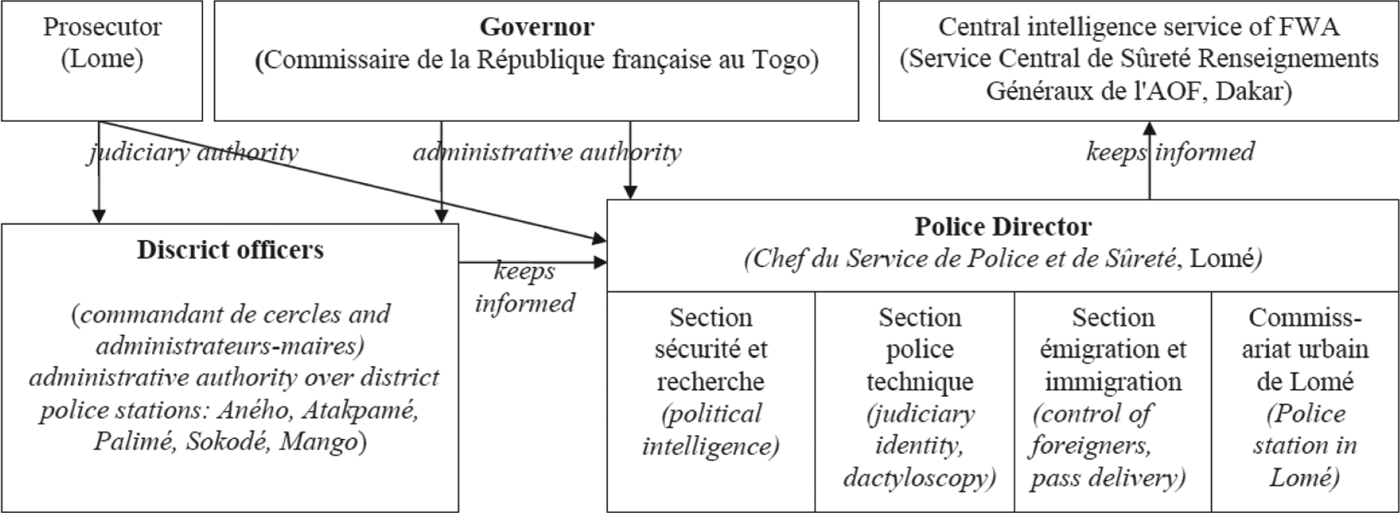
The function of local Sûretés was modelled on the central Sûreté in Dakar. They were in charge not only of intelligence and territorial surveillance (research in the interests of families, control of the press, search for deserters, surveillance of associations and labour unions, security intelligence, centralization of fingerprint files, etc.) and the control of foreigners (emigration statistics, passports, expulsions), but also of the organization and technical control of the local police (urban, rural, and railways).
Indeed, the simultaneous reorganization of intelligence services and urban police services blurred the lines between the two activities. Both forms of policing were viewed as a common tool in the exercise of colonial sovereignty. The same police stations and the same inspectors, officers, and agents would be responsible for implementing daily policing on a local scale (including ‘urban’ or ‘proximity’ policing) and surveillance and intelligence policing on a larger scale.Footnote 57
THE FAILURE OF MILITARY POLICING AND THE CREATION OF A CIVIL POLICE FORCE
Despite the impulse from Dakar, successive governors of Togo resisted the creation of a local Sûreté for budgetary reasons.Footnote 58 But in January 1933, in the face of the Lomé riots, the French governor eventually had to implement the new policy. The Lomé riots, well studied by Benjamin Lawrance and others, were the trigger for a major change.Footnote 59 The economic crisis of 1929, the tax increases, and the clumsy policies of Governor De Guise led to a series of protests. On 24 and 25 January, demonstrations for the release of two clerks from prison challenged the governor's authority. The native guard and the Milice failed to control the crowd, and the governor had to ask Porto Novo and Abidjan for military support. Facing disaster, De Guise gave ground on all fronts. He was forced by the mob to release the two imprisoned clerks and to suspend the tax increase. In the end as a result, he resolved to create a Togolese Sûreté based on the FWA model.
The Lomé riots had revealed the incapacity of colonial police forces to monitor urban civilian crowds. The administration, lacking an intelligence service, was surprised by the events. The lines of communication collapsed.Footnote 60 On the first day of demonstrations, the camp, which was located two kilometres from the administrative city, was unreachable by phone. Once in the city, faced by this unarmed crowd composed mostly of women and children, the police commander realized that crowd control could not rely on sandbags, barbed wire, bayonets, and machine guns.Footnote 61 The guards stationed at strategic points around the town and on the roads leading to Lomé were incapable of halting the moving crowd. The demonstrators were well aware of the impotence of the guards: ‘you only have air in your guns’, they sang.Footnote 62
The arrival of Tirailleurs from the Ivory Coast on 1 February marked the start of the repression of the protests. 170 infantrymen were stationed in Lomé, Palimé, and Aného.Footnote 63 Raids were carried out in villages near Lomé, particularly in Amoutivé and Kodjoviakopé. Huts were searched and 137 arrests were made.Footnote 64 Suspects were punished with forced labour and prison sentences quickly delivered in collective judgments.Footnote 65 The colonial administration was then ‘cleansed’, service by service, of civil servants who had supported the protests.Footnote 66 Finally, the press was controlled.
The repression by the ‘gros souliers’ (big boots), as the Tirailleurs were called, angered Togo's urban residents. The Gold Coast Spectator headline read: ‘reign of terror in Lomé’.Footnote 67 On the streets, in shops, in brothels, fights broke out between residents and Tirailleurs.Footnote 68 The commander of the company of Tirailleurs acknowledged that his men had brutalized civilians.Footnote 69
The Minister of the Colonies Albert Sarraut, well aware that Togo was of particular interest to the League of Nations and the international community, asked Governor De Guise to account for the debacle. De Guise took advantage of the presence of Inspector Cazaux who happened to be in Togo at this time to make his enquiries. De Guise, in accordance with the dominant discourse of the period, argued at length that the reason for the riots was the ‘floating population’ of Lomé, a city in which there were ‘too many unemployed, too many foreigners’ whom he would prefer to expulse from the capital.Footnote 70 He also put forward the hypothesis that the ‘intrusion of foreign elements inserted in the core of Togo’ was instrumental to the matter.Footnote 71 These ‘agitators’ were, he stated, probably from the Gold Coast or Dahomey. He spoke of ‘unhappy leaders’ from ‘the West or the East’.Footnote 72
He then evoked as possible causes Bolshevism, Germany, and even Britain. Duawo members were putatively ‘working for suspicious individuals abroad and linked to communism’.Footnote 73 According to the governor, a German plot could not be excluded, and he took the anti-colonial propaganda of the Togobund as proof.Footnote 74 The British administration also took some of the blame. During its occupation of Lomé, it had allegedly left many issues unresolved (‘seven years of deficiencies’) and was even now unable to tackle the problem of political agitators in the Gold Coast.Footnote 75 Militarized forces and the use of machine guns, he argued last, were inadequate to respond to a demonstration of civilians, especially in an area under the scrutiny of the League of Nations and competing colonial powers.Footnote 76
The governor furthermore stressed the communication problems between civilian and military services, and the failure of the intelligence services. Despite ‘forewarning indicators’, he said, the police forces had been unable to foresee the riots.Footnote 77 The police forces lacked an information system, and the commandants de cercle were overworked and did not have time to conduct proper investigations.Footnote 78 The police services did not hear the rumours preceding the events; not only were they unable to gather new information during the crisis, but they were not even able to prevent information and documents being stolen from the police station.Footnote 79
The remedy for the diagnosis was prescribed by Paris: the creation of a local Sûreté in Lomé. Less than three weeks after the riots, the police forces were completely reorganized and the Service de Police et de Sûreté was established.Footnote 80 A director of this service was appointed: the gendarme Maréchal des Logis Julien Cœurdevey. All this, however, did not save De Guise, who was transferred to Paris.
Sûreté and urban police in Togo in the mid-1930s.Footnote 81
The new police chief and superintendent for Lomé, Cœurdevey, was put in charge of the reorganization of the police force. He was given new staff: newly recruited well-educated local assistant police inspectors (inspecteur assistant de police or inspecteur auxiliaire). Police stations were set up in the city centres, in Lomé, Aného, Atakpamé, Palimé, Sokodé, and Mango. For the first time, criminal investigations and intelligence services would be run by Togolese whose social and language skills would be very welcome.
These young men, all aged between eighteen and thirty, were recruited through a written examination competition and came from the urban coastal bourgeoisie. At first this was a small group of 12 men, but it soon expanded and became instrumental in urban policing. In the 1940s, these men would become the first generation of African superintendents in Togo. General policing, such as administrative, criminal, and municipal policing, were in fact organized and enforced by this very same handful of men. A group of native guards formerly working for the central camp was subordinated to them and appointed to the new police stations in the city centres.
THE ‘AFFAIRE CŒURDEVEY’: POLICEMEN'S AGENCY AND THE LOGIC OF THE CITY
The protest against Cœurdevey took place less than three years after his appointment. Facing the letter denouncing his misconduct, the first reaction of the administration was to protect the superintendent. As in several other cases, the administration pretended that the document was not actually signed by ‘the policemen of the commune mixte of Lomé’. When the governor general's office asked the government of Togo for details of the complaints, the commandant de cercle of Lomé obtained from the first signatory of the letter, the adjudant Tanoga, a confession that he in fact never signed the letter: ‘I did not sign the letter dated October 31, 1936 and sent to the Governor General’, the report quoted him as saying, ‘the signature Tanoga is not of my hand. I do not know how to read or write.’Footnote 82 The governor then promised the governor general by telegram that he would ‘find the apocryphal letter writer’.Footnote 83 A few days later, he was on a trail:Footnote 84
Without being certain – and I cannot attain full certainty of this in this short lapse of time – I have the feeling that the action of pro-German propaganda which has interest in causing discontent between the black population and the French population or even within the French population is not foreign to this affair. This is, again, an impression. The result of my investigation will confirm or invalidate it.Footnote 85
The results of this investigation provided no further details on the authors of the letter. And for good reason: while the governor claimed to doubt that the letter came from the ‘so-called Lomé policemen’, he did at the same time acknowledge that the information the letter contained clearly came from ‘native staff subordinated to the police superintendent’.Footnote 86 These were in fact the policemen of Lomé.
The governor's strategy was thus to disqualify the letter attacking his superintendent by linking it to ‘the atmosphere of anonymous letters and petty rumours that weighed too heavily on the peace of the country of the Bight of Benin’.Footnote 87 This strategy of disqualification was used on different occasions by the French administration in Togo. Less than a year after the case that concerns us here, a letter signed by members of the Council of Notables of Lomé was also described as apocryphal by the colonial administration.Footnote 88 The commandant de cercle then noted: ‘[a]pocryphal or anonymous letters are not uncommon in the circles of the south’; they would be ‘written by agents provocateurs sometimes staying in the French zone, sometimes in the English area’.Footnote 89 Yet, in spite of the claim that these letters were apocryphal, the administration took the complaints they contained very seriously.
The policemen's letter was supported by a letter written the same day and signed by ‘senior leaders, heads of districts’ and ‘notables of the commune mixte of Lomé’ and addressed to the Minister of the Colonies in Paris.Footnote 90 This second letter confirmed point by point the arguments in the first. These two letters, sent the same day, are complementary in such a way that their authors must have been, at least partly, the same. Finally, given the accuracy and precision of the information on the internal life of the police station, it is impossible that they did not come from the police staff, most probably at inspector level. It is more likely than not that the letter was written by policemen. Even in the latter case, the key informants of the letter-writer were certainly policemen.
The administration de facto quickly acknowledged the facts listed in the letter. Curiously, while criticizing the form, it recognized the truth of the content. If the adjudant Tanoga said, according to the report, that he did not sign the letter, he nevertheless confirmed its content. Another witness cited in the inquiry confirmed the fact, reported in the letter, that the adjudant had been beaten by the superintendent in the slaughterhouse for refusing to accede to his request to translate a sentence from Mina, a language he did not speak.Footnote 91 The administration was finally forced to acknowledge that the superintendent was involved in ‘acts of violence on persons’.Footnote 92 While minimizing the seriousness of the accusations against him, the colonial administration transferred Cœurdevey first within Lomé (to the general service in Lomé in November 1936), then from Lomé to another Togolese city (to Aného, in February 1937), and, eventually away from Togo (he was transferred to Dakar in March 1937).
The letter from the policemen encapsulates the moment of police history in which this institution was captured by what Karin Barber calls the ‘explosion of writing and print’ in colonial Africa.Footnote 93 This explosion did not only include literacy from above (the reading and writing practices of African elites: newspapers, novels, petitions, etc.), but also a huge range of practices of literacy from below (including diaries, letters, notebooks, etc.) by amateurs with little formal education. In interwar West Africa, writing became a tool of resistance and negotiation in the bureaucratic repression of colonialism. In Lomé, illiterate individuals could hire professional letter writers (‘bush lawyers’) to produce bureaucratic documents such as legal briefs for gaining access to court, testaments, correspondence, applications, and financial forms.Footnote 94 The policemen's petition was issued by agents in an institution which increasingly defined professionalism in relation to the ability to fulfil bureaucratic tasks (typing, fingerprinting, reporting, etc.).Footnote 95
But most specifically, this letter must be placed at the intersection of two epistolary genres that animated political life in Togo between the wars. On the one hand, ‘petitions’ were sent by different groups of people to different levels of the French administration in Togo or to the Commission of Mandates of the League of Nations in Geneva, which was entitled to receive such complaints.Footnote 96 On the other hand, individual letters were addressed by African civil servants to their superiors, either for routine requests (vacation, illness, transfer) or for exceptional requests (request for support in a trial, complaint against an administrative decision, claims against another agent, etc.). The letter of 1936 is specific because it cuts across the two genres, which, as far as the maintenance of order was concerned, remained independent from one another.
The letter borrowed the tone and the language from these two epistolary genres. The tone oscillated between the pathetic and the factual, and the language veered between the language of personal loyalty and that of bureaucratic rules. Pathos was present in phrases like the ‘supplication of excruciating pain’ (‘la supplication de souffrances atroces’), ‘the barbarous wickedness of our police superintendent’ (‘la barbare méchanceté de notre Commissaire de Police’), and the ‘poor Blacks’ (‘pauvres Noirs’), on the one hand, and the ‘Motherland of France [that] covers our Togo with her wings of sublime dedication’ (‘la Mère Patrie la France [qui] couvre notre Togo de ses ailes aux dévouements sublimes’), on the other. The language of personal ties is found in the ways of addressing the governor general (‘our dear Papa’, ‘generous father’, ‘our messiah’, ‘our grandfather in Dakar’), from whom a ‘benevolent and paternal intervention’ is needed, because of his ‘paternal heart’. This sets the frame for the factual arguments.
The first set of arguments concerns the defence of police workers. ‘He beats us’, they wrote. He ‘slapped and kicked’ policemen. The example of the adjudant is presented. Then the case of unfair dismissal ‘by the hundreds’ is made. Finally, it is the organization of police work as a whole that is at risk. The superintendent delegates ‘all his work’ to his auxiliary police inspectors.Footnote 97 He does not provide them office material such as penholders and rulers, which they must buy themselves. The case of auxiliary inspectors is detailed in the second letter, which states that the hours of service imposed by the superintendent – from 5am til 1pm, and duty from 9pm to midnight – are unreasonable. ‘He beats the agents and molests the auxiliary inspectors’, says the second letter.Footnote 98 Even the commandant de cercle, defending his superintendent, was forced to admit, after investigation, that these accusations were well founded.Footnote 99
The second set of arguments addresses the misconduct of the police superintendent against the inhabitants of Lomé. By doing so, the letter moves from a specific argument to a broader concern about French rule. This rise towards generality is instrumental in the critique delivered by the policemen in order to transform a critique against their superior into a defence of the public interest.Footnote 100 ‘In only three years as Commissioner of Police in Lomé’, they summarize, ‘Cœurdevey has done more harm in Togo than all the other commissioners since 1920.’
Prisoners escape from the prison where he is in charge, the letter states. In addition, he is involved in various forms of corruption. There is fraud involving the police and Lebanese traders: the police purchase goods on credit from these merchants, reselling them at a profit. The superintendent is ‘handsomely paid for this shameful work’ and even takes more than his share.Footnote 101 The police also demand illegal payments for services that are normally free. The superintendent receives ‘gifts’ (for instance 500 francs to avoid trial after arrest). The superintendent also abuses governmental resources, since he uses police staff for his personal service. ‘All the Europeans in Togo pay their cook and boys’, says the second letter, ‘Julien Cœurdevey abuses the administration, using policemen for his household, and rewarding them with promotions they do not deserve.’Footnote 102 Finally, Cœurdevey also hits women and children, and beats people coming to the police station.
The superintendent, of course, soon launched a counter-attack. While acknowledging, in veiled terms, some of the charges (‘I acknowledge having been often obliged to act energetically with the police staff’), he downplayed the gravity of the accusations. He used an argument of authority, balancing his reputation as an ‘old servant and veteran’ with ‘18 years of service, ten of them in the colonies’ against ‘public opinion and rumour’.Footnote 103 He recalled the services he had rendered, especially his efforts to restore order in Lomé after the riots: ‘I was sent to Togo on duty in February 1933, during effervescence, at a critical moment.’Footnote 104
The commander of the police force, who took his side, relayed his argument. The commander praised Cœurdevey as ‘an excellent assistant, dedicated, honest and fair, honouring the elite corps that he represents in Togo [the gendarmerie]’.Footnote 105 The commandant de cercle of Lomé defended Cœurdevey, and eventually, so did the head of the territory. The policemen had ‘exaggerated the importance’ of the allegations against the superintendent.Footnote 106 ‘He indeed perpetrated some unfortunate to very unfortunate acts, but which cannot be qualified as they are in the letter.’ The governor even obtained a letter from the conseil des notables defending Cœurdevey and denying the charges against him.Footnote 107
But these denials were to no avail. Prosecutor Thébault ordered an investigation into the accusations against Cœurdevey. A young Togolese assistant inspector, Gabriel Venance, was in charge of this investigation. The superintendent attacked the ‘morality’ of the prosecutor ‘as a result of certain facts relating to his private life’, and the ‘personality’ of the police inspector, ‘a corrupt man who abused a prisoner’.Footnote 108 Cœurdevey claimed to have information proving that the men conducting the investigation against him were in fact taking revenge on him for older disputes between them. However, he could not prove his case. By order of Dakar, the police superintendent had to leave the country in March 1937. His last and pathetic attempt to postpone his mandatory embarkation on a steamship for Dakar was quickly rejected by his superiors.Footnote 109
CONCLUSION
The successful protest against Cœurdevey epitomized the ability of Togolese policemen to collectively defend their interests. The alliance between the police rank and file and the new generation of educated African police officers proved to be powerful enough to defeat one of the senior officers of the French mandate administration. The event took place in a context of shifting policing strategies. While the colonial administration in Togo had succeeded for the previous forty years in secluding the guardians of colonial order from the logic of the city by maintaining them under the control of military camps, the crisis of the early 1930s put an end to the status quo. The shift of colonial discourse from military and rural policing to civilian and urban control led to the creation of new police services and the recruitment of educated policemen who could defend their interests in the very language of the colonial administration.
The colonial police bureaucratized its methods and procedures in order to improve its control over the colonized population, and so did the policemen, using the language of bureaucracy to pressure the colonial administration. This does not mean that the African guardians of colonial order before the 1930s were not able to defend their interests – in fact they often did so through desertion, rebellion, or refusal to obey orders, that is, through attempts to escape the control of colonial administration. After 1937, however, they could also have a reasonable hope of influencing the course of colonial administration from within – for instance by prompting the removal of a senior European officer. For this new generation of policemen, the issue would not be to elude the control of the camp, but to shape the logic of the city.