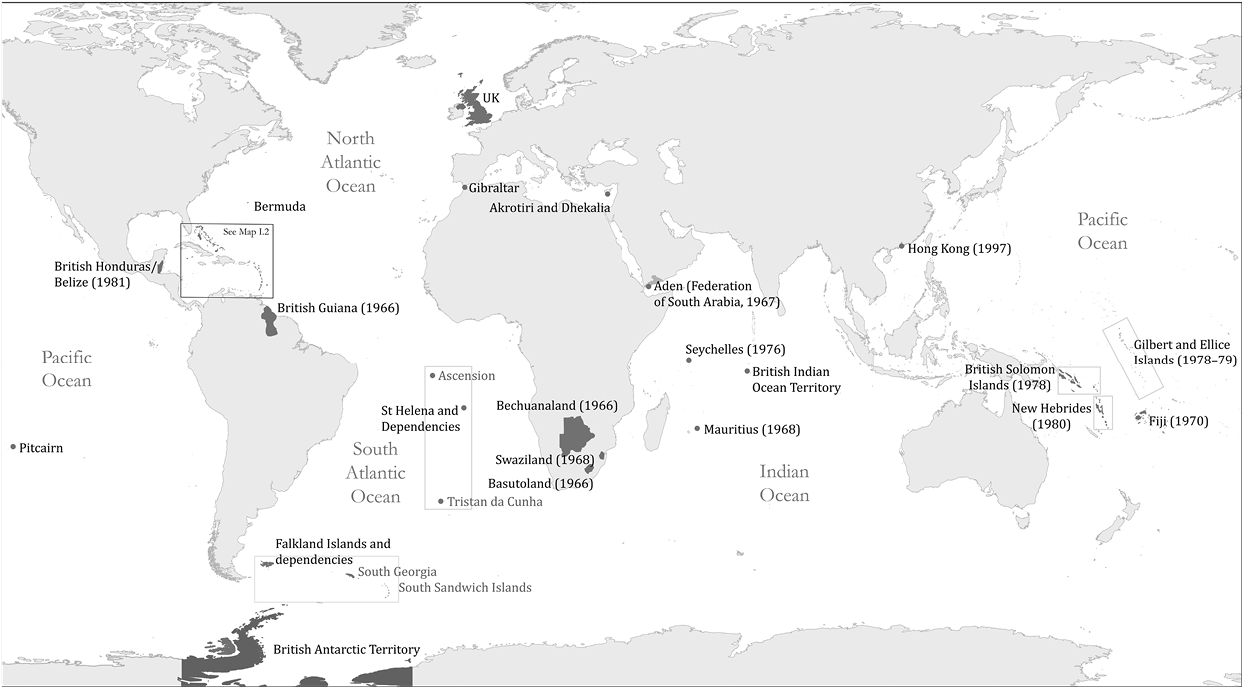
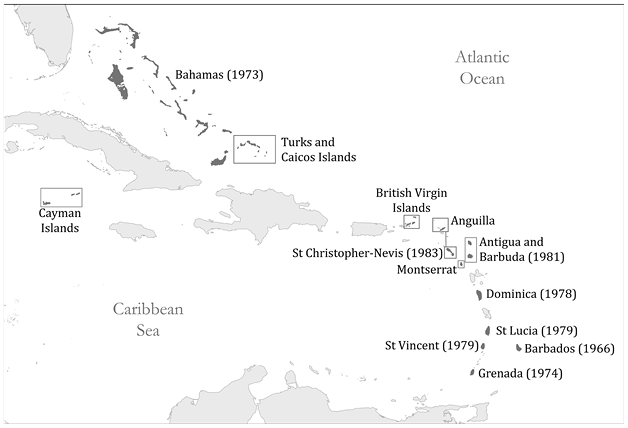
In November 1965, capital punishment was abolished in Britain for the crime of murder, initially until July 1970. Within days, the Labour Secretary of State for the Colonies, Anthony Greenwood, called on colonial administrations to reform their own murder laws and end executions across the British Empire.Footnote 1 Since the end of the Second World War, two decades of decolonisation had greatly reduced the Empire’s scope and scale, but it still encompassed more than thirty colonial territories, with a combined population of nearly 9 million people (Maps I.1 and I.2).Footnote 2 The Empire shrank further in the late 1960s and at the same time the British government rowed back on Greenwood’s initial enthusiasm for exporting abolition. Even so, with Parliament voting to extend abolition indefinitely in Britain in 1969, these years were a watershed for the death penalty in British colonial jurisdictions. By the end of the decade, capital punishment was struck from the murder laws of seven colonies: the British Solomon Islands, the Falkland Islands, Gibraltar, the Gilbert and Ellice Islands, St Helena, the Seychelles and the Sovereign Base Areas of Akrotiri and Dhekelia. It survived in the rest of the Empire but executions were increasingly rare. In colonies that remained under British rule at the end of the 1960s, there were more than 300 death sentences but only eleven hangings after Britain abolished the death penalty (Table I.1).Footnote 3 The executions took place in the Bahamas, Belize, Bermuda, the British Virgin Islands and Hong Kong and were statistically little more than a footnote in the long history of capital punishment in the Empire. Colonial Office research in the mid 1950s documented 1,613 colonial executions between 1951 and 1954 alone.Footnote 4
British Colonial Territories and Protectorates, November 1965
Note: Excludes British protected states and Southern Rhodesia after UDI. Years of independence in brackets except for Hong Kong, which was transferred to Chinese rule in 1997.
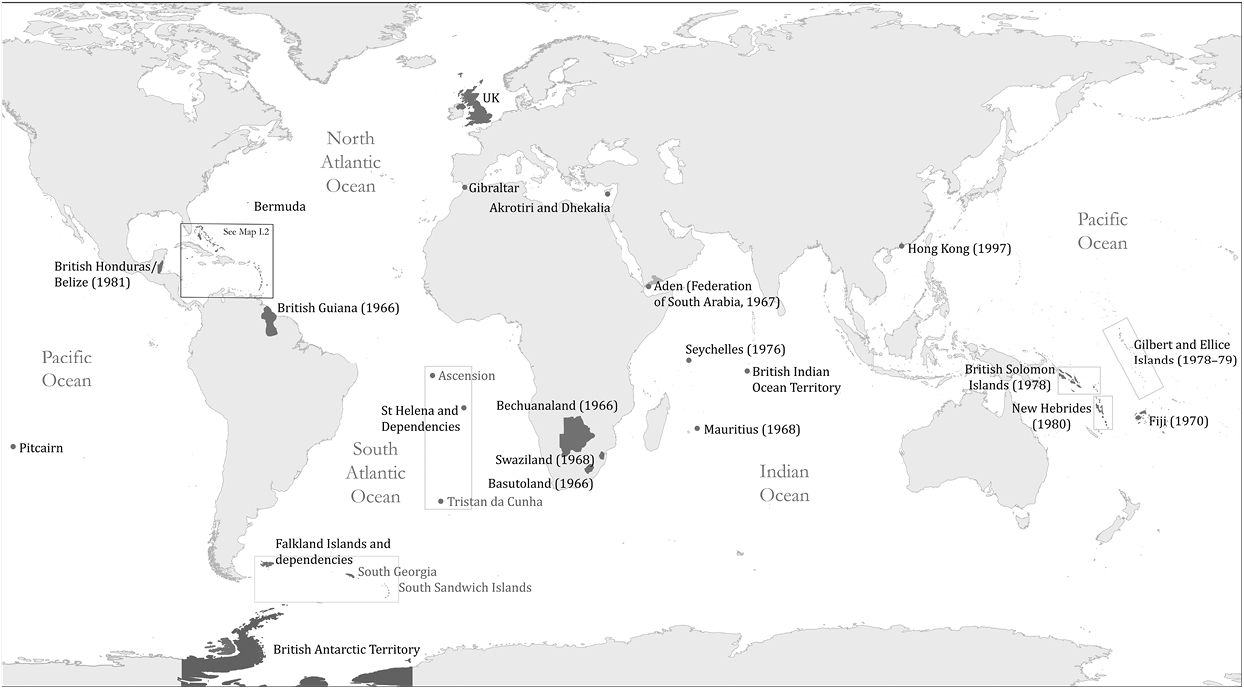
Map I.1 Long description
South Georgia, South Sandwich Islands, Tristan da Cunha, St Helena and dependencies, Gibraltar, the UK, Bechuanaland independence in 1966, Swaziland independence in 1968, Basutoland independence in 1966, Akrotiri and Dhekelia, Aden independence in 1967, Seychelles independence in 1976, British Indian Ocean Territory, Mauritius independence in 1968, Hong Kong transferred to Chinese control in 1997, British Solomon Islands independence in 1978, New Hebrides independence in 1980, Gilbert and Ellice Islands independence in 1978–79, Fiji independence in 1970, Pitcarin, and British Antarctic Territory.
British Caribbean Colonies, November 1965
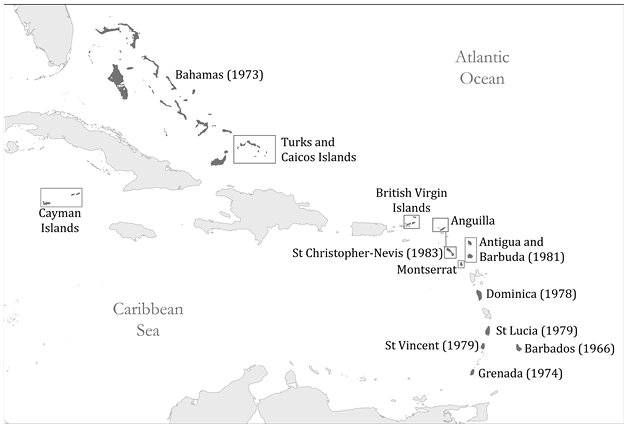
Map I.2 Long description
From left to right, labels include Cayman Islands, Bahamas independence in 1973, Turks and Caicos Islands, British Virgin Islands, St Christopher-Nevis independence in 1983, Montserrat, Anguilla, Antigua and Barbuda independence in 1981, Dominica independence in 1978, St Lucia independence in 1979, Barbardos independence in 1966, St Vincent independence in 1979, Grenada independence in 1974.
| Date | Name | Colony |
|---|---|---|
| 1966 | – | – |
| 15 April | Lau Pui | Hong Kong |
| 12 July | Samuel Thompson | Bahamas |
| 16 November | Wong Kai-Kei | Hong Kong |
| 1969 | – | – |
| 18 March | Daniel Gentle | Belize |
| 2 June | Alexander Barr | Bahamas |
| 1971 | – | – |
| 13 April | Charles Glinton | Bahamas |
| 1972 | – | – |
| 28 June | George Chalwell | British Virgin Islands |
| 1974 | – | – |
| 28 March | William Robinson | Belize |
| 1977 | – | – |
| 2 December | Erskine Burrows | Bermuda |
| 2 December | Larry Tacklyn | Bermuda |
| 1981 | – | – |
| 22 April | Seymour Thomas | Belize |
The imperial death penalty was nonetheless of enduring significance in the late twentieth century. Between 1965 and the 1990s, when capital murder laws were abolished in the last of what by then were officially known as British Dependent Territories, there was persistent debate in both the colonies and in Britain about the merits of abolition and the fate of condemned prisoners.Footnote 5 This book presents the first collective analysis of the life-and-death decisions taken in these cases, the development of British policy on capital punishment and the history of abolition in these last outposts of the British Empire. Death penalty decisions taken in London and colonial capitals in the final decades of the twentieth century were heavily politicised and connected to broader questions about colonial rule, just as they had been throughout Britain’s imperial past. But the dynamics of policy and practice moved in new ways that reflected constitutional reforms, evolving ideas about crime and punishment and Britain’s shifting diplomatic and domestic political priorities in an era of decolonisation and growing international abolitionism.
Historians have explored in depth the many and diverse ways that capital punishment operated across the British Empire. They have shown that the death penalty was a central element of coercive networks of state violence, deployed both to punish offenders convicted of ordinary crimes and repress anti-colonial resistance, from slave rebellions in the seventeenth-century Caribbean to uprisings and independence struggles across Africa, Asia and Europe in the mid twentieth century. They have uncovered a diversity of colonial death penalty practices over time and place, establishing, for example, the limits of metropolitan attempts to impose uniformity on capital trials and punishments and showing that colonial executions were influenced by white supremacist ideologies and characterised by extreme brutality, torture and post-mortem punishments long after such practices had declined or been outlawed in Britain. Yet current scholarship also makes clear that colonial death penalty policy was rarely uncontested. It was challenged by the colonial populations it targeted, as well as politicians, penal reformers and anti-colonial activists in Britain, and sometimes by officials who maintained and enforced capital murder laws in colonial capitals. Executions were deployed to terrorise colonial populations and assert imperial domination into the second half of the twentieth century, but British authorities voiced concerns from at least the mid nineteenth century that unchecked displays of state violence and barbarity were either strategically counterproductive (since, for example, they fuelled local resistance rather than securing colonial rule), or inconsistent with liberal conceptions of the Empire’s humanitarian and civilising missions. Running through the politics of capital trials and punishments over the centuries of British colonialism, therefore, was a tension between a commitment to the rule of law as an underlying rationale of empire and authoritarian mechanisms of control premised on loosely regulated violence.Footnote 6
As the death penalty was central to the establishment and consolidation of the British Empire, so it was entangled with the prolonged and varied independence movements and processes of decolonisation that dismantled almost all the Empire in the decades after the Second World War and reshaped colonial rule and systems of governance in Britain’s remaining colonies in the late twentieth century. Studies by David Anderson and Stacey Hynd have uncovered the critical and expansive role of capital punishment in response to colonial insurgencies in the mid twentieth century. Capital laws were extended under emergency regulations in Aden, Cyprus, Kenya, Malaya and Palestine between the 1940s and 1960s and there were calls for their wider use to repress colonial dissent in Hong Kong, even as new restrictions were placed on the death penalty in Britain. In analysis of the post-colonial era, Hynd has shown that governments in newly independent African states in the mid 1960s justified retention of the death penalty using arguments about crime, society and deterrence previously deployed by colonial rulers.Footnote 7 Legal scholars have similarly documented the persistence of the death penalty in the postcolonial Caribbean and the role of the Judicial Committee of the Privy Council in first sustaining and later restricting a system of state killing established under British rule.Footnote 8 The retention of the colonial death penalty and the British government’s involvement in capital cases after 1965, by contrast, constitutes a final chapter in the history of the British Empire and executions that historians have only just begun to explore.Footnote 9
Even for colonies that rejected what were only ever limited efforts by the British government to persuade them to strike the death penalty from their homicide laws, the Murder Act of 1965 had a transformative impact on the political, penological and judicial context in which death sentences were imposed, commuted and enforced. Constitutional arrangements varied across the Empire, but responsibility for criminal law was normally delegated both formally and in practice to colonial governors, lawmakers and other officials.Footnote 10 However, the political symbolism and significance of executions meant that the British state was always more concerned with capital punishment than other elements of the colonial justice system and this remained the case as decolonisation fundamentally changed Britain’s constitutional and political relationships with colonial governments and populations. It could hardly have been otherwise, for there were profound and often intractable tensions between the end of executions in Britain and the retention of the gallows in British colonies.
By the 1970s, British colonial policy promoted enhanced self-governance and envisaged eventual independence for most colonies that retained the death penalty. It also publicly denied any connection between abolition in British domestic law and capital punishment in colonial laws. Yet the British government could never extricate itself fully from colonial death penalty decisions and nor did it try to; on the contrary, ministers in London became more deeply and consistently involved in colonial capital cases in the late twentieth century for three main reasons. First, because condemned prisoners could petition the Crown for clemency and they did so with increasing regularity in the wake of abolitionism’s success in Britain. Second, because growing numbers of the central protagonists involved in death penalty decision-making in Britain and the colonies, including governors, ministers, judges and lawyers, were opposed to executions as a matter of principle. Third, because in a context of burgeoning global opposition to capital punishment, death sentences had increasingly significant ramifications not only for British colonial rule, but also for domestic politics, diplomatic interests and international treaty commitments. Capital cases therefore exposed the complexities, contradictions and tensions of British colonialism after 1965 and revealed the scope and limits of Britain’s commitment to death penalty abolition as a matter of domestic, colonial and foreign policy in the late twentieth century.
The Royal Prerogative of Mercy
The British government most often became involved in late twentieth-century colonial death penalty cases through the influence of ministers and civil servants on the decisions of governors and other colonial officials who exercised the royal prerogative of mercy. In the common law tradition, the royal prerogative developed from the medieval to the early modern period as a broad discretionary power of the Crown and was principally exercised in Britain by the monarch and designated royal officials until the early 1700s. Over the next century, responsibility for granting or withholding clemency was gradually assumed by trial judges and Parliament. From the late 1830s, it rested with the Home Secretary, who oversaw an increasingly centralised and bureaucratic system that operated according to its own conventions and rules. As death was the mandatory penalty for murder until the late 1950s (as it was in nearly all British colonies), mercy was the only mechanism for distinguishing between killings of different magnitude, and certain categories of offenders and certain types of murders were especially likely to prompt the Home Secretary’s intervention. Clemency was routinely extended to the young, pregnant women and the mentally ill, for example, and to persons who were provoked into violence or convicted of unpremeditated murders.Footnote 11
The prerogative of mercy also served a quasi-judicial function, guarding against miscarriages of justice, particularly (but not only) before the introduction of criminal appeals in Britain in 1907. Yet the prerogative power was not justiciable; rather, it was understood by the courts as an act of grace that operated outside the law – it charted the law’s ‘borderlands’, in Austin Sarat’s evocative phrase – and clemency proceedings were shaped by legal and non-legal considerations in ways that did not have to be consistent or just and resulted in decisions that were inherently and inevitably political.Footnote 12 As Carolyn Strange has argued, mercy’s political power is often ‘obscured’, hidden by allusions to the benevolence of the state or sovereign and appeals to ideas of justice or public sentiment, ‘but the ineluctable point was that the bodies saved were the ones that power-holders chose to save’.Footnote 13 In the British context, Douglas Hay argued that mercy in the eighteenth century legitimised both the rule of law and the power of the ruling class, while in Roger Chadwick’s assessment of the later nineteenth century, home secretaries acted, ‘conservatively, protecting both the absolute standards of the criminal law and the moral order of society as they saw it’. More recently, Lizzie Seal and Alexa Neale have shown through analysis of the cases of fifty-seven people of colour sentenced to death in Britain during the twentieth century that clemency proceedings were deeply racialised.Footnote 14
In the British Empire, the prerogative of mercy was delegated by the Crown to colonial governors and other chief administrators. While procedures for administering mercy varied, governors were normally required by Royal Instructions to consult with an advisory body (commonly an executive council by the second half of the twentieth century) and were expected to take account of a report from the trial judge that included a recommendation for or against clemency. In almost all cases, however, they were empowered to grant or refuse mercy at their own discretion and were not bound by the advice they received.Footnote 15 Mercy in the colonies, as in Britain itself, could take different forms. It encompassed the removal of penal sanctions in part or in full by a free or conditional pardon; the temporary suspension of a sentence (known as respite or reprieve); and a reduction in the severity of a penalty imposed by the court (commutation). In twentieth-century capital cases, however, the royal prerogative was nearly always used to substitute a term of imprisonment for the death sentence, and the terms ‘clemency’, ‘commutation’ and ‘reprieve’ were commonly used interchangeably to describe this process, as they are in this volume.Footnote 16
As in Britain, colonial clemency decisions were influenced by non-legal factors that research over the past thirty years has shown varied across time and place. Robert Turrell, for example, argues that rates of reprieve were especially unstable, ‘in colonies where the process of colonialism involved the conquest and incorporation of indigenous peoples and the suppression of working class struggle’.Footnote 17 In a study of twentieth-century Kenya, Stacey Hynd called mercy ‘a selective instrument of racial justice … shaped by shifting landscapes of power and racialized stereotypes of African behaviour, as well as by the necessity of maintaining “white prestige” through the self-ascribed benevolence of British justice’.Footnote 18 Alastair McClure has similarly shown that mercy was strategically deployed to legitimise British rule in India and ‘accommodate colonial ideas of Indian cultural difference’.Footnote 19 Considerations of race, ethnicity, gender and religion also influenced clemency decisions in Canada, Australia and the Caribbean, though rates of reprieve varied markedly over time and place. More than 40 per cent of death sentences in Jamaica were commuted between 1860 and the 1930s, for example, and annual commutation rates reached up to 40 per cent in African colonies in the mid twentieth century. Figures in Britain itself were comparable; clemency was extended to 46 per cent of 1,210 condemned prisoners in the first half of the twentieth century.Footnote 20
The British government’s increasing involvement in determining the fate of condemned prisoners in colonial capital cases after 1965 marked a departure from earlier practice. In constitutional law, the delegation of the royal prerogative of mercy to governors ‘in Her Majesty’s name and on Her Majesty’s behalf’, did not ‘entirely divest’ the sovereign of the power to grant clemency. All British subjects had the right to petition the Crown, but condemned prisoners rarely bypassed colonial authorities to appeal to the sovereign directly before the mid twentieth century and it was well-established precedent that the monarch would not normally override a governor’s decision to allow the law to take its course.Footnote 21 In a 1926 history of the Colonial Office, the former Permanent Under-Secretary of State for the Colonies, Sir George Fiddes, wrote that all attempts to involve the Colonial Office as a Court of Appeal against colonial death sentences had been ‘firmly resisted’, and he considered it ‘essential to justice that this should be so’. The Colonial Office could have only second-hand knowledge of the circumstances surrounding cases tried in the colonies, and the delay in which their involvement would inevitably result would likely force the commutation of capital sentences on humanitarian grounds and result in ‘the practical abolition of the death penalty’.Footnote 22 Fiddes described two recent occasions when pressure was brought to bear on the Secretary of State to remit a colonial death sentence, but in both instances the law took its course and over the following decades successive colonial secretaries mostly adhered to the policy of abstention. A Colonial Office review in 1964 found no record in living memory of any occasion when the sovereign had commuted a colonial death sentence. The closest example was reported by Sir Charles Dixon, who had worked in the Colonial Office since 1911 and recalled that King George V had wanted to mark his ascension to the throne by granting pardons to ‘a number of offenders in one of the overseas territories [believed to be a self-governing territory] … but he was persuaded by the then Colonial Secretary, Mr. (later Viscount) Harcourt, who disapproved of such largesse’.Footnote 23
The Colonial Office had neither the staff nor the inclination ‘to act as an informal court of appeal for the whole colonial empire’, but did offer advice to governors on procedures and principles for handling clemency petitions, normally through informal channels.Footnote 24 In 1929, Labour Colonial Secretary Sidney Webb set out a series of ‘broad principles’ to guide his department’s involvement in colonial clemency in response to a non-capital case from St Lucia, in which a young girl sentenced to eighteen months’ hard labour for theft was pardoned due to the absence of an appropriate juvenile reformatory in the Windward Islands. These principles included respecting the decisions of local courts, but also affirmed that the Secretary of State was ultimately responsible for ‘the efficiency of the machinery of justice’. If notified of an apparent miscarriage of justice, they should ‘[address] the Governor semi-officially, conveying the doubts which have arisen, and suggesting a reconsideration of the question’[.]Footnote 25 The limits of this policy were apparent over the following years. In 1935, the Colonial Office received a petition addressed to the King seeking mercy for Yanni Toffi, who was scheduled to be executed in Cyprus in four days’ time. The Governor was advised that the Secretary of State would not act on such an appeal and it was not necessary even to delay the execution to allow the matter to be considered.Footnote 26 This position was reaffirmed the following year, when the Colonial Office advised Cypriot authorities that clemency appeals to the King need not be forwarded unless they involved special circumstances that should be brought to the Secretary of State’s attention, though a brief review of this policy in 1942 argued that this should be understood ‘as a rule of practice rather than as a decision on the principle involved’.Footnote 27
A more comprehensive statement of British policy on the colonial death penalty was made by the Labour Colonial Secretary Arthur Creech Jones in 1947 in the wake of a controversial murder case in the Gold Coast. On 29 February 1944, Akyea Mensah, a town chief in Akyem Abuakwa state, was reported missing. This was the last day of funerary rites for the state’s former king, Nana Sir Ofori Atta I, who had died the previous August. Evidence suggested that Mensah had been ritually killed as part of a feud with the late monarch’s family. In July, eight men were arrested and charged with the murder. All were high-ranking officials and relatives of Ofori Atta I, and by the end of the year they had been convicted and sentenced to death. The sentences imposed on two of the men were commuted by the Governor, Sir Alan Burns, in 1946, and a third man died in custody. The other five defendants launched a series of appeals to the West African Court of Appeal, the Supreme Court of the Gold Coast and, on three occasions, the Judicial Committee of the Privy Council, which sat in London and served as the Empire’s highest appellate court. These appeals stretched into 1947 and on repeated occasions the condemned men were prepared for execution only for the proceedings to be halted at the last moment. Three of the men were finally hanged on 24 March 1947, but the lives of the other two, who were scheduled to die later the same day, were saved when their lawyer gave notice of an intention to lodge a new appeal to the Privy Council. Governor Burns commuted their death sentences to life imprisonment four days later. He explained the decision as a humanitarian gesture, motivated by the mental anguish the men must have suffered from witnessing their accomplices’ execution and anticipating their own imminent deaths.Footnote 28
The Gold Coast affair provoked scrutiny and outrage in Parliament. In an era when death sentences in Britain were often carried out within six weeks of sentencing, critics from across the political spectrum, including Winston Churchill, declared the years that had elapsed between the prisoners’ conviction and hanging an affront to British standards of justice, administration and humanity.Footnote 29 Anxious to avoid a repeat of what had become an embarrassing and politically damaging situation for the government, Creech Jones confirmed that if colonial governors rejected appeals for mercy, condemned prisoners could seek clemency directly from the monarch but the normal practice of the Secretary of State in such circumstances was to advise that the Crown should not intervene. Citing logistical, political and judicial considerations, Jones argued that no other policy could reasonably be adopted. Government ministers in London, he explained, were too ‘remote from the scene of the crime fully to consider the facts of each case and all the considerations which bore on it’. If they advised the monarch to reprieve a condemned prisoner, it would generate more clemency petitions than the Colonial Office could handle and lead to delays in carrying out executions. The routine involvement of the British government in capital cases would also conflict with the constitutional powers of governors and colonial administrators and fundamentally compromise their authority. Finally, the best mechanism to guard against injustice ‘in so grave a matter’, Jones declared, was for one person to have ‘undivided responsibility’ for making the decision. In exceptional circumstances, the Secretary of State might advise the monarch to grant clemency to prevent a miscarriage of justice, but Jones considered it ‘inconceivable’ that such a situation could arise. Any concerns about the justice of a death sentence would be raised directly with the Governor of the colony in question and resolved without recourse to the Crown.Footnote 30
The principles outlined in what became known as the ‘Creech Jones doctrine’ were the basis of British policy on colonial clemency petitions until the final abolition of capital punishment in British Dependent Territories in the 1990s. Yet Creech Jones was a non-legally binding convention that, as the historian Benedict Greening has argued, could have been amended or discarded at any time. Beginning in the early 1960s, it was reviewed frequently by both Conservative and Labour governments, normally in response to a Governor’s decision to refuse clemency to a condemned prisoner and a subsequent petition to the Queen. Notwithstanding occasional procedural innovations, however, on each occasion until 1991, British ministers resisted any temptation to change formally the underlying policy of deferring to governors’ decisions. In a study of the executions of Erskine Burrows and Larry Tacklyn, who were hanged in Bermuda in 1977 for a series of high-profile murders, including of Governor Richard Sharples, Greening showed convincingly that domestic political concerns were a primary reason why Britain’s Labour government refused to challenge the death sentences. The Creech Jones doctrine was a ‘nebulous set of rules on which to base decisions of life and death … [that] allowed politicians to claim legal justification for their decisions even if such justification was questionable’.Footnote 31
The Creech Jones doctrine proved remarkably resilient partly because it was so malleable, yet the Burrows and Tacklyn case provides only a snapshot of how it operated in practice and it was unrepresentative in important respects. Analysis of the hundreds of death sentences imposed in British colonies between 1965 and the early 1990s reveals wide variations in the dynamics of executions and reprieves across the end of Empire. There were differences in how and why British policy evolved towards different colonies; how governors, elected colonial leaders and local communities understood and engaged with death sentences; and how the death penalty in each colony intersected with broader histories of capital punishment, global abolitionism and colonialism in the late twentieth century.Footnote 32 Even as successive British governments publicly adhered to the strictures of the Creech Jones doctrine, ministers and officials in the Colonial Office and its successors, the Commonwealth Office (1966–68), and the Foreign and Commonwealth Office (FCO, from 1968), repeatedly exercised extensive influence over governors’ clemency decisions. They sometimes did so in ways that reflected concerns about the justice and humanity of death sentences, and a distrust of local judicial processes, but they rarely challenged capital punishment itself. Instead, they sought to mitigate capital sentences by urging the adoption of clemency principles that often had been deemed unworkable or unjustifiable in Britain during domestic debates over abolition. They raised questions, for example, about the mental capacity of condemned prisoners, the relative seriousness of different forms of murder and the practice of rescheduling executions after last-minute delays. They also called on the Home Office to advise on relevant British precedents, even though such precedents were increasingly outdated.
If the facts of colonial death penalty cases always mattered when British government ministers and officials weighed the merits of clemency petitions, they did so in conjunction with political calculations and domestic and foreign policy interests. The British government’s political priorities were wide-ranging and shifted over time, but both Conservative and Labour governments were consistently concerned about their implications for debates about law and order and capital punishment’s restoration in Britain, as well as the potential for controversial reprieves and executions to spark protests against British governors and compromise the stability of colonial rule. In contrast to earlier periods, by the 1970s, officials in London most often concluded that British interests were best served by restricting colonial executions, but this was not a straightforward calculation since efforts to secure clemency for condemned prisoners were often strongly criticised by colonial political leaders as unjustifiable and unconstitutional violations of local sovereignty. Such criticisms reflected the pro-death penalty sentiments of many colonial communities, as well as locally elected leaders’ determination to give meaning to constitutional reforms towards internal self-government that had been implemented since the 1960s.
The history of late twentieth-century colonial capital punishment therefore offers insights into the dynamics of British rule at the end of Empire. It demonstrates the fragmented and piecemeal nature of British involvement in Dependent Territories’ affairs in the 1970s and 1980s and the extent to which British domestic and diplomatic interests drove policy-making. Helen Hintjens and Dorothea Hodge have argued that until the late 1990s, Britain only exercised significant control over the Dependent Territories during periods of emergency, such as financial crises and natural disasters. They conclude that British officials’ primary concern in response to such events was to prevent political and economic instability and minimise the financial and reputational costs that Britain incurred from the retention of its imperial possessions.Footnote 33 Death penalty cases and law serve as an example of more routine British involvement in the Dependent Territories, albeit motivated by similar considerations that reflected an understanding in government that the significance of capital sentences was always far greater than narrowly defined issues of crime and punishment. It was also – as the colonial death penalty had always been – about imperial rule and its implications in and for Britain.
The Global Death Penalty and Abolition
The practice and abolition of the death penalty in late twentieth-century British colonies occurred amidst – and as part of – an unprecedented global abolition movement. The origins of modern abolitionism are found in the works of eighteenth-century penal reformers, notably the Italian nobleman Cesare Beccaria, whose On Crimes and Punishments presented the first sustained secular critique of capital punishment.Footnote 34 Arguments in support of a utilitarian, proportionate and rational system of criminal sanctions influenced the restriction of executions to the most serious crimes across much of Europe and the Americas during the nineteenth century. Venezuela became the first nation-state permanently to abolish the death penalty for all crimes in 1863, but abolition was rare until after the Second World War and commonly restricted to so-called ‘ordinary crimes’, most notably murder, perpetrated in peacetime.Footnote 35 As late as 1965, only twenty-five countries worldwide had placed even such limited restrictions on the death penalty but the pace of abolition accelerated thereafter. Twenty-four countries abolished the death penalty for all crimes by 1979 and this figure increased by fourteen during the 1980s and a further thirty-seven in the 1990s.Footnote 36 Many of these new abolitionist states were in Eastern Europe, where the death penalty was widely restricted following the end of the Cold War, but abolition also made significant progress in Africa and Oceania and growing numbers of Asian countries were abolitionist in practice if rarely in law.Footnote 37
Scholarship on the modern death penalty has identified political and cultural explanations for global patterns of abolition and retention. David Garland emphasises that capital punishment is always an exercise in state power and its history is closely connected to the character of the state and the state’s relationship with its citizens.Footnote 38 In this formulation, abolition is associated with the formation of stable, liberal democracies committed to individual rights and with constitutionally protected limits to state power, effective criminal justice systems, high levels of economic equality and welfare state provisions and a consensual political culture that discourages the politicisation of criminal justice.Footnote 39 Andrew Hammel further argues that abolition movements are invariably led by social elites and flourish especially in parliamentary democracies that insulate elite opinion from the views of the general population, which tends to be more supportive of capital punishment.Footnote 40 The course of abolition has also been linked to moments of political transition, with developments such as the establishment of new democracies and the conclusion of civil wars prompting challenges to capital punishment as part of broader debates about the powers of the state and the rights of citizens.Footnote 41 Yet this is far from an inevitable process and, as the American anti-death penalty philosopher Hugo Bedau argued, the death penalty can also be co-opted as a tool of state-building; it ‘symbolizes the ultimate power of the state, and of the government of society, over the individual citizen’, and consequently can be used by governments as, ‘a public gesture of strength, self-confidence and reassurance’.Footnote 42
Beyond domestic political circumstances, the wave of late twentieth-century abolitions reflected the influence of a newly globalised abolition movement and profound shifts in human rights law and culture since the Second World War. Beginning with the United Nations’ adoption of the Universal Declaration of Human Rights in 1948, international legal instruments sought to limit the state’s right to kill, and informed new standards for states administering the death penalty. Article 6 of the International Covenant on Civil and Political Rights (ICCPR), drafted in 1957 and formally adopted in 1966, restricted the death penalty to ‘the most serious crimes’ (albeit without defining the term), and was framed to promote the progressive restriction of capital punishment and ‘set abolition as a goal’. In 1989, the Second Optional Protocol to the ICCPR went further and committed signature states to permanently ending executions.Footnote 43 In Europe, Protocol No. 6 to the European Convention on Human Rights, adopted in 1982, committed signature states (which did not include Britain until 1998) to abolition of the death penalty, except ‘in time of war or of imminent threat of war’.Footnote 44 The European Court of Human Rights’ (ECHR) ruling against the extradition of Jens Soering from the UK to stand trial for capital murder in Virginia in 1989 further extended the responsibility of European states for death penalty practices beyond the continent’s borders.Footnote 45 There is no axiomatic relationship between the development of human rights standards and the progress of death penalty abolition, but international treaties and court judgments have facilitated opposition to the death penalty in several ways. They have provided mechanisms for coordinating diplomatic pressure on retentionist states, established and transmitted norms and standards of human rights and penal culture that were incompatible with state executions and underpinned legal challenges to the death penalty in national courts.Footnote 46
Since the 1970s, international non-governmental organisations (INGOs) have been central to these processes. They have expanded the reach of human rights-based abolitionism through their influence on national abolitionist constituencies and the political calculations of governments, and by challenging capital punishment in domestic and international courts.Footnote 47 As Matthew Mathias argues, however, the impact of both international legal instruments and INGOs’ opposition to capital punishment is contingent and shaped by factors such as institutional structures and cultural beliefs that determine nation-states’ receptiveness to abolitionist scripts. Capital punishment has tended to be abolished early in Catholic countries and retained in Islamic countries, for example, while, in a global analysis of abolition, Carsen Ancker argues that a history of slavery is associated with support for the death penalty, as human bondage served to normalise violence and death and undermine respect for human life.Footnote 48 Ian O’Donnell similarly found that execution rates in twentieth-century Ireland were connected to changing ideas about death, concluding that ‘when life is degraded … the prospect of hanging an occasional murderer excites less concern’.Footnote 49
Despite the extensive literature on death penalty abolition from a global perspective, there remains a pressing need for histories of the particular political and legal processes through which capital punishment has been implemented, reformed and restricted in recent decades. The sociologist David Johnson has argued that analysis of the death penalty in different historical and geographical contexts is critical to identifying and understanding what is ‘peculiar—and ordinary’ in contemporary capital punishment regimes. New studies of capital punishment in Asia and Africa have taken up this challenge, pushing the historiography beyond its traditional focus on the US and Western Europe.Footnote 50
Analysis of death sentences, clemency proceedings and abolition in British colonies since 1965 adds to this burgeoning literature in unique ways. First, at the macro level, the two waves of British colonial abolition – in Western Pacific, South Atlantic and Mediterranean colonies in the mid to late 1960s and in Hong Kong, Bermuda and British Caribbean colonies in the 1990s – broadly align with the evolution of abolitionist critiques of the death penalty during the second half of the twentieth century from causalist arguments focused on Eurocentric notions of civilisation and criminal justice policies to more universal human rights concerns. They illustrate what that transformation meant for Britain and colonial governments in terms of policy and practice, demonstrating the limits of twentieth-century British abolitionism, the racial ideologies that underpinned colonial death penalty retention and the influence of the global turn in anti-death penalty activism. International human rights lobbying, treaties and court rulings influenced British policy towards the Dependent Territories, but mostly as what Jan Eckel has called ‘a tactical resource in political confrontations’, rather than a ‘moral vision’.Footnote 51
Comparative analysis of capital cases and debates about death penalty reform across all of Britain’s late twentieth-century colonies, and Britain itself, demonstrates modern abolitionism should be understood as a transnational process in two main ways. First, the fate of condemned prisoners, and of the death penalty itself, was shaped by connected and evolving penal policies, cultures and personnel across British colonial jurisdictions. The idea that Empire operated as a ‘web’ or network, in which ideas, practices and people travelled ‘horizontally’ between colonies as well as ‘vertically’ between the colonial periphery and the metropolitan centre is well established in the historiography of imperialism and holds true for the era of death penalty abolition.Footnote 52 The outcome of capital cases was commonly determined through intense negotiations between Westminster and colonial capitals. But as the Empire shrank, a dwindling group of justices, governors and civil servants also shared knowledge and experience of capital laws, clemency proceedings and executions from one posting to the next and one case to the next. Political leaders and interests in one colony influenced the fate of condemned prisoners in others, and even gallows plans and machinery were transported between colonial prisons as executions became increasingly rare events.
International networks of nation-states and non-governmental organisations (NGOs) constitute a second set of transnational networks within which the death penalty histories of Britain and its last colonies must be situated. These include organisations and institutions that directly engaged in death penalty politics and law, from Amnesty International to the UN, but they also incorporate regional networks through which states such as China (in the case of Hong Kong), the US and independent Anglophone Caribbean nations influenced colonial penal cultures and policies through their actions, interests and example. The last British colonies were entangled in webs of migration, culture, diplomacy and economics that reached far beyond the boundaries of Empire in ways that affected – both directly and indirectly – how the death penalty was perceived and practiced.
The last British colonies of the late twentieth century also present novel socioeconomic and political contexts in which to consider the meaning and enforcement of the death penalty. Capital cases prosecuted in territories such as St Helena and the British Virgin Islands, for example, offer evidence of the logistical, judicial and cultural challenges posed by complex criminal trials, clemency processes and executions in small island communities, including some where capital prosecutions were uncommon and judicial resources and experience limited. Such circumstances contributed to an acceptance of abolition in some communities, despite persistent and broad support for the death penalty in principle, but in other places retentionists were able to bolster their cause by highlighting the unsuitability of small local prison facilities for the long-term incarceration of dangerous offenders. British ministers rarely sought to address these concerns by linking the case for ending colonial executions to broader programmes of criminal justice and penal reform. The persistent under-resourcing of police and prison services in the Dependent Territories appears here as a barrier to developing popular support for abolition.
There are also important parallels between the death penalty histories of colonies that remained in the British Empire after 1960 and the post-colonial Anglophone Caribbean, where Lynsey Black, Lizzie Seal and Florence Seemungal have argued that the persistence of capital punishment after independence stemmed from political leaders’ understanding of legal continuity as a demonstration of political maturity. While the death penalty developed under British rule as an instrument of racial control, in the post-independence era it was ‘re-fashioned as a sovereign symbol to be protected as a manifestation of order’.Footnote 53 The death penalty served a similar function in British colonies such as Belize and the British Virgin Islands in the 1970s and 1980s, as exerting control over questions of life and death in capital cases became an important mechanism through which elected politicians (whose powers were circumscribed by dependency status) sought to define the limits of British involvement in their territories’ domestic affairs. In this respect, they are consistent with the findings of historian Brian Simpson that anti-colonial movements were primarily, ‘about who should govern colonial peoples, not about how they should be governed’. They were concerned with ending (or, in the case of Dependent Territories that remained under British rule, restricting), foreign domination of government and not, ‘in essence’, with human rights. Yet they also accord with the view that the idea of human rights itself was refashioned in the 1970s in ways that served liberal, Western interests and ‘cast aside much of the most vital content and appeal of human rights for postcolonial peoples’.Footnote 54
Analysis of the death penalty in late twentieth-century British colonies also addresses neglected elements of Britain’s history of capital punishment, which in other respects has been extensively studied. Histories of the death penalty in Britain include an extraordinary body of scholarship on the rise and reform of the ‘Bloody Code’ from the mid eighteenth to the mid nineteenth century, but fewer works focus on the period after the abolition of public executions in 1868.Footnote 55 With some notable exceptions, such as Lizzie Seal’s analysis of the cultural life of capital punishment, studies of the twentieth century overwhelmingly concern the parliamentary politics of abolition and typically end in the late 1960s.Footnote 56 This encourages a celebratory narrative that positions the UK at the forefront of modern abolitionism. Reflecting on the fiftieth anniversary of Britain’s last hangings, which were carried out in 1964, a spokesperson for Amnesty International hoped that the British people were proud ‘that the UK is an abolitionist country and has been for such a long time’.Footnote 57 Julian Knowles QC similarly wrote in a history of UK abolition published by the abolitionist NGO the Death Penalty Project in 2015 that ‘it should be a matter of real pride that the United Kingdom is now a vocal opponent of the death penalty worldwide, and that the painful lessons it learned on its journey to abolition … continue to matter’.Footnote 58
British abolitionism is likewise a prominent theme in studies of the death penalty in the modern Anglophone Caribbean that give prominence to the role of the Judicial Committee of the Privy Council in restricting executions since the landmark ruling of Pratt and Morgan v. The Attorney-General for Jamaica (1993) that excessive delays in enforcing capital sentences were inhumane and unconstitutional.Footnote 59 In William Lofquist’s assessment, Britain moved in the post-colonial era from ‘exporting the legal apparatus necessary to support minority and colonial rule, such as the death penalty, to exporting legal modernization and penal restraint’, while Andrew Novak writes that colonies that remained under British rule in the late twentieth century ‘benefited from the abolition of the death penalty in British law’.Footnote 60 Yet as Saul Lehrfreund has documented, there was not a straightforward connection between British abolition and colonial death penalty jurisprudence. Privy Council judgments in capital cases from Commonwealth nations consistently supported executions through the 1970s and 1980s, and later decisions that limited the death penalty were heavily influenced by evolving international jurisprudence as much as legal or political changes in Britain.Footnote 61 It is highly significant that alongside Privy Council rulings upholding the death penalty, British ministers continued to support death sentences and tolerate capital murder laws in colonial jurisdictions for a quarter of a century after domestic abolition.Footnote 62 Only when the diplomatic implications of death penalty retention changed in the 1980s did the British position on colonial abolition shift decisively and it did so, in Mai Sato’s terminology, due to international regulation rather than because Britain had become a ‘moral crusader in enforcing its anti-death penalty advocacy’.Footnote 63 In this respect, Reluctant Abolitionists points to the importance of integrating foreign and colonial policy into national death penalty histories. It contributes to an emerging literature led by recent studies of capital punishment in cases of drug offences in the 1980s and international terrorism in the 2010s that explores abolitionist nations’ inconsistent opposition to executions beyond their domestic borders and demonstrates how this has reinforced the pro-death penalty policies of retentionist states.Footnote 64
Sources, Scope and Structure
Reluctant Abolitionists engages with a vast and largely untapped archival record of Britain’s interactions with colonial authorities over murder law reforms, clemency proceedings and executions in the decades after British abolition. Beginning in the early 1970s, colonial governors were expected to notify the FCO whenever they upheld a death sentence so the Foreign Secretary could act promptly if and when a petition were submitted to the Queen. In 1973, this policy was extended so that all murder convictions were reported to London. In practice, governors communicated with the FCO about death sentences quite routinely, even before this date. They also regularly alerted ministers to potentially controversial cases at an early stage of the prosecution process and sought advice about issues such as how a case might have been handled in Britain prior to the abolition of the death penalty in 1965, current debates about capital punishment in the UK and the transfer of murder convicts to British prisons under the Colonial Prisoners Removal Act 1884 in the event a death sentence was commuted.
The archival record associated with post-1965 colonial death sentences comprises hundreds of government files and thousands of documents. These records do not include every death sentence imposed in the period (some governors were more diligent than others in communicating with the British government, which was, in turn, more interested in the subject on some occasions than others), yet they present a detailed and often remarkably candid account of hundreds of trials and sentencing outcomes, deliberations about clemency, the political, social and cultural contexts in which cases unfolded and evolving debates about death penalty policy. Critically, the British archives preserve not only documents generated by government officials and administrators, but also the writings and perspectives of many others involved in capital proceedings, including elected politicians, jurists, community members and condemned prisoners in the colonies. These records are not comprehensive and were shaped in form and content by the requirements of legal and clemency proceedings and varied political interests and objectives. Moreover, their preservation was dependent on choices made by officials in Westminster and some records remain closed under Freedom of Information Act exemptions to protect sensitive information. In addition to the British archives, therefore, this study draws on newspapers, legislative records, appellate court rulings, autobiographies and archival holdings in former colonies and current British Overseas Territories to illuminate further the perspectives and histories of those involved in death penalty decision-making in the final decades of the British Empire. For many of the former and current territories that are a focus of this study, local records about post-1960s capital cases are limited or not readily accessible. When read collectively, however, the available source material allows for a detailed reconstruction and analysis of death penalty policy, capital cases and clemency proceedings.
The book’s scope and structure reflect the evolving geography of the colonial death penalty in the second half of the twentieth century. The chronology of decolonisation is significant; the chapters that follow concern the death penalty as it operated under British rule and as a matter of British policy and do not address developments in former colonies after independence. Nor do all the last British colonies feature equally in the analysis, which instead follows the evidence to places where the British government engaged most extensively with capital punishment policy and enforcement. This was, in part, determined by constitutional arrangements that varied across the Empire in ways that affected Britain’s responsibility for internal affairs, including criminal justice policy and executive clemency. Britain did not officially interfere with the death penalty in the six Caribbean colonies that formed the West Indies Associated States in 1967, for example, or in protected states where its responsibilities were limited to foreign and defence policy.Footnote 65 These included the Persian Gulf protectorates of Bahrain, Qatar and the Trucial States, which in the 1960s were ‘independent states in special treaty relations with the United Kingdom’. They also included Tonga, which was a British protected state from 1900 to 1970 with internal self-government and an independent monarchy, and Brunei, where a new constitution in 1959 vested full executive authority over internal affairs in the Sultan as head of state. This included the power to pardon offenders and remit criminal sentences. A British high commissioner retained the right to advise the Sultan on matters of government until 1971, but they did not do so in practice after 1959. Britain was also unable to affect death penalty law and practice in the very different circumstances of Rhodesia after the unilateral declaration of independence in November 1965.Footnote 66
The colonies that feature most prominently in the book are those where both British colonial rule and the death penalty persisted longest. These include the Bahamas and Belize, which both retained capital punishment at the time of their independence in 1973 and 1981, respectively, as well as Hong Kong, which abolished the death penalty in 1993, four years before the transfer to Chinese control. They also include the current British Overseas Territories of Anguilla, the British Virgin Islands, the Cayman Islands, Montserrat and the Turks and Caicos Islands, where abolition was imposed by Britain in 1991, and Bermuda, where it was enacted by local legislation in 1999. As the term ‘Overseas Territories’ was not officially adopted until 2002, the earlier terminology of colonies and Dependent Territories is used in this book when writing about the twentieth century.Footnote 67
One final note on terminology is important to the scope of the study: It is concerned with the death penalty only for the crime of murder. Capital punishment was retained for crimes including treason and piracy, as well as use in wartime after 1965, both in Britain and colonial jurisdictions, and for colonial emergencies. Retention of the death penalty for any crimes has significant judicial, political and penological implications, but there were no prosecutions under these laws and little debate about their retention in the colonial context until the 1990s, when the death penalty was abolished for all offences in the UK by the Crime and Disorder Act 1998.Footnote 68 Its use in wartime has been prohibited since Britain ratified Protocol No. 13 of the European Convention on Human Rights in 2002.Footnote 69
The book’s seven chapters follow the course of colonial death penalty policy debates and cases with which the British government engaged most directly and extensively from the 1950s to the 1990s. Chapter 1 examines connections between abolition debates and legislation in Britain and the decisions of colonial administrations to amend, retain or abolish the death penalty in the 1950s and 1960s. The British government made only limited efforts to promote abolition across the Empire and readily accepted arguments made by governors, political and judicial appointees and elected lawmakers for retaining executions. The course of imperial abolition was consequently uneven in ways that reflected the diversity of colonial legal and penal cultures, crime control concerns, constitutional arrangements and political dynamics, and which saw racialized systems of colonial penal violence persist long after British abolition. Yet even in colonies where the death penalty was retained into the 1970s and beyond, death sentences were upheld in an increasingly narrow range of murder cases. In some colonies, this shift predated British abolition and indicates a more pervasive and dispersed turn against capital punishment across the Empire than is captured in statute laws alone.
Despite the marked decline in colonial death sentences and executions, a gulf developed between colonial and British murder laws that proved a source of persistent political and constitutional conflict. Chapter 2 examines changes in colonial mercy proceedings from the late 1940s to the 1960s and the tensions that arose between decolonisation and British involvement in determining the fate of condemned prisoners. In the immediate aftermath of British abolition, these tensions were most evident and significant in the Bahamas, which had a constitutionally advanced system of internal self-government and where, in 1968, British ministers prevented the execution of two prisoners whom locally elected political leaders and the Governor had decided should hang. An FCO review subsequently reaffirmed the Creech Jones doctrine as the basis of British policy and sought to limit the impact of domestic abolition on colonial death penalty cases, but the review also recognised that Britain could not detach itself entirely from responsibility for colonial executions and reprieves.
As a result of the Bahamas cases, Britain came to know more about colonial death penalty cases in the 1970s than ever before but remained formally committed to not interfering in their resolution except to prevent miscarriages of justice. British officials nonetheless influenced clemency deliberations consistently throughout the 1970s, invariably discouraging, and sometimes explicitly preventing, executions for a range of mostly political reasons. Chapter 3 explores the unique case of Hong Kong, where there were 261 death sentences but no executions after 1966. Previous studies have argued that Britain imposed de facto abolition in Hong Kong in the mid 1960s, but analysis of colonial correspondence on clemency decisions shows both that reprieves were normally supported by the Executive Council and that clemency was not automatic until the mid 1970s. Governor Murray MacLehose played a critical role in securing Executive Council support for commutations, as he strived to prevent controversy over the death penalty compromising his administration’s reform agenda, which aimed to stabilise and legitimise British rule in Hong Kong amidst rapid economic change and widespread social discontent.
In contrast to Hong Kong, there were no restrictions on the death penalty in Belize, Bermuda or British Dependent Territories in the Caribbean, where a total of thirty-one death sentences were imposed between 1966 and 1979 and there were five executions. Chapter 4 examines cases from these territories up to 1977 in which executions and reprieves prompted protests related to British governance, constitutional reform and beliefs about crime, justice and national identity. After Belize and the British Virgin Islands carried out three executions between 1969 and 1974 with little dissent from British ministers, the FCO under the Labour government of Harold Wilson became more diligent in reviewing capital cases. They repeatedly pressured governors to commute death sentences due to doubts about the safety of convictions and sometimes for explicitly political reasons.
Chapter 5 analyses the Burrows and Tacklyn case in Bermuda in the wider context of British colonial death penalty policy after 1965. Foreign Secretary David Owen has been strongly criticized for allowing the executions to proceed and using the Creech Jones doctrine to defend a decision that was influenced by Labour’s domestic political interests. This chapter argues that abandoning Creech Jones was not a straightforward proposition, but nor was it a necessary precondition for commuting the death sentences in Bermuda. Owen’s refusal to investigate all possible grounds for a reprieve and advise Bermuda Governor Peter Ramsbotham accordingly was a decisive break from recent precedent. Even so, the chapter shows that Britain’s handling of the Bermuda case was not wholly exceptional and nor did it mark the end of the colonial death penalty. There was no formal shift in British policy before Labour’s general election defeat in May 1979. Capital punishment continued to operate in Belize, Bermuda and the Caribbean Dependent Territories into the 1980s much as it had since British abolition. The FCO worked behind the scenes to prevent executions and tolerated periodic political crises over controversial death sentences for fear that advocating abolition would have still more damaging repercussions.
In the 1980s, the Conservative government of Margaret Thatcher reaffirmed Britain’s commitment to support governors who refused to exercise clemency, consistent with strong support for the resumption of hanging in the UK among sections of the Conservative Party. Nevertheless, the hanging of Seymour Thomas in Belize in 1981 was the last execution in any British jurisdiction. Chapter 6 shows that over the next decade diverse domestic, colonial and global factors, from drugs trafficking in the Caribbean to failed attempts to reverse abolition in Britain and the emergence of capital punishment as a matter of global diplomatic significance, combined to make the Creech Jones doctrine an increasingly untenable element of British death penalty policy.
Chapter 7 presents the first analysis of the abolition of the death penalty in Britain’s Caribbean Dependent Territories in 1991 based on recently declassified government records. The decision to impose abolition reflected the broad changes in crime and governance in the Caribbean over the preceding decade and the new diplomatic significance of British death penalty policy, but in the short term it was entangled with a scheduled execution in Anguilla and a dozen more capital cases that were pending in other Caribbean Dependent Territories and Bermuda. It was a sign of the colonial death penalty’s resilience that Britain was forced to impose abolition in part because the likelihood of an execution seemed higher than in many years.
Hanging was one of the most significant legacies of the British Empire, but abolition of the death penalty in Britain also had important colonial implications that stretched from the corridors of political power to the cells where condemned prisoners could spend months and even years waiting to learn their fate as distant British ministers and local political leaders wrangled over the justice of their convictions, the merits of clemency and the political implications of executions.Footnote 70 Amidst growing British concern with the reform of colonial capital murder laws and intervention in mercy proceedings after 1965, the retention of the death penalty into the 1990s was evidence of the deep roots of the imperial gallows, but also the diversity of penal cultures across the Empire and the significant limitations of Britain’s commitment to abolition. The history of death sentences, executions and the end of capital punishment in Britain’s last colonies shows that British governments were reluctant abolitionists. It illustrates the persistent influence on penal policy of ideas about race and violence rooted in Empire; the inconsistent, contingent and reactionary nature of late colonial rule and the powerful diplomatic influence of international abolition movements in the late twentieth century.