Introduction
Obsessive–compulsive disorder (OCD) is a mental disorder characterized by obsessions and/or compulsions (APA, 2013), with a 2–3% prevalence in the general population (Goodman, Grice, Lapidus, & Coffey, Reference Goodman, Grice, Lapidus and Coffey2014; Kessler, Petukhova, Sampson, Zaslavsky, & Wittchen, Reference Kessler, Petukhova, Sampson, Zaslavsky and Wittchen2012; Ruscio, Stein, Chiu, & Kessler, Reference Ruscio, Stein, Chiu and Kessler2010). Obsessions are experienced as intrusive, unwanted, disturbing thoughts and images, whereas compulsions refer to repetitive behaviours such as excessive cleaning, washing, and checking (Goodman et al., Reference Goodman, Grice, Lapidus and Coffey2014). OCD is associated with poor outcomes, reduced social functioning, and significant health burden (Wu et al., Reference Wu, Hamblin, Nadeau, Simmons, Smith, Wilson and Storch2018). However, the underlying neurobiological mechanism of OCD is not clearly known (Bruin, Denys, & van Wingen, Reference Bruin, Denys and van Wingen2019; Goodman et al., Reference Goodman, Grice, Lapidus and Coffey2014). Empirical evidence suggests that environmental stressors, such as childhood trauma, maybe a vulnerability factor of OCD (Ay & Erbay, Reference Ay and Erbay2018; McGregor et al., Reference McGregor, Hemmings, Erdman, Calmarza-Font, Stein and Lochner2016; Real et al., Reference Real, Labad, Alonso, Segalàs, Jiménez-Murcia, Bueno and Menchón2011).
Childhood trauma is a form of life stress involving physical, psychological, and/or sexual abuse or neglect of children (Miller, Esposito-Smythers, Weismoore, & Renshaw, Reference Miller, Esposito-Smythers, Weismoore and Renshaw2013). It has been identified as a risk factor contributing to a wide range of mental disorders such as eating disorder, bipolar disorder, major depressive disorder, post-traumatic stress disorder, and schizophrenia (Aas et al., Reference Aas, Dazzan, Fisher, Morgan, Morgan, Reichenberg and Pariante2011; Cancel et al., Reference Cancel, Comte, Boutet, Schneider, Rousseau, Boukezzi and Fakra2017; De Bellis & Zisk, Reference De Bellis and Zisk2014; Heim, Newport, Mletzko, Miller, & Nemeroff, Reference Heim, Newport, Mletzko, Miller and Nemeroff2008; Tasca et al., Reference Tasca, Ritchie, Zachariades, Proulx, Trinneer, Balfour and Bissada2013; Varese et al., Reference Varese, Smeets, Drukker, Lieverse, Lataster, Viechtbauer and Bentall2012; Yehuda, Halligan, & Grossman, Reference Yehuda, Halligan and Grossman2001). Childhood trauma is also a potential trigger of OCD and continuously influences the disease progress (Ay & Erbay, Reference Ay and Erbay2018; McGregor et al., Reference McGregor, Hemmings, Erdman, Calmarza-Font, Stein and Lochner2016; Real et al., Reference Real, Labad, Alonso, Segalàs, Jiménez-Murcia, Bueno and Menchón2011). A trauma-related environment may also trigger obsessive thoughts and induce obsessive impulses (Cromer, Schmidt, & Murphy, Reference Cromer, Schmidt and Murphy2007; Real et al., Reference Real, Labad, Alonso, Segalàs, Jiménez-Murcia, Bueno and Menchón2011). Individuals who experience traumatic events in childhood have been found to exhibit increased intrusive thoughts in response to stressors later in life (Dykshoorn, Reference Dykshoorn2014). Studies investigating childhood trauma in OCD patients suggest that childhood trauma is correlated with obsessive symptoms and the increased probability of suicide in OCD patients (Ay & Erbay, Reference Ay and Erbay2018; Selvi et al., Reference Selvi, Besiroglu, Aydin, Gulec, Atli, Boysan and Celik2012; Semiz, Inanc, & Bezgin, Reference Semiz, Inanc and Bezgin2013).
Recent neuroimaging studies have also demonstrated that childhood trauma has detrimental effects on the developing brain, which may continue into adulthood (Cassiers et al., Reference Cassiers, Sabbe, Schmaal, Veltman, Penninx and Van Den Eede2018). The relationship between childhood trauma and altered resting-state functional connectivity (rsFC) has been widely reported, and such trauma-related alterations in rsFC are widespread in the whole brain covering dorsolateral prefrontal cortex (DLPFC), ventromedial prefrontal cortex amygdala, insula, as well as resting-state functional network (default mode network and frontoparietal network) (Cancel et al., Reference Cancel, Comte, Boutet, Schneider, Rousseau, Boukezzi and Fakra2017; Lu et al., Reference Lu, Gao, Wei, Wang, Hu, Huang and Li2017; Wang et al., Reference Wang, Dai, Peng, Tan, Ding, He and Li2014; Yu et al., Reference Yu, Linn, Shinohara, Oathes, Cook, Duprat and Sheline2019). The altered rsFC in the thalamus is also associated with childhood trauma (Philip et al., Reference Philip, Tyrka, Albright, Sweet, Almeida, Price and Carpenter2016; Wang et al., Reference Wang, Dai, Peng, Tan, Ding, He and Li2014). Wang et al. (Reference Wang, Dai, Peng, Tan, Ding, He and Li2014) found that functional connectivity strength in the bilateral thalamus was negatively correlated with emotional neglect in major depressive disorder with childhood neglect. Empirical finding also showed that childhood trauma could predict thalamic hyperconnectivity in a transdiagnostic sample, including healthy controls (HCs), patients with major depressive disorder, and post-traumatic stress disorder who have experienced childhood trauma (Philip et al., Reference Philip, Tyrka, Albright, Sweet, Almeida, Price and Carpenter2016). Furthermore, the thalamus is also a key brain region in OCD, which is in the cortico-striato-thalamo-cortical (CSTC) circuit (van den Heuvel et al., Reference van den Heuvel, van Wingen, Soriano-Mas, Alonso, Chamberlain, Nakamae and Veltman2016). It is a critical brain circuit involved in the neuropathology of OCD (van den Heuvel et al., Reference van den Heuvel, van Wingen, Soriano-Mas, Alonso, Chamberlain, Nakamae and Veltman2016). However, current findings on thalamic rsFC in patients with OCD are mixed. While some studies reported an increased rsFC between the thalamus and striatal areas (Anticevic et al., Reference Anticevic, Hu, Zhang, Savic, Billingslea, Wasylink and Pittenger2014; Jung et al., Reference Jung, Yücel, Yun, Yoon, Cho, Parkes and Kwon2017), others reported a decreased rsFC between the thalamus and the caudate (Chen et al., Reference Chen, Juhas, Greenshaw, Hu, Meng, Cui and Li2016a) or no thalamic dysfunction in OCD patients (Hou et al., Reference Hou, Zhao, Zhang, Song, Wu, Wang and Li2014; Koh et al., Reference Koh, Seol, Kang, Kim, Namkoong, Chang and Kim2018). These inconsistent findings might have been confounded by the presence of childhood trauma encountered by OCD patients. In other words, although patients with OCD may exhibit similar clinical and behavioural features, neural alterations in the thalamus, if present, maybe due to the disease process itself or the impact of both OCD and childhood trauma. However, there is no study examining the impact of childhood trauma on thalamic rsFC in OCD patients.
More importantly, previous studies choosing the thalamus as a region of interest (ROI) only considered the thalamus as a whole region (Anticevic et al., Reference Anticevic, Hu, Zhang, Savic, Billingslea, Wasylink and Pittenger2014). Recent studies have shown that the thalamus is a highly heterogeneous structure, composed of several subdivisions and each subdivision is connected to specific cortical regions (Behrens et al., Reference Behrens, Johansenberg, Woolrich, Smith, Wheelerkingshott, Boulby and Ciccarelli2003; Jahanshahi, Obeso, Rothwell, & Obeso, Reference Jahanshahi, Obeso, Rothwell and Obeso2015), including the primary motor, somatosensory, occipital, prefrontal, premotor, parietal and temporal subdivisions (Behrens et al., Reference Behrens, Johansenberg, Woolrich, Smith, Wheelerkingshott, Boulby and Ciccarelli2003). Specifically, Li et al. (Reference Li, Zhang, Yang, Zhu, Wang, Shi and Zhang2019) found that the altered rsFC at the posterior parietal thalamus is correlated with the severity of compulsive symptoms in OCD patients. Hence, examining the different subdivisions of the thalamus could provide insight into the specific brain functional changes associated with childhood trauma in OCD patients.
In this study, we aimed to examine the impact of childhood trauma on thalamic rsFC in OCD patients by comparing patients with different degrees of childhood trauma. We hypothesized that compared with HCs, OCD patients would exhibit alterations in thalamic rsFC, irrespective of whether they experienced childhood trauma or not. We further hypothesized that compared with HCs and OCD patients with low levels of childhood trauma, OCD patients with high levels of childhood trauma would exhibit rsFC alterations between the thalamus and specific brain regions, including the prefrontal cortex, the amygdala and the insula.
Materials and methods
Participants
Seventy-nine patients with OCD were recruited from the Shanghai Mental Health Centre, China, including 44 unmedicated patients and 35 medicated patients. All patients with OCD included in this study met the following inclusion criteria: (a) diagnosed with OCD according to the Diagnostic and Statistical Manual of Mental Disorders, Fourth Edition (APA, 1994) and (b) age ranged from 18 to 50 years. The exclusion criterion was a lifetime history of any comorbid axis I psychiatric disorder ascertained by the Mini-International Neuropsychiatric Interview (MINI) (Sheehan et al., Reference Sheehan, Lecrubier, Sheehan, Amorim, Janavs, Weiller and Dunbar1998). OCD patients were further divided into two subgroups by cluster analysis based on their scores on the Childhood Trauma Checklist (Bernstein et al., Reference Bernstein, Stein, Newcomb, Walker, Pogge, Ahluvalia and Zule2003; Zhao et al., Reference Zhao, Zhang, Li, Zhou, Li and Yang2005). The procedures and results of cluster analysis are described under statistical analysis.
Forty-seven demographically matched HCs were also recruited using the MINI. All participants met the following inclusion criteria: (a) no personal or family history of any psychiatric disorder and (b) age ranged from 18 to 50 years. Potential participants were excluded if they had a history of brain injury, drug or alcohol abuse, serious physical illness, or any contraindications for magnetic resonance imaging (MRI) scanning. The study was approved by the Ethics Committees of the Shanghai Mental Health Centre (No. 2013-23). All participants gave written informed consent.
Measure
OCD symptoms were measured by the Yale-Brown Obsessive–Compulsive Scale (Y-BOCS) (Goodman et al., Reference Goodman, Price, Rasmussen, Mazure, Delgado, Heninger and Charney1989). The scale consists of two subscales: obsessive thought and compulsive behaviour. We also measured depressive and anxiety symptoms using the Chinese version of the BDI-II (Beck, Steer, Ball, & Ranieri, Reference Beck, Steer, Ball and Ranieri1996; Wang et al., Reference Wang, Yuan, Huang, Li, Chen, Zhang and Xiao2011) and the Chinese version of the Beck Anxiety Inventory (BAI) (Cheng et al., Reference Cheng, Wong, Wong, Chong, Wong, Chang and NG2002; Steer, Rissmiller, Ranieri, & Beck, Reference Steer, Rissmiller, Ranieri and Beck1993) in both OCD patients and HCs.
Childhood trauma was assessed using the Chinese version of the Childhood Trauma Questionnaire-Short Form (CTQ-SF) (Bernstein et al., Reference Bernstein, Stein, Newcomb, Walker, Pogge, Ahluvalia and Zule2003; Zhao et al., Reference Zhao, Zhang, Li, Zhou, Li and Yang2005). The CTQ-SF comprises five factors: physical abuse, emotional abuse, sexual abuse, physical neglect and emotional neglect. The scale consists of 28 items rated from 1 (never true) to 5 (very often true), and each subscale contains five items and three validity items to assess minimization/denial. The Chinese version of the CTQ-SF has been shown to possess good reliability and validity (Zhao et al., Reference Zhao, Zhang, Li, Zhou, Li and Yang2005).
Imaging acquisition
Brain scanning was performed using a 3.0T Verio scanner (Siemens, Erlangen, Germany) at the Shanghai Mental Health Centre. Resting-state functional images were acquired using a gradient echo, echoplanar imaging sequence with multi-band technique through a 32-channel head coil for each participant (repetition time (TR) = 2000 ms, echo time (TE) = 30 ms, flip angle = 77°, slice thickness = 3 mm and number of points = 240, imaging matrix = 64 × 64, field of view (FOV) = 220 mm2, voxel size = 3.0 × 3.0 × 3.0 mm3 and no slice gap). Structural MRI images were also acquired using the magnetization-prepared rapid gradient-echo sequence (TR = 2300 ms, TE = 3.5 ms, flip angle = 9°, matrix size = 64 × 64, FOV = 256 mm2, and voxel size = 1 × 1 × 1 mm3). Participants were asked to close their eyes and relax but not fall asleep during scanning.
Data processing
Resting-state functional MRI (fMRI) data were processed using Data Processing & Analysis for Brain Imaging (DPABI_V3.0 software, http://www.restfmri.net) (Yan, Wang, Zuo, & Zang, Reference Yan, Wang, Zuo and Zang2016; Yan & Zang, Reference Yan and Zang2010) and Statistical Parametric Mapping Software (SPM12, http://www.l.ion.ucl.ac.uk/spm) in MATLAB 2015b. The first 10 volumes were removed, leaving 230 volumes for each participant. Head motion correction was then performed using the Friston 24-parameter model. We excluded participants whose maximum head motions during the resting-state fMRI scan were >2 mm or had a rotation >2° based on absolute movement in the preprocessing analysis. Three HCs and 12 OCD patients were excluded due to the excessive head motion, leaving the above-mentioned final sample of 79 OCD patients and 47 HCs. Nuisance covariates, including Friston 24-parameter, white matter, and cerebrospinal fluid signals, were regressed out. The structural images were checked one by one and manually re-oriented to align the anterior commissure to the origin, and then co-registered to the mean functional images. They were then segmented as grey matter, white matter and cerebrospinal fluid by the diffeomorphic anatomical registration through exponentiated Lie algebra (DARTEL) algorithm (Ashburner, Reference Ashburner2007). Then, the functional images were normalized with DARTEL into the standard Montreal Neurological Institute (MNI) Space in 3 mm × 3 mm × 3 mm voxel size by applying the parameters obtained during segmentation. Smoothing by a Gaussian kernel with 4 mm full-width at half-maximum value was then carried out. Finally, temporal band-pass filtering (0.01–0.1 Hz) was performed. In order to exclude the potential effect of the head motion, the mean frame-wise displacement (FD), a relative movement parameter, was calculated as a covariate in the subsequent analysis (Goto et al., Reference Goto, Abe, Miyati, Yamasue, Gomi and Takeda2015).
Functional connectivity analysis
Based on the Oxford-FSL thalamus probabilistic Atlas (https://fsl.fmrib.ox.ac.uk/fsl/fslwiki/Atlases), the whole thalamus was parceled into seven subdivisions, including the primary motor, somatosensory, occipital, prefrontal, premotor, parietal and temporal subdivisions (Behrens et al., Reference Behrens, Johansenberg, Woolrich, Smith, Wheelerkingshott, Boulby and Ciccarelli2003). To examine the rsFC between the thalamus and the whole brain, we used the seven thalamic subdivisions as functional ROIs to conduct voxel-wise rsFC analysis between each seed and the whole brain voxels by DPABI. The mean time series of the seeds were calculated and correlated with the time series of all other whole-brain voxels. The correlation r-maps were then converted into Z-maps by Fisher's r–z transformation. The full factorial model was used to examine the rsFC differences in the seven seeds among the three groups by SPM12 in the general linear model, with mean FD, BDI scores BAI scores as covariates. The clusters were considered as exhibiting significant group differences if they reached a voxel-level threshold of p < 0.001 with cluster-level p (false discovery rate corrected) <0.05 and had a cluster size of >30 voxels.
Statistical analysis
First, demographic information, BDI scores, BAI scores, and CTQ scores of the OCD patients and HCs were compared with χ2 or independent sample t tests using the Statistical Package for Social Science (SPSS version 20.0 for Windows). We also examined whether the rsFC of the thalamic subdivisions was different between OCD patients and HCs.
Second, cluster analysis was conducted for patients with OCD based on their scores on the CTQ subscales. According to the standard procedure of cluster analysis (Lange, Iverson, Senior, & Chelune, Reference Lange, Iverson, Senior and Chelune2002), we first explored the cluster number via the two-step cluster analysis, with squared Euclidean as proximity measure (Everitt, Reference Everitt1980). The optimum cluster solution chosen was based on the small value of the Schwarz's Bayesian information criterion (BIC) and a corresponding smallest change value of the index from neighbouring clusters (Mooi & Sarstedt, Reference Mooi and Sarstedt2011). Next, K-means cluster analysis was conducted to check the stability of the cluster solution generated by the two-step cluster analysis. Discriminant function analysis was run to verify the sufficient distance between different cluster groups.
Based on the subgroups of OCD patients derived from the cluster analysis, we compared the demographic information, BDI scores, BAI scores, and CTQ scores of the OCD subgroups and HCs using χ2, independent sample t tests, or F-tests. We then examined the rsFC differences among the OCD subgroups and HCs. To test whether rsFC differences between the subgroups of OCD patients were mainly driven by the severity of childhood trauma, the effects of OCD symptoms and comorbid mood symptoms (depressive and anxiety symptoms), hierarchical linear analyses were conducted. We first entered the CTQ scores in the model, we then added the interactions of the BDI and BAI scores into the second step. Finally, the Y-BOCS score was entered into the model. The dependent variables were the connectivity strength of rsFC differences between the subgroups of OCD patients.
Results
Baseline summary
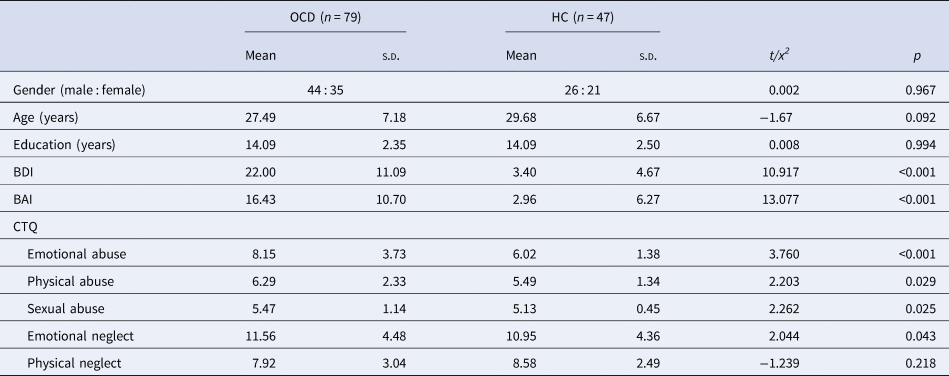
Table 1 summarizes the demographic information of both the OCD patients and HCs. No significant differences were found between the two groups in gender (x 2 = 0.002, p = 0.976), age (t 124 = −1.67, p = 0.092) and length of education (t 124 = 10.917, p = 0.994). OCD patients reported significantly higher BDI (t 124 = 10.917, p < 0.001) and BAI scores (t 124 = 13.077, p < 0.001) than HCs. OCD patients also reported more emotional abuse (t 124 = 3.760, p < 0.001), physical abuse (t 124 = 2.203, p = 0.029), sexual abuse (t 124 = 2.262, p = 0.025) and emotional neglect (t 124 = 2.044, p = 0.043) based on the score on the CTQ compared with HCs.
Demographic information of OCD patients and HCs

BDI, Beck Depression Inventory; BAI, Beck Anxiety inventory; CTQ, Childhood Trauma Questionnaire; OCD, obsessive–compulsive disorder.
Cluster analysis
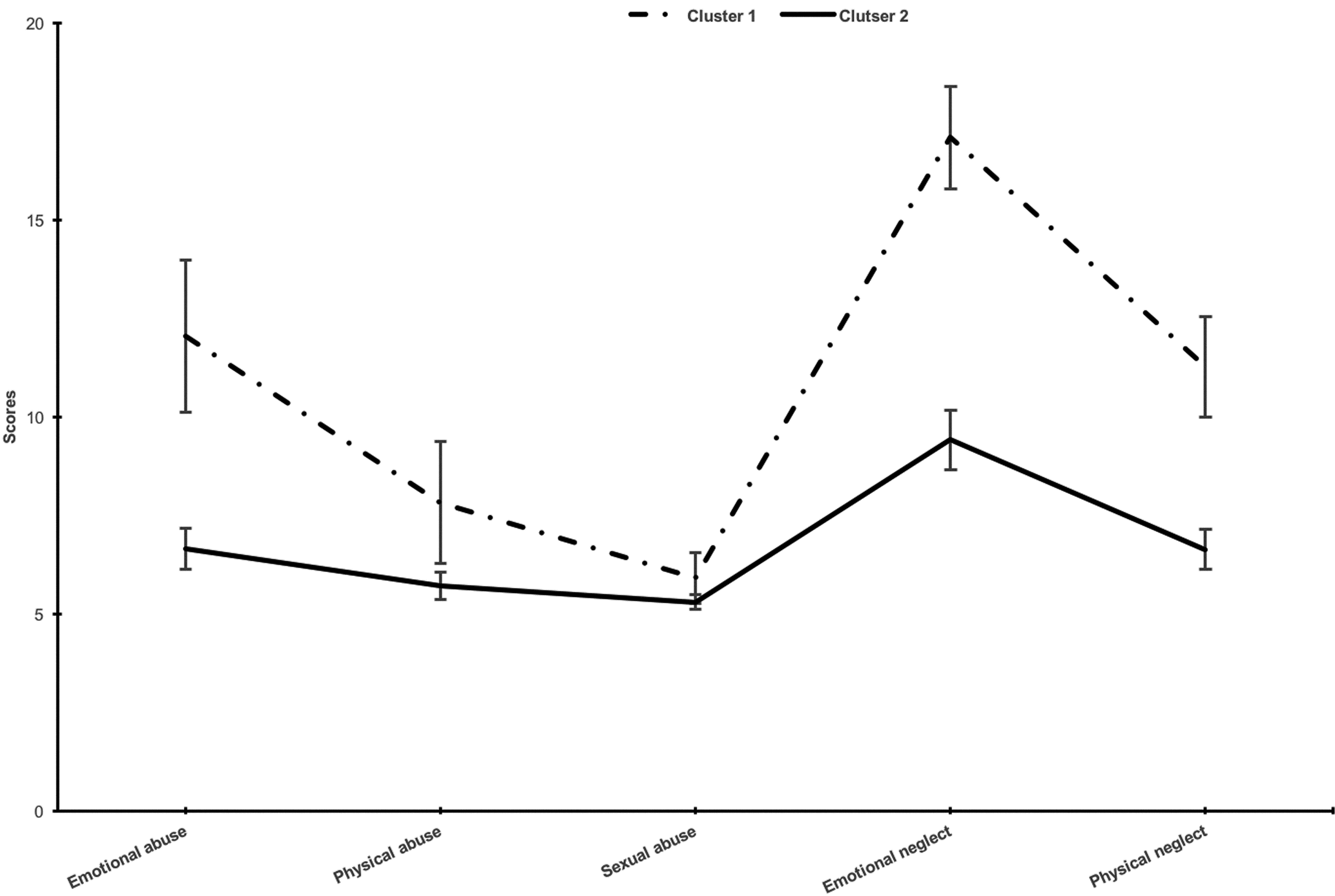
Cluster analysis indicated that the best solution was a two-cluster solution. When the cluster number was two, the BIC was the smallest (cluster number = 1, BIC = 314.98; cluster number = 2, BIC = 299.70, BIC change = 15.28; cluster number = 3, BIC = 331.67, BIC change = 31.97; cluster number = 4, BIC = 370.61, BIC change = 38.94; cluster number = 5, BIC = 410.45, BIC change = 39.84; cluster number = 6, BIC = 447.62, BIC change = 37.18; cluster number = 7, BIC = 436.16, BIC change = −11.46; cluster number = 8, BIC = 466.58, BIC change = 30.42; cluster number = 9, BIC = 504.42, BIC change = 37.85; cluster number = 10, BIC = 528.11, BIC change = 23.68). K-means cluster analysis showed that 22 cases were included in cluster 1 and 57 cases were included in cluster 2. The result of cluster analysis based on CTQ subscale scores is presented in Fig. 1. Cluster 1 consisted of OCD patients with high levels of childhood trauma (OCD_HCT), while cluster 2 consisted of OCD patients with low levels of childhood trauma (OCD_LCT). Discriminant function analysis showed that 98.7% of the cases were accurately classified, with a 95.5% accuracy for cluster 1 and a 100% classification accuracy for cluster 2 (Wilk's λ = 0.286, p < 0.001).
Profiles of cluster analysis based on CTQ subscales. Error bars represent 95% confidence intervals.

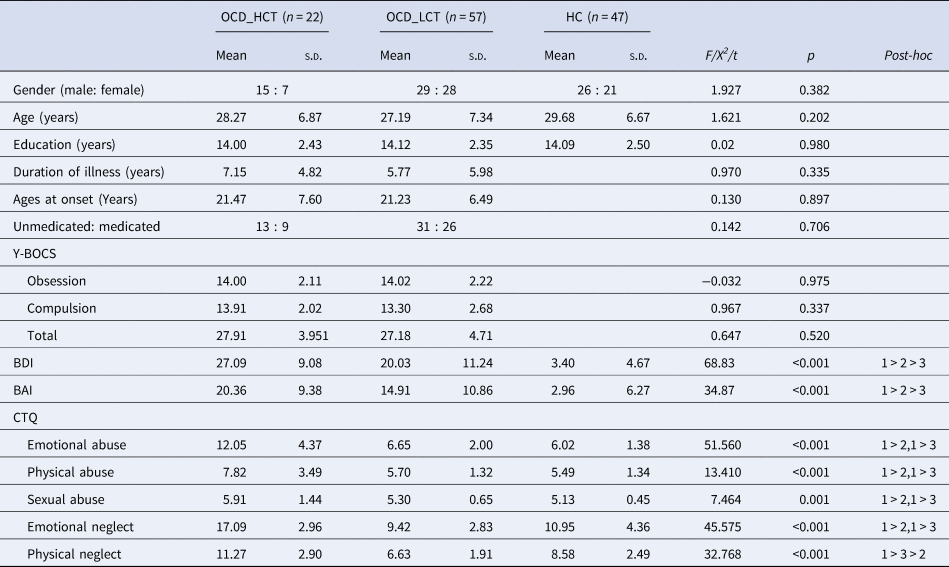
Table 2 summarizes the demographic information of the two OCD subgroups and HCs. There were 13 unmedicated patients and nine medicated patients in the OCD_HCT group, while there were 31 unmedicated patients and 26 medicated patients in the OCD_LCT group. The two subgroups did not differ in the proportion of medicated and unmedicated patients (x 2 = 0.142, p = 0.706). There was also no significant difference found among the three groups in gender (x 2 = 1.927, p = 0.382), age (F (2,123) = 1.621, p = 0.202) and length of education (F (2,123) = 0.02, p = 0.980). However, there were significant differences in BDI (F (2,123) = 68.83, p < 0.001) and BAI (F (2,123) = 34.87, p < 0.001) scores. Post-hoc analysis showed that compared with HC, the two OCD subgroups reported significantly higher BDI and BAI scores, and the OCD_HCT group reported significantly higher BDI and BAI scores compared with the OCD_LCT group. No significant difference was found between the OCD_HCT and OCD_LCT groups in duration of illness (t 77 = 0.970, p = 0.335), age of onset (t 77 = 0.130, p = 0.897), Y-BOCS total scores (t 77 = 0.647, p = 0.647), Y-BOCS obsessions subscale score (t 77 = −0.032, p = 0.975) and Y-BOCS compulsive subscale score (t 77 = 0.967, p = 0.337).
Demographic information of OCD groups and HCs

Y-BOCS, Yale-Brown Obsessive–Compulsive Scale; BDI, Beck Depression Inventory; BAI, Beck Anxiety Inventory; CTQ, Childhood Trauma Questionnaire; OCD_HCT, OCD patients with high childhood trauma; OCD_LCT, OCD patients with low childhood trauma.
Function connectivity
Functional connectivity in OCD patients and HCs
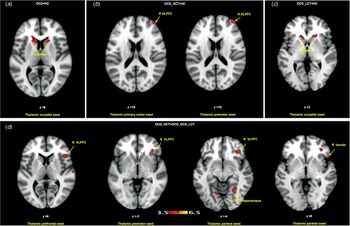
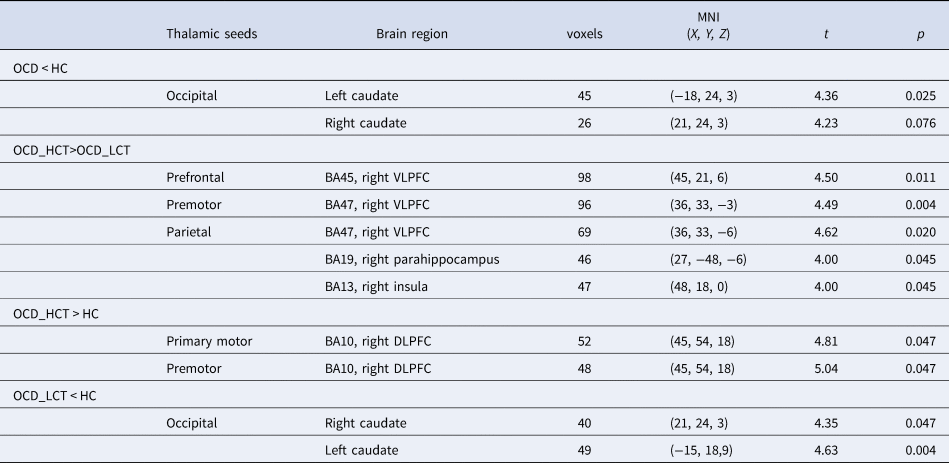
Compared with HCs, we found that patients with OCD exhibited significantly decreased rsFC between the thalamic occipital seed and the left caudate. There was also a trend towards significance indicating decreased rsFC between the thalamic occipital seed and the right caudate (see Table 3, Fig. 2a). Connectivity strengths in both OCD patients and HCs are presented in online supplementary Table S1.
Comparison of rsFC in OCD_HCT, OCD_LCT and HC. Panel a shows a decreased FC in the whole group of OCD relative to HC. Panel b shows an increased FC in OCD_HCT relative to HC. Panel c shows a decreased FC in OCD_LCT relative to HC. Panel d shows an increased FC in OCD_HCT relative to OCD_LCT. R: right; DLPFC: dorsolateral prefrontal cortex; VLPFC: ventrolateral prefrontal cortex; OCD_HCT: OCD patients with high childhood trauma; OCD_LCT: OCD patients with low childhood trauma.

rsFC group comparisons

OCD_HCT, OCD patients with high childhood trauma; OCD_LCT, OCD patients with low childhood trauma; PFC, prefrontal cortex; VLPFC, ventral lateral prefrontal cortex; BA, Broadmann area.
Functional connectivity in the OCD subgroups and HCs
Table 3 summarizes the results of the rsFC in OCD_HCT patients, OCD_LCT patients, and HCs (connectivity strengths are presented in online supplementary Table S1). Compared with HCs, OCD_HCT patients exhibited significantly increased rsFC between (1) the thalamic primary motor seed and the right DLPFC and (2) the thalamic premotor seed and the right DLPFC (see Fig. 2b). However, we found significantly decreased rsFC between the thalamic occipital seed and the bilateral caudate in OCD_LCT patients compared with HCs (see Fig. 2c).
Compared with OCD_LCT patients, OCD_HCT patients also exhibited significantly increased rsFC between (1) the thalamic prefrontal seed and the right ventral lateral prefrontal cortex (VLPFC); (2) the thalamic premotor seed and the right VLPFC; and (3) the thalamic parietal seed and the right VLPFC, the parahippocampus and the insula (see Fig. 2d). Subsequent post-hoc hierarchical linear analyses showed that CTQ score was positively correlated with the connectivity strength of prefrontal thalamic subdivision – right VLPFC, parietal thalamic seed – right VLPFC, and parietal thalamic seed – right parahippocampus (online supplementary Table S2). The effect of CTQ remained after adding the interaction of BDI and BAI, and the score of Y-BOCS into the model. In particular, there was no significant contribution from the interactions of BDI and BAI in the second step. Finally, the Y-BOCS score only contributed significantly to the prediction in rsFC of parietal thalamic seed – right VLPFC (β = 0.231, p = 0.049). These results further verified that the rsFC differences between the OCD_LCT and OCD_HCT patients were mainly driven by childhood trauma.
Discussion
Our main findings showed that OCD_HCT patients exhibited significantly increased thalamic rsFC with the prefrontal cortex, while decreased rsFC between the caudate and the thalamus was found in OCD_LCT patients. To the best of our knowledge, this is the first study showing OCD patients with high and low levels of childhood trauma exhibit different changes in thalamic rsFC.
Compared with OCD_LCT patients, OCD_HCT patients exhibited increased rsFC between the prefrontal, premotor and parietal thalamic subdivisions and the right VLPFC. The thalamus-VLPFC connection is a part of the ‘ventral cognitive’ CSTC circuit, which is associated with inhibitory response (Milad & Rauch, Reference Milad and Rauch2012; van den Heuvel et al., Reference van den Heuvel, van Wingen, Soriano-Mas, Alonso, Chamberlain, Nakamae and Veltman2016). Dysfunction in inhibitory response is considered a fundamental deficit in OCD that accounts for intrusive thoughts and compulsive behaviours (Kalanthroff, Henik, Simpson, Todder, & Anholt, Reference Kalanthroff, Henik, Simpson, Todder and Anholt2017). Previous studies have found that childhood trauma was correlated with inhibition dysfunction (Ernst et al., Reference Ernst, Mohr, Schött, Rickmeyer, Fischmann, Leuzinger-Bohleber and Grabhorn2018; Quidé, O'Reilly, Watkeys, Carr, & Green, Reference Quidé, O'Reilly, Watkeys, Carr and Green2018). Hence, the hyperconnectivity of the thalamus–VLPFC pathway may underline dysfunctional response inhibition, which may be more prominent in OCD_HCT patients. In this study, we did not measure response inhibition in OCD patients, which might have prevented us from examining this issue. Future studies should further investigate the effect of childhood trauma on OCD patients' response inhibition capacity.
Compared with HCs, we also found increased thalamic rsFC in OCD_HCT patients, mainly between the primary motor and premotor thalamic subdivisions and the right DLPFC. The thalamus–DLPFC pathway is part of the ‘dorsal cognitive’ CSTC circuit, and some researchers have suggested that the hyperactivation in this circuit may be a compensatory mechanism (van den Heuvel et al., Reference van den Heuvel, van Wingen, Soriano-Mas, Alonso, Chamberlain, Nakamae and Veltman2016). Indeed, some previous studies in OCD patients have also reported the presence of a compensatory mechanism in inhibition and working memory (de Vries et al., Reference de Vries, de Wit, Cath, van der Werf, van der Borden, van Rossum and van den Heuvel2014; de Wit et al., Reference de Wit, de Vries, van der Werf, Cath, Heslenfeld, Veltman and van den Heuvel2012; van den Heuvel et al., Reference van den Heuvel, van Wingen, Soriano-Mas, Alonso, Chamberlain, Nakamae and Veltman2016). On the other hand, the DLPFC plays an important role in executive function, such as planning and memory (Kaplan, Gimbel, & Harris, Reference Kaplan, Gimbel and Harris2016; Ouerchefani, Ouerchefani, Allain, Ben Rejeb, & Le Gall, Reference Ouerchefani, Ouerchefani, Allain, Ben Rejeb and Le Gall2018). Hyperactivity in the DLPFC may impede the ability to reduce internal conflict, which is related to intrusive thoughts and compulsive behaviour (Chen et al., Reference Chen, Meng, Hu, Cui, Ding, Kang and Wang2016b; Maltby, Tolin, Worhunsky, O'Keefe, & Kiehl, Reference Maltby, Tolin, Worhunsky, O'Keefe and Kiehl2005). However, findings from functional brain imaging studies on OCD are inconsistent. Some studies found dysconnectivity in the DLPFC (den Braber et al., Reference den Braber, Ent, Blokland, van Grootheest, Cath, Veltman and Boomsma2008; Hirosawa et al., Reference Hirosawa, Jin, Sakai, Nishida, Ishida, Nakamae and Fukui2013; Menzies et al., Reference Menzies, Chamberlain, Laird, Thelen, Sahakian and Bullmore2008; Russell et al., Reference Russell, Cortese, Lorch, Ivey, Banerjee, Moore and Rosenberg2003), while others found no alteration (Koh et al., Reference Koh, Seol, Kang, Kim, Namkoong, Chang and Kim2018; Stern, Fitzgerald, Welsh, Abelson, & Taylor, Reference Stern, Fitzgerald, Welsh, Abelson and Taylor2012). In this study, we recruited a relatively homogeneous sample of OCD_HCT patients and observed increased rsFC between the thalamus and the DLPFC compared with HCs. This observed hyper-connectivity may result from the disease process itself or due to the impact of childhood trauma, which warrants further research. However, the fact that the same hyper-connectivity was not observed in OCD_LCT patients compared with HCs suggests that the change may more likely be due to childhood trauma, which may also explain the heterogeneous findings in previous studies.
In OCD_LCT patients, we found decreased rsFC between the occipital subdivision of the thalamus and the caudate compared with HCs. This decreased thalamic rsFC with the caudate was also found in the whole group of OCD patients in our study, suggesting that this may be a general neural correlate of OCD. Indeed, caudate abnormalities in OCD have been well-documented in previous studies (Hou et al., Reference Hou, Zhao, Zhang, Song, Wu, Wang and Li2014; Whiteside, Port, & Abramowitz, Reference Whiteside, Port and Abramowitz2004). The caudate receives inputs from the cerebral cortex and selects, filters, and generates new activity patterns that are forwarded to specific basal ganglia nuclei, which are then projected back to the cortex through the thalamus (Chen et al., Reference Chen, Juhas, Greenshaw, Hu, Meng, Cui and Li2016a; Postuma & Dagher, Reference Postuma and Dagher2006). Decreased rsFC of the caudate–thalamic pathway within the CSTC circuit may cause a failure in dissociating from obsessions and initiating new activities (Beucke et al., Reference Beucke, Sepulcre, Eldaief, Sebold, Kathmann and Kaufmann2014; Chen et al., Reference Chen, Juhas, Greenshaw, Hu, Meng, Cui and Li2016a). We also found a trend of decreased occipital thalamic seed–caudate connection in the OCD_HCT group relative to HCs, but the alteration was marginally non-significant, which may be due to the small sample size of the group.
Taken together, abnormality in the CSTC circuit appears to be a shared feature of OCD patients, irrespective of whether they experience childhood trauma or not. However, patients with high and low levels of childhood trauma exhibited different changes in the CSTC circuit. Increased connectivity between the thalamus and the prefrontal cortex may be a more specific neural correlate in OCD_HCT patients, whereas decreased caudate–thalamus rsFC may be a more general neural correlate for OCD patients in general.
Apart from the aberrant thalamocortical rsFC within the CSTC circuit in OCD_HCT patients, we also found altered rsFC between the thalamus and other regions involving more extensive neural networks, including the right parahippocampus and the insula. The parahippocampus plays an important role in the memory-forming process (Shao et al., Reference Shao, Wang, Ye, Jin, Ni, Yang and Yang2013). Previous studies have reported that childhood trauma is associated with poor memory in both healthy adults and individuals with mental disorders, such as schizophrenia and depression (Goodman, Quas, & Ogle, Reference Goodman, Quas and Ogle2010; Petkus, Lenze, Butters, Twamley, & Wetherell, Reference Petkus, Lenze, Butters, Twamley and Wetherell2018; Saleh et al., Reference Saleh, Potter, McQuoid, Boyd, Turner, MacFall and Taylor2017; Shannon et al., Reference Shannon, Douse, McCusker, Feeney, Barrett and Mulholland2011). Hence, the rsFC alteration between the thalamus and the parahippocampus may be correlated with the dysfunction of memory formation and retrieval after experiencing childhood trauma. Furthermore, we also found an alteration in thalamus–insula rsFC in OCD_HCT patients relative to OCD_LCT patients. The insula, especially the right side, responds to negatively valenced stimuli, such as disgusted faces, aversive conditions and anticipation, or presentation of pain (Cho et al., Reference Cho, Fromm, Guyer, Detloff, Pine, Fudge and Ernst2013). The increased rsFC between the thalamus and the insula in OCD_HCT patients might be explained by the possibility that childhood trauma experience may alter the vulnerability to adverse stimuli in OCD patients. Future OCD studies could further investigate this hypothesis.
This study has several limitations. First, although there is no difference in the proportion of these patients between the two OCD subgroups, medication exposure might still have confounded the results. The small sample size might have limited the statistical power to perform such a stratification based on medication. Future studies should recruit a larger sample of drug-naive patients to verify these findings. Second, we did not explore the differential effects of childhood trauma subtypes. Future studies examining the impact of different trauma subtypes may provide insight into the effect of specific trauma types on OCD patients. Third, daily stressful events in adulthood were not evaluated in our study, although we did assess the severity of depressive and anxiety symptoms in our participants. Future studies could consider adding an assessment of life events to control its confounding effect. Fourth, although the thalamus is a heterogeneous structure and boundaries between thalamic nuclei that can be visualized histologically are not easily seen in magnetic resonance images, the subdivisions do not follow histologically defined borders, making the interpretation of imaging findings challenging. Finally, we did not divide our participants into different OCD-subtypes, but different subtypes may have different neural correlates.
Notwithstanding the above limitations, our findings provide a detailed investigation of the specific role of childhood trauma on brain connectivity alteration in OCD. Increased rsFC in the CSTC circuit may be a neural correlate of OCD_HCT, whereas decreased caudate–thalamus rsFC may be a neural correlate for OCD in general. Longitudinal studies are needed to verify the causal relationship between childhood trauma and OCD psychopathology.
Supplementary material
The supplementary material for this article can be found at https://doi.org/10.1017/S0033291720004328
Acknowledgements
The authors thank all the volunteers who took part in the study.
Financial support
This research was supported by grants from the National Natural Science Foundation of China (grant 81671340), the National Key Research and Development Programme (2016YFC0906402), the grants from the Shanghai Municipal Education Commission–Gao Feng Clinical Medicine (20161321), the Shanghai Municipal Health Commission (2017BR058, 2019ZB0201), the Shanghai Key Laboratory of Psychotic Disorders (No.13dz2260500), and the CAS Key Laboratory of Mental Health, Institute of Psychology.
Conflict of interest
None.
Ethical standards
The authors assert that all procedures contributing to this work comply with the ethical standards of the relevant national and institutional committees on human experimentation and with the Helsinki Declaration of 1975, as revised in 2008.