Introduction
Witchweed (Striga hermonthica) is a root parasitic weed of cereals in tropical agro- ecosystems, most notably in the savannah region of Africa. Frequently, crop yield losses due to this parasite can be as high as 100% under heavy infestation. Striga is considered to be one of the most important limiting factors on the yields of cereals (Yoder and Musselman, Reference Yoder and Musselman2006).
Laboratory investigations are essential for the study of Striga for development of appropriate control measurements. Screening of potential trap crops (crops that stimulate suicidal germination of Striga seeds) or host plant resistance in vitro is vital, as it enables much more material to be evaluated than would be possible with limited field space. Several standard techniques are available for conditioning Striga seeds and germination bioassays. Prior to germination the seeds need an after-ripening period of several months, and no germination occurs without appropriate germination stimulants, moisture and temperature (Parker and Riches, Reference Parker and Riches1993). In germination bioassays, preconditioned Striga seeds are usually placed on a glass fibre filter disc (Berner et al., Reference Berner, Winslow, Awad, Cardwell, Mohan Raj and Kim1997; Matusova et al., Reference Matusova, van Mourik and Bouwmeester2004, Reference Matusova, Rani, Verstappen, Franssen, Beale and Bouwmeester2005) or in a well of a microtitre plate (Gurney et al., Reference Gurney, Press and Scholes2002) and exposed to a germination stimulant. The final evaluation of germinated seeds is performed by visual examination of the protruded radicle under a dissecting microscope (Berner et al., Reference Berner, Winslow, Awad, Cardwell, Mohan Raj and Kim1997; Gurney et al., Reference Gurney, Press and Scholes2002; Matusova et al., Reference Matusova, Rani, Verstappen, Franssen, Beale and Bouwmeester2005). However, the tiny seeds (0.25–0.50 mm in size) (Parker and Riches, Reference Parker and Riches1993), and the rather hyaline and colourless radicles, make observations and counting a laborious task. To our knowledge, staining of Striga seeds has been reported only for viability testing using tetrazolium red dye (Berner et al., Reference Berner, Winslow, Awad, Cardwell, Mohan Raj and Kim1997), but staining protocols to ease evaluation of germinated Striga seeds have not been reported. We searched for a reliable, simple, fast and inexpensive staining method to allow investigation of germinated Striga seeds. Moreover, we were particularly interested in a method that avoids the use of highly toxic compounds in the staining solution.
Materials and methods
Preconditioning of Striga seeds
Seeds of Striga hermonthica (Del.) Benth. were harvested from infested sorghum plants in Maroua, Cameroon in October 2005. According to Matusova et al. (Reference Matusova, van Mourik and Bouwmeester2004) and Lendzemo (Reference Lendzemo2004), the seeds were surface-sterilized with 2.5% sodium hypochlorite solution (Merck, Darmstadt, Germany) containing two drops of Tween 20 for 5 min, transferred to a funnel lined with a folded filter paper (MN 615 ¼, Machery-Nagel, Germany) and thoroughly rinsed with sterile, deionized water. The filter paper with the seeds was removed and placed on a layer of tissue paper to dry. Thereafter, lids of a Petri dish (90 mm diameter) were lined with two layers of filter paper (Whatman No. 2, Dassel, Germany) and moistened with 5 ml deionized sterile water. Thirty glass fibre filter discs (1 cm diameter, Whatman, GF/A, Dassel, Germany) were evenly distributed on the wetted filter paper in each Petri dish, and the Striga seeds were spread (c. 80–100 seeds) on each wetted glass fibre filter disc. The Petri dishes were sealed with Parafilm™, wrapped in aluminium foil and incubated at 28°C in the dark for 15–21 d.
Germination bioassay
After the preconditioning period of 15–21 d, the 1 cm glass fibre filter paper discs containing the Striga seeds were removed and dried on tissue paper for 1 h to remove excess moisture. The discs were transferred to a new lid of a Petri dish (5 discs per Petri dish) lined with a filter paper ring (outer diameter 90 mm, inner diameter 80 mm) moistened with 1 ml of deionized water. Subsequently, 50 μl of the synthetic germination stimulant GR24 (1 mg l− 1) was added to each disc, the Petri dishes were sealed with Parafilm™ and incubated at 28°C in darkness for 2 d (Lendzemo, Reference Lendzemo2004; Matusova et al., Reference Matusova, van Mourik and Bouwmeester2004).
Staining solutions
The following stains, frequently used in microscopy and plant pathological laboratories (Dhingra and Sinclair, Reference Dhingra and Sinclair1995) were tested: Lactophenol Blue solution (Fluka, Buchs, Switzerland), Cotton Brown (Bayer, Leverkusen, Germany), Bengal Rose B (Bayer, Leverkusen, Germany), Coomassie Brilliant Blue R250 (Fluka, Buchs, Switzerland), Bromophenol Blue (Riedel-de Haen, Seelze, Germany), Cochenille Red (Bayer, Leverkusen, Germany), Aniline Blue (Fluka, Buchs, Switzerland), Evans Blue (Sigma-Aldrich, Steinheim, Germany), Methylene Blue (Merck, Darmstadt, Germany), Methyl Red (Merck, Darmstadt, Germany), Toluidine Blue O (Sigma-Aldrich, Steinheim, Germany), Rubin S ( = Fuchsin acid) (Merck, Darmstadt, Germany) and Trypan Blue (Fluka, Buchs, Switzerland).
Ink is used in routine staining of the pathogenic fungus Pseudocercosporella herpotrichoides (Mauler-Machnik and Nass, Reference Mauler-Machnik and Nass1990) and mycorrhizal fungi (Vierheilig et al., Reference Vierheilig, Coughlan, Wyss and Piché1998). We tested Black ink (Sheaffer, Ft. Madison, USA), Brilliant Black ink (Pelikan, Hannover, Germany), Brilliant Green ink (Pelikan, Hannover, Germany), Brilliant Red ink (Pelikan, Hannover, Germany), Brilliant Blue ink (Pelikan, Hannover Germany) and Blue ink (Geha, Brilon, Germany). Stock solutions (1%, w/v) were prepared by dissolving the powdery stains in the diluent, storing for 24 h under ambient light and temperature conditions, and subsequent filtering through filter paper (MN 615 ¼, Macherey-Nagel, Germany). The liquid stains (Lactophenol Blue solution and the inks) were used without filtration. Based on preliminary results, the final concentrations of the staining solutions were adjusted with the respective diluent. Apart from deionized sterile water, we used lactic acid (12.1 M) (Fluka, Buchs, Switzerland), which is known to macerate and clarify plant tissue (Wittmann, Reference Wittmann1994), and household vinegar (clear, brownish-yellow, 5% acetic acid) (Mautner-Markhof, Vienna, Austria) as diluents. Fresh working solutions of each dye and ink were prepared for each experiment.
Staining procedure
Thirty microlitres of staining solution were added to each glass fibre disc containing pregerminated Striga seeds. The seeds were incubated at room temperature under natural light and observed under a stereo microscope for germination and staining of the radicle after 5 min, 2 h and 5 h. Each staining solution was tested on three individual filter discs.
Results
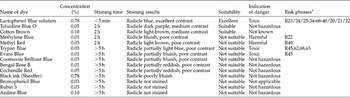
Out of 14 stains diluted in water, only Lactophenol Blue solution, a substance classified as toxic, resulted in excellent staining of Striga radicles within 5 min (Table 1). Compared to the unstained hyaline radicles, Lactophenol Blue solution gave uniformly blue-stained radicles and a pronounced contrast to the brown seeds. Concurrently, the glass fibre filter background was hardly stained. Toluidine Blue O and Cotton Brown showed a slightly reduced staining result. Due to the staining time of 2 h, these stains were classified only as ‘suitable’. Bromophenol Blue, Rubin S and Aniline Blue did not stain Striga radicles. All other water-based stains were classified as not suitable, due to the poor contrast of the stained radicles and the filter paper background.
Comparison of different stains diluted in water for staining of germinated Striga seeds

aStated in the manufacturers' material safety data sheets according to EU regulation (http://eur-lex.europa.eu/LexUriServ/LexUriServ.do?uri = CELEX:32001L0059:EN:HTML). R23/24/25, Toxic by inhalation, in contact with skin and if swallowed; R48/20/21/22, harmful: danger of serious damage to health by prolonged exposure through inhalation, in contact with skin and if swallowed; R34, causes burns; R68, possible risks of irreversible effects; R22, harmful if swallowed; R40, possible risk of cancer; R45, may cause cancer; R62, possible risk of impaired fertility; R63, possible risk of harm to the unborn child.
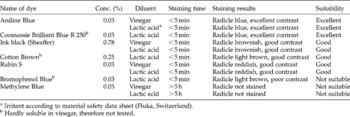
The protocols with several non-toxic stains, frequently used in microbiological laboratories, were more successful when diluted in lactic acid and vinegar (Table 2). In particular, Aniline Blue (in both diluents) and Coomassie Brilliant Blue R250 resulted in excellent staining results. Black ink (Sheaffer), Cotton Brown and Rubin S showed good suitability. Bromophenol Blue and Methylene Blue were not suitable due to insufficient or absent staining of the Striga radicles.
Comparison of different stains, diluted in vinegar or lactic acid, for staining of germinated Striga seeds
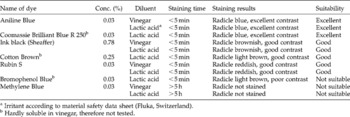
aIrritant according to material safety data sheet (Fluka, Switzerland).
b Hardly soluble in vinegar, therefore not tested.
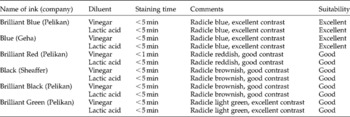
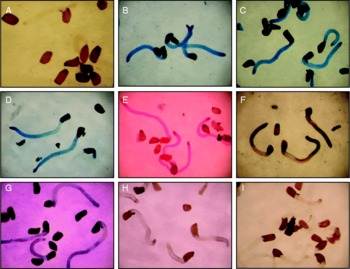
Due to safety concerns, availability and the convenience of handling, other ink products were tested (Table 3). Blue inks (Geha and Pelikan) exhibited better contrast than black inks and could be considered as excellent. All other inks tested showed good staining results. Both diluents, lactic acid and household vinegar, yielded similar staining results. Representative results are illustrated in Fig. 1.
Comparison of different inks (0.78% in lactic acid or vinegar) for staining of germinated Striga seeds

Representative staining results of germinated Striga seeds. Staining time is reported in parentheses. (A) Unstained radicles; (B) Blue ink (Geha) diluted in vinegar ( < 5 min); (C) Lactophenol Blue solution in water ( < 5 min); (D) Aniline Blue in vinegar ( < 5 min); (E) Rubin S in lactic acid ( < 5 min); (F) Black ink (Sheaffer) in vinegar ( < 5 min); (G) Toluidine Blue O in water (2 h); (H) Black ink (Sheaffer) in water (>5 h); (I) Aniline Blue in water (>5 h).

Discussion
Our results show that Striga radicles can be easily stained with minimal effort. Several dyes, frequently used for microscopic examination of fungi (Dhingra and Sinclair, Reference Dhingra and Sinclair1995), effectively stained Striga radicles. While aqueous Lactophenol Blue gave an excellent radicle stain, it is a potential hazard with known toxicity. The excellent to good contrast of Striga radicles stained with Aniline Blue, Coomassie Brilliant Blue R250, Rubin S, Cotton Brown or ink is an indication that toxic compounds such as Lactophenol Blue solution can be avoided by using lactic acid or vinegar as diluents. Of the stains tested, Blue ink diluted in vinegar is highly recommended. This solution is easy to handle, readily available, gives excellent staining results and is free of known toxic ingredients. Thus, staining germinated Striga seeds can be stained with Blue ink/vinegar without special precautions and can be proposed for routine use in the scoring of Striga germination assays.
Acknowledgements
We thank Roswitha Mammerler for technical assistance. We acknowledge funding from the Eurasia-Pacific Uninet in cooperation with the Austrian Council for Research and Technology Development (Technology Scholarship to S.L.).