I. INTRODUCTION
The general crystallochemical formula for sodium zirconium phosphate (NZP) group of materials is described as (M1) (M2)3 {[L2 (PO4)3] p−}3∞ where M1 and M2 are crystallographic positions in the framework holes and L the positions of the framework. The NZP core framework and the ions placed into M1 and M2 sites behave as two parts of the structure playing different roles. Bonds between the atoms of the framework are strongly covalent, whereas the inserted ions to M1 and M2 interstitial sites are relatively weakly bonded. The weakest one is for cations like Na having +1 oxidation state. This combination of stability and flexibility of NZP structure allows the existence of iso and heterovalent substitutions at all non-oxygen lattice sites and gives rise to a large number of compounds with identical connections between their structural units (Petkov et al., Reference Petkov, Orlova, Kazantsev, Samoilov and Spiridonova2001). Based on the available coordination sites, the standard structural formula for such compounds is described as [M′] [M″3] [AVI2] [XIV3] O12. The octahedral site AVI is normally occupied by Zr4+ while the XIV site is tetrahedral and occupied by P5+. In rhombohedral polycrystalline sodium zirconium phosphates, the PO4 tetrahedra are linked with ZrO6 octahedra by corner sharing, hence forming a three-dimensional framework with [Zr2(PO4)3]− where each oxygen atom is bonded to only one P and one Zr atom. The columns of three units lie along the c-direction running in hexagonal unit cell parallel to each other. These columns are inter-linked through PO4 tetrahedra in the direction perpendicular to the c-axis to develop a framework of columns, which are capable of accommodating the larger alkali metal cations. The three-dimensional NZP structure possesses two kinds of holes, site I (M′1) occurs in the column of Zr octahedra and the other site II (M″2) is located between columns of Zr octahedra. This M″2 site can be populated by additional cations that compensate the charge with polyvalent cations other than zirconium in the three-dimensionally linked interstitial spaces. The alkali atoms such as Na, K, Ca, Ba, Mg, and Sr etc. can be located in the holes between ZrO6 octahedra (Yoon et al., Reference Yoon, Kim, Kim and Hong2001). Site I has distorted octahedral coordination, while site II has trigonal prismatic coordination (Bhuvneshwari and Varadaraju, Reference Bhuvneshwari and Varadaraju1999; Bois et al., Reference Bois, Guitter, Carrot, Trocellier and Guatier-Soyer2001). Several divalent cations substitute for two alkali ions, while rare earth elements are assumed to occupy the Zr4+ site. The strongly bonded but open NZP structure allows high mobility of alkali ions tunneling through the PO4–ZrO6 polyhedral chain. As a result, there are a number of compounds containing 1–5 different cations, belonging to this family (Rega et al., Reference Rega, Agrawal, Huang and McKinstry1992; Varadaraju et al., Reference Varadaraju, Sugantha and Subba Rao1994; Petkov and Orlova, Reference Petkov and Orlova2003). They are also well known for their applications as catalyst supporters, fast ion conductors, and host for immobilizing radioactive waste effluents (Breval et al., Reference Breval, McKinstry and Agrawal1998; Tantri et al., Reference Tantri, Ushadevi and Ramasesha2002). This communication describes the synthesis and Rietveld refinement of crystal structures of trivalent substituted NZP phases.
II. EXPERIMENTAL
The stoichiometric amount of AR grade Na2CO3, ZrO2, Sb2O3/ Cr2O3/Al2O3, and NH4H2PO4 were mixed in a mortar and pestle with an appropriate quantity of glycerol to make a semisolid paste. The paste was gradually heated initially at 600 °C for 8 h to decompose Na2CO3 and (NH4)H2PO4 with the emission of carbon dioxide, ammonia and water vapor. The mixture was reground to micron size, pressed into pellet at room temperature and finally sintered in a platinum crucible at 1050 °C for 24 h.
The materials were characterized by powder X-ray diffraction (XRD) between 2θ = 10–90° on a Rigaku RUH3R diffractometer using CuKα radiation at a step size of 2θ = 0.02° and a fixed counting rate of 2 s per step. The data were analyzed by the Rietveld method using the General Structure Analysis System (GSAS), which is capable of handling and refining the step analysis diffraction data in a comprehensive manner. SEM and EDAX analysis of antimony, chromium, and aluminum substituted NZP has been performed on JEOL JSM-5600 microscope.
III. RESULTS AND DISCUSSION
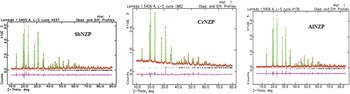
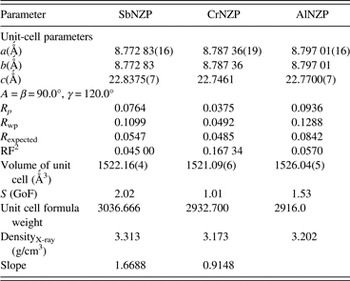
Phase pure solid solutions of SbNZP, CrNZP, and AlNZP crystallize in the rhombohedral system (space group R-3c). The conditions for the rhombohedral lattice: (i) −h + k + l = 3n, (ii) when h = 0, l = 2n, and (iii) when k = 0, l = 2n have been verified for reflections between 2θ = 10–90°. The intensity and positions of the diffraction patterns match with the characteristic pattern of sodium zirconium phosphate, which give several prominent reflections between 2θ = 13.98–46.47° [JCPDS file no. 71-0959 (2000; Figure 1]. The Rietveld refinement of all three phases was performed by the least squares method using GSAS software (Larson and Von Dreele, Reference Larson and Von Dreele2000). Assuming that Na1.1Zr1.9Sb0.1P3O12, Na1.1Zr1.9Al0.1P3O12, and Na1.1Zr1.9Cr0.1P3O12 belong to the Nasicon family, Zr, P, and O atoms are in the 12c, 18e, and 36f Wyckoff positions, respectively, of the R-3c space group. The Na atoms were assumed to occupy the M1 and M2 sites. In the first step, Na occupies fully the M1 site (6b) and the excess of sodium was located in the M2 site (18e). In the second step, the occupancies of Na1 and Na2 were allowed to vary, but the total Zr and Sb/Al/Cr contents were constrained to 0.95 and 0.05, respectively. The refinement leads to a rather good agreement between the experimental and calculated diffraction pattern and yields acceptable reliability factors (R p, R wp and RF 2). The normal probability plot for the histogram gives nearly a linear relationship indicating that the Io and Ic values for most part of the curve are normally distributed. The unit-cell parameters of the materials are close to the corresponding values for un-substituted NZP (Carla et al., Reference Carla, Garrido, Alves, Calle, Martinez Juarez, Iglesias and Rojo1997). The unit-cell parameters register slight increase in the c-direction (Table I). The presence of Na(1)O6/Na(2)O8 distorted polyhedron in the M2 site stretches the bridging PO4 tetrahedra in the c-direction. Simultaneously, the structures show a slight contraction along the a-direction. This may be attributed to bond-angle distortions as a result of the coupled rotation of ZrO6 and PO4 polyhedra (Govindan Kutty et al., Reference Govindan Kutty, Asuvathraman and Sridharan1998).
Rietveld refinement patterns of SbNZP, CrNZP, and AlNZP ceramic samples. The ‘ + ’ are the raw XRD data and the overlapping continuous line is the calculated pattern. Black vertical lines in the profile indicate Bragg's positions of allowed reflections for CuKα1 and CuKα2. The curve at the bottom is the difference in the observed and calculated intensities in the same scale.

Crystallographic data for SbNZP, CrNZP, and AlNZP ceramic phases at room temperature.
Structure: rhombohedral; space group; R-3c; Z = 6.

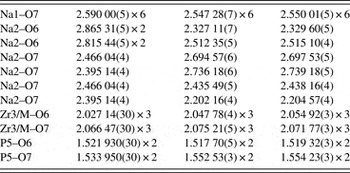
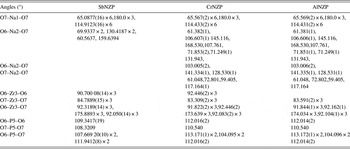
Alteration in unit-cell parameters indicates that the network slightly modifies its dimensions to accommodate the cations occupying M1 and M2 sites without breaking the bonds. The basic framework of NZP accepts the cations of different sizes and oxidation states to form solid solutions yet at the same time keeping the overall geometry unchanged. The final atomic coordinates, inter-atomic distances (Table II), bond angles (Table III), and (h k l) values corresponding to prominent reflections are extracted from the crystal information file (CIF) prepared by the software. The refinement leads to acceptable Zr/M–O, P–O, and Na–O bond distances (where M = Sb, Cr and Al) Zr/M atoms are displaced from the center of the octahedron because of the Na+–Zr4+/M3+ repulsions. The average Zr/M–O distance 2.0468 Å for SbNZP, 2.0615 Å for CrNZP, and 2.0633 Å for AlNZP is smaller than the values calculated from the ionic radii data of 2.12 Å (Shannon, Reference Shannon1976). The P–O distances are close to those found in Nasicon-type phosphates (Chakir et al., Reference Chakir, El Jazouli and de Waal2006). The O–(Zr/M)–O angles vary between 83.31and 175.89°, the angles implying shorter bonds are superior to those involving longer ones because of O–O repulsions which are stronger for O(6)–O(6) than for O(6)–O(7).
Atom-oxygen bond distances (Å) of SbNZP, CrNZP, and AlNZP ceramic powders at room temperature.

O–M–O angles (degree) in SbNZP, CrNZP, and AlNZP ceramic powders at room temperature.

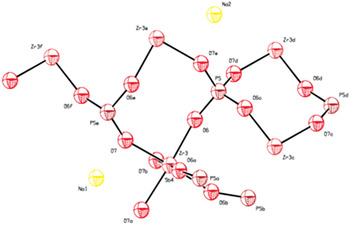
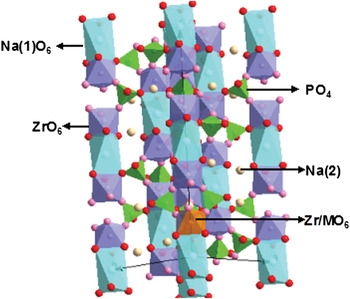
The O–P–O angles vary from 104.09 to 113.17°. The Na(1) atoms occupy the center of the M1 site, while Na(2) atoms located in the M2 site are surrounded by eight or six oxygen atoms. Figure 2 shows the PLATON projection of the molecular structure depicting the inter linking of ZrO6 and PO4 through a bridge oxygen atom. The ORTEP view generated by the refined structural data shows that the Zr–O bonds are in three pairs resulting in six coordinations of zirconium and P–O distanced in one pair resulting in four coordinations of phosphorus. Figure 3 illustrates the DIAMOND view showing the ZrO6 inter ribbon distance in the structure of the title phase which is a function of amount and size of alkali cation in the M(2) site of the 3D framework, built from ZrO6 octahedra and corner sharing PO4 tetrahedra. The bond valences calculated using valence sum rule (West, Reference West2003) are in agreement with the expected formal oxidation states of Na+, Zr4+, and P5+, respectively. The chemical bonding mechanism based on the contour maps of charge density reveals that at the center of the Zr atoms the charge density maxima are between 5.75 and 5.82 a.u.3. There are two charge density minima for two different bond distances between Zr and O atoms. The Zr–O bond is covalent with some degree of ionic character because of hybridization effect between Zr-4d and O-2p states (Terki et al., Reference Terki, Bertrand and Aourag2005), Similarly, there are two electron density minima for two types of P–O bond lengths 1.5219(30) and 1.5339(30) Å, respectively. The charge density ratios at the center of the Zr and P atoms of various contours vary from a low of 3.01 to a high of 4.36 against the expected value of 3.6.
PLATON projection of molecular structure showing Zr coordination in ZrO6 and P coordination in PO4 polyhedron at 50% probability level.

DIAMOND view of coordination sites of Na, Zr/M, (Sb, Cr, Al) and P.

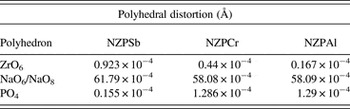
From the individual bond lengths of metal-oxygen polyhedra, polyhedral distortion can be calculated by the following equation Δ = 1/n Σ{(R i−R m)/(R m)}2 (Roger et al., Reference Roger, Ruslan and Liferovich2004). The calculated distortions in ZrO6 octahedra, PO4 tetrahedra, and NaO8 polyhedra have been summarized in Table IV. The ZrO6 octahedron of Al-substituted NZP has been found to be approximately three times more distorted than the corresponding octahedron of Cr-substituted NZP.
Bond distortions in ZrO6, Na(2)O8, and PO4 structural units of SbNZP, CrNZP, and AlNZP ceramic sample.

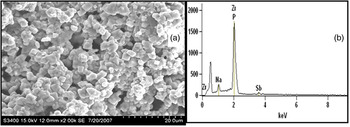
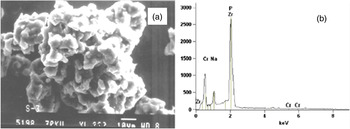
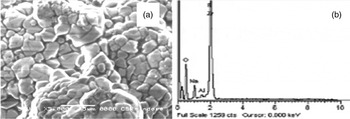
The morphology and microstructure of the specimen have been examined by scanning electron microscopy. The evolution of solid monophase is seen clearly in the electron micrographs of ceramic powders, Sb-substituted NZP has parallelepiped grains 1.5–2.0 μm in diameter [Figure 4(a)], Cr and Al-substituted NZP phases show isolated grains of approximately 2.5–3.0 μm visible in the form of their agglomerates [Figures 5(a) and 6(a)]. The EDX analysis of the phases on selected locations on atomic and weight % of Na, Zr, Sb/Al/Cr, and P are acceptable with their corresponding expected molar ratios. The EDX spectrum reveals that antimony/chromium/aluminum is crystallochemically fixed in the NZP matrix [Figures 4(b), 5(b), and 6(b)]. Simultaneously, the crystallite size was also studied using Scherrer's equation where broadening of the peak is expressed as full-width at half-maxima (FWHM) in the recorded XRD pattern (Shrivastava and Chourasia, Reference Shrivastava and Chourasia2008). The crystallite size measured along various reflecting planes does not show significant h. k. l dependent broadening; however, the minimum and maximum size depends on substituent cation (Sb, Cr, and Al).
(a) Scanning electron micrograph and (b) EDAX spectrum of polycrystalline SbNZP mono phase.

(a) SEM and (b) EDAX spectrum of CrNZP ceramic powder synthesized at 1050 °C.

(a) SEM and (b) EDAX spectrum of AlNZP ceramic material synthesized at 1050 °C.

ACKNOWLEDGEMENTS
The authors thankfully acknowledge the financial assistance received from the Department of Science and Technology, Government of India, New Delhi for research project no. SR/S3/ME/20/2005-SERC-Engg. under the SERC scheme. Rashmi Chourasia is thankful to UGC, New Delhi, India for the award of Dr D.S. Kothari Post Doctoral fellowship (PDF).