Clostridioides difficile infection (CDI) is a common healthcare-associated infection that can cause mild, self-limiting diarrhea to life-threatening disease. CDI is considered an urgent threat by the Centers for Disease Control and Prevention (CDC) 2019 Antibiotic Resistance Threats Report. 1 Although healthcare-associated cases are declining, community-associated cases are on the rise. 1 The Infectious Diseases Society of America (IDSA) and Society for Healthcare Epidemiology of America (SHEA) 2017 clinical practice guidelines for CDI in adults and children recommend therapy with oral vancomycin 125 mg 4 times daily or fidaxomicin 200 mg twice daily for 10 days for an initial episode of nonsevere or severe CDI. Metronidazole is suggested for an initial episode of nonsevere CDI only if patients are unable to access first-line therapies. Reference McDonald, Gerding and Johnson2 As a result, our institutional CDI treatment protocols were modified, and providers were educated regarding the updated guidelines. Although antimicrobial stewardship programs have been developed to increase guideline-concordant prescribing for inpatients with CDI, little is known regarding the management of CDI outpatient.
A prior study performed by our antimicrobial stewardship program evaluated the CDI therapy of 126 patients diagnosed in an ambulatory clinic between January 1, 2018, and June 30, 2019. Metronidazole was the most frequently prescribed CDI treatment (65%), followed by vancomycin (33.4%). Overall, only 37 patients (29.3%) were prescribed the appropriate antimicrobial therapy and duration. Reference Morrison, Kenney and Outpatient3 A high proportion of outpatients had guideline discordant CDI management, associated with numerically worse clinical cure, greater CDI recurrence, and unanticipated healthcare visits. Reference Morrison, Kenney and Outpatient3 As a result, an electronic medical record (Epic Systems, Verona, WI) best practice advisory (BPA) was designed and implemented on June 3, 2020, to assist with ambulatory prescribing (Supplementary Fig. 1 online).
In this study, we evaluated the impact of clinical decision support on the management of outpatients with CDI. We evaluated guideline-concordant CDI therapy, patient outcomes, and provider acceptance.
Methods
Participants
This study was approved by the Henry Ford Health System (HFHS) Institutional Review Board (IRB #14404) and was a quasi-experiment that compared 2 groups of adult patients diagnosed with and treated for an initial episode of CDI at an ambulatory clinic between November 1, 2019, and November 30, 2020. The first group included patients from November 1, 2019, to June 2, 2020, before the BPA was implemented and the second group included patients from June 3, 2020, to November 30, 2020, after the BPA was implemented (Fig. 1). This study was conducted at Henry Ford Health System (HFHS), which includes ∼50 outpatient medical centers located throughout southeastern and southern central Michigan. HFHS ambulatory clinics include primary, urgent, and specialty care clinics. Primary care included internal and family medicine clinics. Specialty care included nonprimary care, medicine subspecialty clinics like gastroenterology and oncology. Patients were included in the study if they were at least 18 years of age and had a clinical diagnosis of CDI, diarrhea, and a positive C. difficile toxin or polymerase chain reaction (PCR) test. Additionally, patients had to have an initial episode of CDI diagnosed within HFHS and treatment initiated by a HFHS ambulatory clinic prescriber. Patients were excluded if they had fulminant CDI, were seen by an infectious diseases provider, or were under outpatient hospice care.
Study timeline.

BPA description
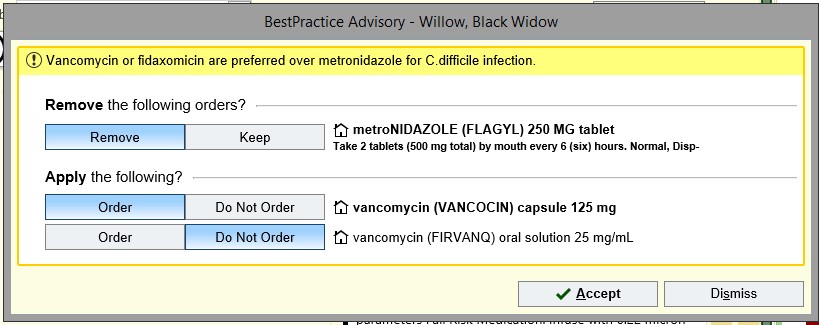
The BPA was sent to the outpatient ordering provider at the time of prescription signature for oral metronidazole for patients with a history of a positive C. difficile test in the previous 14 days. The alert excluded emergency department settings. The alert stated, “Vancomycin or fidaxomicin are preferred over metronidazole for C. difficile infection” and displayed buttons to remove the order for metronidazole and place an order for a 10-day course of oral vancomycin capsules or suspension.
Specimen collection and testing
Stool specimens were collected in accordance with the procedure outlined by the HFHS Department of Pathology Laboratory User’s Guide and were tested at the core clinical microbiology laboratory. Specimens were collected in a sterile container and were transported at room temperature within 24 hours of collection. Specimens were stored and transported at 2°–8°C if transport to the laboratory was anticipated to exceed 48 hours. The laboratory performed 2-step testing Reference McDonald, Gerding and Johnson2 : (1) C. difficile toxin A and B and glutamate dehydrogenase (GDH) followed by (2) toxin negative but GDH positive samples reflex to C. difficile PCR. Formed stool specimens that were submitted were rejected and were not tested.
Outcomes
The purpose of this study was to evaluate the impact of clinical decision support on outpatients diagnosed with an initial episode of nonsevere or severe CDI. The primary end point was the proportion of patients prescribed guideline-concordant CDI therapy. Guideline-concordant CDI therapy was defined as vancomycin 125 mg by mouth 4 times daily or fidaxomicin 200 mg twice daily for 10–14 days according to national practice guidelines. Reference McDonald, Gerding and Johnson2 Metronidazole 500 mg by mouth 3 times daily for 10–14 days was considered guideline concordant if there was documentation specifying that it had been prescribed due to lack of access to first-line therapies. Secondary end points included prescriber response to the BPA, patient outcomes (clinical response, recurrence, and unplanned encounter), and reasons for alternative CDI therapy. Clinical response was defined as symptom improvement or resolution without additional healthcare treatment for CDI within 14 days of treatment initiation. Recurrent CDI was defined as CDI diagnosis within 14–56 days of a previous CDI diagnosis. Reference McDonald, Gerding and Johnson2 Unplanned encounter was defined as emergency department or urgent care visit within 14 days after treatment initiation. Unplanned encounter related to CDI was defined as an unplanned encounter for CDI sequelae (ie, dehydration, kidney injury, and/or abdominal pain).
Data collection
Data were manually abstracted using a standard case report form. Data collected included patient characteristics, clinic type, treatment, outcomes, and prescriber BPA acceptance. Demographic information included age, gender, race, and ethnicity.
Statistical analysis
Based on the prior study findings, Reference Morrison, Kenney and Outpatient3 a minimum of 184 patients (92 patients in each group) were required to reach a power of 80% to demonstrate an absolute increase of 20% in appropriate prescribing after implementation of the BPA. Descriptive statistical analysis was conducted to assess demographic patient characteristics. Median values and interquartile ranges are shown for continuous variables, and numbers and percentages are provided for categorical variables. The χ2 or Fisher exact test was used for categorical variables, and the Mann-Whitney U test was used for continuous variables. All statistical analyses assumed a significance level of 0.05, and data were analyzed using IBM SPSS Statistics Software (IBM, Armonk, New York).
Results
Participants
In total, 128 patients were evaluated for inclusion in the first group: 56 (44%) were toxin positive and 72 (56%) were PCR positive. Among 144 patients, 61 (42%) toxin positive and 83 (58%) PCR positive were screened for the post-BPA group. After applying inclusion and exclusion criteria, 92 patients were included in the first group and 97 were included in the post BPA group. Baseline characteristics are displayed in Table 1. Although there was no difference in overall antibiotic exposure within 90 days of CDI diagnosis between the 2 groups, more patients in the BPA group had fluoroquinolone exposure (8.7% vs 21.6%; P = .014). The most common antibiotic exposure was cephalosporin therapy (24%), followed by penicillin (22%), fluoroquinolone (15%), and clindamycin (15%).
Baseline Characteristics

Note. BPA, best practice advisory; IQR, interquartile range; CDI, Clostridioides difficile infection.
a Comorbidities included inflammatory bowel disease, presence of colostomy/ileostomy, history of transplant on immunosuppressive therapy, cancer on chemotherapy.
b Prior exposure within 90 d of CDI diagnosis.
Primary outcome
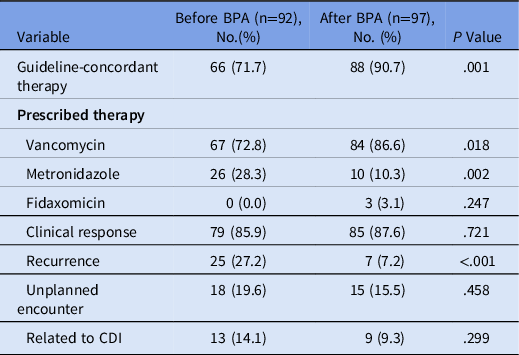
Guideline-concordant therapy increased after implementation of the BPA (71.7% vs 90.7%; P = .001) (Table 2). Specifically, vancomycin prescribing increased (72.8% vs 86.6%; P = .018) and metronidazole prescribing decreased (28.3% vs 10.3%; P = .002). Three patients were prescribed fidaxomicin after BPA implementation. Antibiotic dose and frequency were appropriate 95.8% and 99.5% of the time, respectively, and 75.7% of patients were prescribed 10 days of antibiotic therapy (22.2% were prescribed 14 days of therapy). According to the electronic medical records, prescriptions for CDI therapy were filled by 185 patients (97.9%).
Outcomes

Note. BPA, best practice advisory; CDI, Clostridioides difficile infection.
Secondary outcomes
The BPA was accepted 23 (88.5%) of 26 times and optimized the therapy of 16 patients in 6 months. In patients who did not receive first-line CDI therapy, alternative therapy was documented for 5 patients in each group (P = .107). Reasons for alternative therapy included medication cost (2 patients), lack of insurance coverage (7 patients), and non-CDI infection (1 patient). There was no difference in clinical response or unplanned encounter within 14 days after treatment initiation (Table 2). After implementation of the BPA, fewer patients had CDI recurrence within 14–56 days of the initial episode (27.2% vs 7.2%; P < .001). Of the 32 patients who had recurrence, 21 patients received vancomycin and 11 patients received metronidazole therapy.
Discussion
Clinical decision support increased prescribing of guideline-concordant CDI therapy for adults diagnosed with and treated for an initial episode of CDI in the outpatient setting. The BPA was well received by prescribers; vancomycin prescribing increased and metronidazole prescribing decreased. Patient outcomes, including clinical response and unplanned encounter were similar, whereas CDI recurrence decreased after the BPA. Despite recommendations from clinical practice guidelines, Reference McDonald, Gerding and Johnson2 36 patients (26 before and 10 after the BPA) were unable to receive first-line CDI therapy mainly due to cost and insurance barriers. This finding highlights common challenges that patients and prescribers face.
Although community-acquired CDI is a growing burden, studies evaluating outpatient antimicrobial stewardship interventions for CDI are lacking. Antimicrobial stewardship programs in outpatient settings have been shown to improve antimicrobial prescribing without detrimental patient outcomes. Reference Drekonja, Filice and Greer4 Several strategies that have proven effective in improving appropriate prescribing include computerized clinical decision support, prescriber feedback, antimicrobial restriction, and diagnostic testing. Reference Drekonja, Filice and Greer4,Reference Wenzler, Mulugeta and Danziger5 Similarly, in our study, clinical decision support in the form of a targeted BPA was effective and unlikely to contribute to alert fatigue, with a modest number of alerts over 6 months. The high rates of alert acceptance may have been influenced by the psychology of “doing more” compared to “less is more” antimicrobial stewardship interventions. Resources are largely dedicated to hospital antimicrobial stewardship. Thus, well-designed decision support is a desirable approach for resource-limited outpatient settings.
This study had several limitations. Prescribers likely became more familiar with the updated CDI treatment guidelines, which may have led to more appropriate prescribing regardless of BPA implementation. Despite this possible confounder, an educational rollout was conducted after our CDI treatment protocols were modified. Additionally, the BPA was accepted, and it optimized the therapy of 16 patients. Rejection of formed stools and use of a 2-step testing approach as recommended in guidelines does not entirely mitigate the potential for overdiagnosis, and some patients may have been colonized. Reference McDonald, Gerding and Johnson2 This study included 1 year of data, which is a relatively short period and may not accurately represent prescribing practices. Additionally, clinical response, no unplanned encounter, and no recurrence were all assumed if there was no follow-up encounter or if CDI testing was not performed. These assumptions may have underestimated clinical outcomes. Our finding that CDI recurrence decreased cannot be completely explained by the BPA because this is not an evidence-based benefit of vancomycin over metronidazole. It is possible that patients with clinical failure delayed outpatient care due to the initial surge of the coronavirus disease 2019 (COVID-19) pandemic during the pre-BPA phase of the study and were misclassified as recurrent. Finally, metronidazole was considered inappropriate if the reason for alternative therapy was not documented in the electronic medical record, which may have caused the overestimation of inappropriate prescribing.
As community-associated CDI cases continue to rise, strategies to curb the spread of C. difficile and to optimize CDI treatment are needed. Our study showed that prescribing first-line CDI therapies for outpatients improved after BPA implementation. A targeted BPA is an effective stewardship intervention that may be especially useful in settings with limited antimicrobial stewardship resources.
Acknowledgments
The authors thank Charles Makowski, PharmD, BCPS for assistance obtaining patient lists.
Financial support
No financial support was provided relevant to this article.
Conflicts of interest
S.L.D. has received consulting fees from Summit Therapeutics. All other authors have no conflicts of interest relevant to this manuscript.
Supplementary material
To view supplementary material for this article, please visit https://doi.org/10.1017/ice.2021.397