Introduction
Subjective memory complaints (SMC) are common in older people and clinicians often rely heavily on such complaints when deciding whether or not to take action/treatment. SMC may be an early symptom of dementia in those with normal cognition, and may be useful to clinicians in predicting development of dementia (Abdulrab and Heun, Reference Abdulrab and Heun2008).
Subjective cognitive impairment (SCI), usually defined by subjective reports of memory worsening and cognitive performance in the normal adjusted range (Stewart, Reference Stewart2012), are increasingly a focus in studies on prodromal Alzheimer disease (AD) and risk for dementia. The majority of longitudinal studies have identified SCI as predictor for future decline (Reid and MacLullich, Reference Reid and MacLullich2006). In a follow-up study of healthy older people with SMC over seven years, it was reported that 8% of the sample progressed to mild cognitive impairment (MCI), a condition with impaired cognitive functions, although criteria for dementia are not met yet (Albert et al., Reference Albert2011), or dementia proper (Reisberg et al., Reference Reisberg, Shulman, Torossian, Leng and Zhu2010). The risk in SCI of declining to a diagnosis of MCI was 10% over three years in a recent study, about three times higher than what is seen in persons without SCI (Jessen et al., Reference Jessen2010).
There is a growing body of evidence suggesting that SMC are related to early AD-related brain changes. A variety of studies have demonstrated a relationship between SMC and putative biomarker evidence such as brain activation on functional imaging (Erk et al., Reference Erk, Spottke, Meisen, Wagner, Walter and Jessen2011), cerebral hypometabolism (Scheef et al., Reference Scheef2012), gray matter volume loss (Saykin et al., Reference Saykin2006), amyloid accumulation (Perrotin et al., Reference Perrotin, Mormino, Madison, Hayenga and Jagust2012), and cerebrospinal fluid markers (Visser et al., Reference Visser2009).
There has been inconsistent empirical evidence to date about the link between SMC and actual cognitive functioning including memory performance. Some previous literature suggests that SMC are related to cognitive performance (Lam et al., Reference Lam, Lui, Tam and Chiu2005; Jessen et al., Reference Jessen2007; Clement et al., Reference Clement, Belleville and Gauthier2008; Slavin et al., Reference Slavin2010), whereas other studies have not found such a relationship (Jungwirth et al., Reference Jungwirth, Fischer, Weissgram, Kirchmeyr, Bauer and Tragl2004; Purser et al., Reference Purser, Fillenbaum and Wallace2006; Lenehan et al., Reference Lenehan, Klekociuk and Summers2012). Instead, it has been related to depressive symptoms (DS) and personality (Abdulrab and Heun, Reference Abdulrab and Heun2008; Stewart, Reference Stewart2012). This may be partly due because the possible approaches to eliciting and assessing SMC are highly variable in the literature (Reid and MacLullich, Reference Reid and MacLullich2006) and there is no consensus regarding as to which aspects of patient-reported SMC are most predictive of cognitive impairment (Abdulrab and Heun, Reference Abdulrab and Heun2008). In some studies, SMC were solicited, and in others, they were volunteered. Furthermore, some studies have used simple one-item questions, while others used a battery of questions. Based on previous studies, which showed better results for current memory self-ratings compared to the endorsement of general memory worsening in the past year (Snitz et al., Reference Snitz, Morrow, Rodriguez, Huber and Saxton2008) we used a psychometric validated measure to investigate current SMC (past four weeks) in patients attending a memory outpatient clinic.
Specifically, we were interested in the prevalence of SMC and whether SMC were related to DS, cognitive performance, and cognitive status. We hypothesized that patients attending a memory outpatient clinic will report more SMC compared to a cognitively healthy control group and that MCI classification will lead to a higher prevalence rate than SCI classification.
Methods
Subjects and procedure
The current data are part of a larger research project, the Vienna Conversion to Dementia Study (VCD-Study). The VCD is a prospective cohort study encompassing consecutive, community-dwelling patients complaining of cognitive problems who come to the memory outpatient clinic for assessment of a possible cognitive disorder. The study protocol has been approved by the Ethical Committee of the Medical University of Vienna and written informed patient consent to perform this study has been received.
All patients received a complete neurological examination, standard laboratory blood tests and psychometric testing. In most cases, a magnetic resonance imaging (MRI) scan of the brain was obtained. In determining significant cerebrovascular disease, both neuroimaging and clinical patient features were used. All participants were subjected to the Neuropsychological Test Battery Vienna (NTBV) that included attention, executive functioning, language, and memory domains with corresponding domain z scores (Lehrner et al., Reference Lehrner, Maly, Gleiß, Auff and Dal-Bianco2007). A total z-score across all tests was also computed (Pusswald et al., Reference Pusswald2013). The Alters-Konzentrations-Test (AKT) (Gatterer, Reference Gatterer2008), a geriatric cancellation test, the digit symbol subtest of the German WAIS-R (Tewes, Reference Tewes1994), the symbol counting task from the cerebral insufficiency test (C.I.) (Lehrl and Fischer, Reference Lehrl and Fischer1997), the Trail Making Test B (Reitan, Reference Reitan1979), and the score difference of the Trail Making Test A and B (Reitan, Reference Reitan1979) were applied to assess attention. Executive functions were investigated using the Trail Making Test A (Reitan, Reference Reitan1979), the Five-Point Test (Regard et al., Reference Regard, Strauss and Knapp1982), the Maze Test from the NAI Test Battery (Oswald and Fleischmann, Reference Oswald and Fleischmann1997), the Stroop Test from the NAI Test Battery (Oswald and Fleischmann, Reference Oswald and Fleischmann1997), and the interference test from the C.I (Lehrl and Fischer, Reference Lehrl and Fischer1997). Naming as many words beginning with the letters b, f, and l that came to mind within one minute for each task was used to tap lexical verbal fluency. In order to test language functions, we used verbal fluency tasks and a confrontation naming task (Goodglass and Kaplan, Reference Goodglass and Kaplan1983). Naming as many animals, supermarket items and tools that came to mind within one minute for each task was used to tap semantic verbal fluency. The modified Boston Naming Test (mBNT)(Morris et al., Reference Morris1989) was used for assessing naming capabilities. Episodic memory was tested using the Verbal Selective Reminding Test (VSRT) with the subtests of immediate recall, total recall, delayed recall, and recognition (Lehrner et al., Reference Lehrner, Gleiß, Maly, Auff and Dal-Bianco2006).
Inclusion and exclusion criteria were similar to other studies. Patients were excluded from the study if any of the following conditions applied: (i) evidence of stroke as determined by neuroradiologic and clinical examination, (ii) history of severe head injury, (iii) current psychiatric diagnosis according to ICD-10 (Dilling et al., Reference Dilling, Mombour and Schmidt2000), however, patients with (sub-) depressive symptoms were included because (sub-) depressive symptoms often occur in elderly patients, (iv) any medical condition that leads to severe cognitive deterioration including renal, respiratory, cardiac, and hepatic disease, and (v) diagnosis of dementia according to DSM IV (Saß et al., Reference Saß, Wittchen, Zaudig and Houben2003).
After the completion of the evaluation, the cognitive status of MCI subtypes was determined according to the Peterson criteria (Petersen and Morris, Reference Petersen and Morris2005), and the cut-off score used was 1.5 standard deviations below age and education corrected norms using a normative sample of cognitively healthy controls. For this purpose, the flexible GAMLSS (Generalized Additive Models for Location, Scale and Shape) model class was used (Stasinopoulus and Rigby, Reference Stasinopoulus and Rigby2007; Pusswald, et al., Reference Pusswald2013). The mean mode of MCI classification was used and patients were divided into three groups of patients based on cognitive features as follows: subjective cognitive impairment (SCI) patients (mean z-scores of each domain were greater than −1.5 SD), amnestic MCI (mean z-score of the memory domain was below −1.5 SD) and non-amnestic MCI patients (mean z-scores of at least one domain other than memory domain were below −1.5 SD), respectively.
Patients
Five-hundred eighty-one consecutive patients complaining about memory problems who came to the memory outpatient clinic for assessment of a possible cognitive disorder and fulfilled the inclusion criteria were included in the study. Patients were either referred by physicians or were self-referrals. Mean age of patients was 66.4 ± 9.2 years. Altogether, 40.6% of the patients were male and 59.4% were female. Mean years of formal education was 11.8 ± 3.7. The median MMSE performance of patients was 28 (quartile 27–29). Subtyping procedure of patients revealed that 366 patients are in the SCI group, 134 patients are in the naMCI group, and 81 patients are in the aMCI group, respectively. Mean age of SCI patients was 66.0 ± 9.4 years. Altogether, 40.4% of the SCI patients were male and 59.6% were female. The median of years of formal education of SCI patients was 11 (quartile 8–14). The median MMSE performance of SCI patients was 29 (quartile 27–29). Mean age of naMCI patients was 68.0 ± 9.1 years. Altogether, 39.5% of the naMCI patients were male and 60.5% were female. The median of years of formal education of naMCI patients was 10 (quartile 8–14). The median MMSE performance of naMCI patients was 28 (quartile 27–29). Mean age of aMCI patients was 65.4 ± 8.3 years. Altogether, 43.2% of the aMCI patients were male and 56.8% were female. The median of years of formal education of aMCI patients was 12 (quartile 8–15). The median MMSE performance of aMCI patients was 27 (quartile 26–28).
Cognitively healthy control subjects
Great care was taken enrolling a sufficient number of cognitively healthy control subjects living independently at home. Control subjects were recruited by means of advertisements. They underwent a rigorous screening evaluation using a standardized clinical interview and cognitive screening. Imaging procedures, neurological examination, standard laboratory blood tests, and informant reports were not included in the evaluation. They were assessed as being in good health. Criteria for healthy function were identified as being similar to those in the Mayo research studies (Ivnik et.al., Reference Ivnik1992): (i) no active neurological or psychiatric disease, (ii) no psychotropic medications, and (iii) the subjects may have medical disorders but neither they nor their treatment compromises cognitive function. Cognitive status was given special attention and cognitively healthy control subjects were screened for intact cognition. They were required to have an MMSE score greater than or equal to 27 and a MOCA score greater than or equal to 26 adjusted for education. Twohundred forty-seven elderly controls were included in the study.
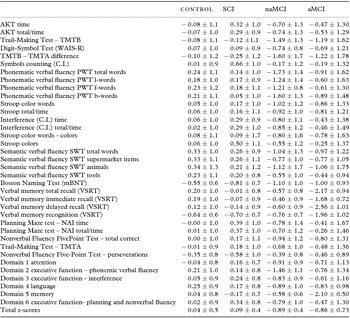
Mean age of controls was 66.3 ± 8.4 years. Altogether, 58.3% of controls were male and 41.7% were female. Mean years of formal education were 11.5 ± 3.8. The median MMSE performance of patients was 29 (quartile 28–29). The neuropsychological performance of controls and patient groups are reported in Table 1.
Neuropsychological test scores (single tests z-scores as well as domain test z-scores and total z-score) across Control group, SCI group, naMCI group, and aMCI group

AKT = Alters-Konzentrations-Test; WAIS-R = Wechsler Adult Intelligence Scale - Revised; TMTA = Trail Making Test Version A; TMTB = Trail Making Test Version B; NAI = Nürnberger Alters Inventar; C.I. = Cerebral Insufficiency Test; VSRT = Verbal Selective Reminding Test; mBNT = modified Boston Naming Test.
Measures
Assessment of subjective memory complaint
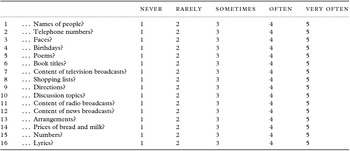
For the assessment of subjective memory complaint, the Forgetfulness Assessment Inventory (FAI) scale was used. The FAI was developed to evaluate subjective complaints regarding everyday memory problems (Kogler, Reference Kogler2013). The questions were selected to focus on the subjective evaluation of memory problems, particularly in relation to episodic memory which has been found to be very sensitive in the early detection of MCI and AD. It is a 16-item instrument to measure subjective memory problems in daily life scored on the basis of a Likert scale. Subjects were asked, e.g. “How often did you have problems during the past 4 weeks remembering . . . . . e.g. a shopping list. 1 = never; 2 = rarely, 3 = sometimes, 4 often, 5 very often.” See Table 2 for specific items. The average score across all 16 items was used for statistical analyses. Higher scores reflect poorer subjective functioning and greater complaints (possible range: 1–5). Raw scores were also transformed into z-scores using a normative sample and the flexible GAMLSS (Generalized Additive Models for Location, Scale and Shape) model class (Stasinopoulus and Rigby, Reference Stasinopoulus and Rigby2007; Pusswald, et al., Reference Pusswald2013). The measure has been shown to be internally consistent (Cronbach's alpha = 0.85). Participants indicating a considerable degree of SMC defined as complaining at least 1.5 SD's below of the age, sex, and schooling specific mean of the normative sample are reported.
Forgetfulness Assessment Inventory (FAI) self-report

Here are a few questions regarding your memory. Please answer each question by selecting the appropriate digit (1,2,3. . ..). If you are not sure how to answer the question, give your best possible answer and make a remark on the left side of the page. Please do not hesitate to ask for support if you need help reading or filling in the questionnaire. How often did you have problems during the past 4 weeks remembering. . .
Assessment of depressive symptoms (DS)
The Beck Depression Inventory (BDI-II), a 21-item instrument to detect DS in adults was used. It asks about how often one felt certain ways within the past two weeks, rated on a four-point scale. A score above ten is indicative of clinical relevant DS (Hautzinger et al., Reference Hautzinger, Keller and Kühner2006).
Statistical Methods
Demographic variables are described by means and standard deviations except MMSE scores and BDI-II scores, which are presented as median and quartiles due to the skewed distribution of these variables. FAI scores and z-scores of the neuropsychological test variables are described by means and standard deviations.
In order to compare dependent variables between groups, t-tests and one-way ANOVAs have been computed. Uncorrected p-values are given. Post-hoc pairwise comparisons have been adjusted using Tukey's method. Spearman correlational analyses were also performed.
The reported p-values are the result of two-sided tests. p-values ≤ 0.05 were considered to be statistically significant. All computations were performed using SAS software Version 9.2 (SAS Institute Inc., Cary, NC, USA, 2002–2008), except GAMLSS estimation, which was done using R 2.11.1.
Results
A statistically significant difference (p < 0.001) between control group and patient group (2.33 ± 0.65 vs. 2.93 ± 0.77) regarding mean FAI score was detected. Furthermore, a statistically significant difference (p < 0.001) between control group and total patient group (0.03 ± 1.01 vs. −1.01 ± 1.34) regarding mean FAI z-score was detected. The frequency (prevalence) of controls and patients indicating subjective memory complaint (defined as complaining at least 1.5 SD's below of the age, sex, and schooling specific mean of the normative sample) are also reported. Ninteen controls out of 247 (7.7%) reported a considerable degree of SMC, whereas 208 patients out of 581(35.8%) reported a considerable degree of SMC.
Statistical analysis detected a significant difference (p < 0.001) between the control group and patient group (5; quartiles 2–9 vs. 10; quartiles 6–15) regarding the median Beck depression score. The frequency (prevalence) of patients and controls having DS (defined as having a BDI score >10) are also reported. Forty-one controls (16.6%) out of 247 showed DS, whereas 282 patients (48.5%) out 581 showed DS.
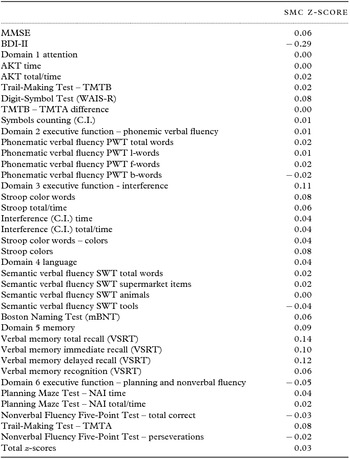
Correlation analysis for the patient group between FAI z-score and MMSE, BDI-II score and neuropsychological test scores (single test z-scores as well as domain test z-scores and total z-score) revealed low correlation coefficients (all rs below 0.18) except for BDI-II, which showed a moderate association (r = −0.29). All correlation coefficients were statistically significant (all ps < 0.05). See Table 3 for details.
Spearman correlation coefficients (r) for the patient group between FAI z-score and MMSE, BDI-II score and neuropsychological test scores (single tests z-scores as well as domain test z-scores and total z-score)

AKT = Alters-Konzentrations-Test; WAIS-R = Wechsler Adult Intelligence Scale - Revised; TMTA = Trail Making Test Version A; TMTB = Trail Making Test Version B; NAI = Nürnberger Alters Inventar; C.I. = Cerebral Insufficiency Test; VSRT = Verbal Selective Reminding Test; mBNT = modified Boston Naming Test.
In order to investigate the influence of cognitive status of controls and patients on FAI, we further categorized the study population into a control group, a SCI group, a naMCI group, and a aMCI group. Mean FAI z-score was 0.03 ± 1.01 for the control group, −0.93 ± 1.32 for the SCI group, −0.85 ± 1.25 for the naMCI group, and −1.62 ± 1.41 for the aMCI group, respectively. An analysis of variance revealed a statistically significant difference in FAI between the four groups (p < 0.001). Pairwise post-hoc comparisons detected significant differences for all pairwise comparisons (Tukey-corrected p < 0.001) except for SCI versus naMCI.
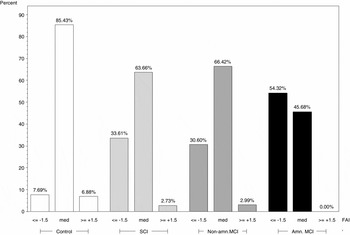
The frequency of considerable SMC in controls and SCI subgroup, naMCI subgroup and aMCI subgroup is also reported. Whereas only roughly 8% of controls reported considerable degree of SMC, 34% of the SCI group, 31% of the naMCI group, and 54% of the aMCI group showed a considerable degree of SMC. See Figure 1.
Distribution of the frequency of patients reporting subjective memory complaint (FAI) (defined as age, sex, and schooling specific z-score below or equal to −1.5) across groups (controls, SCI group, a naMCI group, aMCI group).

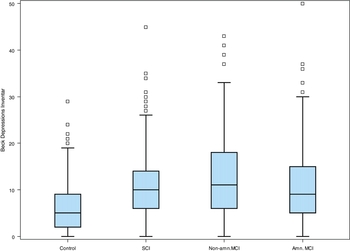
In order to investigate the influence of cognitive status of patients on DS, we performed an analysis of variance with the factor cognitive status (controls, SCI group, naMCI group, and aMCI group) and log-transformed BDI score as a dependent variable. Median BDI-score was 5 (2–9) for the control group, 10 (6–14) for the SCI group, 11 (6–18) for the naMCI group, and 9 (5–15) for the aMCI group. An analysis of variance revealed a statistically significant difference between the four groups (p < 0.001). Pairwise post-hoc comparisons detected a statistically significant difference between controls and all patient groups (Tukey-corrected p < 0.001). See Figure 2. Whereas 16.6% of controls reported DS, 48.6% of the SCI group, 52.2% of the naMCI group, and 42.0% of the aMCI group showed significant DS, respectively.
Depressive symptoms across groups (controls, SCI group, a naMCI group, aMCI group): boxplots.

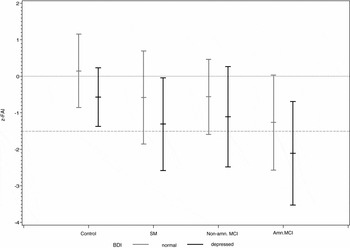
Additionally, we investigated whether depressive status and cognitive status had an impact on SMC. We performed a two-factor analysis of variance with the factor cognitive status (controls, SCI group, a naMCI group, aMCI group) and the factor depressive status (depressed vs. not depressed) and FAI z-score as a dependent variable. Both factors were significant (p < 0.001), whereas the interaction was not (p = 0.820). This means that the difference in FAI between depressed and non-depressed is not significantly different between the four cognitive groups. Post-hoc analyses revealed significant pairwise differences between all groups except for SCI versus naMCI (p = 0.78). See Figure 3 for details.
Subjective memory complaint (FAI) and its relation to depressive status and cognitive status (controls, SCI group, a naMCI group, aMCI group): error bars show mean ± 1 standard deviation.

Discussion
In the present study, we investigated SMC and DS and their relationship to cognitive functioning and cognitive status in patients attending a memory disorder outpatient clinic. We found that patients reported significantly more SMC than a cognitively healthy, age-matched control group. Whereas 7% of controls showed elevated SMC, 36% of the patients reported elevated SMC. Although, prevalence of SMC is dependent on several factors including setting and methodology, our finding is in line with recent work. For instance, in a study of 758 older people attending Primary Care, 24% reported SMC (Waldorff et al., Reference Waldorff, Siersma, Vogel and Waldemar2012). A different finding was obtained for DS. Whereas 16% of controls showed clinical relevant DS, roughly half of the patients (48%) showed DS. This result is in line with the prevalence of depression in elderly individuals seeking help for cognitive problems in hospitals (Panza et al., Reference Panza2010).
A correlational analysis found low-correlation coefficients between SMC as measured by FAI except for BDI-II which showed a moderate association. This finding is in accordance with previous research showing that in SCI-patients and MCI-patients, SMC are more strongly associated with DS than cognitive functioning (Reid and MacLullich, Reference Reid and MacLullich2006; Abdulrab and Heun, Reference Abdulrab and Heun2008; Stewart, Reference Stewart2012).
When cognitive status was taken into account, we found that SMC significantly differed across controls and patient groups except for SCI versus naMCI. Whereas only 8% of controls reported considerable SMC, roughly one-third of SCI and naMCI patients and about half of aMCI patients reported considerable SMC, respectively. Furthermore, all three patient groups reported significantly more DS compared to controls, however, patient groups did not differ. Whereas 16% of controls reported DS, almost half of the SCI group and more than half of the naMCI group showed significant DS. In contrast, only 42% of the aMCI group showed significant DS. All of the patients reporting significant DS were subsequently referred to a neurologist/psychiatrist to take into consideration anti-depressive treatment.
Our findings demonstrate that SMC are increasing from cognitively healthy to aMCI and therefore may go along with neuropathologic AD manifestation in these patient groups (Jessen et al., Reference Jessen2010; Stewart, Reference Stewart2012). DS were most often found in naMCI patients, indicating that there may be an association with vascular damage, because vascular processes have been found in depressed patients with naMCI (Naismith et al., Reference Naismith, Norrie, Mowszowski and Hickie2012).
An important goal of the current study was to investigate the relationship between SMC and depressive status and cognitive status. We found that SMC differed across all groups and that patients with depressive symptomatology had significantly more SMC across all groups compared to patients without depression. Thus, the main new finding of the present study is that SMC are directly related to cognitive status independent of depressive status. There is a possible clinical continuum from cognitively healthy persons to aMCI regarding SMC and depressive status is exerting a negative influence by increasing SMC across all groups investigated.
A number of factors may have influenced the findings and should be considered when interpreting the results. Prevalence of SMC and DS may vary as a result of different diagnostic criteria and different sampling and assessment procedures. For instance, SMC and DS may be higher in hospital-based studies than in population-based studies reflecting different referral patterns and selection criteria (Panza et al., Reference Panza2010). A common underlying factor regarding reporting memory complaints and depressive symptoms might be a certain personality style (Stewart, Reference Stewart2012). The present study did not address this question but in further studies it should be integrated as control measure.
There are a number of strengths of this cross sectional study. Assuming that SCI and MCI may be the earliest identifiable clinical stages of dementia, SMC and DS may be an early manifestation or a risk factor for dementia and Alzheimer disease. For this reason, it is important to know the relationship between memory complaints and depressive symptoms in patient groups with different cognitive status. Furthermore, it is important to know the prevalence of memory complaints and depressive symptoms in these patient groups. The present study used a well-characterized patient sample with sufficient sample sizes in order to clarify these important questions.
For patients with SCI and patients with MCI reporting considerable SMC and DS, the findings on increased risk of incident MCI or its progression to dementia are conflicting (Reid and MacLullich, Reference Reid and MacLullich2006; Panza, et al., Reference Panza2010). More longitudinal studies are needed to investigate the predictive validity of SMC and DS in predicting future cognitive decline and dementia. A current investigation by our group is underway to clarify this question.
In conclusion, a large proportion of patients seeking help in a memory outpatient clinic report considerable memory problems, with an increasing degree from cognitively healthy elderly to patients with amnestic MCI. SMC are directly related to cognitive status independently of depressive status, however, depressive status increases SMC consistently across groups with different cognitive status.
Conflict of interest
None
Description of authors’ roles
Dr Lehrner designed the study, supervised the data collection, and wrote the paper. Dr Moser collected the data and assisted with writing the paper. Dr Klug collected the data and assisted with writing the paper. Dr Gleiß was responsible for the statistical design of the study and for carrying out the statistical analysis. Dr Auff designed the study and assisted with writing the paper. Dr Dal-Bianco collected the data and assisted with writing the paper. Dr Pusswald collected the data and assisted with writing the paper.
Acknowledgment
The authors thank Arinya Eller for proofreading this manuscript.