Introduction
ENT is one of the most common surgical specialties encountered across various medical disciplines. ENT conditions represent up to 25 per cent of adult and 50 per cent of paediatric primary care consultations.Reference Griffiths1 In the hospital setting, ENT is the third largest specialty behind orthopaedics and general surgery.Reference Powell2 Furthermore, ENT emergencies are commonplace in accident and emergency departments.Reference Sharma, Machen, Clarke and Howard3 Despite its common occurrence within clinical practice, both junior doctors and medical students report minimal exposure and training in the specialty.Reference Khan and Saeed4–Reference Chawdhary, Ho and Minhas6
The lack of ENT teaching in medical school has been well-reported for decades. Ishman et al.,Reference Ishman, Stewart, Senser, Stewart, Stanley and Stierer7 in 2015, identified the need for increased exposure to the specialty. Meanwhile, Ferguson et al.,Reference Ferguson, Bacila and Swamy8 in 2016, described an overwhelming lack of confidence in the practice of ENT amongst final year medical students and junior doctors. In their survey of undergraduate ENT teaching in 27 UK medical schools, Mace and NarulaReference Mace and Narula9 found that the average time spent by medical students in an ENT clinical attachment was only 1.5 weeks. Furthermore, 22 per cent of these schools did not offer an ENT attachment.Reference Mace and Narula9 Morris et al.Reference Morris, Osborne and Bowyer10 found, in their pre-course questionnaires, that 74 per cent of the students felt their undergraduate anatomy teaching to be insufficient; specifically, 71 per cent believed there had been insufficient coverage of head and neck anatomy at medical school. This highlights the limited time and priority given to ENT topics by medical schools. Given the underrepresentation of ENT in the medical school curriculum, it is especially important that ENT teaching be delivered using the most effective methods available. The majority of existing secondary literature consistently identifies the inadequate coverage of ENT conditions within the undergraduate medical curricula and junior doctor training.
A systematic review of otolaryngology in undergraduate medical education showed that the most commonly used teaching methods were out-patient clinics and operating theatre attendance.Reference Ishman, Stewart, Senser, Stewart, Stanley and Stierer7 Despite this, a survey of newly qualified doctors in the UK draws into question the effectiveness of these teaching methods.Reference Powell, Cooles, Carrie and Paleri5 It is clear there is a need for change in ENT education in the undergraduate curriculum. However, the factor that limits change is the available time within the undergraduate medical curriculum. Any additional teaching for one specialty would likely lead to a reduction for another. Therefore, it is especially important to identify novel teaching solutions to better optimise the time allocated for ENT education. This systematic review aimed to evaluate current innovations that can provide possible solutions to this issue.
Research question
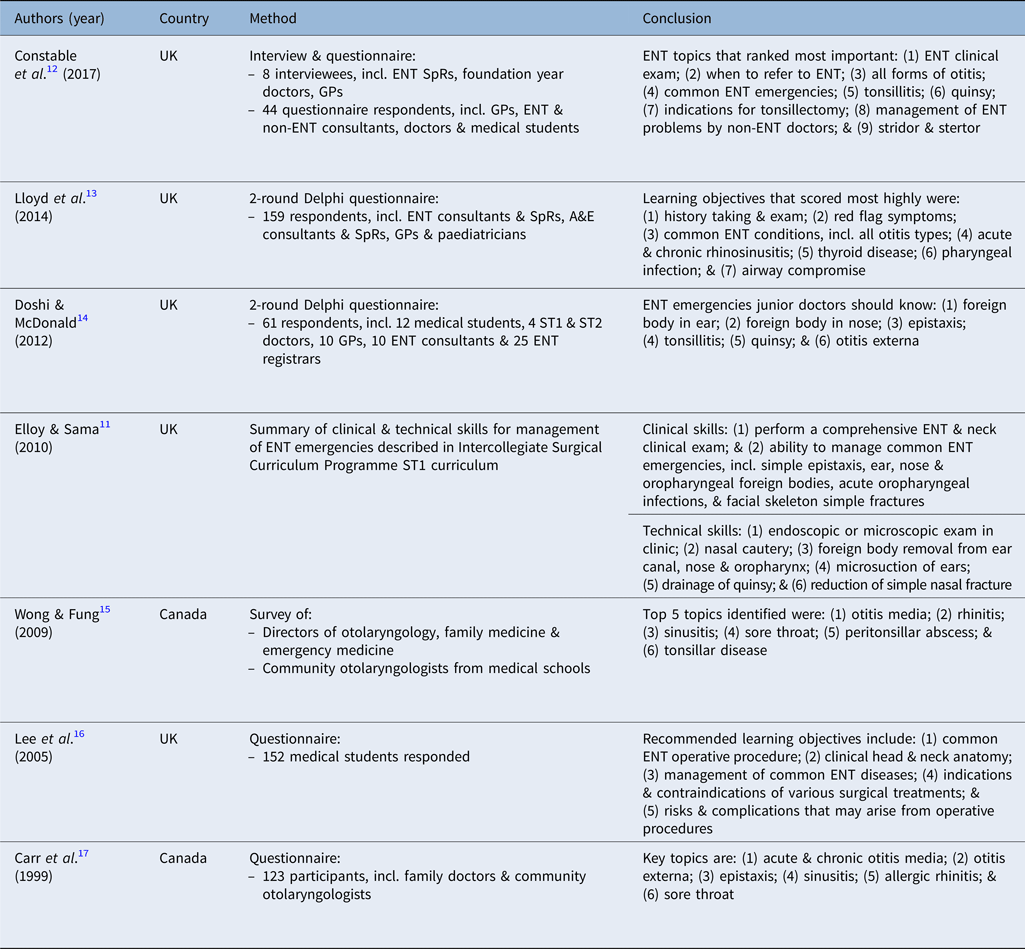
Our systematic review aimed to bridge the existing knowledge gap by reviewing all high-quality primary research of ENT educational innovations developed in the past 15 years to improve the teaching of core ENT competencies described above (Table 1).Reference Elloy and Sama11–Reference Carr, Brown and Reznick17 We aimed to review comparisons of all ENT educational innovations developed for both medical students and junior doctors to defined current educational standards. The specific outcomes investigated included the objective assessment of knowledge and skills, and the subjective assessment of confidence and preference, following implemented innovations.
Summary of core ENT competencies

Summary of core ENT competencies: (1) knowledge of common ENT conditions – all forms of otitis, rhinosinusitis, tonsillar diseases, sore throat & thyroid diseases; (2) recognition & management of common ENT emergencies – foreign body in ear or nose, epistaxis, quinsy, surgical complications & airway compromise; (3) ENT history & examination; (4) recognition of red flag symptoms & when to refer for ENT specialist input; (5) knowledge of clinical head & neck anatomy; and (6) knowledge of common ENT procedures – nasolaryngoscopy, nasal cautery, foreign body removal, microsuction of ears, quinsy drainage & reduction of simple nasal fractures. Incl. = including; SpR = specialist registrar; GP = general practitioner; A&E = accident and emergency; ST = specialist trainee (year)
Core ENT competencies
There is currently large variation in otolaryngology content in the undergraduate medical curriculum. The Royal College of Surgeons of England published a National Undergraduate Curriculum in Surgery in 2015 to help address some of the issues surrounding the variability in undergraduate teaching.18 This curriculum included six key surgical conditions relating to ENT. However, the learning outcomes listed for each surgical condition are often vague, with room for personal interpretation.
Therefore, we performed a preliminary literature review to collate studies defining core ENT competencies for junior doctors within the medical curricula (Table 1). These can be broadly classified into six main groups: knowledge of common ENT conditions, recognition and management of common ENT emergencies (e.g. foreign body in the ear or nose, epistaxis, quinsy, surgical complications, airway compromise), ENT history and examination, recognition of red flag symptoms and when to refer patients for ENT specialist input, knowledge of clinical head and neck anatomy, and knowledge of common ENT operative procedures (e.g. tonsillectomy, nasolaryngoscopy). We based our inclusion and exclusion criteria on these competencies, defined within the literature as crucial objectives of ENT medical education.
Materials and methods
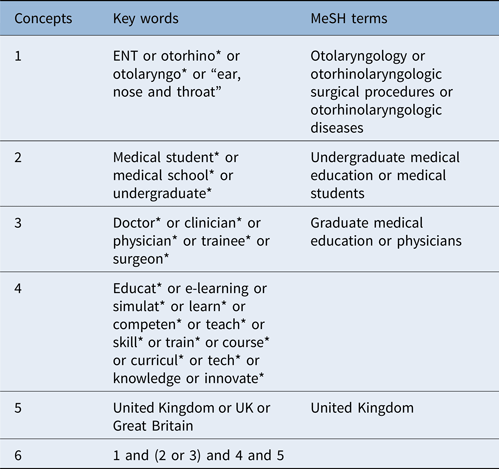
This study was conducted based on methods established in a protocol written a priori (Appendix 1, available online). Three investigators independently performed a literature review of all published articles relating to otolaryngology in medical education. We searched for articles across five databases: Medline, Embase, Education Resources Information Center (‘ERIC’), Cochrane and Web of Science. The literature search was conducted from 6 July 2019 to 13 September 2019. Table 2 shows the key words and medical subject headings used in our search strategy.
Key words and MeSH terms used in search strategy

MeSH = medical subject headings
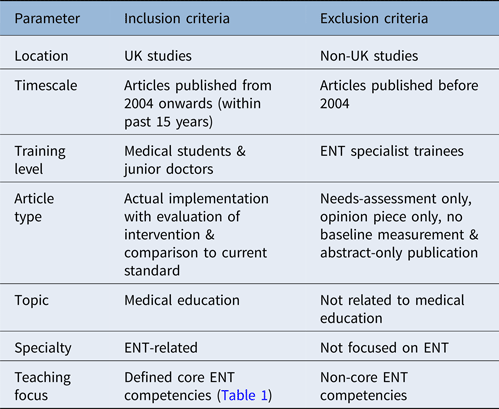
Our inclusion and exclusion criteria are summarised in Table 3. Non-randomised studies of interventions and randomised, controlled trials (RCTs) were included in our study following comprehensive risk of bias assessments. Both study types were included given the paucity of RCTs in educational research. Only studies that evaluated changes in our desired outcome measures after the implementation of an educational innovation were included.
Inclusion and exclusion criteria

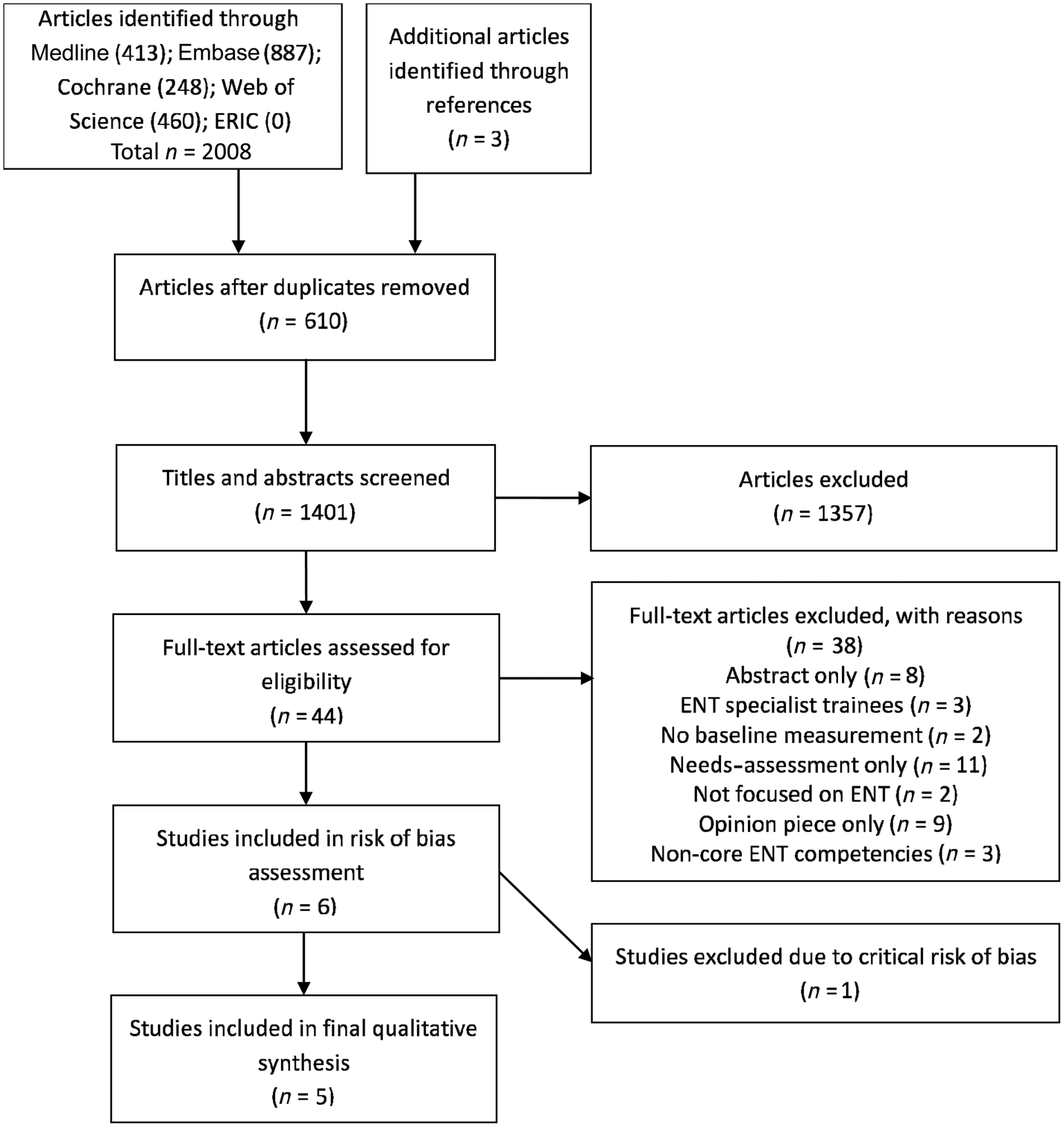
An initial literature search was performed independently by all three investigators; disagreements between the investigators regarding study inclusion were resolved through discussion. Subsequent results are presented in a Preferred Reporting Items for Systematic Reviews and Meta-Analyses (‘PRISMA’) diagram (Figure 1).
Preferred Reporting Items for Systematic Reviews and Meta-Analyses (‘PRISMA’) flow diagram for our literature search process. ERIC = Education Resources Information Center

Included studies were critically appraised using a tailored data extraction form (Appendix 2, available online), developed based on recommendations by the UK National Health Service Centre for Reviews and Dissemination.19 Data extraction was performed independently by all three investigators and consensus was achieved prospectively. Extracted data from these studies were then analysed using qualitative synthesis methods.
Results
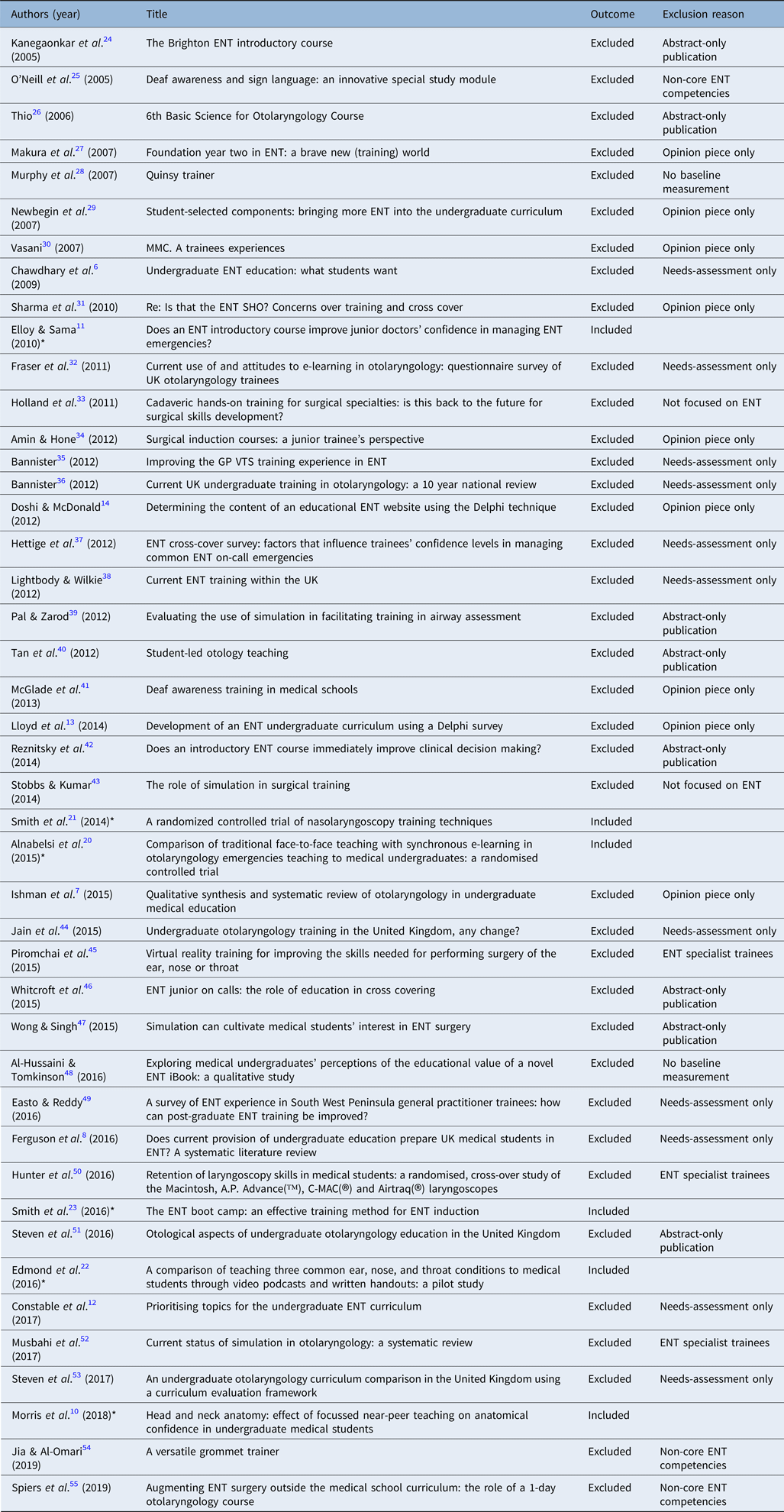
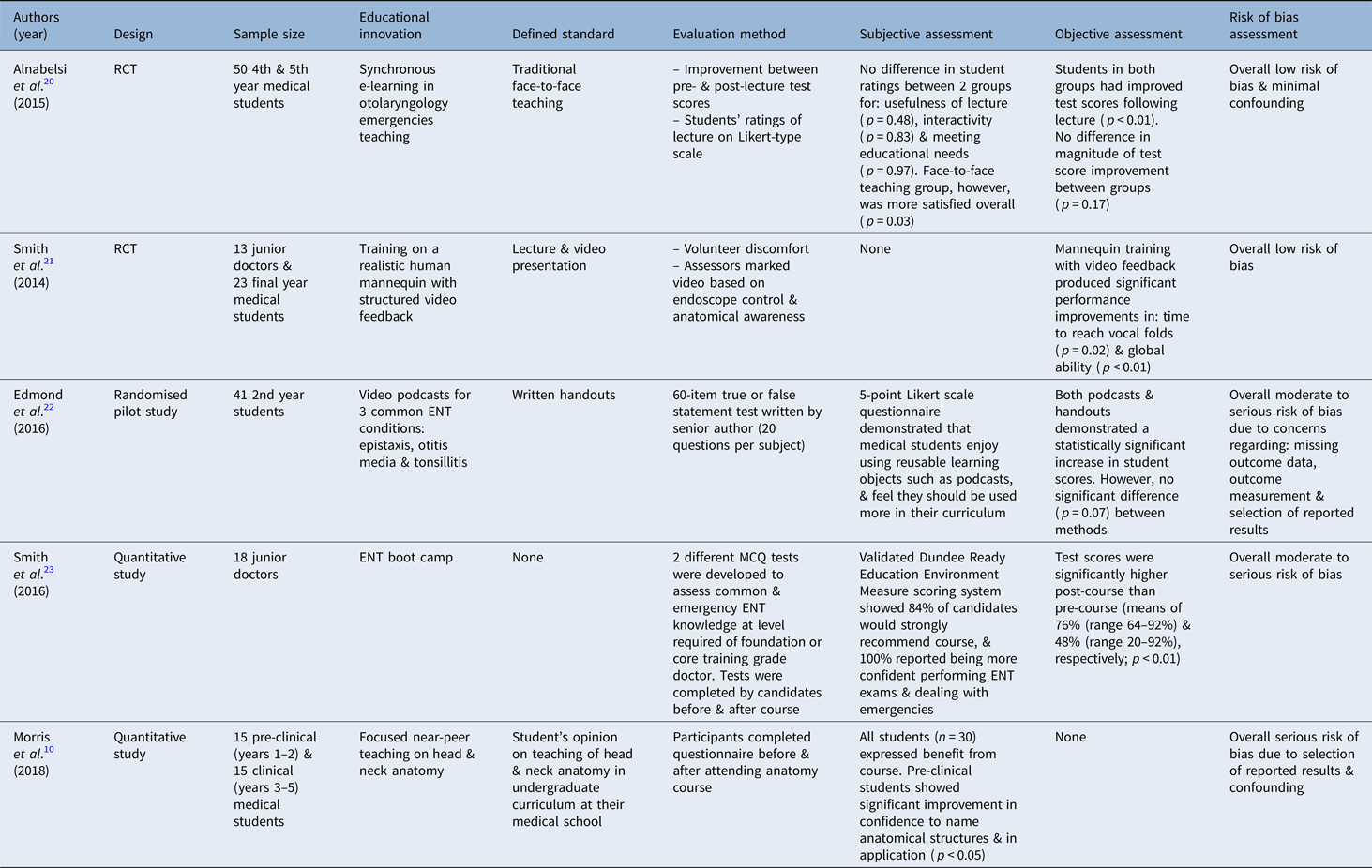
A total of 2008 studies were identified by searching Medline, Embase, Education Resources Information Center, Cochrane and Web of Science databases. All identified studies were entered into Endnote and 610 duplicates were removed. The remaining 1401 studies underwent a thorough review of titles and abstracts, of which 1357 studies did not meet our inclusion criteria. Forty-four studies underwent full-text analysis (Table 4).Reference Chawdhary, Ho and Minhas6–Reference Ferguson, Bacila and Swamy8,Reference Morris, Osborne and Bowyer10–Reference Doshi and McDonald14,Reference Alnabelsi, Al-Hussaini and Owens20–Reference Spiers, Enayati, Moussa, Zargaran, Thomas and Murtaza55 Of these studies, 38 were excluded for failing to meet our inclusion criteria. Six studies were then rigorously assessed for their risk of bias levels, after which one study was excluded because of a critical risk of bias. Five studies were included for final qualitative synthesis and their baseline data are presented in Table 5.Reference Morris, Osborne and Bowyer10,Reference Alnabelsi, Al-Hussaini and Owens20–Reference Smith, Trinidade and Tysome23 Figure 1 shows an overview of our literature search process.
Outcomes of 44 articles that underwent full-text analysis

*Indicates that study fulfilled inclusion criteria
Baseline data of final five included studies

RCT = randomised, controlled trial; MCQ = multiple-choice question
Study quality assessment
Six studies were assessed for risk of bias, using the Risk of Bias in Non-Randomised Studies of Interventions I toolReference Sterne, Hernan, Reeves, Savovic, Berkman and Viswanathan56 and the Revised Cochrane Risk-of-Bias tool for Randomised Trials.Reference Sterne, Savovic, Page, Elbers, Blencowe and Boutron57 Two randomised, controlled trials (RCTs), conducted by Alnabelsi et al.Reference Alnabelsi, Al-Hussaini and Owens20 and Smith et al.,Reference Smith, Leung, Sharma, Nazeer and McFerran21 were found to have a low risk of bias. The RCT performed by Edmond et al.Reference Edmond, Neville and Khalil22 was found to be at a moderate risk of bias because of concerns regarding: missing outcome data, outcome measurements and possible selection bias of its reported results. The single arm cohort study performed by Smith et al.Reference Smith, Trinidade and Tysome23 had a moderate risk of bias because of concerns regarding apparent confounding and outcome measurement biases. The study conducted by Morris et al.Reference Morris, Osborne and Bowyer10 had a serious risk of bias as a result of an inherent selection bias of its outcome measures. Lastly, the study conducted by Elloy and SamaReference Elloy and Sama11 was found to have a critical risk of bias, as per the Risk of Bias in Non-Randomised Studies of Interventions I assessment tool. This is because there was significant missing outcome data and unadjusted confounders. As such, an a posteriori decision was made amongst the three investigators to exclude this study from the final qualitative synthesis.
Objective assessment
Alnabelsi et al.Reference Alnabelsi, Al-Hussaini and Owens20 compared synchronous e-learning in otolaryngology emergencies teaching to traditional face-to-face teaching. Twenty-five students (16 fourth-year and 9 fifth-year medical students) were randomised to the face-to-face teaching group and 25 students (15 fourth-year and 10 fifth-year medical students) were randomised to the synchronous e-learning group. Objective assessment revealed no significant difference in the magnitude of improvement in lecture test scores between the two groups (p = 0.17).
Edmond et al.Reference Edmond, Neville and Khalil22 compared video podcasts to written handouts in the teaching of three common ENT conditions: epistaxis, otitis media and tonsillitis. Objective assessment revealed no significant difference (p = 0.07) between the two methods, with the handout group scoring fractionally higher with a larger average improvement (mean post-exposure score of podcasts and handouts = 37.8 and 38.3, respectively).
Smith et al.Reference Smith, Trinidade and Tysome23 developed a practical and simulation-based intensive ENT ‘boot camp’ to prepare junior doctors entering ENT jobs, using emergency simulation methods. Objective assessment using pre- and post-course multiple-choice questions at the level required of a foundation doctor or core training grade doctor revealed that the post-course test scores (average of 76 per cent, range of 64–92 per cent) were significantly higher than the pre-course test scores (average of 48 per cent, range of 20–92 per cent) (p < 0.01).
Smith et al.Reference Smith, Leung, Sharma, Nazeer and McFerran21 assessed whether training on a realistic human mannequin with structured video feedback improved flexible nasolaryngoscopy performance, in comparison to a lecture and video presentation only. Objective assessment revealed that mannequin training together with video feedback produced significant performance improvements in terms of the time taken to reach the vocal folds (p = 0.02) and global ability (p < 0.01).
Subjective assessment
Subjective assessment by Alnabelsi et al.Reference Alnabelsi, Al-Hussaini and Owens20 revealed no difference between the synchronous e-learning and the face-to-face teaching groups in terms of the lecture's usefulness (p = 0.48), interactivity (p = 0.83) and its ability to meet educational needs (p = 0.97); the face-to-face teaching group, however, was more satisfied overall (p = 0.03).
Subjective assessment by Edmond et al.,Reference Edmond, Neville and Khalil22 using a five-point Likert scale questionnaire, demonstrated that medical students enjoyed using video podcasts more than written handouts.
Subjective assessment by Smith et al.,Reference Smith, Trinidade and Tysome23 using a validated Dundee Ready Education Environment Measure scoring system, revealed that 84 per cent of candidates would strongly recommend the ENT boot camp, and 100 per cent reported they were more confident performing ENT examinations and dealing with emergencies.
Morris et al.Reference Morris, Osborne and Bowyer10 described focused near-peer teaching on three areas of head and neck anatomy. Subjective assessment showed that all students (n = 30) had increased confidence in their knowledge after the course.
Discussion
To our knowledge, this study represents the first attempt to systemically review all existing levels of evidence of educational innovations developed to improve ENT teaching for medical students and junior doctors in the UK. We limited our timescale of the literature search to the past 15 years, since 2004, in order to identify the most recent developments in the field of ENT medical education. The most prominent finding highlighted by this systematic review is the paucity of evidence exploring ENT educational innovations and their impact. This limited the number of studies included in our final analysis (Table 5).
Two innovations – ENT boot camp and nasolaryngoscopy training on a realistic human mannequin – demonstrated significant improvements in participants’ knowledge and skills through objective assessments. Consistent improvements in students’ confidence and personal preference across most of the studied innovations were also noted. This indicates that there would be benefits and positive responses to the implementation of these educational innovations within the existing medical curriculum.
Innovations in ENT teaching can be classified according to different modalities, such as information technology (IT) developments, extra-curricular ENT courses and simulation-based training. In the following paragraphs, we decided to evaluate the benefits of the different innovations in our included studies according to these three main themes.
Over the past years, IT resources have had increasing roles in medical education, but this development has outpaced the research to demonstrate its efficacy. Critical assessment of these IT resources is essential to determine their benefits. The IT educational innovations included in this review have been found to be as good as traditional methods in teaching ENT topics.Reference Alnabelsi, Al-Hussaini and Owens20,Reference Edmond, Neville and Khalil22 Alnabelsi et al.Reference Alnabelsi, Al-Hussaini and Owens20 highlighted the potential of e-learning modalities in overcoming the restrictions of time and space that traditional face-to-face teaching require. Students felt that video podcasts were more enjoyable than traditional handouts and expressed desire for their incorporation into the main curriculum.Reference Edmond, Neville and Khalil22 Given the benefits, we felt that synchronous e-learning and video podcasts have great potential for further application in effective teaching of core ENT topics. This mirrors the findings of Fung,Reference Fung58 who reported that e-learning is well received by medical students for ENT teaching and should be incorporated into the undergraduate medical curriculum following empirical assessment.
Morris et al.Reference Morris, Osborne and Bowyer10 showed that a relevant extra-curricular ENT course can improve students’ confidence in their knowledge of the ENT topics being taught. They also demonstrated that near-peer teaching of anatomy is preferred by students over traditional anatomy teaching methods, and it improved their retention of knowledge.Reference Morris, Osborne and Bowyer10 This has been attributed to the more effective communication that takes place between near-peer tutors and tutees.Reference Evans and Cuffe59 This suggests it might be useful to incorporate near-peer teaching into the undergraduate ENT curriculum.
Also in this theme, Smith et al.Reference Smith, Trinidade and Tysome23 demonstrated that junior doctors feel more prepared to provide emergency ENT cover after an ENT boot camp. This is especially important given the cross-cover system currently in place, which implies that most ENT departments’ out-of-hours emergency work may be provided by a junior doctor with limited ENT experience and expertise.Reference Kyle60 Their boot camp differs from traditional ENT introductory courses, as it places a greater emphasis on the simulation of scenarios and skills to train participants in the management of ENT emergencies.Reference Smith, Trinidade and Tysome23 Their findings suggest that acquisition of the skills crucial for junior doctors during out-of-hours ENT emergency work is better achieved by an intensive, practical, skills-focused approach, rather than via traditional training.Reference Smith, Trinidade and Tysome23 This highlights how the correct teaching method can yield more knowledge in less time.
There is evidence that simulation-based training has seen growing importance in the field of surgical education.Reference Nagendran, Gurusamy, Aggarwal, Loizidou and Davidson61,Reference Zendejas, Brydges, Hamstra and Cook62 Simulation of evolving ENT emergencies in an ENT boot camp, such as airway obstruction and epistaxis, was shown to improve candidates’ knowledge and confidence.Reference Smith, Trinidade and Tysome23 The importance of simulation-based training in ENT was further highlighted by Smith et al.,Reference Smith, Leung, Sharma, Nazeer and McFerran21 who established the benefit of using a mannequin with video feedback for improving trainees’ flexible nasolaryngoscopy technique, with no significant difference in outcomes between the students and junior doctors. This suggests that the training benefits a diverse range of trainees at different career grades. Given these benefits, there is potential for similar simulation-based training to be incorporated into the undergraduate and post-graduate curriculum to teach other ENT practical skills covered in the Intercollegiate Surgical Curriculum Programme.Reference Elloy and Sama11
Despite the significant benefits that these innovations bring, we strongly believe that time and resource constraints are the limiting factors of educational change. Although traditional teaching methods fare lower in subjective assessments by students, they could be more financially feasible compared to some of the innovations assessed in this review. For example, Smith et al.Reference Smith, Trinidade and Tysome23 and Edmond et al.Reference Edmond, Neville and Khalil22 noted up-front financial costs in implementing the ENT boot camp and video podcasts. Therefore, time and resource demands should be variables included in future studies.
The relative scarcity of literature on ENT medical education was the main limitation of our systematic review, which led to only five studies being included in our final qualitative synthesis. There could be educational innovations adopted by other centres in the UK that have not been evaluated and published. We recommend further research evaluating the advantages and disadvantages of recent ENT educational innovations so that they can be considered for incorporation into current teaching practices.
Conclusion
Our review demonstrates that there have been educational innovations developed in the past 15 years, in the form of IT, extra-curricular courses and simulation-based training, to enhance the teaching of core ENT competencies. More research is needed, focusing on the impact that these educational advances have on the state of ENT medical education in the UK. We hope that this review will provide suggestions for institutions to improve their ENT training, serve as a springboard for further research in this area, and ultimately help prepare medical students and junior doctors to manage ENT conditions in their practice.
Competing interests
None declared