1. Introduction
Sandstones have been effectively used to constrain provenance and identify ancient tectonic settings (e.g. Bhatia, Reference Bhatia1983; Dickinson et al. Reference Dickinson, Beard, Brakenridge, Erjavec, Ferguson, Inman, Knepp, Lindberg and Ryberg1983; McLennan et al. Reference McLennan, Hemming, McDaniel and Hanson1993; Osae et al. Reference Osae, Asiedu, Banoeng-Yakubo, Koeberl and Dampare2006; Chen et al. Reference Chen, Zhang, Li, Yu and Wu2016). Provenance and tectonic setting constraints of sandstones can be determined in a variety of ways, including petrographic analysis, chemical index of alteration, whole-rock chemistry, and zircon U–Pb and Lu–Hf isotopic analyses (Han et al. Reference Han, Liu, Neubauer, Genser, Zhao, Wen, Li, Wu, Jiang and Zhao2012; Chen et al. Reference Chen, Zhang, Li, Yu and Wu2016). The petrographic features and chemical index of sandstones can be used to help interpret their sedimentary environment, source area and tectonic depositional setting (Dickinson & Suczek, Reference Dickinson and Suczek1979; Dickinson et al. Reference Dickinson, Beard, Brakenridge, Erjavec, Ferguson, Inman, Knepp, Lindberg and Ryberg1983; Chen et al. Reference Chen, Zhang, Li, Yu and Wu2016). The chemical composition of sandstones, such as major elements (Fe2O3* + MgO), TiO2, Al2O3/SiO2 and K2O/Na2O, immobile elements such as La, Th, Sc and Zr, and their ratios, can further reveal their tectonic setting and provenance (Bhatia & Crook, Reference Bhatia and Crook1986; McLennan & Taylor, Reference McLennan and Taylor1991; McLennan et al. Reference McLennan, Hemming, McDaniel and Hanson1993; Griffin et al. Reference Griffin, Belousova, Shee, Pearson and O'Reilly2004; Sun, Gui & Chen, Reference Sun, Gui and Chen2012; Shi et al. Reference Shi, Wang, Huang, Yang and Song2016). The zircon Lu–Hf isotope compositions combined with U–Pb ages from zircons within sandstones can provide further valuable information on the provenance, depositional age and tectonic setting of sedimentary basins (Andersen, Reference Andersen2005; Augustsson et al. Reference Augustsson, Münker, Bahlburg and Fanning2006; Cawood, Hawkesworth & Dhuime, Reference Cawood, Hawkesworth and Dhuime2012; Chen et al. Reference Chen, Zhang, Li, Yu and Wu2016; Du et al. Reference Du, Yang, Wyman, Nutman, Lu, Song, Zhao, Geng and Ren2016).
The southern Lhasa subterrane (Fig. 1b) has formed as a result of the tectonic evolution from the subduction of the Neo-Tethys oceanic slab that was initiated during Late Triassic time or even earlier (Mo et al. Reference Mo, Dong, Zhao, Zhou, Wang, Qiu and Zhang2005b; Chu et al. Reference Chu, Chung, Song, Liu, O'Reilly, Pearson, Ji and Wen2006, Reference Chu, Chung, O'Reilly, Pearson, Wu, Li, Liu, Ji, Chu and Lee2011; Zhang et al. Reference Zhang, Xu, Guo, Zong, Cai and Yuan2007; Ji et al. Reference Ji, Wu, Chung, Li and Liu2009; Tang et al. Reference Tang, Li, Li, Zhang, Tang, Deng, Lang, Huang, Yao and Wang2010; Guo et al. Reference Guo, Liu, Liu, Cawood, Wang and Liu2013; Lang et al. Reference Lang, Tang, Li, Huang, Ding, Yang, Xie, Zhang, Wang and Zhou2014; Meng et al. Reference Meng, Xu, Santosh, Ma, Chen, Guo and Liu2016b), to the Indian–Asian continental collision which began during Paleocene time (c. 65–50 Ma) (Yin & Harrison, Reference Yin and Harrison2000; Mo et al. Reference Mo, Zhao, Deng, Dong, Zhou, Guo, Zhang and Wang2003; Ding, Kapp & Wan, Reference Ding, Kapp and Wan2005). Previous investigations of the southern Lhasa subterrane have focused on the initial timing of the India–Asia collision and the Cretaceous–Cenozoic magmatism and sedimentation (e.g. Yin & Harrison, Reference Yin and Harrison2000; Mo et al. Reference Mo, Niu, Dong, Zhao, Hou, Zhou and Ke2008; Kapp et al. Reference Kapp, Yin, Harrison and Ding2005, Reference Kapp, Decelles, Gehrels, Heizler and Ding2007a, Reference Kapp, Decelles, Leier, Fabijanic, He, Pullen and Gehrelsb; Volkmer et al. Reference Volkmer, Kapp, Guynn and Lai2007). By contrast, the Late Triassic – Jurassic tectonic evolution of the southern Lhasa subterrane is relatively poorly understood and even a controversial subject. Over the past few years, some studies have reported that the geological setting of the southern Lhasa subterrane was a continental island-arc setting during the Late Triassic–Jurassic period (e.g. Yang et al. Reference Yang, Hou, Xia, Song and Li2008; Zhu et al. Reference Zhu, Pan, Chung, Liao, Wang and Li2008; Ji et al. Reference Ji, Wu, Chung, Li and Liu2009; Guo et al. Reference Guo, Liu, Liu, Cawood, Wang and Liu2013; Meng et al. Reference Meng, Dong, Cong, Xue and Cao2016a, b; Wang et al. Reference Wang, Ding, Zhang, Kapp, Pullen and Yue2016; Ma et al. Reference Ma, Meng, Xu and Liu2017a), whereas others have suggested that it was probably an oceanic island-arc setting (Aitchison, Ali & Davis, Reference Aitchison, Ali and Davis2007; Kang et al. Reference Kang, Xu, Wilde, Feng, Chen, Wang, Fu and Pan2014; Huang et al. Reference Huang, Xu, Chen, Kang and Dong2015; Tang et al. Reference Tang, Lang, Xie, Gao, Li, Huang, Ding, Yang, Zhang, Wang and Zhou2015; Lang et al. Reference Lang, Wang, Tang, Deng, Cui, Yin and Xie2017; Ma et al. Reference Ma, Xu, Meert and Santosh2017b; Ma, Yi & Xu, Reference Ma, Yi and Xu2017; Yin et al. Reference Yin, Lang, Cui, Yang, Xie and Wang2017). This controversy limits our understanding of the tectonic evolution of the southern Lhasa subterrane. Moreover, the Kohistan–Ladakh block, which is located to the west of Lhasa terrane, has been recognized as an oceanic island arc related to subduction of the Neo-Tethys oceanic slab (Rolland, Pêcher & Picard, Reference Rolland, Pêcher and Picard2000; Mahéo et al. Reference Mahéo, Bertrand, Guillot, Villa, Keller and Capiez2004; Ahmad et al. Reference Ahmad, Tanaka, Sachan, Asahara, Islam and Khanna2008). The key issue is whether the tectonic setting of the southern Lhasa subterrane resembles the Kohistan–Ladakh block. To determine the early Mesozoic tectonic evolution of the southern Lhasa subterrane, most researchers have focused on the geochemistry and geochronology of the Upper Triassic – Jurassic igneous rocks distributed in the southern Lhasa subterrane; however, contemporaneous sedimentary rocks were not considered. Sedimentary rocks can provide effective information with which to constrain the ancient tectonic setting, and it is also a far more reliable guide to tectonic setting than the compositions of the volcanic rocks themselves (Li et al. Reference Li, Arndt, Tang and Ripley2015). We therefore present in this paper the petrology, geochemical composition, detrital zircon U–Pb age and Lu–Hf isotopes of sandstones from the Lower–Middle Jurassic Xiongcun Formation within the southern Lhasa subterrane to constrain their depositional age and to deduce provenance and tectonic setting. The results provide additional information for reconstructing the tectonic evolution of the southern Lhasa subterrane during the Late Triassic – Jurassic period.
Simplified map of: (a) China, showing the location of the Himalayan–Tibetan orogeny; (b) regional geology of the Himalayan–Tibetan orogen, showing the location of the study region (modified from Zhu et al. Reference Zhu, Zhao, Niu, Mo, Chung, Hou, Wang and Wu2011b); and (c) geology of the study region, showing the distribution of Triassic–Jurassic igneous rocks related to the subduction of the Neo-Tethys oceanic slab (modified from Zhu et al. Reference Zhu, Pan, Chung, Liao, Wang and Li2008; Hou et al. Reference Hou, Yang, Lu, Kemp, Zheng, Li, Tang, Yang and Duan2015b). Data source: (1) Lang et al. (Reference Lang, Tang, Li, Huang, Ding, Yang, Xie, Zhang, Wang and Zhou2014); (2) Qu et al. Reference Qu, Xin and Xu(2007b) and Tang et al. (Reference Tang, Li, Li, Zhang, Tang, Deng, Lang, Huang, Yao and Wang2010); (3) Guo et al. (Reference Guo, Liu, Liu, Cawood, Wang and Liu2013) and Qiu et al. (Reference Qiu, Wang, Zhao and Yu2015); (4) Chu et al. (Reference Chu, Chung, Song, Liu, O'Reilly, Pearson, Ji and Wen2006), Ji et al. (Reference Ji, Wu, Chung, Li and Liu2009), Guo et al. (Reference Guo, Liu, Liu, Cawood, Wang and Liu2013) and Meng et al. Reference Meng, Dong, Cong, Xue and Cao(2016a); (5) Zhang et al. (Reference Zhang, Xu, Guo, Zong, Cai and Yuan2007) and Guo et al. (Reference Guo, Liu, Liu, Cawood, Wang and Liu2013); (6) Meng et al. Reference Meng, Xu, Santosh, Ma, Chen, Guo and Liu(2016b); (7) McDermid et al. (Reference McDermid, Aitchison, Davis, Harrison and Grove2002); (8) Kang et al. (Reference Kang, Xu, Wilde, Feng, Chen, Wang, Fu and Pan2014); (9) Geng et al. (Reference Geng, Pan, Wang, Zhu and Liao2006) and Zhu et al. (Reference Zhu, Pan, Chung, Liao, Wang and Li2008); (10) Yang et al. (Reference Yang, Hou, Xia, Song and Li2008); (11) Zhu et al. Reference Zhu, Zhao, Pan, Lee, Kang, Liao, Wang, Li, Dong and Liu2009; and (12) Zhu et al. Reference Zhu, Zhao, Niu, Mo, Chung, Hou, Wang and Wu(2011b).

2. Geological background and sampling
2.a. Geological background
The Lhasa terrane is bound to the north by the Banggong–Nujiang Suture Zone (BNSZ) and to the south by the Yarlung–Zangbo Suture Zone (YZSZ; Fig. 1b; Yin & Harrison, Reference Yin and Harrison2000). It can be divided into northern, central and southern subterranes by the Shiquan River–Nam Tso Mélange Zone (SNMZ) and the Luobadui–Milashan Fault (LMF; Fig. 1b; Zhu et al. Reference Zhu, Zhao, Niu, Mo, Chung, Hou, Wang and Wu2011b). This study is mainly focused on the southern Lhasa subterrane (Fig. 1b, c), characterized by juvenile crust (Hou et al. Reference Hou, Yang, Lu, Kemp, Zheng, Li, Tang, Yang and Duan2015b). In the southern Lhasa subterrane, the sedimentary cover is limited and is mainly of the Lower Jurassic – Tertiary volcanic-sedimentary sequences (Mo et al. Reference Mo, Dong, Zhao, Zhou, Wang, Qiu and Zhang2005b; Pan et al. Reference Pan, Mo, Zhu, Wang, Li, Zhao, Geng and Liao2006; Tang et al. Reference Tang, Li, Zhang, Huang, Deng and Lang2007; Zhu et al. Reference Zhu, Zhao, Pan, Lee, Kang, Liao, Wang, Li, Dong and Liu2009, Reference Zhu, Zhao, Niu, Mo, Chung, Hou, Wang and Wu2011b; Kang et al. Reference Kang, Xu, Wilde, Feng, Chen, Wang, Fu and Pan2014). The Jurassic–Cretaceous volcanic-sedimentary sequences primarily includes the Lower–Middle Jurassic Yeba and Xiongcun formations as well as the Lower Jurassic – Lower Cretaceous Sangri Group (Fig. 1c; Pan et al. Reference Pan, Mo, Zhu, Wang, Li, Zhao, Geng and Liao2006; Zhu et al. Reference Zhu, Pan, Chung, Liao, Wang and Li2008, Reference Zhu, Zhao, Pan, Lee, Kang, Liao, Wang, Li, Dong and Liu2009; Kang et al. Reference Kang, Xu, Wilde, Feng, Chen, Wang, Fu and Pan2014). The Tertiary volcanic-sedimentary sequence is predominantly the Paleocene–Eocene Linzizong volcanic succession, which consists of the andesitic lower Dianzhong Formation, dacitic middle Nianbo Formation and rhyolitic upper Pana Formation (Mo et al. Reference Mo, Zhao, Deng, Dong, Zhou, Guo, Zhang and Wang2003; Lee et al. Reference Lee, Chung, Lo, Ji, Lee, Qian and Zhang2009).
Magmatic activity in the southern Lhasa subterrane was related to the northwards subduction of the Neo-Tethys oceanic slab and the subsequent collision of the Indian and Eurasian plates (Yin & Harrison, Reference Yin and Harrison2000; Mo et al. Reference Mo, Dong, Zhao, Guo, Wang and Chen2005a; Ji et al. Reference Ji, Wu, Chung, Li and Liu2009; Chu et al. Reference Chu, Chung, O'Reilly, Pearson, Wu, Li, Liu, Ji, Chu and Lee2011; Li et al. Reference Li, Qin, Li, Xiao, Chen and Zhao2011; Lang et al. Reference Lang, Tang, Li, Huang, Ding, Yang, Xie, Zhang, Wang and Zhou2014). The Late Triassic–Jurassic and Cretaceous arc volcanic rocks, granitoid intrusions, and porphyries in the southern Lhasa subterrane were formed in a subduction geologic setting (Fig. 1c; Chu et al. Reference Chu, Chung, Song, Liu, O'Reilly, Pearson, Ji and Wen2006; Qu et al. Reference Qu, Xin and Xu2007b; Zhang et al. Reference Zhang, Xu, Guo, Zong, Cai and Yuan2007; Yang et al. Reference Yang, Hou, Xia, Song and Li2008; Wen et al. Reference Wen, Liu, Chung, Chu, Ji, Zhang, Song, Lee, Yeh and Lo2008; Ji et al. Reference Ji, Wu, Chung, Li and Liu2009; Tang et al. Reference Tang, Li, Li, Zhang, Tang, Deng, Lang, Huang, Yao and Wang2010; Guo et al. Reference Guo, Liu, Liu, Cawood, Wang and Liu2013; Lang et al. Reference Lang, Tang, Li, Huang, Ding, Yang, Xie, Zhang, Wang and Zhou2014). The Paleocene–Eocene Linzizong volcanism, voluminous granitoid batholiths and porphyries formed in a continental collisional geological setting (Mo et al. Reference Mo, Dong, Zhao, Zhou, Wang, Qiu and Zhang2005b, Reference Mo, Niu, Dong, Zhao, Hou, Zhou and Ke2008; Chu et al. Reference Chu, Chung, Song, Liu, O'Reilly, Pearson, Ji and Wen2006; Ji et al. Reference Ji, Wu, Chung, Li and Liu2009; Lee et al. Reference Lee, Chung, Lo, Ji, Lee, Qian and Zhang2009). The Miocene intrusions, which formed in a post-collisional geological setting and have an adakite-like affinity, were commonly emplaced as small stocks and/or dykes in the southern Lhasa subterrane (Hou et al. Reference Hou, Gao, Qu, Rui and Mo2004; Chung et al. Reference Chung, Chu, Zhang, Xie, Lo, Lee, Lan, Li, Zhang and Wang2005; Qu et al. Reference Qu, Hou, Zaw and Li2007a; Wang et al. Reference Wang, Richards, Hou and Yang2014a, Reference Wang, Richards, Hou, Yang and Dufraneb).
The strata exposed in the Xiongcun district belong to the Lower–Middle Jurassic Xiongcun Formation, which are mainly exposed near the Xiongcun village, Xietongmen County, southern Lhasa subterrane (Fig. 1). The Xiongcun Formation is divided into three volcanic-sedimentary successions. From bottom to top, these include: (1) a lower section composed of volcanic breccia as well as minor lava, tuff, sandstone and siltstone interlayered with argillite; (2) a middle section composed of tuff and minor lava and siltstone interlayered with argillite; and (3) an upper section composed of sandstone and siltstone interlayered with argillite as well as minor tuff, conglomerate and limestone (Tang et al. Reference Tang, Li, Zhang, Huang, Deng and Lang2007). The intrusive rocks in the Xiongcun district are of Jurassic and Eocene age (Fig. 2a; Lang et al. Reference Lang, Wang, Tang, Deng, Cui, Yin and Xie2017). The Jurassic intrusions include Early Jurassic quartz diorite porphyry, Early–Middle Jurassic quartz diorite porphyry, Middle Jurassic quartz diorite porphyry and diabase dykes, and Late Jurassic gabbro. The Eocene intrusions include biotite granodiorite, quartz diorite, granitic aplite dykes and lamprophyre dykes. Three porphyry copper–gold deposits (No. 1, No. 2 and No. 3) have been discovered in the Xiongcun district (Fig. 2a). The mineralization was hosted in the Jurassic porphyries and the surrounding contemporary volcanic rocks (Tafti et al. Reference Tafti, Mortensen, Lang, Rebagliati and Oliver2009, Reference Tafti, Lang, Mortensen, Oliver and Rebagliati2014; Lang et al. Reference Lang, Tang, Li, Huang, Ding, Yang, Xie, Zhang, Wang and Zhou2014, Reference Lang, Wang, Tang, Deng, Cui, Yin and Xie2017; Tang et al. Reference Tang, Lang, Xie, Gao, Li, Huang, Ding, Yang, Zhang, Wang and Zhou2015). The No. 1 deposit is associated with the Middle Jurassic quartz diorite porphyry and formed at c. 161.5 ± 2.7 Ma (Lang et al. Reference Lang, Tang, Li, Huang, Ding, Yang, Xie, Zhang, Wang and Zhou2014); the No. 2 deposit is associated with the Early Jurassic quartz diorite porphyry and formed at 174.4 ± 1.6 Ma (Lang et al. Reference Lang, Tang, Li, Huang, Ding, Yang, Xie, Zhang, Wang and Zhou2014); and the No. 3 deposit is a newly discovered deposit.
(a) Geological map of the Xiongcun district, showing the sampling locations (modified from Lang et al. Reference Lang, Tang, Li, Dong, Ding, Wang, Zhang and Huang2012); and (b) A–B cross-section in the Xiongcun district, showing the sampling locations (BL01-14-1, BL01-14-3 and BL01-14-4). The location of the A–B cross-section is shown in Figure 2a.

2.b. Sampling
Sandstone samples for this study were collected from outcrops of the Xiongcun Formation in the Xiongcun district. Eight of the least weathered samples from the lower section (two samples, BL21-06-04 and BL21-06-05) and upper section (six samples, BL01-14-1, BL01-14-3, BL01-14-4, BL12-07-1, BL12-07-2 and BL12-08-2) of the Xiongcun Formation were studied. The location of samples is shown in the geological map (Fig. 2a) along with a typical cross-section (Fig. 2b) and a stratigraphic column (Fig. 3). The exact locations of the studied samples are given in Table 1.
Stratigraphic column of the Xiongcun Formation in the Xiongcun district.

Framework modal analytical results of the lithic sandstones in the Xiongcun Formation.

Qm – monocrystalline quartz; Qp – polycrystalline quartz; Pl – plagioclase; KF – K-feldspar; Lm – metamorphic rock fragment; Lv – volcanic rock fragment; Ls – sedimentary rock fragment; Q = Qm + Qp, total number of quartz grains; F = Pl + KF, feldspar; L = Lv + Lm + Ls, lithic grains
3. Methodology
3.a. Petrographic analysis
To observe sample petrographic textures, photomicrographs were taken using a Nikon polarized microscope at the Key Laboratory of Tectonic Controls on Mineralization and Hydrocarbon Accumulation, Chengdu University of Technology. Point counting in thin-sections of the sandstones was used to quantify the mineral abundances. Modal analysis was performed by the Gazzi–Dickinson counting method (Gazzi, Reference Gazzi1966; Dickinson, Reference Dickinson1970). Zircon cathodoluminescence (CL) images were taken using a FEI Quanta 200F scanning electron microscope at Nanjing Hongchuang Dikan Co., Ltd.
3.b. Whole-rock geochemical analysis
The whole-rock major- and trace-element concentrations of eight sandstone samples (BL01-14-1, BL01-14-3, BL01-14-4, BL12-07-1, BL12-07-2, BL21-08-2, BL21-06-04 and BL21-06-05) were determined at the analytical laboratory of the Beijing Research Institute of Uranium Geology. Whole-rock major elements were analysed using X-ray fluorescence (XRF). Powder samples of approximately 0.5 g were mixed with 5 g Li2B4O7 to make glass disks, which were then analysed using an AXIOS mineral spectrometer. The accuracy of XRF analysis was within 5 %. Whole-rock trace elements, including rare Earth elements (REEs), were analysed using a Finnigan Element inductively coupled plasma mass spectrometer (ICP-MS) after acid digestion of the samples in high-pressure Teflon bombs. The detailed analytical procedures are described in Qi, Hu & Grégoire (Reference Qi, Hu and Grégoire2000) and the analytical precision was generally less than 5 % error. The chemical index of alteration (CIA) was calculated using the formula CIA = 100 × Al2O3/(Al2O3 + CaO* + Na2O + K2O) (Nesbitt & Young, Reference Nesbitt and Young1982). The chemical index of weathering (CIW) was calculated using the formula CIW = 100 × Al2O3/(Al2O3 + CaO* + Na2O) (Harnois, Reference Harnois1988). In the above equations, CaO* is the content of CaO incorporated in the silicate fraction, and all major oxides are expressed in molar proportions. There is no direct method to distinguish and quantify the contents of CaO belonging to the silicate and non-silicate fractions (carbonates and apatite). Here we used the method reported by McLennan (Reference McLennan1993) to calculate CaO* (CaO – 10/(3 × P2O5)). Function 1 (F1) and Function 2 (F2) were calculated via: F1 = 0.074SiO2 – (0.226Fe2O3) – (0.270Al2O3) + 4.489TiO2 + 0.153CaO – (0.137MgO) + 0.398Na2O + 1.447K2O + 52.458P2O5 – (9.655); and F2 = 0.190SiO2 + 0.268Fe2O3 + 0.313Al2O3 – (0.336TiO2) + 0.209CaO + 4.107MgO + 3.866Na2O – (1.293K2O) – (6.570P2O5) – 18.926 (Tobia & Aswad, Reference Tobia and Aswad2014).
3.c. Zircon LA-ICP-MS U–Pb dating method
Two sandstone samples (BL01-14-3 and BL21-06-05) were chosen for zircon U–Pb isotopic analyses. The analyses were performed using LA-ICP-MS at the State Key Laboratory of Continental Dynamics, Northwest University, Xi'an, China. Zircons were separated by heavy-liquid and magnetic separation methods. Pure zircons were handpicked under a binocular microscope, before being mounted in epoxy resin and polished until the grain interiors were exposed. Before analysis, the surface was cleaned using 3 % HNO3 to remove any Pb contaminants. The sites for zircon U–Pb age analysis were selected on the basis of the CL imaging. During the analyses, a laser repetition rate of 6–8 Hz at 100 mJ was used, and the spot sizes were 40–60 μm. Every fifth sample analysis was followed by the analysis of a suite of zircon standards: Harvard zircon 91500 (Wiedenbeck et al. Reference Wiedenbeck, Alle, Corfu, Griffin, Meier, Oberli, Von Quadt, Roddick and Spiegel1995), Australian National University standard zircon TEMORA 1 (Black et al. Reference Black, Kamo, Allen, Aleinikoff, Davis, Korsch and Foudoulis2003) and NISTSRM 610. Each spot analysis consisted of approximately 30 s of background acquisition and 40 s of sample data acquisition. The 207Pb/206Pb, 206Pb/2238U, 207Pb/235U (235U = 238U/137.88) and 208Pb/232Th ratios were corrected using Harvard zircon 91500 (Wiedenbeck et al. Reference Wiedenbeck, Alle, Corfu, Griffin, Meier, Oberli, Von Quadt, Roddick and Spiegel1995) as the external standard. Common Pb contents were evaluated using the method described by Andersen (Reference Andersen2002). The isotopic ratios and element concentrations of the zircons were calculated using GLITTER (version 4.4.2, Macquarie University).
3.d. In situ zircon Hf analysis
In situ zircon Hf isotopic analysis was carried out at the Tianjin Center of China Geological Survey on relatively large zircon grains from the two sandstone samples (BL01-14-3 and BL21-06-05) that were also analysed for U–Pb isotopes. The Hf isotopes of those zircons were obtained using a Nu Plasma multi-collector MC-ICP-MS instrument coupled with a 193 nm ArF excimer laser-ablation system. The analytical method used is described by Tang et al. (Reference Tang, Zhao, Han, Han and Su2008) and He et al. (Reference He, Zhu, Zhong, Ren, Bai and Fan2013). The standard zircons Mud Tank and TEMORA were used in this analysis. A laser repetition rate of 8 Hz at 20 J cm–2 and a spot size of 44 μm were used. The isobaric interference of 176Lu on 176Hf was corrected by measuring the intensity of the interference-free 175Lu isotope and using a recommended 176Lu/175Lu ratio of 0.02669 (De Bievre & Taylor, Reference De Bievre and Taylor1993) to calculate 176Lu/177Hf. The 176Yb/172Yb value of 0.5886 (Chu et al. Reference Chu, Taylor, Chavagnac, Nesbitt, Boella, Milton, Germain, Bayon and Burton2002) and the mean βYb value obtained during Hf analysis of the same spot were applied to correct for the interference of 176Yb on 176Hf (Iizuka & Hirata, Reference Iizuka and Hirata2005). The initial 176Hf/177Hf ratios were calculated with reference to the chondritic reservoir at the time of zircon growth from the magma. The decay constant of 176Lu was 1.867 × 10⁻¹¹ a−1 (Söerlund et al. Reference Söerlund, Patchett, Vervoort and Isachsen2004) in all calculations. For the calculation of εHf(t) values, we used chondritic ratios of 176Hf/177Hf = 0.282785 and 176Lu/177Hf = 0.0336 (Bouvier, Vervoort & Patchett, Reference Bouvier, Vervoort and Patchett2008). Single-stage model ages (T DM1) were calculated using the measured 176Lu/177Hf ratios with reference to a model depleted mantle with a present-day 176Hf/177Hf ratio of 0.28325 and 176Lu/177Hf of 0.0384 (Griffin et al. Reference Griffin, Wang, Jackson, Pearson, O'Reilly, Xu and Zhou2002). Two-stage model ages (T DM2) were calculated for the source rock of the magma by assuming a mean 176Lu/177Hf value of 0.015 for the average continental crust (Griffin et al. Reference Griffin, Wang, Jackson, Pearson, O'Reilly, Xu and Zhou2002).
4. Results
4.a. Petrography
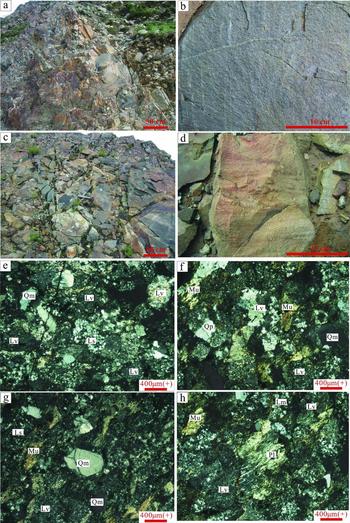
The analysed sandstone samples from the Xiongcun Formation show yellow–grey colours, medium- to coarse-grain sizes, and angular to sub-angular shapes (Fig. 4). They are texturally immature, with very low degrees of rounding and sorting. The framework grains of the sandstones are mainly composed of lithic fragments (63–70 %, mostly volcanic rock fragments), quartz (18–28 %, monocrystalline and polycrystalline), feldspar (8–12 %, alkali feldspar and plagioclase), and minor detrital grains (<5 %) of muscovite, biotite, apatite and zircon (Fig. 4e, f; Table 1). The rocks have a high amount of matrix (15–20 %) composed of quartz, feldspar, muscovite and clay. According to their mineral constituents these sandstones can be classified as lithic arenite in a QFL diagram (Fig. 5a), indicating a magmatic-arc provenance (Fig. 5b). On the other hand, using the geochemical classification diagram of Taylor & McLennan (Reference Taylor and McLennan S1985), the sandstones from the Xiongcun Formation are classified as graywackes and show magmatic-arc provenance (Fig. 5c).
(a–d) Outcrop photos and (e–h) microphotos of the sandstones in the Xiongcun Formation. Qm – monocrystalline quartz; Qp – polycrystalline quartz; Pl – plagioclase; Lv – volcanic rock fragment; Ls – sedimentary rock fragment; Mu – muscovite.

(a) QFL classification diagram (after Okada, Reference Okada1971), (b) QFL provenance diagram (after Dickinson, Reference Dickinson and Zuffa1985) and (c) Th–Hf–Co discrimination diagram (after Taylor & McLennan, Reference Taylor and McLennan S1985) for the sandstones in the Xiongcun Formation. A – felsic volcanic rocks; B – quartzite from cratonic basin; C – feldspar sandstones; D – shale (average upper continental crust); E – greywackes (arcs).

4.b. Whole-rock geochemistry
The whole-rock major- and trace-element concentrations of Jurassic sandstones in the Xiongcun district are listed in Table 2.
Major oxides (%) and trace elements (ppm) of the sandstones in the Xiongcun Formation.

Normalized data after aSun & McDonough (Reference Sun, McDonough, Saunders and Norry1989) and bTaylor & McLennan (Reference Taylor and McLennan S1985)
4.b.1. Major elements
As shown in Table 2, it is apparent that the sandstone samples show moderate SiO2 contents (53.27–66.13 %, mean 58.27 %) and high Al2O3 (14.53–24.04 %, mean 20.12 %) and FeO (3.25–10.65 %, mean 7.12 %) abundance. Meanwhile, these sandstones have low Na2O (0.41–1.49 %, mean 0.85), TiO2 (0.68–1.25 %, mean 0.91), CaO (0.54–1.87 %, mean 0.92), K2O (1.04–3.75 %, mean 2.17), Fe2O3 (0.87–4.96 %, mean 2.39) and MgO (1.28–3.34 %, mean 2.35) abundance, with a collective total of less than 10 %. In addition, these sandstone samples show high Fe2O3* + MgO contents (7.26–17.60 %, mean 12.66 %) and Al2O3/SiO2 ratios (0.22–0.45 %, mean 0.29 %). The calculated CIA and CIW values range over 77.19–85.36 (mean 79.96) and 86.19–95.59 (mean 89.98), respectively (Table 2). The F1 and F2 values range from –2.90 to 9.46 (mean 4.30) and 2.23 to 11.7 (mean 8.07), respectively (Table 2).
4.b.2. Trace elements
The Jurassic sandstones in the Xiongcun district exhibit similar REE compositions, with total REE contents ranging over 59.02–102.10 ppm (Table 2). The chondrite-normalized REE patterns (Fig. 6a; Sun & McDonough, Reference Sun, McDonough, Saunders and Norry1989) of these sandstones exhibit moderate light REE (LREE) enrichment compared with heavy REE (HREE, LaN/YbN = 4.33–8.54), and generally present smooth patterns with slightly negative Eu anomalies (δEu = 0.63–1.10) (Table 2; Fig. 6a). The post-Archean average Australian shale (PAAS) -normalized REE patterns are widely used in the study of sedimentary rocks (Bhatia, Reference Bhatia1985; Khan, Dar & Khan, Reference Khan, Dar and Khan2012; Kurian et al. Reference Kurian, Nath, Kumar and Nair2013). In the PAAS-normalized REE patterns (Fig. 6b; Taylor & McLennan, Reference Taylor and McLennan S1985), these sandstone samples show moderate LREE depletion when compared with HREE (LaN/YbN = 0.45–0.88), with moderately positive Eu anomalies (δEu = 0.99–1.70) and slightly negative Ce anomalies (δCe = 0.74–0.96) (Table 2; Fig. 6b). In addition, the sandstones show low abundances of La (12.2–20.9 ppm), Th (2.14–2.82 ppm), Hf (3.28–4.07 ppm) and Nb (3.60–8.50 ppm), and low ratios of Th/U (1.61–3.61) and La/Sc (0.42–1.05) (Table 2). They also show high abundances of Co (8.11–26.4 ppm) and Zr (98–131 ppm), and high ratios of La/Th (4.60–8.29), Zr/Th (40.0–54.7) and Co/Th (3.1–11.4) (Table 2).
(a) Chondrite (after Sun & McDonough, Reference Sun, McDonough, Saunders and Norry1989) and (b) post-Archean average Australian shale (PAAS) (after Taylor & McLennan, Reference Taylor and McLennan S1985) -normalized REE discriminatory plots for the sandstones in the Xiongcun Formation. Sandstone data of oceanic island arc, continental island arc, andean type and passive margin are from Bhatia (Reference Bhatia1985).

4.c. LA-ICP-MS U–Pb ages
The detrital zircon crystals of sandstone samples BL01-14-3 and BL21-06-05 have similar features. They are mainly euhedral to subhedral with sizes over the range 50–200 μm (Fig. 7), indicating short transportation distances. These detrital zircon crystals have obvious oscillatory zones and Th/U ratios > 0.1 (Fig. 7; online Supplementary Table S1, available at http://journals.cambridge.org/geo), indicating a magmatic origin. Sample BL01-14-3, collected from the upper section of the Xiongcun Formation, yielded 109 usable 206Pb/238U ages (discordance < 20 %) in the range 161–220 Ma (Supplementary Table S1), with an age peak of c. 186 Ma (Fig. 8). Sample BL21-06-05, from the lower section of the Xiongcun Formation, yielded 132 usable 206Pb/238U ages (discordance < 20 %) in the range 191–243 Ma (Supplementary Table S1), with the peak centred at c. 211 Ma (Fig. 8).
Representative cathodoluminescence (CL) images of detrital zircons from the sandstones in the Xiongcun Formation.

Detrital zircon age distribution from the sandstones in the Xiongcun Formation and relevant regions. Data sources: central Lhasa subterrane (Leier et al. Reference Leier, Paul, Gehrels and Decelles2007; Pullen et al. Reference Pullen, Kapp, Gehrels, Decelles, Brown, Fabijanic and Ding2008a; Gehrels et al. Reference Gehrels, Kapp, Decelles, Pullen, Blakey, Weislogel, Ding, Guynn, Martin, Mcquarrie and Yin2011; Zhu et al. Reference Zhu, Zhao, Niu, Dilek, Wang and Mo2011a), Qiangtang terrane (Pullen et al. Reference Pullen, Kapp, Gehrels, Vervoort and Ding2008b, Reference Pullen, Kapp, Gehrels, Ding and Zhang2011; Dong et al. Reference Dong, Li, Wan, Wang, Wu, Jie and Liu2011; Gehrels et al. Reference Gehrels, Kapp, Decelles, Pullen, Blakey, Weislogel, Ding, Guynn, Martin, Mcquarrie and Yin2011; Zhu et al. Reference Zhu, Zhao, Niu, Dilek, Wang and Mo2011a) and High Himalaya (Gehrels et al. Reference Gehrels, Decelles, Ojha and Upreti2006, Reference Gehrels, Kapp, Decelles, Pullen, Blakey, Weislogel, Ding, Guynn, Martin, Mcquarrie and Yin2011; McQuarrie et al. Reference McQuarrie, Robinson, Long, Tobgay, Grujic, Gehrels and Ducea2008; Myrow et al. Reference Myrow, Hughes, Searle, Fanning, Peng and Parcha2009, Reference Myrow, Hughes, Goodge, Fanning, Williams, Peng, Bhargava, Parcha and Pogue2010).

4.d. In situ zircon Hf isotopes
A total of 69 relatively large detrital zircon grains from the sandstone samples BL01-14-3 (n = 30) and BL21-06-05 (n = 39) were analysed for in situ Hf isotopic abundance (Fig. 7; online Supplementary Table S2, available at http://journals.cambridge.org/geo). The εHf(t) values of sample BL01-14-3 vary from 10.45 to 16.21 (Fig. 9), with T DM1 model ages in the range 170–404 Ma and T DM2 model ages in the range 162–526 Ma. The εHf(t) values of sample BL21-06-05 vary from 10.80 to 15.96 (Fig. 9), with T DM1 model ages in the range 215–419 Ma and T DM2 model ages in the range 210–529 Ma.
U–Pb ages versus εHf(t) values of the detrital zircons from the sandstones in the Xiongcun Formation. Southern Lhasa subterrane igneous rocks after Ji et al. (Reference Ji, Wu, Chung, Li and Liu2009) and central Lhasa subterrane igneous rocks after Zhu et al. (Reference Zhu, Zhao, Pan, Lee, Kang, Liao, Wang, Li, Dong and Liu2009, Reference Zhu, Zhao, Niu, Mo, Chung, Hou, Wang and Wu2011b).

5. Discussion
5.a. Volcanism-sedimentation age of the Xiongcun Formation
The youngest U–Pb age of zircon grains in populations of detrital zircons can roughly reflect the depositional age, although it should not be applied to precisely constrain maximum depositional ages of stratigraphic units (Surpless et al. Reference Surpless, Graham, Covault and Wooden2006; Brown & Gehrels, Reference Brown and Gehrels2007; Dickinson & Gehrels, Reference Dickinson and Gehrels2009; Gehrels, Reference Gehrels2015). On the other hand, minimum volcanism-sedimentation ages can be constrained by cross-cutting intrusive rocks. We therefore utilized the ages of volcanic and intrusive rocks coupled with the youngest single-grain U–Pb ages from the sandstone samples to constrain a permissible period for deposition. In the lower section of Xiongcun Formation, sandstone sample BL21-06-05 yielded a youngest detrital zircon 206Pb/238U age of 191 ± 3 Ma (Supplementary Table S1), suggesting that the initial deposition of sandstones from the lower section of Xiongcun Formation likely occurred after 191 Ma. Qu et al. Reference Qu, Xin and Xu(2007b) obtained a SHRIMP zircon U–Pb age of 195 ± 4.6 Ma from a dacite in the lower section of the Xiongcun Formation (Fig. 3); the lower section of Xiongcun Formation therefore probably formed during the Early Jurassic period. For the upper section of Xiongcun Formation, Tang et al. (Reference Tang, Li, Li, Zhang, Tang, Deng, Lang, Huang, Yao and Wang2010) reported a LA-ICP-MS zircon U–Pb age of 176 ± 5 Ma from tuff (Fig. 3). Sandstone sample BL01-14-3 yielded a youngest detrital zircon 206Pb/238U age of 161 ± 2 Ma (Supplementary Table S1), indicating deposition likely occurred after 161 Ma. However, the upper section of Xiongcun Formation was intruded by the 165.3 ± 1.0 Ma diabase dykes (Fig. 3; Lang et al. Reference Lang, Wang, Tang, Deng, Cui, Yin and Xie2017). This inconsistent feature can probably be ascribed to the fact that the youngest U–Pb age of detrital zircon grains does not reliably constrain the maximum depositional age of stratigraphic units (Dickinson & Gehrels, Reference Dickinson and Gehrels2009). According to the age of the diabase dykes, we propose that the upper section of Xiongcun Formation probably formed during Middle Jurassic time. In summary, we interpret that the Xiongcun Formation formed during the Early–Middle Jurassic period (195–165 Ma).
5.b. Weathering
The alteration of rocks during weathering results in the depletion of alkali and alkaline Earth elements and preferential enrichment of Al2O3 in sediments (Sun, Gui & Chen, Reference Sun, Gui and Chen2012). The weathering history of ancient sedimentary rocks can therefore be partly evaluated by examining relationships among the alkali and alkaline Earth elements (Nesbitt & Young, Reference Nesbitt and Young1982), and the chemical indexes of CIA and CIW (Nesbitt & Young, Reference Nesbitt and Young1982; Cullers, Reference Cullers2000) are widely used to identify the chemical weathering intensity of a source area. The high CIA and CIW values (Table 2) of the sandstones from the Xiongcun Formation indicate moderate to high weathering and tropical conditions in the source area during the Late Triassic – Jurassic period (Nesbitt & Young, Reference Nesbitt and Young1982). In the A (Al2O3) – CN (CaO * + Na2O) – K (K2O) diagram (Fig. 10), which is useful for examining weathering and evaluating fresh rock compositions (Nesbitt & Young, Reference Nesbitt and Young1982, Reference Nesbitt and Young1989; Fedo, Nesbitt & Young, Reference Fedo, Nesbitt and Young1995), the sandstone samples show moderate to intensive weathering and a felsic and intermediate igneous provenance (andesite, granodiorite and granite). To summarize, the source weathering condition of the sandstones from the Xiongcun Formation is similar to a modern tropical climate. This is supported by the palaeogeography of the Lhasa terrane that suggests a location near the equator during the Late Triassic – Jurassic period (Metcalfe, Reference Metcalfe2006).
A–CN–K diagram for the sandstones in the Xiongcun Formation (after Nesbitt & Young, Reference Nesbitt and Young1984). Arrows 1–3 represent the weathering trends of andesite, granodiorite and granite, respectively.

5.c. Provenance
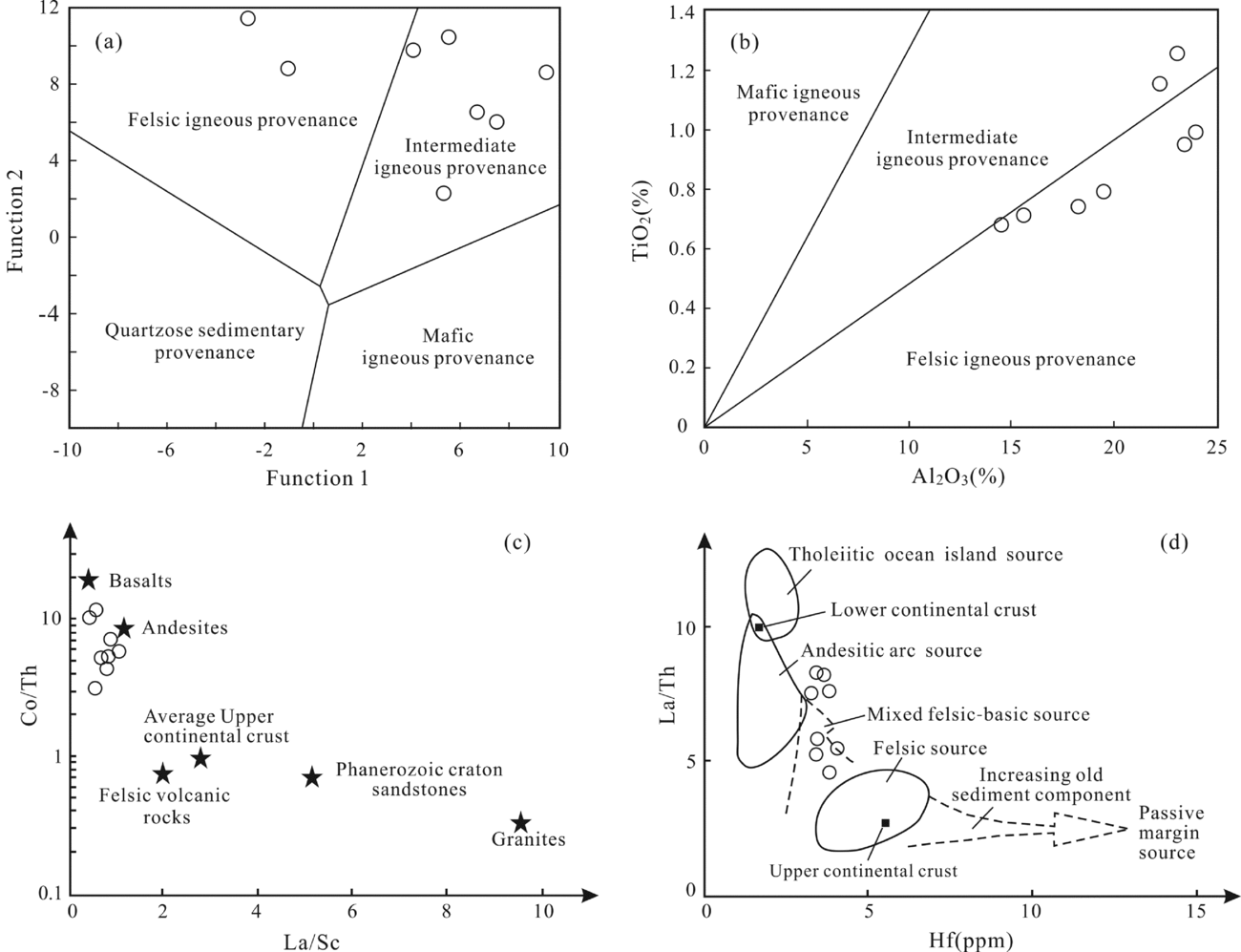
Modal abundance, whole-rock chemistry, and zircon U–Pb and Lu–Hf isotopes can provide useful constraints for the provenance of sandstones (Dickinson & Suczek, Reference Dickinson and Suczek1979; Bhatia, Reference Bhatia1983; McLennan et al. Reference McLennan, Hemming, McDaniel and Hanson1993; Griffin et al. Reference Griffin, Belousova, Shee, Pearson and O'Reilly2004; Han et al. Reference Han, Liu, Neubauer, Genser, Zhao, Wen, Li, Wu, Jiang and Zhao2012; Sun, Gui & Chen, Reference Sun, Gui and Chen2012; Chen et al. Reference Chen, Zhang, Li, Yu and Wu2016). Detrital zircons of sandstone from the Xiongcun Formation are typically prismatic crystals with oscillatory zoning (Fig. 7), indicating that these zircons are magmatic in origin and were likely derived from the contemporaneous igneous rocks in the region, a proximal source. Modal abundance shows that the provenance of the sandstones was mainly a magmatic arc (Fig. 5b). The Th–Hf–Co discrimination diagram proposed by Taylor & McLennan (Reference Taylor and McLennan S1985) also supports a magmatic arc provenance (Fig. 5c). In the A–CN–K diagram (Fig. 10), the sandstones show a felsic and intermediate igneous provenance. In the F1 versus F2 discrimination diagram (Fig. 11a), the analysed data also plot in the felsic and intermediate igneous provenance fields. Again, the Al2O3 versus TiO2 diagram shows that the sandstones are of felsic and intermediate igneous provenance (Fig. 11b). In addition, in the trace-element plot of La/Sc versus Co/Th (Fig. 11c), the data display high Co/Th ratios and low La/Sc ratios, dominantly indicating andesitic source rocks. Similarly, in the Hf versus La/Th diagram (Fig. 11d), the data fall within the mixed felsic-basic source and andesitic arc source fields.
(a) Discriminant function diagram (after Roser & Korsch, Reference Roser and Korsch1988); (b) Al2O3 versus TiO2 diagram (after Hayashi et al. Reference Hayashi, Fujisawa, Holland and Ohmoto1997); (c) La/Sc versus Co/Th diagram (after Gu et al. Reference Gu, Liu, Zheng, Tang and Qi2002); and (d) Hf versus La/Th diagram (after Floyd & Leveridge, Reference Floyd and Leveridge1987) for the sandstones in the Xiongcun Formation.
Detrital zircon age data indicate that the Jurassic sandstones from the Xiongcun Formation received detritus from sources of age 161–243 Ma. Ages in this range have been reported for igneous rocks in the central and southern Lhasa subterranes (Chu et al. Reference Chu, Chung, Song, Liu, O'Reilly, Pearson, Ji and Wen2006; Zhang et al. Reference Zhang, Xu, Guo, Zong, Cai and Yuan2007; Ji et al. Reference Ji, Wu, Chung, Li and Liu2009; Zhu et al. Reference Zhu, Zhao, Pan, Lee, Kang, Liao, Wang, Li, Dong and Liu2009, Reference Zhu, Zhao, Niu, Mo, Chung, Hou, Wang and Wu2011b). However, detrital zircons from the Jurassic sandstones in the Xiongcun district show high and positive εHf(t) values (10.45–16.21), indicating that they are probably derived from igneous rocks in the southern Lhasa subterrane rather than the central Lhasa subterrane (Fig. 9). The Triassic and Jurassic igneous rocks in the southern Lhasa subterrane have been attributed to the northwards subduction of the Neo-Tethys oceanic slab (Chu et al. Reference Chu, Chung, Song, Liu, O'Reilly, Pearson, Ji and Wen2006; Zhang et al. Reference Zhang, Xu, Guo, Zong, Cai and Yuan2007; Qu et al. Reference Qu, Xin and Xu2007b; Ji et al. Reference Ji, Wu, Chung, Li and Liu2009; Tang et al. Reference Tang, Li, Li, Zhang, Tang, Deng, Lang, Huang, Yao and Wang2010; Guo et al. Reference Guo, Liu, Liu, Cawood, Wang and Liu2013; Lang et al. Reference Lang, Tang, Li, Huang, Ding, Yang, Xie, Zhang, Wang and Zhou2014; Qiu et al. Reference Qiu, Wang, Zhao and Yu2015; Meng et al. Reference Meng, Dong, Cong, Xue and Cao2016a, b). This is consistent with the modal abundance and whole-rock chemistry findings that the sandstones from the Xiongcun Formation are derived from felsic and intermediate igneous rocks in a magmatic arc. Furthermore, detrital zircon ages from the sandstones in the Xiongcun Formation lack the typical ages from the central Lhasa subterrane (age peaks of c. 600, 1200, 1600 and 2700 Ma), the Qiangtang terrane (age peaks of c. 600, 800, 1000 and 2500 Ma) and the High Himalaya (age peaks of c. 1000, 1700 and 2600 Ma) (Fig. 8), probably suggesting a lack of provenance from the central Lhasa subterrane, the Qiangtang terrane and the High Himalaya. On the other hand, the fact that the southern Lhasa subterrane is characterized by an absence of ancient, evolved basement rocks and is composed of juvenile crust (Hou et al. Reference Hou, Duan, Lu, Zheng, Zhu, Yang, Yang, Wang, Pei, Zhao and McCuaig2015a) further supports the interpretation that the local provenance of the Jurassic sandstones in the Xiongcun Formation lacks old basement components. In summary, the sandstones from the Xiongcun Formation were likely derived from Triassic and Jurassic subduction-related felsic and intermediate igneous rock in the southern Lhasa subterrane.
5.d. Tectonic settings
Sandstones can be formed in tectonic settings such as oceanic island arcs, continental island arcs, active continental margins and passive margins (Bhatia, Reference Bhatia1983, Reference Bhatia1985; Bhatia & Crook, Reference Bhatia and Crook1986). The studies of Bhatia (Reference Bhatia1983) have shown that there is an increase in TiO2, Fe2O3* + MgO and Al2O3/SiO2 as the tectonic setting changes from the passive margin type (average TiO2 = 0.49 %, Fe2O3* + MgO = 2.89 %, Al2O3/SiO2 = 0.10), to an active continental margin (average TiO2 = 0.46 %, Fe2O3* + MgO = 4.63 %, Al2O3/SiO2 = 0.18), to a continental island arc (average TiO2 = 0.64 %, Fe2O3* + MgO = 6.79 %, Al2O3/SiO2 = 0.20) to an oceanic island arc (average TiO2 = 1.06 %, Fe2O3* + MgO = 11.73 %, Al2O3/SiO2 = 0.29). The sandstones from the Xiongcun Formation are characterized by high contents of TiO2 and Fe2O3* + MgO and high Al2O3/SiO2 ratios (Table 2), which are similar to the major-element characteristics of sandstones from an oceanic island-arc setting (Bhatia, Reference Bhatia1983). In addition, in the (Fe2O3* + MgO) versus TiO2 and (Fe2O3* + MgO) versus (Al2O3/SiO2) diagrams (Fig. 12), the sandstone samples plot near the oceanic island-arc field, again suggesting that they probably formed in an oceanic island-arc setting.
Tectonic setting discrimination diagrams of (a) (Fe2O3* + MgO) v. TiO2 and (b) (Fe2O3* + MgO) v. Al2O3/SiO2 for the sandstones in the Xiongcun Formation (after Bhatia, Reference Bhatia1983). OIA – oceanic island arc; CIA – continental island arc; ACM – active continental margin; PM – passive margin.

The REE characteristics of sandstones are also used to discriminate among tectonic settings (Winchester & Max, Reference Winchester and Max1989). In chondrite-normalized REE patterns (Fig. 6a) and PAAS-normalized REE patterns (Fig. 6b), the REE characteristics of the sandstones from the Xiongcun Formation are consistent with those of an oceanic island-arc setting. Immobile trace elements have additionally been used to successfully discriminate among the tectonic settings of clastic sediments (Bhatia & Crook, Reference Bhatia and Crook1986; McLennan et al. Reference McLennan, Hemming, McDaniel and Hanson1993; Griffin et al. Reference Griffin, Belousova, Shee, Pearson and O'Reilly2004; Sun, Gui & Chen, Reference Sun, Gui and Chen2012; Shi et al. Reference Shi, Wang, Huang, Yang and Song2016). The Jurassic sandstones in the Xiongcun district show: low abundances of La, Th, Zr and Nb; low ratios of Th/U and La/Sc; and high ratios of La/Th and Zr/Th (Table 2). These trace-element characteristics are very similar to those of sandstones from an oceanic island-arc setting (Bhatia & Crook, Reference Bhatia and Crook1986). On the La–Th–Sc, Th–Sc–Zr/10 and Th–Co–Zr/10 diagrams proposed by Bhatia & Crook (Reference Bhatia and Crook1986), all the sandstones were plotted in the oceanic island-arc fields (Fig. 13a–c). In the La/Sc versus Ti/Zr and Th versus La diagrams proposed by Bhatia & Crook (Reference Bhatia and Crook1986), all the samples also fall into the oceanic island-arc fields (Fig. 13d-e).
Tectonic setting discrimination diagrams of (a) La–Th–Sc, (b) Th–Sc–Zr/10, (c) Th–Co–Zr/10, (d) La/SC versus Ti/Zr and (e) Th versus La for the sandstones in the Xiongcun Formation (after Bhatia & Crook, Reference Bhatia and Crook1986). Abbreviations as for Figure 12.

The detrital zircon U–Pb ages of the sandstones from the Xiongcun Formation range over 161–243 Ma (Supplementary Table S1; Figs 7, 8), which obviously lack older zircons from adjacent crustal domains such as the central Lhasa subterrane, the Qiangtang terrane and the High Himalaya (Fig. 8). This indicates that the sandstones most likely formed in an oceanic island arc rather than a continental island arc. Similarly, the Jurassic igneous rocks in the Xiongcun porphyry copper–gold district were also interpreted to have been generated within an oceanic island-arc system (Tang et al. Reference Tang, Lang, Xie, Gao, Li, Huang, Ding, Yang, Zhang, Wang and Zhou2015; Lang et al. Reference Lang, Wang, Tang, Deng, Cui, Yin and Xie2017; Ma et al. Reference Ma, Xu, Meert and Santosh2017b; Yin et al. Reference Yin, Lang, Cui, Yang, Xie and Wang2017).
We suggest that the tectonic setting of the sandstone from the Xiongcun Formation was probably an oceanic island-arc setting (Fig. 14). Our data support the opinion that the southern Lhasa subterrane was likely an oceanic island-arc setting rather than a continental island-arc setting during the Late Triassic–Jurassic period.
Schematic diagram showing provenance and tectonic setting of the sandstones in the Xiongcun Formation (modified from Tang et al. Reference Tang, Lang, Xie, Gao, Li, Huang, Ding, Yang, Zhang, Wang and Zhou2015).

6. Conclusions
Based on petrology, geochemistry, zircon U–Pb dating and Lu–Hf results from Jurassic sandstones of the Xiongcun Formation in the Xiongcun district, we can draw the following conclusions.
(1) The sandstones of Xiongcun Formation formed during Early–Middle Jurassic time (195–165 Ma). The sandstones are exposed in the lower and upper sections of the Xiongcun Formation. These sandstones mainly contain L63–70 (lithic fragments), Q18–28 (monocrystalline and polycrystalline quartz) and F8–12 (alkali feldspar and plagioclase), indicating that they can be classified as lithic arenite. The high CIA values (77.19–85.36, mean 79.96) and CIW values (86.19–95.59, mean 89.98) of the sandstones imply moderate to high weathering and tropical climate conditions in the source area.
(2) Framework petrography, major oxides and trace elements indicate that these sandstones were derived from felsic and intermediate igneous rocks, probably with a magmatic-arc provenance. Detrital zircon ages and εHf(t) values further constrain the sandstones provenance as Triassic and Jurassic subduction-related felsic and intermediate igneous rocks in the southern Lhasa subterrane. The tectonic setting discrimination diagrams, as well as the chemical compositions and detrital zircon ages, support an oceanic island-arc setting for the sandstones from the Xiongcun Formation.
(3) The geologic setting of the southern Lhasa subterrane during the Late Triassic – Jurassic period was probably an oceanic island-arc setting rather than a continental island-arc setting.
Acknowledgements
This research was jointly supported by the National Science Foundation of China (41502079), State Key Laboratory of Continental Tectonics and Dynamics (K201401), State Key Laboratory of Ore Deposit Geochemistry (201503), State Key Laboratory for Mineral Deposits Research (2017-LAMD-K04), Special Scientific Research Fund of Public Welfare Profession of MLR, China (201511022-05) and Sichuan Youth Science and Technology Foundation (2014JQ0047). We are grateful to Dr Andrew Laskowski and the other anonymous reviewer for their constructive comments, which greatly improved the manuscript.
Supplementary material
To view supplementary material for this article, please visit https://doi.org/10.1017/S0016756818000122