Introduction
Graves’ disease is an autoimmune disease and the commonest cause of hyperthyroidism. In patients who relapse after initial treatment with antithyroid medication, total thyroidectomy is an accepted treatment strategy. Post-operative hypocalcaemia is a common complication of total thyroidectomy. The reported incidence of temporary hypocalcaemia varies from 0.5 per cent to 65 per cent and 0–16 per cent patients may suffer permanent hypocalcaemia (up to 30 per cent after thyroid cancer surgery).Reference Pfleiderer, Ahmadi, Draper, Vrotsou and Smith1–Reference Kim, Chung and Son3 According to the British Association of Endocrine and Thyroid Surgeons Fourth National Audit Report (2012), the rate of post-operative hypocalcaemia is 24.9 per cent (based on a large data sample).4
The relationship between thyroid hormones and bone health is interesting: increased circulating thyroid hormones can cause osteoporosis from either hyperthyroidism or overtreatment of hypothyroidism after excessive osteoclastic stimulation.Reference Allain and McGregor5, Reference Britto, Fenton, Holloway and Nicholson6 This process may be reversed after total thyroidectomy, leading to a change in calcium flux into bone and possible hypocalcaemia. A marker for bone turnover may therefore identify patients at risk of hypocalcaemia. Several candidate biochemical markers may be used for this purpose.Reference Siddiqi, Burrin, Noonan, James, Wood and Price7 For instance, a correlation between low pre-operative serum vitamin D and post-operative hypocalcaemia has been established.Reference Kirkby-Bott, Markogiannakis, Skandarajah, Cowan, Fleming and Palazzo8–Reference Erbil, Ozbey, Sari, Unalp, Agcaoglu and Ersöz10 However, serum vitamin D assay facilities are not universal, and testing can be slow and expensive.
In contrast, serum alkaline phosphatase testing is readily available and commonly performed in all hospitals. Demeester-Mirkine et al. reported that post-operative serum calcium concentrations were elevated in patients with pre-operative uncontrolled thyrotoxicosis.Reference Demeester-Mirkine, Hooghe, Van Geertruyden and De Maertelaer11 They reported that the increased bone turnover rate could take months to normalise and found raised pre-operative serum alkaline phosphatase values in patients rendered biochemically euthyroid. However, other researchers suggested that elevated serum calcium may be a consequence of thyroid surgery itself rather than thyrotoxicosis.Reference Wilkin, Isles, Paterson, Crooks and Beck12
This study aimed to identify whether elevated serum alkaline phosphatase is a pre-operative biochemical predictor of post-operative hypocalcaemia. It also aimed to establish a correlation of pre-operative raised serum alkaline phosphatase and post-operative hypocalcaemia with normal post-operative parathyroid hormone (PTH) levels. This information could help clinicians target at-risk patients for appropriate pre-operative interventions.
Materials and methods
Study design and data gathering
A database of all patients who underwent total thyroidectomy in our unit between 2003 and 2011 was established. Patients were divided into Graves’ disease and non-Graves’ disease groups. All indications except Graves’ disease were considered non-Graves’ disease, including toxic multinodular goitre and toxic adenoma. Data were collected retrospectively from medical notes and various electronic sources and tabulated using Microsoft Excel (Microsoft, Redmond, Washington, USA). Data for Graves’ disease and non-Graves’ disease patients were compared.
Patients were excluded if they had subtotal thyroidectomy, pre-existing liver disease, unconfirmed histopathology, a low post-operative PTH concentration, or incomplete data on pre- and post-operative serum alkaline phosphatase levels and post-operative PTH levels.
Biochemical measurements
The first post-operative calcium level was measured between 6 and 24 hours after total thyroidectomy. However, the timing of subsequent calcium measurements was determined by the first post-operative measurement, clinical status of the patients and surgeon preference. Pre-operative serum alkaline phosphatase concentrations measured within 12 months prior to total thyroidectomy were considered satisfactory. Post-operative serum alkaline phosphatase concentrations were routinely measured as part of the calcium analysis. PTH concentrations were measured between 12 and 72 hours after total thyroidectomy in all patients.
Pre- and post-operative corrected calcium titres were collated (normal range in our laboratory 2.10–2.55 mmol/l).Reference Yu, Leese, Smith and Donnan13 For evaluation, post-operative hypocalcaemia was classified as mild (2.00–2.09 mmol/l), moderate (1.80–1.99 mmol/l) or severe (< 1.80 mmol/l). Values less than 2.0 were considered clinically significant. Hypocalcaemia was considered temporary if resolution occurred within six months of surgery and permanent if treatment was required for more than six months. The normal PTH range was 1.0–6.9 pmol/l.Reference Yu, Leese, Smith and Donnan13 Serum alkaline phosphatase data were corrected for age at surgery using the standardised values of our laboratory reference ranges for various age groups.
Statistical analysis
Statistical analyses were conducted using IBM SPSS Statistics software version 15.0 (Chicago, Illinois, USA). Pearson's chi-squared test analysis was performed to determine significant associations between pre-operative serum alkaline phosphatase levels and post-operative hypocalcaemia.
Results
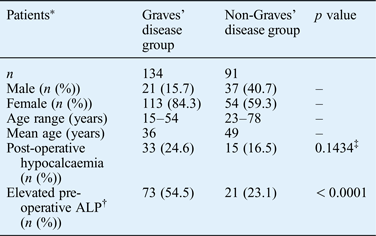
A total of 302 thyroidectomy patients were identified. Of these, 77 were excluded (subtotal thyroidectomy, 10; unconfirmed histopathology, 3; low post-operative PTH level, 19; incomplete data, 31; and pre-existing liver disease, 14), leaving 225 patients included in the study. Table I outlines some important patient parameters. Graves’ disease was the most common indication (134 Graves’ disease patients; 59.5 per cent), and the remaining thyroidectomies were performed for other reasons (91 non-Graves’ disease patients). In the non-Graves’ group, 17 patients had toxic goitre (18.7 per cent), 25 (27.5 per cent) had non-toxic goitre and the remainder predominantly had a suspected or confirmed thyroid malignancy.
Patient demographics, post-operative hypocalcaemia and elevated pre-operative serum ALP

*Total n = 225. †Levels measured within 12 months prior to total thyroidectomy. ‡Not statistically significant. ALP = alkaline phosphatase.
Overall, post-operative hypocalcaemia was noted in 48 patients (21.3 per cent), 94 patients (41.8 per cent) had elevated pre-operative serum alkaline phosphatase levels and 131 patients (58.2 per cent) had normal pre-operative serum alkaline phosphatase levels, regardless of the indications for total thyroidectomy. Of those with hypocalcaemia, 31 patients (13.8 per cent) had mild hypocalcaemia, 10 (4.4 per cent) had moderate hypocalcaemia and 7 (3.1 per cent) had severe hypocalcaemia. Hypocalcaemia was temporary in 44 patients (19.6 per cent) and permanent in 4 (1.8 per cent).
Some degree of post-operative hypocalcaemia was noted in 33 Graves’ disease patients (24.6 per cent) and 15 non-Graves’ disease patients (16.5 per cent). The incidence of elevated pre-operative serum alkaline phosphatase level was significantly higher in Graves’ disease patients (54.5 per cent) than in non-Graves’ patients (23.1 per cent; Table II).
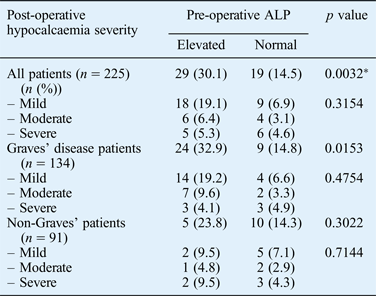
A summary of post-operative hypocalcaemia in relation to pre-operative serum ALP
*Significant. ALP = alkaline phosphatase
For 167 patients (74.2 per cent), pre-operative serum calcium and alkaline phosphatase were measured within 6 months prior to surgery, often as part of the pre-operative assessment. A minority of patients (4.9 per cent) had mild hypercalcaemia (serum calcium level > 2.55 and < 2.90 mmol/l) prior to surgery and all went on to develop post-operative hypocalcaemia. Interestingly, all of these patients had Graves’ disease and elevated pre-operative serum alkaline phosphatase level (significant association with pre-operative hypercalcaemia; p < 0.05).
Table II summarises the association between pre-operative serum alkaline phosphatase levels and post-operative hypocalcaemia. Generally, the incidence of post-operative hypocalcaemia was higher in the group with elevated pre-operative serum alkaline phosphatase. Overall, a significant association between elevated pre-operative serum alkaline phosphatase and post-operative hypocalcaemia was observed, regardless of the indication for total thyroidectomy (chi-square test: Graves’ disease, p = 0.0032; non-Graves’ disease, p < 0.05). However, this finding was not significant when hypocalcaemia severity was considered (chi-square test: Graves’ disease, p = 0.3154; non-Graves’ disease, p > 0.05). A similar observation was made when only Graves’ disease patients were considered. In non-Graves’ disease patients, there was no significant association between elevated pre-operative serum alkaline phosphatase and overall post-operative hypocalcaemia or hypocalcaemia severity (chi-square test p > 0.05).
The risk of developing post-operative hypocalcaemia increased as the pre-operative serum alkaline phosphatase level increased above normal (Figures 1 and 2). There was a correlation between increased pre-operative serum alkaline phosphatase level and decreased post-operative calcium level (r = −0.653). However, there was no correlation between the degree of pre-operative serum alkaline phosphatase elevation and post-operative hypocalcaemia severity. Further analysis showed that an increased pre-operative serum alkaline phosphatase level predicts hypocalcaemia at less than 24 hours and more than 24 hours post-operatively; however, no predictions beyond 72 hours post-operatively could be made.
Graph showing the effect of pre-operative serum alkaline phosphatase concentration above the normal range (adjusted for different age ranges) on the percentage of patients who develop post-operative hypocalcaemia. ALP = alkaline phosphatase; post-op = post-operative
Graph showing the correlation between elevated pre-operative serum alkaline phosphatase and post-operative hypocalcaemia. Spearman's rank correlation, r = −0.653. ALP = alkaline phosphatase; post-op = post-operative
Discussion
Principal results
The association between elevated pre-operative serum alkaline phosphatase and overall post-operative hypocalcaemia was significant, particularly when Graves’ disease was the indication. However, there was no significant association with the degree of hypocalcaemia severity. In addition, there were significantly more patients with elevated pre-operative serum alkaline phosphatase levels in the Graves’ disease group than in the non-Graves’ group. Elevated pre-operative serum alkaline phosphatase has no significant impact on the incidence of post-operative hypocalcaemia in patients who did not have Graves’ disease. The risk of developing post-operative hypocalcaemia increased with increasing pre-operative serum alkaline phosphatase concentration; however, this had no impact on hypocalcaemia severity.
Previous studies
The serum alkaline phosphatase level partly reflects osteoblastic and osteoclastic activity, and may be regarded an index of thyrotoxic osteodystrophy.Reference Michie, Duncan, Hamer-Hodges, Bewsher, Stowers and Pegg14 The underlying mechanism by which persistently elevated thyroid hormone levels affect bone activity is poorly understood, with both direct and indirect thyroid hormone actions on osteoclastic activity being proposed.Reference Allain and McGregor5–Reference Siddiqi, Burrin, Noonan, James, Wood and Price7, Reference Abu, Bord, Horner, Chatterjee and Compston15 Patients presenting with unopposed Graves’ disease may be hypercalcaemic with raised serum alkaline phosphatase. Despite being rendered euthyroid with antithyroid drugs, these patients can develop significant post-thyroidectomy hypocalcaemia with normal serum PTH levels. Hungry bone syndrome is established in parathyroid surgery.Reference Bhattacharyya and New16 However, its role in thyroid surgery, especially in its diagnosis, is less well established. As our patients had normal post-operative PTH concentrations, the mechanism of hypocalcaemia is likely to be independent of hypoparathyroidism.
However, a small proportion of Graves’ disease patients had mild pre-operative hypercalcaemia with elevated serum alkaline phosphatase levels, which supports the possibility that thyrotoxicosis induced hyperdynamic bone turnover. Overall, our results suggest that pre-operative serum alkaline phosphatase level may be a good predictor of post-operative hypocalcaemia, particularly in Graves’ disease patients. In a recent large study of 393 patients, Ali et al. also suggested that pre-operative serum alkaline phosphatase is one of the variables with the highest predictive accuracy for post-operative hypocalcaemia after total thyroidectomy, although most patients (88.8 per cent) in their series had been diagnosed with malignancy based on a pre-operative fine-needle aspiration biopsy.Reference Ali, Yu, Palmer, Ganly, Shaha and Shah17 This contradicts a report by Wilkin et al. in the 1970s that did not support elevated pre-operative alkaline phosphatase as a predictor.Reference Wilkin, Isles, Paterson, Crooks and Beck12 In their study of 54 Graves’ disease patients, the post-operative calcium levels of 22 (40.7 per cent) patients were not measured in the first 24 hours and subsequent calcium measurements were performed on post-operative day 4 (for 50 out of 54 patients). It is possible that measuring the calcium levels of all 54 patients within the first post-operative 24 hours would have significantly affected the results. Our study did not demonstrate a clear relationship between pre-operative serum alkaline phosphatase levels and post-operative hypocalcaemia severity. Interestingly, for most patients who experienced hypocalcaemia, it was in the mild range; only a few patients developed severe hypocalcaemia (3.1 per cent).
Limitations of this study
Although the sample size was large, this was a retrospective study. More than 25 per cent of patients had pre-operative serum calcium and alkaline phosphatase measurements taken more than six months before surgery. Therefore, for many patients, the serum levels at the time of surgery may not have been accurately represented. This is particularly important when the continued action of thyrotoxicosis is considered for patients with established Graves’ disease. Owing to the retrospective nature of the study, some data were not available. In addition, variations in surgical practice mean that the exact timing of post-operative calcium and PTH measurements varied slightly. Therefore, the degree of hypocalcaemia severity and/or PTH levels may not have been accurately represented by the figures used in this study. In addition, data was available only on total pre- and post-operative serum alkaline phosphatase concentrations rather than on bone alkaline phosphatase levels. These concentrations may therefore not reflect bone turnover, although to minimise this possibility patients with a history of previous liver disease were excluded.
• Total serum alkaline phosphatase is a standard liver function test
• Elevated pre-operative serum alkaline phosphatase may predict post-thyroidectomy hypocalcaemia in Graves’ disease patients
• Hyperdynamic bone turnover may affect calcium metabolism in thyrotoxicosis patients
• Pre-operative serum alkaline phosphatase analysis may identify total thyroidectomy patients that would benefit from pre-operative intervention
All patients with low post-operative PTH concentrations were excluded to reduce the potential effect of parathyroid insufficiency on post-thyroidectomy hypocalcaemia development. However, some patients with PTH in the normal range may still have relative parathyroid insufficiency. Pre-operative PTH may be another measure of increased bone turnover, but this parameter was not measured in this cohort. The correlation between serum alkaline phosphatase level and post-operative serum calcium was weak (r = −0.653). Furthermore, the lack of correlation between serum alkaline phosphatase and hypocalcaemia severity is caused by the statistical calculation being under powered. The determination coefficient (r 2) is rather low (around 0.36), showing that increased serum alkaline phosphatase explains only a third of the hypocalcaemia observed. As the timing of pre-operative serum alkaline phosphatase measurement was variable (up to 12 months), it is possible that changes in pre-operative antithyroid treatment may have affected these results. It is important to stress that multiple factors contribute to post-thyroidectomy hypocalcaemia development.
Conclusion
Elevated pre-operative serum alkaline phosphatase may help identify patients at risk of developing post-thyroidectomy hypocalcaemia, particularly those with Graves's disease. However, it is important that the limitations of this retrospective study are considered.