Introduction
Environmental disturbances generate changes in conditions (Vitt Reference Vitt, Avila-Pires, Caldwell and Oliveira1998), resources (Spaan et al. Reference Spaan, Ramos-Fernández, Bonilla-Moheno, Schaffner, Morales-Mávil, Slater and Aureli2020) and habitat structure (Almeida-Gomes & Rocha Reference Almeida-Gomes and Rocha2014; Flores et al. Reference Flores, Zanette and Araujo2017), which can directly affect the composition and species distribution (e.g., Hewitt et al. Reference Hewitt, Thrush, Lohrer and Townsend2010; Whitbeck et al. Reference Whitbeck, Oetter, Perry and Fyles2016). Among the forms of anthropogenic disturbance, agricultural land use is among the main threats to biodiversity (Ellis et al. Reference Ellis, Goldewijk, Siebert, Lightman and Ramankutty2010). As parasites are closely related to their hosts and can affect their density and ecology, they are necessarily considered to be good environmental bioindicators (Vidal-Martínez et al. Reference Vidal-Martínez, Pech, Sures, Purucker and Poulin2010). Understanding how interactions between parasites and hosts are affected by agricultural land use allows us to make predictions of how these anthropogenic impacts affect parasites (Mckenzie Reference Mckenzie2007).
Helminth parasites can infect their hosts through direct contact of the larvae or through intermediate hosts. Infection parameters (e.g., abundance, prevalence) can be affected by aspects such as diet (Silva et al. Reference Silva, Manoel, Uieda, Ávila and da Silva2019), microhabitat use (Brito et al. Reference Brito, Corso, Almeida, Ferreira, Almeida and Anjos2014) and host density (Kelehear et al. Reference Kelehear, Brown and Shine2012), and these factors can be affected by environmental alterations, such as the agricultural land use (Portela et al. Reference Portela, dos Santos and dos Anjos2020). Among the problems that agricultural land use can cause in helminths, for example, are the reduction in the immune response or competence of the hosts (Kiesecker Reference Kiesecker2002), changes in habitat (Sillero et al. Reference Sillero, Argaña, Matos, Franch, Kaliontzopoulou and Carretero2020) and changes in resource availability (Becker et al. Reference Becker, Streicker and Altizer2015) that may imply changes in parasitism patterns (Brito et al. Reference Brito, Corso, Almeida, Ferreira, Almeida and Anjos2014; Becker et al. Reference Becker, Streicker and Altizer2015; Kiesecker Reference Kiesecker2002).
It is noteworthy that different groups of parasites can respond differently to environmental variables (Lafferty Reference Lafferty1997). In indirect life cycle species (heteroxenous) the need for more than one host to complete their life cycle can cause limitations in surviving in anthropic environments (Werner & Nunn Reference Werner and Nunn2020), since degradation of the natural environment can lead to differences in species density, including of intermediate hosts for some parasites (Mckenzie & Townsend Reference McKenzie and Townsend2007). However, the opposite may also be true when there is an increase in intermediate hosts with anthropization. In eutrophic waters, for example, the increase in insects and snails due to differences in environmental conditions facilitates increases in the rate of parasite transmission in anurans that live close to aquatic environments (Mckenzie Reference Mckenzie2007). Direct life cycle species tend to be less harmed from anthropization because they do not need intermediate hosts to complete their life cycle (King et al. Reference King, Mclaughlin, Boily and Marcogliese2010).
In this work, we evaluate how helminth parasitism in the generalist lizard Tropidurus hispidus Spix, 1825 is affected by agricultural land use. Tropidurus hispidus (Tropiduridae) feeds predominantly on insects (Ribeiro & Freire Reference Ribeiro and Freire2011) and has sit-and-wait behavior as its main foraging strategy (Kolodiuk et al. Reference Kolodiuk, Ribeiro and Freire2009). These lizards can be found both in natural environments and in anthropic areas (they even seem to benefit from urbanization, Andrade et al. Reference Andrade2019), being good models to test the effect of agricultural land use on parasite communities. We hypothesize that there is a reduction in abundance and prevalence of heteroxenous helminths with agricultural land use but not of monoxenous species.
Materials and methods
We developed this work around three Protected Areas in Brazil: the Aiuaba Ecological Station (AES, 6° 41′03.4″S 40°12′52.3″W), located in the State of Ceará, in Caatinga sensu stricto areas; the Ubajara National Park (UNP, 3°50′31.2″S 40°54′00.5″W), located in the northwest of the State of Ceará, in Caatinga sensu stricto and Relictual Humid Forest areas; and Sete Cidades National Park (SCNP, 4°06′58.8″S 41°43′41.8″W), located in the north of the State of Piauí, in open Cerrado areas (Cerrado sensu stricto), a marginal area close to the Caatinga (Santos Reference Santos2018). Some of the differences between the two Caatinga areas are, for example, rainfall, higher in UNP surroundings and aridity, higher in Aiuaba surroundings (Caitano et al. Reference Caitano, Lopes and Teixeira2011).
Caatinga is a Seasonally Dry Tropical Forest (SDTF) distributed throughout the Northeast of Brazil. It has high annual evapotranspiration, causing a water deficit for most of the year, and thus it has predominantly deciduous vegetation (Prado Reference Prado, Leal, Tabarelli and Silva2003). This region harbors exceptional areas, such as the Relictual Humid Forests (Moro et al. Reference Moro, Macedo, Moura-Fé, Castro and Costa2015), which are less seasonal than the Caatinga that surrounds it and have greater rainfall and perennial vegetation (Medeiros & Cestaro Reference Medeiros and Cestaro2019). These forests are believed to have been formed through the expansion and retraction of tropical forests (the Amazon and Atlantic Forests) in the past (Santos et al. Reference Santos, Cavalcanti, Silva and Tabarelli2007; Castro et al. Reference Castro, Rodrigues, Borges-Leite, Lima and Borges-Nojosa2019). In addition, on the margins of Caatinga it is also possible to find vegetation from other biomes with which they have contact, such as the Cerrado (Veloso et al. Reference Veloso, Sampaio, Giulietti, Barbosa, Castro and Queiroz2002). The Cerrado (Tropical Savanna) may have different phytophysiognomies, but the predominant one is the open Cerrado (Cerrado stricto sensu). It contains spaced trees, with adaptations to fire, and considerable grass cover (Santos et al. Reference LAC, Miranda and CMS2020). Due to heterogeneity of vegetation types in its coverage area, the Caatinga can be seen, in addition to a specific vegetation type (Caatinga sensu stricto), as a domain (Queiroz et al. Reference Queiroz, Cardoso, Fernandes, Moro, Silva, Leal and Tabarelli2017).
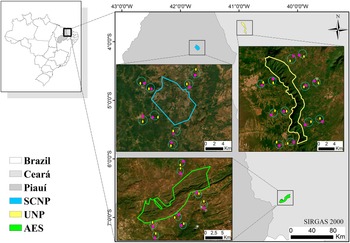
We built maps for each area (Figure 1). In each area, we delimited four transects (minimum distance of 3 km from each other, Figure 1), except in UNP, where we delimited three transects in the Relictual Humid Forest and three transects in Caatinga (Figure 1). For each transect, we delimited two circles outside of the protected area, with a radius of 1 km, to select the points within each radius (Figure 1). The circles served to delimit the area in which the points can be demarcated. In each transect, we selected two conserved area points and two agricultural area points, one of each category per circle (Figure 1). Each point had a minimum distance of 500 m from the other points in the same transect. Within the demarcated sampling radius, we used the statistical method of random stratification to select sampling points representing conserved vegetation and agricultural areas. Areas with conserved vegetation have a high density of plants, and areas with agricultural plantations were classified as agricultural areas.
Maps of each study area, with the points of conserved areas (yellow) and agricultural areas (pink) inside the circles. SCNP, Sete Cidades National Park; UNP, Ubajara National Park; AES, Aiuaba Ecological Station.

Mapping was done through supervised classification and then refined with the OpenLayers Plugin tool in QGIS, with Google satellite images. Supervised classification uses algorithms to classify the pixels of an image in order to represent the evaluated classes. We used the “random” function in Excel to randomly select the points for each class. We repeated this procedure for all classes and recorded geographic coordinates of the selected points in GPS for field location. We used QGIS v. 2.18.19 (QGIS Development Team, 2019; http://qgis.osgeo.org) for map production, classification and demarcation of points.
The agricultural areas in Caatinga and Cerrado were abandoned in the dry period, but they were irrigated in the Relictual Humid Forest. Therefore, we visited abandoned agricultural areas in Caatinga and Cerrado and cultivated areas in the Relictual Humid Forest during the dry season. All agricultural areas were cultivated in the rainy season. The crops in Caatinga and Cerrado were mostly maize, maize with beans and maize with cassava. In the Relictual Humid Forest, there was maize with beans in addition to cultivars (avocado, passion fruit, banana, tomato).
We carried out three expeditions (between 2018 and 2020) in each study area: two expeditions during the rainy season and the third one during the dry season (except in the SCNP surroundings, where we carried out three expeditions during the rainy season and another one during the dry season). We collected data during daytime (between 8 a.m. and 5 p.m.), spending 60 min at each point. In one of the expeditions in the rainy season, there were two collectors in one field and four in the others. In SCNP surroundings, there were four expeditions, two in the rainy season with two collectors and the others with four. The visual encounter survey (VES) was utilized as a sampling method (Crump & Scott Jr. Reference Crump, Scott, Heyer, Donnelly, Mcdiarmid, Hayek and Foster1994) to search for specimens of T. hispidus. In addition to the areas outside the conservation units, we collected some lizards in conserved areas within protected areas (SISBIO licenses No. 68031-1). After collected, the specimens were euthanized with a lethal injection of 2% lidocaine chloridate.
We necropsied the collected animals under a stereo microscope with a longitudinal incision in the anteroposterior axis for the collection of parasites. We examined the organs in the gastrointestinal tract, lungs, and abdominal cavity. All parasites found were collected, including encysted forms of Acanthocephala. We fixed the parasites in 70% ethyl alcohol and necropsied the fixed specimens of T. hispidus in 3.7% formaldehyde. Subsequently, we preserved the specimens in 70% ethyl alcohol and then deposited them in the herpetological collection of the Núcleo Regional de Ofiologia (NUROF) of the Federal University of Ceará.
For the identification of parasite species, we clarified nematodes and Acanthocephala with lactic acid, stained the cestodes and trematodes with hydrochloric carmine and diaphonized with eugenol. We prepared temporary slides with parasite specimens for observation under a microscope. For parasite identification we used the following literature: Rêgo & Ibáñez Reference Rêgo and Ibáñez1965; Vicente et al. Reference Vicente, Rodrigues, Gomes and Pinto1993; Gibson et al. Reference Gibson, Jones and Bray2002; Anderson et al. Reference Anderson, Chabaud and Willmon2009; Bursey et al. Reference Bursey, Rocha, Menezes, Ariani and Vrcibradic2010; Fernandes & Kohn Reference Fernandes and Kohn2014. We preserved the parasite specimens in 70% ethyl alcohol and then deposited them in the Parasitological Collection of Federal University of Ceará (CPUFC).
To analyze the abundance of helminths (number of individuals of a particular parasite in/on a single host regardless of whether or not the host was infected (Bush Reference Bush, Lafferty, Lotz and Shostak1997)) between conserved and agricultural areas, we used Negative Binomial Mixed Models (NBMM), using the study site, season (dry or rainy) and age (adult or juvenile) as a random factor and agricultural areas and conserved areas as fixed effects. We considered as adults specimens with SVL equal to or greater than 65 mm for females and equal to or greater than 68 mm for males (Ribeiro et al. Reference Ribeiro, Silva and Freire2012). Parasitism descriptors followed Bush et al. guidelines (Reference Bush, Lafferty, Lotz and Shostak1997). To assess the difference in prevalence between conserved and agricultural areas, we used z-tests. As we expected the prevalence of monoxenous species to be higher in agricultural areas and that of heteroxenous ones to be higher in conserved areas (i.e., a directional prediction), we used one-tailed tests.
Results and discussion
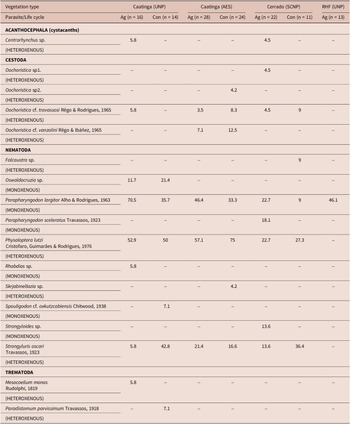
A total of 128 specimens of T. hispidus were analyzed, 79 in agricultural areas and 49 in conserved vegetation. We recorded a total of 17 helminth species, 12 species registered in agricultural areas (five monoxenous and seven heteroxenous), of which one was Acanthocephala (cystacanths), three were Cestoda, seven were Nematoda and one was Trematoda; and 11 in conserved areas (three monoxenous and eight heteroxenous), of which three were Cestoda, seven were Nematoda and one was Trematoda (Table 1). The species with the highest mean abundance (MA) and prevalence (PR) in conserved areas was the nematode Physaloptera lutzi Cristofaro, Guimarães & Rodrigues, 1976 (MA = 3.9; PR = 57%), followed by the nematode Strongyluris oscari Travassos, 1923 (MA = 2.5; PR = 28%), both heteroxenous. In agricultural areas it was the monoxenous nematode Parapharyngodon largitor Alho & Rodrigues, 1963 (MA = 2.12; PR = 45%), followed by the heteroxenous nematode P. lutzi (MA = 1.53; PR = 37.5%) (Table 1).
Parasite composition and their respective prevalence (%) registered in Tropidurus hispidus by disturbance level.

Ag, Agricultural areas; Con, Conserved vegetation; RHF, Relictual Humid Forest, UNP, Ubajara National Park; AES, Aiuaba Ecological Station; SCNP, Sete Cidades National Park.
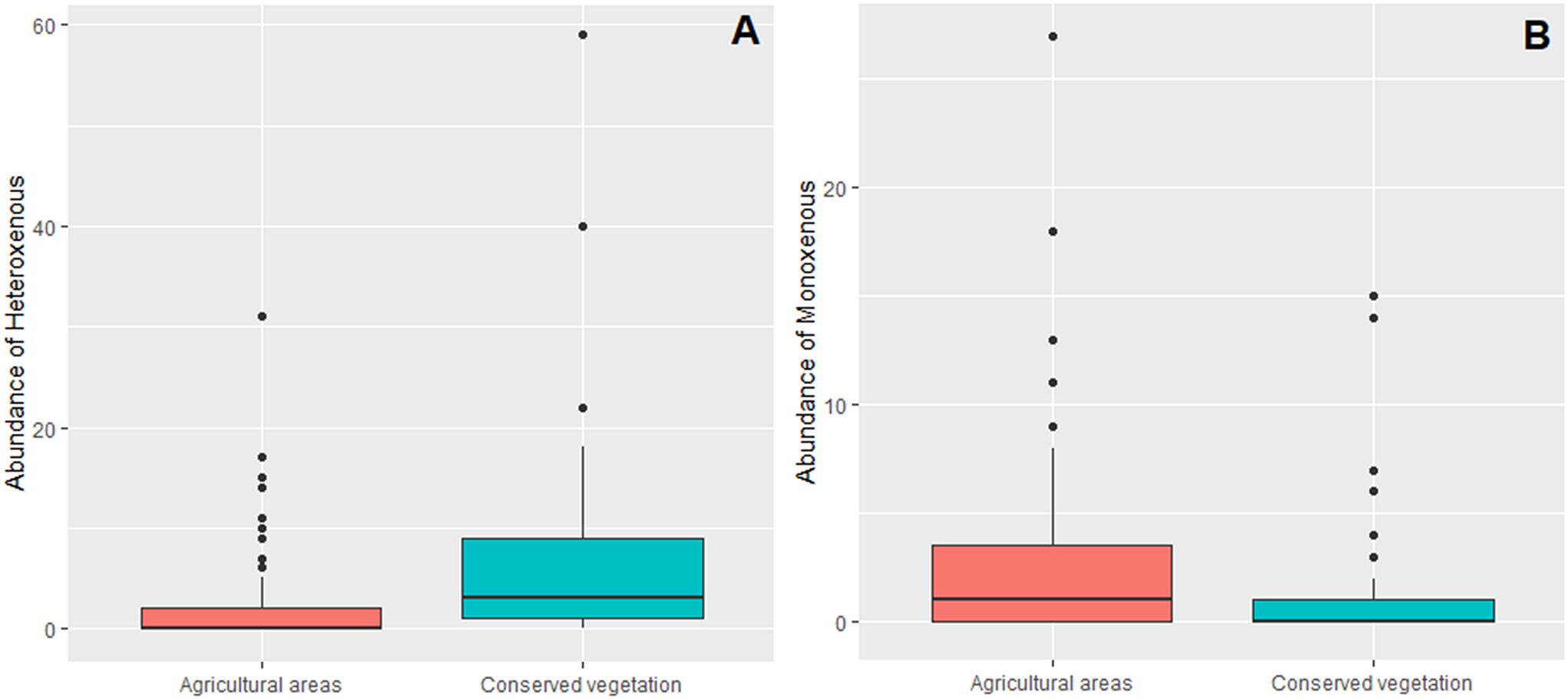
The general abundance of monoxenous species was higher in agricultural areas (2.65 ± 4.5) than in conserved areas (1.24 ± 3.5, Est = -0.66, z = -2.06, p = 0.03), while the general abundance of heteroxenous ones was greater in conserved areas (6.95 ± 10.7) than in agricultural ones (2.34 ± 4.8, Est = 1.09, z = 4.16, p < 0.001) (Figure 2). The general prevalence of monoxenous species was lower in conserved areas (31%) than in agricultural areas (52%) (X² = 4.8, p = 0.01). The general prevalence of heteroxenous species was higher in conserved areas (77%) than in agricultural areas (50%) (X² = 8.6, p = 0.001).
Differences in abundance of heteroxenous (A) and monoxenous (B) between agricultural areas and conserved vegetation.

The abundance and prevalence of monoxenous parasites were higher in agricultural areas, while those of heteroxenous parasites were higher in conserved areas. Differences in parasitism parameters in anthropized environments may be related to the parasite life cycle, quality of available resources, and aggregation and condition of hosts (revision in Becker et al. Reference Becker, Streicker and Altizer2015). In the literature, an increase in rates of parasitism by helminths with an intensification of disturbance is frequently identified (Mckenzie & Townsend Reference McKenzie and Townsend2007; Portela et al. Reference Portela, dos Santos and dos Anjos2020). However, when it is not considered that different species’ life cycles can be affected differently by anthropization, the effect on parasites can be masked.
Heteroxenous parasites that have lizards as definitive hosts are mainly obtained through diet (Anderson Reference Anderson2000), and the simplification of habitat through the conversion of natural vegetation into agricultural areas is among the factors that comprise the loss of biodiversity (e.g., Flores et al. Reference Flores, Zanette and Araujo2017; Rogan & Lacher Jr. Reference Rogan and Lacher2018). Associated with this, the use of pesticides is another factor related to the decrease of parasitism in agricultural areas (King et al. Reference King, McLaughlin, Gendron, Pauli, Giroux and Rondeau2007). Tropidurus hispidus predominantly consumes insects (Ribeiro & Freire Reference Ribeiro and Freire2011), so it is possible that the lower abundance of heteroxenous parasites in agricultural areas, beyond habitat simplification, is related to the decrease in the insect population. Since the consumption of insects in the diet of lizards can influence their helminth fauna composition (Silva et al. Reference Silva, Manoel, Uieda, Ávila and da Silva2019), it is possible that a change in the availability of resources could affect the consumption of intermediate hosts through the loss of species biodiversity (Marcogliese et al. Reference Marcogliese, King, Salo, Fournier, Brousseau and Spear2009; Becker et al. Reference Becker, Streicker and Altizer2015).
Evaluating how the arthropods that make up the diet are affected by land use intensification can help to better understand how heteroxenous parasites are affected by anthropization. Monoxenous parasites could be less affected by agriculture because they do not need an intermediate host for reproduction (King et al. Reference King, Mclaughlin, Boily and Marcogliese2010). Before generalizing patterns for different related taxa, it is also important to consider that responses to parasitism can be species-specific. For example, there was an increase in the parasite infection intensity (number of parasites in individuals having at least one parasite) in urban environments for the lizard Anolis sagrei Duméril & Bibron, 1837, but not for its congener, Anolis cristatellus Duméril & Bibron, 1837, thus demonstrating that these responses may be species-specific (Thawley et al. Reference Thawley, Moniz, Merritt, Battles, Michaelides and Kolbe2019). We must consider that, in addition to land use, characteristics of the environment can also influence the life history of species (Albuquerque et al. Reference Albuquerque, Protázio, Cavalcanti, Lopez and Mesquita2018). Therefore, analyses for each individual vegetation type of study are required to further understand these patterns.
Acknowledgments
We thank Instituto Chico Mendes de Conservação da Biodiversidade - ICMBio for the collect licenses (nº 72762, 29613 and 68031-1), as well as the managers and employees of the Aiuaba Ecological Station, Sete Cidades National Park and Ubajara National Park Protected Areas for their logistical support. We thank the UVA (CHUVA) and UFC (NUROF) herpetology laboratories members for supporting data collection.
Financial support
This work was supported by the Instituto Humanize (Data Collection and Processing), as well as Fundo Brasileiro para a Biodiversidade (FUNBIO), and in part by the Coordenação de Aperfeiçoamento de Pessoal de Nível Superior - Brasil (CAPES) - Finance Code 001 (Scholarship). CAPES, CNPq and Fundação Cearense de Apoio Científico e Tecnológico FUNCAP supported the project “Conservação da biodiversidade em nível de paisagem: mudanças climáticas e distúrbios antropogênicos” (CNPQ / ICMBIO / FAPs nº 18/2017 - process nº 421350 / 2017-2), which was responsible for financing the initial data collection.
Competing interest
None.
Author contribution
ACB and EFFC wrote the paper and collected data for the study. All authors read and approved the final manuscript.
Ethical standard
The authors declare that all procedures contributing to this work comply with the ethical standards of the relevant national and institutional committees on human experimentation, as well as with the Helsinki Declaration of 1975, as revised in 2008.