Externalizing behaviors in children and adolescents, including disruptive, delinquent, and aggressive behaviors, are highly common and can hinder functioning at home (Jonson-Reid, Reference Jonson-Reid2002), in academic settings (Metsäpelto et al., Reference Metsäpelto, Pakarinen, Kiuru, Poikkeus, Lerkkanen and Nurmi2015), and in the community (Moffitt, Reference Moffitt, Cicchetti and Cohen2006), leading to long-term psychosocial problems (Schaeffer & Borduin, Reference Schaeffer and Borduin2005). Although for many children externalizing problems begin during the preschool or school-age years, children are most at risk during the adolescent years, a developmental period characterized by significant biological and psychological changes that coincide with increased social challenges, during which earlier problems may intensify or new problems may emerge. National prevalence estimates suggest that as many as 35% to 45% of high school students report externalizing behaviors, such as physical fights and alcohol use (Centers for Disease Control and Prevention, 2007). Results of large longitudinal studies indicate a developmental perspective is needed to understand patterns of externalizing behavior development due to reciprocal associations between children's adaptation and their context (Bongers, Koot, van der Ende, & Verhulst, Reference Bongers, Koot, van der Ende and Verhulst2004); that is, children's behavior, including oppositional, disruptive, destructive, and aggression symptoms, influence how they interact with multiple ecological systems (i.e., family, school, and community), and these influences can in turn augment or decrease externalizing problems over time (Cicchetti & Rogosch, Reference Cicchetti and Rogosch2002). A developmental psychopathology perspective may be particularly useful to understand externalizing problems during early adolescence, allowing integration of multiple levels of analysis to capture the multilayered complexity of child functioning (Cicchetti, Reference Cicchetti1993).
Previous research has focused on trajectories of externalizing problems to capture changes in behavior problems over time and predict long-term outcomes (Nagin & Tremblay, Reference Nagin and Tremblay1999). A widely used model of youth externalizing behavior trajectories is Moffitt's (Reference Moffitt1993) developmental taxonomy of offending behavior, which consists of three groups: nonoffending, adolescent-limited (transitory increases in offending behavior during adolescence), and life-course persistent (early onset behavior problems that persist across development), which is associated with more adult delinquency, psychopathology, and violence in relationships (Broidy et al., Reference Broidy, Nagin, Tremblay, Bates, Brame, Dodge and Lynam2003). The model posits that individuals in the life-course persistent group have a biological predisposition to externalizing problems and encounter more early adversity (Moffitt, Reference Moffitt1993), leading to widespread deficits in social skills and behavioral regulation, which result in maladaptation at multiple developmental stages and in multiple domains (i.e., employment, romantic relationships, etc.). However, most studies that test this model have relied on theoretical guidelines to delineate categorical distinctions without empirical validation.
To address this limitation, studies increasingly use empirically based analytic strategies, such as group-based trajectory modeling, to illuminate longitudinal patterns of behavior. At least four studies have utilized this approach to understand trajectories of externalizing behavior from childhood to adolescence with large, normative, low-risk samples. Studies typically report three to six different trajectories, often including one group with chronically high externalizing problems and one group with low externalizing behaviors. Pepler, Jiang, Craig, and Connolly (Reference Pepler, Jiang, Craig and Connolly2010) used self-reports of delinquency (N = 746) and found five groups of youth: rare delinquency, low to moderate, early onset, late onset, and chronic high delinquency. In contrast, Latendresse et al. (Reference Latendresse, Bates, Goodnight, Lansford, Budde, Goate and Dick2011) obtained three trajectories (N = 378) using youth self-reports: stable high, decreasing moderate, and decreasing low. Bongers et al. (Reference Bongers, Koot, van der Ende and Verhulst2004; N = 2,074) identified trajectories for different types of symptoms, ranging from three groups for aggression, property, and status violations, to six groups for oppositional behaviors. Finally, Nagin and Tremblay (Reference Nagin and Tremblay1999) examined opposition and aggression independently in their sample of boys (N = 1,037) and found both types of symptoms could be captured by four trajectories: low, moderate desister, high desister, and high chronic.
Trajectories among normative samples may not represent the experience of children growing up in high-risk or adverse environments. However, only two studies have examined children from populations particularly at risk for externalizing problems. Both studies found five different trajectories, and results were fairly consistent, with low, high, increasing, and decreasing groups. Chung, Hawkins, Gilchrist, Hill, and Nagin (Reference Chung, Hawkins, Gilchrist, Hill and Nagin2002) documented five trajectories of externalizing behavior among a sample of low socioeconomic status (SES) youth (N = 432): chronic, escalator, desister, late onset, and nonoffender. Similarly, Tabone et al. (Reference Tabone, Guterman, Litrownik, Dubowitz, Isbell, English and Thompson2011) examined behavior problem trajectories among maltreated school-aged children (ages 4 to 10) and found five trajectories: low, low-medium, increasing, decreasing, and high-chronic groups. These studies address potent predictors of delinquency and involvement in the juvenile justice system: poverty and child maltreatment. However, one of the studies did not account for family violence (Chung et al., Reference Chung, Hawkins, Gilchrist, Hill and Nagin2002), one of the strongest predictors of externalizing problems (Graham-Bermann, Gruber, Howell, & Girz, Reference Graham-Bermann, Gruber, Howell and Girz2009), and the other did not encompass adolescence (Tabone et al., Reference Tabone, Guterman, Litrownik, Dubowitz, Isbell, English and Thompson2011), a developmental period in which delinquency and externalizing behaviors often escalate (Moffitt, Reference Moffitt1993). The present study seeks to replicate and extend the findings of these two studies, assessing a sample of youth characterized by low SES and high rates of maltreatment allegations throughout the adolescent period.
Ecological Model of Externalizing Behavior
Individual, family, peer/school, community, and cultural factors all shape the development of externalizing behavior (e.g., Miner & Clarke-Stewart, Reference Miner and Clarke-Stewart2008). Moreover, a developmental psychopathology perspective highlights the interactional nature of child adaptation; that is, different social–ecological levels have reciprocal associations with each other and with child behavior, influencing one another over time (Arnett, Reference Arnett1999; Cichetti & Rogosch, Reference Cicchetti and Rogosch2002). Specific to externalizing problems, child characteristics such as temperament influence family and peer responses (DeLisi & Vaughn, Reference DeLisi, Vaughn, Beaver and Walsh2016), and family and peer interactions, in turn, impact later aggression and delinquency (Niolon, Kuperminc, & Allen, Reference Niolon, Kuperminc and Allen2015). Moreover, during adolescence, youth are increasingly directly exposed to community or neighborhood factors, such as protective resources and violence (Ensminger, Lamkin, & Jacobson, Reference Ensminger, Lamkin and Jacobson1996), while the more proximal, peer and family settings continue to be influenced by the larger community characteristics (Margolin & Gordis, Reference Margolin and Gordis2000). Although clearly these different ecological levels do not exist in isolation, few studies have incorporated factors at multiple social–ecological levels as prospective predictors of externalizing longitudinal trajectories.
Previous studies evaluating longitudinal trajectories have identified predictors of chronic or increasing externalizing problems, including child factors, such as child developmental disability (Tabone et al., Reference Tabone, Guterman, Litrownik, Dubowitz, Isbell, English and Thompson2011) and alcohol use (Chung et al., Reference Chung, Hawkins, Gilchrist, Hill and Nagin2002); peer factors, such as peer antisocial behaviors (Chung et al., Reference Chung, Hawkins, Gilchrist, Hill and Nagin2002; Latandresse et al., 2010); family factors, such as caregiver alcoholism and depression (Tabone et al., Reference Tabone, Guterman, Litrownik, Dubowitz, Isbell, English and Thompson2011), family management, and conflict (Chung et al., Reference Chung, Hawkins, Gilchrist, Hill and Nagin2002); and neighborhood factors, such as community quality and mental health services (Tabone et al., 2010) and neighborhood availability of drugs (Chung et al., Reference Chung, Hawkins, Gilchrist, Hill and Nagin2002). However, no trajectory studies thus far have incorporated school-level factors or identified the protective factors that lead to decreases in externalizing behaviors, key for prevention and intervention efforts that remain unknown. The present study seeks to address some of these gaps by integrating multiple individual, family, school, and neighborhood risk and protective factors as predictors of different trajectories of externalizing behaviors among a sample of adolescents at risk for maltreatment.
Individual factors
Difficult temperament in early childhood is consistently linked to later externalizing behaviors (Tackett, Martel, & Kushner, Reference Tackett, Martel, Kushner, Marcel and Shiner2012), substance use (Horner, Reynolds, Braxter, Kirisci, & Tarter, Reference Horner, Reynolds, Braxter, Kirisci and Tarter2015), and delinquency (Walters, Reference Walters2014). Temperamental difficulty may reflect high negative affectivity and difficulties with emotion regulation, and can lead to later angry and uninhibited behaviors (Blair, Denham, Kochanoff, & Whipple, Reference Blair, Denham, Kochanoff and Whipple2004). In addition, child difficult temperament and externalizing behaviors may reduce socialization skills, which can enhance functioning for youth with stressful life experiences (Quamma, & Greenberg, Reference Quamma and Greenberg1994). Ethnic minority status may also serve as a risk factor; in a study of 5,935 youth ages 13–15, minority status youth were twice as likely to report engaging in violent aggression (e.g., attacked someone with a weapon) than their White counterparts (Peterson, Esbensen, Taylor, & Freng, Reference Peterson, Esbensen, Taylor and Freng2007). Racial disparities in aggression is often associated with poverty-, school-, and neighborhood-level characteristics faced by minority youth (Smokowski, Evans, Cotter, & Webber, Reference Smokowski, Evans, Cotter and Webber2013). In addition, males are more likely than females to engage in physically aggressive behavior both in childhood (Baillargeon et al., 2013) and in adolescence (Zimmerman & Messner, Reference Zimmerman and Messner2010). However, rates of relational aggression are higher among female adolescents (Crapanzo, Frick, & Terranova, Reference Crapanzano, Frick and Terranova2010), and findings indicate relational aggression is a stronger predictor of social–psychological maladjustment than other forms of aggression (Marsee & Frick, Reference Marsee and Frick2007).
Family factors
The family environment is central to early development and continues to shape regulatory and coping processes during childhood and adolescence (Kobak, Ferenz-Gillies, Everhart, & Seabrook, Reference Kobak, Ferenz-Gillies, Everhart and Seabrook1994; Morris, Silk, Steinberg, Myers, & Robinson, Reference Morris, Silk, Steinberg, Myers and Robinson2007). Maltreatment from caregivers is a consistent and robust risk factor for later aggression (van der Put, Lanctôt, De Ruiter, & Van Vugt, Reference van der Put, Lanctôt, De Ruiter and Van Vugt2015) and socioemotional difficulties (Widom, Reference Widom, Corbin and Krugman2014). Early maltreatment, in particular, is found to predict children's externalizing behavior over time (Font & Berger, Reference Font and Berger2015). Similarly, severe forms of physical discipline are associated with increased child externalizing behavior (for a review, see Gershoff, Lansford, Sexton, Davis-Kean, & Sameroff, Reference Gershoff, Lansford, Sexton, Davis-Kean and Sameroff2012). Maltreatment and harsh discipline are often co-occurring with interparental violence, placing a child at disproportionate risk for externalizing behaviors (Martinez-Torteya, Bogat, von Eye, & Levendosky, Reference Martinez-Torteya, Bogat, von Eye and Levendosky2009) and violence in later dating relationships (Roberts, McLaughlin, Conron, & Koenen, Reference Roberts, McLaughlin, Conron and Koenen2011). These varying types of family violence/aggression may influence self-regulation and deprive the child models of effective, prosocial behavioral regulation and conflict resolution, increasing risk for disruptive, delinquent, and aggressive behaviors (Carlson, Reference Carlson2000).
In contrast, strong relationships with caregivers constitute a significant protective factor. The importance of father involvement in youth adjustment is well demonstrated in the literature; increased father involvement is associated with improved behavior regulation (Easterbrooks, Raskin, & McBrian, Reference Easterbrooks, Raskin and McBrian2014) and academic outcomes (Jeynes, Reference Jeynes2015), and reductions in externalizing behaviors (Kennedy, Betts, Dunn, Sonuga-Barke, & Underwood, Reference Kennedy, Betts, Dunn, Sonuga-Barke and Underwood2015). These associations may result from enhanced attachment security (Brown, McBride, Shin, & Bost, Reference Brown, McBride, Shin and Bost2007), interaction characteristics unique to father–child relationships, as paternal advice-giving content and style is predictive of a child's social competence above and beyond the mother's advice (McDowell, Parke, & Wang, Reference McDowell, Parke and Wang2003), and/or emotion regulation strategies that fathers convey either through modeling or direct teaching that youth may incorporate into their own self-regulation (Dubowitz et al., Reference Dubowitz, Black, Cox, Kerr, Litrownik, Radhakrishna and Runyan2001).
School and peer factors
Affiliation with a group of deviant peers is one of the most potent predictors of youth delinquent and antisocial behaviors (Barrera et al., Reference Barrera, Prelow, Dumka, Gonzales, Knight, Michaels and Tein2002), particularly during adolescence (Laird, Jordan, Dodge, Petit, & Bates, Reference Laird, Jordan, Dodge, Petit and Bates2001), as deviant peer relationships are less conducive to the development of nonaggressive social problem-solving skills and externalizing behavior is often reinforced by deviant peers (Capaldi, Dishion, Stoolmiller, & Yoerger, Reference Capaldi, Dishion, Stoolmiller and Yoerger2001). In contrast, perceived safety at school is associated with better socioemotional functioning (US Department of Education, National Center for Education Statistics, 1997) and fewer externalizing problems (Bowen & Bowen, Reference Bowen and Bowen1999), in part due to perceptions of school climate, discipline procedures and decreased likelihood of victimization (Brady, Winston, & Gockley, Reference Brady, Winston and Gockley2014).
Neighborhood factors
Neighborhood crime predicts increased youth externalizing problems, including conduct problems and antisocial behaviors (Manly, Oshri, Lynch, Herzog, & Wortel, Reference Manly, Oshri, Lynch, Herzog and Wortel2013), which may result from low levels of social connections and monitoring of collective socialization, criminogenic behavior, and norms, or “collective efficacy,” a construct associated with delinquency and conduct problems among children and adolescents (Simons, Simons, Conger, & Brody, Reference Simons, Simons, Conger and Brody2004).
Current Study
The current study examined externalizing behavior trajectories across ages 10–16 among a sample characterized by low SES and high maltreatment rates (Longitudinal Studies in Child Abuse and Neglect [LONGSCAN]). The study had two primary aims. First, to identify distinct subgroups of child externalizing behavior across early adolescence (ages 10–16), and second, to examine child-, family-, school/peers-, and neighborhood-level predictors of trajectory group membership. It was hypothesized that externalizing trajectories exist in the current sample and can be identified as distinct subgroups. It was also hypothesized that higher levels of baseline risk and fewer protective factors (assessed at age 10 years or earlier) would predict membership in groups with children exhibiting more severe or worsening externalizing behavior trajectories, and lower levels of risk and higher levels of protective factors would predict membership in low or improving trajectories. A longitudinal examination of externalizing behavior using multi-informant reports and a social–ecological perspective provides valuable insight into factors that contribute to the development of externalizing behavior over time.
Method
Participants
Data for the current study was drawn from LONGSCAN, a longitudinal multisite study including 1,077 children (544 boys, 533 girls) either at risk for or reported to Child Protective Services (CPS) for maltreatment (78.1% of children had one or more CPS reports for maltreatment; 51.7% of children had substantiated cases of maltreatment). Children and maternal caregivers were invited to in-person interviews at child age 4, and subsequent child, parent, and teacher measures were obtained at ages 6, 8, 10, 12, 14, 16, and 18. (For a complete description of study procedures and sample demographics, see http://www.unc.edu/depts/sph/longscan/.) For this study, we used data collected at ages 4, 8, 10, 12, 14, and 16. When children were 8, 69.5% of caregivers had a high school education or less (M = 11.92 years of education) and median family income was $15,000–20,000. Among child participants, ethnicities were 26.4% White, 54.6% African American, 7.5% Hispanic, 10.3% multiracial, and 1.2% other.
Measures
Externalizing behavior trajectories: Caregiver report, ages 10, 12, 14, and 16 years
The Child Behavioral Checklist for ages 6–18 (CBCL/6-18; Achenbach & Rescorla, Reference Achenbach and Rescorla2001) is a 113-item questionnaire that assesses maternal report of behavioral and emotional problems, which yield broadband internalizing and externalizing scales and eight subscales. Caregivers completed this measure at child ages 10, 12, 14, and 16 years. For the externalizing scores, the age-normed T scores (range = 30–100) were used. For the current sample, α = 0.91.
Predictors of trajectory membership
Most predictors were assessed when children were 8 years old to enhance prospective prediction of trajectories from ages 10 to 16. However, temperament during early childhood and peer deviance during adolescence were assessed at different time points due to increased saliency at specific developmental stages.
Child-level
Socialization skills: Caregiver report, child age 8 years
The Vineland Screener (Sparrow, Carter, & Cicchetti, Reference Sparrow, Carter and Cicchetti1993) is a 45-item measure administered in a semistructured interview with the child's primary caregiver. The socialization skills domain was used for the current analyses. In the current study, α = 0.81.
Difficult temperament: Caregiver report, child age 4 years
The Infant Characteristic Questionnaire (Bates, Freeland, & Lounsbury, Reference Bates, Freeland and Lounsbury1979) is composed of 24 items describing infant behavior. For the current analyses, the fussy/difficult subscale was used. This scale has been validated in community and clinical samples and demonstrates good internal consistency (Bates et al., Reference Bates, Freeland and Lounsbury1979). In the current study, α = 0.79.
Family-level
Maltreatment: Substantiated CPS reports from birth to age 10 years
CPS records were coded based on the Modified Maltreatment Classification System (English & LONGSCAN Investigators, Reference English1997) to determine type of maltreatment allegation and conclusion (substantiated, indicated, or unsubstantiated). A dichotomous substantiation variable (any allegation found vs. all allegations unsubstantiated) was used in analyses.
Father involvement: Caregiver report, child age 8 years
The Father Involvement With Child measure is a LONGSCAN-developed instrument designed to measure the extent and quality of father-figure involvement with the child as perceived by the primary caregiver. The caregiver rates the father's companionship, emotional support, physical care, and financial support. A Total Support score was obtained. In the current study, α = 0.76.
Severe physical discipline: Caregiver report, child age 8 years
The Discipline Methods Measure (Straus, Reference Straus1979) is a LONGSCAN-adapted version of the psychological aggression, minor assault, and severe assault scales of the Conflict Tactics Scales. A sum score was used for whether a caregiver has used various forms of physical discipline, including “Kick, bite, or hit him/her” and “Threaten with a knife or gun.” In the current study, α = 0.64.
Home violence: Child report, age 8 years
The home violence subscale of the Things I've Seen and Heard Scale (Richters & Martinez, Reference Richters and Martinez1992) was used for this variable. It is composed of six items, including “How many times have you heard grown-ups in your home yell at each other?” and “How many times have you seen a gun in your home?” For the home violence subscale in the current study α = 0.76.
School/peer level
School safety: Teacher report, child age 8 years
The School Safety Questionnaire is a LONGSCAN-adapted assessment of eight items assessing the amount of violence and antisocial behavior in the school environment. The teacher ranks the level of perceived safety in the school and the presence of serious discipline problems. In the current study, α = 0.86.
Deviant peers: Child report, age 12 years
The Risky Behavior of Family and Friends measure is a LONGSCAN-adapted measure of 27 items assessing the child's perception of the school behavior and performance of close friends and how many close friends use illegal substances and engage in risky behaviors, including drug carrying or sales, fighting, and weapon carrying. Age 12 reports were used (as opposed to 8) due to evidence that peer influences are particularly salient in early adolescence (Lam, McHale, & Crouter, Reference Lam, McHale and Crouter2014). For the current study, α = 0.91.
Neighborhood level
Neighborhood satisfaction: Caregiver report, age 8 years
The Neighborhood Short Form is a LONGSCAN-adapted measure of nine items assessing neighborhood quality. The caregiver ranks the perceived amount of social support, safety, and neighborhood pride/morale. For the current analyses, a total satisfaction score was used. For the current study, α = 0.87.
Community violence: Child report, age 8 years
For this variable, the community violence subscale of The Things I've Seen and Heard Scale (Richters & Martinez, Reference Richters and Martinez1992) was used, compose of 14 items, including “How many times have you seen someone being beat up?” and “How many times have you seen somebody pull a gun on another person?” For the community violence subscale in the current study, α = 0.64.
Results
Missing data
Patterns of missing data were assessed using Little's missing completely at random test (p > .05). To make full use of all available data, full information maximum likelihood estimation methods were used to produce unbiased parameter estimates and standard errors (Enders, Reference Enders2001).
Behavior trajectory groups
Growth-based trajectory modeling was conducted using the SAS PROC TRAJ procedure to approximate distinct subgroups of externalizing behavior among children at ages 10, 12, 14, and 16. Analyses included CBCL externalizing subscale scores. The growth-based trajectory modeling approach assumes the population is composed of a mixture of distinct groups; this allows individual-level heterogeneity to be expressed through group differences. The optimal number of groups in the data and the best explanatory shapes of trajectories (including linear, quadratic, and cubic functions) were determined based on Bayesian information criteria (BIC). BIC rewards parsimony and is also consistent in selecting the true model (Nagin & Tremblay, Reference Nagin and Tremblay1999). The censored normal distribution specification was used for modeling externalizing behavior, as CBCL scores are censored by a scale minimum and maximum. Finally, to assess the quality of the model's fit to the data, posterior probabilities were calculated to ensure each individual surpasses the minimum .7 threshold (Nagin, Reference Nagin2005).
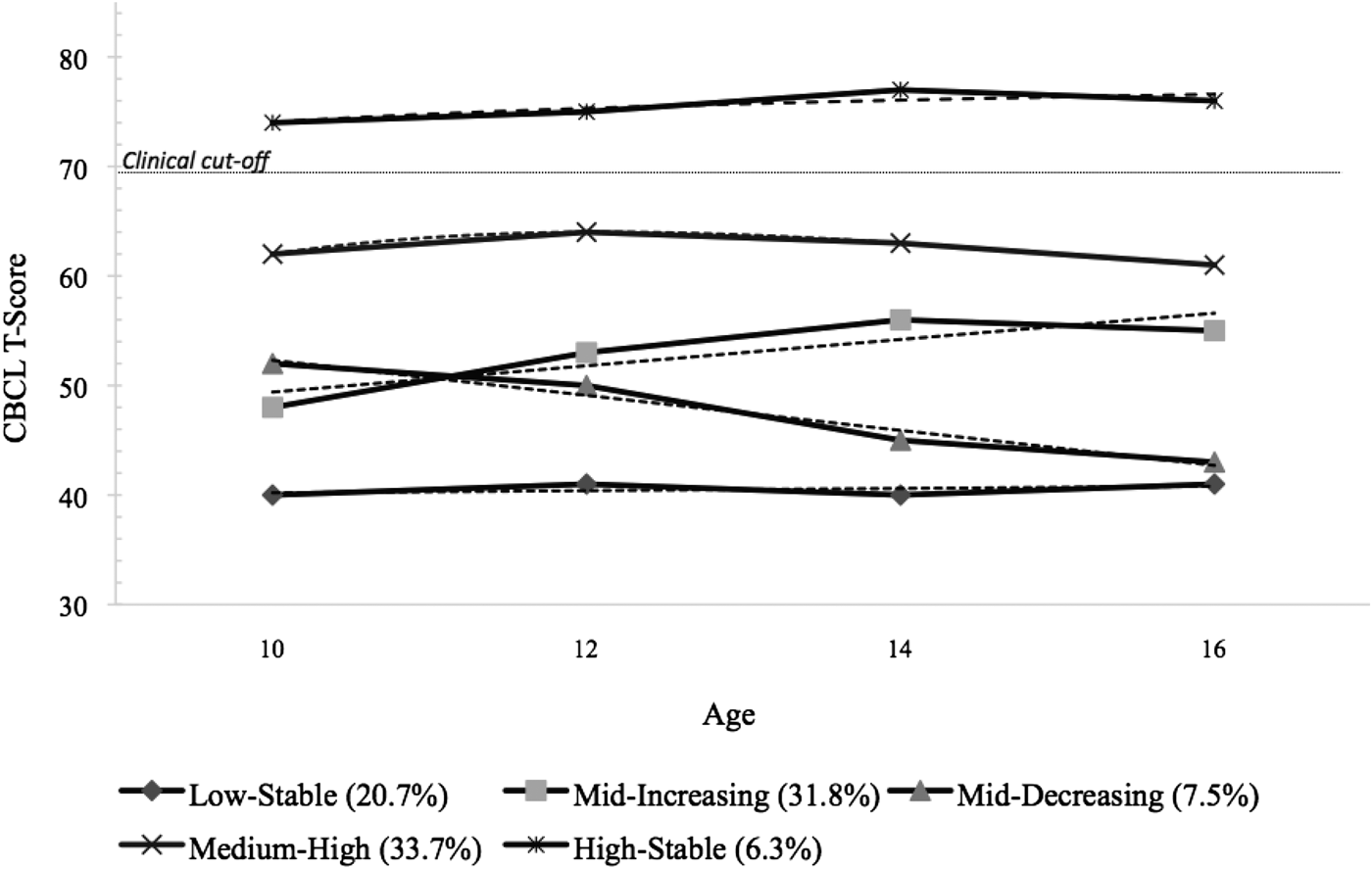
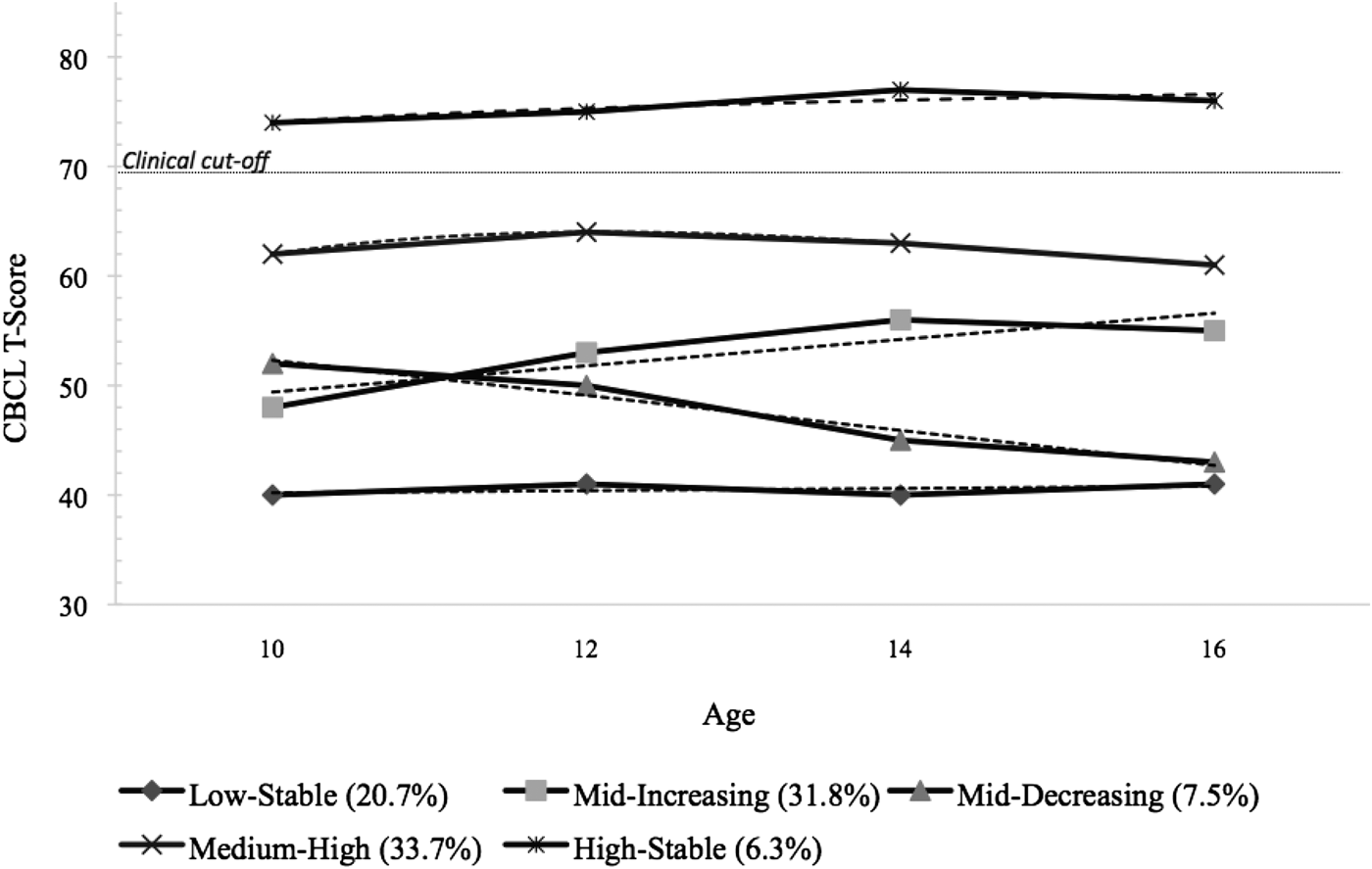
Model fit for externalizing behavior trajectories was selected using BIC estimates for one-group (–14,256.78), two-group (–13,653.10), three-group (–13,511.70), four-group (–13,443.46), five-group (–13,429.34), six-group (–13,418.16), and seven-group (–13,427.63) models. The six-group solution produced the smallest absolute BIC and Akaike information criteria values. One group in the six-group solution did not meet minimum sample size proportion requirements (<5%; Nagin, Reference Nagin2005), and was thus eliminated from further analyses. Final model selection consisted of three groups following linear trajectories and two groups following a quadratic function. The retained groups of externalizing behavior included low-stable (stable, low scores; n = 223), mid-increasing (increasing externalizing behavior; n = 342), mid-decreasing (decreasing externalizing behavior; n = 81), medium-high (stable, moderately elevated scores; n = 363), and high-stable (stable, elevated scores; n = 68), and are plotted in Figure 1. To examine gender differences, trajectory models were run separately for boys and girls. For both analyses, the six-group solution produced the best model fit (BIC boys = –13,426.19; girls = –13,429.21) with comparable trajectory shapes, and thus, the combined gender model is used in additional statistical analyses.
Externalizing behavior trajectories.
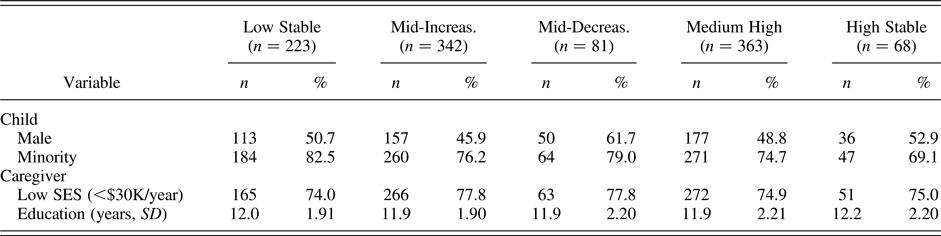
To examine demographic variations across trajectory groups, demographic characteristics for each trajectory are presented in Table 1. High rates of minority status (69.1%–82.5%) and low-SES status (74.0%–77.8%) were found across trajectory groups.
Demographic characteristics across trajectory groups

Note: SES, socioeconomic status.
Impact of risk and protective factors
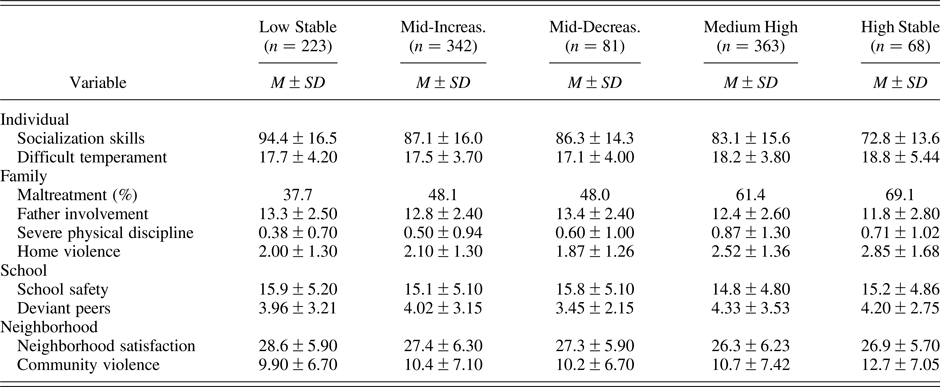
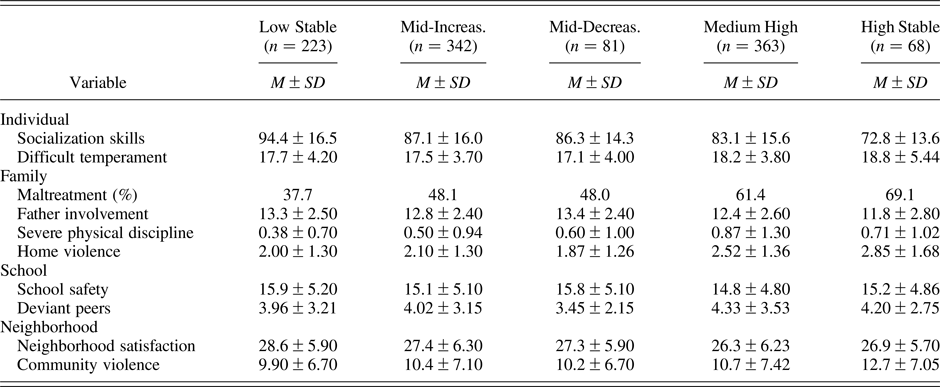
To assess the effects of the ecological factors on each trajectory group, a multinomial logistic regression with trajectory membership as the outcome was estimated with all individual, family, school/peer and neighborhood factors included as predictors and gender, ethnicity, and income at child age 8 years held constant as covariates. For means and standard deviations of all variables across trajectory groups, see Table 2.
Means and standard deviations of risk and protective factors across trajectory groups
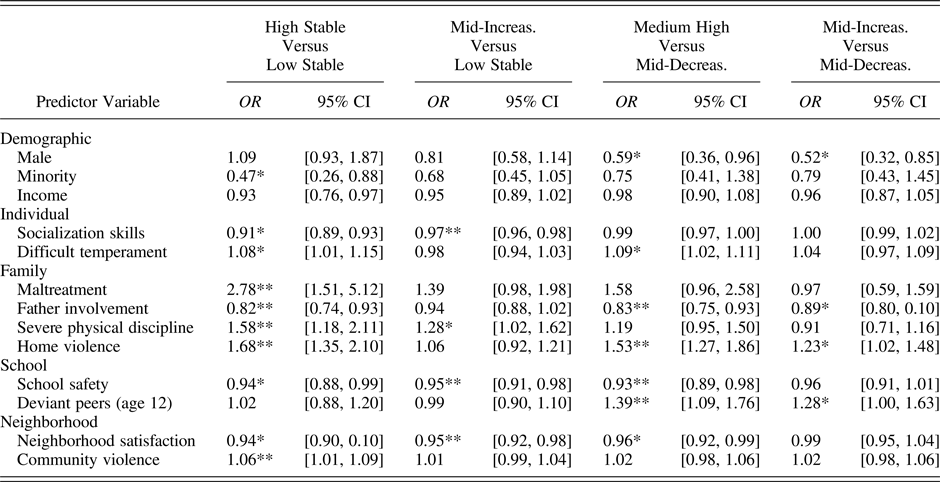
Analyses focused on four contrasts: high stable versus low stable, mid-increasing versus low stable, medium high versus mid-decreasing, and mid-increasing versus mid-decreasing. These contrasts were chosen to examine meaningful comparisons. The first contrast examined the trajectory with the least externalizing behaviors over time to the high stable trajectory to highlight factors that differentiate the least and most severe groups. Another contrast compares low stable and worsening trajectories; by examining trajectories with comparable baseline scores, risk and protective factors that differentiate behavior over the course of adolescence may be identified. Two contrasts compared the trajectory exhibiting improving externalizing behavior to the worsening trajectory and the trajectory with comparable baseline scores but stable externalizing behavior across adolescence to uncover factors that contribute to improvements in externalizing behavior over time. For regression results, see Table 3.
Multinomial logistic regressions for individual effect of ecological predictor variables on group membership
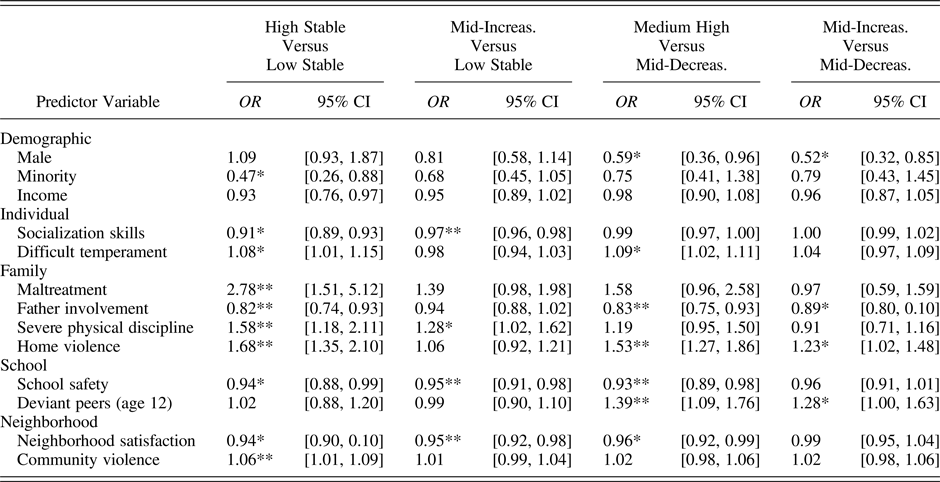
*p < .05. **p < .01.
Discussion
Externalizing trajectories
The current study found five distinct developmental trajectories of externalizing behavior from ages 10 to 16 among a sample of youth at risk for externalizing problems: low stable (n = 223), mid-increasing (n = 342), mid-decreasing (n = 81), medium high (n = 363), and high stable (n = 68). These results are consistent with the other two studies that have used trajectory modeling with youth at risk for externalizing problems (e.g., Chung et al., Reference Chung, Hawkins, Gilchrist, Hill and Nagin2002; Tabone et al., Reference Tabone, Guterman, Litrownik, Dubowitz, Isbell, English and Thompson2011) and suggest that models that classify children in two or three groups, based in theoretically driven or clinically derived criteria (e.g., Moffit, Reference Moffitt1993), may not provide an accurate representation of the experiences of at-risk children throughout adolescence. A substantial proportion of youth (71.8%) were classified in the high stable (6.3%), medium high (33.7%), and mid-increasing groups (31.8%), all groups with concerning levels of externalizing behaviors and likely functional impairment. This is strikingly high when compared to trajectory distributions found in community samples. For example, Reef, Diamantopoulou, van Meurs, Vehulst, and van der Ende, (Reference Reef, Diamantopoulou, van Meurs, Verhulst and van der Ende2010) found over 70% of their community sample in “near-zero” trajectories for aggression and property violations, and Korhonen et al. (Reference Korhonen, Luoma, Salmelin, Helminen, Kaltiala-Heino and Tamminen2014) found only 5% of their sample in the “moderate to high” trajectory for CBCL externalizing problems. This pattern is likely a reflection of examining a sample with low SES and high rates of maltreatment, a potent predictor of externalizing problems, and focusing on early adolescence, a developmental period concomitant with increases in externalizing behavior (Moffitt, Reference Moffitt1993).
The high-stable trajectory is consistent with the life-course persistent theory of antiscocial behavior (Moffitt, Reference Moffitt1993), representing a small subset of youth with severe, enduring externalizing behaviors across childhood and adolescent development. However, youth in the medium-high group also had a pattern of elevated externalizing symptoms that began by age 10 and did not remit throughout adolescence, emphasizing the stability of elevated (even if subthreshold) externalizing symptoms. The long-term negative outcomes associated with increases in externalizing problems highlight the importance of early intervention efforts with all children identified as at risk for high-stable or increasing externalizing problem trajectories; that is, about 40% of children in our sample are likely to benefit from prevention/treatment efforts that target externalizing problems, even though only a small subset of these present with the extreme elevations that are characteristic of the “life course” trajectory.
In contrast, the mid-decreasing group (7.5%) exhibited lessening maladaptive behaviors across adolescence. Together with the low-stable group (20.7%), these trajectories highlight stable or improving adaptive behavior in adolescence. Trajectory analyses of younger children have found higher proportions of decreasing externalizing behavior (e.g., about 30%; Korhonen et al., Reference Korhonen, Luoma, Salmelin, Helminen, Kaltiala-Heino and Tamminen2014), which further accentuates the notion of adolescents being particularly at risk. Identifying the factors that predict decreased or low-chronic externalizing behavior over time may highlight crucial protective factors to promote adaptive behavior.
Predictors of trajectory membership
Developmental risk factors
Difficult early temperament
Difficult early temperament predicted membership in the two high chronic externalizing behavior trajectories. This finding highlights the relative developmental stability of temperamental characteristics and the predictive ability of caregiver-reported early temperament on later outcomes. Although temperament is often considered a stable character trait, the implementation of differential parent discipline strategies may be effective in curtailing transactional patterns of difficult behavior and harsh parenting. Van Zeijl et al. (Reference van Zeijl, Mesman, Stolk, Alink, van IJzendoorn, Bakermans-Kranenburg and Koot2007) found children with difficult temperaments are more likely to exhibit externalizing behaviors in response to negative discipline (e.g., prohibition or giving in), and showed fewer externalizing problems with positive discipline (e.g., distraction or understanding), compared to children with relatively easy temperaments. Early identification of temperamental qualities and implementation of differential discipline strategies, specifically positive discipline, may interrupt cycles of parent–child interactions that contribute to externalizing behavior over time.
Maltreatment and severe physical discipline
The occurrence of early maltreatment significantly predicted chronic externalizing behaviors. These findings align with prior longitudinal studies of maltreatment predicting later externalizing behavior (e.g., Egeland, Yattes, Appleyard, & Van Dulmen, 2002). Egeland et al. (Reference Egeland, Yates, Appleyard and Van Dulmen2002) posit a developmental pathway model of early adverse experiences to later antisocial behavior, noting young children with harsh parenting experiences tend to develop attachment relationships characterized by limited comfort seeking, affective sharing, and a lack of trust (Lyons-Ruth & Jacobvitz, Reference Lyons-Ruth and Jacobvitz1999). Over time, these attachment dynamics extend and generalize into other adult and peer relationships, which leads to relational difficulties and consequent antisocial behavior. Accordingly, longitudinal examinations of harsh discipline strategies and externalizing behavior reveal bidirectional associations (e.g., Gershoff et al., Reference Gershoff, Lansford, Sexton, Davis-Kean and Sameroff2012), highlighting the need for family-level interventions aimed at increasing less severe discipline strategies to disrupt the negative cycle of harsh discipline and externalizing behavior. Illustratively, intervention efforts for maltreated youth targeting attachment and other relational dynamics demonstrate promising impact on later externalizing behavior (e.g., parent–child interaction therapy; Chaffin et al., Reference Chaffin, Silovsky, Funderburk, Valle, Brestan, Balachova and Bonner2004; child–parent psychotherapy; Lieberman, Ippen, & Van Horn, Reference Lieberman, Ippen and Van Horn2006).
Home violence
Witnessing interparental violence (IPV) predicted membership in the high-stable, medium-high, and mid-increasing trajectories. A substantial body of research has clearly established associations between exposure to violence in the home and externalizing behavior (for a review, see Holt, Buckley, & Whelan, Reference Holt, Buckley and Whelan2008). Some studies suggest 40%–60% of children with exposure to IPV exhibit clinical levels of emotional and/or behavioral problems (Wolfe, Crooks, Lee, McIntyre-Smith, & Jaffe, Reference Wolfe, Crooks, Chiodo and Jaffe2009), including aggression, as exposure to family violence may alter perceptions of appropriate conflict resolution strategies in interpersonal relationships, including an increased acceptance of violence as a justifiable conflict resolution strategy (O'Keefe, Reference O'Keefe1997). Child cognitive appraisals of IPV (e.g., perceived threat, self-blame, coping efficacy, etc.) is often found to mediate the association between IPV exposure and maladaptive outcomes, suggesting the child's perceptions of conflict directly impact internalizing and externalizing behavior (Fosco, DeBoard, & Grych, Reference Fosco, DeBoard and Grych2007), and these perceptions often vary with the quality of their relationship with their caregivers (Grych, Raynor, & Fosco, Reference Grych, Raynor and Fosco2004). Further, IPV exposure is directly associated with diminished quality of caregiver–child relationships, indicated by consistent findings of IPV preceding and/or co-occurring with various forms of child abuse (e.g., Madu, Idemudia, & Jegede, Reference Madu, Idemudia and Jegede2003). Intervention efforts strengthening the parent–child relationship may serve to impact child appraisals and curtail externalizing outcomes (e.g., parent–child interaction therapy; Eyberg, Reference Eyberg1988), as stronger attachment bonds in the context of IPV are linked to a reduced risk of antisocial behavior in adolescence (Sousa et al., Reference Sousa, Herrenkohl, Moylan, Tajima, Klika, Herrenkohl and Russo2011).
Deviant peers
Association with deviant peers, assessed at age 12, predicted membership in the medium-high and mid-increasing trajectories. For youth entering early adolescence with high levels of externalizing behavior, association with deviant peers sustained those behaviors across adolescence, and for those with low externalizing behavior at baseline, deviant peers increased externalizing behaviors. “Deviancy training,” or the reinforcement of antisocial behavior by deviant peers, is one mechanism in which deviant peers are thought to perpetuate externalizing behavior (Capaldi et al., Reference Capaldi, Dishion, Stoolmiller and Yoerger2001). Capaldi et al. (Reference Capaldi, Dishion, Stoolmiller and Yoerger2001) also note that antisocial youth often have more contentious and less satisfying peer relationships than their nondeviant peers, which serves as a poor context for obtaining prosocial skills (Patterson, Reid, & Dishion, Reference Patterson, Reid and Dishion1992). In turn, increasing association with nondeviant peers may be protective in reducing externalizing behaviors across adolescence (e.g., Fourth R Prevention Program; Wolfe et al., Reference Wolfe, Crooks, Chiodo and Jaffe2009).
Community violence
Exposure to community violence predicted membership in the high-stable trajectory. The association between community violence and externalizing problems is consistently demonstrated in cross-sectional and longitudinal studies (e.g., Gorman-Smith, Henry, & Tolan, Reference Gorman-Smith, Henry and Tolan2004). Exposure to community violence is linked to physiological hyperarousal that may increase aggression via a hostile attribution bias in benign situations (Dodge & Somberg, Reference Dodge and Somberg1987), and may result in a transactional cascade over time, where children with externalizing behaviors are more likely to engage in situations that increase exposure to community violence (Lynch & Cicchetti, Reference Lynch and Cicchetti1998). Treatment modalities that encompass community-level violence factors demonstrate long-term reductions in externalizing behaviors, such as multisystemic therapy (Borduin & Henggeler, Reference Borduin, Henggeler, McMahon and Peters1990), with findings of reduced rates of arrest and recidivism up to 15 years later (Schaeffer & Borduin, Reference Schaeffer and Borduin2005).
Developmental protective factors
Socialization skills
Socialization skills predicted membership in the low-stable group. Studies suggest a bidirectional association between socialization skills and externalizing behavior over time (e.g., Skalická, Stenseng, & Wichstrøm, Reference Skalická, Stenseng and Wichstrøm2015), such that early social exclusion fosters negative emotions and use of strategies to reinstate social inclusion that interfere with emotional and behavioral regulation capacities (Baumeister, Bratslavsky, Muraven, & Tice, Reference Baumeister, Bratslavsky, Muraven and Tice1998) with growing evidence that early externalizing behavior predicts later deficits in socialization skills. Stenseng, Belsky, Skalicka, and Wichstrøm (Reference Stenseng, Belsky, Skalicka and Wichstrøm2014) posit that early externalizing behavior may result in peer rejection that reduces opportunities to learn and practice appropriate social and conflict resolution skills. Interventions targeting social skill deficits have demonstrated effectiveness in reducing later externalizing behavior, as evidenced by several meta-analyses (e.g., Ang & Hughes, Reference Ang and Hughes2001; for a review of meta-analyses, see Gresham, Cook, Crews, & Kern, Reference Gresham, Cook, Crews and Kern2004).
Father involvement
Father involvement predicted group membership in the low-stable and mid-decreasing trajectories. The protective impact of father involvement may be similar to the role of maternal caregivers (such as increased emotional support; Cabrera, Tamis-LeMonda, Bradley, Hofferth, & Lamb, Reference Cabrera, Tamis-LeMonda, Bradley, Hofferth and Lamb2000), and distinct, as shown by findings of increased likelihood of fathers to encourage their children to be competitive and independent and to engage their children in playful and physically stimulating interactions (DeKlyen, Speltz, & Greenberg, Reference DeKlyen, Speltz and Greenberg1998). Empirical findings support the protective value of father involvement against psychological maladjustment in adolescents (Flouri & Buchanan, Reference Flouri and Buchanan2003), and is linked to increased social competence (Yongman, Kindlon, & Earls, Reference Yongman, Kindlon and Earls1995). Further, treatment efforts with aims to increase father involvement demonstrate improvements in family environments, father–child relationships, and later developmental outcomes (e.g., Bagner & Eyberg, Reference Bagner and Eyberg2003).
School safety
School safety predicted membership in the low-stable and mid-decreasing trajectories. In the school climate literature, school safety refers to overlapping domains of emotional, social, intellectual, and physical safety (Thapa, Cohen, Guffey, & Higgins-D'Alessandro, Reference Thapa, Cohen, Guffey and Higgins-D'Alessandro2013), and is consistently linked to student learning and prosocial behavior (Devine & Cohen, Reference Devine and Cohen2007). A growing body of research supports the notion that externalizing behavior may be a response to structurally embedded dynamics within the academic setting (Brady et al., Reference Brady, Winston and Gockley2014), particularly, a school's strategies and consistency in managing misbehavior. For example, in schools with consistent discipline enforcement, students report less victimization and increased perceptions of school safety and comfort in seeking help (e.g., Gregory, Skiba, & Noguera, Reference Gregory, Skiba and Noguera2010). Thus, over time, inconsistent and ineffective discipline strategies may allow for, or perpetuate, increased victimization and antisocial behavior in schools. Fortunately, recent reviews of effective school discipline procedure implementations highlight strides toward improving perceptions of school safety and reducing externalizing behavior in schools (e.g., Gregory & Cornell, Reference Gregory and Cornell2009; Osher, Bear, Sprague, & Doyle, Reference Osher, Bear, Sprague and Doyle2010).
Neighborhood satisfaction
Neighborhood satisfaction predicted membership in the low-stable and mid-decreasing trajectories. Neighborhood quality may affect youth's externalizing behavior directly through experiences with adults and peers outside of the home, as “more advantaged neighborhoods may provide better health and social resources—such as quality health services, schools, and housing, as well as youth programs, parks, and sport facilities—than poor neighborhoods” (Leventhal & Brooks-Gunn, Reference Leventhal and Brooks-Gunn2003) or indirectly through influences on the family environment (for a review, see Leventhal & Brooks-Gunn, Reference Leventhal and Brooks-Gunn2000). For example, Plybon and Kliewer (Reference Plybon and Kliewer2001) found that family stress mediated the association between neighborhood quality and behavior problems, and family cohesion moderated the association between neighborhood quality and child behavior problems.
Minority status
Racial minority status predicted membership in the low-stable trajectory relative to the high-stable trajectory. These findings run counter to prior findings of elevated rates of externalizing behavior among minority youth compared to their White counterparts (Peterson et al., Reference Peterson, Esbensen, Taylor and Freng2007). It is important to consider variations in caregiver reporting of externalizing behavior, as previous findings indicate European American caregivers are more likely to endorse mental health problems for their children (Roberts, Alegría, Roberts, & Chen, Reference Roberts, Alegría, Roberts and Chen2005). Alternatively, these findings urge further exploration of domain-specific resiliency in at-risk, minority youth (Martinez-Torteya, Miller-Graff, Howell, & Figge, 2016).
Gender
Male gender predicted membership in the mid-decreasing trajectory, suggesting externalizing behaviors in this sample of males tended to decrease over the course of adolescence, relative to females. Similar to ethnicity, these findings run counter to previous findings of generally elevated externalizing behavior in male populations (e.g., Beyers, Bates, Pettit, & Dodge, Reference Beyers, Bates, Pettit and Dodge2003), but align with prior trajectory findings specific to mother-reported externalizing behavior for males (Miner & Clarke-Stewart, Reference Miner and Clarke-Stewart2008). Current findings warrant examination of males’ relative sensitivity to the impact of protective factors that become more salient during adolescence (e.g., peers or community mentors) and reduce externalizing behavior over time. As an example, Ensminger et al. (Reference Ensminger, Lamkin and Jacobson1996) found males are particularly influenced by neighborhood-level resources, such as engagement in extracurricular activities.
Limitations and future directions
The trajectories identified in the current study may not generalize to other, not at risk, samples of children. Although the prospective design of this study is a strength, one limitation is we mostly used baseline (age 8) variables to predict trajectory membership, which does not capture changes in an adolescent's social ecology over time. The current approach highlights the predictive power of early experiences; however, future studies should aim to better capture an adolescent's evolving ecological environment. Further examinations of the interaction between risk and protective factors at different levels of the social ecology is warranted, including the interactive effect of genetic correlates and behavioral outcomes (e.g., Gene × Environment interactions), particularly within the scope of a developmental psychopathology framework. Youth experience a combination of risk and protective factors that are not independent but instead are in constant transaction, and moderation analyses may provide a more accurate representation of youth's experiences over time. This study notes the importance of multiple informants across ecological levels, and includes measures completed by youth, caregivers, and teachers. However, the majority of measures in this study were completed by caregivers (6 out of 10), and the large majority of LONGSCAN caregiver measures were completed by the maternal caregiver. Prior findings illuminate notable discrepancies in maternal-reported child symptomatology compared to teachers and youth, and that mothers may report “distorted” levels of child functioning for a variety of reasons (Briggs-Gowan, Carter, & Schwab-Stone, Reference Briggs-Gowan, Carter and Schwab-Stone1996). Further examinations that encompass greater variation in reporters is warranted to better capture functioning across ecological domains.
Conclusion
The current study suggests that chronically high, chronically low, improving, and worsening trajectories of externalizing problems can be identified from preadolescence to adolescence among a high-risk sample of youth. Our study also examined risk and protective factors at the individual, family, neighborhood, and school/peer levels, and findings suggest adolescent externalizing trajectories are best understood using a social–ecological framework. Predictors of decreasing externalizing problems can inform interventions to curtail externalizing behavior, incorporating strategies to promote socialization skills, father involvement, school safety, and neighborhood satisfaction. The predictors identified in this study highlight the complex and layered domains that influence externalizing behaviors, and outline specific directions for future research and clinical intervention.