


Introduction
Efficient supervision as part of training is an important factor for dissemination and implementation of evidence-based treatments (EBT) into clinical practice (Edmunds et al., Reference Edmunds, Beidas and Kendall2013; Fixsen et al., Reference Fixsen, Naoom, Blase, Friedman and Wallace2005). Motivational interviewing (MI) has been demonstrated as a clinically effective EBT and has been implemented in a number of different clinical and healthcare settings (Miller and Moyers, Reference Miller and Moyers2017). The client-centred and directional therapeutic method for strengthening clients’ motivation and commitment to change requires careful training to achieve sustained practice change (Miller and Rollnick, Reference Miller and Rollnick2013). However, prior research shows that training formats that include supervision are more likely to enhance skills than the most common form of MI training (i.e. a 2-day workshop) (Barwick et al., Reference Barwick, Bennett, Johnson, McGowan and Moore2012; de Roten et al., Reference de Roten, Zimmermann, Ortega and Despland2013; Madson et al., Reference Madson, Loignon and Lane2009; Schwalbe et al., Reference Schwalbe, Oh and Zweben2014).
Clinical supervision
Although clinical supervision is widely recognized as important for professional development and to ensure client outcomes, less is known about the impact of supervision on both clinical practice and client outcome (Bambling et al., Reference Bambling, King, Raue, Schweitzer and Lambert2006). However, research has shown that supervision can be beneficial for the supervisee’s self-awareness, skills, self-efficacy, theoretical orientation, and for the supervisee–client relationship (Watkins, Reference Watkins2011; Wheeler and Richards, Reference Wheeler and Richards2007). There is also growing evidence for the association between supervision and better outcomes for both clinicians and their clients (Rakovshik et al., Reference Rakovshik, McManus, Vazquez-Montes, Muse and Ougrin2016). However, the sparse previous studies on the effect on therapist behaviour and client outcome shows ambiguous results (Simpson-Southward et al., Reference Simpson-Southward, Waller and Hardy2016; Zarbock et al., Reference Zarbock, Drews, Bodansky and Dahme2009), and the methodological shortcomings of this research make it difficult to identify the specific supervision features that constitute best practices (Bearman et al., Reference Bearman, Schneiderman and Zoloth2017). In recent years, there has been an increased focus on ensuring supervisor competence and effective supervision practice in both evidence-based clinical supervision (Milne and Reiser, Reference Milne and Reiser2012) and competency-based supervision (Falender and Shafranske, Reference Falender and Shafranske2007). Both these supervision practices share a few core components: articulations of supervision goals, feedback on both adherence and skills based on monitoring of sessions, individualized coaching/training including active learning (e.g. structured performance feedback, reflection, and behavioural rehearsal/role-play), and evaluation of targeted supervision competencies. Despite this increased attention to supervision as part of training programmes for practitioners, many questions remain regarding the included strategies for a successful transfer into clinical settings (Edmunds et al., Reference Edmunds, Beidas and Kendall2013).
Systematic feedback
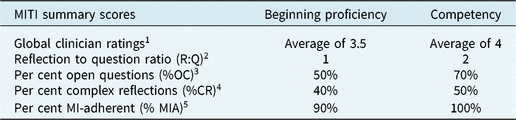
Performance-related feedback is perceived as an important part of clinical supervision and has demonstrated slight but possibly essential improvements in clinical practice (Ivers et al., Reference Ivers, Jamtvedt, Flottorp, Young, Odgaard-Jensen, French and Oxman2012). Feedback typically contains evaluation of a supervisee’s skills and adherence (Parsons et al., Reference Parsons, Rollyson and Reid2012). Feedback based on monitoring of sessions often also informs the supervisees how well they performed relative to a standard level, allows for the supervisor to direct the supervisee’s attention to specific behaviours, and may also aid the supervisee to self-assess more accurately (Parsons et al., Reference Parsons, Rollyson and Reid2012). The Motivational Interviewing Treatment Integrity (MITI) Code is a coding system with acceptable psychometric properties (Moyers et al., Reference Moyers, Martin, Manuel, Hendrickson and Miller2005), intended to be used as a treatment integrity measure in clinical trials of MI, and for providing structured feedback to practitioners in non-research settings. MITI 3.1 (Moyers et al., Reference Moyers, Martin, Manuel, Miller and Ernst2010) has two components: (1) the behaviour counts (i.e. giving information, MI adherent behaviours, MI non-adherent behaviours, closed questions, open questions, simple reflections and complex reflections), and (2) the global scores, which capture the overall impression of the session in five different dimensions (i.e. empathy, evocation, collaboration, autonomy and direction) on a Likert-type scale from 1 to 5. MITI also specifies proficiency and competency thresholds for practitioners (Table 1). When used as a feedback tool, the MITI provides a comprehensive picture of MI skills to the supervisee, with the primary purpose of supporting the acquisition of skills. However, in a recent semi-structured interview with ten MI supervisors using the MITI for objective feedback (Beckman et al., Reference Beckman, Bohman, Forsberg, Rasmussen and Ghaderi2017a), 50% of the supervisors reported that the MITI feedback, and in particular the global dimensions, may have induced negative emotions among the supervisees that hindered their learning. The supervisors perceived the behaviour frequency counts as being more objective and less judgemental, and argued that especially supervisees with longer work experience had difficulties handling the global scores on the lower side. This viewpoint is consistent with earlier research which suggests that supervisees may fear negative feedback (Abernethy and Cook, Reference Abernethy and Cook2011; Bernard and Goodyear, Reference Bernard and Goodyear2014; Clarke and Giordano, Reference Clarke and Giordano2013; Ellis et al., Reference Ellis, Hutman and Chapin2015; Friedberg et al., Reference Friedberg, Gorman and Beidel2009; Lombardo et al., Reference Lombardo, Milne and Procter2009), and that supervisors often feel critical and worry that their feedback may harm the supervisory working alliance (Chur-Hansen and McLean, Reference Chur-Hansen and McLean2006). Self-reported data even suggests that supervisors sometimes withhold corrective feedback and/or give higher ratings to avoid negative reactions or harming the supervisory relationship (Turner et al., Reference Turner, Fischer and Luiselli2016). High levels of supervisee anxiety have been proposed to cause defensiveness, reduce readiness to reveal information, cause supervisor–supervisee role conflicts, and decrease supervisee clinical performance (Ellis et al., Reference Ellis, Hutman and Chapin2015). Findings from the science of learning have also suggested that aspects of emotions could be important to consider (La Rochelle et al., Reference La Rochelle, Durning, Pangaro, Artino, van der Vleuten and Schuwirth2011), and emotions have thus gained increased attention in recent years’ medical education research (Young et al., Reference Young, Van Merrienboer, Durning and Ten Cate2014). Emotions affect both the attention to information and how memory is stored and retrieved (Gooding et al., Reference Gooding, Mann and Armstrong2017): positive emotions during learning are linked to deeper cognitive processing and improved learning, while negative emotions are linked to more superficial cognitive processing and impeded learning (Young et al., Reference Young, Van Merrienboer, Durning and Ten Cate2014). However, other findings from the supervision field propose that the usual assumption of recordings of sessions as overburdening is a misconception, and that supervisees often quickly adapt to recordings of sessions and can handle corrective feedback, especially within a positive supervisory working alliance (Ellis, Reference Ellis2010; Ladany et al., Reference Ladany, Mori and Mehr2013). Some researchers even suggest that providing both positive and corrective feedback enhances the supervisory relationship and increases the supervisor’s satisfaction with their role (Chur-Hansen and McLean, Reference Chur-Hansen and McLean2006).
The aim of this study was to evaluate how two different types of objective feedback (i.e. based on only the behaviour counts part of the MITI, or based on both the five global dimensions and the behaviour counts of the MITI) provided during six sessions of MI supervision affect the supervisory relationship, potential feelings of discomfort/distress provoked by the supervision sessions, and the supervisees’ MI skill acquisition.
Recommended MITI beginning proficiency and competency thresholds

MITI, Motivational Interviewing Treatment Integrity Code. 1(Empathy + Evocation + Collaboration + Autonomy)/4. 2(Simple + Complex reflections)/(Open + Closed questions). 3Open questions/(Open + Closed questions). 4Complex reflections/(Simple + Complex reflections). 5MI Adherent behaviours/(MI adherent + MI non-adherent behaviours).
Method
Data were obtained from a Swedish MI dissemination study conducted in five county councils across Sweden (ClinicalTrials.gov: NCT01197027). In the original study, a total of 174 self-selected practitioners were randomized to either regular county council MI training or regular county council MI training with six sessions of subsequent supervision. All the MI training increased the participants’ MI skills to about the same level, but the group that received subsequent supervision had gained more MI skills at follow-up (Beckman et al., Reference Beckman, Forsberg, Lindqvist, Diez, Eno Persson and Ghaderi2017b). Analyses also showed generally preserved MI proficiency levels for all participants at follow-up, but the majority did not reach the beginning proficiency levels at either the post-workshop or at the follow-up assessment (Beckman et al., Reference Beckman, Forsberg, Lindqvist, Diez, Eno Persson and Ghaderi2017b).
Participants
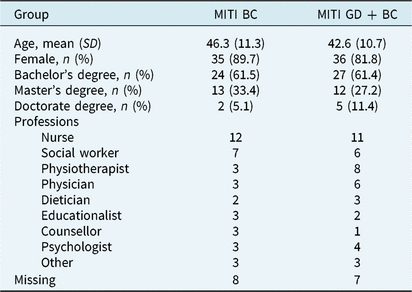
The sample consisted of the 98 participants from the dissemination study randomized to receive MI supervision. All participants participated in MI workshop trainings in five Swedish county councils from January 2013 to September 2014. The mean age was 44.3 years (SD = 11.1), and 85.5% were female (n = 71). The education level varied from bachelor’s degree (n = 51, 61.4%) to master’s degree (n = 25, 30.2%) and doctorate degree (n = 7, 8.4%), and the participants came from a variety of professions (Table 2).
Demographic characteristics of the two groups

MITI BC, supervision including systematic feedback based on only the behaviour counts part of the MITI; MITI GD + BC, supervision including systematic feedback based on both the five global dimensions and the behaviour counts; SD, standard deviation.
Procedure
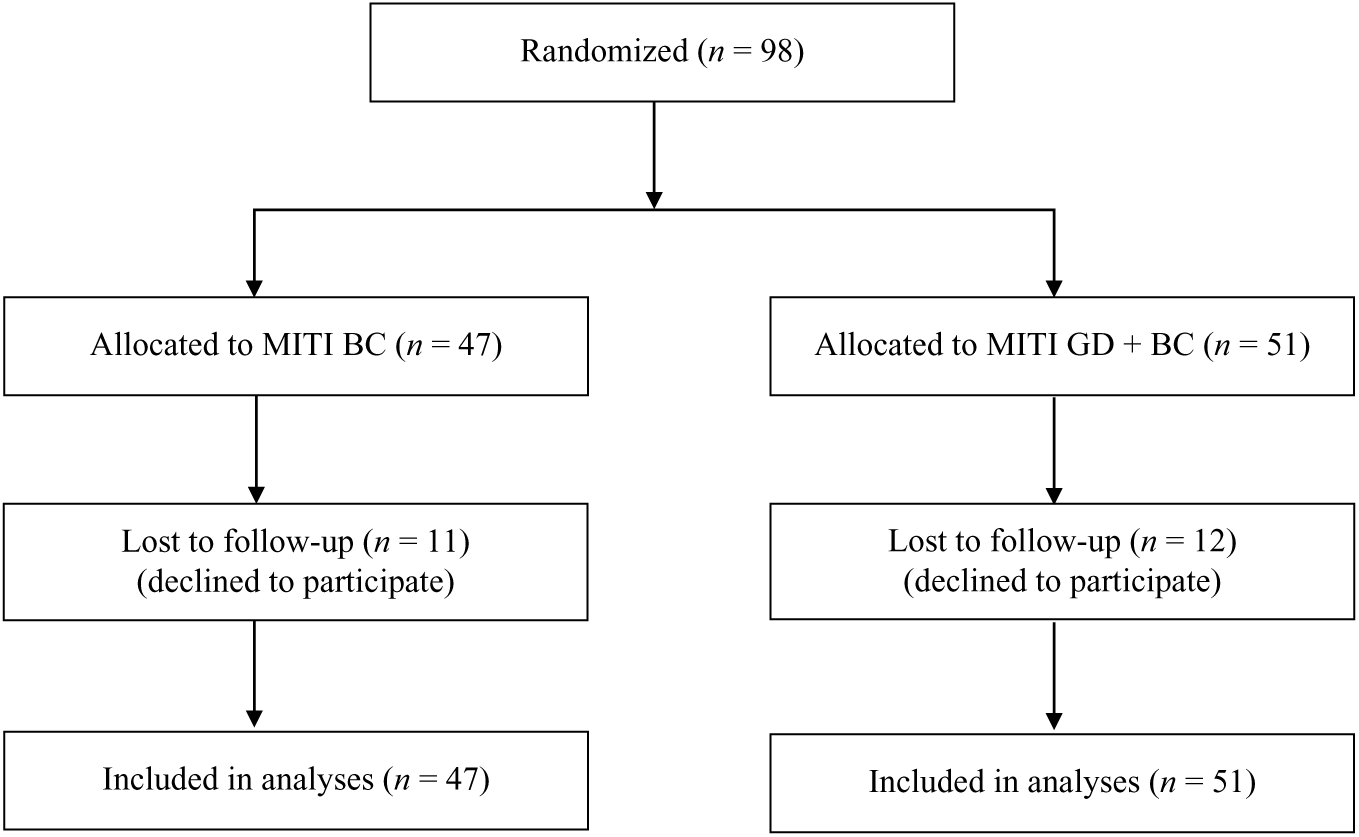
Written informed consent was obtained from all participants before they enrolled (the Regional Ethical Review Board in Stockholm, Sweden; 2012/2195-31/5). The participants were then randomized to one of two groups (see Fig. 1): (1) supervision including systematic feedback based on only the behaviour counts part of the MITI (MITI BC), or (2) supervision including systematic feedback based on both the five global dimensions and the behaviour counts of the MITI (MITI GD + BC). The randomization procedure was conducted across all participants, and are described in detail elsewhere (Beckman et al., Reference Beckman, Forsberg, Lindqvist, Diez, Eno Persson and Ghaderi2017b). The participants recorded seven 20-minute telephone sessions with actors playing standardized clients: the first one after the MI training (baseline), and the following with monthly intervals. The supervision sessions followed after sessions 1 to 6. Before all recordings, the participants were sent information regarding the role-played client and a specified session target behaviour by email. The standardized clients were based on the lifestyle habits in The Swedish National Guidelines for Methods of Preventing Disease (socialstyrelsen.se/nationalguidelines): hazardous use of alcohol, insufficient physical activity, unhealthy eating habits, and tobacco use.
Flow diagram. MITI BC = supervision including systematic feedback based on only the behavior counts part of the MITI; MITI GD + BC = supervision including systematic feedback based on both the five global dimensions and the behaviour counts of the MITI.

Telephone supervision
The study’s six monthly sessions of individual telephone supervision were all 30 minutes long and performed by twelve coders trained in the manual based MI supervision at the Motivational Interviewing Quality Assurance (MIQA) group at Karolinska institutet in Sweden. The primary purpose of the sessions was further development of MI skills. The MITI BC group received their systematic feedback based on only the behaviour counts part of the MITI. In these sessions, the supervisor could speak in general terms about the global dimensions (e.g. state that the supervisee had a relatively large proportion of complex reflections which could affect the global variable empathy). However, the global scores had been removed from the protocol, and the supervisor did not talk about the supervisee’s individual global scores in these sessions. The MITI GD + BC group received feedback based on the results of both the five global dimensions and the behaviour counts. Ten minutes before the sessions, the coder emailed the protocol to the participant. All sessions were manual-based (please see ‘Supplementary material’), and are described in detail elsewhere (Beckman et al., Reference Beckman, Forsberg, Lindqvist, Diez, Eno Persson and Ghaderi2017b).
Assessment
Participant’s demographics (Table 2) were collected with a self-report questionnaire. The Swedish version of the MITI, version 3.1.1 (Forsberg et al., Reference Forsberg, Forsberg, Forsberg, van Loo and Rönnqvist2011) was used for assessing the recordings for MI proficiency. The twelve coders had all received 120 hours of initial coding training and participated in weekly group-codings to maintain high inter-rater reliability. The coders were not blinded for group allocation. To measure the supervisory relationship, an adapted version of the short Working Alliance Inventory (WAI-S), and a question regarding discomfort/distress were used. The WAI (Horvath and Greenberg, Reference Horvath and Greenberg1989) is one of the questionnaires most frequently used to measure working alliance (Busseri and Tyler, Reference Busseri and Tyler2003). The WAI-S (Tracey and Kokotovic, Reference Tracey and Kokotovic1989) contains 12 items rated on a 7-point scale. The total score measures the global working alliance, and three subscales assess primary components of the working alliance: Goal (agreement with regard to goals), Task (agreement with regard to tasks) and Bond (the empathic bond between client and therapist). The adaptation consisted of minor reframing of items to apply to the relationship between supervisee–supervisor instead of client–therapist. Potential feelings of discomfort/distress provoked by the supervision sessions were assessed with one single question – the participants were asked to specify a number from 1 (i.e. No feeling of discomfort/distress or anything that may fall under the category of a negative feeling or experience), to 10 (i.e. A feeling of discomfort/distress or a negative feeling or experience of any kind) that corresponded with their experience of the supervision session.
Data analysis
All data were analysed with the Statistical Package for the Social Sciences (SPSS), version 23.0. The primary outcomes were the seven MITI proficiency measurements, the WAI-S scores, and the single question regarding discomfort/distress at baseline and the 6-month assessment. To examine baseline differences, t-tests and chi-square tests were performed. To control for incomplete and nested data and to handle non-normal data efficiently, a generalized linear mixed model (GLMM) was used. Both main effects and interactions were examined for all primary outcomes. The best distribution for data was found by QQ-plots and other descriptive statistics. For the normal covariance structure, the identity link was used. For the gamma distribution, the log link was used. Adjustments other than nesting for repeated measures and random intercept for individuals did not provide a better data fit. Chi-square analyses were used for the proportions of clinicians that met the MITI beginning proficiency levels, the Bonferroni correction was used for reducing the chances of false-positive results, and Cohen’s d was used as effect size measure. Moreover, to assess the MIQA coders’ inter-rater agreement, 12 randomly selected recordings are two times a year double-coded by the whole coding group. Intraclass correlation coefficients (ICC) in a two-way mixed model with single measures and absolute agreement are then used for calculating the coders inter-rater agreement. According to Cicchetti’s (Reference Cicchetti1994) system, an ICC below 0.40 is considered poor, an ICC between 0.40 and 0.59 is considered fair, an ICC between 0.60 and 0.74 is considered good, and an ICC between 0.75 and 1.00 is considered excellent. In January 2014 (i.e. the middle of the study period), the MIQA ICCs for all the MITI variables ranged between good (Empathy 0.60, Evocation 0.69, Collaboration 0.74, Closed questions 0.64, Simple reflections 0.73, and Complex reflections 0.68), to excellent (Autonomy 0.75, Giving information 0.89, MI adherent behaviors 0.81, and Open questions 0.92), except for Direction and MI non-adherent, for which the results were fair (Direction 0.49, and MI non-adherent behaviours 0.59).
Results
Working alliance and the discomfort/distress question
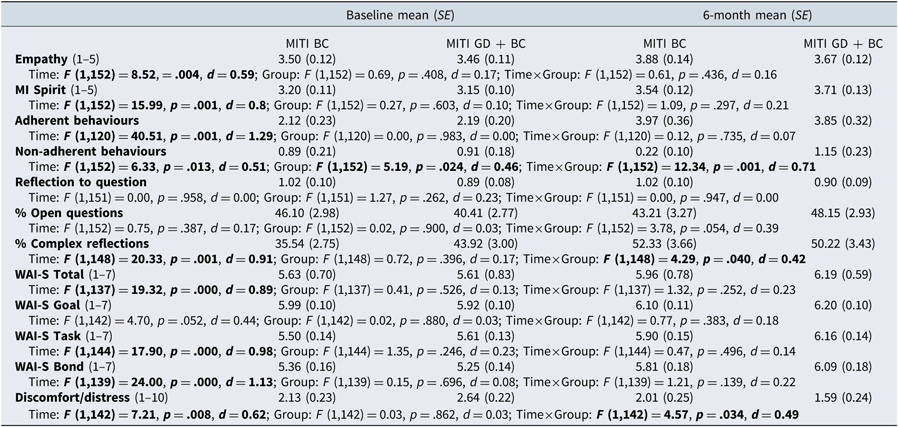
The group means of WAI-S and the discomfort/distress question for the two groups at the two assessment points are presented in Table 3. The GLMM analyses of the working alliance showed no significant interaction or group effects, but a significant effect of time for the total WAI-S score as well as for two of the three subscales (Table 3). The analyses also showed a significant time and group interaction for the discomfort/distress question (Table 3). The MITI GD + BC supervision group had a somewhat higher score at baseline and a somewhat lower score at the 6-month assessment compared with the MITI BC group, indicating a more apparent decrease of discomfort/distress over time for the MITI GD+BC group. Furthermore, the analysis of the discomfort/distress question showed no significant group effect but a significant time effect (Table 3).
Group means of the seven MITI proficiency measures, the WAI-S and the discomfort/distress question for the two groups at the two assessment points

MITI, Motivational Interviewing Treatment Integrity Code; WAIS-S, Working Alliance Inventory (Short Form); SE, standard error; MITI BC, supervision including systematic feedback based on the behaviour counts part of the MITI; MITI GD + BC, supervision including systematic feedback based on both the five global dimensions and the behaviour counts.
MI skill acquisition
The group means of the seven MITI proficiency measures for the two groups at the two assessment points are presented in Table 3. The GLMM analyses showed significant time and group interactions for MI non-adherent behaviours and per cent complex reflections (Table 3). The MITI BC supervision group performed better at the 6-month assessment with regard to both of those proficiency measures, and thus had a better development over time. Moreover, the analyses also showed one significant group effect for MI non-adherent behaviours, and significant time effects for five of the seven MITI proficiency measures (Table 3).
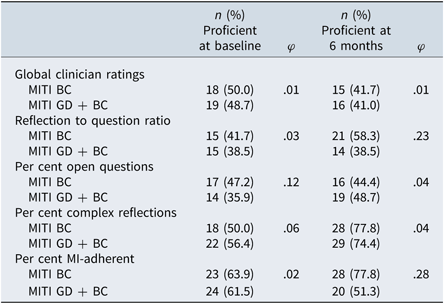
Table 4 shows the number and proportion of participants in the two groups reaching MITI beginning proficiency thresholds at the two assessment points. At baseline, directly after the county council workshop trainings, 35.9– 63.9% of the participants reached beginning proficiency levels on indicators. At the 6-month assessment, the proportion had increased for both groups for per cent complex reflections, and decreased for global clinician ratings. For the other indicators, the results for the two groups were mixed at the 6-month assessment. The MITI BC group had a higher proportion of participants reaching beginning proficiency levels on four of the five indicators at the 6-month assessment, but after the Bonferroni correction was applied none of these differences remained significant (Table 4). Per cent MI-adherent showed the highest proportion of participants reaching beginning proficiency thresholds baseline, and per cent complex reflections showed the highest proportion at the 6-month assessment.
The number and percentage of the participants in the two groups reaching the MITI beginning proficiency thresholds at the two assessment points, and statistical comparisons between the groups

ϕ, phi coefficient; MITI BC, supervision including systematic feedback based on only the behavior counts part of the MITI; MITI GD + BC, supervision including systematic feedback based on both the five global dimensions and the behaviour counts.
Discussion
The objective of study was to evaluate how two different types of objective MI feedback affect the supervisory relationship, potential feelings of discomfort/distress provoked by the feedback, and the supervisees’ skill acquisition. Neither of the two different ways to provide objective feedback seemed to negatively affect the supervisory relationship: at the 6-month assessment, the WAI-S total score and all three subscales (i.e. goal, task and bond) had increased for both groups from already high scores at baseline (Table 3), with no between-groups differences. However, the results did reveal a significant difference in discomfort/distress between the two groups. Nonetheless, at the 6-month assessment, the discomfort/distress scores had decreased in both groups from already low scores at baseline (Table 3), indicating that the objective feedback was not difficult to handle for any of the supervisees. The differences between the MI skill acquisition of the two feedback groups were also small (i.e. the MITI BC group performed better on only two of the seven skill measures).
Working alliance and the discomfort/distress question
With slightly higher scores at the first recording (indicating a somewhat higher discomfort/distress) and slightly lower scores at the last recording (Table 3), the MITI GD+BC group had a more apparent decrease over time on the discomfort/distress question. There is no obvious explanation for these results. Maybe the exposure to the global dimensions of the MITI led to an extinction of the initial provoked discomfort/distress for the MITI GD+BC group over the course of time? Exposure techniques are common in effective psychotherapies and involve repeated exposure to a feared object or situation in order to overcome distress (Vervliet et al., Reference Vervliet, Craske and Hermans2013). However, the difference between the groups was small and measured with just one single question. Additionally, the group effect for the discomfort/distress question was not significant and the low scores for both groups at both assessment points indicates that the objective feedback did not provoke significant negative emotions in any of the groups, at any of the time points. These results are consistent with a recent study that compared the effect of active learning techniques versus ‘supervision as usual’, where participants in both groups reported equally high levels of satisfaction (Bearman et al., Reference Bearman, Schneiderman and Zoloth2017), and with previous conclusions that supervisees can handle both positive and corrective performance feedback, especially within a positive supervisory relationship (Ellis, Reference Ellis2010; Ladany et al., Reference Ladany, Mori and Mehr2013).
MI skill acquisition
The differences between the groups’ MI skill acquisition were small (i.e. the MITI BC group performed better on only two of the seven skill measures), and it is not clear what really generated them. In the study by Beckman and colleagues (2017), the supervisors expressed concern that in particular the global dimensions of the MITI may have caused negative emotions that hindered the supervisees’ learning. As neither of the two different ways to provide objective feedback in this study caused negative emotions or negatively affected the supervisory relationship, the concern expressed by the supervisors in the previous study (Beckman et al., Reference Beckman, Bohman, Forsberg, Rasmussen and Ghaderi2017a) might be dismissed. The MITI 3.1 is a multi-faceted compilation of supervisees’ skills (Moyers et al., Reference Moyers, Martin, Manuel, Miller and Ernst2010), and the minor differences in skill acquisition between the two groups may simply be explained by the limited number of variables presented at each session for the MITI BC group. Cognitive load theory (CLT) (van Merrienboer and Sweller, Reference van Merrienboer and Sweller2010) is one of the leading cognitive learning theories with implications for both complex learning and skills acquisition. CLT provides a theoretical framework of the cognitive architecture, with the basic assumption that the capacity of the working memory is limited. According to the theory, three sources of cognitive load should be considered in all learning situations: the intrinsic load from the complexity of the learning task, the extraneous load created by the learning situation, and the germane load from processing the material. When the cognitive load exceeds the capacity of the working memory, learning and skills acquisition can be reduced or even hindered (van Merrienboer and Sweller, Reference van Merrienboer and Sweller2010). Limiting the number of variables when providing objective feedback could possibly reduce the risk of overloading supervisees’ cognitive capacity and thus facilitate learning during supervision. Part-task, sequenced, spaced or distributed practice also allows for repetition and for the supervisee to reflect and practise in between sessions (Kerfoot et al., Reference Kerfoot, Baker, Koch, Connelly, Joseph and Ritchey2007; Rakovshik and McManus, Reference Rakovshik and McManus2010; Young et al., Reference Young, Van Merrienboer, Durning and Ten Cate2014). Acquisition of long-term knowledge and skills is dependent on all these variables, and training provided in doses could thereby possibly be a more effective form of learning.
Limitations
This study has several limitations: The self-selected participants in the Swedish MI dissemination study may limit the generalizability of the results. Also, the design of the dissemination study did not allow a third supervision group (control) without objective feedback, and the recruitment difficulties in that trial had consequences for the ideal sample size. Moreover, a larger number of recordings at each assessment point could have provided more accurate estimates of MI skills, as MI performance can vary significantly within the same practitioner (Dunn et al., Reference Dunn, Darnell, Atkins, Hallgren, Imel, Bumgardner and Roy-Byrne2016; Imel et al., Reference Imel, Baldwin, Baer, Hartzler, Dunn, Rosengren and Atkins2014). The use of standardized clients can also provide inadequate information regarding MI in actual clinical practice (Decker et al., Reference Decker, Nich, Carroll and Martino2014). However, standardized clients keep the characteristics fixed among participants and assessment points, and if not used simultaneously with clients, role-plays can provide valuable data on MI performance (Decker et al., Reference Decker, Carroll, Nich, Canning-Ball and Martino2013; Imel et al., Reference Imel, Baldwin, Baer, Hartzler, Dunn, Rosengren and Atkins2014). Furthermore, during coding, the coders were not blind to the group allocations, and the same coder both coded the recordings and provided supervision, which may have affected the reliability of the codings (Moyers et al., Reference Moyers, Rowell, Manuel, Ernst and Houck2016). Despite these limitations, this study can provide some knowledge and direction for future supervision studies, by being one of few studies that compare two different way to provide feedback based on practice samples.
Conclusions
Pursuant to earlier research (Ellis, Reference Ellis2010; Ladany et al., Reference Ladany, Mori and Mehr2013), objective feedback does not seem to negatively affect either the supervisor–supervisee working alliance or the supervisees’ supervision experience. Although restricting the number of variables when providing objective feedback might promote learning during supervision, the observed differences between the two groups’ MI skill acquisition were small and on only two of seven parameters. Earlier research has found providing feedback as one of the weaker skill areas for clinical supervisors (Cummings et al., Reference Cummings, Ballantyne and Scallion2015), and lack of feedback or exclusively positive feedback is a frequent criticism during clinical training (Cummings et al., Reference Cummings, Ballantyne and Scallion2015). Directions for future practice could be focused on both positive and corrective feedback, based on monitoring of sessions, as important parts of clinical supervision. Directions for future research could instead be focused on comparing different ways of providing feedback. As objective feedback seem to be an important part of supervision (Ivers et al., Reference Ivers, Jamtvedt, Flottorp, Young, Odgaard-Jensen, French and Oxman2012), and efficient supervision an important factor for the dissemination and implementation of EBT (Edmunds et al., Reference Edmunds, Beidas and Kendall2013; Fixsen et al., Reference Fixsen, Naoom, Blase, Friedman and Wallace2005), constructive replications are needed to ascertain the mode and complexity of feedback that optimizes practitioners’ learning, while minimizing the sense of discomfort and distress.
Supplementary material
To view supplementary material for this article, please visit: https://doi.org/10.1017/S1352465819000687
Acknowledgements
The authors would like to thank the research participants.
Financial support
The Swedish National Board of Health and Welfare funded this study (2.4-59457/2012).
Conflicts of interest
The authors have no conflicts of interest with respect to this publication.
Ethical statements
The authors have abided by the Ethical Principles of Psychologists and Code of Conduct as set out by the American Psychological Association. Ethical approval for the trials was granted by the Regional Ethical Review Board in Stockholm, Sweden; 2012/2195-31/5).




Comments
No Comments have been published for this article.