INTRODUCTION
Fusiliers (family Caesionidae) comprise a group of marine perciforms distributed in the tropical Indo-Pacific Ocean, and were first described by Johnson (Reference Johnson1980) based on extensive osteological research. It has two sub-families, four genera, six subgenera, and 21 species. Initially, there were 15 species listed under this family (Johnson, Reference Johnson1980) and six more species were later added by Carpenter (Reference Carpenter1987). Fusiliers are primarily reef inhabiting, planktivorous and schooling fish.
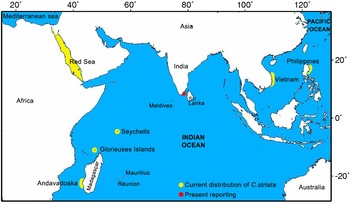
Caesio striata Rüppell, 1830, commonly known as ‘striated fusiliers' has a discontinuous distribution. According to Carpenter (Reference Carpenter1988), its distribution was very much limited to the Red Sea, but there is now more information about its distribution elsewhere. In the Indian Ocean it is known from western Madagascar (Gillibrand et al., Reference Gillibrand, Harris and Mara2007), Glorieuses Archipelago (Durville et al., Reference Durville, Chabanet and Quod2003) and the Seychelles (Anon., 2012), although it has not been reported from the adjacent island territories of Réunion (Letourneur et al., Reference Letourneur, Chabanet, Durville, Taquet, Teissier, Parmentier, Quéro and Pothin2004) and Mauritius (Baissac, Reference Baissac1990). Further eastwards, in the northern Pacific Ocean, C. striata is known from Vietnam (Nguyen & Nguyen, Reference Nguyen and Nguyen2006) and the Philippines (Ganaden & Lavapie-Gonzales, Reference Ganaden and Lavapie-Gonzales1999). However, C. striata has not been reported from the Arabian Sea and the Bay of Bengal.
MATERIALS AND METHODS
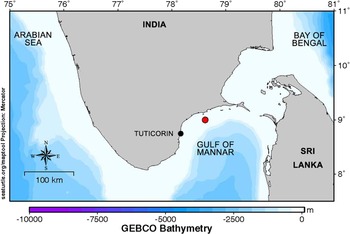
On 16 September 2010, a single specimen of Caesio striata (Figure 1) weighing approximately 200 g, was collected from Tuticorin fisheries harbour (south-east coast of India), from the by-catch landed by a motorized fishing vessel using a drift gill-net (net length 5000 m; net height 14 m). The specimen was caught approximately 55 km north-east of Tuticorin harbour (9°00′03.83″N and 78°37′00.07″E) in the Gulf of Mannar at a depth of 50–80 m (Figure 2). The specimen was identified as a striated fusilier, Caesio striata based on the morphometric and meristic characters described by Carpenter (Reference Carpenter1988). This is the first record of Caesio striata from Indian waters and a new distribution record for the species outside its known geographical range (Figure 3).
Lateral view of the Caesio striata captured from the Gulf of Mannar.

Capture location of Caesio striata from the Gulf of Mannar (red circle).

Present known records of Caesio striata from the world (Yellow highlights) and present reporting from Indian waters (red highlight).

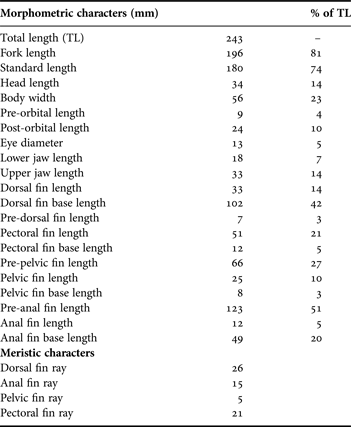
Measurements were taken to the nearest mm using a digital caliper according to Masuda et al. (Reference Masuda, Amaoka, Araga, Uyeno and Yoshino1984). Morphometric and meristic characters are shown in Table 1. In the following section, a brief morphological description of the specimens collected is provided.
Morphometric and meristic characters of Caesio striata captured from the Gulf of Mannar.

RESULTS
SYSTEMATICS
Kingdom ANIMALIA
Phylum CHORDATA
Class ACTINOPTERYGII
Order PERCIFORMES
Family CAESIONIDAE
Genus Caesio
Species Caesio striata (Rüppell, 1830)
DESCRIPTION
Body fusiform, elongate and moderately compressed. Post-maxillary process single and posterior end of maxilla blunt. Three types of teeth: conical, vomer and palatines. Dorsal fin with IX spines 15 soft rays, anal fin with III spines and 12 soft rays. Pectoral fin with 20 rays. Lateral line scales 62; upper peduncular scale rows 11, lower peduncular scale rows 15; nine scale rows present above lateral line to dorsal fin origin and 16 scale rows below the lateral line to anal fin origin. Pre-dorsal scale 25 and supra-temporal band of scales continuous at dorsal midline. Body light bluish to greenish on the dorsal side and white in ventral side, four narrow black longitudinal stripes on upper side and a yellow stripe between the two black stripes above the lateral line. Black streaks on the caudal fin with black blotch on tip of each lobe. Outer caudal lobe with white margin, inner margin with light cream. Pectoral, pelvic and anal fin white; axil of pectoral fin black and dorsal fin light blue.
DISCUSSION
Fusiliers prefer the warm waters of the tropical Indo-Pacific region. So far, no member of this family has ever been noted to extend either into subtropical waters or into the Atlantic or Caribbean Sea (Carpenter, Reference Carpenter1988). Caesio striata was originally thought to be restricted to the Red Sea (Carpenter, Reference Carpenter1988) but recent records report the occurrence of this species from the Indian Ocean and from the northern Pacific Ocean. Even though the known geographical range of Caesio striata is broad, its distribution is not uniform. The reason for this discontinuous distribution is not really understood. Six out of eight known Caesio species are recorded from the Gulf of Mannar region of the Bay of Bengal (Carpenter, Reference Carpenter1988). This is the first record of Caesio striata from the Bay of Bengal. It is assumed that this species might have extended its range in the Indian Ocean up to the Bay of Bengal via the Arabian Sea. More in depth research and exploration will help in better understanding of C. striata distribution in the Arabian Sea and adjacent waters of Sri Lanka and the Maldives.
ACKNOWLEDGEMENTS
The authors thank the Director, Central Marine Fisheries Research Institute (CMFRI), and Scientist in Charge (SIC), of Tuticorin Research Centre (TRC) of CMFRI for providing facilities and encouragement. The first author acknowledges the support of K. Sivakumar and G.V. Gopi, Scientist's Widlife Institute of India, Dehradun during manuscript preparation. The online GIS program MAPTOOL, provided by SEATURTLE.ORG is also acknowedged.