High-level disinfectants (HLDs) are used throughout the healthcare industry to chemically disinfect reusable, semicritical medical and dental devices. Currently, the Food and Drug Administration (FDA)-approved HLDs in commercially available products contain one of the following active ingredients: glutaraldehyde, orthophthalaldehyde (OPA), peracetic acid (PA), hydrogen peroxide (HP), hydrogen peroxide/peracetic acid (HPPA), or hypochlorous acid/hypochlorite (bleach). 1
Glutaraldehyde has been linked to adverse occupational health effects including dermatitisReference Fowler 2 – Reference Hansen 6 and asthma.Reference Di Stefano, Siriruttanapruk, McCoach and Burge 7 – Reference Dimich-Ward, Wymer and Chan-Yeung 9 It is important to note that little is known about the potential occupational health risks of other HLDs more recently cleared by the FDA. A case report in Japan suggests that occupational asthma and dermatitis were caused by OPA exposure in a nurse working in an endoscopy unit.Reference Fujita, Ogawa and Endo 10 Also, HPPA has been implicated in 2 cases of occupational asthma.Reference Cristofari-Marquand, Kacel, Milhe, Magnan and Lehucher-Michel 11
Workplace controls for reducing exposure during the use of HLDs in the disinfection processes in U.S. healthcare settings have not been previously reported in the literature. A 2007 report on a study of 5 hospitals in Quebec indicated that all 19 locations that used glutaraldehyde lacked any type of local exhaust ventilation (LEV), with half of the 53 workers reporting at least 1 incident of dermal exposure.Reference Nayebzadeh 12 Guidelines for the safe use and handling of glutaraldehyde, including recommended engineering controls, personal protective equipment (PPE), and work practices, have been published by the National Institute for Occupational Safety and Health (NIOSH) 13 and the Occupational Safety and Health Administration (OSHA). 14
The primary objective of this study was to describe the current usage, precautionary practices including extent of exposure control use, and barriers to using PPE by healthcare workers who disinfect medical devices using HLDs. This study is distinct from previous studies; it has national reach, includes commonly used HLDs in healthcare, and includes a large number of respondents and diverse occupations and workplaces.
Methods
Survey Methodology
The NIOSH Health and Safety Practices Survey of Healthcare Workers was a voluntary, anonymous, multimodule, web-based survey conducted in early 2011. The study population for the hazard module on HLDs included members of professional practice organizations representing nurses, technologists/technicians, dental professionals, respiratory therapists, and others who reported handling 1 or more HLDs in the previous week. Participating organizations invited members via an e-mail that included a hyperlink to the survey.
Information on the methods used in the development and testing of the survey web instrument, survey implementation, respondent characteristics, strengths and limitations, and other information have been previously reported.Reference Steege, Boiano and Sweeney 15
Hazard Module on HLDs
The multimodule survey included 1 screening module, 7 hazard modules addressing selected chemical hazards commonly found in healthcare settings, and 1 core module. Participants were eligible to complete the hazard module on HLDs if they responded ‘yes’ to the screening question asking whether they had chemically disinfected medical or dental devices using 1 or more of the following HLDs during the previous week: glutaraldehyde, OPA, PA, HP, and HPPA. The format of the questions varied and included multiple choice, multipart, and yes/no questions. Most questions sought information relative to the previous 7 calendar days unless otherwise noted. To minimize response error, photos were included for automated reprocessors, manual immersion trays, LEV, and respirators.
Data Analysis
Data were analyzed using SAS 9.3. 16 Simple frequencies and prevalences are presented. Stratification was used to further describe some aspects of the use of HLDs. Results include responses to questions in the HLD hazard module and selected questions in the core module that describe demographic, employer, and occupation characteristics. Respondents who worked outside the United States and its territories were excluded from analyses.
Human Subjects Review Board
The NIOSH Institutional Review Board determined that the activities in this project constituted surveillance and did not meet the criteria of research according to 45 CFR 46.1101(b)(2) and Centers for Disease Control and Prevention’s Guidelines for Defining Public Health Research and Public Health Non-Research. 17
Results
Respondent Characteristics
A total of 4,657 respondents completed the hazard module addressing HLDs. Of these, 3,994 (86%) completed the core module and thus could be characterized by demographic and other descriptive information. Respondents were mostly female (80%), non-Hispanic (96%), and older than 40 years of age (83%). The majority of respondents were white (91%); few reported that they were black (5%), Asian (4%), or another race (2%). Education level varied, with most having either an Associate’s degree (32%) or a Bachelor’s degree (31%), followed by Master’s degree (12%), vocational certificate (12%), professional/doctoral degree (9%), and less than grade 12 (5%).
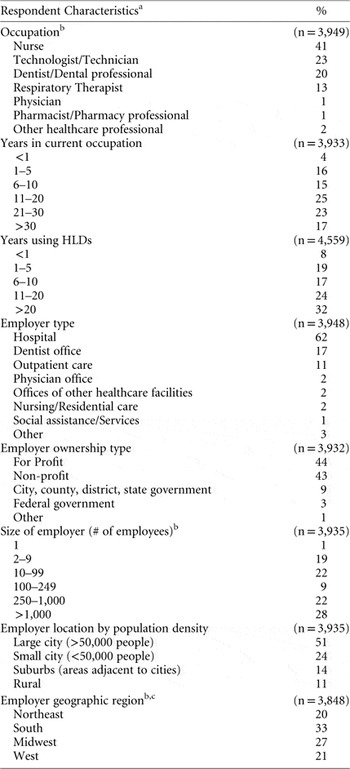
Respondents included mainly nurses (41%), technologists/technicians (23%), dentists/dental professionals (20%), and respiratory therapists (13%) (Table 1). Of the respondents, 80% had ≥6 years of experience in their current occupation, and 52% reported working with their current employer for ≤10 years. In addition, 56% reported using HLDs for ≥11 years; 455 of 3,896 respondents (12%) were members of a labor union. The majority of respondents indicated that they were employed at hospitals (62%), with most others working in dentist offices (17%) or outpatient care facilities (11%). In addition, 50% reported that their employer had ≥250 employees. The percentages of for-profit and non-profit employers were similar, 44% and 43% respectively, with the remaining employers being publicly owned institutions. Respondents worked in all U.S. geographical regions, with the South having the highest representation (33%), followed by the Midwest (27%), the West (21%), and the Northeast (20%). More than 50% of employers were located in large cities.
Occupational and Employer Characteristics of Respondents

Note. HLDs, high-level disinfectants.
a Number of respondents varied for individual items (eg, number of eligible respondents less number who elected not to answer).
b Percentages do not total 100 due to rounding.
c Northeast (CT, ME, MA, NH, NJ, NY, PA, RI, VT); South (AL, AR, DE, DC, FL, GA, KY, LA, MD, MS, NC, OK, SC, TN, VA, WV); Midwest (IL, IN, IA, KS, MI, MN, MO, NE, ND, OH, SD, WI); West (AK, AZ, CA, CO, HI, ID, MT, NV, NM, OR, UT, WA, WY).
HLD Use Characteristics
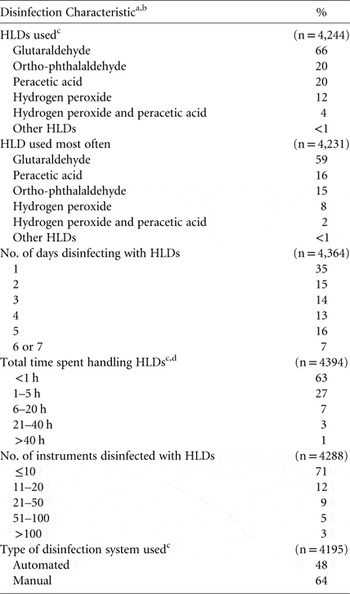
When asked to select from a list the HLD used most often during the previous week, 59% of respondents reported glutaraldehyde, followed by PA (16%), OPA (15%), HP (8%), HPPA (2%), and other (0.2%) (Table 2). Because dental professionals represented 1 of every 5 respondents, the high glutaraldehyde use among this group (92%) greatly contributed to the reported use by all respondents, which was 52% when dental professionals were excluded. The number of days disinfecting with HLDs over the previous 7 days differed; 35% reported 1 day only and comprised the largest response group. When respondents were asked to report the total time they spent handling or working with HLDs during the previous week, they were instructed to include only the time spent loading or unloading instruments, adding and/or replacing HLD solution, and cleaning reprocessors or immersion trays. Of the respondents, 63% reported that they had handled or worked with HLDs for a total of ≤1 hour during the previous week, and 90% of respondents used them for ≤5 hours. Most respondents (3,312 of 4,366 or 76%) reported that the total time spent handling HLDs during the previous week was no different than usual. Most respondents (71%) reported that they had disinfected ≤10 instruments during the previous week, and <10% reported disinfecting >50 instruments. In addition, 64% of respondents reported using manual immersion disinfection systems; 48% reported using automated systems (ie, reprocessors); and 12% reported using both systems.
Disinfection Operational Characteristics

NOTE. HLD, high-level disinfectant.
a Number of respondents varied for individual items (eg, number of eligible respondents less number who elected not to answer).
b Based on previous 7 calendar days.
c Percentages may total >100 because respondents could select >1 answer.
d Includes only time loading or unloading instruments, adding and/or replacing HLD solution, and cleaning processors or trays.
Training and Awareness of Employer Procedures
Of 4,572 respondents, 766 (17%) reported that they had never been trained on the safe handling of HLDs. Of the 3,806 who had received training, 42% reported that the training had been >12 months previously. Of 4,566 respondents, 872 (19%) reported that their employer lacked standard procedures for safe handling of HLDs or were unaware of their existence.
Presence of LEV on Manual and Automated Disinfection Systems
Only 24% of respondents reported that manual disinfection systems were equipped with LEV, while 47% reported LEV on automated systems. A substantial percentage of respondents using manual disinfection systems (34%) and automated disinfection systems (38%) did not know whether LEV was present. For systems with LEV present, 97% of respondents perceived the LEV to be effective. For systems lacking LEV, 1 of every 5 respondents reported that the general ventilation was ineffective.
Adding or Removing HLDs from Disinfection Systems
Of 4,125 respondents, 1,227 (30%) reported manually pouring HLDs into automated reprocessing units or manual immersion trays in the previous 7 days. Of the respondents that reported manual pouring, 47% reported pouring <1 gallon, and only 5% reported pouring >10 gallons. Of 4,105 respondents, 917 (22%) reported that they had manually drained HLDs from automated processing units or immersion trays during the same period.
Skin Contact
Of 4,111 respondents, 482 (12%) reported that their skin had come into direct contact with HLDs during the previous week.
Use of Personal Protective Equipment
The proportion of respondents reporting that they did not always wear a water-resistant gown/outer garment when handling HLDs was 44%; for or eye/face protection, that proportion was 42%. Only 9% of respondents reported that they did not always wear protective gloves. Moreover, for those respondents who reported skin contact with HLDs, the proportion that did not always wear protective gloves was 33%. Few respondents reported using a respirator.
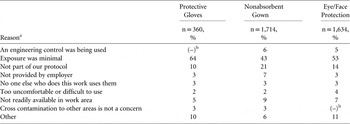
Respondents who reported that they did not always wear PPE when handling HLDs were asked to select all that applied from a list of 9 reasons for not wearing PPE; percentages of respondents selecting each of these reasons by type of PPE are presented in Table 3. ‘Exposure was minimal’ and ‘not part of our protocol’ were the top two reasons reported by respondents for not always wearing gloves, gowns/outer garments, or eye/face protection.
Reasons for Not Always Wearing Personal Protective Equipment When Using High-Level Disinfectants

a Column percentages total >100 because respondents could select >1 answer.
b Dash (–) indicates this reason was not included in question response options.
Respondents were 3, 2, and 1.5 times more likely to report never wearing gloves, eye/face protection, and water-resistant gowns, respectively, if they had never received training on the safe handling of HLDs.
Frequency of Spills and Availability of Spill Kits
Respondents were asked whether spills occurred in the previous 7 days while they were handling HLDs and, if so, whether the spills were <2 cups (~500 ml) or ≥2 cups. Of 4,050 respondents, 173 (4%) reported spills of <2 cups, and 34 of 3,915 (<1%) reported spills of ≥2 cups. Only 151 of 182 of those reporting spills (83%) indicated that these spills were always cleaned up. Of 4,110 respondents, 2,917 (71%) reported that hazardous chemical spill kits were available, while 29% indicated that they were not available or did not know whether they were available.
Took Home Potentially Contaminated Clothing
When respondents were asked whether they took home any clothing that came into contact with HLDs, 560 (14%) responded affirmatively and another 7% did not know.
Exposure Monitoring
When respondents were asked whether exposure monitoring had been conducted in the previous 12 months to assess their own or their coworkers’ exposure to HLDs, 548 of 3,899 (14%) reported that monitoring had been conducted. Most of these respondents (64%) reported that the monitoring was for glutaraldehyde, followed by OPA (19% of respondents) and HP (17% of respondents).
Discussion
With the introduction of additional products approved for use as HLDs by the FDA over the last decade, it is important from an occupational health and safety perspective to understand the types and use of exposure controls and barriers to using PPE. This survey is the first of its kind that evaluates precautionary practices for commonly used HLDs in healthcare settings.
Direct skin exposures to HLDs were not uncommon; they were reported by 12% of respondents. Gloves and water-resistant gowns should be worn whenever handling HLDs and during cleanup of spills to prevent skin contact. Eye/face protection should be worn during pouring, draining, and replacing HLDs or whenever splashes are likely. Survey findings showed that >4 of every 10 respondents did not always wear water-resistant gowns/outer garments and that nearly 1 of every 10 did not always wear gloves. Respondents reporting skin exposures were 4 times more likely not to wear gloves, and 33% of respondents reported not always wearing gloves. Limited use of respiratory protection was reported, but respiratory protection is necessary only if airborne exposures exceed occupational exposure limits or if air concentrations are unknown, such as during cleanup of large spills. ‘Exposure was minimal’ was reported as the most frequent reason for not wearing PPE, even though 12% reported direct skin contact with an HLD in the previous 7 calendar days.
According to OSHA’s Hazard Communication Standard (29CFR1910.1200), employers must provide training to workers who handle HLDs. Training must include understanding the hazards of the chemical(s), safe handling precautions, PPE, emergency procedures (such as a spill response), and how to use safety data sheets. Training should occur at the time of initial assignment and whenever a new chemical or process change is introduced. Results from this survey indicate that some employers are not adhering to this standard; 1 of every 6 respondents indicated that they had never received training on the safe handling of HLDs.
Potential exposure to HLDs can be reduced through the use of automated systems, where the disinfection process occurs in an enclosed unit.Reference Niven, Cherrie and Spencer 18 Exposure to HLDs in automated systems generally only occurs during the refilling of reservoirs, during improper handling or disposal of containers, as a result of improperly maintained equipment, or during testing of the HLD. In our study, 48% of respondents used automated systems, and this statistic was lower for dental professionals (14%).
HLD exposure is greatly reduced with the presence of effective LEV. A study in endoscopy units found that LEV reduced exposures by >70% in manual disinfection processes.Reference Pisaniello, Gun, Tkaczuk, Nitshcke and Crea 19 In this survey, 42% of survey respondents who used manual disinfection systems reported that LEV was absent; of respondents who used automated disinfection systems 15% indicated the absence of LEV. The survey did not ascertain whether automated systems required the use of LEV or whether the manual systems were covered or uncovered when not in use. Greater than 33% of respondents in the study were not sure whether the manual or automated disinfection systems were equipped with LEV.
The results of this survey suggest that use of glutaraldehyde in healthcare settings has decreased in favor of alternatives such as OPA and PA. Prior to the 2000s, glutaraldehyde use predominately ranged between 84% and 89%.Reference Brullet, Ramirez-Armengol and Campo 20 – Reference Gorse and Messner 22 Findings from this survey indicate that glutaraldehyde was used by 59% of respondents, which is slightly elevated compared to recent estimates, which ranged from 49% to 55%.Reference Rideout, Teschke, Dimich-Ward and Kennedy 23 – Reference Fratila and Tantau 25 However, these estimates were obtained from studies that did not include dental professionals. PA and OPA were less commonly used at 16% and 15%, respectively. The majority of survey respondents were low-level users of HLDs, with 63% spending <1 hour disinfecting during the previous week and 71% disinfecting 10 instruments or fewer during the previous week.
Limitations of the study need to be considered when interpreting the survey results. The survey was targeted to professional practice organizations and elicited voluntary participation from their members. Because the survey was not a probability sample, the conclusions and findings are not representative of the healthcare industry as a whole but are limited to healthcare workers who participated. Additionally, the delivery of and response to the survey was conducted electronically, limiting respondents to those who have e-mail and Internet access. Response rates could not be calculated because the survey invitation specified the specific chemical hazards under study; it is unknown who decided not to participate because they did not use any of the chemicals and were therefore ineligible versus those who used them but decided not to participate for other reasons. Demographic information for respondents was not available for participants who did not complete the core module. Survey data are self-reported and subject to recall and reporting biases. Information on barriers to using LEV (especially on manual systems), automated reprocessors, and spill kits were not collected in this study and should be evaluated in future studies.
This survey indicates that the use of recommended PPE, particularly gowns/outer garments, is not universal among workers who use HLDs to disinfect medical instruments. Best practices for handling HLDs, including wearing protective gloves, water-resistant gowns, and eye/face protection to minimize skin and eye exposure, are not always followed. The most commonly reported reason for the underutilization of gloves, gowns, and eye/face protection suggests a perception that exposures are negligible or so infrequent that they do not warrant their use. Lack of training on safe handling practices and lack of employer standard procedures suggest that employers may not fully recognize the hazards and potential adverse health effects of HLDs.
Acknowledgments
The findings and conclusions in this report are those of the authors and do not necessarily represent the views of NIOSH. Mention of company names or products does not constitute endorsement by NIOSH. The authors thank Paul Hennenberger and Amber Mitchell for their comments and suggestions regarding an early draft of the manuscript.
Financial Support. None reported.
Potential Conflicts of Interest. All authors report no conflicts of interest relevant to this article. All authors submitted the ICMJE Form for Disclosure of Potential Conflicts of Interest, and the conflicts that the editors consider relevant to this article are disclosed here.