Introduction
The link between minor physical anomalies and adult onset of schizophrenia has been widely described (McNeil et al. Reference McNeil, Cantor-Graae and Ismail2000; Weinberg et al. Reference Weinberg, Jenkins, Marazita and Maher2007). Such anomalies occur more frequently in a range of developmental deficits as well as in schizophrenia, which is indicative of a neurodevelopmental aetiology (Lloyd et al. Reference Lloyd, Doody, Brewin, Park and Jones2003). However, there have been few large epidemiological investigations of major birth defects in offspring of parents with mental illness. For example, a national Danish study (Bennedsen et al. Reference Bennedsen, Mortensen, Olesen and Henriksen2001) reported a 70% higher risk of any type of registered birth defect with maternal schizophrenia. Studies have also attempted to identify teratogenic effects of in utero exposure to psychotropic medication (e.g. Kallen & Tanberg, Reference Kallen and Tanberg1983; McKenna et al. Reference McKenna, Koren, Tetelbaum, Wilton, Shakir, Diav-Citrin, Levinson, Zipursky and Einarson2005). However, in general these studies have been based on relatively small samples with possible selection and reporting biases. Strong population-based evidence is needed to describe risk of major birth defect in offspring of mentally ill parents, across a range of parental diagnostic categories and between maternal versus paternal psychopathology. In particular, evidence for effects linked with paternal disorders is lacking.
Our recent critical review found no published studies of fatal birth defect risk (Webb et al. Reference Webb, Abel, Pickles and Appleby2005). For this empirical study we aimed to estimate relative risks associated with history of parental psychiatric admission. Investigation of fatal birth defect was selected as an objective and clinically important outcome measure with complete case ascertainment through infancy and childhood. We were primarily interested in estimating risks linked with parental schizophrenia and related disorders, with affective disorders and alcohol/drug-related illnesses also assessed as comparison groups of parents with severe mental illness.
Method
Description of the study cohort, exposures and outcomes
The birth cohort is described in greater detail in our previous paper (Webb et al. Reference Webb, Abel, Pickles, Appleby, King-Hele and Mortensen2006), which reported all-cause offspring mortality risks from the same cohort. It consisted of all singleton live births in Denmark during 1973–1998 to Danish-born mothers (n=1.45 million). As with our previous reports from this cohort (Webb et al. Reference Webb, Abel, Pickles, Appleby, King-Hele and Mortensen2006, Reference Webb, Pickles, Appleby, Mortensen and Abel2007; King-Hele et al. Reference King-Hele, Abel, Webb, Mortensen, Appleby and Pickles2007) exposure was defined by date of first maternal or paternal psychiatric admission. All admissions nationally from 1969 onwards were identified through the Psychiatric Central Register (Munk-Jørgensen & Mortensen, Reference Munk-Jørgensen and Mortensen1997), according to the following diagnostic categories:
(1) All psychiatric diagnoses: ICD-8: 290–315; ICD-10: F00–F99.
(2) Schizophrenia and related disorders (schizophenia, schizophrenia-like or schizo-affective): ICD-8: 295, 296.8, 297, 298.39, 301.83; ICD-10: F20–F29.
(3) Affective disorders (including bipolar disorder): ICD-8: 296.09, 296.19, 296.29, 296.39, 296.99, 298.09, 298.19, 300.49, 301.19; ICD-10: F30–F39.
(4) Alcohol/drug-related disorders: ICD-8: 291, 294.30, 294.38, 303; ICD-10: F10, F11, F16, F18, F19.
The diagnostic category ‘schizophrenia and related disorders’ is referred to as ‘schizophrenia’ for the remainder of the paper, with the broader diagnostic group selected to maximize statistical power and precision. Although diagnoses recorded in the Psychiatric Central Register are routinely checked against those entered in the medical notes (Munk-Jørgensen & Mortensen, Reference Munk-Jørgensen and Mortensen1997), they are nonetheless made heterogeneously in the course of routine clinical practice and without reference to standardized research criteria (Strudsholm et al. Reference Strudsholm, Johannessen, Foldager and Munk-Jørgensen2005). For example, a registered diagnosis with schizophrenia has a high positive predictive value (Munk-Jørgensen, Reference Munk-Jørgensen1995), but the consistency of an affective disorder diagnosis over time is less certain (Kessing, Reference Kessing1998).
The terms ‘birth defect’, ‘congenital malformation’, ‘congenital anomaly’ and ‘congenital abnormality’ are used interchangeably in the literature; in this paper we refer consistently to ‘fatal birth defects’. All types of fatal birth defect were ascertained by linkage to the national Causes of Death Register (Juel & Helweg-Larsen, Reference Juel and Helweg-Larsen1999) using ICD-8 codes 740–759 (‘congenital anomalies’) for years 1973–1993 (WHO, 1967) and ICD-10 Q00–Q99 (‘congenital malformations, deformations and chromosomal abnormalities’) for 1994 onwards (WHO, 1992). Risks of death from all other causes were also estimated to assess the specificity with particular parental diagnostic categories of observed effects on fatal birth defect risk. Predominant among these other causes were: immaturity, anoxia/brain injury and other perinatal conditions; cancer; sudden infant death syndrome; and unnatural causes (mostly accidents). Classification was made according to the underlying cause of death, with coding being over 99% complete up to 31 December 1998. Since 1976, all Danish death certificates have to be completed by a physician but, as with any national mortality registration system, validity relies on the quality of physicians' notification and the accuracy of subsequent classification and coding performed at the National Board of Health (Juel & Helweg-Larsen, Reference Juel and Helweg-Larsen1999). No external validation of the cause of death coding could be performed because of the historical nature of the data. Inconsistency in classification between the eighth and tenth ICD revisions was minimized by use of a broad range of codes to delineate both exposures and outcomes.
We could find no standardized age range for measuring risk of fatal birth defect reported in the paediatric literature. However, we opted to use 0–4 years in line with the age stratification applied in our previous studies of this cohort (Webb et al. Reference Webb, Abel, Pickles, Appleby, King-Hele and Mortensen2006, Reference Webb, Pickles, Appleby, Mortensen and Abel2007; King-Hele et al. Reference King-Hele, Abel, Webb, Mortensen, Appleby and Pickles2007), and also because 96% (3867/4042) of all fatal birth defects in childhood (before 16th birthday) occurred at ages 0–4 years. Stillbirths due to birth defect were excluded from our analyses because paternal identity could not be established for these cases, and one of our primary aims was to compare risks of fatal birth defect with maternal versus paternal mental illness.
Maternal identity was registered for every birth in the cohort, whereas paternal identity was missing for 1.2% of all live births, 15% of fatal birth defects at 0–4 years and 18% of deaths due to any other causes in this age range. This missing paternal identity among offspring deaths is due to an artefact in the Danish Civil Registration System; the younger the age of death the higher the percentage of missing paternities (and so 27% of all early neonatal deaths lacked a registered father). Following birth, a child's mother is automatically registered, whereas parents must themselves register the father's identity at the mother's local parish church some time later. For married people, the child's father is always assumed to be the mother's husband, so rates of unregistered fatherhood are especially high in offspring of unmarried mothers. In cases of perinatal death, paternal registration only occurs if requested by the mother, or if this information is required for legal purposes. The rate of unregistered paternity has fallen since 1990. It should also be noted that the registered father may not necessarily have been the biological one as this information is not recorded in the Civil Registration System (Pedersen et al. Reference Pedersen, Gøtzsche, Moller and Mortensen2006).
Statistical analyses
These were conducted using Stata software version 9 (StataCorp, College Station, TX, USA). Relative risks were estimated by log-linear Poisson regression models without overdispersion (Gardner et al. Reference Gardner, Mulvey and Shaw1995). The models were adjusted for calendar year of death (in 5-year bands) and finely stratified offspring age, and the interaction between these terms. The reference group for calculating relative risk was offspring whose mothers or fathers had not been admitted for psychiatric treatment at any time before or during the observation period. A pooled estimate from birth to early childhood (0–4 years) was made to achieve adequate precision in comparing effects between parental diagnostic categories. Effects specific to a particular parental diagnostic category (e.g. schizophrenia versus all other admitted maternal conditions) were assessed by two-tailed Wald z tests for linear comparison of the regression coefficients. To eliminate the possibility of reverse causality bias, offspring subjects who died were only classified as being exposed if first parental admission occurred prior to their death.
Results
Descriptive analyses
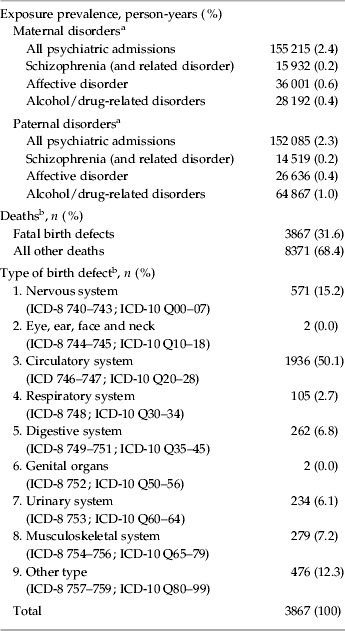
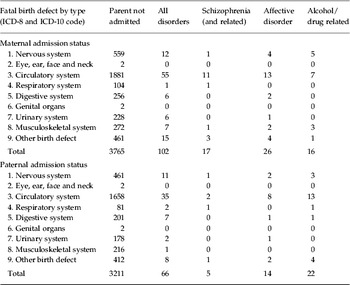
Exposure prevalence by parental diagnosis, numbers of fatal birth defects versus other causes of death and frequency by type of birth defect, across the whole birth cohort, are shown in Table 1. With parental disorder measured according to parental admission before the child's fifth birthday or death, the prevalence of exposure was low (more than 2% for any maternal or paternal admission and less than 1% for specific diagnostic groups). Fifty per cent of all cases were defects of the circulatory system, 89% of which were cardiac defects; the next most common type was nervous system defects (15% of the total). Distributions by type of fatal birth defect and according to parental illness exposure status are presented in Table 2. The pattern by fatal birth defect type was generally similar across the categories of exposed and unexposed offspring subjects.
Descriptive data for the whole national birth cohort: exposure prevalence, number of deaths and type of fatal birth defect

a Exposure prevalence estimated using the total person-years denominator for the 1.45 million live births, i.e. 6.48 million person-years at 0–4 years (Note: registered paternal identity was missing for 55592.9 person-years, 0.9% of the total denominator).
b Numerators relate to the whole study population irrespective of exposure status.
Frequency counts for type of fatal birth defect (0–4 years) and by parental psychiatric admission status

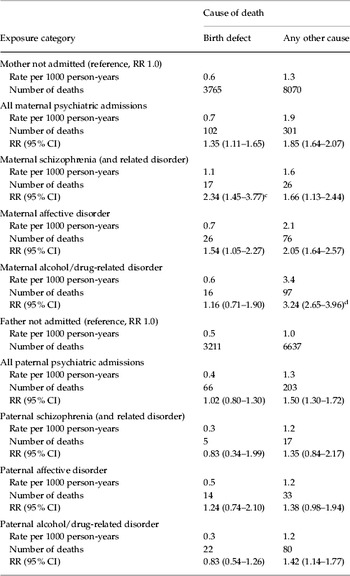
Relative risk of fatal birth defect with maternal admission
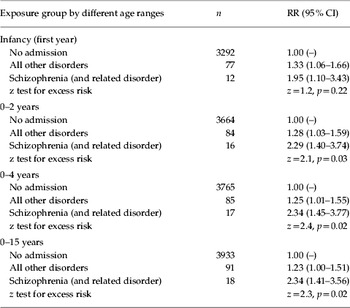
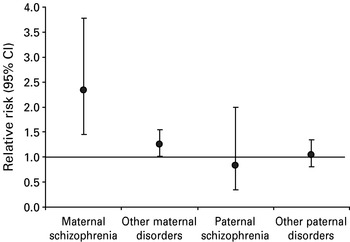
These results are shown in Table 3. Risk was elevated with any maternal admission history but the increase in risk was modest (35%). Risk was significantly elevated by around 50% with affective disorders but there was no evidence of higher risk with alcohol/drug-related disorders. The highest risk was associated with schizophrenia [n=17, relative risk (RR) 2.34, 95% confidence interval (CI) 1.45–3.77] whereas the increase in risk with all maternal diagnoses other than schizophrenia was modest (n=85, RR 1.25, 95% CI 1.01–1.55); linear comparison between effects for these two diagnostic categories indicated an excess risk specific to schizophrenia (z=2.4, p=0.018). We assessed whether this key result was specific to our selection of 0–4 years as the follow-up age range. In a sensitivity analysis we estimated relative risks with maternal schizophrenia and with all other admitted maternal disorders using different age ranges: infancy (first year); 0–2 years; 0–4 years; 0–15 years. These estimates are shown in Table 4. The excess risk with maternal schizophrenia was not specific to 0–4 years; the estimates were consistent across the various age ranges (although in infancy the excess risk was non-significant because of the smaller numbers of observed events). A higher risk with schizophrenia was also seen in both earlier (1973–1989: n=12, RR 2.69, 95% CI 1.52–4.74) and later (1990–1998: n=5, RR 1.78, 95% CI 0.74–4.29) study periods, with homogeneity in these effect sizes confirmed by an interaction test (χ2=0.6, df=1, p=0.44).
Relative risk of fatal birth defect and death from any other cause at 0–4 years, by parental diagnostic categoriesFootnote a,b

RR, Relative risk; CI, confidence interval.
a All models adjusted for offspring age by time period interaction.
b Paternity was unregistered for 15% of fatal birth defects and 18% of deaths from any other cause.
c Excess risk of fatal birth defect (versus all other maternal diagnoses): z=2.4, p=0.02.
d Excess risk of death from any other cause (versus all other maternal diagnoses): z=6.1, p<0.001.
Sensitivity analysis indicating consistency of effect sizes for maternal schizophrenia versus other admitted disorders by different offspring age ranges

RR, Relative risk; CI, confidence interval.
Relative risks of offspring death due to any cause other than birth defect associated with history of maternal admission are also shown in Table 3. For this outcome the effect linked with schizophrenia was statistically comparable to that with all other maternal diagnoses (z=−0.6, p=0.58). The highest risk of death by any other cause was seen with maternal alcohol/drug-related disorders, which constituted a significant excess risk versus all other admitted maternal illnesses (z=6.1, p<0.001).
Relative risk of fatal birth defect with paternal admission
These results are also presented in Table 3. There was no evidence of higher fatal birth defect risk if the father was admitted with schizophrenia or any other psychiatric disorder. The relative risks with paternal schizophrenia and alcohol/drug-related disorders were below unity, whereas for each maternal diagnostic category the effects were consistently in a positive direction (whether they reached statistical significance or not). Fig. 1 highlights the marked difference in risk of fatal birth defect between maternal versus paternal schizophrenia. The event data were too sparse to enable assessment of effects by number of affected parents as there was just one fatal birth defect if both parents were admitted for schizophrenia. There was evidence of modestly raised risk of offspring death by any other cause with paternal admission history, although these effects were weaker than if the mother had been admitted.
Relative risk of fatal birth defect at 0–4 years: maternal versus paternal admission with schizophrenia and all other admitted parental disorders.

Specific types of fatal birth defect: cardiac and neural tube defects
We compared risks for cardiac defect (ICD-8 746; ICD-10 Q20–24) with all other types of fatal birth defect. With maternal affective disorder the effect size was the same for cardiac (n=12, RR 1.56, 95% CI 0.88–2.75) as for non-cardiac defects (n=14, RR 1.54, 95% CI 0.91–2.61). The relative risk of fatal cardiac defect with maternal schizophrenia (n=11, RR 3.43, 95% CI 1.90–6.21) was higher than the relative risk of all other types of fatal defect (n=6, RR 1.48, 95% CI 0.66–3.29), although joint analysis of competing risks (Pierce & Preston, Reference Pierce and Preston1993) indicated no statistically significant difference between these effect sizes (χ2=2.6, 1 df, p=0.11). Nonetheless, compared to the 11 cases of fatal cardiac defect with maternal schizophrenia, there were no cases of this type with paternal schizophrenia (Fisher's exact test: p=0.026).
Fatal neural tube defects were identified according to the three most common specific types: anencephaly (ICD-8 740, ICD-10 Q00); spina bifida (ICD-8 741, ICD-10 Q05); and encephalocele (ICD-8 743.0, ICD-10 Q01). These events were extremely sparse; across the whole 26-year study period only four cases were seen among offspring of mothers admitted with any diagnosis, and three cases among those with admitted fathers. The only parental diagnostic groups to contain any such events were maternal affective disorder (two cases) and maternal alcohol/drug-related disorder (two cases).
Discussion
To our knowledge, this is the first population-based investigation to describe the risks of fatal birth defect associated with maternal and paternal psychiatric illness. Among a range of maternal conditions resulting in admission prior to offspring death, the highest risk was linked to schizophrenia and related disorders. For this diagnostic category there was an excess risk compared to all other groups of admitted mothers. Our results indicate that the excess risk with maternal schizophrenia could be due to cardiac defects. That no fatal cardiac defects were found with paternal schizophrenia strengthens this notion, but this finding requires replication in other large cohorts. The excess risk with maternal schizophrenia was confined to birth defect inasmuch as the risk of death from any other cause was similar to that seen with other maternal psychiatric diagnoses.
An elevated risk of fatal birth defect was also seen with maternal affective disorder. The likely external validity of this observed association is, however, limited by the fact that most women in this diagnostic range would not have been admitted during the study period. Thresholds for admission with affective disorder many also vary greatly between countries. Maternal admission with alcohol/drug-related disorders conferred a large excess risk of death by any cause other than birth defect; further detailed analyses of this cohort has shown that this excess risk was largely explained by cases of sudden infant death syndrome in the first year of life (King-Hele et al. Reference King-Hele, Abel, Webb, Mortensen, Appleby and Pickles2007). We found no evidence of higher risk of fatal birth defect if the father was admitted with schizophrenia or any other diagnostic category.
Our study was conducted using a large national birth cohort. The Danish Civil Registration System enables record linkage between all mothers (but not all fathers) and their offspring, and complete ascertainment of all cases of fatal birth defect, and all other causes of death, nationally (Pedersen et al. Reference Pedersen, Gøtzsche, Moller and Mortensen2006). We could also appropriately censor the data to account for loss to follow-up due to emigration. Pooling the estimates across ages 0–4 years increased statistical power and precision.
However, the study had several important weaknesses. First, 15% of fathers were unregistered among cases of fatal birth defect because of imperfections in the registration system. Thus, our relative risk estimates with maternal admission are more robust than those with paternal admission. The degree of any resulting bias is difficult to assess, although unknown fathers with admission histories are most likely to have attenuated the effect estimates. Furthermore, we could not compare effects of maternal versus paternal admission on risk of stillborn fatal birth defect, again because of missing paternity data; however, in line with our results from the live-born cohort, higher risks for stillborn birth defect with maternal schizophrenia and affective disorder were indicated. Second, the rarity of fatal birth defect meant that we lacked sufficient event data and statistical power to examine effects linked with specific parental diagnoses, such as tightly defined schizophrenia or bipolar disorder. Small numbers also precluded assessment of exposure by timing of admission across diagnostic categories. Third, parental diagnoses recorded in the register were made during routine clinical practice rather than by standardized research tools. Fourth, as with any national mortality registration system, the classification of cause of death was not entirely accurate (Juel & Helweg-Larsen, Reference Juel and Helweg-Larsen1999).
From our data we can only speculate about the likely causal mechanisms involved. We might consider possible genetic factors linked directly with maternal disorder. Higher rates of minor physical anomaly have been consistently reported in people with schizophrenia and their close relatives (Ismail et al. Reference Ismail, Cantor-Graae and McNeil1998). Although the topic has not been widely studied, genetic mechanisms linking parental schizophrenia and fatal birth defect in offspring cannot be excluded. These may be complex, involving gene–environment interaction or pleiotropic effects, whereby a range of pathological outcomes (other than schizophrenia itself) could be linked with maternal disorder (Moldin, Reference Moldin1994; Hallmayer, Reference Hallmayer2000). We observed a markedly elevated risk with maternal schizophrenia (RR 2.34), but found no evidence of higher risk with paternal schizophrenia (RR 0.83), which points towards a greater environmental than genetic aetiological contribution. It could be that failure to find a link between paternal schizophrenia and risk of fatal birth defect occurred because of bias by unregistered fatherhood. However, a trend towards higher risk of death from any other cause was seen with paternal schizophrenia, which perhaps suggests otherwise.
Environmental determinants with higher prevalence in mentally ill women could include health-care factors such as lower antenatal attendance and poorer standards of care (Kelly et al. Reference Kelly, Danielson, Golding, Anders, Gilbert and Zatzick1999), and lifestyle factors such as diet, smoking and substance misuse. These factors may apply to women diagnosed with schizophrenia or affective disorder. Elevated risk of birth defect has been linked with both malnutrition (Lam & Torfs, Reference Lam and Torfs2006) and obesity (Scialli, Reference Scialli2006). For example, a body mass index of 30 or greater confers a doubling in risk of neural tube defects. Honein et al. (Reference Honein, Paulozzi and Watkins2001) reported modest effect sizes linking maternal smoking with non-fatal defects such as gastroschisis, oral clefts and clubfoot, although Tuthill et al. (Reference Tuthill, Stewart, Coles, Andrews and Cartlidge1999) observed no higher risk of fatal birth defect with this exposure. We were unable to assess the effects of antenatal smoking as this was not routinely recorded in the registers.
Particularly high risks have been shown with heavy alcohol consumption in pregnancy. Habbick et al. (Reference Habbick, Nanson, Snyder and Casey1997) reported an elevated mortality risk in cases of foetal alcohol syndrome, with nine out of 12 observed deaths being due to birth defects. We found no association between maternal admission for alcohol/drug-related disorders and higher risk of fatal birth defect, although actual levels of substance misuse in pregnancy were not recorded. Furthermore, rates of diagnosed substance misuse disorders among Danish psychiatric in-patients are likely to be underestimated by around a half (Hansen et al. Reference Hansen, Munk-Jørgensen, Gulbæk, Solgård, Lauszus, Albrechtsen, Borg, Egander, Faurholdt, Gilberg, Godsen, Lorenzen, Richelsen, Weischer and Bertelsen2000). Without detailed measurements of exposure, we cannot rule out the possibility of causal links with maternal substance misuse during pregnancy. Furthermore, specific anomalies such as neural tube defect that have been studied in relation to parental substance misuse (Shaw et al. Reference Shaw, Velie and Morland1996) may be too rare for investigation, even with the large sample size that was available to us.
Foetal exposure to prescribed psychotropic drugs may also be important but ethical constraints have precluded the conduct of randomized evaluations of psychotropic medication in pregnancy (Howard et al. Reference Howard, Webb and Abel2004), and there are few large population-based observational studies that have measured these exposures directly. Munk et al. (Reference Munk, Norgaard, Gislum, Mortensen and Sorensen2005) conducted a large cohort study across four Danish counties (a combined population of 1.4 million people) by linking prescription registry data to the national Medical Birth Register. With just four exposed cases, they reported a suggestion of elevated risk of major birth defect with foetal exposure to antipsychotic medication [odds ratio (OR) 4.1, 95% CI 0.5–34.4]. However, this estimate was imprecise and far from being statistically significant. Observational data from sources other than population-based registers may be prone to selection bias, reporting bias and low statistical power. For example, McKenna et al. (Reference McKenna, Koren, Tetelbaum, Wilton, Shakir, Diav-Citrin, Levinson, Zipursky and Einarson2005) reported finding no apparent link between in utero exposure to higher potency atypical antipsychotic drugs and risk of major birth defect. However, their sample of 151 exposed pregnant women (and 151 unexposed controls) was based on maternal self-reported medication usage; they observed only one exposed and two unexposed cases. To have adequate power to detect a twofold higher risk, a sample size of several thousand subjects in the exposure group would be required.
Despite the lack of direct evidence, the possibility that psychotropic medication may be linked to fatal teratogenic risk should be of great interest to clinicians. Use of atypical antipsychotics, which are less likely to cause hyperprolactinaemia-related side-effects such as reduced fertility, is increasing (McKenna et al. Reference McKenna, Einarson, Levinson and Koren2004). This implies that more women with schizophrenia and other psychotic illnesses will become pregnant. Our finding that relative risks of fatal birth defect were homogeneous between earlier (1973–1989) and later (1990–1998) time periods, in relation to maternal schizophrenia, is difficult to interpret without greater understanding of the causal mechanisms. Although risk of fatal birth defect in our study was lower with maternal affective disorders than with schizophrenia, it was still 50% higher than the general population rate. There is some evidence indicating links between in utero exposure to selective serotonin reuptake inhibitors (SSRI) antidepressants and risk of major birth defect (e.g. cardiac malformation with paroxetine use; Bar-Oz et al. Reference Bar-Oz, Einarson, Einarson, Boskovic, O'Brien, Malm, Bérard and Gideon2007) and other perinatal complications (e.g. persistent pulmonary hypertension of the newborn with SSRI use after the 20th gestational week; Chambers et al. Reference Chambers, Hernandez-Diaz, Van Marter, Werler, Louik, Jones and Mitchell2006). These effects may require further investigation using large population-based samples.
Our study has highlighted important links between maternal schizophrenia and affective disorder and higher risk of fatal birth defect. As we failed to observe elevated risk with paternal admission for these disorders, our findings may indicate a greater environmental than genetic aetiology. This result requires replication in national registry studies from other countries, ideally without missing registered fatherhood data, although such a large and comprehensive national cohort with complete paternity data may not currently exist in any country. Future work should focus on generating high-quality observational cohorts, including detailed prospective measurement of medication usage during pregnancy, to enable precise determination of the causal mechanisms involved.
Declaration of Interest
None.
Acknowledgements
We are grateful to Carsten B. Pedersen, Thomas M. Laursen and Heine Gøtzsche, National Centre for Register-based Research (Aarhus, Denmark), for extracting and linking the data and providing statistical advice. The study was funded by the Wellcome Trust, London, UK (grant ref. 073935) and by the Stanley Medical Research Institute, Chevy Chase, MD, USA.