










1. Introduction
Recently, a great deal of attention has been devoted to the study of the following non-local elliptic equation
 \[ (Ch)\begin{cases} -\Delta u + u= (I_{\alpha} \ast |u|^{p})|u|^{p-2}u \hbox{ in } \mathbb{R}^{N},\\ u,v \in H^{1}(\mathbb{R}^{N}), \end{cases} \]
where  $I_{\alpha }$ denotes the Riesz potential and
 $\ast$ indicates the convolution operator. Equation
 $(Ch)$ is well known in the literature as the ‘Choquard equation’ and has strong appeal in physical modelling. For example, it can be used as an approximation to the Hartree-Fock theory for one-component plasma [Reference Lieb and Loss13]. To describe the quantum physics of a polaron at rest [Reference Pekar19]. As well as the coupling of the Schrödinger equation under classical Newtonian gravitational potential [Reference Diósi3, Reference Jones9, Reference Moroz, Penrose and Tod10].
Equations of type  $(Ch)$ have been studied by so many authors that it would be impossible to cite all of them; nevertheless, in what follows, we highlight some classical and recent works on this subject. In
 $N=3$, for
 $p=2$ and
 $\alpha =2$, using critical point theory, Lions showed the existence of a nontrivial weak solution (see [Reference Lions14, Reference Lions15]). In [Reference Moroz and Van Schaftingen17] Moroz and Van Schaftingen, using
 $\alpha \in (0,\,N)$, proved that
 $(Ch)$ has a ground state solution if
 \[ \frac{N-2}{N+\alpha} < \frac{1}{p} <\frac{N}{N+\alpha}, \]
and does not have any nontrivial solutions if
 \[ \frac{1}{p} \leq \frac{N-2}{N+\alpha} \hbox{ or } \frac{1}{p} \geq \frac{N}{N+\alpha}. \]
In this context, we say that  $(Ch)$ has lower critical growth (resp. upper critical growth) if
 $1/p = N/(N+\alpha )$ (resp.
 $1/p = (N-2)/(N+\alpha )$), see proposition 2.2 in § 2.
Later on, Van Schaftingen and Xia [Reference Van Schaftingen and Xia21] studied the  $(Ch)$ problem with lower critical growth and a nonlinear perturbation. More precisely, they showed the existence of a solution for the problem
 \[ (ChP)\begin{cases} -\Delta u + u= (I_{\alpha} \ast |u|^{\frac{\alpha}{N}+1})|u|^{\frac{\alpha}{N}-1}u + f(x,u) \hbox{ in } \mathbb{R}^{N},\\ u,v \in H^{1}(\mathbb{R}^{N}), \end{cases} \]
where  $N\geq 1$, the perturbation
 $f$ has polynomial subcritical growth and the decay rate of
 $f$ near zero is not too fast.
Finally, we highlight the recent paper [Reference Chen, Tang and Wei2], where Chen, Tang and Wei established the existence of solutions for  $(ChP)$ with
 $N=2$ and
 $f$ having exponential critical growth.
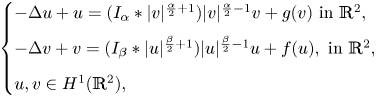
Motivated by the aforementioned papers, this work is devoted to studying the following class of Hamiltonian-Choquard-type systems with double critical growth
 \[ (P)\begin{cases} -\Delta u + u= (I_{\alpha} \ast |v|^{\frac{\alpha}{2}+1})|v|^{\frac{\alpha}{2}-1}v + g(v) \text{ in } \mathbb{R}^{2},\\ - \Delta v + v= (I_{\beta} \ast |u|^{\frac{\beta}{2}+1})|u|^{\frac{\beta}{2}-1}u + f(u), \text{ in } \mathbb{R}^{2},\\ u,v \in H^{1}(\mathbb{R}^{2}), \end{cases} \]
where,  $f,\,g \in C^{1}(\mathbb {R}^{2})$ has exponential critical growth and
 $I_{\alpha }$ and
 $I_{\beta }$ are the Riesz potentials of order
 $\alpha \in (0,\,2)$ and
 $\beta \in (0,\,2)$, respectively, defined at each point
 $x \in \mathbb {R}^{2}\setminus \lbrace 0 \rbrace$ by
 \[ I_{\alpha}(x) = \frac{A_{\alpha}}{|x|^{2-\alpha}}, \hbox{ with } A_{\alpha} = \frac{\Gamma\left(\frac{2-\alpha}{2} \right)}{2^{\alpha}\pi\Gamma\left(\frac{\alpha}{2}\right)} \]
and
 \[ I_{\beta}(x) = \frac{A_{\beta}}{|x|^{2-\beta}}, \hbox{ with } A_{\beta} = \frac{\Gamma\left(\frac{2-\beta}{2} \right)}{2^{\beta}\pi\Gamma\left(\frac{\beta}{2}\right)}, \]
where  $\Gamma$ represents the gamma function.
Systems of the type,
 \[ \begin{cases} -\Delta u + u= g(v) \text{ in } \mathbb{R}^{2},\\ -\Delta v + v= f(u) \text{ in } \mathbb{R}^{2},\\ u,v \in H^{1}(\mathbb{R}^{2}), \end{cases} \]
are known as Hamiltonian systems, and one complication that arises when studying such elliptic systems via variational methods is that the energy functional is strongly indefinite, that is, its quadratic part is both coercive and anti-coercive in infinite dimensional subspaces of the energy space. Readers interested in this subject may consult [Reference de Figueiredo, do Ó and Ruf5, Reference de Figueiredo and Yang7, Reference Li and Yang12] and the references therein.
Hamiltonian elliptic systems with nonlocal nonlinearity of the Choquard type were studied by the authors in [Reference Maia and Miyagaki16], who used approximation methods, combined with Linking arguments, to show the existence of solutions for
 \[ \begin{cases} -\Delta u + V(x)u= (|x|^{-\alpha} \ast G(v))g(v), \text{ in } \mathbb{R}^{2},\\ - \Delta v + V(x)v= (|x|^{-\alpha} \ast F(u))f(u), \text{ in } \mathbb{R}^{2},\\ u,v \in H^{1}(\mathbb{R}^{2}), \end{cases} \]
where  $f,\,g$ has exponential growth and
 $V$ is a potential defined in such way that the embedding
 $H^{1}(\mathbb {R}^{2})\hookrightarrow L^{p}(\mathbb {R}^{2})$, is compact for all
 $p\geq 2$.
In the present work, new questions and problems are addressed. The first and most natural question involves the nonexistence of a result for  $(P)$ when
 $f=g=0$; for this problem, we will use arguments similar to those in [Reference Korman11] to obtain a Pohozaev-type identity. When
 $f,\,g \neq 0$, the major difficulty will come in how to handle the non-local character of the nonlinearity, the strongly indefinite energy functional and the lack of compactness inherent to the double critical growth and the space
 $\mathbb {R}^{N}$ to guarantee the existence of solution for
 $(P)$; note that the arguments used in [Reference Maia and Miyagaki16] cannot be applied here since we do not have the compact embedding
 $H^{1}(\mathbb {R}^{2})\hookrightarrow L^{p}(\mathbb {R}^{2})$ (
 $p\geq 2$). Hence, to overcome these difficulties, we will adapt some arguments from [Reference Chen, Tang and Wei2] and [Reference de Figueiredo, do Ó and Zhang4] based on the minimization techniques in the generalized Nehari manifold introduced by Pankov in [Reference Pankov18].
Before presenting our main results, we state the following conditions:
(H 0)
 $f,\, g \in C^{1}(\mathbb {R}^{2})$ have $\omega$-exponential growth with the critical exponent $\omega _{0}$, that is,
and\[ \displaystyle\lim_{s\rightarrow +\infty}\frac{f(s)}{e^{\omega s^{2}}}=\begin{cases} 0, \forall \omega > \omega_{0}\\ + \infty , \forall \omega < \omega_{0} \end{cases} \]
\[ \displaystyle\lim_{s\rightarrow +\infty}\frac{g(s)}{e^{\omega s^{2}}}=\begin{cases} 0, \forall \omega > \omega_{0}\\ + \infty , \forall \omega < \omega_{0}; \end{cases} \]
(H 1)
$\lim _{s \rightarrow 0^{+}}f(s)s^{-1} = \lim _{s \rightarrow 0^{+}}g(s)s^{-1}=0$;(H 2) there exists
$2 < \theta \leq \min \lbrace \alpha + 2,\, \beta + 2\rbrace$ such that for all $s > 0$
where\[ 0< \theta F(s) \leq s f(s) \text{ and }0< \theta G(s) \leq s g(s), \]
$F(s)= \int _{0}^{s}f(\tau )d\tau$ and $G(t)=\int _{0}^{t}g(\tau )d\tau$;(H 3) there exist constants
$s_{0},\, M_{0} > 0$ such that for all $s \geq s_{0}$
\[ 0 < F(s)\leq M_{0}f(s) \text{ and }0 < G(s) \leq M_{0}g(s); \]
(H 4) there exist constants
$2< p < 4$ and $C_{p}>0$ such that, for all $s \geq 0$,
where\[ F(s),G(s) \geq C_{p}s^{p}, \]
$C_{p}$ is defined in § 5;(H 5) the maps
$s\mapsto \dfrac {f(s)}{s}$ and $s\mapsto \dfrac {g(s)}{s}$ are strictly increasing $\forall s >0$.


Throughout the text, we assume that  $f(s) = g(s) = 0$ for
 $s \leq 0$ and
 $F(s)=G(s)=0$ for
 $s \leq 0$.
Observe that for  $\omega > \omega _{0}$ given by
 $(H_{0})$ and
 $q \geq 1$, it follows from
 $(H_{0})$ and
 $(H_{1})$, for any given
 $\varepsilon > 0$, there exists constants
 $b_{1},\, b_{2} > 0$ such that
 \begin{equation} f(s),g(s) \leq \varepsilon|s| + b_{1}|s|^{q-1}(e^{\omega s^{2}}-1), \text{ for all } s \in \mathbb{R} \end{equation}
and
 \begin{equation} F(s),G(s) \leq \frac{\varepsilon}{2}|s|^{2} + b_{2}|s|^{q}(e^{\omega s^{2}}-1), \text{ for all } s \in \mathbb{R}. \end{equation}
A simple example of a function that verifies  $(H_{0})-(H_{5})$ is
 $f(s) = C_{p}|s|^{p-2}s + 2s(e^{s^{2}}- 1)$, for
 $s \in \mathbb {R}$.
Our main results follow.
Theorem 1.1 Nonexistence result
Let  $u,\,v\geq 0$ in
 $C^{2}(\mathbb {R}^{N})$ such that
 $(u,\,v)$ satisfies
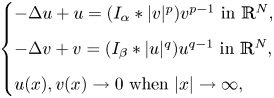
 \[ (P_{*})\begin{cases} -\Delta u + u= ( I_{\alpha} \ast |v|^{p'} )v^{p'-1} \text{ in } \mathbb{R}^{N}, p'>1, \\ -\Delta v + v= ( I_{\beta} \ast |u|^{q'} )u^{q'-1} \text{ in } \mathbb{R}^{N}, q'>1, \\ u(x),v(x) \rightarrow 0 \text{ when } |x|\rightarrow \infty, \end{cases} \]
then: i) if  $N\geq 3$ and
 \[ \frac{N+\alpha}{p'} + \frac{N+\beta}{q'} \leq 2(N-2), \]
we have that  $u=v=0$. In particular,
 $(P_{*})$ does not have a nontrivial non-negative solution for
 ${p'}\geq \frac {N+\alpha }{N-2}$ and
 ${q'}\geq \frac {N+\beta }{N-2}$.
ii) if  $N = 2$ and
 \[ \frac{N+\alpha}{p'} + \frac{N+\beta}{q'} \geq 2N, \]
we have that  $u=v=0$. In particular,
 $(P_{*})$ does not have a nontrivial non-negative solution for
 $p'\leq \frac {\alpha }{N}+1$ and
 $q'\leq \frac {\beta }{N}+1$.
Theorem 1.2 Suppose that  $(H_{0})-(H_{5})$ holds; then the system
 $(P)$ has a nontrivial ground state weak solution.
Theorem 1.3 Suppose that  $(H_{0})-(H_{5})$ holds; then the system
 $(P)$ has a nontrivial non-negative weak solution.
The rest of paper is organized as follows. Section 2 contains some technical results and the variational formulation of the problem  $(P)$. In § 3, we prove theorem 1.1. Section 4 contains the definition of a generalized Nehari manifold and lists some properties related to the problem
 $(P)$. Subsequently, in § 5, we provide an estimate for the minimax level of problem
 $(P)$ and reveal some properties of the Palais-Smale sequences of the energy functional associated with
 $(P)$. Finally, in § 6, using the Ekeland principle and Lions’ lemma, we prove the existence of a solution for
 $(P)$.
2. Preliminary results and variational formulation
In this section, we set up the problem  $(P)$ variationally and state some results that will play a crucial role in proving our existence theorem. We start with the following Trudinger-Moser-type inequality in
 $H^{1}(\mathbb {R}^{2})$ defined by Cao [Reference Cao1].
Proposition 2.1 Trudinger-Moser inequality
If  $\omega >0$ and
 $u \in H^{1}(\mathbb {R}^{2}),$ then
 \[ \int_{\mathbb{R}^{2}}\left(e^{\omega |u|^{2}} -1 \right) <{+}\infty. \]
Moreover, if  $|\nabla u|^{2}_{2}\leq 1,$
 $|u|_{2}\leq M < \infty$ and
 $\omega < 4\pi ,$ then there exists
 $C(M,\,\omega ),$ such that
 \begin{equation} \int_{\mathbb{R}^{2}}\left(e^{\omega |u|^{2}} -1 \right) \leq C(M,\omega). \end{equation}
Since we are going to study the non-local-type-problems with the Riesz potential, we will need the famous Hardy-Littlewood-Sobolev inequality (see theorem 4.3, [Reference Lieb and Loss13]).
Proposition 2.2 Hardy–Littlewood–Sobolev Inequality
Let  $N \geq 1$,
 $\alpha \in (0,\,N)$ and
 $p \in (1,\,N/\alpha )$. Then for any
 $\varphi \in L^{p}(\mathbb {R}^{N})$,
 $(I_{\alpha } \ast \varphi ) \in L^{\frac {Np}{N-\alpha p}}(\mathbb {R}^{N})$ and
 \begin{equation} \int_{\mathbb{R}^{N}}|I_{\alpha} \ast \varphi|^{\frac{Np}{N-\alpha p}} \,{\rm d}x \leq C\left( \int_{\mathbb{R}^{N}}|\varphi|^{p} \,{\rm d}x \right)^{\frac{N}{N-\alpha p}}, \end{equation}
where the constant  $C > 0$ depends only on
 $\alpha ,\, N$ and
 $p$.
By the semi-group identity for the Riesz potential  $I_{\alpha } = I_{\alpha /2} \ast I_{\alpha /2}$ (corollary 5.10, [Reference Lieb and Loss13]), the Hardy–Littlewood–Sobolev inequality (HLS) can be rewritten as
 \begin{equation} \int_{\mathbb{R}^{N}}(I_{\alpha} \ast |u|^{p})|u|^{p}\,{\rm d}x = \int_{\mathbb{R}^{N}}|I_{\alpha/2} \ast |u|^{p}|^{2}\,{\rm d}x \leq C\left(\int_{\mathbb{R}^{N}}|u|^{\frac{2Np}{N+\alpha}}\,{\rm d}x\right)^{\frac{\alpha}{N}+1}. \end{equation}
The integral in (2.2) is well defined in  $H^{1}(\mathbb {R}^{N})$ if and only if
 \[ \frac{\alpha}{N+1} \leq p \leq \frac{N+\alpha}{(N-2)_{+}}. \]
This statement justifies the nomenclature lower and upper critical growth.
As an immediate consequence of proposition 2.2, we have the following estimates
Corollary 2.3 Let  $u,\,v \in H^{1}(\mathbb {R}^{2})$ and
 $\alpha ,\,\beta \in (0,\,2),$ then
 \[ \left\vert\int_{\mathbb{R}^{2}} \left( I_\beta \ast |u|^{\beta/2+1}\right) u^{\frac{\beta}{2}} v \,{\rm d}x \right\vert\leq C_{\beta}|u|^{\beta+1}_{2}|v|_{2} \]
and
 \[ \left\vert \int_{\mathbb{R}^{2}} \left( I_\alpha \ast |v|^{\alpha/2+1}\right) |v|^{\frac{\alpha}{2}} |u|\,{\rm d}x \right\vert\leq C_{\alpha}|v|_{2}^{\beta+1}|u|_{2}, \]
where the constants  $C_{\beta } > 0$ and
 $C_{\alpha } > 0$ depend only on the orders
 $\beta$ and
 $\alpha ,$ respectively.
Proof. Set
 \[ p=\dfrac{4}{\beta +2}, \quad q=\dfrac{4}{2-\beta}, \ r=\dfrac{4}{\beta} \text{ and }\frac{1}{q'}= \frac{1}{2}+\frac{1}{r}. \]
Since  $u^{\frac {\beta }{2}+1} \in L^{\frac {4}{\beta +2}}(\mathbb {R}^{2})$, using proposition 2.2, we have that
 $(I_\beta \ast |u|^{\beta /2+1}) \in L^{q}(\mathbb {R}^{2})$. Noticing that
 $1/q+1/q'=1$ and applying Hölder's inequality, we obtain
 \[ \int_{\mathbb{R}^{2}} \left( I_\beta \ast |u|^{\beta/2+1}\right) |u|^{\frac{\beta}{2}} |v| \,{\rm d}x \leq | I_\beta \ast |u|^{\beta/2+1} |_{q} | |u|^{\beta/2}|v||_{q'}. \]
Then, from (HLS) and the generalized Hölder's inequality, it follows that
 \begin{align*} | I_\beta \ast
|u|^{\beta/2+1} |_{q} | |u|^{\beta/2}|v||_{q'} &\leq
C_{\beta} | |u|^{\beta/2+1}|_{p} | |u|^{\beta/2}|v| |_{q'} \\
&\leq | u|_{2}^{(\beta+2)/2} | |u|^{\beta/2}|_{r} | v|_{2} =
C_{\beta} | u|_{2}^{(\beta+2)/2} | u|_{2}^{\beta/2} |
v|_{2}. \end{align*}
Thus,
 \[ \int_{\mathbb{R}^{2}} \left( I_\beta \ast |u|^{\beta/2+1}\right) |u|^{\frac{\beta}{2}} |v| \,{\rm d}x \leq C_{\beta}|u|^{\beta+1}_{2}|v|_{2}. \]
Analogously,
 \[ \int_{\mathbb{R}^{2}} \left( I_\alpha \ast |v|^{\alpha/2+1}\right) |v|^{\frac{\alpha}{2}} |u|\,{\rm d}x \leq C_{\alpha}|v|_{2}^{\alpha+1}|u|_{2}.\]
□
Taking  $u=v$ in the corollary above, we obtain
 \begin{equation} \int_{\mathbb{R}^{2}}(I_{\beta} \ast |u|^{\frac{\beta}{2}+1})|u|^{\frac{\beta}{2}+1}\,{\rm d}x \leq C_{\beta}\left(\int_{\mathbb{R}^{2}}|u|^{2}\,{\rm d}x \right)^{\frac{\beta}{2}+1} \end{equation}
and
 \begin{equation} \int(I_{\alpha} \ast |v|^{\frac{\alpha}{2}+1})|v|^{\frac{\alpha}{2}+1}\,{\rm d}x \leq C_{\alpha}\left(\int_{\mathbb{R}^{2}}|v|^{2}\,{\rm d}x \right)^{\frac{\alpha}{2}+1}. \end{equation}
These estimates can be restated in terms of the minimizers of the following minimization problems.
 \begin{equation} S_{\beta} = \inf \left\lbrace \int_{\mathbb{R}^{2}}|u|^{2} \,{\rm d}x; u \in H^{1}(\mathbb{R}^{2}) \hbox{ and } \int_{\mathbb{R}^{2}}(I_{\beta} \ast |u|^{\frac{\beta}{2}+1})|u|^{\frac{\beta}{2}+1}\,{\rm d}x = 1 \right\rbrace \end{equation}
and
 \begin{equation} S_{\alpha} = \inf \left\lbrace \int_{\mathbb{R}^{2}}|v|^{2} \,{\rm d}x; v \in H^{1}(\mathbb{R}^{2}) \hbox{ and } \int_{\mathbb{R}^{2}}(I_{\alpha} \ast |v|^{\frac{\alpha}{2}+1})|v|^{\frac{\alpha}{2}+1}\,{\rm d}x = 1 \right\rbrace \end{equation}
Remark 2.4 In view of theorem 4.3 in [Reference Lieb and Loss13], there exist functions  $U,\,V \in H^{1}(\mathbb {R}^{2})$ such that the sharp constants
 $S_{\beta }$ and
 $S_{\alpha }$ are achieved by
 $U$ and
 $V$, respectively.
Throughout this work, we consider the space  $H^{1}(\mathbb {R}^{2})$ with the usual inner product and norm
 \[ \langle u, v \rangle = \int_{\mathbb{R}^{2}} \nabla u \nabla v \,{\rm d}x + \int_{\mathbb{R}^{2}}uv \,{\rm d}x \hbox{ and } ||u||^{2} = \langle u, u \rangle \]
Let us define the functional  $J$ associated with the problem
 $(P)$, where
 $J: E \rightarrow \mathbb {R}$ is given by
 \begin{align*} J(u,v)&= \langle u,
v \rangle -
\frac{1}{2+\alpha}\int_{\mathbb{R}^{2}}(I_{\alpha} \ast
|v|^{\frac{\alpha}{2}+1})|v|^{\frac{\alpha}{2}+1}\,{\rm d}x \\
&\quad - \frac{1}{2+\beta}\int_{\mathbb{R}^{2}}(I_{\beta} \ast
|u|^{\frac{\beta}{2}+1})|u|^{\frac{\beta}{2}+1}\,{\rm d}x
- \int_{\mathbb{R}^{2}}[F(u)+G(v)]\,{\rm d}x,
\end{align*}
where  $E= H^{1}(\mathbb {R}^{2}) \times H^{1}(\mathbb {R}^{2})$ is a reflexive Banach space equipped with the norm
 \[ ||(u,v)||_{E} = ||u||^{2} + ||v||^{2}, \]
where  $||.||$ denotes the norm in
 $H^{1}(\mathbb {R}^{2})$.
Using proposition 2.1, (2.3) and (2.4), it is possible to show that  $J$ is well defined. Moreover, using standard arguments, we can show that
 $J$ is continuously differentiable, where
 \begin{align*} J'(u,v)(\varphi,\psi) & = \langle u, \psi\rangle + \langle v, \varphi \rangle - \int(I_{\alpha} \ast |v|^{\frac{\alpha}{2}+1})|v|^{\frac{\alpha}{2}}\psi \,{\rm d}x\\ &\quad- \int_{\mathbb{R}^{2}}(I_{\beta} \ast |u|^{\frac{\beta}{2}+1})|u|^{\frac{\beta}{2}}\varphi \,{\rm d}x - \int_{\mathbb{R}^{2}}[f(u)\psi + g(v)\varphi]\,{\rm d}x \end{align*}
for all  $(\varphi ,\,\psi ) \in E$. Thus, a critical point of
 $J$ turns out to be a weak solution of system
 $(P)$, and vice versa.
3. Nonexistence result
As mentioned earlier, in the context of the Choquard equations, in [Reference Moroz and Van Schaftingen17], Moroz and Van Schaftingen established that if  $u \in W^{2,2}_{loc}(\mathbb {R}^{N}) \cap W^{1,\frac {2N}{N+\alpha }p}(\mathbb {R}^{N})$ solves
 $(Ch)$ and
 \[ \frac{1}{p}\leq \frac{N-2}{N+\alpha} \hbox{ or } \frac{1}{p}\geq \frac{N}{N+\alpha}, \]
then  $u=0$. Our aim in this section is to prove theorem 1.1 and then to extend (in a certain sense) the nonexistence of a result discovered in [Reference Moroz and Van Schaftingen17] for Hamiltonian Choquard equations.
In what follows, we define the auxiliary functions that will play a key role in this section. For this endeavour, consider  $\varphi \in C^{\infty }_{0}(\mathbb {R}^{N},\, [0,\,1])$ to be such that
 \[ \varphi(x) =\begin{cases} 1 \text{ for } x \in B(0;1), \\ 0 \text{ for } x \in \mathbb{R}^{N}\setminus B(0;2). \end{cases} \]
We set
 \[ \tilde{u}_{\lambda}(x) = \varphi(\lambda x)x \cdot \nabla u(x) \text{ and } \tilde{v}_{\lambda}(x) = \varphi(\lambda x)x \cdot \nabla v(x), \]
where the symbol  $\cdot$ stands for the inner product in
 $\mathbb {R}^{N}$.
Lemma 3.1 Let  $u,\,v \geq 0$ be
 $C^{2}(\mathbb {R}^{N})$ and
 $p,\,q>0$. The following hold:
(i)
$\lim _{\lambda \rightarrow 0}(\int _{\mathbb {R}^{N}}u\tilde {v}_{\lambda } + \int _{\mathbb {R}^{N}}v \tilde {u}_{\lambda }) = - N \int _{\mathbb {R}^{N}}uv;$(ii)
$\lim _{\lambda \rightarrow 0} \int _{\mathbb {R}^{N}}(I_{\alpha } \ast |v|^{p+1})|v|^{p}\tilde {v}_{\lambda } = -\frac {N+\alpha }{2(p+1)}\int _{\mathbb {R}^{N}}(I_{\alpha } \ast |v|^{p+1})|v|^{p+1};$(iii)
$\lim _{\lambda \rightarrow 0} \int _{\mathbb {R}^{N}}(I_{\beta } \ast |u|^{q+1})|u|^{q}\tilde {u}_{\lambda } = -\frac {N+\beta }{2(q+1)}\int _{\mathbb {R}^{N}}(I_{\beta } \ast |u|^{q+1})|u|^{q+1}$.


Proof. The proofs of items  $(ii)$ and
 $(iii)$ are contained in [Reference Moroz and Van Schaftingen17], proposition 3.1. We just need to prove item
 $(i)$. We observe that
 \begin{align*} \int_{\mathbb{R}^{N}}u\tilde{v}_{\lambda} + \int_{\mathbb{R}^{N}}v \tilde{u}_{\lambda} & = \int_{\mathbb{R}^{N}} u ( \varphi(\lambda x)x \cdot \nabla v(x)) + \int_{\mathbb{R}^{N}}v ( \varphi(\lambda x)x \cdot \nabla u(x)) \\ & = \int_{\mathbb{R}^{N}}u \sum_{i=1}^{N}\varphi(\lambda x)x_{i}v_{x_{i}} + \int_{\mathbb{R}^{N}}v \sum_{i=1}^{N}\varphi(\lambda x)x_{i}u_{x_{i}} \\ & = \int_{\mathbb{R}^{N}}\sum_{i=1}^{N}\varphi(\lambda x)x_{i}(uv_{x_{i}} + vu_{x_{i}}) \\ & = \int_{\mathbb{R}^{N}}\sum_{i=1}^{N}\varphi(\lambda x)x_{i}(uv)_{x_{i}}. \end{align*}
From the above equality and Green's identities, we get
 \begin{align*}
\int_{\mathbb{R}^{N}}u\tilde{v}_{\lambda} +
\int_{\mathbb{R}^{N}}v
\tilde{u}_{\lambda}&=\int_{\mathbb{R}^{N}}
\sum_{i=1}^{N}(uv)(\varphi(\lambda x)x_{i})_{x_{i}}\\
& ={-}\int_{\mathbb{R}^{N}} \sum_{i=1}^{N}(uv)(\lambda
\varphi(\lambda x)_{x_{i}}x_{i} + N\varphi(\lambda x)) \\ &
={-}\int_{\mathbb{R}^{N}}(N \varphi(\lambda x)) + \lambda x
\cdot \nabla \varphi(\lambda x))uv
\end{align*}
By Lebesgue's dominated convergence theorem, the following holds
 \[ \lim_{\lambda \rightarrow 0}\left(\int_{\mathbb{R}^{N}}u\tilde{v}_{\lambda} + \int_{\mathbb{R}^{N}}v \tilde{u}_{\lambda}\right) ={-} N \int_{\mathbb{R}^{N}}uv. \]
This concludes the proof.□
Lemma 3.2 Let  $u,\,v \in C^{2}(\mathbb {R}^{N})$ and
 $p',\,q'>1$. If
 \[ (P_{*})\begin{cases} -\Delta u + u= ( I_{\alpha} \ast |v|^{p'} )v^{p'-1} \text{ in } \mathbb{R}^{N}, \\ -\Delta v + v= ( I_{\beta} \ast |u|^{q'} )u^{q'-1} \text{ in } \mathbb{R}^{N} \\ u, v > 0, \quad u(x),v(x) \rightarrow 0 \text{ when } |x|\rightarrow \infty, \end{cases} \]
then the following identity is true
 \begin{align}
&\left(\frac{N+\alpha}{p'} -(N-2)
\right)\int_{\mathbb{R}^{N}}(I_{\alpha} \ast
v^{p'})v^{p'}\,{{\rm d}}x\notag\\
&\qquad + \left( \frac{N+\beta}{q'}-(N-
2)\right)\int_{\mathbb{R}^{N}}(I_{\beta} \ast
u^{q'})u^{q'}\,{{\rm d}}x \notag\\ & \quad =
(N+2)\int_{\mathbb{R}^{N}}uv\,{{\rm d}}x. \end{align}
Proof. In this proof, we shall set  $p'=p+1$ and
 $q'=q+1$, where
 $p,\,q > 0$. We believe that making this simple change will allow the reader to follow the technicalities presented below more easily.
Recall that
 \[ \tilde{u}_{\lambda} (x) = \varphi(\lambda x)x \cdot \nabla u(x) \text{ and } \tilde{v}_{\lambda} (x) = \varphi(\lambda x)x \cdot \nabla v(x). \]
Hence, since  $(u,\,v)$ solves
 $(P_{*})$, we can check that
 \begin{align} & v
\Delta \tilde{u}_{\lambda} + v\mathcal{H}(\lambda,v) +
\varphi(\lambda x)\sum_{i=1}^{N} \left( (p+1)(I_{\alpha}
\ast v^{p}v_{x_{i}})v^{p+1}x_{i} + p(I_{\alpha} \ast
v^{p+1})v^{p}v_{x_{i}}x_{i}\right) \notag\\
&\quad={-}2(I_{\alpha} \ast v^{p+1})v^{p+1}\varphi(\lambda
x) + uv\varphi(\lambda x), \end{align}
where
 \begin{align*}
\mathcal{H}(\lambda,w) &= \lambda^{2}(\Delta \varphi(\lambda
x))\nabla w \cdot x + \lambda
\sum_{i=1}^{N}\left(\frac{\partial \varphi(\lambda
x)}{\partial x_{i}} \frac{\partial(\nabla w \cdot
x)}{\partial x_{i}} \right)\\
&\quad + \lambda \varphi(\lambda
x)\sum_{i=1}^{N}\left( \frac{\partial^{2} w}{\partial
x_{i}^{2}}x_{i} + \frac{\partial w}{\partial x_{i}}\right)
\end{align*}
By performing some calculations, we see that
 \begin{align*}
&(p+1)(I_{\alpha} \ast v^{p}v_{x_{i}})v^{p+1}x_{i} +
p(I_{\alpha} \ast v^{p+1})v^{p}v_{x_{i}}x_{i}\\
&\quad =
\frac{\partial}{\partial x_{i}}[(I_{\alpha}\ast
v^{p+1})v^{p+1}x_{i}] - (I_{\alpha}\ast v^{p+1})v^{p+1}
- (I_{\alpha} \ast v^{p+1})v^{p}v_{x_{i}}x_{i}.
\end{align*}
Hence, by integrating (3.2) over  $\mathbb {R}^{N}$, we obtain
 \begin{align}
&\int_{\mathbb{R}^{N}} v \Delta \tilde{u}_{\lambda} \,{\rm
d}x + \int_{\mathbb{R}^{N}}v\mathcal{H}(\lambda,v)\,{\rm
d}x +
\int_{\mathbb{R}^{N}}\sum_{i=1}^{N}\frac{\partial}{\partial
x_{i}}[(I_{\alpha}\ast v^{p+1})v^{p+1}x_{i}]\varphi(\lambda
x) \,{\rm d}x \notag\\ &\qquad-
N\int_{\mathbb{R}^{N}}(I_{\alpha}\ast v^{p+1})v^{p+1}
\varphi(\lambda x)\,{\rm d}x -
\int_{\mathbb{R}^{N}}\sum_{i=1}^{N}(I_{\alpha} \ast
v^{p+1})v^{p}v_{x_{i}}x_{i}\varphi(\lambda x) \,{\rm d}x
\nonumber\\ &\quad={-}2\int_{\mathbb{R}^{N}}(I_{\alpha}
\ast v^{p+1})v^{p+1}\varphi(\lambda x) \,{\rm d}x
+ \int_{\mathbb{R}^{N}}uv\varphi(\lambda x) \,{\rm d}x
\end{align}
Analogously,
 \begin{align}
&\int_{\mathbb{R}^{N}} u \Delta \tilde{v}_{\lambda} \,{\rm
d}x + \int_{\mathbb{R}^{N}}u\mathcal{H}(\lambda,u)\,{\rm
d}x +
\int_{\mathbb{R}^{N}}\sum_{i=1}^{N}\frac{\partial}{\partial
x_{i}}[(I_{\beta}\ast u^{q+1})u^{q+1}x_{i}]\varphi(\lambda
x) \,{\rm d}x \notag\\ &\qquad-
N\int_{\mathbb{R}^{N}}(I_{\beta}\ast u^{q+1})v^{q+1}
\varphi(\lambda x)\,{\rm d}x -
\int_{\mathbb{R}^{N}}\sum_{i=1}^{N}(I_{\beta} \ast
u^{q+1})u^{q}u_{x_{i}}x_{i}\varphi(\lambda x) \,{\rm d}x \notag\\
&\quad={-}2\int_{\mathbb{R}^{N}}(I_{\beta} \ast
u^{q+1})u^{q+1}\varphi(\lambda) x\,{\rm d}x
+ \int_{\mathbb{R}^{N}}uv\varphi(\lambda x) \,{\rm d}x
\end{align}
We multiply the first line in  $(P_{*})$ by
 $\tilde {v}_{\lambda }$, integrate and subtract from (3.3) to obtain
 \begin{align}
&\int_{\mathbb{R}^{N}}\tilde{v}_{\lambda}\Delta u \,{\rm
d}x -\int_{\mathbb{R}^{N}}v \Delta
\tilde{u}_{\lambda}\,{\rm d}x
+\int_{\mathbb{R}^{N}}u\tilde{v}_{\lambda}\,{\rm d}x\notag\\
&\qquad +
2\int_{\mathbb{R}^{N}}(I_{\alpha} \ast
v^{p+1})v^{p}\tilde{v}_{\lambda} \,{\rm d}x -
\int_{\mathbb{R}^{N}}v\mathcal{H}(\lambda,v)\,{\rm d}x \notag\\
&\qquad+N\int_{\mathbb{R}^{N}}(I_{\alpha}\ast
v^{p+1})v^{p+1} \varphi(\lambda x)\,{\rm d}x -
\int_{\mathbb{R}^{N}}\varphi(\lambda x)
\frac{\partial}{\partial x}(I_{\alpha} \ast v^{p+1})v^{p+1}
\,{\rm d}x \nonumber\\
&\quad=2\int_{\mathbb{R}^{N}}(I_{\alpha} \ast
v^{p+1})v^{p+1}\varphi(\lambda x)\,{\rm d}x -
\int_{\mathbb{R}^{N}}uv\varphi(\lambda x)\,{\rm d}x.
\end{align}
In a similar way, we multiply the second line in  $(P_{*})$ by
 $\tilde {u}_{\lambda }$, integrate and subtract from (3.4) to obtain
 \begin{align}
&\int_{\mathbb{R}^{N}}\tilde{u}_{\lambda}\Delta v \,{\rm
d}x -\int_{\mathbb{R}^{N}}u \Delta
\tilde{v}_{\lambda}\,{\rm d}x
+\int_{\mathbb{R}^{N}}u\tilde{v}_{\lambda}\,{\rm d}x\notag\\
&\qquad +
2\int_{\mathbb{R}^{N}}(I_{\beta} \ast
u^{q+1})u^{q}\tilde{u}_{\lambda} \,{\rm d}x -
\int_{\mathbb{R}^{N}}u\mathcal{H}(\lambda,u)\,{\rm d}x \notag\\
&\qquad+N\int_{\mathbb{R}^{N}}(I_{\beta}\ast
u^{q+1})u^{q+1} \varphi(\lambda x)\,{\rm d}x -
\int_{\mathbb{R}^{N}}\varphi(\lambda x)
\frac{\partial}{\partial x}(I_{\beta} \ast u^{q+1})u^{q+1}
\,{\rm d}x \nonumber\\
&\quad=2\int_{\mathbb{R}^{N}}(I_{\beta} \ast
u^{q+1})u^{q+1}\varphi(\lambda x)\,{\rm d}x -
\int_{\mathbb{R}^{N}}uv\varphi(\lambda x) \,{\rm d}x. \end{align}
Now, we observe that
 \[ (\tilde{v}_{\lambda}\Delta u - v \Delta \tilde{u}_{\lambda}) + (\tilde{u}_{\lambda}\Delta v - u \Delta \tilde{v}_{\lambda}) = \sum_{i=1}^{N}\left[ u_{x_{i}}\tilde{v}_{\lambda} - (\tilde{u}_{\lambda})_{x_{i}}v + v_{x_{i}}\tilde{u}_{\lambda} - (\tilde{v}_{\lambda})_{x_{i}}u \right]_{x_{i}}. \]
Consequently, adding (3.5) and (3.6), using Fubini-Tonelli Theorem and recalling that  $u(x),\,v(x) \rightarrow 0$ when
 $|x|\rightarrow \infty$, we get
 \begin{align*}
&\int_{\mathbb{R}^{N}}u\tilde{v}_{\lambda}\,{\rm d}x -
\int_{\mathbb{R}^{N}}v\mathcal{H}(\lambda,v)\,{\rm d}x +
2\int_{\mathbb{R}^{N}}(I_{\alpha} \ast
v^{p+1})v^{p}\tilde{v}_{\lambda}\,{\rm d}x \\
&\qquad +N\int_{\mathbb{R}^{N}}(I_{\alpha}\ast v^{p+1})v^{p+1}
\varphi(\lambda x)\,{\rm d}x \\
&\int_{\mathbb{R}^{N}}v\tilde{u}_{\lambda}\,{\rm d}x -
\int_{\mathbb{R}^{N}}u\mathcal{H}(\lambda,u)\,{\rm d}x +
2\int_{\mathbb{R}^{N}}(I_{\beta} \ast
u^{q+1})u^{q}\tilde{u}_{\lambda}\,{\rm d}x \\
&\qquad +N\int_{\mathbb{R}^{N}}(I_{\beta}\ast u^{q+1})u^{q+1}
\varphi(\lambda x)\,{\rm d}x \\ &\quad=
2\int_{\mathbb{R}^{N}}(I_{\alpha} \ast
v^{p+1})v^{p+1}\,{\rm d}x +
2\int_{\mathbb{R}^{N}}(I_{\beta} \ast u^{q+1})u^{q+1}\,{\rm
d}x - 2\int_{\mathbb{R}^{N}}uv\varphi(\lambda x) \,{\rm
d}x. \end{align*}
Taking  $\lambda \rightarrow 0$ and using lemma 3.1, we finally obtain
 \begin{align}
&-N\int_{\mathbb{R}^{N}}uv \,{\rm d}x - \left(
\frac{N+\alpha}{p+1}\right)\int_{\mathbb{R}^{N}}(I_{\alpha}
\ast v^{p+1})v^{p+1}\,{\rm d}x\notag\\
&\qquad - \left(
\frac{N+\beta}{q+1}\right)\int_{\mathbb{R}^{N}}(I_{\beta}
\ast u^{q+1})u^{q+1}\,{\rm d}x \notag\\ &\qquad+
N\int_{\mathbb{R}^{N}}(I_{\alpha} \ast
v^{p+1})v^{p+1}\,{\rm d}x +N
\int_{\mathbb{R}^{N}}(I_{\beta} \ast u^{q+1})u^{q+1}\,{\rm
d}x \nonumber\\ &\quad=2\int_{\mathbb{R}^{N}}(I_{\alpha}
\ast v^{p+1})v^{p+1}\,{\rm d}x +
2\int_{\mathbb{R}^{N}}(I_{\beta} \ast u^{q+1})u^{q+1}\,{\rm
d}x - 2\int_{\mathbb{R}^{N}}uv\,{\rm d}x, \end{align}
which is equivalent to
 \begin{align*}
&\left(\frac{N+\alpha}{p+1} -(N-2)
\right)\int_{\mathbb{R}^{N}}(I_{\alpha} \ast
v^{p+1})v^{p+1}\,{\rm d}x\\\
&\qquad + \left( \frac{N+\beta}{q+1}-(N-
2)\right)\int_{\mathbb{R}^{N}}(I_{\beta} \ast
u^{q+1})u^{q+1}\,{\rm d}x \\ &\quad=
(N+2)\int_{\mathbb{R}^{N}}uv\,{\rm d}x.
\end{align*}
Therefore, the identity (3.1) is proved.□
Proof of theorem 1.1. Proof of theorem 1.1
Case 1:  $N\geq 3$ and
 \[ \frac{N+\alpha}{p'} + \frac{N+\beta}{q'} \leq 2(N-2), \]
Let  $(u,\,v) \in C^{2}(\mathbb {R}^{N})$ be a non-negative solution for
 $(P_{*})$ and suppose, without loss of generality, that
 \[ \int_{\mathbb{R}^{N}}(I_{\alpha} \ast v^{p'})v^{p'}\,{\rm d}x \geq \int_{\mathbb{R}^{N}}(I_{\beta} \ast u^{q'})u^{q'}\,{\rm d}x. \]
By the strong maximum principle, either  $u>0$ or
 $u = 0$. Therefore, by identity (3.1) we have
 \[ \left(\frac{N+\alpha}{p'} + \frac{N+\beta}{q'} -2(N-2) \right)\int_{\mathbb{R}^{N}}(I_{\alpha} \ast v^{p'})v^{p'}\,{\rm d}x \geq (N+2)\int_{\mathbb{R}^{N}}uv\,{\rm d}x \geq 0, \]
which implies that if  $\frac {N+\alpha }{p'} + \frac {N+\beta }{q'} \leq 2(N-2)$, then
 $u=v=0$, thus proving the case.
Case 2:  $N = 2$ and
 \[ \frac{N+\alpha}{p'} + \frac{N+\beta}{q'} \geq 2N. \]
Again, we consider  $(u,\,v) \in C^{2}(\mathbb {R}^{N})$ to be a non-negative solution for
 $(P_{*})$. If
 $N=2$, the identity (3.1) implies that
 $\int _{\mathbb {R}^{2}}uv\textrm {d}x=0$ and consequently,
 \begin{equation} 2\langle u, v \rangle_{H^{1}(\mathbb{R}^{2})}= \int_{\mathbb{R}^{N}}(I_{\alpha} \ast v^{p'})v^{p'}\,{\rm d}x + \int_{\mathbb{R}^{N}}(I_{\beta} \ast u^{q'})u^{q'}\,{\rm d}x \geq 0.\end{equation}
Hence, we can rewrite (3.7) as
 \begin{align*}
&\left(\frac{N+\alpha}{p'} - N
\right)\int_{\mathbb{R}^{N}}(I_{\alpha} \ast
v^{p'})v^{p'}\,{\rm d}x + \left(\frac{N+\beta}{p'} - N
\right)\int_{\mathbb{R}^{N}}(I_{\beta} \ast
u^{q'})u^{q'}\,{\rm d}x\\
&\quad ={-} 4\langle u, v
\rangle_{H^{1}(\mathbb{R}^{2})} \leq 0. \end{align*}
Supposing, without loss of generality, that
 \[ \int_{\mathbb{R}^{N}}(I_{\alpha} \ast v^{p'})v^{p'}\,{\rm d}x \geq \int_{\mathbb{R}^{N}}(I_{\beta} \ast u^{q'})u^{q'}\,{\rm d}x, \]
we obtain
 \[ \left(\frac{N+\alpha}{p'} + \frac{N+\alpha}{p'} - 2N \right)\int_{\mathbb{R}^{N}}(I_{\beta} \ast u^{q'})u^{q'}\,{\rm d}x \leq{-} 4\langle u, v \rangle_{H^{1}(\mathbb{R}^{2})} \leq 0. \]
So, case 2 is demonstrated.□
4. Generalized Nehari manifold
Inspired by [Reference Pankov18], we define
 \[ E^{{\pm}}= \lbrace z=(u,v) \in E: v={\pm} u \rbrace. \]
Since
 \[ z = z^{+} + z^{-}= \frac{1}{2}(u+v,u+v) + \frac{1}{2}(u-v, v-u), \text{ where } z^{{\pm}} \in E^{{\pm}}, \]
we note that
 \begin{equation} E = E^{+} \oplus E^{-}. \end{equation}
The generalized Nehari manifold corresponding to  $J$ is defined by
 \[ \mathcal{N} = \lbrace z \in E\setminus E^{-}: J'(z)z=0 \text{ and } J'(z)w=0 \text{ for all } w \in E^{-} \rbrace, \]
for  $z=(u,\,v)$. Clearly, if
 $0 \neq z=(u,\,v) \in E$ and
 $J'(z)=0$, then, by
 $(H_{1})$ and
 $(H_{2})$, we have
 \begin{align*} J(z) &= J(z) - \frac{1}{\theta}J'(z)z \geq \left(\frac{1}{\theta} - \frac{1}{2+\alpha} \right)\int_{\mathbb{R}^{2}}(I_{\alpha} \ast |v|^{\frac{\alpha}{2}+1})|v|^{\frac{\alpha}{2}+1}\,{\rm d}x \\ &\quad+ \left(\frac{1}{\theta} - \frac{1}{2+\beta} \right)\int_{\mathbb{R}^{2}}(I_{\beta} \ast |u|^{\frac{\beta}{2}+1})|u|^{\frac{\beta}{2}+1}\,{\rm d}x \\ &\quad+ \int_{\mathbb{R}^{2}}\left[\left( \frac{1}{\theta}f(u)u - F(u) \right) + \left( \frac{1}{\theta}g(v)v - G(v) \right)\right]\,{\rm d}x \geq 0. \end{align*}
On the other hand, if  $z=(u,\,-u) \in E^{-}$, we obtain
 \begin{align*} J(z) &= \langle u, - u \rangle - \int_{\mathbb{R}^{2}}[F(u) + G({-}u)] \\ &={-} ||u||^{2} - \int_{\mathbb{R}^{2}}[F(u) + G({-}u)] \leq 0. \end{align*}
Consequently, if  $z \in E$ is a nontrivial critical point of
 $J$, then
 $w \in E \setminus E^{-}$. Hence, every nontrivial critical point of
 $J$ belongs to
 $\mathcal {N}$.
We say that  $(u_{0},\,v_{0})$ is a ground state solution for
 $(P)$ if
 $(u,\,v)$ solves
 $(P)$ and
 \[ c_{0}= J(u_{0},v_{0}) = \inf_{(u,v) \in \mathcal{N}}J(u,v). \]
In the next results, we shall show that  $\mathcal {N}\neq \emptyset$ and provide a characterization for the minimax level
 $c_{0}$. To do so, for
 $z=(u,\,v) \in E \setminus E^{-}$, we set
 \[ \widehat{E}(z) = \mathbb{R}^{+}z \oplus E^{-} , \text{ where } \mathbb{R}^{+}= [0,+\infty). \]
Lemma 4.1 Under the hypotheses  $(H_{0})-(H_{5}),$ for each
 $z=(u,\,v) \in E \setminus E^{-},$ there exists
 $R = R(z) > 0$ such that
 \[ J(w) \leq 0 \hbox{ if } w \in \widehat{E}(z) \setminus B_{R}(0), \]
where  $B_{R}(0)= \lbrace z \in E; ||z|| \leq R \rbrace$.
Proof. The proof can be accomplished by following the same steps used in lemma 2.2 in [Reference de Figueiredo, do Ó and Zhang4]□
Proposition 4.2 Under the hypotheses  $(H_{0})-(H_{5}),$ we have:
(i) for any
$z \in \mathcal {N},$ $J_{|\widehat {E}(z)}$ admits a unique maximum point precisely at $z;$(ii) for any
$z \in E\setminus E^{-},$ the set $\widehat {E}(z)$ intersects $\mathcal {N}$ at exactly one point, which is the unique global maximum point of $J_{|\widehat {E}(z)}$.


Proof. (i) Let  $z= (u,\,v) \in \mathcal {N}$ and
 $w \in \widehat {E}(z)$. By the definition of
 $\widehat {E}(z)$,
 $w$ can be written as
 $w=((1+s)u + e,\, (1+s)v -e)$, where
 $e \in H^{1}(\mathbb {R}^{2})$,
 $s\geq -1$. Since
 $z \in \mathcal {N}$, we have
 $J'(z)z=J'(z)(e,\,-e)=0$. Consequently,
 \begin{equation} J(w) = J(z) + \frac{s^{2}+2s}{2}J'(z)z + (1+s)J'(z)(e,-e). \end{equation}
Now, we set
 \begin{align*} \tilde{f}(u)&= \int_{\mathbb{R}^{2}}(I_{\beta} \ast |u|^{\frac{\beta}{2}+1} )|u|^{\frac{\beta}{2}}u\,{\rm d}x + \int_{\mathbb{R}^{2}}f(u)\,{\rm d}x,\\ \tilde{g}(v)&= \int_{\mathbb{R}^{2}}(I_{\alpha} \ast |v|^{\frac{\alpha}{2}+1} )|v|^{\frac{\alpha}{2}}v\,{\rm d}x + \int_{\mathbb{R}^{2}}g(v)\,{\rm d}x \end{align*}
as well as  $\tilde {F}(u) = \int _{0}^{u}\tilde {f}(s)ds$ and
 $\tilde {G}(v)=\int _{0}^{v}\tilde {g}(s)ds$.
Then, from (4.2), is possible to check that
 \begin{align*} J(w) &=
J(z) - ||e||^{2} +
\int_{\mathbb{R}^{2}}\tilde{f}(u)\left[s\left(\frac{s}{2}+1\right)u
+(1+s)e\right]\,{\rm d}x\\
&\quad +
\int_{\mathbb{R}^{2}}[\tilde{F}(u)-
\tilde{F}((1+s)u+e)]\,{\rm d}x \\ &\quad+
\int_{\mathbb{R}^{2}}\tilde{g}(v)\left[s\left(\frac{s}{2}+1\right)v
+(1+s)e\right]\,{\rm d}x +
\int_{\mathbb{R}^{2}}[\tilde{G}(v)-
\tilde{G}((1+s)u+e)]\,{\rm d}x. \end{align*}
By conditions  $(H_{2}),\, (H_{4})$ and
 $(H_{5})$, all the requirements of lemma 2.2 in [Reference Szulkin and Weth20] have been fulfilled. Now, if
 $su+e,\,sv-e\neq 0$, it follows that
 \[ \tilde{f}(u)\left[s\left(\frac{s}{2}+1\right)u +(1+s)e\right] +\tilde{F}(u)- \tilde{F}((1+s)u+e) < 0 \]
and
 \[ \tilde{g}(v)\left[s\left(\frac{s}{2}+1\right)v +(1+s)e\right] +\tilde{G}(v)- \tilde{G}((1+s)v+e) < 0. \]
From (4.2), we conclude that
 \[ J(w) \leq J(z), \text{ for all } w \in \widehat{E}(z), z\neq w. \]
On the other hand, if  $w \in \widehat {E}(z)$ is such that
 \[ J(w)=J(z), \]
then  $w=z$; otherwise, we would have
 $s\neq 0$ and
 $h \neq 0$, which implies that
 $J(w) < J(z)$. This proves item (i).
(ii) Since  $\widehat {E}(z) = \widehat {E}(z^{+})$, using item (i), it suffices to prove that
 $\mathcal {N} \cap \widehat {E}(z^{+})\neq \emptyset$ for any
 $z \in E \setminus E^{-}$. Without loss of generality, we assume that
 $z = (u,\, u) \in E^{+}$ and
 $||z||=1$. By lemma 4.1, we know that there exists
 $R>0$ sufficiently large such that
 \[ J(u,u)\leq 0 \text{ if } ||(u,u)|| > R. \]
On the other hand, from the growth conditions (1.2) (for  $q=2$) and inequalities (2.3) and (2.4), we obtain
 \begin{align*} J(tu,tu) &\geq t^{2}||u||^{2} - \frac{t^{\beta+2}}{\beta+2}C_{\beta}|u|_{2}^{\frac{2+\beta}{2}} - \frac{t^{\alpha+2}}{\alpha+2}C_{\alpha}|u|_{2}^{\frac{2+\alpha}{2}} \\ &\quad- {\varepsilon t^{2}}\int_{\mathbb{R}^{2}}|u|^{2} \,{\rm d}x - 2b_{2}t^{2}\left( \int_{\mathbb{R}^{2}}|u|^{2}(e^{\omega t u^{2}}-1)\,{\rm d}x \right). \end{align*}
Since  $||u||\leq 1$, we can pick
 $t>0$ such that
 $2\omega t < 4\pi$ and combine the Hölder and Trundinger-Moser inequalities (2.1) to get
 \[ \int_{\mathbb{R}^{2}}|u|^{2}(e^{\omega t u^{2}}-1)\,{\rm d}x \leq C(\omega)|u|_{2}, \]
Hence, using the above and the continuous embedding  $H^{1}(\mathbb {R}^{2})\hookrightarrow L^{2}(\mathbb {R}^{2})$, we can estimate
 \begin{align*}
J(tu,tu) &\geq t^{2}C|u|^{2}_{2} -
\frac{t^{\beta+2}}{\beta+2}\int_{\mathbb{R}^{2}}(I_{\beta}
\ast |u|^{\frac{\beta}{2}+1})|u|^{\frac{\beta}{2}+1}\,{\rm
d}x\\
&\quad -
\frac{t^{\alpha+2}}{\alpha+2}\int_{\mathbb{R}^{2}}(I_{\alpha}
\ast
|u|^{\frac{\alpha}{2}+1})|u|^{\frac{\alpha}{2}+1}\,{\rm d}x
\\ &\quad- {\varepsilon t^{2}}\int_{\mathbb{R}^{2}}|u|^{2}
\,{\rm d}x - 2b_{2}t^{2}|u|_{2}. \end{align*}
Note that  $\beta +2 >2$. Thus, for
 $t>0$ sufficiently small, we have that
 $J(tu,\,tu) >0$. Hence, item
 $(ii)$ is demonstrated.
As an immediate consequence of the last proposition, we have a characterization for the minimax level of the functional restricted to the generalized Nehari.
Corollary 4.3 The following holds
 \[ c_{0}= \inf_{\bar{z}\in \mathcal{N}}J(\bar{z} ) = \inf_{z \in E\setminus E^{-}}\max_{w \in \widehat{E}(z)}J(w). \]
Proposition 4.4 The minimax level  $c_{0}$ is positive.
Proof. From corollary 4.3, it is possible to conclude that
 \[ \displaystyle\inf_{\bar{z} \in \mathcal{N}}J(\bar{z}) \geq \displaystyle\inf_{z \in E^{+}}\displaystyle\max_{t\geq 0}J( tz + w ), \]
for all  $w \in E^{-}$. Hence, we can conclude that for any
 $a> 0$,
 \[ \displaystyle\inf_{\bar{z}\in \mathcal{N}}J(\bar{z}) \geq \displaystyle\inf_{z \in S_{a}^{+}}\displaystyle\max_{t \geq 0}J(t z), \]
where  $S_{a}^{+}= \lbrace \bar {z} \in E^{+}: ||\bar {z}||=a\rbrace$.
Using the growth conditions on  $f$ and
 $g$, we are able to show that
 $\displaystyle \max _{t\geq 0} J(t z)>0$ for all
 $z \in S^{+}_{a}$. In fact, let
 $z=(u,\,v) \in S^{+}_{a}$. Then, from (1.2), we obtain
 \begin{align*} J(t z) & \geq t^{2}\langle u,v \rangle \\ &\quad- \frac{t^{2+\alpha}}{2+\alpha}\int_{\mathbb{R}^{2}}(I_{\alpha} \ast |v|^{\frac{\alpha}{2}+1})|v|^{\frac{\alpha}{2}+1}\,{\rm d}x - \frac{t^{2+\beta}}{2+\beta}\int_{\mathbb{R}^{2}}(I_{\beta} \ast |u|^{\frac{\beta}{2}+1})|u|^{\frac{\beta}{2}+1}\,{\rm d}x \\ &\quad+ \varepsilon t^{2}\int_{\mathbb{R}^{2}}(|u|^{2} + |v|^{2})\,{\rm d}x + b_{1}t^{q}\left( \int_{\mathbb{R}^{2}}|u|^{q}e^{\omega t u^{2}}\,{\rm d}x + \int_{\mathbb{R}^{2}}|v|^{q}e^{\omega t v^{2}} \,{\rm d}x\right). \end{align*}
Choosing  $t > 0$ sufficiently small, that is, such that
 $pt\omega < 4\pi$, proposition 2.1 give us
 \[ \left(\int_{\mathbb{R}^{2}}e^{p\omega t u^{2}}\,{\rm d}x\right)^{\frac{1}{p}}, \left(\int_{\mathbb{R}^{2}}e^{p\omega t v^{2}}\,{\rm d}x\right)^{\frac{1}{p}} \leq C, \hbox{ for } u,v \in H^{1}(\mathbb{R}^{2}), \]
for some  $C>0$.
Hence, for  $p ,\, p'>0$ such that
 $1/p + 1/p'=1$, using the Hölder inequality and the continuous embedding
 $H^{1}(\mathbb {R}^{2}) \hookrightarrow L^{p}(\mathbb {R}^{2})$ (
 $p\geq 2$), we observe that
 \begin{align*} &\left( \int_{\mathbb{R}^{2}}|u|^{q}e^{\omega t u^{2}}\,{\rm d}x + \int_{\mathbb{R}^{2}}|v|^{q}e^{\omega t v^{2}}\,{\rm d}x \right) \\ &\quad\leq \left[\left(\int_{\mathbb{R}^{2}}e^{p\omega t u^{2}}\,{\rm d}x\right)^{\frac{1}{p}}\left(\int_{\mathbb{R}^{2}}|u|^{p'q}\,{\rm d}x \right)^{\frac{1}{p'}} + \left(\int_{\mathbb{R}^{2}}e^{p\omega t v^{2}}\,{\rm d}x\right)^{\frac{1}{p}}\left(\int_{\mathbb{R}^{2}}|v|^{p'q}\,{\rm d}x\right)^{\frac{1}{p'}} \right] \\ &\quad\leq C(|u|_{{p'q}} + |v|_{{p'q}} ) \leq CC_{1}(||u||^{p'q} + ||v||^{p'q}) \leq CC_{1}a^{p'q}, \end{align*}
where  $C_{1}>0$ is the embedding constant.
Thus, we conclude that  $J(t z)>0$ for
 $q>2$,
 $\varepsilon$ small and
 $t$ sufficiently near
 $0$; therefore,
 \[ \max_{t\geq 0} J(t z) > 0, \text{ for all } z \in S^{+}_{a}. \]
Thus,
 \[ c_{0}= \displaystyle\inf_{\bar{z}\in \mathcal{N}}J(\bar{z}) \geq \displaystyle\inf_{z \in E^{+}}\displaystyle\max_{t \geq 0}J(t z + w) > 0. \]
□
5. Estimates of the minimax level and Palais-Smale sequences
In this section, we obtain an estimate for the minimax level  $c_{0}$ and also show that the
 $(PS)_{c_{0}}$ sequences for
 $J$ are bounded in
 $E$.
Let  $S_{\beta }$ and
 $S_{\alpha }$ be the constants defined in (2.5) and (2.6), and
 $U$ and
 $V$ be the functions defined in remark 2.4. For further purposes, we consider the following functions
 \[ h(t)= ({|\nabla U|^{2}_{2} + |\nabla V|^{2}_{2}})t^{2} - \int_{\mathbb{R}^{2}}[F(tU) -G(tV)]\,{\rm d}x \]
and
 \[ \tilde{h}(t) = (S_{\alpha} + S_{\beta})t^{2} - \frac{t^{\alpha+2}}{\alpha+2} - \frac{t^{\beta+2}}{\beta+2}. \]
It is easy to check that  $\tilde {h}(t)$ attains a global maximum point at
 $t^{*}$, where
 \[ t^{*} = 2^{\frac{1}{\alpha}} S^{\frac{1}{\alpha}} + 2^{\frac{1}{\beta}} S^{\frac{1}{\beta}}. \]
Next, we give a precise definition of the constant  $C_{p}$ that appears in condition
 $(H_{4})$. To do so, we first need to define the following constants
 \begin{equation} T_{0} > \max \left\lbrace t^{*}, [(\alpha+2)(|\nabla U|_{2}^{2}+ |\nabla V|_{2}^{2}+ S_{\alpha} + S_{\beta} )]^{\frac{1}{\alpha}}, \frac{4\pi}{(|\nabla U|_{2}^{2}+ |\nabla V|_{2}^{2})\omega_{0}} \right\rbrace \end{equation}
and
 \begin{equation} 0 < t_{0} < \min\left\lbrace t^{*}, \left(\frac{4\pi}{(|\nabla U|_{2}^{2}+ |\nabla V|_{2}^{2}+ S_{\alpha} + S_{\beta} )\omega_{0}}\right)^{\frac{1}{2}} \right\rbrace. \end{equation}
Finally, we define  $C_{p}>0$ as
 \begin{equation} C_{p} > \frac{T_{0}(|\nabla U|_{2}^{2}+ |\nabla V|_{2}^{2}) + \tilde{h}(t^{*}) -4\pi / \omega_{0} }{t_{0}^{p}(|U|_{p}^{p}+|V|_{p}^{p})}. \end{equation}
Lemma 5.1 Assume that  $(H_{0})-(H_{5})$ hold. Then
 $c_{0} = \inf _{(u,v) \in \mathcal {N}}J(u,\,v) < 4\pi /\omega _{0}$.
To begin our proof, we remember that the constants  $S_{\alpha }$ and
 $S_{\beta }$ can be achieved by
 $V$ and
 $U$, respectively; therefore,
 \[ |V|_{2}^{2} = S_{\alpha} \hbox{ and } \int_{\mathbb{R}^{2}}(I_{\alpha} \ast |V|^{\frac{\alpha}{2}+1})|V|^{\frac{\alpha}{2}+1}=1 \]
and
 \[ |U|_{2}^{2} = S_{\beta} \hbox{ and } \int_{\mathbb{R}^{2}}(I_{\beta} \ast |U|^{\frac{\beta}{2}+1})|U|^{\frac{\beta}{2}+1}=1. \]
We can estimate
 \begin{align} J(tU,tV)
&= t^{2}\langle U, V\rangle -
\frac{t^{\alpha+2}}{\alpha+2}\int(I_{\alpha} \ast
|V|^{\frac{\alpha}{2}+1})|V|^{\frac{\alpha}{2}+1}\,{\rm d}x \notag\\
&\quad - \frac{t^{\beta+2}}{\beta+2}\int(I_{\beta} \ast
|U|^{\frac{\beta}{2}+1})|U|^{\frac{\beta}{2}+1}\,{\rm d}x
- \int_{\mathbb{R}^{2}}[F(tU) + G(tV)]\,{\rm d}x \nonumber\\
&\leq t^{2}\left(|\nabla U|_{2}^{2} + |\nabla V|_{2}^{2}
\right) + t^{2}(S_{\alpha}+ S_{\beta}) -
\frac{t^{\alpha+2}}{\alpha+2} - \frac{t^{\beta+2}}{\beta+2}
\nonumber\\ &\quad- \int_{\mathbb{R}^{2}}[F(tU)
+G(tV)]\,{\rm d}x = h(t) + \tilde{h}(t). \end{align}
By the definition of  $t_{0}$ in (5.2), it follows immediately that
 \begin{equation} h(t)+ \tilde{h}(t) \leq t^{2}_{0}\left(|\nabla U|_{2}^{2} + |\nabla V|_{2}^{2} \right) + t_{0}^{2}(S_{\alpha}+ S_{\beta}) \leq \frac{4\pi}{\omega_{0}}, \text{ for all } 0\leq t\leq t_{0}. \end{equation}
Also, we observe that
 \[ h(t)+ \tilde{h}(t) \leq t^{2}\left( |\nabla U|_{2}^{2} + |\nabla V|_{2}^{2} + S_{\alpha} + S_{\beta} - \frac{t^{\alpha}}{\alpha +2} \right). \]
Then, using the definition of  $T_{0}$ in (5.1), we obtain
 \begin{equation} h(t) + \tilde{h}(t) \leq 0 < \frac{4\pi}{\omega_{0}}, \text{ for all } t\geq T_{0}. \end{equation}
Next, we are going to show that
 \[ h(t)+ \tilde{h}(t) \leq \frac{4\pi}{\omega_{0}}, \text{ for all } t_{0}\leq t \leq T_{0}. \]
To do so, observe that from condition  $(H_{4})$, we can deduce that
 \[ h(t)+ \tilde{h}(t) \leq \tilde{h}(t) + t^{2}(|\nabla U|^{2}_{2} + |\nabla V|^{2}_{2}) - C_{p}t^{p}(|U|_{p}^{p}+|V|^{p}_{p}). \]
Thus, from (5.3), it follows that
 \begin{equation} h(t)+ \tilde{h}(t) \leq \tilde{h}(t^{*}) + T^{2}_{0}(|\nabla U|^{2}_{2} + |\nabla V|^{2}_{2}) - C_{p}t_{0}^{p}(|U|_{p}^{p}+|V|^{p}_{p}) \leq \frac{4\pi}{\omega_{0}} \end{equation}
for all  ${t_{0}\leq t \leq T_{0}}$.
So, putting the estimates (5.5), (5.6) and (5.7) in (5.4), we arrive at
 \[ J(tU,tV) \leq \frac{4\pi}{\omega_{0}}, \text{ for all } t \geq 0. \]
To finish our proof, we only need to show that there exists  $\overline {t} >0$ such that
 $J(\overline {t}U,\,\overline {t}V) \geq c_{0}$. Using
 $(H_{4})$ and the definition of
 $J'$, it is simple to check that
 \begin{equation} \lim_{t\rightarrow +\infty} J'(tU,tV)(tU,tV)={-}\infty. \end{equation}
From the definitions of  $U$ and
 $V$, we note that
 $\langle U,\, V \rangle > 0$. Using the growth condition (1.1) for
 $\omega > \omega _{0}$, we can estimate
 \begin{align*} J'(tU,tV)(tU,tV)
&\geq 2t^{2}\langle U, V \rangle - {t^{\alpha +2}} -
{t^{\beta +2}}\\
&\quad - b_{1}|t|^{q}\left( \int_{\mathbb{R}^{2}}
[|U|^{q}e^{\omega t U^{2}} + |V|^{q}e^{\omega t
V^{2}}]\,{\rm d}x \right). \end{align*}
Choosing  $q > 2$, we note that
 \begin{align*} J'(tU,tV)(tU,tV)
&\geq t^{2} \left[ 2\langle U, V \rangle - {t^{\alpha}} -
{t^{\beta}}\right.\\
&\quad - \left.b_{1}|t|^{q-2}\left( \int_{\mathbb{R}^{2}}
[|U|^{q}e^{\omega t U^{2}} + |V|^{q}e^{\omega t
V^{2}}]\,{\rm d}x \right)\right]. \end{align*}
Taking  $t>0$ to be arbitrarily small, we have
 $t q\omega U^{2}$,
 $t q\omega V^{2} \leq 4\pi$. Applying the Hölder inequality combined with Trudinger-Moser inequality (2.1), we derive that there exists
 $C>0$ such that
 \[ \left( \int_{\mathbb{R}^{2}} |U|^{q}e^{\omega t U^{2}}\right) \leq C|U|_{q'} \textrm { and } \left( \int_{\mathbb{R}^{2}} |V|^{q}e^{\omega t V^{2}}\right) \leq C|V|_{q'}, \]
where  $1/q + 1/q'=1$. Hence, we infer that
 \[ J'(tU,tV)(tU,tV) \geq t^{2} \left[ 2\langle U, V \rangle - {t^{\alpha}} - {t^{\beta}} - b_{1}|t|^{q-2}C(|U|_{q'} + |V|_{q'}) \right]. \]
Consequently,
 \begin{equation} J'(tU,tV)(tU,tV) > 0 \hbox{ for } t > 0 \text{ sufficiently small}. \end{equation}
Hence, it follows from (5.8) and (5.9) that we can use the Intermediate Value Theorem to obtain a  $\overline {t} >0$ such that
 \[ J'(\overline{t}U,\overline{t}V)(\overline{t}U,\overline{t}V)= 0. \]
Thus,  $(\overline {t}U,\,\overline {t}V) \in \mathcal {N}'$, where
 \[ \mathcal{N}' = \lbrace (u,v) \setminus \lbrace 0 \rbrace \in E; J'(u,v)(u,v)=0 \rbrace. \]
Observe that  $\mathcal {N} \subset \mathcal {N}'$. Hence, we obtain
 \[ J'(\overline{t}U,\overline{t}V) \geq \inf_{(u,v) \in \mathcal{N}'}J(u,v) \geq \inf_{(u,v) \in \mathcal{N}}J(u,v)= c_{0}. \]
Thus, the proof is done.
The remaining part of this section is dedicated to the study of the Palais-Smale sequences for  $J$. We recall that a sequence
 $\lbrace (u_{n},\,v_{n}) \rbrace \subset E$ is said to be a Palais-Smale sequence for
 $J$ in
 $E$ at level
 $c$ (
 $(PS)_{c}$ for short) if:
 \begin{equation} J(u_{n},v_{n}) \rightarrow c \hbox{ and } J'(u_{n},v_{n})(\varphi,\psi) \rightarrow 0 \hbox{ as } n\rightarrow +\infty \end{equation}
for all  $(\varphi ,\,\psi ) \in E$.
The next technical result will be helpful in proving that the  $(PS)_{c}$ sequences for
 $J$ are bounded.
We will first state a technical result that will help us ensure the boundedness of the Palais-Smale sequence.
Lemma 5.2 The following inequality holds:
 \[ st \leq\begin{cases} (e^{t^{2}}-1) + s(\log s)^{1/2}, \text{ for all } t\geq 0 \text{ and } s\geq e^{1/4}, \\ (e^{t^{2}}-1) + \frac{1}{2}s^{2}, \text{ for all } t\geq 0 \text{ and } 0\leq s\leq e^{1/4}. \end{cases} \]
Proof. See lemma 2.4 in [Reference de Figueiredo, do Ó and Zhang4].
Lemma 5.3 Let  $(u_{n},\,v_{n})$ be a
 $(PS)_{c_{0}}$ sequence for
 $J,$ then
 \[ \int_{\mathbb{R}^{2}}[f(u_{n})u_{n} + g(v_{n})v_{n}] \leq C \]
for some  $C>0$.
Proof. Noting that  $J'(u_{n})(u_{n},\,v_{n})= o_{n}(1)(||u_{n}||+||v_{n}||)$ and
 $J(u_{n},\,v_{n})=c_{0}+o_{n}(1)$, where
 $o_{n}(1) \rightarrow 0$ as
 $n\rightarrow +\infty$, we have
 \begin{align*} & 2 \langle
u_{n},v_{n}\rangle - \int_{\mathbb{R}^{2}}(I_{\beta} \ast
|u_{n}|^{\frac{\beta}{2}+1})|u_{n}|^{\frac{\beta}{2}+1}\,{\rm
d}x - \int_{\mathbb{R}^{2}}(I_{\alpha} \ast
|v_{n}|^{\frac{\alpha}{2}+1})|u_{n}|^{\frac{\alpha}{2}+1}\,{\rm
d}x\\
&\quad -\int_{\mathbb{R}^{2}}[f(u_{n})u_{n} +
g(v_{n})v_{n}]\,{\rm d}x = o_{n}(1) \end{align*}
and
 \begin{align*} &\langle u_{n},v_{n}\rangle - \frac{1}{\beta + 2}\int_{\mathbb{R}^{2}}(I_{\beta} \ast |u_{n}|^{\frac{\beta}{2}+1})|u_{n}|^{\frac{\beta}{2}+1}\,{\rm d}x - \frac{1}{\alpha +2} \int_{\mathbb{R}^{2}}(I_{\alpha} \ast |v_{n}|^{\frac{\alpha}{2}+1})|v_{n}|^{\frac{\alpha}{2}+1}\,{\rm d}x \\ &\quad- \int_{\mathbb{R}^{2}}[F(u_{n}) + G(v_{n})]\,{\rm d}x -c_{0} = o_{n}(1). \end{align*}
Consequently,
 \begin{align*}
&\left(1 - \frac{2}{\beta+2}
\right)\int_{\mathbb{R}^{2}}(I_{\beta} \ast
|u_{n}|^{\frac{\beta}{2}+1})|u_{n}|^{\frac{\beta}{2}+1}\,{\rm
d}x\\
&\quad + \left(1 - \frac{2}{\alpha+2}
\right)\int_{\mathbb{R}^{2}}(I_{\alpha} \ast
|v_{n}|^{\frac{\alpha}{2}+1})|v_{n}|^{\frac{\alpha}{2}+1}\,{\rm
d}x \\ &\quad+
\int_{\mathbb{R}^{2}}[f(u_{n})u_{n}+g(v_{n})v_{n}]\,{\rm
d}x= 2\int_{\mathbb{R}^{2}}[F(u_{n})+G(v_{n})]\,{\rm d}x +
2c_{0} + o_{n}(1), \end{align*}
which implies that
 \[ \int_{\mathbb{R}^{2}}[f(u_{n})u_{n}+g(v_{n})v_{n}]\,{\rm d}x \leq 2\int_{\mathbb{R}^{2}}[F(u_{n})+G(v_{n})]\,{\rm d}x + 2c_{0} + o_{n}(1). \]
Using condition  $(H_{2})$, we obtain
 \[ \int_{\mathbb{R}^{2}}[f(u_{n})u_{n}+g(v_{n})v_{n}]\,{\rm d}x \leq \frac{2}{\theta}\int_{\mathbb{R}^{2}}[f(u_{n})u_{n}+g(v_{n})v_{n}]\,{\rm d}x + 2c_{0} + o_{n}(1), \]
that is
 \[ \left( 1 -\frac{2}{\theta} \right)\int_{\mathbb{R}^{2}}[f(u_{n})u_{n}+g(v_{n})v_{n}]\,{\rm d}x \leq 2c_{0} + o_{n}(1).\]
□
Proposition 5.4 Every  $(PS)_{c_{0}}$ sequence for
 $J$ is bounded in
 $E$.
Proof. Choosing  $(\varphi ,\,\psi )= (v_{n},\,0)$ and
 $(\varphi ,\,\psi )=(0,\,u_{n})$ in (5.10), we have
 \[ ||v_{n}||^{2} \leq \int_{\mathbb{R}^{2}}(I_{\beta}\ast |u_{n}|^{\frac{\beta}{2}+1})|u_{n}|^{\frac{\beta}{2}}v_{n}\,{\rm d}x + \int_{\mathbb{R}^{2}}f(u_{n})v_{n}\,{\rm d}x \]
and
 \[ ||u_{n}||^{2} \leq \int_{\mathbb{R}^{2}}(I_{\alpha}\ast |v_{n}|^{\frac{\alpha}{2}+1})|v_{n}|^{\frac{\alpha}{2}}u_{n}\,{\rm d}x + \int_{\mathbb{R}^{2}}g(v_{n})u_{n}\,{\rm d}x. \]
Without loss of generality, we suppose that  $||u_{n}||,\,||v_{n}||>1$ for
 $n$ large. Setting
 $U_{n}= u_{n}/||u_{n}||$ and
 $V_{n}= v_{n}/ ||v_{n}||$, we have
 \begin{equation} ||v_{n}|| \leq \int_{\mathbb{R}^{2}}f(u_{n})V_{n} + \frac{1}{||v_{n}||}\int_{\mathbb{R}^{2}}(I_{\beta}\ast |u_{n}|^{\frac{\beta}{2}+1})|u_{n}|^{\frac{\beta}{2}}v_{n}\,{\rm d}x \end{equation}
and
 \begin{equation} ||u_{n}|| \leq \int_{\mathbb{R}^{2}}g(v_{n})U_{n} + \frac{1}{||u_{n}||}\int_{\mathbb{R}^{2}}(I_{\alpha}\ast |v_{n}|^{\frac{\alpha}{2}+1})|v_{n}|^{\frac{\alpha}{2}}u_{n}\,{\rm d}x. \end{equation}
From  $(H_{0}) - (H_{1})$, for
 $\omega > \omega _{0}$, we have that
 \[ f(s) \leq C_{1}e^{\omega s^{2}}, \forall s \geq 0. \]
Using lemma 5.2 with  $t=V_{n}$ and
 $s=f(u_{n})/C_{1}$, the estimate (1.1) and the Trudinger-Moser inequality, we obtain
 \begin{align*} C_{1}\int_{\mathbb{R}^{2}}\frac{f(u_{n})}{C_{1}}V_{n} & \leq C_{1}\int_{\mathbb{R}^{2}}e^{V^{2}_{n}} + C_{1}\int_{\lbrace f(u_{n})/C_{1} > e^{1/4} \rbrace}\frac{f(u_{n})}{C_{1}}\left[\log \frac{f(u_{n})}{C_{1}}\right]^{1/2} \\ &\quad+\int_{\lbrace f(u_{n})/C_{1}\leq e^{1/4}\rbrace}\frac{1}{C_{1}^{2}}[f(u_{n})]^{2} \leq C_{2} + C_{3}\int_{\mathbb{R}^{2}}f(u_{n})u_{n}. \end{align*}
This estimate together with (5.11) imply that
 \[ ||v_{n}|| \leq C_{2}+C_{3}\int_{\mathbb{R}^{2}}f(u_{n})u_{n} + \frac{C_{\beta}}{||v_{n}||}{|u_{n}|_{2}^{\beta+1}|v_{n}|_{2}}. \]
Similarly we deduce from (5.12)
 \[ ||u_{n}|| \leq C_{2}+C_{3}\int_{\mathbb{R}^{2}}g(v_{n})v_{n} + \frac{C_{\alpha}}{||u_{n}||}{|v_{n}|_{2}^{\alpha+1}|u_{n}|_{2}} \]
Suppose without loss of generality that  $||u_{n}||,\,||v_{n}|| >1$ for
 $n$ large, otherwise, we finish the proof. Using lemma 5.3, we get the estimates
 \begin{equation} ||v_{n}|| \leq \bar{C} + C_{\beta}|u_{n}|_{2}^{\beta+1} \end{equation}
and
 \begin{equation} ||u_{n}|| \leq \bar{C} + C_{\alpha}|v_{n}|_{2}^{\alpha+1}, \end{equation}
where  $\bar {C}>0$.
For some  $\delta >0$, consider the sets
 $\Sigma ^{1}_{n}= \lbrace x \in \Omega ; |u_{n}(x)| \geq \delta \rbrace$ and
 $\Sigma ^{2}_{n}= \lbrace x \in \Omega ; |u_{n}(x)| < \delta \rbrace$. Thus, from
 $(H_{2})$ and lemma 5.3
 \begin{equation} C \geq \frac{1}{\theta}\int_{\mathbb{R}^{2}}f(u_{n})u_{n} \geq \int_{\Sigma^{1}_{n}}F(u_{n}) \geq C_{p} \int_{\Sigma^{1}_{n}}|u_{n}|^{p} \geq C_{\delta} \int_{\Sigma^{1}_{n}}|u_{n}|^{2}, \end{equation}
where  $C_{\delta }>0$.
Moreover, from  $(H_{0})-(H_{2})$ there exist
 $0< \delta < 1$ sufficiently small, such that
 \[ F(u_{n}) \leq K|u_{n}(x)|^{2}, \hbox{ for } x \in \Sigma^{2}_{n}, \]
for some  $K>0$. From this and
 $(H_{4})$, we obtain
 \begin{equation} \int_{\Sigma^{2}_{n}}|u_{n}|^{2} \leq \int_{\Sigma^{2}_{n}}|u_{n}|^{p-2} \leq \frac{K}{C_{p}}. \end{equation}
From (5.15) and (5.16) we conclude that  $|u_{n}|_{2}$ is bounded in
 $\mathbb {R}$, therefore by (5.13),
 $||v_{n}||$ is bounded. Using this fact and the continuous embedding
 $H^{1}(\mathbb {R}) \hookrightarrow L^{2}(\mathbb {R}^{2})$ in (5.14), we show that
 $||u_{n}||$ is bounded.□
Lemma 5.5 If  $(u_{n},\, v_{n})$ is a bounded sequence in
 $E$ and
 $(u_{0},\,v_{0})$ is its weak limit in
 $E,$ then
 \[ (I_{\beta} \ast |u_{n}|^{\frac{\beta}{2}+1})|u_{n}|^{\frac{\beta}{2}-1}u_{n} \rightarrow (I_{\alpha} \ast |u_{0}|^{\frac{\beta}{2}+1})|u_{0}|^{\frac{\beta}{2}} \hbox{ in } L^{1}_{loc}(\mathbb{R}^{2}) \]
and
 \[ (I_{\alpha} \ast |v_{n}|^{\frac{\alpha}{2}+1})|v_{n}|^{\frac{\alpha}{2}-1}v_{n} \rightarrow (I_{\alpha} \ast |v_{0}|^{\frac{\alpha}{2}+1})|v_{0}|^{\frac{\alpha}{2}} \hbox{ in } L^{1}_{loc}(\mathbb{R}^{2}). \]
Proof. Define
 \[ \xi(u_{n}) = (I_{\beta} \ast |u_{n}|^{\frac{\beta}{2}+1})|u_{n}|^{\frac{\beta}{2}-1}u_{n}. \]
By (2.3), the continuous embedding  $H^{1}(\mathbb {R}^{2})\hookrightarrow L^{p}(\mathbb {R}^{2})$
 $(p\geq 2)$ and the boundedness of
 $(u_{n})$ in
 $H^{1}(\mathbb {R}^{2})$, we note that
 \begin{align*}
\int_{\mathbb{R}^{2}}\xi(u_{n})u_{n}\,{\rm d}x &\leq
\int_{\mathbb{R}^{2}}(I_{\beta} \ast
|u_{n}|^{\frac{\beta}{2}+1})|u_{n}|^{\frac{\beta}{2}+1}\,{\rm
d}x \leq
C_{\beta}\left(\int_{\mathbb{R}^{2}}|u_{n}|^{2}\,{\rm d}x
\right)^{\frac{\beta}{2}+1}\\
& \leq
C_{H}||u_{n}||^{\frac{\beta}{2}+1} \leq C \end{align*}
Invoking lemma 2.1 from Ref. [Reference de Figueiredo, Miyagaki and Ruf6], we obtain
 \[ \xi(u_{n}) \rightarrow \xi(u_{0}) \hbox{ in } L^{1}_{loc}(\mathbb{R}^{2}), \]
which is equivalent to
 \[ (I_{\beta} \ast |u_{n}|^{\frac{\beta}{2}+1})|u_{n}|^{\frac{\beta}{2}} \rightarrow (I_{\alpha} \ast |u_{0}|^{\frac{\beta}{2}+1})|u_{0}|^{\frac{\beta}{2}} \hbox{ in } L^{1}_{loc}(\mathbb{R}^{2}). \]
In an analogous manner, we obtain
 \[ (I_{\alpha} \ast |v_{n}|^{\frac{\alpha}{2}+1})|v_{n}|^{\frac{\alpha}{2}} \rightarrow (I_{\alpha} \ast |v_{0}|^{\frac{\alpha}{2}+1})|v_{0}|^{\frac{\alpha}{2}} \hbox{ in } L^{1}_{loc}(\mathbb{R}^{2}).\]
□
6. Existence results
Proof of theorem 1.2. Proof of theorem 1.2
Arguing as in [Reference de Figueiredo, do Ó and Zhang4] (see proposition 2.8 and remark 2.9), we can use the Ekeland variational principle (see theorem 2.4, [Reference Willem22]) to show that there exists  $(u_{n},\,v_{n}) \subset \mathcal {N}$ such that
 \[ J(u_{n},v_{n}) \rightarrow c_{0}= \inf_{(u,v) \in \mathcal{N}}J(u,v) \text{ and } J'(u_{n},v_{n})(\varphi,\psi) \rightarrow 0, \text{ when } n\rightarrow +\infty. \]
for all  $\varphi ,\,\psi \in H^{1}(\mathbb {R}^{2})$.
By proposition 5.4,  $(u_{n},\,v_{n})$ is bounded in
 $E$. Hence, there exists
 $(u_{0},\,v_{0})$ such that
 $(u_{n},\,v_{n})$ converges weakly to
 $(u_{0},\,v_{0})$ in
 $E$. Taking
 $\varphi \in C^{\infty }_{0}(\mathbb {R})$, from the definition of the
 $(PS)_{c_{0}}$ sequence, we can infer that
 \begin{align*} \langle
u_{n}, \varphi \rangle + \langle v_{n}, \varphi \rangle &=
\int_{\mathbb{R}^{2}}(I_{\beta} \ast
|u_{n}|^{\frac{\beta}{2}+1})|u_{n}|^{\frac{\beta}{2}-1}u_{n}\varphi
\,{\rm d}x\\
&\quad + \int_{\mathbb{R}^{2}}(I_{\alpha} \ast
|v_{n}|^{\frac{\alpha}{2}+1})|v_{n}|^{\frac{\alpha}{2}-1}v_{n}\varphi
\,{\rm d}x \\ &\quad+ \int_{\mathbb{R}^{2}}[f(u_{n})+
g(v_{n})]\varphi \,{\rm d}x. \end{align*}
Using lemmas 5.5 and 5.3 combined with lemma 2.1 from Ref. [Reference de Figueiredo, Miyagaki and Ruf6] and letting  $n \rightarrow +\infty$, we obtain
 \begin{align*} \langle
u_{0}, \varphi \rangle + \langle v_{0}, \varphi \rangle &=
\int_{\mathbb{R}^{2}}(I_{\beta} \ast
|u_{0}|^{\frac{\beta}{2}+1})|u_{0}|^{\frac{\beta}{2}-1}u_{0}\varphi
\,{\rm d}x\\
&\quad + \int_{\mathbb{R}^{2}}(I_{\alpha} \ast
|v_{0}|^{\frac{\alpha}{2}+1})|v_{0}|^{\frac{\alpha}{2}-1}v_{0}\varphi
\,{\rm d}x \\ &\quad + \int_{\mathbb{R}^{2}}[f(u_{0})+
g(v_{0})]\varphi \,{\rm d}x, \hbox{ for all } \varphi \in
C^{\infty}_{0}(\mathbb{R}^{2}). \end{align*}
By the density of  $C^{\infty }_{0}(\mathbb {R}^{2})$ in
 $H^{1}(\mathbb {R}^{2})$, we conclude that
 $J'(u_{0},\,v_{0}) = 0$ in
 $E$; in other words,
 $(u_{0},\, v_{0})$ is a critical point of
 $J$.
Next, we are going to prove that  $u_{0},\,v_{0} \neq 0$. Note that if
 $(u_{0},\,v_{0})$ is a weak solution for
 $(P)$ and
 $u_{0}=0$ (resp.
 $v_{0}=0$), then
 $v_{0}=0$ (resp.
 $u_{0}=0$). Hence, we have two cases to consider:
Case 1:  $(u_{n},\,v_{n})$ converges strongly to
 $(u_{0},\,v_{0}) = (0,\,0)$, that is,
 $||u_{n}||,\,||v_{n}|| \rightarrow 0$.
By the Cauchy–Schwarz inequality, we obtain
 \begin{equation} |\langle u_{n}, v_{n}\rangle| \rightarrow 0 \text{ as } n\rightarrow +\infty. \end{equation}
Using lemma 3.5 in [Reference do Ó, Medeiros and Severo8], we obtain
 \[ \int_{\mathbb{R}^{2}}[F(u_{n})+G(v_{n})]\,{\rm d}x \rightarrow 0 \text{ as } n\rightarrow +\infty. \]
From (2.3), (2.4) and the continuous embedding  $H^{1}(\mathbb {R}^{2}) \hookrightarrow L^{2}(\mathbb {R}^{2})$, we have
 \begin{align*}
&\int_{\mathbb{R}^{2}}(I_{\alpha} \ast
|v_{n}|^{\frac{\alpha}{2}+1})|v_{n}|^{\frac{\alpha}{2}+1}\,{\rm
d}x\\
&\quad + \frac{1}{2+\beta}\int_{\mathbb{R}^{2}}(I_{\beta} \ast
|u_{n}|^{\frac{\beta}{2}+1})|u_{n}|^{\frac{\beta}{2}+1}\,{\rm
d}x \rightarrow 0 \text{ as } n\rightarrow +\infty
\end{align*}
Thus, the last convergences show us that  $J(u_{n},\,v_{n}) \rightarrow c_{0}\leq 0$, a contradiction. Hence, this case cannot occur.
Case 2:  $(u_{n},\, v_{n})$ converges weakly to
 $(u_{0},\,v_{0}) = (0,\,0)$ in
 $E$ but does not converge strongly. In other words,
 $(u_{n},\,v_{n}) \rightharpoonup (0,\,0)$ in
 $E$ and there is a constant
 $a>0$ such that
 $\displaystyle \liminf _{n\rightarrow +\infty }||u_{n}|| \geq \displaystyle \liminf _{n\rightarrow +\infty }||v_{n}|| \geq a$.
Let us define  $L_{\beta },\,L_{\alpha }:H^{1}(\mathbb {R}^{2}) \rightarrow \mathbb {R}$, which is given by
 \[ L_{\beta}(v) = \left( I_\beta \ast |u|^{\beta/2+1}\right) |u|^{\frac{\beta}{2}-1}u v \,{\rm d}x \]
and
 \[ L_{\alpha}(u)= \int_{\mathbb{R}^{2}} \left( I_\alpha \ast |v|^{\alpha/2+1}\right) |v|^{\frac{\alpha}{2}-1}v u\,{\rm d}x. \]
It follows from corollary 2.3 that  $L_{\beta }$ and
 $L_{\alpha }$ belong to the dual space
 $(H^{1}(\mathbb {R}^{2}))_{*}$. Therefore, since
 $(u_{n},\,v_{n})\rightharpoonup (0,\,0)$ in
 $E$, we conclude that
 \begin{equation} L_{\beta}(v_{n}) \rightarrow 0 \hbox{ and } L_{\alpha}(u_{n}) \rightarrow 0 \text{ as } n\rightarrow +\infty. \end{equation}
Taking  $(\varphi ,\,\psi )= (v_{n},\,u_{n})$ in (2.6) and using (6.2), we estimate
 \[ ||u_{n}||^{2} \leq o_{n}(1) + \int_{\mathbb{R}^{2}}g(v_{n})u_{n}\,{\rm d}x \hbox{ and } ||v_{n}||^{2} \leq o_{n}(1) + \int_{\mathbb{R}^{2}}f(u_{n})v_{n}\,{\rm d}x \]
For  $\delta >0$ sufficiently small, we set
 \[ \overline{u}_{n}= \frac{u_{n}}{||u_{n}||} \quad \hbox{and}\quad \overline{v}_{n}= \frac{v_{n}}{||v_{n}||} \]
and then
 \begin{align*}
&\left(\frac{4\pi}{\omega_{0}} -
\delta\right)^{\frac{1}{2}}||u_{n}|| \leq
\int_{\mathbb{R}^{2}}g(v_{n})|\overline{u}_{n}|\,{\rm d}x +
o_{n}(1) \hbox{ and}\\
& \left(\frac{4\pi}{\omega_{0}} -
\delta\right)^{\frac{1}{2}}||v_{n}|| \leq
\int_{\mathbb{R}^{2}}f(u_{n})|\overline{v}_{n}|\,{\rm d}x.
\end{align*}
Following the same steps used in [Reference de Figueiredo, do Ó and Zhang4, p. 26], we are able to show that
 \[ ||u_{n}||+ ||v_{n}|| \leq 2\left(\frac{4\pi}{\omega_{0}} - \delta\right)^{\frac{1}{2}}, \]
for  $n$ sufficiently large.
Assuming, without loss of generality, that
 \[ ||v_{n}|| \leq \left(\frac{4\pi}{\omega_{0}} - \delta\right)^{\frac{1}{2}}, \]
using (1.1) (for  $q=1$) and Hölder's inequality, we obtain the following estimate
 \begin{align} \int_{\mathbb{R}^{2}}g(v_{n})v_{n}\,{\rm d}x & \leq \varepsilon \int_{\mathbb{R}^{2}}|v_{n}|^{2}\,{\rm d}x + b_{1}\int_{\mathbb{R}^{2}}|v_{n}|\left(e^{\omega_{0}v_{n}^{2}}-1\right)\,{\rm d}x \nonumber\\ &\leq\varepsilon \int_{\mathbb{R}^{2}}|v_{n}|^{2}\,{\rm d}x + b_{1}\int_{\mathbb{R}^{2}}|v_{n}|\left(e^{\omega_{0}||v_{n}||^{2}\left(\frac{v_{n}}{||v_{n}||} \right)^{2}} -1\right)\,{\rm d}x \nonumber\\ & \leq \varepsilon \int_{\mathbb{R}^{2}}|v_{n}|^{2}\,{\rm d}x + b_{1}|v_{n}|_{p}\left(e^{(4\pi - \omega_{0}\delta) p'\left(\frac{v_{n}}{||v_{n}||} \right)^{2}} -1\right)\,{\rm d}x, \end{align}
where  $p'=p/(p-1)$.
Choosing  $p>0$ sufficiently large in (6.3) in such way that
 $p' (4\pi - \omega _{0} \delta ) \leq 4\pi$ follows from Trudinger-Moser inequality (2.1) that
 \begin{equation} \int_{\mathbb{R}^{2}}g(v_{n})v_{n}\,{\rm d}x \leq \varepsilon |v_{n}|_{2}^{2} + C|v_{n}|_{p}, \end{equation}
for some  $C>0$.
Using the compact embedding  $H^{1}(\mathbb {R}^{2})\hookrightarrow L^{2}_{loc}(\mathbb {R}^{2})$ once more and recalling that we are supposing that
 $(u_{n},\,v_{n}) \rightharpoonup (0,\,0)$ in
 $E$, we obtain
 \[ \lim_{n\rightarrow +\infty}\sup_{y \in \mathbb{R}^{2}}\int_{B_{R}(y)}(u_{n}^{2}+v_{n}^{2})\,{\rm d}x = 0. \]
Then, by Lion's concentration compactness principle (lemma 1.21, [Reference Willem22] ), we have  $u_{n},\,v_{n} \rightarrow 0$ in
 $L^{p}(\mathbb {R}^{2})$ for
 $2 < p < \infty$.
Since  $\varepsilon >0$ is arbitrary in (6.4), using that
 $v_{n} \rightarrow 0$ in
 $L^{p}(\mathbb {R}^{2})$ for
 $2 < p < +\infty$, we conclude that
 \[ \int_{\mathbb{R}^{2}}g(v_{n})v_{n}\,{\rm d}x \rightarrow 0, \]
Which, from (2.6), implies that for  $(\varphi ,\,\psi )=(u_{n},\,v_{n})$,
 $\langle u_{n},\,v_{n} \rangle \rightarrow 0$. From the observations made in case 1, we know that this situation cannot occur; consequently, we must have
 $(u_{0},\,v_{0}) \neq 0$.
To finish our proof, we evoke condition  $(H_{2})$ and Fatou's Lemma to estimate
 \begin{align*} c_{0} +
o_{n}(1)&= J(u_{n}, v_{n}) - \frac{1}{\theta}J(u_{n},
v_{n})\\
&\geq
\int_{\mathbb{R}^{2}}\left[\frac{f(u_{n})u_{n}}{\theta}
-F(u_{n}) \right]\,{\rm d}x
+\int_{\mathbb{R}^{2}}\left[\frac{g(v_{n})v_{n}}{\theta}
-G(v_{n}) \right]\,{\rm d}x + o_{n}(1) \\ &\geq
\left[\frac{f(u_{0})u_{0}}{\theta} -F(u_{0}) \right]\,{\rm
d}x
+\int_{\mathbb{R}^{2}}\left[\frac{g(v_{0})v_{0}}{\theta}
-G(v_{0}) \right]\,{\rm d}x + o_{n}(1)\\
&= J(u_{0},v_{0}) +
J'(u_{0},v_{0})(u_{0},v_{0}) +o_{n}(1).
\end{align*}
On the other hand, because  $J'(u_{0},\,v_{0})(u_{0},\,v_{0})=0$, we have that
 $(u_{0},\,v_{0})$ and then
 $J(u_{0},\,v_{0}) \geq c_{0}$. Thus,
 $(u_{0},\,v_{0})$ is a nontrivial ground state solution for
 $(P)$.□
Proof of theorem 1.3. Proof of theorem 1.3
Repeating the same arguments made up until this point, we can show the existence of a weak solution for the problem
 \[ (P_{+})\begin{cases} -\Delta u + u= (I_{\alpha} \ast v_{+}^{\frac{\alpha}{2}+1})v_{+}^{\frac{\alpha}{2}} + g(v) \hbox{ in } \mathbb{R}^{2},\\ -\Delta v + v= (I_{\beta} \ast u_{+}^{\frac{\beta}{2}+1})u_{+}^{\frac{\beta}{2}} + f(u), \hbox{ in } \mathbb{R}^{2},\\ u,v \in H^{1}(\mathbb{R}^{2}), \end{cases} \]
where  $\alpha ,\, \beta ,\, I_{\alpha }$ and
 $I_{\beta }$ are the same for
 $(P)$. The terms
 $u_{+}$ and
 $v_{-}$ represent the positive parts of
 $u$ and
 $v$, respectively.
Consider  $(\bar {u},\,\bar {v})$ to be a nontrivial weak solution for
 $(P_{+})$, then
 \begin{align*}
J'(\bar{u},\bar{v})(\varphi,\psi) & = \langle \bar{u},
\psi\rangle + \langle \bar{v}, \varphi \rangle -
\int(I_{\alpha} \ast
\bar{v}_{+}^{\frac{\alpha}{2}+1})\bar{v}_{+}^{\frac{\alpha}{2}}\psi
\,{\rm d}x\\ &\quad- \int_{\mathbb{R}^{2}}(I_{\beta} \ast
\bar{u}_{+}^{\frac{\beta}{2}+1})\bar{u}_{+}^{\frac{\beta}{2}}\varphi
\,{\rm d}x\\
&\quad - \int_{\mathbb{R}^{2}}[f(\bar{u})\psi +
g(\bar{v})\varphi]\,{\rm d}x=0, \text{ for all }
(\varphi,\psi) \in E. \end{align*}
Choosing  $(\varphi ,\,\psi )= (0,\, \bar {u}_{-})$ above, where
 $\bar {u}= \bar {u}_{+} - \bar {u}_{-}$, we have
 \[ -||\bar{u}_{-}||^{2} = \langle \bar{u}, \bar{u}_{-} \rangle = \int_{\mathbb{R}^{2}}(I_{\alpha} \ast \bar{v}_{+}^{\frac{\alpha}{2}+1})\bar{v}_{+}^{\frac{\alpha}{2}}\bar{u}_{-} \,{\rm d}x + \int_{\mathbb{R}^{2}}g(\bar{v})\bar{u}_{-} \,{\rm d}x \geq 0, \]
which implies that  $\bar {u}_{-} = 0$. Similarly, choosing
 $(\varphi ,\,\psi )= (\bar {v}_{-},\, 0)$, we deduce that
 $\bar {v}_{-} =0$, allowing us to conclude that
 $\bar {u},\,\bar {v} \geq 0$ and
 $(\bar {u},\, \bar {v})$ solves
 $(P)$. Thus, the proof is complete.□
Acknowledgements
O.H. Miyagaki was supported by National Council for Scientific and Technological Development-(CNPq), grant no. 307061/2018-3 and FAPESP grant no. 2019/24901-3.



