Introduction
Fractures of the femur are among the gravest musculoskeletal injuries. Due to the substantial musculature of the thigh, bone fragments in a fracture become misaligned leading to substantial discomfort and the potential for significant blood loss, and even neurovascular injury. The concept of applying traction to femur fractures has been around as early as the time of Hippocrates (460-370bc), although it did not become popularized until the 19th century with the advent of the Thomas splint by Hugh Owen Thomas.Reference Peltier 1
The first wide-spread prehospital usage of the Thomas splint was on the battlefields of World War I (1914-1918) to treat a large number of open femur fractures from ballistic injuries. Military surgeon, Sir Henry Gray, reported a mortality reduction of nearly 65.0% with the introduction of the Thomas splint to treat open femur fractures.Reference HMIW 2 Despite questioning the validity of the anecdotal reports from the battlefield, the Thomas splint nonetheless gained even more popularity after the War.Reference Henry and Vrahas 3
Since the creation of the modern Emergency Medical Services (EMS) systems in the later-half of the 20th century, the traction splint (TS) has been standard equipment on ambulances to treat both adult and pediatric femur fractures. 4 Despite being the standard of care treatment for midshaft femur fractures, little is known about their utilization in the prehospital arena. The prehospital use of the TS has come into question, in part due to several case reports showing iatrogenic effects of the TS, including compartment syndrome of the foot requiring fasciotomy and transient fibular nerve palsies.Reference Mihalko, Rohrbacher and McGrath 5 , Reference Watson and Kelikian 6 The utility of the prehospital TS has come into question, also in part due to a low incidence, 0.35% of patients having a mid-thigh injury in a single, low-volume, urban EMS system.Reference Abarbanell 7 Additional concern has been raised with regards to the proper application of the TS. In one cohort of 40 cases, 38.0% were found to have injuries that would complicate or contraindicate the placement of a TS.Reference Wood, Vrahas and Wedel 8 In a pediatric study including over 100 TS applications, 66.0% were improperly positioned.Reference Daugherty, Mehlman, Moody, LeMaster and Falcone 9 Despite the evidence that questions the utility of a TS, there have also been positive prehospital studies showing greater reduction in pain compared to simple splints and even a reduced requirement for blood transfusions.Reference Hoppe, Keel, Rueff, Rhoma, Roche and Maqungo 10 , Reference Irajpour, Kaji, Nazari, Azizkhani and Zadeh 11
From the pediatric literature, it appears that the TS is underutilized by EMS, with 72.0% of patients with femur fractures arriving at the emergency department without a TS placed. There is presently no literature on either the assessment of prehospital femur fractures or the utilization rate of the TS in adult patients. The overwhelming majority of the current civilian prehospital literature on femur fracture management studied victims of blunt trauma, yet little is known regarding civilian management of penetrating thigh trauma. On the battlefield where there is substantially more penetrating trauma, the TS continues to be an essential tool.Reference Rowlands and Clasper 12 , Reference Melamed, Blumenfeld, Kalmovich, Kosashvili and Lin 13
This study investigated the prehospital assessment and utilization of the TS in patients eligible for treatment with a TS. Additionally, the prehospital rate of intravenous (IV) analgesia was studied in this cohort.
Methods
This study was conducted at the only adult, Level 1 trauma center in Miami-Dade County (Florida USA), serving a population of over 2.5 million. There are two primary, fire-based EMS agencies that transport to this trauma center, one which also operates a helicopter service utilized primarily for the transport of trauma patients. These agencies combined have approximately 300,000 patient transports annually. The primary ambulance staffing model consists of three paramedics certified at the state and local level. The Hare TS (Dynamed Corp.; Roswell, Georgia USA) was used by both agencies.
This study was performed retrospectively using both in-hospital and prehospital patient charts. Data were abstracted using a standardized digital abstraction form by the primary investigator (JN), and the study database was validated by one of the study authors (JM). A trauma center registry of patients with confirmed femoral shaft fractures was reviewed from September 1st, 2008 through September 30th, 2013. Data obtained included: mechanism of injury (MOI), triage revised trauma score (T-RTS), injury severity score (ISS), scene times, transport times, and classification of femur fracture. Patients were excluded from the in-hospital data collection for age <16 years, T-RTS<10, ISS>20, bilateral gunshot wounds (GSW) to the lower extremities, as well as the following fracture types: femoral neck, femoral condyle, intracapsular, intertrochanteric, subtrochanteric, supracondylar, and trochanteric. Strict exclusion criteria were utilized as local EMS protocol dictated that TS should only be applied to stable patients with suspected mid-femur fracture. Local protocol did not exclude TS application for open fractures. Prehospital records of the remaining patients were cross-referenced using databases from the two primary EMS agencies. Prehospital reports were reviewed for physical exam findings of the lower extremities, immobilization method, IV access, and IV analgesia administration. During this study period, morphine sulfate was the only medication available for analgesia. Physical exam findings were limited to deformity, shortening +/- rotation, GSW, GSW+deformity, pain, or none. Although most of the patients described pain, mid-thigh pain was only included as an exam finding if the other potential findings were not documented. Immobilization methods included: backboard (BB), position of comfort, TS, and other splint (ie, board splints, vacuum splints, and improvised splints). Additional exclusions were made in any prehospital care report that documented contraindications to the placement of traction: suspected fracture or injury to the pelvis, knee, lower leg, ankle, and/or foot.
Regarding the assessment and utilization of the TS, patients were dichotomized based on trauma type: blunt or penetrating, as well as a between treatment with TS and non-TS. Eleven patients were excluded from the secondary analysis of IV analgesia utilization due to documentation that IV access was not obtainable. Descriptive statistics were used to characterize both groups. For statistical significance, chi-square and Z-test were used for categorical and continuous variables, respectively. The odds ratio was used to measure strength of association. This study was approved by the Institutional Review Board at Jackson Memorial Medical Center, Miami, Florida (USA).
Results
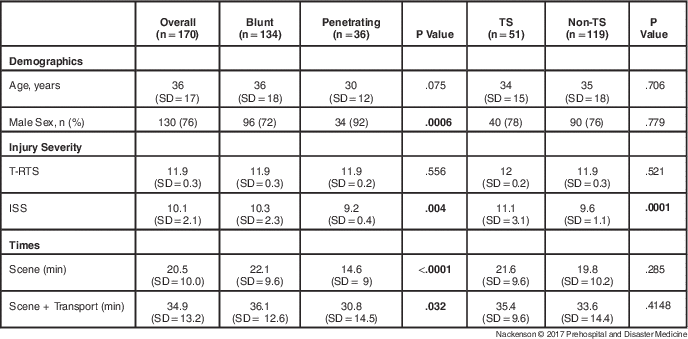
There were 170 patients studied in the cohort. When comparing blunt and penetrating trauma, in the field, the patients were physiologically similar based on T-RTS with no statistically significant differences, although the ISS was higher in the blunt group: 10.3 (SD=2.3) vs 9.2 (SD=0.4); P=.004. Scene times were on average 7.5 minutes less for patients with penetrating trauma: 14.6 (SD=9.0) vs 22.1(SD=9.6); P<.0001. Scene times were not significantly different for patients immobilized with a TS versus other methods of immobilization: 21.6 (SD=9.6) vs 19.8.1 (SD=10.2); P=.285. When the cohort was dichotomized into treatment groups, the only significant result was a higher ISS in the TS group of 11.1 (SD=3.1) vs 9.6 (SD=1.1) in the non-TS group; P=.0001 (Table 1).
Overall Characteristics of Sample and Subgroups

Abbreviations: ISS, injury severity score; T-RTS, triage revised trauma score; TS, traction splint.
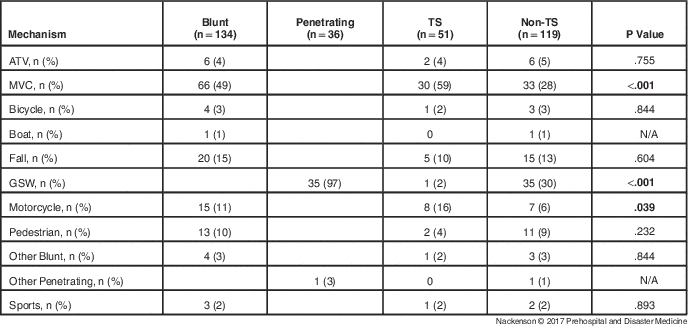
Regarding MOI, motor vehicle collision (MVC) was the most common, representing 66 (39.0%) of the whole cohort. Of the victims of MVC and motorcycle collisions, both have a statistically greater amount of TS applications representing 59.0% and 16.0% of all TS applications versus 28.0% and 6.0% of all non-TS applications. Of the blunt trauma patients, the most common MOI was MVC, which accounted for 49.0% of the blunt trauma group. Of the penetrating trauma patients, 35 of 36 were due to GSW. One patient in the penetrating trauma group was due to a tire pump explosion (Table 2).
Mechanism of Injury

Abbreviations: ATV, all-terrain vehicle; GSW, gunshot wound; MVC, motor vehicle collision; TS, traction splint.
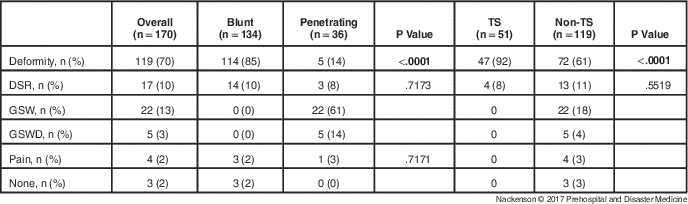
The most common physical exam finding was a deformity +/- shortening and rotation in 136 patients (80.0%), followed by GSW in 22 patients (13.0%), pain or tenderness in four patients (2.4%), and no findings consistent with femur fracture in three patients (1.7%). The three patients that did not have documentation consistent with signs of femur fracture were all victims of blunt trauma. Overall, there were 134 (79.0%) patients that suffered blunt trauma and 36 (21.0%) penetrating trauma.
The finding of gross deformity to the extremity accounted for 119 (70.0%) of the overall cohort, 114 (85.0%) of the blunt patients, and five (14.0%) of the penetrating trauma group. When the whole cohort was analyzed comparing patients who were treated with a TS versus those without, it appeared as if the assessment finding of deformity was seen at a greater rate in those who received a TS: 92.0% vs 61.0%, with a P value of <.0001. This finding likely represents a disproportionate amount of penetrating trauma patients who were not treated with TS. When the data were analyzed excluding penetrating trauma patients, the difference was no longer statistically significant with deformity seen in 92.0% of TS patients and 86.0% of non-TS patients, with a P value of .2971 (Table 3; Figure 1).
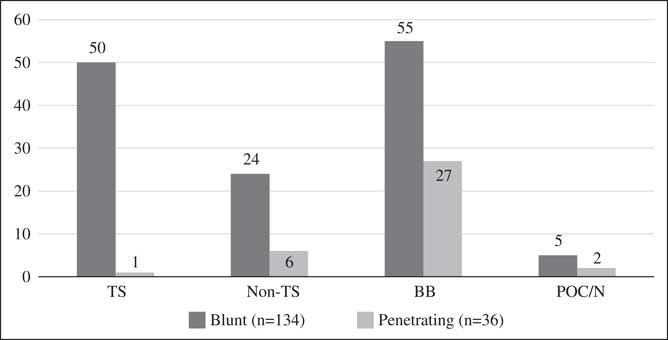
Immobilization Method. Abbreviations: BB, backboard; POC/N, position of comfort or not documented; TS; traction splint.

Assessment Findings

Abbreviations: DSR, deformity with shortening and rotation; GSW, gunshot wound; GSWD, gunshot wound+deformity; TS, traction splint.
Of 134 blunt trauma patients, 50 (37.0%) were immobilized in traction, and of the 36 penetrating trauma victims, one (2.7%) was immobilized in traction. Statistically significant differences were found in the application of a TS between the two groups: OR=20.83; 95% CI, 2.77-156.8; P<.0001. The most common method of immobilization was BB without the addition of any other form of simple splints, accounting for 82 (48.0%) of the patients. Overall, only 51 of 170 (30.0%) of patients with femur fracture were treated with a TS by EMS.
There were 11 patients for which IV access was unobtainable, leaving 159 patients eligible to receive IV analgesia, but only 35 (22.0%) of these patients had pain treated in this manner. Although few patients overall were treated with IV analgesia, in this sample, blunt trauma patients were significantly more likely to receive treatment: OR=6.23; 95% CI, 1.42-27.41; P=.0067. In this sample, no association was found between TS utilization and morphine administration: OR=1.17; 95% CI, 0.52-2.63; P=.708 (Table 4).
Morphine UtilizationFootnote a

Abbreviations: IV, intravenous; TS, traction splint.
a IV access unobtainable in 11 patients.
Discussion
Traction splinting is the standard of care management of femoral shaft fractures in the prehospital setting given the appropriate patient. The focus of prehospital trauma care is rapid stabilization, short scene times, and safe expeditious transport to an appropriate facility. In the polytraumatized patient that is critically ill, rapid initial stabilization and rapid transport take precedence over the application of a TS, as is taught in the nationally recognized Prehospital Trauma Life Support course. 14 The appropriate patient to apply a TS in the prehospital setting is a patient with suspected femur fracture that has no other life-threatening injuries. The application of a TS will likely occur on-scene given space and safety limitations of a moving ambulance, and as such, it’s unreasonable to expect a TS to be applied to any patient with other apparent life-threatening injuries requiring immediate transport. The intent of this study was to review cases of confirmed femur fracture that retrospectively would be appropriate candidates for traction splinting.
The data revealed that the TS was only utilized in 30.0% of the instances it was indicated. This finding is similar to a pediatric study in which 28.0% of the cases utilized a TS.Reference Daugherty, Mehlman, Moody, LeMaster and Falcone 9 It was unexpected to see such a tremendous propensity away from splinting with the TS in penetrating trauma, with only a single TS use in the penetrating trauma group and an odds ratio of TS utilization of 20.81 comparing blunt to penetrating trauma. This finding is particularly interesting in the historical context of the TS used to treat ballistic injuries on the battlefield. Although not studied here, one plausible explanation is an attitude of “primum non nocere,” in which the prehospital providers’ are concerned that the application of traction to a severely comminuted fracture may cause neurovascular injury. Likely, this also represents a deficiency in the education of prehospital providers, as standard EMS texts do not directly address the management of the penetrating trauma patient with a femoral fracture.Reference Sanders 15 , Reference Caroline, Elling and Smith 16 Of the penetrating trauma patients, 22/36 (61.0%) reported GSW as the only assessment finding, and as such, it is not clear if more traditional signs of femur fracture (such as deformity and pain) were assessed by the provider. It is possible that this represents an issue with the documentation in very brief prehospital care reports. Nonetheless, even if all of the cases with GSW as the only documented finding were due to missed injuries, that still would not account for the fact that 35/36 (97.0%) of penetrating trauma patients were immobilized using a non-TS.
Due to the fact that there is a clear educational gap for the management of civilian penetrating trauma to the thigh, a lower rate of TS application was anticipated in that group. The blunt trauma patients, though, had a surprising discrepancy between assessment findings and immobilization method. Of the 134 blunt trauma patients, 128 (96.0%) had a documented assessment finding of either deformity or deformity with rotation; meanwhile, only 50 (37.0%) were placed in traction. One possible explanation for this finding could be a lack of provider comfort with the procedure, given the very infrequent use of the skill, although this will need to be studied prospectively in the future. Another contributing factor could be the provider’s concern for other life-threatening injuries and a decision to immobilize using a method perceived to take less time than the TS in order to initiate rapid transport. Given these findings, future research will be needed to assess the local prehospital providers’ knowledge regarding the assessment and management of the femur fraction in both types of trauma.
The results of the assessment of IV analgesia utilization were similar to the pattern seen with TS application with an apparent large under-utilization. Only 22.0% of patients received IV analgesia, and of the penetrating trauma patients, only 2/36 (6.0%) received IV analgesia. It’s possible that the field providers over-estimated the possibility of additional injury despite high T-RTS scores of 11.9 (SD=0.3), and as such, were concerned IV morphine could lead to unwanted hemodynamic changes in a patient with potential instability. Again, the limited experience treating these injuries likely contributed to this finding.
Limitations
The limitations of this study are primarily design and sample size. Although much of the data collected retrospectively were objective in nature, the documentation of the prehospital reports was particularly brief, and as such, omitted much of the treatment rationale. Additionally, given the low incidence of patients eligible for treatment with a TS,Reference Abarbanell 7 , Reference Enninghorst, McDougall, Evans, Sisak and Balogh 17 it is difficult to obtain large samples, even at a single, busy, Level 1 trauma center over a 5-year period. Given the previous data showing multiple issues with TS placement,Reference Wood, Vrahas and Wedel 8 , Reference Daugherty, Mehlman, Moody, LeMaster and Falcone 9 it is unlikely that these results are locale specific, though as a result of the single-center design, this cannot be excluded. Future studies should attempt to prospectively study the assessment and management of prehospital femur fractures, preferably at multiple centers to ensure sufficient power.
Conclusion
Although signs of femur fracture are recognized in the majority of cases of midshaft femur fracture, only 30.0% of patients were immobilized using a TS. When compared to victims of blunt trauma, those who experience penetrating trauma seldom were treated with a TS. Only 22.0% of patients had their pain treated with IV analgesia, and like the TS, IV analgesia was seldom used for patients who suffered penetrating trauma. Finally, despite being standard of care, there is little evidence indicating efficacy in the urban prehospital setting and it will be imperative to prospectively assess this on a large scale.