Introduction
The prevalence of pain increases with age, and analgesia is often incomplete.1 Pharmacotherapy plays a central role in the control of pain. Suboptimal analgesia is multi-factorial, but may be a result of inappropriate selection, or doses, of analgesic medications.Reference Barber and Gibson2 Fundamental pharmacodynamic changes in pain perception and pain relief, which occur with ageing and with common conditions in old age such as cognitive impairment, contribute to inadequate analgesia.Reference Cole, Farrell, Gibson and Egan3 In older people, the large inter-individual variation in response to analgesic medications increases the risks of toxicity and poor efficacy.Reference McLachlan, Hilmer and Le Couteur4 This is a particular concern in frailty, a condition of increased vulnerability to adverse events.Reference Fried, Tangen and Walston5 Pain assessment and management in older people is further complicated by a limited evidence base: it has been estimated that less than 1% of studies investigating pain control focus on older adults.Reference Fox, Raina and Jadad6
This review describes the clinical pharmacology of commonly used analgesics and outlines the impacts of old age and frailty on the pharmacokinetics and pharmacodynamics of these medicines. An understanding of clinical pharmacology principles will help with drug and dose selection for older people.Reference McLean and Le Couteur7, Reference Hilmer8 Age is only one of many genetic and environmental factors that affect the clinical pharmacology of analgesic medications.Reference McLachlan, Hilmer and Le Couteur4 In the presence of wide inter-individual variability, monitoring for clinical response is essential to optimize pain control. Validated tools are available for assessment of pain and analgesia in old age and cognitive impairment.Reference Hadjistavropoulos, Herr and Turk9 Detection of the adverse effects of analgesic medications in older patients may be complicated by non-specific presentation as geriatric syndromes.Reference Avorn and Shrank10
Epidemiology of pain in older people
With increasing age, there is an increase in the prevalence of pain and pain-associated co-morbidities such as cancer, musculoskeletal conditions, neuropathies and vascular diseases.Reference Davis and Srivastava11 A review of pain studies that included older people from nursing homes, geriatric long-term care facilities, a long-stay geriatric hospital and congregate apartments found that the prevalence of pain was high (49–89%), with musculoskeletal pain of varying intensity the most common.Reference Herman, Johnson, Ritchie and Parmelee12 Community-dwelling adults tend to report less pain than those in nursing homes, hostels or other care facilities. A study of older community-dwelling men found that frailty was independently associated with intrusive pain (pain with moderate to severe interference with activities).Reference Blyth, Rochat and Cumming13
The reported prevalence of pain in older people may be an underestimate, as pain is frequently overlooked in this population.Reference Barber and Gibson2 Older people may under-report pain for reasons that include being more stoic than younger people, harbouring concerns about using analgesic drugs, or simply expecting pain with ageing and not believing that their pain can be alleviated.1 This is compounded by difficulties in accurately measuring the pain experience, particularly in those people with cognitive impairment.Reference Barber and Gibson2
Assessment of pain and analgesia in old age
Despite evidence that older adults have a high prevalence of conditions that are associated with significant pain (e.g. cancer, arthritis, fractures, diabetes mellitus, peripheral vascular disease), pain is often under-treated in this population.1, Reference Gnjidic, Murnion and Hilmer14 There appear to be associations between poor pain management and negative outcomes such as poor sleep, depression and impairment in activities of daily living.Reference Davis and Srivastava11
Clinical assessment in older people is complicated by the presentation of both pain and the effects of analgesic medications as geriatric syndromes. For example, an older person with delirium may be experiencing pain or the effects of analgesic medications, particularly opioids, or drugs with anticholinergic effects. Falls and functional impairment may also be associated with both pain and the effects of analgesic medications with sedative or anticholinergic effects.Reference Hilmer and Gnjidic15
Most pain assessment methods have been designed and tested in younger adults.Reference Gloth16 Cognitive impairment is a substantial barrier to pain assessment in all age groups, especially in elderly people.Reference Scherder, Herr, Pickering, Gibson, Benedetti and Lautenbacher17 Pain scales have been developed for people with cognitive impairment. These include the Modified Residential Brief Pain Inventory, the PAINAD (Pain Assessment in Advance Dementia) Scale and the Abbey Pain Scale.Reference Hadjistavropoulos, Herr and Turk9, Reference Auret and Schug18 A simple 4-point verbal rating scale such as the VRS has been found to be the most easily understood pain scale by older people, including those at all levels of cognitive impairment.Reference Hadjistavropoulos, Herr and Turk9, Reference Scherder, Herr, Pickering, Gibson, Benedetti and Lautenbacher17–Reference Closs, Barr, Briggs, Cash and Seers19 A study of mildly impaired nursing home patients found that 83% were able to use at least one one-dimensional pain intensity scale (such as the visual or numerical rating scales) to describe their pain.Reference Gordon20 Behavioural observation appears to be more sensitive than such scales for detection of pain in older people with cognitive impairment.Reference Horgas, Elliott and Marsiske21 However, no single pain intensity scale has been found to be best for all older people or for all types of pain.Reference Hadjistavropoulos, Herr and Turk9, Reference Gordon20
Pain management in older people
Pain can be ameliorated with appropriately tailored pain management interventions.22 However, targeting and delivering these interventions requires thorough assessment to establish the possible cause and severity of pain, and must take into account the different healthcare needs of older people who are frail, have co-morbidities or may be disabled. As frailty and co-morbidity may be coincident, integrated assessment and treatment are critical.Reference Blyth, Rochat and Cumming13
The management of pain in the older population is complicated by age-related alterations in physiology, which in turn may alter pain perception and the pharmacodynamics and pharmacokinetics of analgesics.Reference Gloth16, Reference Nikles, Yelland, Del Mar and Wilkinson23, Reference Wynne24 Furthermore, the involvement of older people in clinical trials has been limited so that development of an evidence base for rational prescribing of pain relief both to maximize benefit and to reduce risk has been problematic.Reference Wynne16, Reference Crome25 Many analgesic medications are included in lists of ‘inappropriate medications’ prepared by expert consensus panels. For example, the updated Beers’ CriteriaReference Fick, Cooper, Wade, Waller, Maclean and Beers26 for inappropriate medications in older people include analgesics from the non-steroidal anti-inflammatory, opioid and tricyclic antidepressant classes.
Older people are at increased risk of certain side-effects from analgesic medications,Reference Nikles, Yelland, Del Mar and Wilkinson23 which can reduce the adherence and/or willingness of older people to take analgesics. Adverse effects of analgesic agents are specific to individual drug classes and will be discussed in the following section related to the clinical pharmacology of each drug class. Adverse effects of analgesic medications may also be related to interactions with other medications prescribed for a variety of indications. Increasing exposure to drugs with sedative or anticholinergic effects, such as opioids and tricyclic antidepressants, is associated with an increased risk of functional impairment in older people.Reference Hilmer, Mager and Simonsick27 The combination of non-steroidal anti-inflammatory drugs with diuretics and angiotensin-converting enzyme (ACE) inhibitors is common in older people and can precipitate renal failure.Reference Thomas28
Non-pharmacological strategies to treat pain can be grouped into two classes: cognitive-behavioural techniques or physical modalities.22 Cognitive-behavioural techniques may include patient education, relaxation, hypnosis, imagery or biofeedback, but cannot be performed in those with significant cognitive impairment29 and may be unacceptable to many older people.22 Physical modalities for the treatment of pain include heat, cold, exercise, acupuncture, massage and transcutaneous electrical nerve stimulation. Patient and family education, including initial supervision and ongoing reinforcement, is particularly important with the physical modalities.22 As with the behavioural techniques, patients with sensory disturbances or cognitive impairment require special supervision.
Clinical pharmacology in old age and frailty
The most marked pharmacological change with ageing is the increased inter-individual variation. The most significant pharmacokinetic change in ageing is related to the decreased hepatic mass, uptake and blood flowReference McLean and Le Couteur7, Reference Hilmer, McLachlan and Le Couteur30 and to decreased renal function,Reference Hämmerlein, Derendorf and Lowenthal31 impairing the clearance of many drugs and their metabolites.Reference Hilmer8 While Phase I hepatic metabolism is impaired with normal ageing, most studies suggest that the activity of Phase II metabolism is maintained in healthy older people, but reduced in frail older people.Reference Hilmer8, Reference Wynne24
With increasing age, there is a decrease in total body mass and lean body mass and a relative increase in fat mass,Reference Hilmer, Ford, Halter, Ouslander, Tinetti, Studenski, High and Asthana32, Reference Bales and Ritchie33 which may affect the volume of distribution of drugs. Sarcopenia, defined as loss of muscle mass and strength with ageing, increases with age and is associated with frailty.Reference McLachlan, Hilmer and Le Couteur4, Reference Bales and Ritchie33 It can be the result of concomitant diseases, neuroendocrine dysregulation and chronic inflammation.Reference Bales and Ritchie33
Changes in the pharmacodynamics of drugs in old age are related to changes in drug receptors, physiological reserve and in response to injury.Reference Hilmer8 However, these changes have not been as well characterized in ageing as the pharmacokinetic changes. The cardiovascular and central nervous systems are the two best described.Reference Gordon20, Reference Hilmer, Ford, Halter, Ouslander, Tinetti, Studenski, High and Asthana32 A reduction in the responsiveness of the cardiac and β-adrenergic system has been observed in older adults.Reference Hilmer, Ford, Halter, Ouslander, Tinetti, Studenski, High and Asthana32 In the central nervous system, the numbers of dopaminergic neurons and dopamine D2 receptors decrease with age, resulting in an increased risk of extrapyramidal side-effects.Reference Turnheim34 Studies in animal models suggest that increased sensitivity to narcotic and anaesthetic agents may be due to alteration of opioid receptors in old age.Reference Hilmer, Ford, Halter, Ouslander, Tinetti, Studenski, High and Asthana32
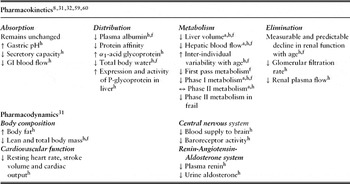
Frailty is associated with an increased risk of illness and mortality,Reference Bales and Ritchie33 as well as reluctance to prescribe certain medications (e.g. warfarin).Reference Perera, Bajorek, Matthews and Hilmer35 Few studies have been conducted on the pharmacokinetics of drugs in older frail people, and even fewer on pharmacodynamics.Reference Wynne, Cope, Herd, Rawlins, James and Woodhouse36–Reference Schwartz39Table 1 summarizes the commonly accepted pharmacokinetic and pharmacodynamic changes that occur with ageing and frailty.
Physiological changes associated with ageing and frailty that can impact on the pharmacokinetics and pharmacodynamics of drugs
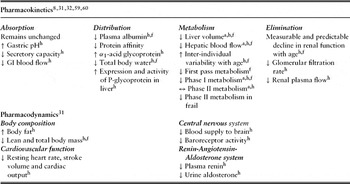
ttheoretical; aanimal studies; hhuman/clinical studies, fpharmacokinetic and/or pharmacodynamic change is accentuated in the frail; ↓, decreased; ↑, increased; ↔, no change.
Simple (non-opioid) analgesics
Paracetamol
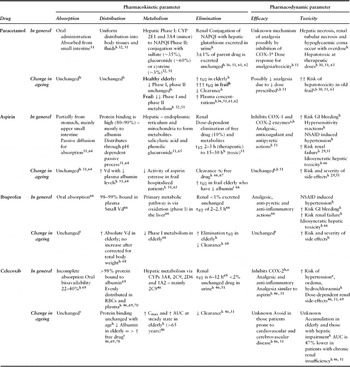
Paracetamol is a weak reversible non-specific cyclo-oxygenase (COX) inhibitor taken orally by a large proportion of older people. It is an effective analgesic agent and represents the first line analgesic therapy for non-malignant pain. One limitation of paracetamol is that it has an upper dosing limit. Paracetamol hepatotoxicity is well described in overdose. Accidental overdose accounts for only 15% of cases in the general population, but for 55% of cases in older adults.Reference Myers, Li, Fong, Shaheen and Quan40 Older age, unintentional overdose, alcohol abuse and underlying liver disease are risk factors for hepatotoxicity with paracetamol overdose.Reference Myers, Shaheen, Li, Dean and Quan41 Emerging case reports indicate that hepatotoxicity may also occur with chronic therapeutic use of paracetamol, even in the absence of risk factors such as chronic alcoholism and malnutrition.Reference Bolesta and Haber42 The clinical increased risk of paracetamol hepatotoxicity in older people is likely to be related to dosing that does not account for decreased liver volume with age, and to frailty and malnutrition.Reference Hilmer, McLachlan and Le Couteur30 Frail older people do not appear to have an increased risk of raised alanine aminotransferase with therapeutic doses of paracetamol, although the clinical implications of such findings are not clear.Reference Mitchell, Murnion, Matthews and Hilmer43 The Food and Drug Administration recommendations on strategies to reduce the risk of unintentional overdose with paracetamol include improving public education and labelling, decreasing the maximum daily adult dose of paracetamol from 4 g to 3.25 g, limiting tablet strength and eliminating combination products.Reference Kuehn44Table 2 describes the clinical pharmacology of paracetamol in ageing.
Pharmacokinetic and pharmacodynamics of simple analgesics
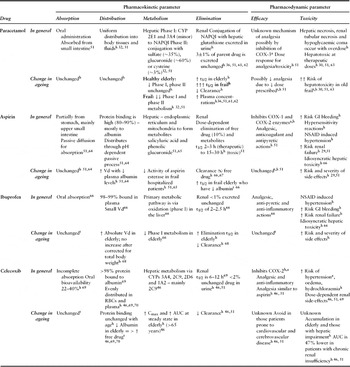
ttheoretical; aanimal studies; hhuman/clinical studies; NAPQI, n-acetyl-p-benzoquinone imine, toxic metabolite; CYP, cytochrome P450 enzyme; COX, cyclo-oxygenase enzyme; IV, intravenous. t1/2, half-life; Vd, volume of distribution; Cmax, maximum concentration; AUC, area under the curve; ↓, decreased; ↑, increased.
Non-steroidal anti-inflammatory drugs
Non-steroidal anti-inflammatory drugs (NSAIDs) are simple analgesics with anti-inflammatory and antipyretic actions. They inhibit cyclo-oxygenase (COX) and differ in their selectivity for different isoenzymes, as well as in their pharmacokinetics. NSAIDs with shorter half-lives are safer in older people. Despite their broad spectrum of clinical efficacy, significant contraindications and adverse effects limit their usefulness.29 There is a dose-related increase in the risk of gastrointestinal bleeding from NSAIDs caused by direct irritation of the gastric mucosa and reduced prostaglandins secondary to COX-1 inhibition. The risk of gastrointestinal bleeding with NSAIDs increases with age.Reference Boers, Tangelder, van Ingen, Fort and Goldstein45 The absolute risks of increased blood pressure, cardiac failure and renal impairment and cardiovascular events with NSAIDs are likely to increase with the age-associated increases in the prevalence of these conditions. This review will focus on the clinical pharmacology of aspirin, ibuprofen and celecoxib in old age.
Aspirin
Aspirin was the first in the class of traditional NSAIDs and plays a role in acute, but not chronic, pain management. It works through non-reversible inhibition of both COX-1 and COX-2 enzymes, and has dose-dependent analgesic, antipyretic, antiplatelet, chemoprotective and anti-inflammatory actions. Aspirin has also been found to be of benefit in preventing cardiovascular disorders and selected cancers. Older people have an increased risk of renal failure and gastrointestinal bleeding when taking aspirin (Table 2).
Ibuprofen
Ibuprofen also inhibits both COX-1 and COX-2 enzymes, and is commonly used by older people for management of acute and chronic pain. It is hepatically metabolized and has a short half-life, with changes in ageing shown in Table 2.
COX-2 selective inhibitors
The selective cyclo-oxygenase-2 (COX-2) inhibitors were developed to selectively inhibit the inducible COX-2 enzyme, while sparing the constitutive COX-1 enzyme, to provide analgesia without the gastrointestinal side-effects of NSAIDs.29, Reference Davies, McLachlan, Day and Williams46 Celecoxib is the most commonly used drug in this class, especially in older people.Reference Kean, Rainsford and Kean47 Two other COX-2 inhibitors have been withdrawn from the market due to an increased risk of cardiovascular events. Celecoxib is extensively metabolized by CYP2C929, Reference Davies, McLachlan, Day and Williams46 and is therefore subject to enzyme induction and inhibition by multiple drugs, as well as the effects of enzyme polymorphisms.Reference Davies, McLachlan, Day and Williams46 The pharmacological changes in ageing are summarized in Table 2.
Opioids
The drugs from the opioid class included in this review are morphine, codeine, tramadol, oxycodone, fentanyl and buprenorphine. They differ in pharmacokinetics, particularly absorption, metabolism and elimination, as well as in pharmacodynamics (full vs. partial agonists). Decreased μ-opioid receptor density and increases in affinity result in increased sensitivity of older people to the effects of opioids.Reference Smith and Gray48, Reference Wilder-Smith49 With advancing age, reduced reserve in the central nervous system and gastrointestinal tract also increases sensitivity to the therapeutic and toxic effects of opioids. An advantage of the opioids is the lack of a ceiling dose, allowing titration of dose requirement to optimize pain control. Opioids are optimally used in combination with full and regular doses of simple (non-opioid) analgesics such as paracetamol. A number of opioid medicines are not recommended for use in older people because their pharmacological profiles (including pharmacokinetic issues) mean that the risks outweigh the benefits. These include pethidine, pentazocin and propoxyphene.Reference Chutka, Takahashi and Hoel2,50 Prevention and management of adverse effects is an essential component of dose titration of opioids. The common side-effects of opioids that require close monitoring and may require prophylaxis or treatment include constipation, nausea, vomiting, sedation, impaired judgement, impaired psychomotor function and respiratory depression.Reference Brunton, Lazo and Parker51, Reference Pergolizzi, Boger, Budd, Dahan, Erdine and Hans52
Morphine
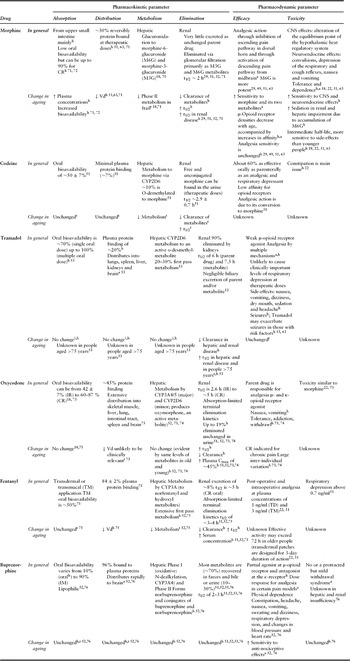
Morphine remains the most widely used opioid in pain management, and it is the standard against which other opioids are compared.29 Furthermore, decreased clearance of the renally excreted metabolites of morphine (morphine-3-glucuronide and morphine-6-glucuronide) results in an increased risk of toxicity in older people with renal impairment (Table 3).Reference Pergolizzi, Boger, Budd, Dahan, Erdine and Hans52
Changes in pharmacokinetics and pharmacodynamics of opioids with ageing
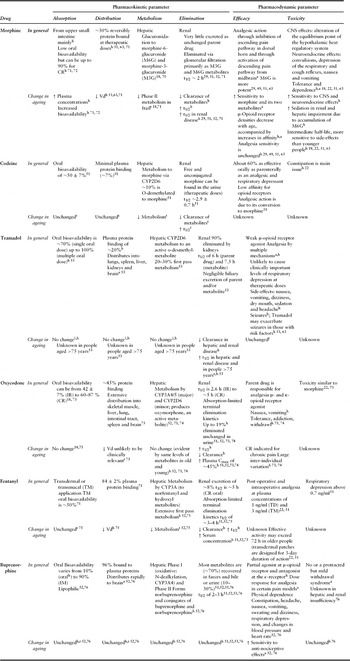
ttheoretical; aanimal studies; hhuman/clinical studies; CYPs, cytochrome P-450 enzymes; CNS, central nervous system; †pharmacokinetic study of young and older (65–75 years); subjects found no change in the absorption, distribution or metabolism of tramadol.
CR, controlled release; IR, immediate release; IM, intramuscular; t1/2, half-life; ↓, decreased; ↑, increased.
Codeine
Codeine is classified by the World Health Organisation as a weak opioid. The analgesic actions of codeine are attributed to its active metabolites, morphine and morphine-6-glucuronide, as codeine itself does not have any analgesic action.29 Codeine is metabolized by CYP2D6, and therefore its efficacy is affected by CYP2D6 polymorphisms and by interactions with CYP2D6 inhibitors that are used commonly in older people, such as fluoxetine and paroxetine. Codeine has low affinity for opioid receptors.Reference Brunton, Lazo and Parker51 Constipation is the major side-effect that requires careful monitoring and laxative prophylaxis (Table 3).
Tramadol
Tramadol is a synthetic codeine analogue that is a weak μ-opioid receptor agonist.29 It is commonly referred to as an atypical centrally acting analgesic because of its opioid agonist effects and its serotonin and noradrenaline reuptake inhibitor effects.29 The most common adverse effects are nausea and vomiting (as shown in Table 3). Tramadol has been associated with a greater risk of serotonergic syndrome and with seizures. Studies suggest that tramadol causes less respiratory depression, less constipation and has less effect on gastric emptying than equi-analgesic doses of morphine, although these were not conducted in frail older people.29, Reference Grond and Sablotzki53 Tramadol can be taken orally (immediate and slow release preparations) as well as by the rectal, intramuscular and intravenous routes.Reference Grond and Sablotzki53
Oxycodone
Oxycodone is a semisynthetic opioid available in immediate and slow release oral formulations, as well as parenteral and rectal formulations.Reference Auret and Schug18 Oxycodone is almost exclusively metabolized. The active metabolites of oxycodone do not accumulate in renal failure.Reference Auret and Schug18 The toxicity of oxycodone in ageing is not well described but it is likely that oxycodone shares many of the adverse effects seen with other drugs in this class (Table 3).22, Reference Pergolizzi, Boger, Budd, Dahan, Erdine and Hans52
Fentanyl
Fentanyl is a synthetic opioid that is approximately 100 times more potent than morphine. It is available in rapidly absorbed transmucosal formulations for relief of breakthrough cancer pain,Reference Auret and Schug18 and as sustained release transdermal patches for treatment of chronic pain. Almost 90% of the dose administered by transdermal patches reaches the systemic circulation.Reference Auret and Schug18 In patients aged 66 ± 0.7 years with osteoarthritis, treatment with transdermal fentanyl for 6 weeks has been shown to reduce pain and improve function more than placebo. However, 26% of those treated with fentanyl withdrew due to adverse events.Reference Langford, McKenna, Ratcliffe, Vojtassak and Richarz54 The effects of fentanyl in frail older people are not well described. Table 3 describes the changes in fentanyl pharmacokinetics and pharmacodynamics with ageing.
Buprenorphine
Buprenorphine is a synthetic opioid with mixed agonist-antagonist properties. At low doses analgesia is the main action, but at higher doses it exhibits antagonist action similar to naltrexone.Reference Cone, Gorodetzky, Yousefnejad, Buchwald and Johnson55 The major route of elimination of buprenorphine is by hepatic metabolism and its metabolites are eliminated in the bile and faeces. As no accumulation of metabolites occurs in those with renal impairment, buprenorphine may be a useful opioid for patients with renal impairment.Reference Boger56 Buprenorphine is administered as a transdermal 7-day patch. While there is little evidence on its use in older people, it is increasingly used for management of chronic pain in older patients. Table 3 describes the changes in the pharmacokinetics and pharmacodynamics of buprenorphine with ageing.Reference Pergolizzi, Boger, Budd, Dahan, Erdine and Hans52
Adjuvant therapies
Tricyclic antidepressants
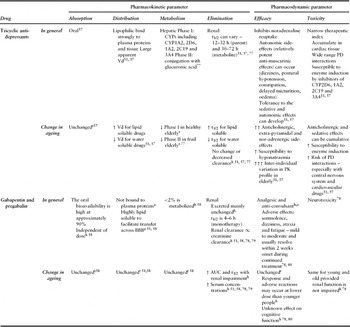
Tricyclic antidepressants (TCAs) are effective in the treatment of chronic neuropathic pain states, chronic headaches and chronic back pain.29 TCAs are metabolized by multiple hepatic enzymes (including CYP2D6) and are susceptible to enzyme inhibition and induction by multiple drugs. TCAs have a broad range of adverse effects including anticholinergic actions, which have a significant impact on cognition.Reference Brunton, Lazo and Parker51, Reference Lotrich and Pollock57 TCAs have a narrow therapeutic index and the risk of pharmacodynamic interactions in the elderly is high (Table 4).
Changes in pharmacokinetics and pharmacodynamics of adjuvant drugs with ageing
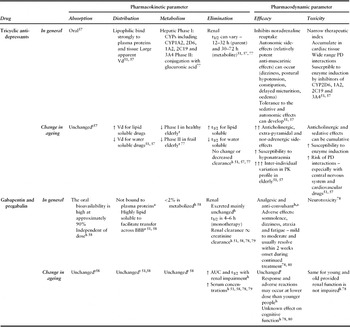
ttheoretical; aanimal studies; hhuman/clinical studies; CYP, cytochrome P450 enzyme; PD, pharmacodynamic; BBB, blood–brain barrier; t1/2, half-life; Vd, volume of distribution; AUC, area under the curve; ↓, decreased; ↑, increased.
Anticonvulsants
Gabapentin and pregabalin are two examples of anticonvulsants used to treat epilepsy, generalized anxiety disorder and neuropathic pain.Reference Ben-Menachem58 Gabapentin is a GABA analogue with a GABA moiety bound to a lipophilic cyclohexane ring, while pregabalin is a structural analogue of GABA. Studies indicate that pregabalin should have a low potential for drug–drug interactions given that it is not metabolized by the liver cytochrome P450 enzymes and does not bind plasma proteins at therapeutic doses.Reference Ben-Menachem58 However, age-associated renal impairment is likely to impair excretion of these drugs. Changes in the pharmacology of these drugs with ageing are described in Table 4.
Conclusion
Older people have a high prevalence of pain, which is often poorly treated, impacting on quality of life. Suboptimal analgesia may be a result of inappropriate analgesic selection or inadequate doses of analgesics. Wide inter-individual variation combined with pharmacokinetic and pharmacodynamic changes in old age may result in increased toxicity and decreased efficacy. Understanding these changes can inform therapeutic decisions. More studies are needed to investigate the changes in the pharmacokinetics and pharmacodynamics in older people, especially in the frail, to provide a rational basis of optimal analgesic drug and dose regimen selection.
Conflicts of interest
The authors declare no conflicts of interest.
Acknowledgements
The authors gratefully acknowledge the support of the Geoff and Elaine Penney Aging Research Unit at Royal North Shore Hospital.