1. Introduction
Although magmas in intracontinental environments represent a volumetrically minor component of the global magmatic budget (Kuritani et al. Reference Kuritani, Kimura, Miyamoto, Wei and Shimano2009), they are of considerable geologic interest and have attracted considerable attention (e.g. Gao et al. Reference Gao, Rudnick, Yuan, Liu, Liu, Xu, Ling, Ayers, Wang and Wang2004; Van der Meer et al. Reference Tian, Sun, Ye, Mao, Wang, Bi and Xia2017; and references therein), because of their critical geochemical features that distinguish them from ‘normal’ mid-ocean ridge and arc magmas, but also because they are associated with many world-class ore deposits (e.g. Cr, Ni, Mo and Au deposits, Naldrett, Reference Naldrett1999, Reference Naldrett2004; Pirajno et al. Reference Pirajno2004). Intracontinental magmatism occurring in different tectonic settings has been attributed to several possible processes, such as deep mantle plumes, back-arc spreading, continental rifting, stagnant slab, and lithospheric thinning (e.g. Gao et al. 2004, Reference Gao, Zhao, Bao and Yang2014; Kuritani et al. 2009, Reference Kuritani, Sakuyama, Kamada, Yokoyama and Nakagawa2017; Zhao et al. Reference Zhao, Jiang, Frimmel, Dai and Ma2012; Van der Meer et al. Reference Tian, Sun, Ye, Mao, Wang, Bi and Xia2017). This suggests that the origins of intracontinental magmatism require detailed investigations in each individual setting (Kuritani et al. Reference Kuritani, Kimura, Miyamoto, Wei and Shimano2009).
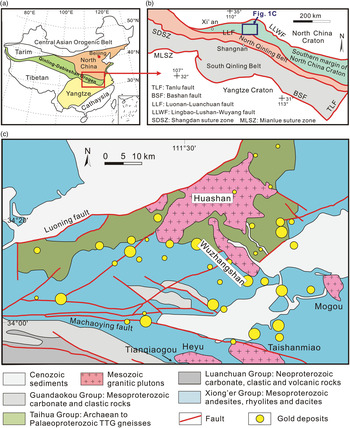
The Qinling orogenic belt (QOB), suturing the North China Craton (NCC) to the north and the Yangtze Craton to the south (Fig. 1a, b), is an important collisional orogen in eastern Asia (Zhang et al. Reference Zhang, Meng, Yu, Sun, Zhou and Guo1996; Mao et al. Reference Mao, Goldfarb, Zhang, Xu, Qiu and Deng2002). The final collision between the Yangtze and North China cratons occurred between 250 and 210 Ma (e.g. Ratschbacher et al. Reference Ratschbacher, Hacker, Calvert, Webb, Crimmer, McWilliams, Ireland, Dong and Hu2003; Dong & Santosh, Reference Dong and Santosh2016; Tang et al. Reference Tang, Zhang, Yang, Santosh, Li, Kim, Hu, Zhao and Cao2019; and references therein), and then the tectonic regime of the QOB transformed into a post-collisional extensional environment between 210 and 200 Ma (e.g. Dong & Santosh, Reference Dong and Santosh2016; Tang et al. Reference Tang, Zhang, Yang, Santosh, Li, Kim, Hu, Zhao and Cao2019). This was accompanied by distinct pulses of Triassic magmatism in volcanic arc, syn-collisional and post-collisional settings (e.g. Dong & Santosh, Reference Dong and Santosh2016; Tang et al. Reference Tang, Zhang, Yang, Santosh, Li, Kim, Hu, Zhao and Cao2019). In addition to the Triassic magmatism, the southern margin of the NCC in the QOB also records intensive intracontinental tectonic–magmatic activity during the Late Jurassic to Early Cretaceous, with widely exposed igneous rocks (e.g. Mao et al. Reference Mao, Xie, Pirajno, Ye, Wang, Li, Xiang and Zhao2010; Zhao et al. Reference Zhao, Jiang, Frimmel, Dai and Ma2012; Gao et al. Reference Gao, Zhao, Bao and Yang2014; Gao & Zhao, Reference Gao and Zhao2017) and many world-class Mo–Au–Ag–Pb–Zn ore deposits (e.g. Mao et al. 2002, Reference Mao, Pirajno, Xiang, Gao, Ye, Li and Guo2011; Chen et al. Reference Chen, Pirajno and Qi2008; Tang et al. Reference Tang, Li, Selby, Zhou, Bi and Deng2013; Tang, Reference Tang2014; Bao et al. Reference Bao, Sun, Zartman, Yao and Gao2017; Tian et al. Reference Tian, Sun, Ye, Mao, Wang, Bi and Xia2017). It has been generally considered that the generation of the Late Jurassic to Early Cretaceous magmatism in the southern margin of the NCC is controlled by intraplate processes − craton destruction (the process of decratonization) and lithospheric thinning − triggered by the far-field effect of the subduction of the Palaeo-Pacific Plate beneath the NCC (e.g. Lapierre et al. Reference Lapierre, Jahn, Charvet and Yu1997; Mao et al. 2002, 2010, Reference Mao, Pirajno, Xiang, Gao, Ye, Li and Guo2011; Ratschbacher et al. Reference Ratschbacher, Hacker, Calvert, Webb, Crimmer, McWilliams, Ireland, Dong and Hu2003; Windley et al. Reference Windley, Maruyama and Xiao2010). Therefore, the Late Jurassic to Early Cretaceous magmas in the southern margin of the NCC along the QOB are of considerable geologic interest, not only because they are associated with one of the most important gold polymetallic metallogenic belts in China, but also because of their geodynamic context and likely relationship to craton destruction (Zhao et al. Reference Zhao, Jiang, Frimmel, Dai and Ma2012).
(a) Simplified structural map of China showing the major tectonic subdivisions of China and the location of Qinling Orogenic Belt (modified from Tang et al. Reference Tang, Zhang, Yang, Santosh, Li, Kim, Hu, Zhao and Cao2019). (b) Tectonic framework of the Qinling Orogenic Belt (modified after Zhang et al. Reference Zhang, Meng, Yu, Sun, Zhou and Guo1996). (c) Geology and the distribution of the gold deposits in the Xiong’ershan area (modified after Tang et al. Reference Tang, Zhang, Yang, Santosh, Li, Kim, Hu, Zhao and Cao2019).

Late Jurassic to Early Cretaceous granites along the southern margin of the NCC have been extensively studied in the past decades, but there is still considerable uncertainty about key issues related to these magmatic rocks, such as (1) the petrogenesis of these rocks: these granites have been proposed to be derived from partial melting of ancient crystalline basement of the NCC, which mixed with mantle-derived melts (e.g. Li et al. Reference Li, Chen, Pirajno, Gong, Mao and Ni2012; Gao et al. Reference Gao, Zhao, Bao and Yang2014; Gao & Zhao, Reference Gao and Zhao2017), or from the subducted continental crust of the northern margin of the Yangtze Craton (e.g. Bao et al. 2014, Reference Bao, Sun, Zartman, Yao and Gao2017); (2) the link between the magmatism and gold: some researchers suggest that gold mineralization has resulted from Late Jurassic to Early Cretaceous magmatic–hydrothermal processes (e.g. Yao et al. Reference Xu, Griffin, Ma, O’Reilly, He and Zhang2009; Tang et al. Reference Tang, Li, Selby, Zhou, Bi and Deng2013; Tian et al. Reference Tian, Sun, Ye, Mao, Wang, Bi and Xia2017), but other researchers classified these gold deposits as orogenic type (e.g. Goldfarb et al. Reference Goldfarb, Phillips and Nokleberg1998; Mao et al. Reference Mao, Goldfarb, Zhang, Xu, Qiu and Deng2002; Chen et al. Reference Chen, Pirajno and Qi2008) or greenstone type (e.g. Li et al. Reference Li, Qu, Su, Huang, Wang and Yue1996), assigning the metamorphic rocks as the main source for the metallic ores (e.g. Li et al. Reference Li, Qu, Su, Huang, Wang and Yue1996; Li & Santosh, Reference Li and Santosh2017); (3) the timing of lithospheric thinning: the age estimates for this event given by previous studies are variable, ranging from 159 Ma to 108 Ma (e.g. Gao et al. Reference Gao, Rudnick, Yuan, Liu, Liu, Xu, Ling, Ayers, Wang and Wang2004; Mao et al. Reference Mao, Xie, Pirajno, Ye, Wang, Li, Xiang and Zhao2010; Li et al. Reference Li, Chen, Pirajno, Gong, Mao and Ni2012; Zhao et al. Reference Zhao, Jiang, Frimmel, Dai and Ma2012). Recently, the Late Jurassic to Early Cretaceous intrusions in the southern margin of the NCC were recognized as the products of two magmatic stages: 160–135 Ma and 135–110 Ma (Mao et al. Reference Mao, Xie, Pirajno, Ye, Wang, Li, Xiang and Zhao2010; Gao & Zhao, Reference Gao and Zhao2017). The intrusions in these two stages show different chemical and isotopic compositions (Gao & Zhao, Reference Gao and Zhao2017), implying different magmatic sources in potentially distinct tectonic settings. Identification of the two magmatic intervals in the in the southern margin of the NCC is important for evaluating the geodynamics of this region and understanding the genesis of magmatic rocks and associated ore deposits.
The Xiong’ershan area, a representative region for the south margin of the NCC, QOB, exposes several Late Jurassic to Early Cretaceous granitic plutons and hosts numerous Au, Mo, Pb, Zn and Ag deposits (Fig. 1c), and ranks as the third largest gold concentration in China (Mao et al. Reference Mao, Goldfarb, Zhang, Xu, Qiu and Deng2002; Deng et al. Reference Deng, Gong, Wang, Carranza and Santosh2014). The Wuzhangshan and Huashan plutons are the two largest batholiths in the Xiong’ershan area. New high-precision zircon U–Pb dates presented in this study indicate that the Wuzhangshan and Huashan monzogranites were emplaced at c. 160 Ma and 127 Ma, respectively, suggesting that they preserve the imprints of two magmatic episodes during the Late Jurassic to Early Cretaceous in the south margin of the NCC, respectively. Furthermore, we provide new petrographic observations, whole-rock major and trace element geochemistry, laser ablation – inductively coupled plasma – mass spectrometry (LA-ICP-MS) zircon U–Pb ages, and Sr–Nd–Hf isotopes for the Wuzhangshan and Huashan monzogranites, to constrain their petrogenesis, geodynamics setting and relationship with gold deposits in the southern margin of the NCC.
2. Geological setting
The Qinling orogenic belt is bound by the Lingbao–Lushan–Wuyang fault with the NCC to the north, and the Mianlue suture zone with the Yangtze Craton to the south (Fig. 1b). The belt can be subdivided into three tectonic units from north to south (Zhang et al. Reference Zhang, Meng, Yu, Sun, Zhou and Guo1996): the southern margin of the NCC, the North and South Qinling belts (Fig. 1b). The Luonan–Luanchuan regional fault separates the southern margin of the NCC and the North Qinling belt, whereas the North and South Qinling belts are separated by the Shangdan suture zone.
The Xiong’ershan area is located in the south margin of the North China Craton, QOB (Fig. 1b). Basement rocks of this region are Neoarchaean to Palaeoproterozoic Taihua group (c. 2.84–2.26 Ga, Xu et al. Reference Xu, Griffin, Ma, O’Reilly, He and Zhang2009; Huang et al. Reference Huang, Wilde, Yang and Zhong2012) that consist of biotite–plagioclase gneiss, plagioclase–amphibole gneiss and amphibolite, all belonging to tonalite–trondhjemite–granodiorite (TTG) suites (Huang et al. Reference Huang, Wilde, Yang and Zhong2012). These rocks are discordantly overlain by the Mesoproterozoic Xiong’er group (c. 1.80–1.75 Ma, Zhao et al. Reference Zhao, Zhai, Xia, Li, Zhang and Wan2004), a low-grade volcanic succession ranging from 3.0 to 7.6 km in thickness, covering an area of >6000 km2 (Zhao et al. Reference Zhao, Zhai, Xia, Li, Zhang and Wan2004). It consists mainly of basaltic andesite and andesite, with minor dacite and rhyolite (Zhao et al. Reference Zhao, Zhai, Xia, Li, Zhang and Wan2004). These rocks are characterized by large-ion lithophile elements and light rare earth elements (LREE) enrichments and high-field-strength elements (HFSE) depletion, indicating hydrous melting of a mantle wedge in a subduction zone (He et al. Reference He, Zhao, Sun and Han2010). The Xiong’er Group is discordantly overlain by Meso- to Neo-proterozoic littoral facies clastic–carbonate rocks and alkaline volcanic rocks of the Guandaokou and Luanchuan groups.
The Mesozoic magmatic rocks in the Xiong’ershan area mainly formed in two periods: Triassic and Late Jurassic to Early Cretaceous. The Triassic magmatic rocks sporadically occur in the Xiong’ershan area. The Late Jurassic to Early Cretaceous magmatic rocks are widespread in the Xiong’ershan area and occur as large batholiths (e.g. Huashan and Wuzhangshan) or small porphyritic bodies (e.g. Qiyugou, Lemengou and Banzhusi) (Fig. 1c). These rocks are composed of biotite amphibole granite, biotite granite, monzogranite and syenogranite (Gao et al. Reference Gao, Zhao, Bao and Yang2014; Nie et al. Reference Nie, Wang, Ke, Yang and Lv2015).
3. Samples and analytical techniques
3.a. Sampling and petrography
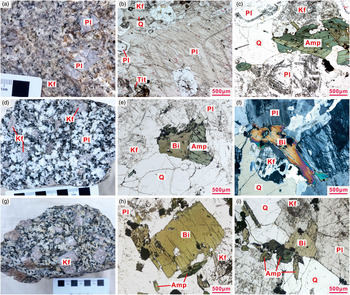
Geochemical and zircon U–Pb dating samples were collected from the Wuzhangshan and Huashan batholiths. The Wuzhangshan pluton, covering an area of ~60 km2 (Nie et al. Reference Nie, Wang, Ke, Yang and Lv2015), intruded into metamorphic rocks of the Taihua Group in the north and volcanic rocks of the Xiong’er Group in the south (Fig. 1c). The rocks are generally reddish, medium- to coarse-grained porphyritic monzogranites (Fig. 2a, b; Fig. S1 in Supplementary Material available online at https://doi.org/10.1017/S0016756819000888), consisting of 3–6 % phenocrysts (mainly plagioclase, with lesser K-feldspar) in a medium-grained granular matrix of K-feldspar (25–30 %), plagioclase (30–35 %), quartz (20–25 %), amphibole (5–10 %) and minor biotite (Fig. 2c); accessory minerals include zircon, titanite, magnetite and apatite. Feldspars are mainly platy, up to 1.5 cm in diameter (Fig. 2a). Amphiboles are euhedral to subhedral (Fig. 2c) and exhibit no alteration, with a grain size of 0.2–2 mm. Quartz shows granular shape, with a grain size of 20–800 µm (Fig. 2b, c). The Wuzhangshan monzogranites contain sporadic xenoliths of the basement rocks, most of which are amphibolites of the Taihua Group, and have sharp boundaries.
Photographs of representative samples from the Wuzhangshan and Huashan monzogranites. (a, b) The Wuzhangshan monzogranites show porphyritic texture with euhedral phenocrysts of plagioclase. (c) The medium-grained granular matrix of the Wuzhangshan monzogranite, showing a mineral assemblage of K-feldspar + plagioclase + quartz + amphibole. (d) The medium- to fine-grained monzogranite of the Huashan pluton. (e, f) Photomicrographs of the Huashan medium- to fine-grained monzogranites, showing a mineral assemblage of K-feldspar + plagioclase + quartz + amphibole + biotite. (g) Porphyritic monzogranite of the Huashan pluton. (h, i) The medium-grained granular matrix of the Huashan porphyritic monzogranites, showing a mineral assemblage of K-feldspar + plagioclase + quartz + biotite + amphibole. Pl – plagioclase; Kf – K-feldspar; Q – quartz; Amp – amphibole; Bi – biotite; Tit – titanite.

The Huashan pluton intruded into the metamorphic rocks of the Taihua Group and covers an area of 300 km2 (Nie et al. Reference Nie, Wang, Ke, Yang and Lv2015). The pluton contains a small amount of mafic magmatic enclaves, which are ellipsoidal to spherical in shape, and have sharp or blurred boundaries with their host rocks (Nie et al. Reference Nie, Wang, Ke, Yang and Lv2015). Rocks from the Huashan pluton are mainly composed of medium- to fine-grained monzogranites and porphyritic monzogranites (Fig. S1 in Supplementary Material at https://doi.org/10.1017/S0016756819000888). The medium- to fine-grained monzogranites (Fig. 2d) are located at the north part of the pluton with an outcrop area of ~100 km2. They are light grey in colour and contain K-feldspar (25–30 %), plagioclase (30–35 %), quartz (20–25 %), biotite (5–8 %) and local amphibole (0–2 %), and accessory zircon, titanite, magnetite and apatite (Fig. 2e, f). The porphyritic monzogranites are located at the southern part of the pluton with an outcrop area of ~200 km2. They are light grey to pink and show porphyritic textures. The phenocrysts are mainly K-feldspar with a grain size of 0.5–3 cm (Fig. 2g). The matrix displays medium- to fine-grained texture, consisting of K-feldspar (30–35 %), plagioclase (25–30 %), quartz (20–25 %), biotite (5–8 %) and local amphibole (1–3 %) (Fig. 2h, i). Accessory minerals include apatite, zircon, magnetite and titanite.
3.b. In situ zircon U–Pb dating and Hf isotopes
About 5 kg of each sample was crushed and sieved for separating zircon grains using standard magnetic and heavy liquid separation procedures. About 80–150 grains were mounted in epoxy and then polished to expose crystal mid-sections. Photographs in polarized and reflected light and cathodoluminescence (CL) images were prepared to examine the internal structures and to select points for analysis.
In situ zircon U–Pb dating was conducted using LA-ICP-MS at the Institute of Geology, Chinese Academy of Geological Sciences, Beijing, China, following the procedures in Hou et al. (Reference Hou, Li and Tian2009). The ablation system operated at a wavelength of 193 nm using a spot diameter of ~32 μm. The data were calibrated according to the M127 reference zircon (U: 923 ppm; Th: 439 ppm; Th/U: 0.475, Nasdala et al. Reference Nasdala, Hofmeister, Norberg, Mattinson, Corfu, Dorr, Kamo, Kennedy, Kronz, Reiners, Frei, Kosler, Wan, Gotze, Hager, Kroner and Valley2008). The zircon GJ-1 with an age of 599.8 ± 1.7 Ma (Jackson et al. Reference Jackson, Pearson, Griffin and Belousova2004) and Plesovice with an age of 337.13 ± 0.37 Ma (Sláma et al. Reference Sláma, Košler, Daniel, Crowley, Gerdes, Hanchar, Horstwood, Morris, Nasdala, Norberg, Schaltegger, Schoene, Tubrett and Whitehouse2008) were used as reference standards. Data processing was conducted using the ICPMSDataCal programs. Common Pb corrections were made following methods of Anderson (Reference Anderson2002). The analytical data are summarized in Table 1 and graphically presented on concordia diagrams with a 1σ error. The ages are weighted means with 2σ errors that were calculated using Isoplot 3.0 at 95 % confidence levels. LA-ICP-MS zircon U–Pb dating yields ages of 336.8 ± 1.0 Ma (n = 6) for the Plesovice zircon during our analyses, completely consistent with the recommended ages (337.13 ± 0.37 Ma, Sláma et al. Reference Sláma, Košler, Daniel, Crowley, Gerdes, Hanchar, Horstwood, Morris, Nasdala, Norberg, Schaltegger, Schoene, Tubrett and Whitehouse2008).
LA-ICP-MS zircon U–Pb analyses for the Wuzhangshan and Huashan monzogranites in the Xiong’ershan area

In situ zircon Hf isotope measurements were subsequently taken on the same spots previously analysed for U–Pb dating. Zircon Hf isotopes were analysed using a GeoLasPro 193 nm laser ablation microprobe that was attached to a Neptune multi-collector ICP-MS at the Institute of Geology, Chinese Academy of Geological Sciences, Beijing, China. The instrumental conditions and data acquisition were similar to those described by Zhao et al. (Reference Zhao, Jiang, Frimmel, Dai and Ma2012). A 44 μm laser beam was used for in situ Hf isotope analysis. Helium was used as a carrier gas in the ablation cell. The 176Lu/175Lu ratio of 0.02655 (Vervoort et al. Reference Vervoort, Patchett, Sőderlund and Baker2004) and 176Yb/173Yb ratio of 0.796218 (Chu et al. Reference Chu, Taylor, Chavagnac, Nesbitt, Boella, Milton, German, Bayon and Burton2002) were used to correct the isobaric interferences of 176Lu and 176Yb on 176Hf. Yb isotope ratios were normalized to a 172Yb/173Yb ratio of 1.35274 (Chu et al. Reference Chu, Taylor, Chavagnac, Nesbitt, Boella, Milton, German, Bayon and Burton2002) and Hf isotope ratios to a 179Hf/177Hf ratio of 0.7325 (Wu et al. Reference Wu, Yang, Xie, Yang and Xu2006) for instrumental mass bias correction. Zircon GJ1 was used as the reference standard during our routine analyses, with a weighted mean 176Hf/177Hf ratio of 0.282007 ± 0.000007 (2σ, n = 36) (the recommended value is 0.282000 ± 0.000005, Morel et al. Reference Morel, Nebel, Nebel-Jacobsen, Miller and Vroon2008). A decay constant value of 1.867 × 10⁻¹¹ a−1 for 176Lu (Soderlund et al. Reference Soderlund, Patchett, Vervoort and Isachsen2004), the present-day chondritic ratios of 176Hf/ 177Hf = 0.282785 and 176Lu/ 177Hf = 0.0336 (Bouvier et al. Reference Bouvier, Vervoort and Patchett2008) were adopted to calculate εHf values. The depleted mantle Hf model age (single-stage model age, T DM1) was calculated in reference to the depleted-mantle source with the present-day 176Hf/177Hf ratio of 0.28325 and 176Lu/177Hf of 0.0384 (Griffin et al. Reference Griffin, Pearson, Belousova, Jackson, Van Achterbergh, O’Reilly and Shee2000). The ‘crust’ Hf model age (two-stage model, T DM2) was calculated with respect to the average continental crust with a 176Lu/177Hf value of 0.015 (Griffin et al. Reference Griffin, Wang, Jackson, Pearson, O’Reilly, Xu and Zhou2002).
3.c. Whole-rock geochemistry
On the basis of the petrographical studies, 16 of the freshest representative rock samples from the Wuzhangshan and Huashan intrusions were selected for whole-rock major-, trace- and rare earth element (REE) analyses. Rock samples were crushed in steel crushers and grinded in an agate mill to a grain size of <200 mesh. Major elements were analysed using standard X-ray fluorescence (XRF), except for the FeO content analysed with the potassium bichromate titrimetric method (Andrade et al. Reference Andrade, Hypolito, Ulbrich and Silva2002), at the Analytical Laboratory of Beijing Research Institute of Uranium Geology, Beijing. Accuracies of XRF analyses are better than 2 %. Trace elements and REE were determined by ICP-MS at the Analytical Laboratory of Beijing Research Institute of Uranium Geology, Beijing, following digestion of sample powder (~0.05 g) in an HF + HNO3 (8:3) solution, drying and second dissolution in 3 mL HNO3. Rh was used as an internal standard to monitor signal drift during counting. The analytical precision of ICP-MS analyses is better than 5 % with internal standards.
3.d. Whole-rock Sr–Nd isotopes
The whole rock Rb–Sr and Sm–Nd isotopic analyses were measured using an IsoProbe-T TI Mass Spectrometer at the Analytical Laboratory of the Beijing Research Institute of Uranium Geology, Beijing, China, following procedures similar to those of Zhao et al. (Reference Zhao, Jiang, Frimmel, Dai and Ma2012). Samples of ~100 mg were spiked and dissolved in screw-top Teflon containers with HF and HNO3. Mass fractionation corrections for Sr and Nd isotopic ratios were based on values of 86Sr/88Sr = 0.1194 and 146Nd/144Nd = 0.7219 (Rasskazov et al. 2010). During a long period of analysis, the 87Sr/86Sr ratio of the Sr NBS-987 standard and the 143Nd/144Nd ratio of the Nd La Jolla standard were 0.710215 ± 11 (2σ, n = 22) (the literature value is 0.710215, Nyquist et al. Reference Nyquist, Bansal, Wiesmann and Shih1994) and 0.511852 ± 4 (2σ, n = 24) (the literature value is 0.511860, Nyquist et al. Reference Nyquist, Bansal, Wiesmann and Shih1994), respectively. Decay constant values of 1.393 × 10⁻¹¹ a−1 for 87Rb (Nebel et al. Reference Nebel, Scherer and Mezger2011) and 6.54 × 10⁻¹² a−1 for 147Sm (Lugmair & Marti, Reference Lugmair and Marti1978), the present-day chondritic ratios of 147Sm/144Nd = 0.1967 (Jacobsen & Wasserburg, Reference Jacobsen and Wasserburg1980) and the present day depleted-mantle ratios of 143Nd/144Nd = 0.513151 and 147Sm/144Nd = 0.2136 (Liew & Hofmann, Reference Liew and Hofmann1988) were adopted to calculate (87Sr/86Sr)t and Nd model ages.
4. Results
4.a. Zircon U–Pb geochronology
Two samples from the Wuzhangshan and Huashan plutons were chosen for LA-ICP-MS zircon U–Pb dating. The results are listed in Table 1. Representative CL images of the zircons in this study are shown in Figure S2 and S3 (in Supplementary Material at https://doi.org/10.1017/S0016756819000888) and the age data are plotted in Figure 3.
Zircon U–Pb concordia and average age diagrams for sample WZS03 from the Wuzhangshan pluton (a, b) and sample HS09 from the Huashan pluton (c, d).

Sample WZS03 (34°12′28″ N, 111°41′50″ E) is a porphyritic monzogranite collected from the Wuzhangshan pluton. Zircon grains from this sample are light yellow to colourless, euhedral and short prismatic shape, with a length of 100–300μm and a length-to-width ratio of 1.5:1 to 3:1 (Fig. S2 in Supplementary Material at https://doi.org/10.1017/S0016756819000888). Most grains show obvious oscillatory zoning in CL images and have high Th/U ratios ranging from 0.22 to 0.99 (Table 1), indicating magmatic origin. Thirteen of nineteen spots have concordant ages between 160 Ma and 162 Ma (Fig. 3a, b), with a weighted mean 206Pb/238U age of 160.7 ± 0.6 Ma (n = 13, MSWD = 0.52), which is interpreted to be the crystallization age. Some zircons contain an inner core (Fig. S2 in Supplementary Material at https://doi.org/10.1017/S0016756819000888). Three spots are analysed from the core domains (WZS-LH01, 02, 03) and yield old 207Pb/206Pb ages of 2465 ± 5 Ma, 1915 ± 43 Ma, 2032 ± 24 Ma, respectively, which are interpreted as inherited zircons.
Sample HS09 (34°21′45″N, 111°35′16″E) is a porphyritic monzogranite collected from the Huashan pluton. Zircon grains from this sample are colourless, transparent and euhedral, with a length of 60–200 μm and a length-to-width ratio of 2:1 to 3:1 (Fig. S3 in Supplementary Material at https://doi.org/10.1017/S0016756819000888). They show pyramid termination with clear oscillatory growth zoning and have high Th/U ratios (0.72–1.13, Table 1), suggesting a magmatic origin. All 20 zircon crystals from sample HS09 are concordant with 206Pb/238U ages ranging from 123.6 ± 2.5 Ma to 130.9 ± 2.4 Ma (Fig. 3c, d), giving a weighted mean 206Pb/238U age of 127.2 ± 1.0 Ma (n = 20, MSWD = 0.74).
4.b. Whole-rock geochemistry
Representative major and trace element concentrations of the Wuzhangshan and Huashan intrusive rocks are listed in Table 2. The Wuzhangshan intrusive rocks have a narrow range of SiO2, ranging from 68.3 to 71.6 wt % (Fig. 4a; Table 2), and low MgO contents ranging from 0.15 to 0.55 wt %. They are slightly peraluminous rocks with ACNK values (molar Al2O3/(CaO + Na2O + K2O)) varying from 1.00 to 1.10 (Fig. 4b). All samples lie within the high-K calcalkaline to shoshonite fields (Fig. 4c). The Wuzhangshan monzogranites are characterized by high Sr (904–1487 ppm) but low Y (12.2–18.9ppm) and Yb (1.5–2.2ppm) contents, with elevated Sr/Y (56.5–97.8) and (La/Yb)N (11.8–19.1) ratios, indicative of apparent adakitic characteristics (Fig. 4d). The rocks are strongly enriched in large-ion lithophile elements (e.g. Rb, K, Ba and Sr), and relatively depleted in HFSEs (e.g. Nb, Ta, P and Ti) (Fig. 5). They have total REE concentrations with ΣREE ranging from 112 ppm to 184 ppm, and are strongly enriched in LREEs and relatively depleted in heavy rare earth elements (HREEs), with LREE/HREE ratio of 11.2–14.0, displaying right-inclined patterns (Fig. 6). The pluton has negligible to slightly positive Eu anomalies (Eu/Eu* = 1.0–1.4) and shows more pronounced fractionation in LREEs than in HREEs with (La/Sm)N and (Dy/Yb)N ratios of 5.5–8.0 and 0.8–1.0, respectively.
Major (wt %) and trace element (ppm) concentrations of the Wuzhangshan and Huashan plutons in the Xiong’ershan area

A/CNK = molar Al2O3/(CaO + Na2O + K2O); A/NK = molar Al2O3/(Na2O + K2O); δEu = ω(Eu)N/[(1/2)(ω(Sm)N + ω(Gd)N)]; data of WZST01-02 and HST01-11 are from Han et al. (Reference Han, Zhang, Franco and Zhang2007) and Xiao et al. (Reference Xiao, Hu, Zhang, Dai, Wang and Li2012).
Geochemistry diagrams for the Wuzhangshan and Huashan monzogranites. (a) SiO2 vs (N2O + K2O) classification diagram (after Middlemost, Reference Middlemost1994). (b) A/CNK vs A/NK diagram (after Maniar & Piccoli, Reference Maniar and Piccoli1989). (c) SiO2 vs K2O classification diagram (after Peccerillo & Taylor, Reference Peccerillo and Taylor1976). (d) Sr/Y vs Y diagram showing adakitic characteristics (after Defant & Drummond, Reference Defant and Drummond1990).

Primitive mantle – normalized trace element diagram for the Wuzhangshan and Huashan monzogranites in the Xiong’ershan area. Primitive mantle values from Sun & McDonough (Reference Sun and McDonough1989).

Chondrite-normalized rare earth element patterns for the Wuzhangshan and Huashan monzogranites in the Xiong’ershan area. Chondrite values from Sun & McDonough (Reference Sun and McDonough1989).

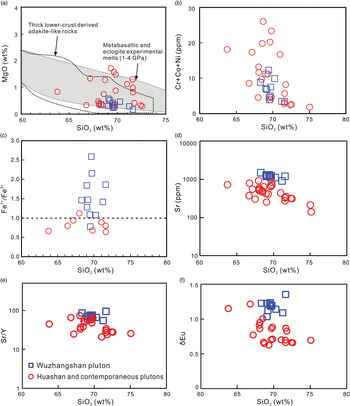
Similar to the Wuzhangshan monzogranites, the Huashan monzogranites are also slightly peraluminous (ACNK = 1.00–1.10) and high-K calcalkalic to shoshonitic (K2O = 3.75–5.62) (Fig. 4b, c). Rocks from the Huashan pluton are also characterized by strong enrichment of light REEs over heavy REEs (LREE/HREE = 12.1–27.2 and (La/Yb)N = 14.8–42.9), weakly differentiated heavy REEs ((Dy/Yb)N = 0.90–1.50), pronounced negative anomalies in HFSEs (e.g. Nb, Ta, P and Ti) and remarkable enrichment in large-ion lithophile elements (e.g. Rb, K and Ba) (Fig. 5). However, compared to the Wuzhangshan rocks, the Huashan monzogranites have a wider range of SiO2, ranging from 63.7 to 75.0 wt %, and higher MgO, Cr, Co and Ni contents, but lower Sr/Y (21.3–76.5) and Fe3+/Fe2+ (0.64–1.12) (Fig. 7c). Binary element and ratio vs SiO2 variation diagrams (Fig. 7d, e, f) show linear trends. The Huashan monzogranites have zero to weak negative Eu anomalies (Eu/Eu* = 0.6–1.0, except for two samples) and elevated 10,000*Ga/Al values. In Figure 8, more than half of the samples from the Huashan monzogranites plot in the ‘A-type granites’ field, and the remaining samples fall near the contact line between the I- and S-type granites field and the ‘A-type granite’ field.
Plots of selected elements and ratios vs SiO2 for the Wuzhangshan and Huashan monzogranites. (a) MgO vs SiO2, (b) (Cr + Co + Ni) vs SiO2, (c) Fe3+/Fe2+ vs SiO2, (d) Sr vs SiO2, (e) Sr/Y vs SiO2 and (f) δEu vs SiO2. The field of thick lower crust-derived adakite-like rocks is after Wang et al. (Reference Wang, Xu, Jian, Bao, Zhao, Li, Xiong and Ma2006). The field of metabasaltic and eclogite experimental melts (1–4 GPa) is from the following: Sen & Dunn (Reference Sen and Dunn1994), Rapp et al. (1999, Reference Rapp, Xiao and Shimizu2002, 2003), Skjerlie & Patino Douce (Reference Skjerlie and Patino Douce2002), and references therein. Data of other felsic rocks contemporaneous with Huashan monzogranite in the Xiong’ershan are from Yao et al. (Reference Xu, Griffin, Ma, O’Reilly, He and Zhang2009) and Cao et al. (Reference Cao, Ye, Chen, Li, Zhang and He2016).

FeO*/MgO, Ce, Nb and Zr versus 10 000Ga/Al discrimination diagrams of Whalen et al. (Reference Whalen, Currie and Chappell1987), showing the A-type nature of the Huashan monzogranites in the Xiong’ershan area.

4.c. Zircon Hf isotopes
In situ zircon Hf analyses of samples from the Wuzhangshan and Huashan plutons are listed in Table 3 and shown in Figure 9. Zircons from the Wuzhangshan pluton have 176Lu/177Hf ratios of 0.001451 to 0.003028 and 176Hf/177Hf ratios of 0.281639 to 0.281973. These results yield εHf (t) values of −37.12 to −25.35, with a mean of −28.14, corresponding to two-stage Hf model ages of 3502 Ma to 2773 Ma (mostly between 2931 Ma and 2773 Ma). One inherited zircon grain shows much lower signature with 176Hf/177Hf ratios of 0.281189, and εHf (t = 2465 Ma) value of −1.8, which is consistent with that of the TTG gneisses of the Taihua Group (Fig. 9). The calculated single-stage and two-stage model ages of the inherited zircon grain are 2857 Ma and 3903 Ma, respectively, which is close to the 207Pb/206Pb age of the analysed inherited zircon. Zircons from the Huashan pluton show homogeneous 176Hf/177Hf ratios of 0.282345 to 0.282426, and have εHf (t) values ranging from −12.79 to −9.91, which yield two-stage model ages of 1961 Ma to 1781 Ma.
LA-ICP-MS in situ analysis of zircon Lu–Hf isotopic composition of the Wuzhangshan and Huashan monzogranites in the Xiong’ershan area

Variation of initial εHf isotope values vs the zircon U–Pb ages of the Wuzhangshan and Huashan plutons in the Xiong’ershan area. Data for the Taihua Group are from Liu et al. (Reference Liu, Wilde, Wan, Wang, Valley, Kita, Dong, Xie, Yang, Zhang and Gao2009), Xu et al. (Reference Xu, Griffin, Ma, O’Reilly, He and Zhang2009), Diwu et al. (Reference Diwu, Sun, Lin and Wang2010) and Huang et al. (Reference Huang, Wilde, Yang and Zhong2012). Data for the Xiong’er Group are from Wang et al. (Reference Wang, Jiang and Dai2010). Data for 122 Ma diorite and the felsic rocks contemporaneous with Huashan monzogranite in the Xiong’ershan area are from Yao et al. (Reference Xu, Griffin, Ma, O’Reilly, He and Zhang2009), Xiao et al. (Reference Xiao, Hu, Zhang, Dai, Wang and Li2012), Gao et al. (Reference Gao, Zhao, Bao and Yang2014) and Cao et al. (Reference Cao, Ye, Chen, Li, Zhang and He2016).

4.d. Whole-rock Sr–Nd isotopes
Samples from the Wuzhangshan pluton have 87Rb/86Sr ratios of 0.2628–0.4547 and 87Sr/86Sr ratios of 0.7077–0.7086, which correspond to (87Sr/86Sr)t values ranging from 0.7068 to 0.7076 (Table 4). The samples show 147Sm/144Nd ratios of 0.0915−0.1019 and 143Nd/144Nd ratios of 0.5115–0.5116, which yield εNd(t) values ranging from −21.0 to −19.1, and two-stage Nd model ages of 2491–2646 Ma. The felsic rocks coeval with Huashan monzogranite in the Xiong’ershan and its adjacent areas have (87Sr/86Sr)t values ranging from 0.7070 to 0.7138 and εNd(t) values from −16.4 to −7.8, with two-stage Nd model ages of 2268–1549 Ma (Gao et al. 2010, Reference Gao, Zhao, Bao and Yang2014; Cao et al. Reference Cao, Ye, Chen, Li, Zhang and He2016).
Whole-rock Sr–Nd isotopic compositions of the Wuzhangshan monzogranites in the Xiong’ershan area

7. Discussion
7.a. Multiple stages of magmatism during Late Jurassic to Early Cretaceous in the Xiong’ershan area
The Wuzhangshan and Huashan plutons have different zircon U–Pb ages, major and trace elemental and Sr–Nd–Hf isotopic compositions, indicating that they were generated from different magmatic sources and potentially in different tectonic environments (Pearce, Reference Pearce1996). Identification of multiple stages of magmatism in the Xiong’ershan area is important for evaluating the geodynamics of this region and understanding the genesis of magmatic rocks and associated ore deposits. In order to further identify magmatic stages during the Late Jurassic to Early Cretaceous in the Xiong’ershan area, published zircon U–Pb ages for the plutons in this region from the recent literature are collected and listed in Table S1 in the Supplementary Material at https://doi.org/10.1017/S0016756819000888. Our new data, in combination with these available data, suggest that the late Mesozoic magmatic event in the Xiong’ershan area mainly took place in 165–113 Ma, lasting for nearly 50 Ma. These zircon U–Pb ages (Fig. 10) also indicate that the magmatism during the Late Jurassic to Early Cretaceous in the Xiong’ershan area can be divided into at least two episodes: 165–150 Ma (early episode) and 138–113 Ma (late episode). The Wuzhangshan and Huashan plutons are the two largest batholiths in the Xiong’ershan area (Fig. 1c). New high-precision zircon U–Pb dates obtained from these two batholiths indicate that the Wuzhangshan and Huashan monzogranites were emplaced at c. 160 Ma and 127 Ma, respectively. These features indicate that the monzogranites from the Wuzhangshan and Huashan probably preserve the imprints of the two magmatic episodes during the Late Jurassic to Early Cretaceous in the Xiong’ershan area, respectively.
Zircon U–Pb age histograms of the Late Jurassic to Early Cretaceous magmatic rocks in the Xiong’ershan area. Data source same as Table S1 (in Supplementary Material at https://doi.org/10.1017/S0016756819000888).

7.b. Petrogenesis of the magmas and their signatures
The geochemical characteristics of the Wuzhangshan monzogranites (e.g. enrichment in LREE with high Sr/Y and La/Yb ratios and without negative Eu anomalies) are similar to those of adakites or adakitic-like rocks. Theories to account for the origin of adakites and adakitic-like rocks include (1) partial melting of a subducting slab (e.g. Defant & Drummond, Reference Defant and Drummond1990; Martin et al. Reference Martin, Smithies, Rapp, Moyen and Champion2005); (2) crustal assimilation and fractional crystallization (AFC) processes from parental basaltic magmas (e.g. Castillo et al. Reference Castillo, Janney and Solidum1999; Du et al. Reference Du, Du and Cao2018); (3) partial melting of mafic rocks in the lower part of a thickened crust (e.g. Petford & Atherton, Reference Petford and Atherton1996; Tang et al. Reference Tang, Wang, Wyman, Chung, Chen and Zhao2017); (4) partial melting of delaminated lower crust (e.g. Gao et al. Reference Gao, Rudnick, Yuan, Liu, Liu, Xu, Ling, Ayers, Wang and Wang2004; Wang et al. Reference Wang, Xu, Jian, Bao, Zhao, Li, Xiong and Ma2006).
As there is little geodynamic evidence for the existence of contemporaneous subduction in the wider region around the Xiong’ershan area, combined with the observation that the Wuzhangshan monzogranites have negative εNd(t) and εHf(t) values with Archaean–Palaeoproterozoic model ages (Tables 3, 4), we conclude that the Wuzhangshan monzogranites are unlikely to have been produced by partial melting of subducted crust. Crustal AFC processes from contemporaneous basaltic magma also seem unlikely to produce the Wuzhangshan monzogranites because no coeval basaltic rocks (165–150 Ma) have been found in the Xiong’ershan area. No changes in Sr, Sr/Y and δEu values as SiO2 increases (Fig. 7d, e, f) suggests that the adakitic geochemical characteristics of the Wuzhangshan monzogranites are probably inherited from the magmatic source, and are not produced by fractional crystallization. On a plot of the La/Yb vs Yb (Fig. 11), the data from the Wuzhangshan pluton are consistent with a partial melting trend (White, Reference White2013). Moreover, the Wuzhangshan pluton has a wide variety of chemical composition but a very narrow range in Sr–Nd–Hf isotopes (Figs 9, 12). These features not only provide further support for the idea that AFC processes could not have produced the geochemical variation within the Wuzhangshan monzogranites, but also indicate that partial melting of mafic rocks in the lower part of a thickened crust or delaminated lower crust may be the most likely interpretation for the origin of the Wuzhangshan monzogranites (Van der Meer et al. Reference Van Der Meer, Waight, Tulloch, Whitehouse and Anderen2018). It is generally believed that the adakitic magmas derived from partial melting of mafic rock in the lower crust should have relatively low MgO, Cr, Co and Ni contents (e.g. Petford & Atherton, Reference Petford and Atherton1996; Tang et al. Reference Tang, Wang, Wyman, Chung, Chen and Zhao2017), whereas the adakitic magmas produced by dehydration melting of delaminated crustal rocks in the mantle should have elevated MgO, Cr, Co and Ni contents (e.g. Rapp et al. Reference Rapp, Shimizu, Norman and Applegate1999; Gao et al. Reference Gao, Rudnick, Yuan, Liu, Liu, Xu, Ling, Ayers, Wang and Wang2004; Wang et al. Reference Wang, Xu, Jian, Bao, Zhao, Li, Xiong and Ma2006), due to the reaction between pure adakitic melts and the mantle peridotite as the pure melts pass through the mantle. The Wuzhangshan plutonic rocks show low MgO, Cr, Co and Ni contents, and all samples fall in the field of adakite-like rocks derived from partial melting of thick lower crust and experimental melts of metabasalt or eclogite at the pressure of 1.0–4.0 GPa in the SiO2 vs MgO diagram (Fig. 7a). These features, together with relatively homogeneous elemental and isotopic compositions (Tables 1–4), indicate that the Wuzhangshan magma came directly from a thick lower-crust source, e.g. newly underplated basaltic lower crust or ancient basement rocks. The newly underplated basaltic lower crust is not considered to be a potential magma source area for the Wuzhangshan pluton because these rocks have negative εNd(t) and εHf(t) values. The oldest basement rocks in the Xiong’ershan area are metamorphosed rocks of the Taihua Group, which formed in the Neoarchaean to Palaeoproterozoic (2.84–2.26 Ma) and strongly deformed and metamorphosed at 2.1–1.8 Ga (Xu et al. Reference Xu, Griffin, Ma, O’Reilly, He and Zhang2009; Huang et al. Reference Huang, Wilde, Yang and Zhong2012). Another widespread ancient rock in the region is volcanic rocks of the Xiong’er Group that formed at 1.80–1.75 Ga (Zhao et al. Reference Zhao, Zhai, Xia, Li, Zhang and Wan2004). The two-stage Nd and Hf model ages of the Wuzhangshan monzogranites range from 2646 to 2491 Ma and from 2931 to 2773 Ma (except one spot), respectively, similar to the forming ages of the Taihua Group. The Sr–Nd isotopic compositions of the Wuzhangshan monzogranites are consistent with those of the amphibolites of the Taihua Group, but are obviously different from those of the volcanic rocks of the Xiong’er Group (Fig. 13). On the εHf(t)–age diagram (Fig. 9), all spots of the Wuzhangshan monzogranites lie in the evolution zone of the Taihua Group amphibolites. Moreover, the CL images and LA-ICP-MS study have identified many inherited zircon grains in the Wuzhangshan monzogranites. Three of them are analysed in this study, and yield old 207Pb/206Pb ages of 2465–1915 Ma with εHf(t) values of −1.8, consistent with those of the Taihua Group (Fig. 9). Based on these lines of evidence, we conclude that the Wuzhangshan monzogranites were formed directly from partial melting of the Neoarchaean to Palaeoproterozoic Taihua Group metamorphic basement rocks, presumably due to heating from a basaltic melt that underplated the continent.
La/Y vs La diagram for the Wuzhangshan and Huashan plutons in the Xiong’ershan area.

Sr and Nd isotopic compositions vs silica content of the Wuzhangshan and Huashan plutons in the Xiong’ershan area. Data for the felsic rocks contemporaneous with Huashan monzogranite in the Xiong’ershan area are from Gao et al. (Reference Gao, Zhao, Yuan, Zhou and Gao2010, Reference Gao, Zhao, Bao and Yang2014) and Cao et al. (Reference Cao, Ye, Chen, Li, Zhang and He2016).

Sr–Nd isotope compositions of the Wuzhangshan and Huashan plutons in the Xiong’ershan area. The data of 400–150 Ma mid-ocean ridge basalt (MORB) are from Wang et al. (Reference Wang, Xu, Jian, Bao, Zhao, Li, Xiong and Ma2006). Fields of amphibolites of the Taihua Group, gneiss and quartz schists of the Taihua Group, and the volcanic rocks of the Xiong’er Group are after Gao & Zhao (Reference Gao and Zhao2017). Data for 122 Ma diorite and the felsic rocks contemporaneous with Huashan monzogranite in the Xiong’ershan area are from Gao et al. (2010, Reference Gao, Zhao, Bao and Yang2014) and Cao et al. (Reference Cao, Ye, Chen, Li, Zhang and He2016).

The Huashan and Wuzhangshan monzogranites share many geochemical features, e.g. they are both slightly peraluminous and high-K calcalkalic to shoshonitic rocks, and have adakitic affinities. These features invite speculation that the Huashan monzogranites may also have occurred due to partial melting of the Taihua Group metamorphic basement rocks. Nevertheless, the Huashan monzogranites have a wider range of SiO2, and higher MgO, Cr, Co and Ni, but lower Sr/Y, Fe3+/Fe2+ and Sr, relative to the Wuzhangshan monzogranites (Fig. 7), suggesting that these basement rocks cannot be solely responsible for the magma source of the Huashan pluton. Furthermore, two-stage Hf and Nd model ages (1961–1781 Ma and 2268–1549 Ma, respectively) of the Huashan pluton and contemporaneous felsic rocks in the Xiong’ershan and its adjacent areas are much younger than the Taihua Group. The Huashan monzogranites and contemporaneous felsic rocks have higher εNd(t) and εHf(t) values than those of the Taihua Group, and all the samples plot in the area between the Taihua Group amphibolite rocks and the 122 Ma diorite that was derived from a relatively juvenile mantle source (Gao et al. Reference Gao, Zhao, Bao and Yang2014) in the age vs εHf (t) and (87Sr/86Sr)t vs εNd (t) diagrams (Figs 9 and 12). These geochemical data indicate that the mantle-derived magmas with depleted Nd and Hf isotopic composition must have been involved in the petrogenesis of the Huashan monzogranites. Generally, the crust-derived granite containing mantle component in non-arc setting is believed to come from mixing of mantle- and crust-derived melts (e.g. Griffin et al. Reference Griffin, Wang, Jackson, Pearson, O’Reilly, Xu and Zhou2002; Barbarin, Reference Barbarin2005) or the partial melting of delaminated lower crust (e.g. Rapp et al. Reference Rapp, Shimizu, Norman and Applegate1999; Wang et al. Reference Wang, Xu, Jian, Bao, Zhao, Li, Xiong and Ma2006). Many samples of the Huashan pluton have a lower Sr content and Sr/Y ratio than those of the Wuzhangshan pluton (Figs 4d, 7d, e, f), and show negative Sr and Eu anomalies (Figs 5, 6), suggesting that the Huashan monzogranites were probably not generated by partial melting of delaminated lower crust. However, mafic microgranular enclaves with ellipsoidal to spherical shapes are enclosed within the Huashan pluton (Nie et al. Reference Nie, Wang, Ke, Yang and Lv2015), which has been generally interpreted as evidence of mixing between mafic and felsic magmas (e.g. Perugini et al. Reference Perugini, Poli, Christofides and Eleftheriadis2003; Barbarin, Reference Barbarin2005). Moreover, sporadic mafic magmatic rocks in the Xiong’ershan and its adjacent areas have been reported in the last decade (Gao & Zhao, Reference Gao and Zhao2017). The mafic magmatic rocks which have zircon U–Pb ages of 148–117 Ma, with peak ages of 129–117 Ma (Xie et al. Reference Xie, Mao, Li, Ye, Zhang, Wan, Li, Gao and Zheng2007; Bao et al. Reference Bao, Li and Qi2009; Gao et al. Reference Gao, Zhao, Bao and Yang2014), are contemporary with the Huashan monzogranites, indicating that crust–mantle interaction likely occurred in this region. High SiO2 samples of the Huashan pluton have more evolved isotopic compositions (Fig. 12), indicative of the mixing between a mafic melt and a crustal component (Van der Meer et al. Reference Van Der Meer, Waight, Tulloch, Whitehouse and Anderen2018). The above evidence, together with elemental and isotopic composition and model ages, suggests that the Huashan monzogranites were probably generated by mixing of mantle-derived magmas and melts generated through the reworking of the Taihua Group metamorphic basement rocks.
7.c. Implication for gold mineralization in the Xiong’ershan area
The gold deposits in the Xiong’ershan area, the third largest gold concentration in China (Mao et al. Reference Mao, Goldfarb, Zhang, Xu, Qiu and Deng2002), have been extensively studied in recent decades (e.g. Mao et al. Reference Mao, Goldfarb, Zhang, Xu, Qiu and Deng2002; Chen et al. Reference Chen, Pirajno and Qi2008; Tang et al. Reference Tang, Li, Selby, Zhou, Bi and Deng2013; Tang, Reference Tang2014; Tian et al. Reference Tian, Sun, Ye, Mao, Wang, Bi and Xia2017), but their origins remain debated and not well understood. Several contrasting genetic models have been proposed, including (1) the gold deposits are considered as greenstone type (Li et al. Reference Li, Qu, Su, Huang, Wang and Yue1996), assigning the metamorphic rocks as the source for the metallic ores (Li & Santosh, Reference Li and Santosh2017); (2) they are orogenic gold deposits formed during the Mesozoic continental collision regime, suggesting the ore-forming materials derived from the Taihua Group metamorphic rocks and/or late Mesozoic magmatic rocks (e.g. Goldfarb et al. Reference Goldfarb, Phillips and Nokleberg1998; Mao et al. Reference Mao, Goldfarb, Zhang, Xu, Qiu and Deng2002; Chen et al. Reference Chen, Pirajno and Qi2008); and (3) a late Mesozoic magma-related hydrothermal origin (e.g. Yao et al. Reference Xu, Griffin, Ma, O’Reilly, He and Zhang2009; Zhai et al. Reference Zhai, Liu and Jiao2011; Tang et al. Reference Tang, Li, Selby, Zhou, Bi and Deng2013; Tian et al. Reference Tian, Sun, Ye, Mao, Wang, Bi and Xia2017). The focuses of the debate are on the source of ore-forming materials, and the key factor controlling the formation of gold deposits in the Xiong’ershan area: the ancient metamorphic basement (e.g. Taihua Group) or late Mesozoic magmatism?
In fact, there is almost a two-billion-year time gap between metamorphism and gold mineralization in the Xiong’ershan area (Li & Santosh, Reference Li and Santosh2017); and the tectonic environment, metamorphic setting and mineralogical characteristics of the gold deposits are different from the accepted models of global orogenic gold deposits (Groves et al. Reference Groves, Goldfarb, Gebre-Mariam, Hagemann and Robert1998). Conversely, the gold deposits in the Xiong’ershan area are mainly distributed around the Huashan and Heyu plutons (Mao et al. Reference Mao, Goldfarb, Zhang, Xu, Qiu and Deng2002) and several small granite stocks (Fig. 1c), and their mineralogical characteristics and fluid geochemistry are consistent with those of the magma-related hydrothermal gold deposits (e.g. Yao et al. Reference Xu, Griffin, Ma, O’Reilly, He and Zhang2009; Zhai et al. Reference Zhai, Liu and Jiao2011; Tang et al. Reference Tang, Li, Selby, Zhou, Bi and Deng2013; Tian et al. Reference Tian, Sun, Ye, Mao, Wang, Bi and Xia2017). Moreover, the sulphur, lead, hydrogen and oxygen isotope data of the gold deposits in the Xiong’ershan area favour a possible magmatic derivation for the gold ores (e.g. Tang et al. Reference Tang, Li, Selby, Zhou, Bi and Deng2013; Tang, Reference Tang2014; Tian et al. Reference Tian, Sun, Ye, Mao, Wang, Bi and Xia2017; Li et al. Reference Li, Zhao, Zhang and Tao2018). Consequently, most researchers accept that no matter what kind of ore genesis, the gold mineralization in the Xiong’ershan area has a close connection with late Mesozoic magmatism.
Identification of two magmatic episodes during the Late Jurassic to Early Cretaceous in the Xiong’ershan area, combined with recent reported high-precision chronological data for the timing of mineralization and associated alteration and magmatic rocks, enable us to further explore the link between gold mineralization and late Mesozoic magmatism. Previous Re–Os and 40Ar/39Ar dating indicates that the Qianhe, Miaoling, Qiyugou and Gongyu gold deposits formed between 135 and 115 Ma (Yao et al. Reference Xu, Griffin, Ma, O’Reilly, He and Zhang2009; Zhai et al. Reference Zhai, Liu and Jiao2011; Tang et al. Reference Tang, Li, Selby, Zhou, Bi and Deng2013; Tang, Reference Tang2014). More recently, Deng et al. (Reference Deng, Gong, Wang, Carranza and Santosh2014) and Cao et al. (Reference Cao, Yao, Deng, Yang, Mao and Mathur2017) provided a comprehensive geochronological study of major gold deposits in the Xiong’ershan area, bracketing their formation mainly in the range of 136–110 Ma except for a few Triassic gold deposits (e.g. Shanggong and Yaogou). These ages are reasonably consistent with the ages of the late-episode (138–113 Ma) magmatic rocks, indicating the gold mineralization was contemporaneous with emplacement of the late-episode magmas during the Late Jurassic to Early Cretaceous in the Xiong’ershan area. The data presented in this study suggest that the early-episode intrusions were formed directly from partial melting of the Neoarchaean to Palaeoproterozoic Taihua Group metamorphic basement rocks, whereas the late-episode intrusions were produced by mixing of crustal- and mantle-derived magmas. Therefore, the gold mineralization coeval with the emplacement of the late-episode magmas implies that crustal–mantle mixed magma might be a better target for gold mineralization compared to the ancient metamorphic basement melt. This invites a reasonable speculation that injection of mantle-derived magmas into a felsic magma chamber is likely to be a key factor controlling the formation of gold deposits in the Xiong’ershan area. The contribution of mantle components to the ore-forming materials was also indicated by mineralogical characteristics and isotope composition of the gold deposits in this region. For example, many deposits (e.g. the Qiyugou, Huanxiangwo gold deposits) in the Xiong’ershan area comprise several telluride, selenide and stibnide minerals (Li & Santosh, Reference Li and Santosh2017). Because of the affinity of Te with refractory (mafic) materials (Salters & Stracke, Reference Salters and Stracke2004), the coexistence of Te and Au in the gold deposits is considered as an indication for mantle (Li & Santosh, Reference Li and Santosh2017). The Sr isotopic compositions of sulphides in the Dianfang gold deposit are higher than the value of mantle but lower than that of continental crust, suggesting the metals in this deposit may have been derived from the mixture of crustal and mantle materials (Tian et al. Reference Tian, Sun, Ye, Mao, Wang, Bi and Xia2017). The Pb isotopic results from the Dianfang and Luyuangou gold deposits also display a mixed signature from the mantle and lower crust (Tian et al. Reference Tian, Sun, Ye, Mao, Wang, Bi and Xia2017; Li et al. Reference Li, Zhao, Zhang and Tao2018). The Re–Os and He–Ar isotopes from the pyrite of the gold systems in this region provide further evidence that at least a part of the ore-forming fluids was from the mantle (e.g. Yao et al. Reference Xu, Griffin, Ma, O’Reilly, He and Zhang2009; Tang, Reference Tang2014). Additionally, Li & Santosh (Reference Li and Santosh2017) found that the gold ore districts (including the Xiong’ershan area) in the southern margin of the NCC are all located at the centres of high heat flow fields that are mainly controlled by the upwelling asthenosphere, reflecting the close relationship between mantle upwelling and gold mineralization.
In summary, all the mineralogical, chronological and isotopic data from igneous rocks and ore minerals suggest that the mantle source plays a crucial role in the gold mineralization of the Xiong’ershan area, although ore-forming components are hypothesized to have multiple sources.
7.d. Implications for the geodynamics
The continental collision between the North China Craton and the Yangtze Craton in the Qinling Orogenic Belt occurred during the early Mesozoic (c. 250–210 Ma), resulting in the lithosphere being markedly compressed, shortened and thickened (Zhang et al. Reference Zhang, Meng, Yu, Sun, Zhou and Guo1996). During the late Mesozoic, the tectonic systems of the Qingling Qrogenic Belt were shifted from a palaeo-Tethys regime to a palaeo-Pacific regime (Mao et al. Reference Mao, Xie, Pirajno, Ye, Wang, Li, Xiang and Zhao2010). At this time, the NCC was undergoing craton destruction and lithospheric thinning (e.g. Lapierre et al. Reference Lapierre, Jahn, Charvet and Yu1997; Mao et al. 2002, Reference Mao, Xie, Pirajno, Ye, Wang, Li, Xiang and Zhao2010; Windley et al. Reference Windley, Maruyama and Xiao2010; Gao & Zhao, Reference Gao and Zhao2017). Therefore, it has been widely accepted that the Late Jurassic to Early Cretaceous magmatism in the southern margin of the NCC is related to the lithospheric thinning (e.g. Mao et al. Reference Mao, Xie, Pirajno, Ye, Wang, Li, Xiang and Zhao2010; Zhao et al. Reference Zhao, Jiang, Frimmel, Dai and Ma2012; Gao et al. Reference Gao, Zhao, Bao and Yang2014). However, previous age estimates for this event vary widely and are not consistent. Gao et al. (Reference Gao, Rudnick, Yuan, Liu, Liu, Xu, Ling, Ayers, Wang and Wang2004) and Tian et al. (Reference Tian, Sun, Ye, Mao, Wang, Bi and Xia2017) suggested the lithospheric delamination and thinning in the southern margin of the NCC were initiated by the Late Jurassic (159–146 Ma). Gao et al. (2010, Reference Gao, Zhao, Bao and Yang2014) and Li et al. (Reference Li, Chen, Pirajno, Gong, Mao and Ni2012) considered that the transformation of the lithosphere from thickening to thinning in the southern margin of the NCC occurred during 148–135 Ma. Other researchers conclude that intensive removal of the thickened lower crust occurred during the Early Cretaceous, such as 130–126 Ma (Hou et al. Reference Hou, Jiang, Jiang, Ling and Zhao2007), 135–108 Ma (Mao et al. Reference Mao, Xie, Pirajno, Ye, Wang, Li, Xiang and Zhao2010), and after 130 Ma (Zhao et al. Reference Zhao, Jiang, Frimmel, Dai and Ma2012) or 127 Ma (Gao & Zhao, Reference Gao and Zhao2017).
The Wuzhangshan and Huashan monzogranites preserve the imprints of the two magmatic episodes during the Late Jurassic to Early Cretaceous in the Xiong’ershan area, respectively. Thus, the two monzogranites can be used to estimate the tectonic evolution of the southern margin of the NCC, especially the timing of lithospheric thinning. The Wuzhangshan monzogranites exhibit typical geochemical features of adakites, and are formed from partial melting of the Taihua Group metamorphic basement rocks. The flat patterns in heavy REEs with Y/Yb = 7.6−8.9 and (Dy/Yb)N = 0.8−1.0, indicate that the amphibole should be the most important residual mineral in the Wuzhangshan monzogranite source because garnet is strongly compatible for HREEs but the amphibole is compatible for MREEs and Y (Defant & Drummond, Reference Defant and Drummond1990; Du et al. Reference Du, Du and Cao2018). Generally, garnet is preferential retention of Lu over Hf, and thus, the presence of garnet in a restite could trigger decoupling of Hf–Nd evolution (Vervoort et al. Reference Vervoort, Patchett, Albarede, Blichert-Toft, Rudnick and Downes2000). The Wuzhangshan monzogranites show εHf(t) and εNd(t) mean values of −28.1 and −20.0, and display slight diversion from the terrestrial Hf–Nd array (Fig. 14), suggesting that their source also contains minor residual garnet. Additionally, plagioclase is inferred to be not a residual phase in the source region, as indicated by the negligible to slightly positive Eu anomalies (Table 2; Fig. 6) and obviously positive Sr anomalies (Fig. 5) of the Wuzhangshan monzogranites. Experimental studies (e.g. Sen & Dunn, Reference Sen and Dunn1994; Rapp et al. 1999, 2002, Reference Rapp, Shimizu and Norman2003) indicate that when mafic rocks are partially melted, garnet becomes stable at pressures equivalent to crustal thickness of >40–50 km (~1.2–1.5 GPa); plagioclase becomes unstable at depths greater than c. 50 km (1.5 GPa). Therefore, the residual phases include amphibole and minor garnet but no plagioclase, indicating the crustal thickness in the Xiong’ershan area must have been at least 50 km when the Wuzhangshan monzogranites were formed. This is consistent with crustal thickness estimation from the Mesozoic lower crust mafic xenoliths (~160 Ma) in Xinyang, southern margin of the NCC (Zheng et al. Reference Zheng, Sun, Lu and Pearson2003).
εHf(t) vs εNd(t) diagram of the Wuzhangshan monzogranite. The terrestrial Hf–Nd array after Vervoort et al. (Reference Vervoort, Patchett, Albarede, Blichert-Toft, Rudnick and Downes2000).

Geochemical characteristics of the Huashan monzogranites, such as enrichment of LREE and flat HREE patterns, negative Eu anomalies and the depletion in Sr with low Sr/Y ratio (Figs 4d, 5, 6), indicate that their parental magmas were generated under lower pressure than that of the Wuzhangshan monzogranites, and amphibole and plagioclase were important residual phases in the source region (e.g. Martin et al. Reference Martin, Smithies, Rapp, Moyen and Champion2005). Consequently, the crustal thickness in the Xiong’ershan area must have been less than 40 km when the Huashan monzogranites were formed. This is also consistent with the results of other studies. Based on the xenoliths studies, Zheng et al. (Reference Zheng, Sun, Lu and Pearson2003) suggested that the Cenozoic lithosphere was significantly thinner than the Mesozoic, and up to 10 km of lowermost crust was delaminated. Several other studies show that the present crust thickness in the Xiong’ershan area is only ~35 km (Sun & Toksoz, Reference Sun and Toksoz2006), and less than 5 km thickness of the upper crust has been eroded since the Early Cretaceous (Zhao et al. Reference Zhao, Jiang, Frimmel, Dai and Ma2012). Therefore, the continental crust in the Xiong’ershan area must have undergone some thinning after the formation of the Wuzhangshan monzogranites (~160 Ma) but before the emplacement of the Huashan monzogranites (~127 Ma). This further indicates that the gold metallogenic and late-episode magmatic activities occurring during the Late Mesozoic in the Xiong’ershan area were probably associated with the lithospheric thinning.
More than half of the samples from the Huashan monzogranites exhibit geochemical characteristics of A-type granites (Fig. 8). The emplacement of the Huashan A-type granites is coeval with the exhumation of metamorphic core complexes and the formation of several deformed basins (Xie et al. Reference Xie, Mao, Li, Ye, Zhang, Wan, Li, Gao and Zheng2007; Mao et al. Reference Mao, Xie, Pirajno, Ye, Wang, Li, Xiang and Zhao2010), indicative of lithospheric extension that dominated the southern margin of the NCC during the emplacement of the Huashan magmas. This, in combination with the lack of magmatic rocks derived from the delaminated lower crust, implies that the crustal thinning during the late Mesozoic in the Xiong’ershan area may be caused by the lithospheric extension, similar to that of SE China (Wang et al. Reference Wang, Xu, Zhao, Bao, Xu and Xiong2004).
As discussed above, the evolution from the Wuzhangshan to Huashan monzogranites marks a change of tectonic regime into an extensional setting, and the lithosphere transformed from thickening to thinning in the Xiong’ershan area, southern margin of the NCC. Lithospheric thinning triggered asthenospheric upwelling, mafic magma underplating, partial melting of the lower crust, and crust–mantle magma mixing. The underplated mantle-derived basaltic magmas supplied both energy and materials for the formation of the late-episode magmatic rocks and gold deposits in the Xiong’ershan area.
8. Conclusions
(1) Two episodes of magmatism (165–150 Ma and 138–113 Ma) are recognized in the Xiong’ershan area. Zircon LA-ICP-MS U–Pb dating for the Wuzhangshan and Huashan monzogranites yields ages of 160.7 ± 0.6 Ma and 127.2 ± 1.0 Ma, respectively, representing the two magmatic episodes.
(2) The Wuzhangshan monzogranites were derived directly from partial melting of the Neoarchaean to Palaeoproterozoic Taihua Group metamorphic basement rocks (especially the mafic amphibolites), whereas the Huashan monzogranites were probably generated by mixing of mantle-derived magmas and melts generated through the reworking of the Taihua Group metamorphic basement rocks.
(3) All the mineralogical, chronological and isotopic data from igneous rocks and ore minerals suggest that the mantle source plays a crucial role in the gold mineralization of the Xiong’ershan area.
(4) The gold metallogenic and late-episode magmatic activities during the Late Jurassic to Early Cretaceous in the Xiong’ershan area were probably related to the lithospheric thinning. The transformation of the lithosphere from thickening to thinning in the Xiong’ershan area, southern margin of the NCC probably occurred between ~160 Ma and ~127 Ma, and was witnessed by the evolution from the Wuzhangshan to Huashan monzogranites.
Acknowledgements
This study was supported financially by the National Natural Science Foundation of China (grant no. 41403032, 41202050) and the China Geological Survey (grant no. 12120113083000). Senior Engineers Weizhi Sun and Jianhui Xiao, and Master Students Xiaowei Zhang, Shaolei Kou and Hongxiang Jia provided valuable assistance in the field and laboratory.
Declaration of Interest
None.
Supplementary material
To view supplementary material for this article, please visit https://doi.org/10.1017/S0016756819000888