Introduction
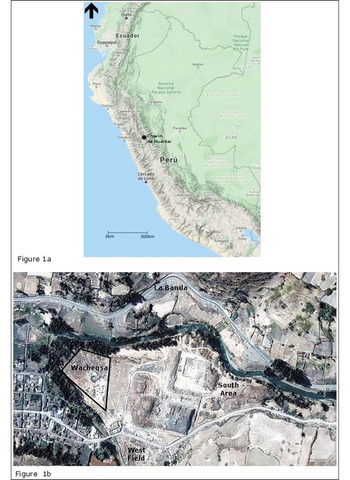
The ceremonial centre of Chavín de Huántar, in the region of Ancash in the northern central Peruvian highlands, lies at 3180m asl (Figure 1a), at the junction of the rivers Wacheqsa and Mosna. It comprises impressive stone buildings with internal galleries, open plazas and a complex network of canals (Figure 1b). Chavín has been pivotal in the discussion of the origins of social complexity in the Andes: as the Andean ‘mother culture’ (the title attributed by Tello Reference Tello1960); as a derivative of developments originating in Mesoamerica (Uhle Reference Uhle1902); as a synthesis of earlier Andean coastal and highland developments (Burger Reference Burger and Keatinge1988); or as a place where authority was forged and transmitted (Kembel & Rick Reference Kembel, Rick and Silverman2004; Rick Reference Rick, Vaughn, Ogburn and Conlee2005, Reference Rick, Conklin and Quilter2008). Until recently, however, only limited research had been conducted in the areas surrounding Chavín's monumental centre (e.g. Espejo Núñez Reference Espejo Núñez1941; Burger Reference Burger1992; Diessl Reference Diessl2004). The nature of the activities carried out in these areas varied according to their location and proximity to the ceremonial centre. The contexts identified at La Banda, on the east bank of the river Mosna, for example, are primarily domestic, but with a ceremonial imprint (Sayre Reference Sayre2010; Rosenfeld & Sayre Reference Rosenfeld and Sayre2016; Sayre et al. Reference Sayre, Miller and Rosenfeld2016), while those identified in the West Field have mostly ceremonial components (Contreras Reference Contreras2017) (for locations, see Figure 1b).
Location (a) and aerial view (b) of Chavín de Huántar (figure by C. Mesia-Montenegro; 1b made using an IKONOS satellite image courtesy of Antamina mining company).

The investigation of Chavín's immediate periphery provides valuable information regarding the activities that were carried out around the monumental core, which were no less complex than those carried out in the architectural centre. This information is also relevant for understanding the monumental centre and its occupation during the early socio-economic development of the Andes. Considering that “The residential zone nearest the old temple […] was probably occupied by the people responsible for the religious activities and the construction and maintenance of the buildings” (Burger Reference Burger1992: 159), the data obtained from excavations between 2003 and 2005 (Mesia-Montenegro Reference Mesia-Montenegro2007) in the Wacheqsa sector, presented here, help us to understand who the inhabitants of that area were and what their relationship with the temple was. If the authorities themselves lived in the Wacheqsa sector, one would expect the presence of elaborate constructions, high-quality ceramics and prestige items; on the other hand, if labourers lived there, one would expect the opposite. But what if there was another option? Craftspeople, for example? Questions relating to the relationship between centres and their peripheries and to early socio-economic developments are relevant worldwide, and Chavín can therefore be used to compare contextual data from Formative societies in the Central Andes with other Formative societies elsewhere.
The Wacheqsa sector
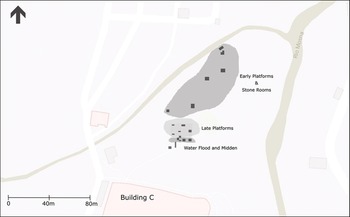
The Wacheqsa sector (Figure 2) is located immediately north of the monumental core, between it and the domestic settlement that stretched into the land now occupied by the modern town of Chavín. Encompassing an area of 1.4ha, the sector is enclosed by the rivers Wacheqsa to the north and Mosna to the east. Its modern topography is the result of the 1945 landslide, which changed the surrounding landscape. In his unpublished field notes, Tello (Reference Tello1940: 28) stated that there were at least three major platforms visible, covered by small agricultural fields where farmers cultivated maize. He also stated that “this land is only flat in some portions, in others it has a marked step towards the river” (Tello Reference Tello1940: 27). This space formed part of the ceremonial centre, but no monumental architecture was visible on the surface at the time of Tello's visit.
The Wacheqsa sector and its spatial units (drawn by C. Mesia-Montenegro).

Chronology
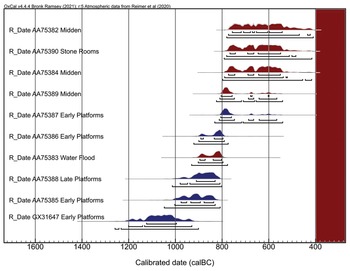
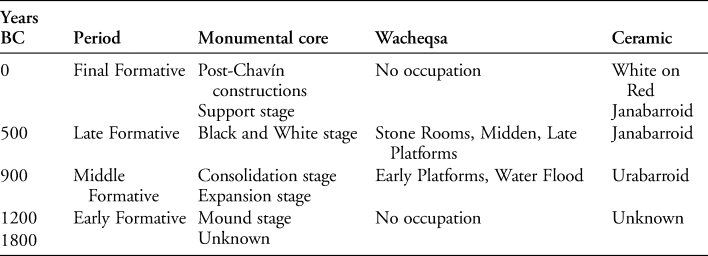
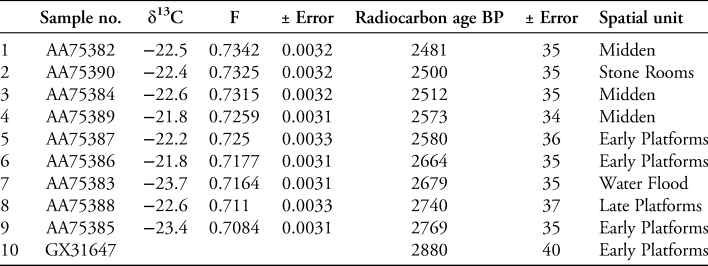
The Wacheqsa sector was occupied between 1100 and 500 cal BC (Tables 1 & 2; Figure 3), during the Middle and Late Formative periods (Mesia-Montenegro Reference Mesia-Montenegro2007, Reference Mesia-Montenegro2014, Reference Mesia-Montenegro and Sara Lafosse2017; Rick et al. Reference Rick2009). There were two occupational periods. The oldest (1100–800 cal BC) comprises two spatial units, named Early Platforms and Water Flood. The Early Platforms unit represents the oldest domestic settlement, while the Water Flood provides evidence of the channelling of the river Wacheqsa during the Middle Formative. The later occupation (800–500 cal BC) consists of three spatial units called Late Platforms, Stone Rooms, and Midden. The Stone Rooms unit probably housed artisans, while the Midden (see Mesia-Montenegro Reference Mesia-Montenegro2014) provides evidence of feasting. The Late Platforms unit seems to be an intermediate area between the other two units (Table 2). This article focuses on the Early Platforms and Stone Rooms units, as they are the only contexts in the Wacheqsa sector that provide evidence of domestic occupation. The Middle Formative is contemporaneous with the period of architectural growth at Chavín de Huántar, between 1200 and 800 cal BC—particularly the period of intensive expansion between 1000 and 800 cal BC. This includes construction of the Black and White Stage, probably between 850 and 800 cal BC. The Late Formative is contemporaneous with the subsequent 300-year period of relative architectural stability in the monumental core following construction of the Black and White Stage (Kembel Reference Kembel2001, Reference Kembel, Conklin and Quilter2008; Kembel & Haas Reference Kembel and Haas2015). Occupation in the Wacheqsa sector began after the start of monumental construction at the site, c. 1200 cal BC (Kembel & Haas Reference Kembel and Haas2015).
Radiocarbon dates from the Wacheqsa sector (figure by C. Mesia-Montenegro, made using OxCal v4.4.4; Reimer et al. Reference Reimer2020; Bronk Ramsey Reference Bronk Ramsey2021).

Chronology of Chavín de Huántar.

Radiocarbon dates from the Wacheqsa sector. Dates calibrated (at 95.4% confidence) using OxCal v4.4.4 and the SHCal20 atmospheric curve (Reimer et al. Reference Reimer2020; Bronk Ramsey Reference Bronk Ramsey2021).

Archaeological contexts
Here, the archaeological assemblages from the Early Platforms and Stone Rooms units are discussed, focusing on ceramic distributions (using kernel density estimations; Baxter et al. Reference Baxter, Beardah and Wright1997), architectural features and other artefact types. The Boone Index (Boone Reference Boone1987) is also used to infer the level of heterogeneity in the distribution of materials per strata excavated. The higher the index (Hi), the more homogeneous the unit is. Equally, Monte Carlo simulations were employed to establish whether the Hi values observed in the Boone Index represent a genuine trend in the archaeological materials from the various deposits and analytical units, or whether they reflect sample size bias (Manly Reference Manly1991; Shennan Reference Shennan2006); the Hi value after the simulations is labelled p(Hi) (see the online supplementary material (OSM)).
Early Platforms
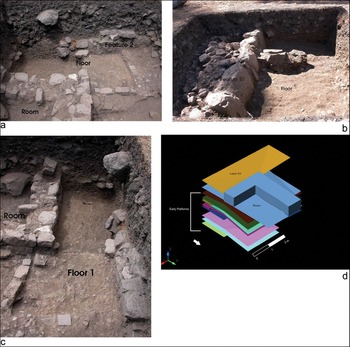
The Early Platforms unit, located in the north and central sections of the Wacheqsa sector, encompasses an estimated area of 1100m2 and its average depth is 2.04m below the current ground level. It is characterised by a sequence of deposits lying directly below the Stone Rooms unit (Figure 4d), and comprises near-flat surfaces with small angular rocks and a low density of archaeological finds. In total, 20.3m3 were excavated and 978 artefacts recovered, with an average density of 48 artefacts per m3.
View of the structures identified in: a) Stone Rooms unit in WQ-4; b) Stone Rooms unit in WQ-3; c) Stone Rooms unit in WQ-4; d) CAD model of WQ-4, showing the superposition of the Stone Rooms and Early Platforms units (photographs and CAD model by C. Mesia-Montenegro).

Ceramics
The Stanford Archaeological Project at Chavin proposed the ceramic nomenclature of Urabarroid and Janabarroid to distinguish it from classic Urabarriu (900–500 BC) and Janabarriu (400–250 BC) ceramic types and phases (Rick et al. Reference Rick2009; Rick Reference Rick and Seki2014). This naming was intended to clarify that there are no formally defined Urabarriu nor Janabarriu ceramic styles or phases, as their original definitions lack formal characteristics and clear dating (Burger Reference Burger1998), making it difficult to assess ceramic styles with rigour and chronological accuracy.
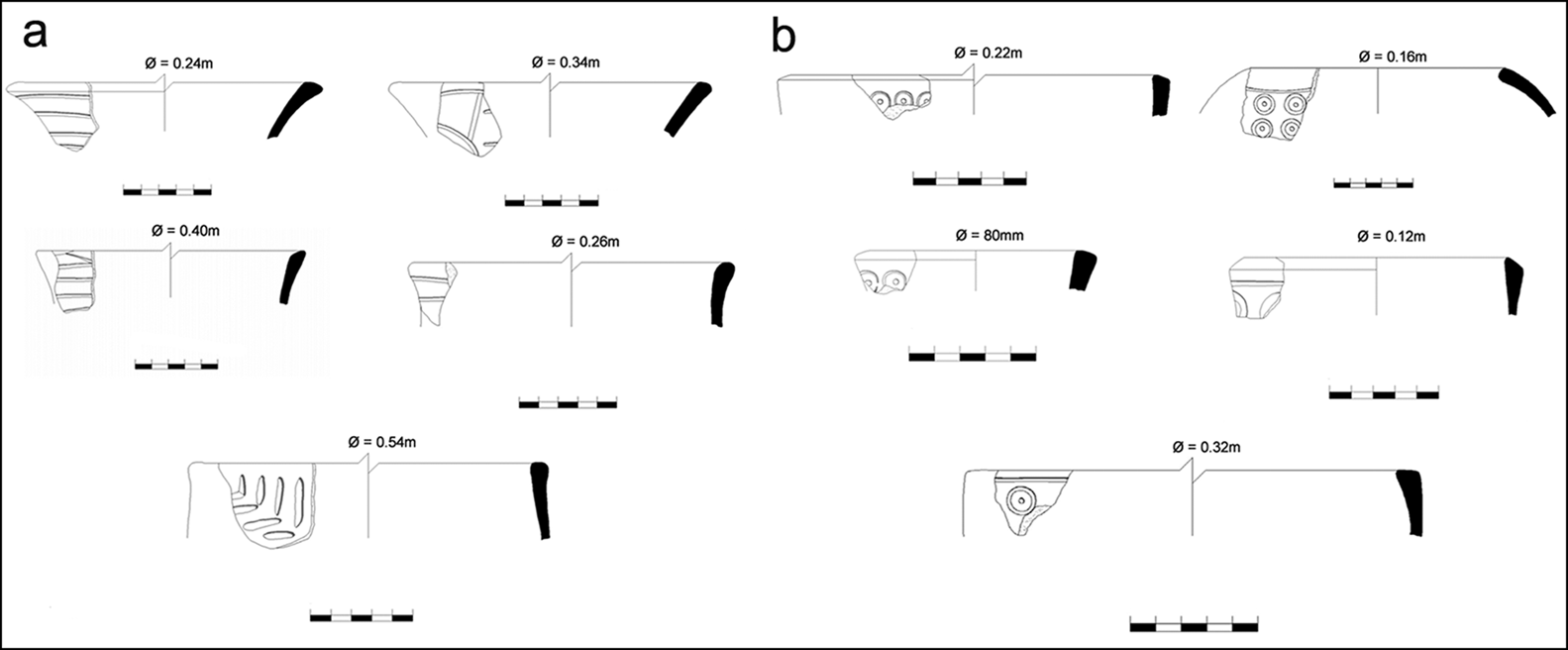
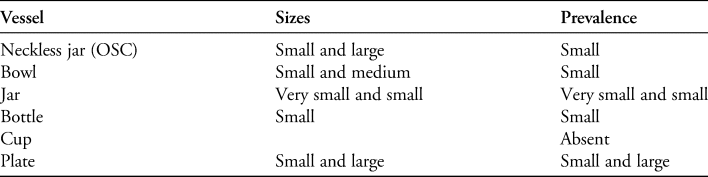
The pottery in the Early Platforms unit relates to Urabarroid ceramics (Rick et al. Reference Rick2009; Mesia-Montenegro Reference Mesia-Montenegro and Sara Lafosse2017) (Figure 5a). Neckless jars are the dominant ceramic type, comprising 49 per cent of the sample. This type is characterised by two sizes—that is, small and large vessels, with a bias towards small containers. Bowls comprise 30 per cent of the sample and are represented by small- and medium-sized vessels, with a strong bias towards small bowls. Jars make up 14 per cent of the sample and are represented by small jars. Bottles and plates together comprise less than 7 per cent of the sample (Figure 6a).
a) Urabarroid ceramics from layer 6 of the Early Platforms unit in WQ-4; b) Janabarroid ceramics from layer 2 of the Stone Rooms unit in WQ-4 (scales in cm) (illustrations by C. Mesia-Montenegro).

Violin plot of ceramics densities: a) in the Early Platforms unit); b) in the Stone Rooms unit. B = bottle; BO = bowl; OSC = neckless jar; P = plate (figure by C. Mesia-Montenegro).

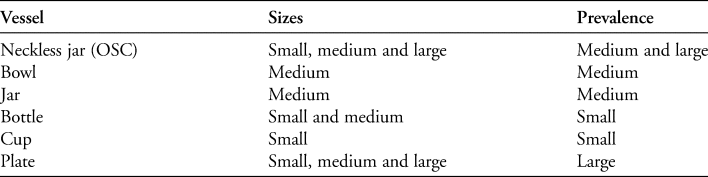
The preponderance of small, neckless jars suggests the preparation of food for a small number of people. This interpretation is reinforced by the bowls predominantly of small size; hence, food was probably consumed at the household level. The presence of a small, but nevertheless consistent, proportion of large-sized, neckless jars and of medium-sized bowls (Table 3) is notable, as this possibly indicates the occasional consumption of food at a larger scale. The ceramic assemblage analysed suggests that cooking was the principal activity carried out on the Early Platforms. Regrettably, there is insufficient information to establish whether the excavated areas were separate from the households or included within them; if the latter, the platforms might be considered as foundations for domestic structures.
Summary of vessel types from the Early Platforms unit.

Other materials
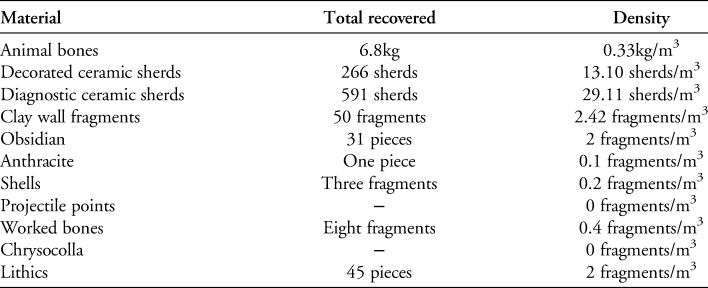
Faunal remains recovered from the Early Platforms unit comprise 6.8kg of animal bone, with a mean density of 0.33kg per m3 (Table 4). Analysis has yet to establish what proportions of animals were consumed, but it was probably dominated by camelids, given the high incidence of camelid consumption previously reported at Chavín de Huántar (e.g. Miller & Burger Reference Miller and Burger1995; Rosenfeld & Sayre Reference Rosenfeld and Sayre2016).
Densities of archaeological material from the Early Platforms unit.

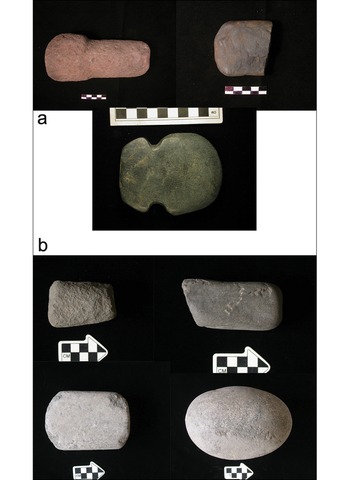
Grinding stones and handaxes were also recovered (Figure 7a). The former may have been used to process different plant foods, as indicated by the presence of maize (Zea mays) and olluco (Ullucus tuberusus) starches; olluco is a root vegetable widely distributed in the Peruvian highland (Mesia-Montenegro Reference Mesia-Montenegroin press).
a) Grinding stones and handaxe from the Early Platforms unit; b) grinding stones from the Stone Rooms unit (photographs by C. Mesia-Montenegro).

Three fragments of clam (Mesodesma donaceum) shell were recovered. Given the costs of bringing shellfish from the coast, and keeping them fresh during transport, these clams can be considered as high-status foodstuffs in the highlands. Even if clams were not consumed, however, and the shells only used for craftwork, these shells would still have been considered exotic and of high status.
From the Midden, which is located to the south of the Early Platforms unit, large fragments of burnt clay were retrieved; vitrification of the clay surfaces indicates exposure to very high temperatures. This material belongs to non-domestic architectural features, such as large formal columns, plastered walls, friezes and floors (Mesia-Montenegro Reference Mesia-Montenegro2014). Burnt clay fragments from the Early Platforms unit are markedly different: they are much smaller than those from the Midden, do not show signs of vitrification, and are thinner (<10mm). Some have the imprints of canes, which indicate that they probably formed part of dried-mud structures, with large wooden canes providing the internal structure. These types of structures are still ubiquitous in the modern town of Chavín, where low stone walls serve as foundations for wattle-and-daub superstructures. The foundations of domestic units have yet to be found in our excavation of the Early Platforms unit. This may be because such structures did not have solid foundations, or that our excavation strategy failed to find any extant structures.
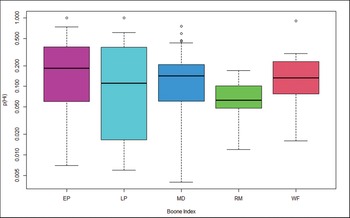
In terms of material diversity, the Early Platforms unit shows the highest p(Hi) mean, indicating that the deposits were very homogeneous compared with the Stone Rooms unit. The lack of prestige items and other related materials suggests a modest occupation, in terms of status, during the Middle Formative period (Figure 8).
p(Hi) plot of all Wacheqsa spatial units. EP = Early Platforms; LP = Late Platforms; MD = Midden; RM = Stone Rooms; WF = Water Flood (figure by C. Mesia-Montenegro).

Stone Rooms
The Stone Rooms unit is located 2m below ground level in the central section of the Wacheqsa sector, directly above the Early Platforms unit (Figure 4). It encompasses an estimated area of 1717m2, with an estimated volume of 668.47m3. The Stone Rooms themselves and their interconnected alleys constitute the earliest occupation in the Stone Rooms unit. The alleys were then intentionally filled with loose matrix mixed with medium-sized cobbles and angular stones. A platform made almost entirely of quadrangular, medium-sized rocks within a loose matrix of soil subsequently sealed the fill of the rooms and alleys, which had been cleaned before being filled. The assemblages recovered from this unit come from the fills of the alleys and platform and may represent the last episode of the Stone Rooms occupation. Unlike the Early Platforms contexts, within which stratified platform surfaces were identified, the Stone Rooms contexts do not show superimposed occupation levels, except for the later platform (Layer 03 on Figure 4) that covered them. No modern intrusions were detected in the Stone Room contexts, and we are confident that the deposits were sealed. In essence, the Stone Rooms contexts give us a glimpse of a particular moment between 800 and 500 cal BC.
Ceramics
The ceramics from the fill of the Stone Rooms relate to Janabarroid forms (Rick et al. Reference Rick2009; Mesía-Montenegro Reference Mesia-Montenegro and Sara Lafosse2017) (Figure 5b). Medium-sized bowls comprise almost 50 per cent of the assemblage from the Stone Rooms unit. Bowls dominate the ceramic assemblage, suggesting that the activities represented in the deposits are related to the serving of food. Neckless jars make up 36 per cent of the ceramic assemblage. They are mostly medium-sized vessels, closely followed by large examples. Jars are represented by medium-sized vessels. Bottles, cups and plates together constitute less than 5 per cent of the assemblage (Figure 6b). The ceramic evidence indicates that the consumption of food was one of the activities carried out in these rooms, with medium-sized bowls probably used for this purpose. While the Early Platforms ceramic assemblage of small, neckless jars and small bowls indicates the consumption of foodstuffs at a household level, that of the Stone Rooms—characterised by medium-sized bowls and large, neckless jars—suggests that food was consumed here by a greater number of people (Table 5).
Summary of vessel types from the Stone Rooms unit.

Changes in ceramic forms and sizes may be interpreted as an increase in the population living in the Wacheqsa sector, or they may reflect a change in the type of inhabitants living there. A change from small to large, neckless jars and bowls indicates that more food and liquids were being produced and stored. If more food was being cooked (neckless jars) and served (bowls), it can be argued that more people were being fed, or that a small number of people were consuming more food. From the Middle to the Late Formative period, an escalation in social complexity is manifested in the radical transformation of Chavín's architectural core: two major plazas were added, monumental constructions were formalised and expanded to reach their fullest known extent, a river was rechannelled, and an extensive network of subterranean canals was greatly expanded (Kembel Reference Kembel2001, Reference Kembel, Conklin and Quilter2008; Contreras Reference Contreras2009, Reference Contreras2017). The amount of energy, labour and skills required to accomplish this architectural feat is an indication of the Late Formative complexity at Chavín de Huántar; such an increase in complexity may also explain the change observed in the ceramic assemblage of the Wacheqsa sector.
Other materials
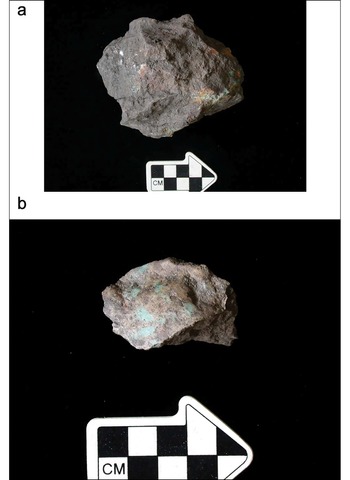
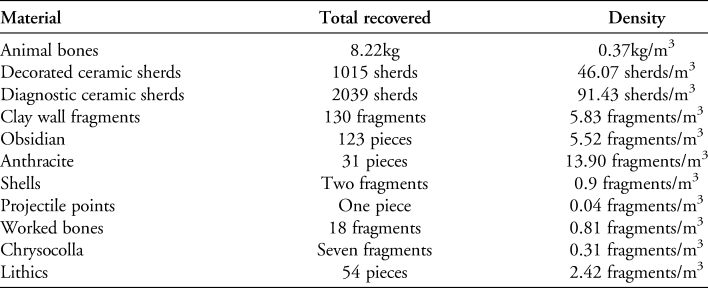
Prestige items, such as obsidian, shells and anthracite mirrors, are also present in the Stone Rooms unit (Table 6). Seven fragments of anthracite mirrors were recovered in this unit, whereas such mirrors are almost absent in the Early Platforms unit. Other special elements recorded in the Stone Rooms unit are chrysocolla beads. Chrysocolla is a hydrated copper silicate, often used as an ornamental stone (Cantarruti Reference Cantarruti, Tripcevich and Vaughn2013). Special importance was placed on pieces of raw chrysocolla, which are the only objects of this type found in the Wacheqsa sector (Figure 9a). A further notable find is a fist-sized fragment of native copper ore (Figure 9b). Three sources of copper ore that could have been exploited for raw materials are reported within less than 1km from Chavín de Huántar. The presence of chrysocolla beads, raw chrysocolla and copper ore may therefore indicate that metallurgy was practised in the Wacheqsa sector during the Late Formative period. As in the Early Platforms unit, grinding stones were recovered (Figure 7b). They may have been used to process different plant foods, as indicated by the presence of beans (Fabaceae sp.) and maize starches.
a) Copper ore block from layer 2b of the Stone Rooms unit in WQ-4; b) chrysocolla block from layer 2b of the Stone Rooms unit in WQ-4 (photographs by C. Mesia-Montenegro).

Densities of archaeological material from the Stone Rooms unit.

In terms of diversity, the Stone Rooms unit also displays the lowest p(Hi) mean, indicating that the deposits were highly diverse within the already high diversity exhibited by all five analytical units. The unique character of the artefact composition in the Stone Rooms unit is best explained by the activities practised inside the rooms rather than by sample size bias (Figure 8).
The Wacheqsa sector as a domestic area
Domestic activities in the Wacheqsa sector have been suggested (Bennett Reference Bennett1944; Tello Reference Tello1960) but never confirmed before the research reported here. In the 1970s, Rosa Fung stated that the northern edge of the Wacheqsa sector was a domestic area located on top of a pre-Chavín occupation: “During our last excavations at Chavín de Huántar, in domestic areas, we have found Kotosh-Kotosh ceramics in deep strata, but it cannot be said that the superimposed Chavín ceramics descend from them” (Fung Reference Fung1975: 199). Later, Burger's excavation, carried out in the modern town of Chavín de Huántar in 1976 (Burger Reference Burger1978), recovered imported Kotosh-Kotosh vessels associated with Urabarroid ceramics, which indicates that the latter were contemporaneous with the Kotosh-Kotosh (1100–900 cal BC) phase at Kotosh—a major Late Archaic and Formative site located 100km south-east of Chavín de Huántar; this ceramic association has also been corroborated by radiocarbon dates (Izumi & Terada Reference Izumi and Terada1972; Rick et al. Reference Rick2009; Kembel & Haas Reference Kembel and Haas2015). Until recently, it was believed that the Kotosh-Kotosh ceramics from the eastern Central Andes were earlier than Chavín ceramics, but the ceramic association at Chavín indicates that the domestic units reported by Fung (Reference Fung1975) date to the Chavín period. The prevalent unidirectional, diffusionist interpretation of Kotosh elements in Chavín (Burger Reference Burger1992) can therefore be challenged; it is possible that Chavín also exerted an influence in the eastern Central Andes and benefited from this mutual interaction. This can also be seen in the Kotosh-Chavín phase at Kotosh, which is dominated by Janabarroid ceramics (Izumi & Sono Reference Izumi and Sono1963; Izumi & Terada Reference Izumi and Terada1972). While not going as far as Tello (Reference Tello1943: 152), who proposed that Kotosh originated under strong Chavín influence, I emphasise here that the relationship between Kotosh and Chavín started earlier than previously suggested.
When describing the extent of the earliest domestic settlement at Chavín de Huántar, Burger (Reference Burger1992: 159) stated that the Wacheqsa sector was probably inhabited by people responsible for the religious activities at the site or engaged in the construction and maintenance of the buildings. The evidence recovered indicates that both Fung and Burger correctly identified an early domestic area in the northern part of the Wacheqsa sector, but we must question who these early inhabitants were and what their relationship with the temple was.
Burger's (Reference Burger1992: 159) statement, quoted above, that people responsible for religious activities and for the construction and maintenance of buildings may have lived in the Wacheqsa sector, requires consideration. If people of authority lived in the Wacheqsa sector during the Middle Formative, one would expect the presence of elaborate architecture, high-quality ceramics, and prestige items, as at La Banda on the opposite bank of the river Mosna, facing the monumental centre, where Late Formative luxury and exotic items are frequent (Sayre Reference Sayre2010; Rosenfeld & Sayre Reference Rosenfeld and Sayre2016; Sayre et al. Reference Sayre, Miller and Rosenfeld2016). Luxury items, such as gold crowns, chest plates, earrings, and jewellery made of exotic stones, are also known from Late Formative burials at Kuntur-Wasi and Pacopampa in the Peruvian northern highlands (Onuki Reference Onuki1995, Reference Onuki1997; Nagaoka et al. Reference Nagaoka, Seki, Hidalgo and Chocano2020). Furthermore, gold ornaments have been recovered on the north coast of Peru (Lothrop Reference Lothrop1941, Reference Lothrop1951). The ceramics recovered from the Early Platforms unit are not luxury items, most being small, neckless jars. Although house foundations have not been found, wall fragments made of clay have been recorded. Food consumption was at the household level, as attested by the predominance of neckless jars and bowls in the ceramic assemblage. While the occupants of the Early Platforms unit had access to special materials such as shells and obsidian, no chrysocolla and anthracite artefacts were recovered there.
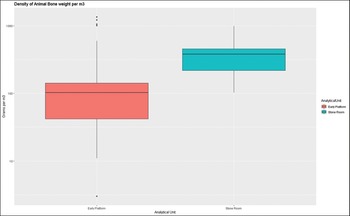
During the Late Formative, the situation changed dramatically, as demonstrated by the Stone Rooms unit. Structures made of two or three rows of quadrangular, medium-sized rocks are ubiquitous above the early Middle Formative domestic settlement level. The evidence recovered suggests that clay or mud was used to build up the walls. There is an increase in obsidian artefacts, and chrysocolla and anthracite artefacts—barely present in the Early Platforms unit—now make an appearance. Chrysocolla and copper ore were present as raw materials, representing a further contrast with the Early Platforms unit. Hence, although the raw material evidence is too limited to state conclusively that artisans were living in the Stone Rooms structures, it is a possibility. What is clear is that the Stone Rooms unit featured durable structures and that their occupants had greater access to special items, including obsidian, anthracite mirrors, and raw materials such as chrysocolla and copper ore. The ceramic assemblage indicates that food was consumed on a larger scale than in the Early Platforms unit, which is also inferred by comparison of the mean densities of animal bone fragments per cubic metre between the two units (Figure 10). The appearance of previously unseen archaeological materials in the Stone Rooms unit is contemporaneous with the ceremonial centre's architectural Black and White stage, or at least part of it.
Comparison of animal bone weight per cubic metre (drawn by C. Mesia-Montenegro).

Social complexity was not the same in the Middle and Late Formative periods, and more specialised work and energy investment is seen in the Late Formative. If we take architecture as a proxy, a steady growth in complexity is detectable. While we still need to understand the degrees of social complexity through time and its material expression at Chavín, the archaeological evidence points to differing levels of social complexity and specialisation throughout Chavín's Formative history over at least seven centuries.
Conclusions
Between 1100 and 800 cal BC, the northern part of the Wacheqsa sector was a settlement inhabited by people who cooked food in small, neckless jars, ate from small bowls and had access to exotic resources, such as shell, anthracite and obsidian. The hypothesis of a settlement located in this area had previously been suggested (Bennett Reference Bennett1944; Tello Reference Tello1960; Fung Reference Fung1975; Burger Reference Burger1978; Lumbreras Reference Lumbreras1989). The results reported here now demonstrate that there was indeed a modest occupation of a domestic nature.
Sometime c. 800 cal BC, occupation in the Wacheqsa sector was reconfigured. Its inhabitants built new structures on solid foundations, cooked in large ollas (jars), used medium-sized bowls as serving vessels, had access to shell, obsidian, chrysocolla and copper ore (the latter two as raw materials), and also possessed anthracite mirrors. It is plausible that people living in the Wacheqsa sector c. 800 cal BC were craftspeople producing artefacts required by the Chavín authorities, but further excavation is needed to confirm this.
Formative societies are characterised by major corporate architectural projects, as seen not only in the Andes but also in Mesoamerica. There, the Formative or Pre-Classic periods saw the “emergence, establishment, and dissemination of unprecedented social, political, and economic practices along with ideological conventions and materializations that would serve as the framework upon which all subsequent Mesoamerican societies would be based” (Doering Reference Doering and Smith2014: 4785). The Formative period in the Central Andes offers a similar picture. Such developments are not limited to the Americas; monumental architecture developed dramatically among Chalcolithic societies in the Near East between 6500 and 5550 BC (Hackley et al. Reference Hackley, Yıldırım and Steadman2021), for example, requiring specialists with the necessary skills to meet the needs of corporate construction projects. Understanding the relationship between artisans and elites is crucial for comprehending the power relations that existed between ceremonial centres and their immediate peripheries and for recognising the strategies that authorities used to entice artisans to work for religious organisations.
Acknowledgements
I wish to thank John Rick, Rosa Rick, Daniel Contreras, John Wolf, Matt Sayre, Iván Falconí, Silvia Kembel, Rosa Fung and Ian Robertson. I also thank the Peruvian National Museum of Archaeology, Anthropology and History, and the San Marcos Museum of Archaeology and Anthropology. Finally, I am grateful to the anonymous reviewers for their comments.
Funding statement
Excavations were funded by Stanford University's Center for Latin American Studies, School of Humanities and Social Sciences, and Department of Anthropological Sciences; the National Geographical Society; and the Global Heritage Fund.
Supplementary material
To view supplementary material for this article, please visit https://doi.org/10.15184/aqy.2022.73