1. Introduction
In 18th-century Europe, desertion had become so widespread that “it was largely accepted as a facet of European military life” (Linch Reference Linch2016: 809), forcing every regime (monarchies and republics alike) to deal with the issue by developing policy instruments of exceptional gravity. According to a military dictionary from the 1700s, “a deserter is, by the articles of wark, punishable by death, and, after conviction is, if in camp, hanged at the head of the regiment he deserted from, with his crime writ on his behalf; and suffered to hang till the army leave the camp, for a terror of others.”Footnote 1 Culture and public sentiments across time and space similarly target deserters as representing the lowest form of human weakness, like selfishness, lack of patriotism, and cowardice (Forrest, Reference Forrest1989).Footnote 2
Despite its importance in military affairs, the issue of desertion has attracted little attention and little theoretical treatment by social scientists. We develop an economic theory of desertion that relies on the “property rights approach” to economic and social institutions. More precisely, we build upon Yoram Barzel's understanding of the nature of economic property rights and the significance of transaction costs for the organization of human activities (Barzel, Reference Barzel1997). The theory is straightforward. We define desertion as a member of the military's act of either (1) refusing to join or (2) abandoning without permission one's military unit.Footnote 3 A soldier's decision to desert is a binary one. Either he supplies (some of) his services to the government or he does not. There is no middle ground.
Whether he is drafted into the army or he joins it voluntarily, a soldier's labor services are de facto transferred to the government of his country. However, this transfer will never be “perfect.”Footnote 4 Labor services are intrinsically linked to the worker's own mind and body and neither of these can ever be fully alienated to one's employer. This makes the enforcing of contracts over these services (whether implicit or explicit, voluntary or coercive) challenging. The practice of desertion, the reappropriation of one's labor from the government, is then a consequence of the particular technological features of property rights over military labor services.
Building on these intuitions, we develop the “desertion as theft” framework and derive several empirical predictions.Footnote 5 We test these against qualitative and quantitative evidence from post-revolutionary France. We find that desertion rates are higher where the expected benefits for deserters are larger (that is, when they can command higher wagesFootnote 6 outside of the army) and where the government's marginal cost of enforcing their legal property rights over the soldiers’ services is higher. More specifically, we find that variables measuring the geographic and environmental characteristics of a given territory predict the rate of desertion in the same territory. As Allan Forrest (Reference Forrest1989: 81) argues in his authoritative work on desertion in revolutionary and Napoleonic France:
Like all aspects of life in the countryside, rural desertion reflected very closely on local topography and the nature of the terrain. Mountains, dispersed habitations, upland pasture, rocks and caves, treacherous marchlands familiar only to the local population, smugglers’ hill tracks that were of very private connaissance all offered escape and evasion.
One of the advantages of the property rights approach lies in its power to produce implications for real-world phenomena (Barzel, Reference Barzel2002: 3). Our empirical analysis illustrates the explanatory power of the theory, and illuminates features of the historical experience of desertion such as the variation in its extent across different jurisdictions. However, due to the nature of our data and necessary limitations in our empirical strategy, we make no claim with respect to the causal nature of the link between our variables of interest.
This paper contributes to several strands of literature. First, we add to the extensive body of work that applies the property rights approach to the study of market and non-market institutions. Allen (Reference Allen1990, Reference Allen1995) studies the incentive structure generated by the distribution of property rights within traditional families and religious institutions respectively. Barzel (Reference Barzel1977) applies this approach to the institution of slavery. Cheung (Reference Cheung1983) develops a transaction costs theory of alternative contractual arrangements. Johnson and Libecap (Reference Johnson and Libecap1982) consider the wealth-dissipating effect of property arrangements in the case of common property fisheries. Leeson (Reference Leeson2012a, Reference Leeson2012b) shows the role of superstition as an enforcement mechanism for property rights in Medieval Europe. Finally, Piano (Reference Piano2017, Reference Piano2018) studies the property rights arrangements within Outlaw Motorcycle Gangs.
Second, we contribute to the economic analysis of military affairs. Brennan and Tullock (Reference Brennan and Tullock1982) study how military tactics are developed to align soldiers’ incentives on the battlefield. Frey and Buhofer (Reference Frey and Buhofer1988) develop a theory of the evolution of the treatment of war prisoners throughout European history. Allen (Reference Allen1998) provides an analysis of the system of military venality, while Allen (Reference Allen2002) studies the provision of incentives in the British navy. Finally, Allen and Leeson (Reference Allen and Leeson2015) offer a political economy explanation for the limited popularity of the longbow (a technologically superior alternative to the more popular crossbow) in Medieval Europe.
Our paper also adds to the social scientific scholarship on desertion. Woodbury (Reference Woodbury1921) categorizes the causes of desertion according to US Court Martial records. He finds that, of over five hundred cases in which evidence of the cause of desertion existed, mental illness, drug addiction, cowardice, weakness of character, and illness of a relative were among the most popular. Agostini (Reference Agostini2007) provides an overview of primary sources on the extent of desertion during the Seven Years War, and identifies the breakdown of desertion rates in the British colonial army by ethnicity and occupation. Leeson (Reference Leeson2007, Reference Leeson2009, Reference Leeson2010) discusses how the 18th century relied heavily on volunteers in order to reduce the likelihood of desertion. Costa and Kahn (Reference Costa and Kahn2010) study the causes of desertion during the American Civil War, finding that company-level characteristics (including occupational and cultural homogeneity) predict the probability of desertion among its members. They also find that deserters were more likely to relocate far away from their hometowns at the end of the war, possibly out of fear of being ostracized and shamed by their communities. Linch (Reference Linch2016) examines the causes of desertion in the British army during the Napoleonic wars, arguing that “desertion from the British Army stemmed from three main factors: adjustment to life as a soldier; discontent with the service; and opportunities outside the Army” (Linch, Reference Linch2016: 808).
2. Desertion as theft
In general, governments have two options available to them when deciding how to staff their army: conscription and voluntary service. These two systems differ over a wide array of margins (Lee and McKenzie, Reference Lee and McKenzie1992; Ross, Reference Ross1994). An obvious difference is that conscription relies on the government's exercise of violence. Conscription and voluntary service also differ in the productivity of the individuals serving in its forces. A volunteer army has a higher direct monetary cost, while conscription generates greater distortions in the economy. Nevertheless, both systems assume that the government is temporarily in control of the labor services of those serving in the army. In the case of a volunteer army, the transfer of control over one's services is consensual and explicitly contractual. The volunteer accepts the terms of military services (including duration, a general description of responsibilities, compensation, and so forth), the value of which he expects to be greater than that of his next best alternative. In the case of conscription, the government unilaterally appropriates the worker's services. While draftees are usually compensated for their labor, since the transfer was not mutually agreed upon, we cannot assume this compensation will generally equal the marginal worker's opportunity cost – nor, for that matter, that of the average worker.
Irrespective of the nature of the initial transfer, under both systems the government claims legal property rights over the soldier's labor services.Footnote 7 Desertion, the reappropriation of one's own labor services, is therefore analytically akin to theft.Footnote 8 Theft exists when the economic and legal rights over an asset diverge, even if only in expectation.Footnote 9 If the government could perfectly and costlessly enforce its claim over the soldier's labor, desertion would not exist. But in a world of uncertainty and imperfect information, enforcing claims is always costly to some extent. Some desertion will exist in equilibrium,Footnote 10 although its extent will vary depending on the technological and environmental circumstances and their effect on the cost of enforcing claims.
We model the choice of the soldier as follows. If he remains in the army and decides to meet his obligations, he receives compensation w* if the army is a volunteer one and ${\bar {\rm w}}$ if he was conscripted into it, where w* is the market wage and $w^{\ast} \gt {\bar w}$
 (Ross, Reference Ross1994). If, instead, he decides to desert, he receives (w* − c) with probability π– that is, the probability that he is caught by the government – and w* with probability (1 − π) – the probability he successfully escapes the government's penalty. c is the magnitude of the punishment the government imposes on the deserter if he is caught.Footnote 11
The soldier will desert whenever π(w* − c) + (1 − π)$w^{\ast} \gt {\bar w}$ , in the case of an army of conscripts, and π(w* − c) + (1 − π)w* >w* in an army of volunteers. The latter inequality yields the first prediction of the model: in an ideal volunteer army system, there would be no desertion. Since voluntary service requires the government to pay a soldier a wage at least as large as what he would obtain in the market, he does not benefit from deserting and risking even the smallest probability of being punished. Of course, in the real world, other factors may still lead a volunteer to desert. For example, exogenous shocks in the economy may lead to an increase in the wage he would command outside the army. Alternatively, the reality of war may force him to update his estimates of his disutility from military service. Nevertheless, these forces would be even more pronounced in the case of a draft army and we will expect desertion to be more prominent under conscription than under voluntary service.Footnote 12
Assuming the government drafts soldiers randomlyFootnote 13 and that workers are remunerated according to their marginal productivity, drafting an increasing share of the population will affect the equilibrium market wage of the marginal draftee. If w* = f′(L(1 − d)), and f′′(L(1 − d)) < 0, with L being the total labor supply and d the share of the population drafted, then ∂w*/∂d = −f′′(L(1 − d)). Hence, as the government conscribes a higher percentage of the population, a larger share of drafted young men will be in a situation where the inequality $\pi (w^{\ast}-c) + \lpar {1-\pi} \rpar w^{\ast}-{\bar w} \gt 0$ holds. That is, as d increases, market wages will increase, leading to:
Prediction 1
Under a conscription-based system, the desertion rate increases with the share of individuals drafted into the army.
In order to derive more implications, we must look into the variables determining the government's ability to enforce its claims over the soldiers’ labor services. Assuming the difference between the market wage, w*, and the wage offered to conscripts, ${\bar w}$ , be constant across the region under the government's sovereignty, its ability to deter desertion will depend on a set of variables affecting the cost of monitoring and enforcement. We focus on two kinds of variables: those measuring the administrative capacity of the government within a region and those measuring the environmental and geographic conditions that facilitate escaping the government's reach. Consider the latter first. Ceteris paribus, the government will face a higher marginal cost of enforcing punishment against desertion if it cannot liberally access a territory. For example, if one can easily hide from the government police, say by taking to the mountains, the expected probability of receiving a penalty from one's government is drastically reduced, thus making desertion more appealing. Administrative capacity has the opposite effect. The stronger the presence of the government within a given territory, the smaller the marginal cost of punishment, which in turn reduces the expected benefits of desertion. Within the framework developed above, the probability that the government identifies and punishes a deserter, π, is an increasing function of a vector of variables measuring administrative capacity, s = s 1, s 2, …, s n, and a decreasing function of a vector of variables measuring the impenetrability of the territory by the government, ε = ε 1, ε 2, …, ε n.
This discussion yields the following two predictions:
Prediction 2
Territories in which geographical and environmental conditions facilitate escaping the government's reach will experience a higher degree of desertion.
Prediction 3
The stronger the presence (in terms of administrative capacity) of the government within a territory, the less desertion there will be in that territory.
We now consider the possibility that the market wage available to the conscripted varies systematically not only at the individual level but across regions. As $\lpar {1-\pi} \rpar w^{\ast}-{\bar w}$ , which measures the expected benefits from desertion, increases we should see regions with higher average market wages endure a higher degree of desertion. This will only hold true if the government sets the wage of conscripted soldiers at the national level, rather than a regional or (even more unlikely) at the individual level. This leads to:
Prediction 4
The larger the discrepancy between market wage and the wage offered to conscripts, the higher the percentage of soldiers that will desert military service.
3. Desertion in post-revolutionary France
This section employs qualitative and quantitative data from post-revolutionary France to test the predictions of our “desertion as theft” approach. We choose this case study for the following reasons. First, under the First Republic (1792–1804), France introduced a wide array of innovative practices and policies in the administration of military affairs that inspired and were partially adopted by most other Western European countries over the following decades. Second, over the same time period, France began collecting statistics on a variety of variables to be employed for use of public administration. Among these, variables pertaining to the number, characteristics, and behavior of French soldiers were of particular importance. Thanks to these efforts, we have access to measures for desertion rates in Napoleonic France.Footnote 14 France was also the first modern European power to adopt large-scale conscription and to extend conscription to the population of annexed territories. Finally, the French army would be involved in a long series of major wars over the two decades following the introduction of conscription in 1798.
Historical background
The French revolution precipitated Western Europe into chaos. Not only were the remaining Ancien Regime powers afraid of the contagious potential of revolutionary ideas, but the most radical amongst the proponents of the revolution in France wanted to export it to the rest of Europe by means of military conquest. This led to a series of armed conflicts, for a total of seven wars, starting in 1792 and until 1815, between France and the other Western European powers. The burden of these “revolutionary wars” on French public finances was unprecedented, forcing the government of the First Republic to reintroduce military conscription in 1798.Footnote 15 As France conquered new territories, it extended conscription to their populations. The Belgian departments and the Cisalpine Republic were not exempt from contributing to the Republican military efforts. As general and then emperor, Napoléon introduced the draft to the newly created satellite states of the Italian Republic (1802), the Kingdom of Naples (1806 and 1809), the Grand Duchy of Berg and the Kingdom of Westphalia (1807), Holland, and the Hanseatic cities (1810) (Grab, Reference Grab1995). In many of these territories, conscription was an entirely new experience (Grab, Reference Grab1995).
In order to administer conscription, the government had to create a specialized bureaucracy. While deserters had always existed in France, the phenomenon had not been perceived as a major military or social problem until after the law of 1798, with which the Republican government reintroduced conscription as a way to staff its army (Forrest, Reference Forrest1989: 69). After Napoléon's rise to power in 1799, this bureaucracy was reformed, with local officials, such as the préfets, being appointed directly by the executive branch. At the same time, the gendarmerie – France's military police – was put in charge of fighting desertion alongside newly created special courts. In every department, the préfet would come up with a list of draftable young men. According to French law, failure to join one's company by the identified date constituted desertion. Frenchmen whose number had been picked during the draft lottery, whether they were present or not, had one month to join their assigned military dépôt before being considered deserters (réfractaires or insoumis).Footnote 16 French law – specifically, Code de la Conscription, Imperial Decree of Fructidor 8, Year XIII, Title VIII, Article 46 – distinguished between those who deserted before joining the depot and those who deserted after joining their assigned military unit.
The significance of desertion in Napoleonic France was large. According to Forrest (Reference Forrest1989: 67) “[desertion] rapidly assumed the guise of a major social malaise as well as that of a purely military problem.” By the turn of the 19th century, the French countryside was already populated by hundreds of thousands of deserters (Forrest, Reference Forrest1989: 70).Footnote 17 Rebellions against the gendarmerie in order to free deserters were common, especially in the countryside and mountainous areas, where entrepreneurs would illegally hire deserters in their farms and factories (Fouché, Reference Fouché1908).
Data description
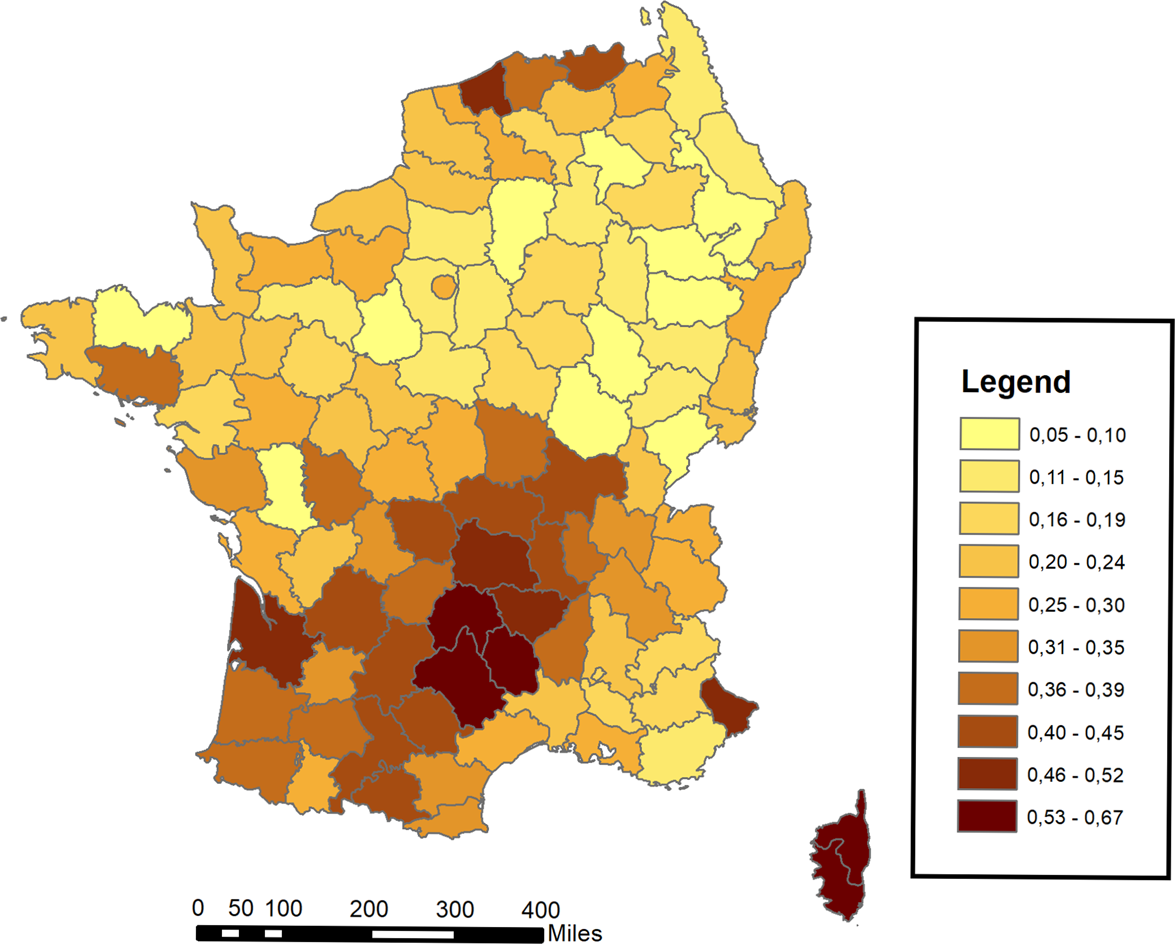
In order to test the predictions of our framework, we use cross-sectional data on desertion for the years 1799–1805. The data refer to desertion rates at the departmental level and were collected by Joseph E. T. Hargenvilliers, Napoleon's appointee to the office overseeing military conscription.Footnote 18 Hargenvilliers does not provide yearly desertion data, but rather the average desertion rate within each department over the entire period. The dataset contains 109 observations, one for each of France's 89 departments, plus the departments created in the newly occupied territories by French authorities (nine in Belgium, seven in Italy, and four in Germany). Figure 1 shows desertion rates across France and occupied territories between 1799 and 1805.
Desertion rates (1799–1805)

The scope of our data is limited in important ways. First, the numbers capture only a subset of all cases of desertion. Specifically, they refer to those individuals who, once drafted, failed to join the assigned company by the specified deadline. This excludes those who deserted after having joined their companies as well as those that deserted on the battlefield. Second, the data contain information about a deserter's department of origin and not his final destination. Figure 1 suggests that desertion was strongest in the Massif Central, a highland region in the southwest of France, as well as in the mountainous island of Corsica. Along the southwestern coast, the shore is covered in swamps and forests, providing many natural shelters to deserters, while the proximity to the Pyrenean Mountains provided opportunities to escape to Spain. In the southeastern region of France, all but two Alpine departments were characterized by desertion rates above the national average.
Variables
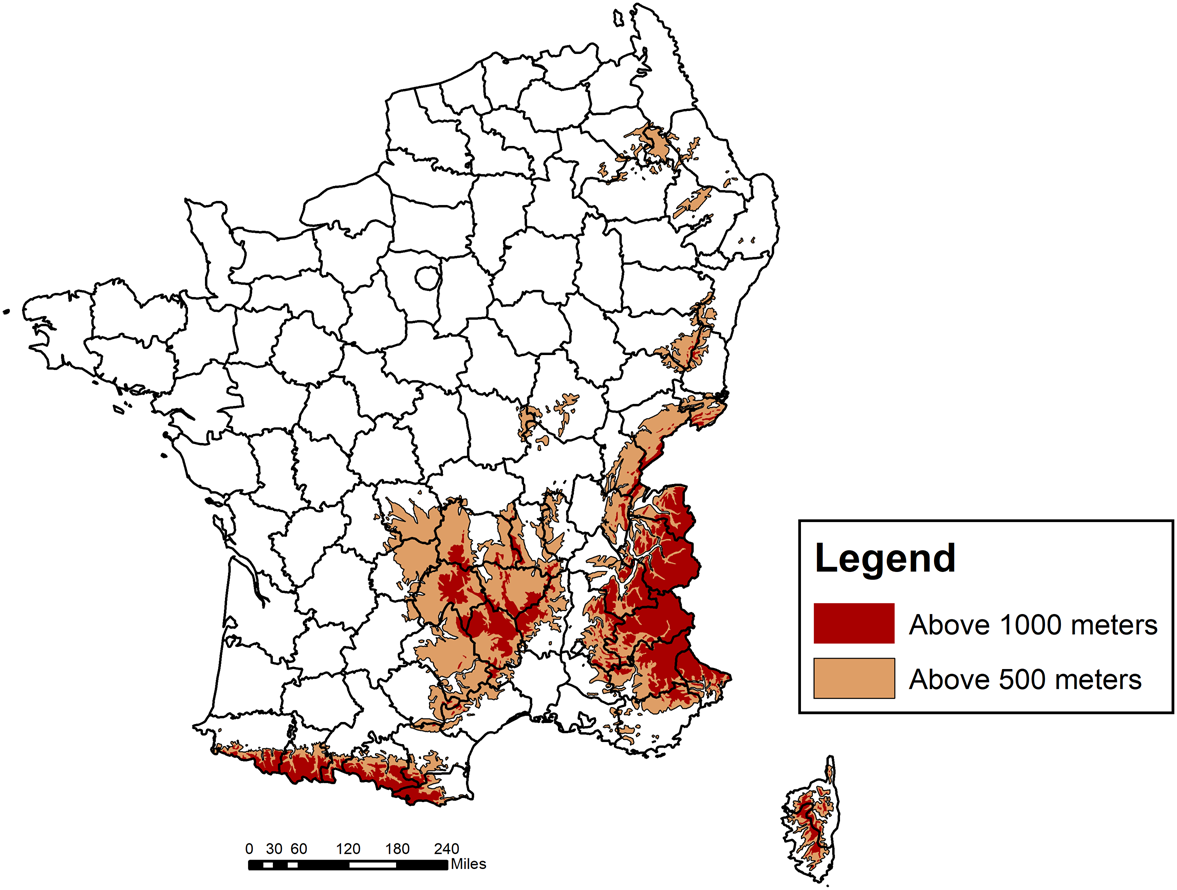
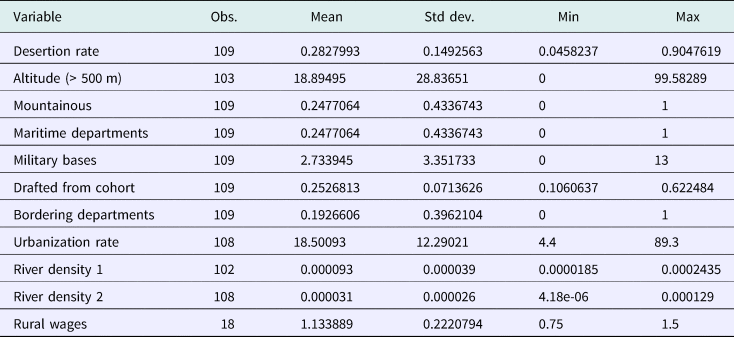
Table 1 presents summary statistics on our department-level variables. As we discuss above, our variable for desertion rates measures the percentage of all drafted men from a cohort who failed to join their military unit by the required date in each department. We calculate this using Hargenvillier's report on desertion and conscription in France and occupied territories over the period 1799–1805 (Vallée, Reference Vallée1937). Our environmental and geographic departmental characteristics are as follows. First, using geocoded data, we use the “second-level administrative divisions” layer for the year 1800 from the Georeferenced Historical Vector Data (Nüssli and Nüssli, Reference Nüssli and Nüssli2008) to generate a variable for the percentage of a department's territory with altitude above 500 meters (see Figure 2). However, due to limitations in this dataset, the observations for this variable do not include six Italian departments.
Altitude above 500 meters

Summary statistics on department-level variables

Second, we rely on Vosgien's (1809) geographic dictionary of France to generate a dummy variable identifying each of our 109 departments as either “mountainous” or not. Our third geographic variable is also binary, taking the value 0 if the department was landlocked and 1 if it had access to the sea (“maritime department”). We also include two measures of river density. The first calculates the ratio of the length of all major rivers in a department to its area in square miles, using “second-level administrative divisions,” “small rivers,” and “big rivers” layers from Nüssli and Nüssli (Reference Nüssli and Nüssli2008). Our second measure of river density simply calculates the number of all rivers per square mile in each department, as given by Prudhomme (Reference Prudhomme1804), which includes more rivers than Nüssli and Nüssli (Reference Nüssli and Nüssli2008) and has observations for the Italian departments. Our final geographic variable identifies departments as either “border departments” – in which case the variable assumes a value of 1 – or not – in which case it takes value 0.
We also generate a series of administrative and economic variables. We first calculate the share of individuals in the relevant cohort drafted into the army each year (which contained all able-bodied men turning 20 years old that year), both of which we get from Hargenvillier (as reported in Vallée (Reference Vallée1937)). This variable gives an idea of the relative weight of conscription imposed on different local communities across France.Footnote 19 Variation across departments was due to the fact that the size of the drafted contingent was partly influenced by political factors (Vallée, Reference Vallée1937: 37). Consequently, an individual's probability of being drafted could diverge significantly across departments.
Data about wages during the period studied are scarce and unsystematic. We use figures from Chabert (Reference Chabert1949) for daily rural wages in 1801. However, this dataset is limited to 18 departments (all within French territory). We also calculate urbanization rates by department from by le Mée (Reference Le Mée1971). Finally, we calculate the number of military bases within each department from Herbin de la Halle (Reference Halle1803). These bases consisted mostly fortifications built in the 16th, 17th, and 18th centuries, long before the introduction of conscription, and may reasonably be interpreted as an approximate measure of the presence of French state and its ability to enforce its laws within each department.
4. Empirical analysis
Evidence on geography, administrative capacity, and conscription rates
Although large cities may have worked as a refuge for deserters, according to Forrest (Reference Forrest1989), desertion was mostly a rural phenomenon; so much so that urban citizens often felt resentment toward their fellowmen in the countryside, arguing that they were risking their lives when the peasantry would escape military service (Forrest, Reference Forrest1989: 79). According to the private correspondence of French ministers during the period, the regions “where conscription problems were endemic [were] all areas where the nature of the terrain came to the assistance of men on the run” (Forrest, Reference Forrest1989: 71). Desertion afflicted the regions in the French northwest, those at the border with Belgium, the mountainous locality of the Massif Central, and the Pyrenees at particularly high rates. “In stark contrast, the plains of the East and the Paris region were models of obedience and patriotic devotion” (Forrest, Reference Forrest1989: 71).
The lack of roads was also associated with higher desertion rates and some villages in the Alps or Pyrenees would be cut off from civilization for several months during the winter, making conscription almost impossible. In some regions, thick forests, impenetrable to the gendarmerie, hosted companies of deserters living together. Finally, the coastline was full of opportunities for deserters to hide (Forrest, Reference Forrest1989: 82–84).
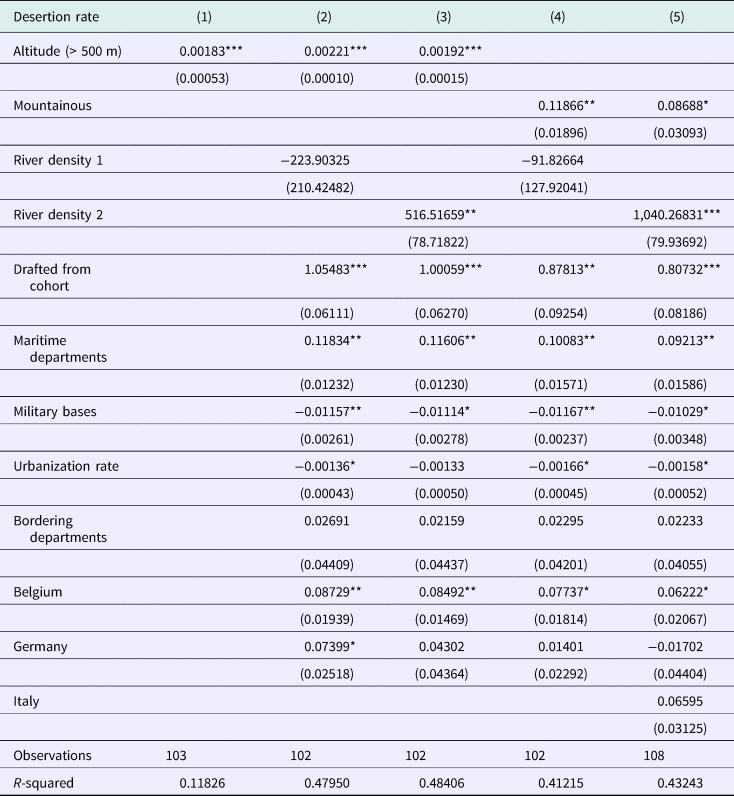
Our econometric results, presented in Table 2, are consistent with our predictions on the relationship between the desertion rate, geographical factors, conscription, and administrative capacity. Since the observations come from four different countries, standard errors are clustered by country. The analysis supports Prediction 1 on the positive relationship between conscription and desertion rates. When the proportion of young men drafted from the relevant cohort increases, the desertion rate increases as well. Our theory suggests that the larger conscription rate will lead to a shrinkage in the local labor supplyFootnote 20 as the share of young people drafted increases, leading workers to command a higher wage on the labor market. The variable “Drafted from cohort” is significant and at the 1% level in all but specification (4) and has a strong positive effect on desertion. A one percentage point increase in the proportion of young men drafted leads the desertion rate to increase by between 0.81 and 1.05 percentage points.
Desertion rates and variables: econometric results

Robust standard errors in parentheses.
*** p < 0.01, ** p < 0.05, * p < 0.1.
The results also support Prediction 2 on the effect of geographical factors on desertion rates. The stronger result from our empirical exercise is the positive and highly significant effect of our preferred measure of territorial accessibility: the share of a department above an altitude of 500 meters. A ten percentage point increase in the share of a department above 500 meters predicts the desertion rate to rise by 1.8 and 2.2 points in regressions 1 and 2 respectively.
As a check on our results, in regressions 4 and 5, we substitute our altitude variable with an alternative measure of territorial accessibility: the dummy variable “mountainous.” The new coefficient is significant in both regression, at the 5 and 10% level respectively. Mountainous departments experienced a desertion rate of 8.7 to 11.9 points higher than non-mountainous ones (columns 3 and 4). These results provide suggestive evidence that desertion was indeed mostly a rural phenomenon, as argued by Forrest (Reference Forrest1989). Our first measure of river density appears insignificant in both specifications (2) and (4), while the second one is significant at the 5 and 10% levels respectively.
Our other geographic variables, our dummy variables for maritime and border departments, both produce coefficients of the right sign, but only the former appears significant (at the 5% threshold). These results are consistent with the claim by Forrest (Reference Forrest1989) that maritime departments were more prone to desertion. From Marseilles to Nice, the coast is rocky and hard to navigate, and the coves of the Côte Bleue and Côte d'Azur are generally difficult of access. On the Atlantic coast, Brittany and Normandy also offered hiding places in caves while, in the Landes, sand dunes and the proximity of forests on the coast made it easy for deserters to live in groups and disperse easily when hunted by the gendarmes. In our own quantitative analysis, maritime departments are predicted to experience, on average, a desertion rate 9.2 to 11.8 points higher (columns 3 and 5) than landlocked ones.
The coefficient on the urbanization rate variable is also significant, although only at the 10% level, and is barely insignificant at the same threshold for specification (3). A 10-point increase in the urbanization rate at the departmental level is expected to reduce the desertion rate by between 1.3 and 1.6 points on average. However, interpreting the sign of the coefficient is not straightforward. The identified negative relationship may be due to greater levels of administrative capacity in cities and the difficulties faced by populations in cities to engage in collective action against the state. Conscripts in cities could also use substitutes to desertion more easily by buying a substitute,Footnote 21 hence avoiding military service.Footnote 22 The number of military fortifications within a department, our proxy measure for administrative capacity, significantly (at the 5 and 10% levels) predicts lower desertion rates. The presence of one additional military base is associated, on average, with a 1.1-point reduction in the desertion rate, yielding some evidence for Prediction 3. Finally, country fixed effects for Belgium and Germany are included for specifications (2) to (5), while the one for Italy is included only for specification (5) due to limitations in the data on altitude. Only the Belgium variable is consistently significant across specifications at the 5 and 10% levels.
Evidence on rural wages
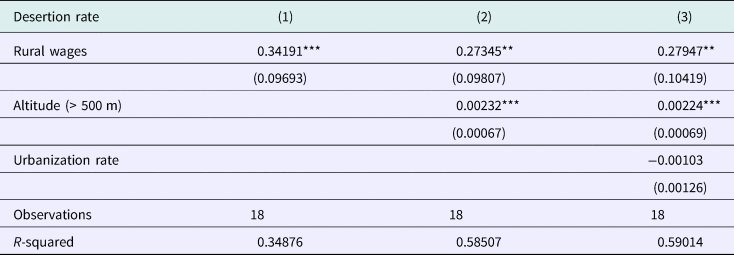
Although we have limited data on wages, a simple linear regression model of the effect of rural wages on desertion rates are broadly consistent with our theory. Using daily rural wages is particularly relevant because rural workers had very little access to institutional alternatives to desertion. As a social class they often supplied substitutes under the system of military replacement, which allowed for the trading of military obligations, but were rarely substituted themselves. We report the results of our regression analysis in Table 3.
Regression analysis results

Robust standard errors in parentheses.
*** p < 0.01, ** p < 0.05, * p < 0.1.
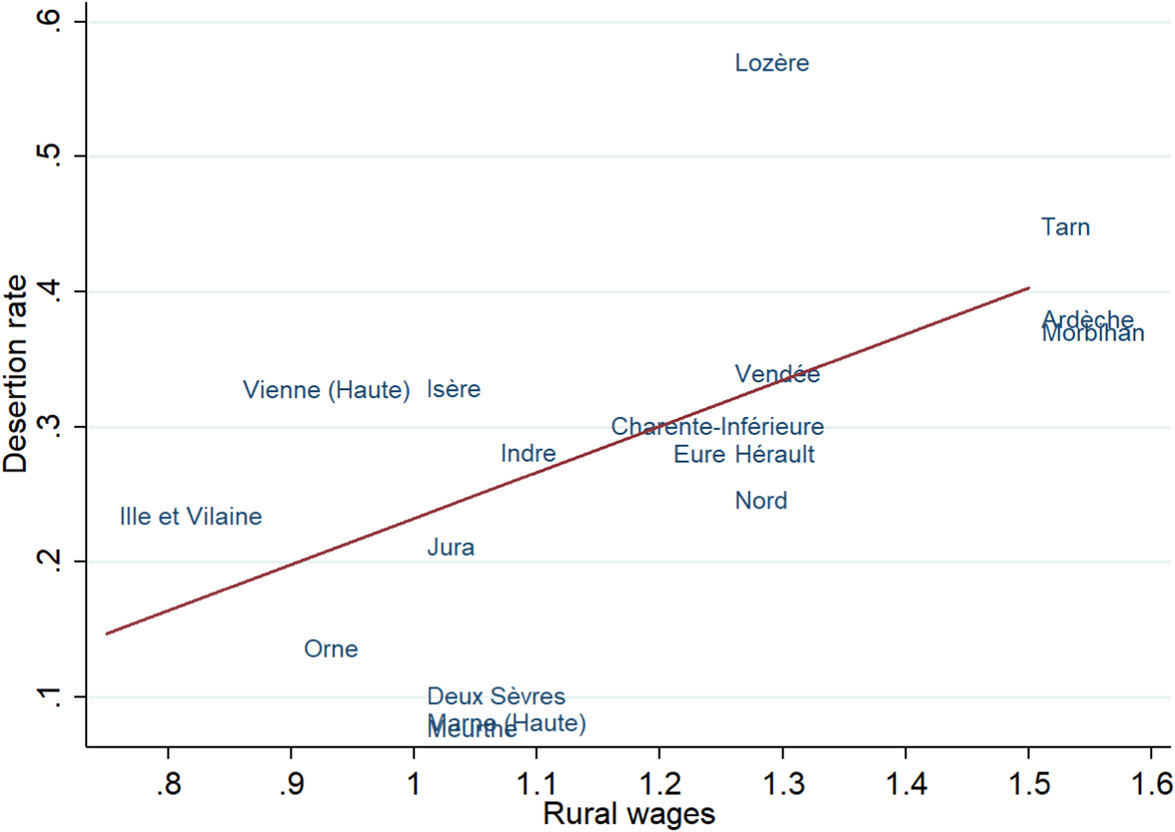
Consistent with Prediction 4, higher real rural wages predict higher desertion rates across 18 departments (see Figure 3). The coefficient on our independent variable is significant at the 1% level in regression (1) and at the 5% level in regressions (2) and (3), which include controls for altitude and altitude and urbanization rate respectively. The limited number of observations gives us only a few degrees of freedom and prevent us from engaging in a more extensive empirical analysis. We must also state, once again, that our estimates are only suggestive and cannot definitely identify causal effects, as we are not able to rule out potential confounding factors due to the limitations of both our data and empirical strategy. Our results are nonetheless consistent with Forrest's (Reference Forrest1989: 91) claim that “the state of the economy and the propensity to desert or the avoid the draft were closely linked.”
Desertion rate and rural wages in eighteen departments (1801)

Qualitative evidence
As is to be expected, French government officials appear to have been wholly aware of the extent of, and danger posed by, desertion. Private correspondence between public officials, including Napoleon himself, suggests that desertion was a constant concern. For example, on August 15, 1806, Napoléon received a note from his minister reporting on the problems desertions was causing in advancing the Italian campaign. According to the note, the Italian Alps provided soldiers with plenty of opportunities to abandon their contingents and escape punishment (Napoléon, Reference Napoléon1862: 548). In response, Napoléon ordered that a gendarmerie detachment be deployed in the region to catch the hiding deserters and deter future ones. In 1808, a report from the prefect of the Puy-de-Dôme complained about the seasonality of the phenomenon and claimed that many deserters found refuge in departments other than their own, making identification by the gendarmerie a hard endeavor (Waquet, Reference Waquet1968: 199). One year later, another prefect would write that desertion intensified during harvest season, attributing this to the fact that “when grains cover the fields [they] make the countryside even more impenetrable” (Waquet, Reference Waquet1968: 199).
In response, the French government took a series of actions aimed at minimizing the extent of desertion. For example, in Year X (1802), it introduced policies to reduce the likelihood of recidivism amongst captured deserters.Footnote 23 One such policy mandated that deserters captured by the government forces were to be organized into battalions to be deployed in the French colonies. Another policy put captured deserters under the authority of the French Navy. Yet another required these men be deployed to islands rather than mainland territories. One thread common to these policies is the strategic choice, by the government, of the geographic, economic, and social environment within which to place individuals perceived to be more likely to desert. Soldiers are less likely to desert when they find themselves in hostile territory and when they have limited outside options. By forcing these men to foreign and faraway lands, remote islands, and on to boats,Footnote 24 the government was implicitly reducing the value of the contested asset (the soldier's labor services) to the soldiers themselves, thus diminishing the incentive to invest resources in the effort to capture the associated benefits. In the language of our model, these policies reduced the value of w* available to potential deserters.
Contingents of rehabilitated deserters were also subjected to unique restrictions and regulations. Soldiers were more strictly monitored than usual. They were housed in fortified sites where they were kept under continuous surveillance by dedicated units of the military police. Soldiers were not allowed to leave their barracks unsupervised. Even for the most modest of tasks, they had to be accompanied by an officer. Potential deserters were also required to wear distinctive uniformsFootnote 25 and a shorter haircut than standard soldiers, which made them easily recognizable by their superiors.Footnote 26
The punishment was proportional to the gravity of the desertion. The Code de la Conscription of Year XII specified that death was the punishment those who deserted to the enemy on the battlefield or any enemy foreign country and deserters who had taken their weapons with them. The ball and chain for ten years were reserved to those who deserted and left the country, those who deserted and stole any asset of the army, and those who deserted more than once. Collective desertion was punished by adding two years of ball and chain to each deserter. Twelve years of ball and chain were also reserved to anybody who left their military fortification unauthorized. Public work (three years) was reserved to réfractaires or insoumis, with the addition of two years for collective desertion. In addition to these punishments, every deserter had to pay a fine to the state.
5. Conclusion
The issue of desertion is of great importance in the history and practice of military affairs. Most studies of it are historical in nature, providing qualitative and some quantitative analysis of the phenomenon. This paper offers the first explicitly theoretical treatment of desertion. It does so by extending the “property rights framework” developed by Yoram Barzel over the past four decades. Following Barzel, we believe that in order to understand social institutions, one must focus on the allocation of claims over resources within society, which is determined by the cost of delineating and enforcing property rights. This logic applies seemingly to any asset imaginable, from the machinery employed in a factory, to land, to slaves, and, as we argue in this paper, to the labor services of soldiers.
The ultimate test for any theoretical framework is whether it is operationalizable, that is, whether it says something specific about observable and measurable real-world variables. Applying the property rights approach to desertion, we are able to derive several testable implications. We test these against an original dataset on desertion across the French departments during the Napoleonic Empire. The results of our econometric exercise are largely consistent with the predictions of the model.
These results should not be taken as ultimate evidence of the causal relationship between our independent variables and the phenomenon of desertion. Due to the limitations intrinsic in our data, we cannot fully rule out the possibility of reverse causality or omitted-variable bias. For example, expecting higher desertion rates, the central government may respond by drafting a higher percentage of the population in the first place. Because our data measure the average desertion rate by department over a six-year period, we cannot control for this possibility by controlling for lagged values of the desertion rate itself. Nevertheless, the data offer suggestive evidence that the variables identified by our theoretical analysis to affect the magnitude of desertion do in fact matter, and matter in the direction predicted by our framework. Our analysis is also consistent with historical experience “out of sample.” For example, in his study of desertion in the British army during the Napoleonic wars, Linch finds that “the location of the soldier and prospects this environment offered to him to escape his unit, avoid recapture, and survive provided the catalyst [for running away]” (Linch, Reference Linch2016: 816). For example, soldiers were keener to desert their ranks during the summer months, when they could command higher wages, due to the increased labor needs of the harvest season. Desertion rates were higher when soldiers were stationed close to home, as in the British Isles, than in occupied foreign territory or insulated enclaves far from the homeland, like Malta and Gibraltar. Finally, he finds that among the British soldiers stationed in North America, those stationed at the border between Canada and the US were most likely to desert.
Acknowledgements
The authors would like to thank Paola Suarez, Clara Jace, and Bryan Cutsinger for comments on previous drafts of the paper. Participants at the 2019 Public Choice Society meeting in Louisville provided helpful criticism. The paper was vastly improved thanks to two anonymous referees. Remaining errors are attributed solely to the authors.