In the autumn of 2018, during the centenary of the Armistice of the First World War, those attuned to the television in Britain witnessed a host of programmes and ceremonies related to commemorating the war. Pervasive were upbeat, patriotic numbers like ‘It's a Long Way to Tipperary’, as well as selections deemed commemorative such as ‘Nimrod’ and ‘The Last Post’, as seen in the replay of the 2005 BBC series The Last Tommies and during the Festival of Remembrance at the Royal Albert Hall and Remembrance Sunday service at the Cenotaph. A project that I mentored in February 2018 focused on the First World War, curated by Trinity Laban students as part of their CoLab Performance Week, incidentally, also featured many of these same titles. After performing the programme at the local Age Exchange, my students and I were surprised at how visibly moved audience members (mostly pensioners) were in hearing these musical selections. Such programmes demonstrate how music has been interpolated into the dominant narratives and cultural memory of the war, and that within the cultural memory of the war's traumatic effects, there is a clear canon of music. While I consider these British national narratives about World War I more thoroughly towards the end of the article and in the context of a sociological model of cultural trauma, I first use historical and psychological models of trauma to consider how we might understand music in relation to a war for which there was not yet cultural memory, during a time when concepts of ‘trauma’ were in their infancy.
Particularly rife places in which to unearth the foundations of such nationalistic legacies of the intersections between music and trauma are spaces in which healing took place during the war, within what Jeffrey Reznick has aptly termed ‘cultures of care’.Footnote 1 Military hospitals cultivated a variety of activities that promoted healing for soldiers, to which music was central. But beyond this physical participation in music, people further embedded music into the contexts, spaces and therapeutic ethos of care. Both fighting men and civilians used music to elucidate memory that was unspeakable, and they drew upon musical language to describe their traumatic experiences in a time in which terms such as ‘PTSD’, ‘psychotherapy’ and ‘music therapy’ did not yet exist.
Craiglockhart, an officers’ hospital in Edinburgh that specialized in treatment of shell shock during the First World War, offers a space in which to interrogate rich intersections between trauma and music. As an innovative facility attuned to the latest developments in psychiatry from the Continent, it was nearly alone among British hospitals (war or civilian) in cultivating analysis and treatment of traumatized patients. It was a place seminal in ‘the discovery of traumatic memory’, a discovery that Allan Young notes is a defining feature of the modern era, and of our understanding of modern notions of PTSD.Footnote 2 Investigating music's central role in the cultural and therapeutic life at Craiglockhart enables the development of new paths for understanding relationships between music and trauma historically, particularly because the First World War took place prior to and was influential in the foundation of music therapy as a discipline.
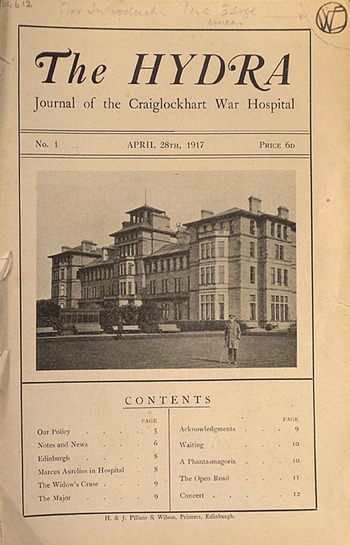
The role of music within the culture of shell shock treatment at Craiglockhart appears most explicitly in the hospital-sponsored magazine The Hydra: The Journal of the Craiglockhart War Hospital.Footnote 3 The first series of The Hydra ran bi-monthly from April 1917 to September 1917 with a cover featuring a photograph of the building and grounds (Fig. 1). The second series ran monthly from November 1917 until July 1918, with a new cover that featured shell shock explicitly (addressed below). British military hospitals commonly fostered in-house magazines, which, as Reznick writes, ‘open a window on to the soldier's multifaceted experience of recovery’.Footnote 4 But the prominent role of music in these magazines, including in The Hydra, has not yet received scholarly attention.Footnote 5 In addition to hospital news and editorials, these magazines (sometimes called gazettes) contain witty and comical reviews of musical entertainments, chronicling a rich musical life. Soldier patients penned nearly all of the content in these magazines. In the case of the general hospitals treating non-ranking soldiers, authors were working-class and lower middle-class men from the British Isles and white men from dominion countries (namely Canada, Australia, New Zealand and South Africa).Footnote 6 But in the case of The Hydra, the authors were army officers – men from the upper classes in Britain. Writers for the magazine included both Siegfried Sassoon and Wilfred Owen, who edited The Hydra briefly. The magazine and Craiglockhart are known today largely because of these two famous war poets;Footnote 7 indeed their voices will echo throughout what follows. Thus, thanks to these two famous literary patients, in addition to its innovative treatment, Craiglockhart has maintained a place in the British cultural imagination and in popular understandings of shell shock and soldiers of the First World War.
Cover of The Hydra, 1st series, no. 1, 28 April 1917, Craiglockhart, Edinburgh, Scotland, The First World War Poetry Digital Archive, The Wilfred Owen Archive, The English Faculty Library, University of Oxford

Unlike magazines from general hospitals, The Hydra illuminates an innovative shell shock treatment culture that was central to establishing modern notions of traumatic memory. As J. Martin Daughtry has shown in his research on sound and trauma related to the Iraq War, ephemeral material (of the sort found in The Hydra, such as poems, stories and concert reviews), although seemingly of ‘marginal significance’, can help us uncover fundamental truths that ‘straight, dry, unreflexive clinical accounts of the principal events and actors’ cannot.Footnote 8 Recognizing the ways in which these officers represented their treatments, care environments and traumatic neuroses is important because, as Jay Winter writes, they have ‘come to symbolize traumatic injury and traumatic memory throughout the twentieth century’.Footnote 9 Thus, the storytelling of soldiers, as we will see in the case of The Hydra, is important for not only understanding individuals’ trauma, but also, as Winter suggests, for establishing how their conceptions of traumatic memory defined notions of trauma in both that historical moment and in the violent century that would follow. Young contends that PTSD is a ‘historical product’, ‘glued together by the practices, technologies, and narratives with which it is diagnosed, studied, treated and represented, and by the various interests, institutions and moral arguments that mobilized these efforts and resources’.Footnote 10 This formulation is particularly useful for understanding how individuals’ narratives in The Hydra relate to larger societal narratives about trauma in the twentieth century.
In what follows I examine music within two contexts in The Hydra: 1) narratives about music performed in hospitals, mainly in the form of reviews, and 2) narratives in literary contents that make use of music in depicting memory and dreams. These two narrative tropes align with the two approaches to shell shock treatment employed at the hospital: Captain Dr Arthur Brock's ‘cure by functioning’ and Dr W. H. R. Rivers's Freudian-based psychotherapeutic practice in which patients explored and discussed, rather than repressed, dreams and traumatic memories, a narrativizing process that I connect to the concept of ‘testimony’ in trauma studies. The sound worlds of these treatment regimes illuminate a soundscape of neurasthenia and its treatment.Footnote 11 But while the ‘cure by functioning’ and psychoanalytic treatments’ uses of music were different, both draw upon music's viscerality; music's curative properties lay in its ability to ultimately move the body and mind. Thus, I establish recognition at Craiglockhart of music's role in what Young has deemed an ‘intersection of two streams of scientific inquiry: somatic and psychological’ that characterized turn-of-the-century understandings of trauma and approaches to treating it.Footnote 12 The Hydra therefore acts as witness to contemporary ideas about trauma and to how the soldiers conceptualized their individual traumas and its treatments, albeit in the subtle, stoic and socially acceptable ways for men of the British upper classes. However, I also posit that music recounted in The Hydra's pages helped to foster a community defined not just by shared space, but also by shared neurasthenia diagnoses and feelings of ostracization – communal trauma that bound them together and had its own language.
Overall, the narratives in The Hydra – of shell shock, of an idealized pre-war past, of loneliness and alienation on the home front and even of jolly musical entertainments – evince a self-fashioning of this shell-shocked community that has over time (amplified by the posthumous legacies of Owen and Sassoon) become central to the dominant British cultural memory of the war. Here I establish music's role in narratives about trauma in First World War Britain, illuminating how shell-shocked officers employed music in testimonies about not only hospital life and community formation, but also loss and recovery, memory and mourning, and sacrifice and resilience. In so doing, I recognize for the first time that music was integral to this place, its identity and the way it was portrayed in the media, and, in turn, to today's cultural memory of the war.
‘Shell Shock’, War Hospitals and Cultures of Care
Craiglockhart was one of six hospitals established by the War Office for shell-shocked, or more specifically, for neurasthenic officers.Footnote 13 Set up in a former hydropathic clinic, just outside of Edinburgh in a rambling country house, the hospital opened in October 1916 at the height of reported shell shock cases, following the Battle of the Somme.Footnote 14 The first few months of the hospital's existence were unsettled due to the Army Medical Services’ local director's preference for strict military management and belief that shell shock did not exist, as well as the dismissal of the first commandant for mistreatment of patients.Footnote 15 But in 1917, the arrivals of William H. Bryce and Rivers from Maghull hospital in Liverpool led to a more stable, sympathetic environment and treatment regime.
Rivers and Brock, unlike most other RAMC doctors, were interested in continental developments in psychiatry. Unusually, the RAMC gave them free reign and time to explore individualized, psychologically based treatments that were unwelcome or impossible at larger hospitals.Footnote 16 As Young elucidates, Craiglockhart's ‘sunny rooms and therapeutic conversations were a world apart from the electrical room at the National Hospital’.Footnote 17 Craiglockhart was successful in part because it dealt with only 1,560 officers between October 1916 and February 1919. It was not just a clearing hospital with the aim of returning men to the front quickly, as was the case at other hospitals; rather, its doctors’ goals were to heal patients – to return them to their individual lives so that they could be not only functional and engaged in their present environments, but also healed emotionally.Footnote 18 But while both Brock and Rivers focused on individuals’ psychological care, the two men's approaches to treatment differed in substantial ways.
Brock advocated ‘activity’ for his patients – a ‘cure by functioning’ treatment or ‘ergotherapy’, to use his terms. He believed the cause of neurasthenia was when the patient's ‘experience of one kind of environment has been so terrific that he is inclined to evade for the future anything savouring of the “environmental” at all’.Footnote 19 As a result, patients became marooned in the present moment and disconnected from his past and future. What could bring ‘people who have been blown up and buried’, feeling ‘more dead than alive’, ‘to get fully alive again’, was purposeful activity. His role as the doctor was to help patients ‘find … their job’ – ‘guiding them to it, keeping them at it and only relinquishing them finally when their interests are sufficiently awakened to ensure that they will now “carry on” of themselves’.Footnote 20 Central within Brock's ideas was physicality. Ergotheraphy was about doing things, and Brock was known for dragging patients up out of bed early for brisk walks, encouraging them to participate in the hospital's many sports and clubs and recommending cold baths and swims.Footnote 21 Restoration of patients’ ‘complete mental and moral health’ depended upon not only full participation in the cultural life and activities of Craiglockhart, but also involvement in a ‘suitable milieu’. In The Hydra, in May 1918, he called for patients ‘to take our place as active citizens in the town, the larger community of Edinburgh’ – ‘to face boldly our civic environment … to do each of us his own work in his own way, but to relate it, as far as possible, to the life-work of the region’.Footnote 22
Brock's re-education and discipline through physicality were manifested through music, as well as through a number of other activities that were included in the ‘cure by functioning’ regime. Music was part of a whole host of ordering activities and ‘brisk amusements’ encouraged during the day to keep the hospital, in the words of Sassoon, ‘elaborately cheerful’.Footnote 23 The Hydra promoted these activities as therapeutic at a variety of levels – more broadly in general news columns – and more specifically in reports connected with various clubs’ weekly activities, such as in an article about the Badminton Club's admonishment to ‘let the shuttle continue to weave health and strength into our tired muscles’.Footnote 24 Brock even conceptualized writing as physical.Footnote 25 Owen, Brock's patient, very much embraced and benefited from Brock's method, not only through the activities of writing and editing – he edited The Hydra for a time – but also through his involvement with a number of the hospital's clubs and the relationships he formed with people in the Edinburgh community.
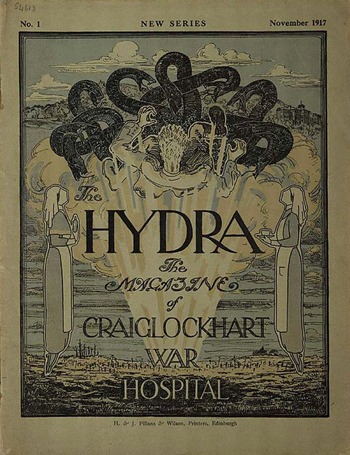
The Hydra explicitly links activities of the cure-by-functioning treatment with fighting the mythical creature of the Hydra. Indeed, the community at Craiglockhart understood the mythical many-headed beast as emblematic of the many heads of neurasthenia symptoms; when one head is lopped off (or one symptom treated), another pops up in its place.Footnote 26 The magazine's cover after November 1917, the start of the second series, reflects this idea, picturing a shell shock victim blasted up towards the Craiglockhart building and grounds. High above a barren battlefield in a cloud of smoke, the soldier struggles with the Hydra beast. The illustration also suggests that this battle is happening in the victim's head: two nurses stand on either side of him, with their feet on the ground, but they are exaggeratedly tall, looking up to the patient as he battles the Hydra (see Fig. 2.)
Cover of The Hydra, 2nd series, no. 1, November 1917, Craiglockhart, Edinburgh, Scotland, The First World War Poetry Digital Archive, The Wilfred Owen Archive, The English Faculty Library, University of Oxford

Individual articles in The Hydra also probe this metaphor of the Hydra beast, suggesting that each activity within the ‘cure by functioning’ regime was a means of cutting off a head or alleviating a symptom. For example, one anonymous patient writes he had ‘been asked to crush one of the heads of the Hydro [sic] with some stories’.Footnote 27 Music was part of these activities, while music's abilities to aid shell-shocked soldiers in battle – both real and psychological – was also a trope in literary writings in the magazine, as I will discuss below.
While Brock focused on the physical, Rivers emphasized the psychological in his treatment philosophy. His approach was Freudian in conception – both in his interrogation of the unconscious and repressed traumatic memories, and in his encouragement of his neurasthenic patients not only to explore their memories and dreams, but also to share their thoughts about these openly in talk therapy sessions. Eric Leed, in his seminal study of shell shock, labels this treatment regime the ‘analytic cure’ or ‘talking cure’Footnote 28. Rivers was one of the first doctors to understand shell shock as related to traumatic memory, rather than the more common view early in the war that shell shock was a result of the physical bombardment of shells that ‘shocked’ the nervous system.Footnote 29
Unlike Freud, who emphasized the unconscious's part in creating traumatic symptoms, Rivers located the repression of traumatic memory within the conscious mind; the patient repressed memories willingly because he found them distressful.Footnote 30 According to Young, Rivers believed that
in most cases, it is not the traumatic memory that produces the physical and emotional symptoms of the war neuroses (anxiety disorder) but rather the reverse: the symptoms … account for the memory. … His point is that the recalled memory is usually not the effective cause of the syndrome but the patient's way of explaining it.Footnote 31
Repressing traumatic memories because they were upsetting was countertherapeutic, Rivers argued. Rather,
we should lead the patient to resolutely face the situation provided by his painful experience. We should point out to him that such experience … can never be thrust wholly out of his life. … His experience should be talked over in all its bearings. Its good side should be emphasised, for it is characteristic of the painful experience of warfare that it usually has a good or even a noble side, which in his condition of misery the patient does not see at all, or greatly underestimates.Footnote 32
Like Freud, Rivers also found answers in dreams, but in the case of his neurasthenic patients, he argued against Freud's idea that dreams are wish fulfilments; rather, for Rivers, they ‘function to perpetuate [a] high level of anxiety’.Footnote 33 He studied patients’ accounts of repetitive nightmares, noting closely when they became less frequent, and how and when patients had them. Moreover, he noted how narration of traumatic experience changed over time, particularly when narration started to become more positive in tone, which he believed indicated a patient's improvement. Like Owen with Brock, Sassoon formed a close friendship with Rivers and openly acknowledged the supreme care he felt he had received from him.Footnote 34
At Craiglockhart, while patients may have been assigned to either Brock or Rivers, the general therapeutic routine of the hospital encouraged both approaches simultaneously. Rivers's patients participated in many activities available at the hospital because of Brock's ideas. And Brock's patients, while busy with their various activities, also probed and narrated their memories, both in talk therapy sessions with Rivers and in written form. In reality, the two approaches fit together well, and by all accounts, did so successfully. As Maureen Huws, daughter of John Burns, who was treated at Craiglockhart in 1917 by Rivers, recalled in an oral interview:
My father adored Craiglockhart – the tennis and the garden and the friends … I think the care he received. … I don't see that they could have done more. … Craiglockhart was his salvation. … They took the most wonderful care of him … considering the treatment for neurasthenia and shell shock were in their infancy. I know the results my father got in living with him (I was not born until 1923). … Craiglockhart was a household word … starting with my birth, I was used to hearing about it, you see it was his salvation, mother thought it was absolutely wonderful. … She was so impressed and thankful . … They were all tremendous.Footnote 35
Notably, Huws also notes her father's musical abilities on the piano, fiddle and drums, exclaiming, ‘I'm sure while he was here at Craiglockhart, he would've played, he would've entertained’. Music is therefore a lens through which we can see Brock's and Rivers's contemporary ideas about trauma and recovery interact and play out, particularly via somatic and psychological representations of music in The Hydra's narratives.
The Hydra as Witness: ‘Orgies of Amusement’ and the Soundscape of ‘Functioning’ at Craiglockhart
Brisk amusements were encouraged, entertainments were got up, and serious cases were seldom sent downstairs.
Sassoon, Sherston's Progress Footnote 36As Sassoon described later of ‘Slateford War Hospital’, the pseudonym he used for Craiglockhart in his memoirs, ‘entertainments’ were a regular part of life at the famous military hospital. Every issue of The Hydra presents reviews of musical performances, which appeared most often in the recurring column ‘Concerts’. But as Sassoon suggests, music at Craiglockhart was more than just distraction and entertainment; it helped the most ‘serious cases’ to avoid ‘being sent downstairs’, where those who were most ill were treated, and thus it was linked to patients’ recovery.
The writers of the ‘Concerts’ columns, who declared their authorship through pennames, documented myriad musical performances, including the repertoire played and those involved.Footnote 37 A main focus throughout The Hydra's two series runs was on Craiglockhart's in-house orchestra. The orchestra usually played several times during each concert, with solos, duets, recitations and sometimes dramatic skits in between. Lauded from the first issue of The Hydra, ‘the orchestral selections and accompaniments form one of the most delightful parts of our weekly entertainments’.Footnote 38 That Craiglockhart's orchestra comprised soldiers, staff and people from the community was unusual for war hospitals. It was most likely not a full orchestra, and the columns only hint at what instruments were included. For example, on one occasion an author notes that the addition of woodwinds had been welcome.Footnote 39 Women were especially active in the planning and performances.Footnote 40 The Hydra mentions the musical contributions of a ‘Miss Ella Moore Grieve’ on a number of occasions. Described as the hospital's pianist, she also played violin, and seems to have been central to the hospital's musical life.Footnote 41 Besides the patients and hospital staff, civilians from the community attended the weekly Saturday evening concerts; for example, the second issue of The Hydra notes that ‘many ladies were among the audience, a fact that rejoiced our hearts’.Footnote 42
Comparison of The Hydra with other British hospital magazines reveals that the musical world created for officers was different than that which existed for non-ranking soldiers. This split also aligns with contemporary discussions in the press and within YMCA discourse about the best and most effective music for soldiers, a debate that centred on whether popular music or classical music was better for rank-and-file soldiers, the former giving them better enjoyment, with the latter leading to moral uplift.Footnote 43 However, the repertoire and musical practices at Craiglockhart were more varied than in other hospitals. Revue music was performed at Craiglockhart in ways similar to its appearance in general hospitals, but The Hydra's authors make minimal reference to ragtime, sing-along choruses or patriotic and religious songs – all of which made up the majority of repertoire at other hospitals. Instead, the entertainments featured much more classical music, and professional singers were brought in occasionally.Footnote 44
Within The Hydra there is a clear bias in favour of classical and older music and against some popular music of the day. The 18 August 1917 column states it is a relief to hear classical music rather than revue music; hearing the orchestra play ‘Chant sans Paroles’, ‘Il Trovatore’ and ‘Ballet Egyptien’ recently were ‘a blessed awakening from the syncope in which modern music is snoring to death’.Footnote 45 Some columns even satirise the perceived banality of popular songs. For example, ‘An Open Letter to Sonia Worst’ strings together a series of titles from popular songs, poking fun at all the clichés.Footnote 46 Concerts also included early music, such as ‘Bois Epais’ and ‘some other mediaeval songs’ at Bowhill on 4 August 1917.Footnote 47 The Hydra reviewers prefer early music to modern popular music, even commenting on the performances through adapting verse contemporary to the music performed. For example, the critic ‘Mustard Seed’, in response to the recent ‘Henry VIII dances and similar fine music – conducted, as usual, by Capt. Williams, and led, as usual, by Miss Grieve’ – ‘crib[bed] a mis-quotation from “Twelfth Night”’:Footnote 48
This clever adaptation of the Twelfth Night passage, besides being historically appropriate to the music and indicating both a preference for older music and discontent with the new popular music, also finds fault with the audience members talking during these concerts. ‘Mustard Seed’ wants quiet, focused listening and an aesthetic experience rather than music hall gaiety and chatter. The magazine expresses this desire even more explicitly elsewhere: ‘To the director of our concerts, we submit for his consideration, and necessary action, that the noise occasioned by the entrance of the late comers to our concerts is very disturbing to any music lover. A very beautiful duet given by “Les Bérets Nois” was completely spoilt for us’.Footnote 49 This kind of listening was a mid- and late nineteenth-century construction related to classical music cultures and its patrons – specifically, the upper and upper-middle classes in and beyond Britain.
Indeed, concerts at Craiglockhart took on more ‘seriousness’ and ‘ambitiousness’ for its officer patients than the ‘swinging’, ‘ebbing and flowing’ entertainments for the non-ranking soldiers at other hospitals like Longleat.Footnote 50 This more ‘sophisticated’ music was thought to be not only more appropriate for the class of these men, but also more appropriate for cultivating the kind of masculinity associated with a neurasthenia diagnosis. Given the long-held beliefs that women and hysteria were linked, working-class men, and particularly private soldiers suffering from trauma, were largely feminized through assumptions that they were malingering or hysterical.Footnote 51 To be neurasthenic implied not just shell shock, but, more significantly, a kind of refined kind of shell shock. Doctors understood it to be due partly from the strain of being responsible for subordinates in harsh conditions, thus aligning neurasthenia with upper-class masculinity, stoicism and class superiority.
Even the title of the column – ‘Concerts’ – in The Hydra insinuates this distinction from music columns in other hospital magazines, which usually used the term ‘Entertainments’. From its very first issue, The Hydra attempted to set itself apart, proclaiming that while the magazine would accept original contributions from ‘anyone, whether patients in the hospital or staff’, its aim was to be ‘ambitious’: ‘We want to maintain as high a tone as possible, and may as well state here that we do not intend to incorporate any of those features which depend for their interest on rumour and speculation’.Footnote 52 Thus, from the start, the magazine implied that its readership and contributors – officers – should be distinguished from other hospital magazines in terms of both content and tone. While other magazines tended to be comical and gossipy, The Hydra had serious artistic and philosophical interests, and frequently alluded to the classics, art and literature. The first issue of the second series in November 1917 reiterates this desire to be highbrow, with the editor noting that he ‘hopes to have one article in each issue dealing with literary, historical, or scientific research’.Footnote 53
The composition and performance of new musical material for performance added to the ethos of high culture that The Hydra advocated. The Hydra reports proudly on premieres of new pieces. For example, the above-mentioned ‘Miss Ella Moore Grieve’ composed a march titled ‘The Hydra’ dedicated to the hospital, which the group ‘Les Bérets Noirs’ performed on a programme with ‘no less than fifteen [pieces that] were new and unrehearsed, and were specially written for Craiglockhart War Hospital’.Footnote 54 Sometimes soldiers and staff added new verses to pre-existing music, even Rivers did this on one occasion.Footnote 55 Indeed, this musical creativity was part of a larger culture of artistic creation at the hospital, from short stories to poetry, which I will explore in the next section.Footnote 56
The routine required to prepare for concerts – the daily practice and weekly orchestra rehearsals needed to play difficult music – can also be understood as a way to re-order the body and mind. The physical touch and movement required to play an instrument or bodily engagement to sing fits within Brock's treatment philosophy. Moreover, this kind of music necessitated a physicality and movement to a degree greater than that played at other hospitals. The Hydra's documentation of a conflict in July 1917 over the space, time and priority given for music rehearsal over badminton – badminton was often ousted from their space three or four times per week’ for music rehearsals – indicates how regularly the musicians were rehearsing and how central the act of rehearsing and performing were to the cultural life and healing ethos of Craiglockhart.Footnote 57
Ideas about the healing benefits of movement were rooted in turn-of-the-century trauma theories of Pierre Janet and Jean-Martin Charcot that emphasized the importance of movement and the body more than Freud's psyche-oriented conceptions of trauma and healing.Footnote 58 Observing the importance of bodily movement facilitated by music, Jillian Rogers demonstrates that the performative act of making music, listening to music and feeling the vibrations of musical sound, were all central to how French musicians processed and coped with trauma in the wake of World War I.Footnote 59 While most officers and soldiers making and listening to music in hospitals in Britain during the war were likely not aware of these theories from France (and the majority of RAMC doctors treating them were oblivious to or even adamantly resisted such ideas from the continent),Footnote 60 many British neurologists nevertheless emphasized trauma's inception in the body.Footnote 61 This connection to the physical makes sense as many shell-shocked men had traumatic memory written in their bodies – what was then known as embodied trauma. As Winter writes:
Images and memories seem to live both imbedded in these people and curiously detached from them; memory itself, or images of overwhelming events, appear to be free-floating powerful agents which somehow control the jaw of the man, or his leg, or all his movements. … In effect, these men's bodies perform something about their war experience. … Here stories become flesh; physical movements occur without end or direction, or there is no movement at all.Footnote 62
Thus, physical activities like regularly playing in the orchestra to reorder the body would in turn reorder the mind. If the body could be reordered through the regular practice of music – especially a kind of music that was not only familiar to the men because of their class backgrounds, but also that involved bodily movement through playing instruments and regular rehearsal – the fragmented identity could be treated and a unified story of before and after could be established.
Advertising within The Hydra echoes Brock's cure-by-functioning philosophy, indicating that local shops were eager to capitalize on the activities Craiglockhart patients engaged in. The magazine carries advertisements for not only music shops where patients could purchase sheet music, instruments, violin strings, and gramophones, but also camera, stationery and sport shops, which advertised tennis and golf equipment. Officers’ visits and purchases to local shops were so frequent that a map of the shops with advertisements in the issue began to be included, starting with the second issue.Footnote 63 Advertisements centred around therapy were also present, as in ones for special lenses for sensitive, damaged and recovering eyes. These advertisements demonstrate that Brock's ‘cure by functioning’ regime was central to all aspects of the hospital and its outputs.
Soldiers sometimes parody these ‘cure by functioning’ activities in The Hydra. Meredith Martin notes a ‘tension between attraction and repulsion to [the] neurological ordering’ in The Hydra. ‘Patients were both aware and suspicious of the artificiality of re-education through forms of physical, mental, and social ordering, and at the same time were relieved and essentially “cured”, from the many symptoms of neurasthenia by the structures that those therapies provided.’Footnote 64 This tension between suspicion and belief makes its way into music-related material, in which ideas about musical activity curing men are mocked and exaggerated. For example, the ‘Concerts’ column in the 26 May 1917 issue states that a Mr Clark ‘gave us a little topical song, written by himself. It's a funny thing what shell shock will do for a man. These orgies of amusement’ turned ‘howling idiots into talented men’.Footnote 65 ‘Thoughts on the Human Body’, in the 9 June 1917 issue, also mocks this view of using movement and music to retrain the rank-and-file soldier's mind. Here a soldier, identified as ‘Cockney’, argues that the ‘human body [is] the highest expression of beauty’. He links education to improvement in bodily movement: the better the education, the abler the person is able to make his body a ‘temple of the Holy Ghost’, a vessel of truth and the divine. ‘Wise thoughts should produce graceful actions; happy thoughts, rapid movements; and so on, until our bodies are the beautifully expressive works of divine art they were intended to be.’ Concluding the column is a hymn titled ‘The Incarnate Word’, that ‘Cockney’ asks readers in favour of his view to all sing. In the hymn, singing and music join the uneducated mind – this ‘ignorance enchained’ in the cockney, uncivilised mind – so that the singing body can reach the divine. This representation of music as a vehicle for transcending trauma will underpin the next section.
The Hydra as Testimony: ‘Unearthly Music’ and the Soundscapes of Traumatic Memory at Craiglockhart
In the poem ‘Secret Music’, written in the midst of fighting in France, Sassoon, one of Craiglockhart's patients, points to music's power to help him cope with the horrors of war. But unlike the actual physical activity of music making and listening described in the previous section, for Sassoon the healing power of music is internal; it is in the mind. Sassoon confesses that he ‘keep[s] such music in [his] brain’ – the memory of music – to find relief from ‘pain’: music is ‘beauty’ in the midst of ‘hell’. Sassoon adopted this conceptualization of music to describe his process of coping with traumatic experience. It also appears as a trope in patients’ poems and prose in The Hydra, which reflect the innovative ‘talking cure’ and scriptographic therapy administered by Rivers, and can be understood, I contend, as ‘testimony’.
Modern trauma clinicians and theorists use the term ‘testimony’ to describe the act of converting traumatic memories into words. Many believe testimony to be therapeutic because it places trauma – which often seems frozen in time – in the past and restores to the afflicted a sense of control, both control of one's life and over flashbacks and nightmares.Footnote 67 Rather than presenting the past in a comprehensive, complete account, traumatized people most often convey this past in fragments through a discursive process.Footnote 68 As a communicative and healing process, testimony also depends on it being heard by another.Footnote 69
Shoshana Felman asserts that testimony has become a literary and discursive ‘mode par excellence of our relation to events of our times’ – of our ‘relation to the traumas of contemporary history: the Second World War, the Holocaust, the Nuclear Bomb, and other war atrocities’.Footnote 70 It has ‘become pervasive in almost every kind of writing’, so much so ‘that our era can precisely be defined as the age of testimony’. But we can see beginnings of this discursive mode earlier, arguably beginning with the myriad verbal responses to trauma in World War I – the first war in which the majority of men and women were literate and that upper-class men (and highly-educated) served in the army,Footnote 71 thus making for a large population that could actually put to pen and paper the trauma they had experienced.Footnote 72 We can link modern ideas about ‘testimony’ – as both a therapeutic and narrative process – with Rivers's ‘talking cure’ and ‘scriptopgraphy’. Indeed, ‘testimony’ as a concept is rooted in turn-of-the century therapeutic theorizing by Freud, whom Rivers followed in some respects, in that patients were encouraged to verbalize their traumatic experiences and to openly share memories. Thus, I argue that narratives of shell-shocked men during the war set in motion the concept of testimony as process of healing and as an artistic trope, that has come to define the modern era.
These modern formulations of testimony and their relation to trauma can be applied to literary texts of the past, as Dominick LaCapra and Katherine Astbury have demonstrated.Footnote 73 And much closer to The Hydra in time and place, Virginia Woolf's novels can also be conceptualized as testimony, as Suzette A. Henke has shown.Footnote 74 Indeed traumatic memory has informed and shaped a diversity of narrative types related to the First World War – from those of the shell-shocked veteran Septimus Smith in Mrs Dalloway to those by women in mourning on the home front.Footnote 75 My own work elsewhere on women's written memorials and collections of the war show that such narratives not only illuminate the inventive and poignant ways in which people responded to trauma, but also reveal an autobiographical framing of testimony along gender and class lines.Footnote 76 Understanding music's representation in trauma testimonies such as these has many advantages: in narrative, we can still rely on the specifics of language, the basis of therapy historically. But as Maria Cizmic argues, ‘an attention to music opens up a consideration of other modes of expression beyond the linguistic’.Footnote 77
Although there is literary content in each Hydra issue that I would classify as testimony, certainly this practice of scriptotherapy was not taken up by all. Not all patients were willing to write for the magazine, as the editorial in the second issue makes clear.Footnote 78 Indeed, the editors encouraged patients on multiple occasions to try their hands at writing. It is understandable, though, that many would not have wanted to write; no doubt they feared harsh criticism and were anxious about their writing abilities, especially given the high standard set by Sassoon and Owen. More significantly, talking about feelings and being vulnerable publicly was outside the usual experience of upper-class British men.Footnote 79 Stoicism was the norm for this generation, and irony, sarcasm and humour came far more naturally to most. It is no surprise, then, that contributors most often wrote anonymously in the magazine, including for the ‘Concerts’ column. Interestingly, in these narratives, authors turned to music as a way to express unarticulated feelings and to verbalise trauma in less directly emotional ways.
A number of writers in The Hydra associate music with a happier, pre-war time, and these memories, conveyed as testimony, often intertwine with analogies to bodily movement and physical sensation. Although these writings on the past might seem to be just about happy memories of life before the war, narrating pre-war memories and relationships was a way to come to terms with traumatic experiences.Footnote 80 As Winter writes, ‘the strain of combat led many men to wonder who they had been before battle, and who they had become as a result’. Herman says as much, but from a clinical angle, stating that ‘reconstructing of the trauma story begins with a review of the patient's life before the trauma and the circumstances that led up to the event’.Footnote 81 Drawing on Herman, Astbury demonstrates how we can understand this representation of pre-war memory within literary narratives, specifically in the way novelists early on in the French Revolution utilized pastoral themes and tropes.Footnote 82 In British war literature and art music composition, we see a similar use of the pastoral to represent home and an idealized past, for example in Sassoon's Memoirs of a Fox Hunting Man, the examples Fussell, Hynes and Winter discuss in their books, and Ralph Vaughan Williams’ Pastoral Symphony.Footnote 83 Understanding the turn to the pastoral and the past in such narratives, as this review of life before the traumatic event, is important because it is an initial stage in the trauma recovery process. And allusions to music are sometimes key in communicating what this past was like, or at least how writers reframe this past in light of traumatic experience and the present.
Unsurprisingly, a number of these representations focus on pre-war romantic interests. In the poem ‘Waiting’, the narrator misses a sweetheart from whom he has recently parted. Alone in Edinburgh now, he feels glum, like ‘an object of scorn or of pity’.Footnote 84 At the end of each verse, he imagines his love's return. He identifies her with sound – her ‘voice in my ear still mingles / a voice reposeful and clear’ (along with a ‘hot kiss on my lips [that] still tingles’). With her gone, ‘My lips shall bourgeon no sweet song, / My heart shall echo no refrain’. However, he tells us that with her return, ‘my song shall be long, and glad, and strong’.Footnote 85 Similarly, in ‘Song of Songs’ the narrator associates his sweetheart's laugh, voice and sigh with singing, which ‘like lifting seas. . . solaceth’ him.Footnote 86 He asks to ‘Let viols die’, for he'd rather hear her. In the final lines of the poem, he cries to hear ‘youth's immortal-moaning chords. . ./ Throbbing through [her], . . . sobbing, unsubdued’, hinting at what he presumes to be his sweetheart's own trauma. Significantly, he imagines this connection between trauma, the body and movement within her – a connection he had learned through Craiglockhart's treatment regime. Rather than productive bodily movement, the narrator here presents the reader with his internal, emotive and bodily response to trauma.
Narratives about friendships with other soldiers in their units, often known from before the war, also foreground music and bodily movement. For example, in ‘The Road to Armentieres’ [sic]Footnote 87, a poem about two soldier-friends in northern France, one of whom is killed, sound – specifically, music – delineates the time before and after the friend's death. The narrator tells us that as the two marched on ‘the lonely road, the weary road, the road o’ mud and stone to Armentiere’, ‘My pal and I were singing in the courage of our years’. But he left his pal asleepin’ by this road – ‘the happy sleep, the endless sleep, the sleep o'quiet ease’. Now the narrator must walk the ‘weary roads, down all the lonely years’, in quiet.Footnote 88 Here he associates singing with this friend from his past, an intimacy that brought relief from the loneliness and desolate landscape of these marches. The positive representation of music while moving (marching) is also key. Indeed, music often bonds men together in The Hydra, to alleviate fear while at the front lines. In the poem ‘The Next War’, men – even while their ‘eyes wept’ – sing choruses and whistle together to ward off the ‘bullets’ and ‘shrapnel’ that ‘Death’ has ‘coughed’ at them. Both of these poems demonstrate that music making for these men was a confidence-instilling protection against loss and destruction.Footnote 89
Writers in The Hydra also associate music with idyllic military pasts in which movement and the body are aligned. In ‘The Passing of the Turk’, voiced from the perspective of a violent and exoticized, downtrodden and war-weary Turk, the narrator links song and singing with an idealized, glorious Ottoman past. He wants to hear the ‘song of the day that is gone / Song of an age that is fled / … song our father sung / sung in the days of old’ as ‘sabres flashed, our spearsmen dashed’ and the ‘white-faced Christians broke / They called on the name of their pale-faced God’ – the ‘day of the grand wild song’.Footnote 90 This connection of music with a glorious military past can be seen again in the short reflection ‘The Drum of Fate’. As in ‘The Passing of the Turk’, music encourages a warrior from some unnamed exotic land; in this case, the sound of martial music, drumming, lures a colonel's son to his future as a warrior.Footnote 91
Like the testimonial poems discussed above, ‘Sick in Billets’ also conjoins music and bodily movement and sensation with memories of an idealized past. Here, however, the narrator initially does not want to think about the past; it comes to him like a nightmare as he lies awake at night in his hospital bed. These memories, these ‘dear songs of long-dead yesterday’, are intrusive to him at first; they are ‘broken’ and ‘childish tones’ with ‘unharmonious clang / with no soft-toned melodious swell’.Footnote 92 Noisy and clashing with his current environment, they are ‘harsh crank against the twilight grey’. However, by the second and third stanzas, the insomniac patient succumbs to the songs and revels in pre-war, pre-traumatic memories of sweetness and passion, specifically through maids in crinoline who dance and beautify domestic spaces with their quiet reading. This musical experience so moves him that by the fourth stanza he is staring at the ‘moonbeams through the gloom / stretching ghost-like fingers in my room’, his ‘head’ ‘wet’ ‘with unshed tears’.
The Hydra's representations of memory through ‘music in the brain’ highlight the anxiety that night time, nightmares and insomnia brought to shell-shocked patients. In his memoirs, Sassoon contrasts the ordered, physical activities of daytime with occurrences at night, when doctors ‘lost control and the hospital became sepulchral and oppressive with saturations of war experience … One became conscious that the place was full of men whose slumbers were morbid and terrifying – men muttering uneasily or suddenly crying out in their sleep.’Footnote 93 Soldiers’ writings in The Hydra attempt to make humour and sarcasm out of these night terrors and Rivers's talk therapy treatments for them. In ‘Panics in the Night’, the ‘new skeleton in the cupboard’ that has become fashionable is talking about one's traumatic experiences with others. But ‘the really grisly skeleton, the ghost that refuses to be laid … is the Panic in the Night’, or the nightmares and anxiety attacks shell-shocked men suffered due to traumatic memory.Footnote 94 The author goes on to argue against Rivers's talk therapy treatment and in favour of Brock's cure-by-functioning regime. In this author's formulation, the distractions of the day help him to forget and, with practice, to simply not care.
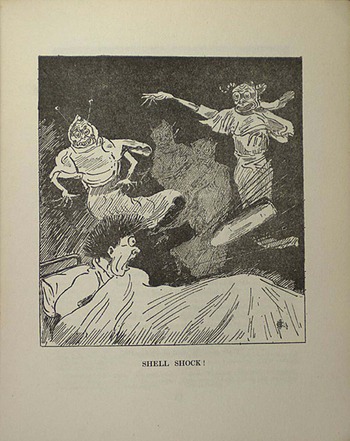
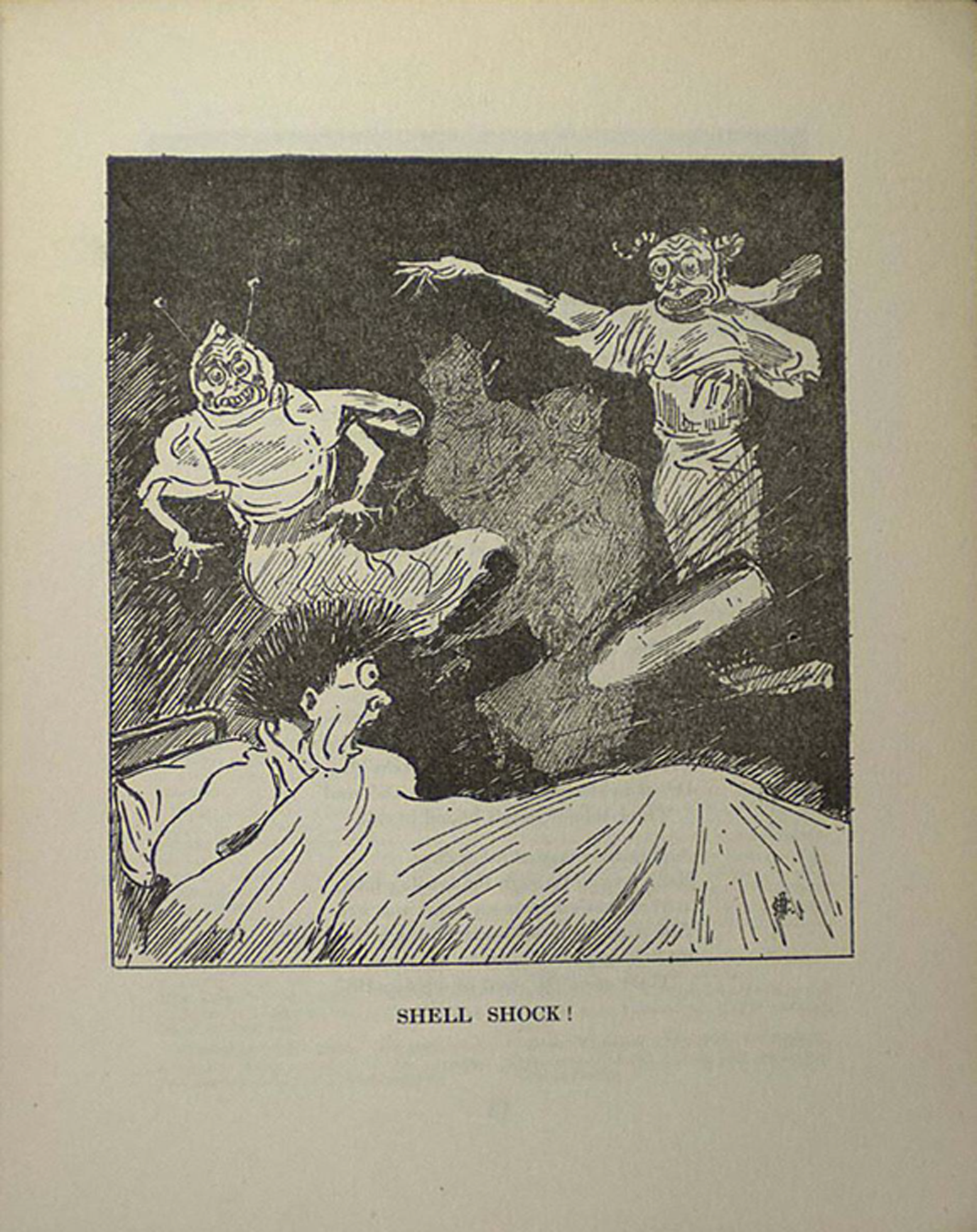
Many of the nightmares that Craiglockhart patients narrated are what Shephard has termed ‘battle dreams’, in which men ‘return[ed] night after night to the same scene of horror’, ‘whether … a faithful repetition of an actual experience or a rendering of the affect, or emotion, cause[d] by it’.Footnote 95 The officer ‘Windup’ captures the repetitiveness of these battle dreams in ‘The Counter Attack – A Story Full of Morals’: ‘Last night I slept badly. Oh, those awful war dreams!!! It was zero minus one hour, and the barrage would start any minute now’.Footnote 96 What he describes of his dream – bombarding the Germans with silk stockings, digging trenches only to find silk stockings, and he himself being tangled in barbed wire made of silk stockings – certainly aligns with what Shephard would recognize as ‘a rendering of the affect, or emotion, caused by [the actual war experience]’, rather than a true depiction. Indeed, Craiglockhart patients depicted representations of their battle dreams even beyond the literary, showing that testimony can go beyond the verbal. The drawing ‘Shell Shock!’ features a patient in bed sleeping, haunted by four ghost-like spectres wearing gas masks as shells come towards him (Fig. 3)
‘Shell Shock!’, The Hydra, 2nd series, no. 2, December 1917, 17, Craiglockhart, Edinburgh, Scotland, The First World War Poetry Digital Archive, The Wilfred Owen Archive, The English Faculty Library, University of Oxford
Soldiers’ accounts of battle dreams, as in other literary content in The Hydra, frequently evoke music. In particular, ‘music in the brain’ often metaphorically propels physical movement through traumatic experiences and toward recovery. In the short story ‘Phantasmagoria’, ‘unearthly music’ transports the dreaming soldier's body from ‘nothing in the dark’ where ‘all sound [is] muffled’, to a battle where ‘above and beneath [him is] … music wild and terrible beyond description’.Footnote 97 From there the ‘Dance of Death commenced’, carrying him over the ‘Mountain of Hatred’ to the ‘Star of Man's Love and Forgiveness’, where the ‘ineffable glow of Promise’ awaits. Such powerful testimony in ‘Phantasmagoria’ about trauma and recovery certainly draws upon what Santanu Das calls ‘the vocabulary of touch as an index of the intimate, or the exposed’ that is ‘antidote against the desolation of death’ in a variety of First World War writings.Footnote 98
Indeed, in these testimonies music appears as a therapeutic tool that propels afflicted men towards movement, bringing them towards healing and peace.Footnote 99 As in ‘Phantasmagoria’, a number of authors conceptualize this peace in religious terms.Footnote 100 An excerpt from ‘Bees in Amber’ (included in ‘A Christmas Message’) lays out this religious element more explicitly. Although the title of ‘Bees in Amber’ came from a popular collection of poems by John Oxenham rather than a traumatized officer, the poem's content clearly resonated with patients’ understandings of music. The poem depicts a child in white who undoubtedly represents Christ. He is carolling, ‘along the arduous road we all had trod’ and says to them ‘Why wait yet here without? Come, follow me!’ ‘We heard his singing’, the narrator says, and they proceed to follow him – even the ‘War Lord cast aside His victor's wreaths, and all his pomp and pride’.Footnote 101 Again, music lures them physically down a different path – not unlike in the poems of the exoticized warriors discussed earlier who are also lured by music – through a doorway away from the ‘arduous road’. The Hydra readers would have conceptualized this safer path as one towards light and God, where the war does not exist. Music prompts physical movement within the poem, but also metaphorically prompts psychological movement and healing.
Overall, Craiglockhart patients used musical allusions in narrativizing traumatic memory within these poems and reflections. In their testimonies, music operates as a curative tool that enables traumatized individuals to process and move through traumatic experiences – this repression of fear and desire to self-preservation – to reach a place of recovery. I will end this section with one last, especially poignant example of this psychological movement via music within testimony – the rest of Sassoon's ‘Secret Music’, the first stanza of which opened this section:
The Hydra and the Soundscape of Collective Trauma
Better to be in the trenches with those whose experience I had shared and understood than with this medley of civilians who, when one generalized about them intolerantly, seemed either being broken by the War or enriched and made important by it. Whatever the soldiers might be as individuals, they seemed a more impressive spectacle as a whole in their endurance of what was imposed on them.
Sassoon, Sherston's Progress Footnote 102Thus far, I have focused on music's role in the individual officer's experience of trauma recovery. But, as the epigraph above implies, shared traumatic experience re-defined and bonded fighting men together. For Sassoon, this collective had its own identity formed over shared trauma and far outweighed what he thought of the men as individuals. In this section, I will consider how music in The Hydra engendered this sense of communal trauma among the men at Craiglockhart.
Literary critics, cultural historians and sociologists working in trauma studies have conceptualized how shared traumatic experiences have bound various people together historically. As Caruth notes, ‘the attempt to gain access to a traumatic history … is also the project of listening beyond the pathology of individual suffering … Such traumatic history may speak through the individual or through the community’.Footnote 103 Kai Erikson further elaborates on trauma's ‘social dimension’: it ‘can create community’, in that ‘traumatic wounds inflicted on individuals can combine to create a mood, an ethos – a group culture, almost – that is different from (and more than) the sum of the private wounds that make it up’.Footnote 104 While many traumatized people withdraw socially, victims who have suffered similar fates often feel ‘that they have been set apart and made special’ and are ‘drawn to others similarly marked’, forming not just a community of survivors, but a ‘spiritual kinship, a sense of identity, even when feelings of affection are deadened and the ability to care numbed’.Footnote 105 For Erikson, these experiences can ‘work their way so thoroughly into the grain of the affected community that they come to supply its prevailing mood and temper, dominate its imagery and its sense of self, and govern the way its members relate to one another’.Footnote 106 Particularly useful for my purposes is Jeffrey Alexander's understanding of how various media narratives (including magazines, television programmes, films, music, advertisements, etc.) can engender a sense of collective identity among affected groups ‘if such traumas are conceived as wounds to social identity’. But this process ‘is a matter of intense cultural and political work. Suffering collectivities – whether dyads, groups, societies, or civilizations – do not exist simply as material networks. They must be imagined into being.’Footnote 107
This theoretical framework of collective trauma is helpful in understanding the community of shell-shocked soldiers in First-World-War Britain and particularly at Craiglockhart where patients formed a community defined by circumstances of neurasthenia, rank, diagnosis, nationality and gender, but who were also ‘imagined into being’, namely by the hospital's activities and The Hydra.Footnote 108 Orchestra rehearsals and concerts, as well as other musical group activities, clearly point to communal identity formation.Footnote 109 Musical discussion in The Hydra – from the concert reviews to the allusions to music in poetry and reflections – also function as a collective response to trauma; in Alexander's words, they act as a ‘narrative and coding’ packed with ‘symbolic construction and framing’, ‘stories and characters’. Thus, at Craiglockhart and within The Hydra, music is seminal in forming the ‘we’ that ‘experiences and confronts the danger’ brought on by collective trauma.Footnote 110
One way in which Craiglockhart patients’ writings create a sense of communal trauma is through juxtaposition of the patients with the larger community of Edinburgh. Even though Brock encouraged patients to involve themselves in the Edinburgh community and to take advantage of the cultural activities the city had to offer, most of the patients, because they were not from Edinburgh, felt out of place. They note this fact often in their Hydra writings, expressing feelings of being lonely, misunderstood and gawked at by locals when they went into town. Butlin bitterly complains that the Edinburgh public believes the patients are either raging lunatics or have nervous disorders because of venereal diseases.Footnote 111 The poem ‘Stared At’ in The Hydra captures this feeling of alienation and public misconception that runs throughout the magazine, with its refrain of ‘I'm stared at’ in response to the variety of situations the narrator finds himself in Edinburgh city centre, where ‘all people think us mad’. Although they did not wear the ‘hospital blues’ or ‘convalescent blues’ – the required uniform for non-officers in war hospitals – nevertheless the visible arm bands officers were required to wear marked them as shell-shocked, as the poem ‘Stared At’ highlights.Footnote 112 Craiglockhart was the only military hospital in Scotland, let alone for nervous disorders, so these men were indeed outside the norm.Footnote 113 But ‘Stared At’ also presents a sense of ‘we’ and ‘us’ formed by this shared negative experience on the home front, in addition to their shared horrific experiences on the front lines and subsequent diagnoses of neurasthenia at Craiglockhart.Footnote 114
It was not just the Edinburgh locals from whom traumatized officers at Craiglockhart felt ostracized and misunderstood; for many of The Hydra's authors, the larger British public seemed equally oblivious and unsupportive. Fighting men even cast coming back to Britain and feeling this alienation as traumatic, as Owen implied in his debut editorial upon taking up the editorship of The Hydra:
In this excellent Concentration Camp we are fast recovering from the shock of coming to England. For some of us were not a little wounded by the apparent indifference of the public and the press, not indeed to our precious selves, but to the unimagined durances of the fit fellow in the line.Footnote 115
That he uses the term ‘concentration camp’, albeit in a sarcastic way, is telling. Although the term did not, of course, have the horrific connotations it does today, it was used to mean a prison for political prisoners by this period, and one gets a sense that the men felt imprisoned by their diagnosis and trauma, and perhaps by the alienation from the rest of society through time spent at Craiglockhart. The editorial then goes on to list (again, sarcastically) a number of ways in which patients felt misunderstood, misrepresented and ostracized by both the public and the press. They also felt misled by politicians, in addition to sensing that politicians did not understand what fighting in the war was actually like. Craiglockhart patients also voiced their feeling that others back in England should take their turn in the war. As Owen put it: ‘I think the terribly long time we stayed unrelieved was unavoidable; yet it makes us feel bitterly towards those in England who might relieve us, and will not.’Footnote 116 These accounts repeatedly illuminate a communal trauma among this group of men, embodying Erikson's notion that ‘People whose view of the world has been tempered by exposure to trauma can easily lose faith not only in the good will but in the good sense of those in charge of a dangerous universe’.Footnote 117
In this sense, trauma illuminated the rift shell-shocked officers felt existed between them and the rest of society. They were a collective set apart from both the military (in that they did not have physical wounds), but also from British society writ large. The Hydra reified this notion of a collective of traumatized patients at Craiglockhart, in which writer (even when anonymous) and reader were in dialogue and empathy, thus ‘imagine[d] into being’, to borrow Alexander's words – a community with its own symbols, rituals and language. Indeed, even Sassoon felt this bond created through shared trauma and recovery. Although he objected to the war, and he could have continued to stay in Britain under Rivers's care indefinitely, he chose to go back to the front lines, so strong was his solidarity with his men after his time at Craiglockhart.Footnote 118
The Hydra's authors represent the intermediaries between the community and the patients – the nurses, the entertainers – as capable of relieving their collective trauma, and, as discussed above, weekly concerts were integral to fostering community–patient links. The editorial quoted above with the laundry list of ways Craiglockhart patients felt ostracized from the British public, ends by acknowledging what did help them cope with these negative feelings:
If there is anyone able to cure us of this cynicism it is our V.A.D's. They sigh often enough over us. We think it is time to thank them for their work in this Hospital. We do thank them, together with all those friends who send gifts, and who come to entertain us on Saturday evenings.Footnote 119
Significantly, Peas-Blossom notes ‘Miss Grieve’ is still ‘one of us’ because she came back to lead music, even though she was no longer working as a nurse at the hospital.Footnote 120 Even Butlin, who writes of being ‘bored’ at Craiglockhart, had many adventures in Edinburgh and a girlfriend in town for six or so weeks, where he went to many professional concerts and the theatre in the city. In spite of this busy social calendar, he notes that he attends the Saturday night Craiglockhart concerts.Footnote 121
Although community building through concerts happened at the general military hospitals as I have shown elsewhere,Footnote 122 the concerts at Craiglockhart were especially important in fostering a collective identity because this was one of the few shell-shock hospitals in Britain. They engendered a ‘spiritual kinship’ to borrow Erikson's phrase, as the patients were suffering from a traumatic condition which was not fully recognized as existing, and the causes of which were misunderstood and treated with suspicion by the public. These cure-by-functioning treatments were ritualistic group activities that promoted purposeful contact with ‘intermediaries’ – the VADs who played music with the men, and others outside the hospital, like Miss Grieve. These musical activities offered ways to envoice cultural trauma as much as they helped to heal individuals through the cure-by-functioning treatment regime.
Moreover, the ways in which patients interpolated music into their writings in The Hydra point to a shared language and set of symbols. These tropes centre on music's conjuring of memories of pre-war pasts – from romances and friendships to pastoral imagery – and music's representation in testimonies of traumatic experience and healing. Ideas of bodily movement and sensation underpin all of these tropes. These themes not only reflect Rivers's and Brocks's treatment regimes for individuals, but also shared media representation, which is seminal in creating a sense of group identity and communal trauma. But while these narratives published in The Hydra helped to foster solidarity and kinship around shared trauma,Footnote 123 they also put forth a narrative of shell shock that has dominated the cultural memory of the war in Britain.
Conclusion: Forging the Soundscape of First World War Cultural Memory at Craiglockhart
It seems to amount to this, I ruminated, twirling my putter as I polished its neck – that I'm exiled from the troops as a whole rather than from my former fellow-officers and men. And I visualised an endless column of marching soldiers, singing ‘Tipperary’ on their way up from the back areas; I saw them filing silently among ruined roads, and lugging their bad boots through mud until they came to some shell-hole and pillar-box line in a landscape where trees were stumps and skeletons and no Quartermaster on earth could be certain of getting the rations up. … ‘From sunlight to the sunless land’. … The idea of going back there was indeed like death.
Sassoon, Sherston's Progress Footnote 124As this passage from Sherston's Progress conveys, Sassoon visualizes and justifies his return to the war through the war's collective of fighting men, marching in miserable conditions in a ‘sunless land’, while singing together. This passage encapsulates much of Craiglockhart's ethos regarding trauma, recovery and music: men singing together as cure-by-functioning, both helped the individual through singing's engagement of the voice and body, and through fostering group identity. Moreover, Sassoon depicts men singing together while marching, a common trope in the literary content of The Hydra that functioned as therapeutic testimony within the hospital's talking cure. Fittingly, Sassoon arrives at this clarity while engaging in other of Craiglockhart's cure-by-functioning activities – golf and writing – specifically, in the case of the latter, in the context of war memoirs, perhaps the ultimate and most explicit kind of ‘testimony’. Here is yet another example of how all of the therapeutic approaches at Craiglockhart coalesced and worked together.
For many commentators, Craiglockhart was a bastion of light in Britain during the war. Compared to the harsh regimes of general hospitals, it was, in Bunhill's words ‘a glorious load’,Footnote 125 a renegade place that cultivated a culture of care, kindness and empathy. There, soldiers at the very least could rest, and there its doctors were well-versed in and open to continental ideas about trauma, unlike the majority of doctors elsewhere in Britain. These soldiers’ privilege must also be recognized: they were allowed this particular recovery experience because of their rank and class, and it was not the treatment most shell-shocked men received. The incorporation of music in the hospitals’ shell shock treatments prefigured modern day arts therapies, ideas about exercise and movement and psychotherapy.
But equally important as Craiglockhart's place in the history of trauma therapy, is its place in forming the narrative that would become enshrined in Britain's cultural memory of the war. Significantly, Sassoon imagines his comrades singing ‘It's a Long Way to Tipperary’. That he wrote these memoirs a decade after the war, shows how the song had by then become aligned with the idea not only of fighting men far from their homes being bonded together, but also of the war as a loss. The song is part of the process in which a collective traumatized identity is imagined into being, which is seminal to the formation of cultural trauma. Undoubtedly, the song embodies Leed's contention that the Armistice was not only the end of the war, but also ‘the beginning of a process in which the experience was framed, institutionalized, given ideological content and relived in political action as well as in fiction’.Footnote 126 This statement still rings true 100 hundred years later, as demonstrated in the song's use in television, Remembrance Sunday and the Trinity Laban student programmes described in the opening of this article.
The Hydra's narratives of shell shock have dominated the cultural memory of the war in Britain. Indeed, Craiglockhart was seminal in the construction, dominance and longevity of this narrative, often silencing other narratives of trauma.Footnote 127 As Alexander writes, in constructing a sense of collective trauma, ‘which narrative wins out is a matter of performative power … [and] effective performance depends upon more than creating powerful symbols. It is a matter also of material resources and demographics, which affect, even if they do not determine, what can be heard and who might listen.’Footnote 128 But the cultural memory of the war in Britain has focused on this trauma – both of individuals and the collective – of privileged people like those at Craiglockhart. As Winter writes, ‘the imagery of the shell-shocked soldier became generalized after the Second World War’.Footnote 129 With its use of Owen's poetry and incredible popularity in post-World War II Britain, Benjamin Britten's War Requiem certainly contributed to this image.Footnote 130 And this imagery comes from the often disillusioned and ironic narratives of officer patients – primarily the war poets – that, as Shephard argues, embody the dramatic tradition favoured in the late twentieth century.Footnote 131 Thus, while ‘the years after the Armistice were a time when competing and contradictory narratives were elaborated, at times by different people’,Footnote 132 this narrative of the neurasthenic literary officer is the one that became central to Britain's contemporary cultural memory of the war. Moreover, the version of trauma that The Hydra legitimized has become the dominant mode of remembering the war in Britain up to the present. As Winter writes, ‘The Great War created categories which have framed much of the language we have used to describe the traumatic memories of victims of the Second World War, the Vietnam War and other conflicts’.Footnote 133
The characters of Miss Grieve and Peas Blossom, as well as poems like ‘Secret Music’ and ‘Phantasmagoria’, certainly bring colour and life to this dominant war narrative. And the ways in which music intertwined with traumatic experience and recovery at Craiglockhart adds nuance to how we might understand music's role in the cultural memory of the war, helping us to go beyond ‘Tipperary’ and ‘The Last Post’. But these tropes of healing and narrating trauma put forth in The Hydra clearly carry on today. Take the 2019 film 1917. Footnote 134 The music in it – from the representation of soldiers being transfixed, comforted and lured into battle by song, to the English pastoral style pervasive in Thomas Newman's score that conjures the idyllic pre-war pasts of the characters – retells familiar narratives found in The Hydra. Thus, Craiglockhart occupies a complicated position in the history of music and trauma. Its musical culture and ethos remain dominant in the popular imagination of the war today, overshadowing other voices and traumatic experiences of the war, and thus serving as yet another example of how class privilege dictates not only the construction of history but also trauma treatment in Britain. But, nevertheless, this musical culture and ethos, as represented in The Hydra, illuminate a pivotal moment in the history of intersections of music and trauma historically. Although rooted in nineteenth-century ideas about music, movement and narrativizing the past, Craiglockhart's soundscapes also put into motion twentieth-century discourse about the legitimacy of a trauma diagnosis, and the potential for music's role in recovery processes.