Introduction
Sea anemones (order Actiniaria) are among the most diverse members of the class Anthozoa, subclass Hexacorallia. They can be found in any marine habitat and at all latitudes and depths (Rodríguez et al., Reference Rodríguez, Barbeitos, Brugler, Crowley, Grajales, Gusmão, Reft and Daly2014), such as hydrothermal vents, oxygen minimum zones, high turbidity and sedimentation zones, abyssal whale carcasses, ice shelves, reef habitats, mangroves, seagrasses and anchialine caves (Aldred et al., Reference Aldred, Riemannzurneck, Thiel and Rice1979; Fautin & Barber, Reference Fautin and Barber1999; López-González et al., Reference López-González, Rodríguez, Gili and Segonzac2003; Daly & Gusmão, Reference Daly and Gusmão2007; Ammons & Daly, Reference Ammons and Daly2008; Fautin, Reference Fautin2016; Durán-Fuentes et al., Reference Durán-Fuentes, Gracia and González-Muñoz2022).
Furthermore, the sea anemones are considered polyphagous opportunistic predators, and it has been suggested that their diet reflects the structure of the community they inhabit (Ayre, Reference Ayre1984; Acuña & Zamponi, Reference Acuña and Zamponi1995; Kruger & Griffiths, Reference Kruger and Griffiths1996; Erralde & Acuña, Reference Erralde and Acuña2020). Intertidal sea anemone species have developed various feeding strategies, ranging from the absorption of organic substances dissolved in seawater to the predation of vagile organisms or the association of a symbiotic relationship with unicellular organisms (zooxanthellae or zoochlorellae) (Erralde & Acuña, Reference Erralde and Acuña2020).
The focus species of this study, Actinostella flosculifera (Le Sueur, Reference Le Sueur1817), has an anatomical structure called a marginal ruff or collar, which is richly provided with zooxanthellae – this favours it during the day. This structure is extended in the form of a ‘rug’ with retracted tentacles, ensuring maximum exposure to light. At night, the situation is the opposite: the tentacles are fully extended, and the marginal ruff can also be used to capture prey by the abundant presence of nematocysts (Ocaña, Reference Ocaña1994; Häussermann, Reference Häussermann2003).
This species is widely distributed in the western Atlantic, with reports from Bermuda to southern Brazil, including the south-eastern Gulf of Mexico (Verrill, Reference Verrill1869; Garese et al., Reference Garese, Guzmán and Acuña2009; González-Muñoz et al., Reference González-Muñoz, Simões, Sánchez-Rodríguez, Rodríguez and Segura-Puertas2012, Reference González-Muñoz, Simões, Tello-Musi and Rodríguez2013, Reference González-Muñoz, Simões, Guerra-Castro, Hernández-Ortíz, Carrasquel, Mendez and Croquer2016; Durán-Fuentes et al., Reference Durán-Fuentes, Gracia and González-Muñoz2022; Smithsonian's National Museum of Natural History, accessed online 25 February 2022), but it also occurs in the Canary Islands (Ocaña & den Hartog, Reference Ocaña and Den Hartog2002) and the Gulf of Guinea (Wirtz, Reference Wirtz2003, Wirtz et al., Reference Wirtz, Serval-Roquefort, Prat, Menut, Louisy and Berenger2020). However, little is known about the ecology of A. flosculifera, especially in the South-western Atlantic. Based on this scenario, this study focuses on recording the interactions of A. flosculifera with other species in tidal pools and thus advancing the knowledge of its ecology.
Materials and methods
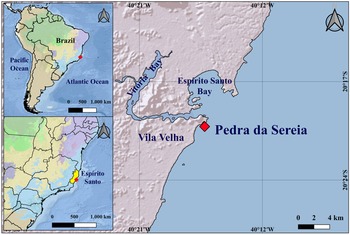
Field observations of several specimens of A. flosculifera and their feeding and interspecific interactions were conducted at Pedra da Sereia (Costa beach) in Vila Velha, Espírito Santo, Brazil (20°20′03.1″S 40°16′23.3″W) (Figure 1). Specimens were recorded on 25 September 2014, and 1, 13 and 15 January 2022, mainly at night during low tide, using a Nikon D5300 camera and Albatroz 722b lighting. No individual was manipulated, and no human interference was observed. All specimens mentioned in this study were identified using specialized literature (e.g. Almeida et al., Reference Almeida, Bezerra, Coelho and Albuquerque2008, Reference Almeida, Terossi, Buranelli, Castilho, Costa, Zara and Mantelatto2018; Carmona et al., Reference Carmona, Lei, Pola, Gosliner, Valdés and Cervera2014; Carmona-Suárez & Poupin, Reference Carmona-Suárez and Poupin2016).
Map of the study area on the shallow shore of the Pedra da Sereia (Costa beach) in Vila Velha (Espírito Santo, Brazil).

The study area is part of a complex of rocky substrates on the coast of Vila Velha, which is associated with freshwater outflow from Vitória Bay, a complex of tropical estuarine systems located in the state of Espírito Santo. The system has two sea communications, the Passagem Channel and the Porto Channel, which comprise the southern part of Vitória Bay. In addition, this is formed by the mouths of several rivers, including the medium-sized Santa Maria da Vitória River, and the small-sized Formate-Marinho, Bubu, Aribiri, Córrego Piranema, and Canal da Costa rivers (Veronez-Júnior et al., Reference Veronez-Júnior, Bastos and Quaresma2009). In this area, a large diversity of fishes, polychaetes, crustaceans, sponges, echinoderms, flatworms, molluscs, sea turtles and cnidarians have been recorded (Basílio et al., Reference Basílio, Carvalho, Souza, Reis, Costa, Paulo and Perônico2020; Costa et al., Reference Costa, Santana, Silva, Souza, Costa, Fuzari, Musiello-Fernandes, Basilio and Basílio2020; Santander et al., Reference Santander-Neto, Perônico, Gomes, Paulo, Mattos, Costa, Hohn, Basílio and Basílio2020).
Results and discussion
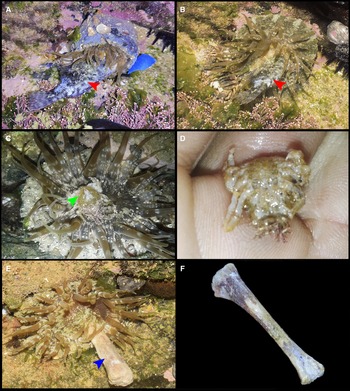
This study reports the first record of interspecific interaction of Actinostella flosculifera, as well as some relevant observations in the study area. We observed a specimen of A. flosculifera feeding on a fish of the family Serranidae, class Actinopterygii (cf. Diplectrum Holbrook, 1855 or Serranus Cuvier, 1816) (Figure 2A, B). Based on the grey colouration and sparse scales on the caudal peduncle, it is possible to infer that the fish was dead before being trapped by the anemone. Species of this family are not common in tidal pools. Therefore, this fish may have died due to a discard of selective fishing, as some artisanal fishers frequently work in the study area. In addition, another sea anemone had a relatively decomposed crab on its oral disc (Figure 2C, D), and a third specimen was observed with an avian bone partially inside its gastrovascular cavity (Figure 2E, F); evidently the anemone is not feeding on the bone, this results from the lack of selectivity in prey capture. Many other specimens of A. flosculifera were observed in the area but hidden by rocks or inside small holes in the rocks.
Actinostella flosculifera (Le Sueur, Reference Le Sueur1817) feeding on: (A, B) a fish (possibly from family Serranidae) (red arrow); (C, D) a small crab (green arrow). And non-selective capture: (C–F) a bone (blue arrow).

In general, sea anemones are polyphagous opportunistic predators (Ayre, Reference Ayre1984; Acuña & Zamponi, Reference Acuña and Zamponi1995; Kruger & Griffiths, Reference Kruger and Griffiths1996; Erralde & Acuña, Reference Erralde and Acuña2020). Erralde & Acuña (Reference Erralde and Acuña2020) recently studied the feeding ecology of the sea anemone Bunodosoma zamponii Gomes, Schama & Solé-Cava, 2011 in the rocky intertidal zone of Punta Cantera, Mar del Plata, Argentina. The authors found 39 different prey items in the contents of the gastrovascular cavity of 154 specimens, mainly prey such as bivalves, amphipods, algae and other molluscs. Kruger & Griffiths (Reference Kruger and Griffiths1996) detail the wide variety in the diet of eight species of sea anemones and the availability of resources at two localities on the Atlantic coast of South Africa. They highlight that the anemones, in addition to feeding on bivalves, gastropods, isopods, insects, platyhelminthes and crinoids, also ingested large amounts of non-digestible waste material, indicating that sea anemones can also be considered non-selective feeders, thus ingesting everything that touches their tentacles, from dead animals (Figure 2A, B), non-digestible organic waste (Figure 2E, F), to microplastic particles or other items of anthropogenic origin (Orte et al., Reference Orte, Clowez and Caldeira2019; Morais et al., Reference Morais, Sarti, Chelazzi, Cincinelli, Giarrizzo and Martinelli Filho2020).
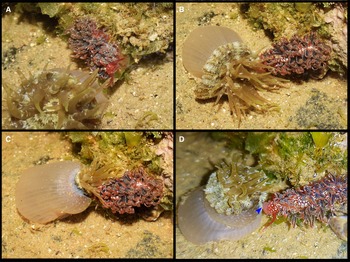
In the second case, a defence mechanism of A. flosculifera against the nudibranch Spurilla braziliana MacFarland, 1909 (Figure 3A–D) was observed. The nudibranch slowly approaches the sea anemone, and then, after the first contact, A. flosculifera responds by retracting the tentacles and column, then by inflating the column and slowly moving away using its pedal disc. In the end, the sea anemone did not detach from the substrate, and we estimated that the attack lasted between 30 and 35 min. After this time, the nudibranch stopped and remained next to the sea anemone. This behaviour can be explained based on the observations of Edmunds et al. (Reference Edmunds, Potts, Swinfen and Waters1976), where the authors mention the attack mechanism of the nudibranch Aeolidia papillosa (Linnaeus, 1761) and the response of the sea anemone Actinia equina (Linnaeus, 1758). Likewise, the nudibranch A. papillosa gets close enough to the column of the sea anemone, extends its buccal mass, and attaches it to the sea anemone over the column to begin feeding, causing tearing in the anemone's tissue, a process with intervals of 10–20 s. After a few minutes, the sea anemone shows signs of abrasion in the injured part by the bites. Feeding is then interrupted for a few minutes and continues at the same side, as the nudibranch keeps feeding on the sea anemone, these pauses are longer and can last for several hours. In addition, A. papillosa continues to feed intermittently until it is satiated or Actinia equina escapes. However, when the anemone fails to escape, the nudibranch follows it wherever it goes and continues to feed on it.
(A–D) Actinostella flosculifera (Le Sueur, Reference Le Sueur1817) (left) being attacked by Spurilla braziliana MacFarland, 1909 (right). (D) Bite of the nudibranch on the sea anemone (blue arrow) with obvious column injury.

Based on the above, this behaviour suggests that the sea anemone may have escaped from the nudibranch Spurilla braziliana since A. flosculifera lives buried in sand or soft substratum fixed on some hard substrate with only the marginal ruff and oral disc protruding into the water column, with the marginal ruff extended in the form of a ‘rug’. In addition, this species is characterized by the presence of verrucae in the distal region of the column next to the marginal projections, and these allow small rocks, shells or other material to adhere (Häussermann, Reference Häussermann2003) (e.g. Figures 2A, 4E, F). In Figure 3, it is possible to observe a specimen with its column totally exposed and clean (without adhered material) and with traces of abrasion on the marginal ruff.
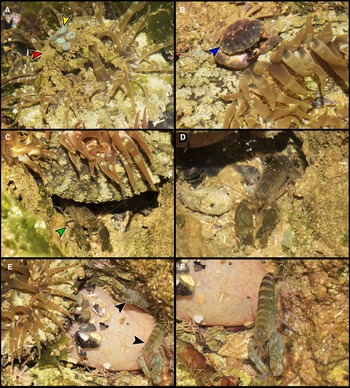
Interspecific associations of Actinostella flosculifera (Le Sueur, Reference Le Sueur1817) with some species of crustaceans: (A) Omalacantha bicornuta (Latreille, 1825) (red arrow) was carrying five polyps of Zoanthus sociatus (Ellis, 1768) (yellow arrow); (B) Menippe cf. nodifrons Stimpson, 1859 (blue arrow); (C, D) Alpheus cf. angulosus McClure, 2002 (green arrow); (E, F) a heterosexual pair of Alpheus cf. carlae Anker, 2012 (black arrow).

Moreover, some species of the genus Spurilla have been reported predating on sea anemones, as these nudibranchs are carnivorous and known to feed on them. They have the ability to secrete mucus to inhibit nematocyst discharge (Greenwood et al., Reference Greenwood, Garry, Hunter and Jennings2004), then extract nematocysts and store them in cnidosacs at the tips of their appendages (cerata) to use for defence against predators (Schlesinger et al., Reference Schlesinger, Goldshmid, Hadfield, Kramarsky-Winter and Loya2009; Garese et al., Reference Garese, García, Muniain and Acuña2013; Bridle, Reference Bridle2017). However, this is the first report of S. braziliana showing signs of predation on A. flosculifera.
Finally, we observed four species of crustaceans associated with A. flosculifera (Omalacantha bicornuta (Latreille, 1825), Menippe cf. nodifrons Stimpson, 1859, Alpheus cf. angulosus McClure, 2002, and Alpheus cf. carlae Anker, 2012) (Figure 4A–F). In addition, five polyps of zoanthid Zoanthus sociatus (Ellis, 1768) associated with O. bicornuta (Figure 4A) were also observed. The interspecific relationships of sea anemones with crustaceans have been well documented (Wirtz & Diesel, Reference Wirtz and Diesel1983; Fautin et al., Reference Fautin, Guo and Hwang1995; Wirtz, Reference Wirtz1997; Acuña et al., Reference Acuña, Excoffon and Scelso2003; Gusmão et al., Reference Gusmão, Rodríguez and Daly2019, Reference Gusmão, Van Deusen, Daly and Rodríguez2020; among others). Furthermore, many of these crustacean species associate with sea anemones to protect themselves against predators such as fish and octopus (Wirtz, Reference Wirtz1997), they also feed on anemone regurgitates and mucus from the anemone's surface, and even crops the tips of its host's tentacles (Wirtz & Diesel, Reference Wirtz and Diesel1983; Fautin et al., Reference Fautin, Guo and Hwang1995).
In contrast, the presence of alphides (snapping shrimps) near A. flosculifera may be due to a mutualistic association (Figure 4C–F) between them. Smith (Reference Smith1977) and McCammon & Brooks (Reference McCammon and Brooks2014) evidenced that the association of Alpheus armatus Rathbun, 1901 with Bartholomea annulata (Le Sueur, Reference Le Sueur1817) showed defensive behaviour in the presence of an anemone predator, e.g. against the fire worms Hermodice carunculata (Pallas, 1766).
Acknowledgments
We thank the editor of this journal and the two anonymous reviewers who provided important suggestions to improve this manuscript. We would like to thank Vanessa Escalante (Alianza Canadiense Barranquilla, Colombia) and Gabriel Giorge da Costa (UNESP) for English language editing.
Author contributions
JDF and SNS conceived and designed research. JDF wrote the manuscript and editing of figures. FM contributed to the field observation, and photographic evidence. All authors contributed to the writing, analysis of the document and approval of the manuscript.
Financial support
J.D.F. was supported by São Paulo Research Foundation (FAPESP), grant numbers 2020/16589-7, S.N.S. was supported by São Paulo Research Foundation (FAPESP), grant numbers 2016/50389-0, 2019/03552-0, CNPq (PROTAX), grant number 440539/2015-3, and CNPq (Research Productivity Scholarship) grant number 307340/2019-8 to S.R.F. and 306672/2018-9 to R.C.C.
Conflict of interest
The authors declare that they have no conflict of interest.
Ethical standards
No animal testing was performed during this study.