INTRODUCTION
In Germany, approximately 120,000 patients are suffering from multiple sclerosis (MS) (Heigl et al., Reference Heigl, Hettich and Lotz2009). However, no such estimation exists for the number of severely affected MS patients. The number and severity of symptoms in severe MS are comparable to those for advanced cancer (Higginson et al., Reference Higginson, Hart and Silber2006). Nevertheless, palliative care (PC) in Germany is still predominantly focused on cancer patients (Ostgathe et al., Reference Ostgathe, Alt-Epping and Golla2011), and a palliative care approach for MS patients is mainly regarded as counterintuitive (Golla et al., Reference Golla, Galushko and Pfaff2014). Against the common notion that MS is not a lethal disease, MS can indeed lead to death (Ragonese et al., Reference Ragonese, Aridon and Mazzola2010; Sumelahti et al., Reference Sumelahti, Hakama and Elovaara2010), and severely affected MS patients are interested in communicating about death and dying (Buecken et al., Reference Buecken, Galushko and Golla2012).
Conventional healthcare services for MS do not necessarily address all of a patient's needs (Kuempfel et al., Reference Kuempfel, Hoffmann and Poellmann2007), and there are first indications that palliative care can be a valuable complementary asset (Higginson et al., Reference Higginson, Hart and Burman2008; Edmonds et al., Reference Edmonds, Hart and Gao2010). In order to bring patients severely affected by MS into contact with PC, we established a PC counseling hotline dedicated to MS. A hotline allows for consultation that does not require a patient to leave his home. We chose a telephone hotline over the use of an informational website. Hardyman and coworkers (Reference Hardyman, Hardy and Brodie2005) found that cancer patients primarily utilized such a website to get factual information, whereas an accompanying hotline was employed to discuss emotionally complicated issues. It can be assumed that seeking information about PC may be such a charged and complicated issue, since PC may be associated with unsettling emotions (Boldt et al., Reference Boldt, Yusuf and Himelstein2006; Fadul et al., Reference Fadul, Elsayem and Palmer2009; Kierner et al., Reference Kierner, Gartner and Bartsch2010). A review revealed that medical counseling hotlines usually yield high degrees of caller satisfaction and acceptance (Byers et al., Reference Byers, Vézina and Campbell2002).
The aims of our study were to (1) develop and implement a pilot PC counseling hotline for severely affected MS patients and their (in)formal caregivers, and (2) test its preliminary feasibility through a pilot study.
METHODS
Development of the Hotline's Concept
We collaborated with the German Multiple Sclerosis Society (Deutsche Multiple Sklerose Gesellschaft; DMSG) as experts in the field who already offer a nationwide MS helpline. This helpline, however, was not specifically targeted at severely affected MS patients and their caregivers who may have PC needs (Edmonds et al., Reference Edmonds, Hart and Gao2010; Golla et al., Reference Golla, Galushko and Pfaff2012; Galushko et al., Reference Galushko, Golla and Strupp2014). Our pilot PC counseling hotline thus aimed to serve as an additional service. We reviewed the literature to gain insight into the best practices for conducting calls (Wahlberg & Wredling, Reference Wahlberg and Wredling2001; Byers et al., Reference Byers, Vézina and Campbell2002; Silverman et al., Reference Silverman, Kurtz and Draper2005; Moscato et al., Reference Moscato, Valanis and Gullion2007; Beaulieu & Humphreys, Reference Beaulieu and Humphreys2008; Derkx et al., Reference Derkx, Rethans and Maiburg2009).
Participants and Settings
The participants targeted for our hotline were patients severely affected by MS as well as their (in)formal caregivers. We did not give a definition of “severely affected by MS,” but left it to the patients to decide whether or not they fit this description (Galushko et al., Reference Galushko, Golla and Strupp2014). In accordance with the principles of PC, we intended to avoid disregarding patients' self-assessments through an explicit definition. Moreover, subjective affectedness has been shown to correlate with disability (Strupp et al., Reference Strupp, Hartwig and Golla2012), captured by the Expanded Disability Status Scale (Kurtzke, Reference Kurtzke1983).
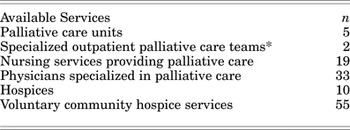
The study setting for testing the pilot hotline's feasibility was the broader region of the cities of Cologne and Bonn (4.3 million inhabitants, approximately 5% of the total population of Germany), which is well equipped with various inpatient and outpatient PC services (see Table 1). The setting was extended to the cities of Aachen and Düsseldorf from January of 2012 until May of 2012. Again, both cities are relatively well equipped with PC structures. The total number of inhabitants in the study setting thus rose to 5 million.
Number of available palliative care services in initial study setting

*For definitions of terms, see the glossary in the Appendix.
Introducing the Hotline to the MS Community
The hotline was introduced through an article in the patient magazine “MS-Magazin” published by the local state association of the DMSG. A permanent online version of this article could also be found and read online at the website of a local DMSG branch. Additionally, we sent leaflets to a convenience sample of formal MS caregivers (MS healthcare centers, neurologists, physical therapists, occupational therapists, speech therapists, urologists and general practitioners) and MS self-help groups in the study setting asking them to distribute them among MS patients. The hotline's extension to Düsseldorf and Aachen was again publicized in a short article in the DMSG magazine, and leaflets were sent to general practitioners in the two cities. A total of 3000 leaflets were sent out.
Concept of the Hotline (Intervention)
Aims and Services of the Hotline
Our pilot PC counseling hotline aimed to serve as a bridge between palliative care and severely affected MS patients along with their (in)formal caregivers by
-
a. discussing the caller's individual situation in order to assess the caller's eligibility for PC, and to clarify what specific service of PC would be most helpful
-
b. providing information about PC
-
c. providing access to PC by recommending available local PC services
Office Hours of the Hotline
From June of 2011 until January of 2012, the office hours of the hotline were Monday to Thursday from 4:00 to 6:00 p.m. Along with the extension of the hotline's service area in January of 2012, we changed the office hours to Monday and Thursday from 10:00 a.m. to 1:00 p.m., and 2:00–6:00 p.m. to provide an additional opportunity for morning calls.
Conduction of Calls and Data Collection
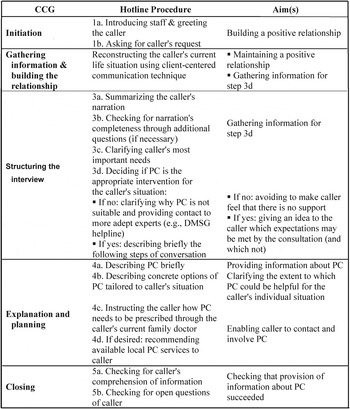
The operator (AK) attended a two-day seminar in client-centered communication technique (Rogers, Reference Rogers1965), which is recommended for such hotlines (Byers et al., Reference Byers, Vézina and Campbell2002; Beaulieu & Humphreys, Reference Beaulieu and Humphreys2008). Being authentic with respect to the nature of palliative care, the availability of PC services, and the possible boundaries connected to the consultation, we sought to encourage callers' confidence in the operator and her consultation. With respect to offering a well-structured consultation and to provide an orientation tool for the hotline operator, we developed a semistructured interview guide (Figure 1) inspired by the Calgary Cambridge Guideline (Silverman et al., Reference Silverman, Kurtz and Draper2005).
Interview form in the style of the Calgary Cambridge Guide (CCG).

Sociodemographic and disease-related information as well as concerns regarding death and dying, including the wish for hastened death and suicidal ideations, were collected by a standardized case report form and field notes. The data were pseudonymized using a code for each caller.
Evaluation of the Feasibility of the Hotline's Concept
Feasibility Objectives and Criteria
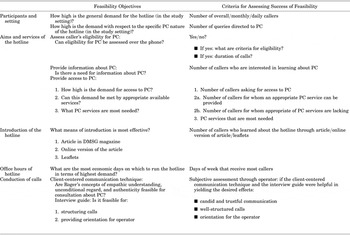
One main objective of our study was to test the preliminary feasibility of the hotline through a pilot feasibility study. Feasibility objectives along with criteria for assessing their success are shown in Table 2.
Feasibility objectives and criteria for success of feasibility

Sampling
The sample included all callers who contacted the hotline during the pilot phase between June 1, 2011 and May 31, 2012 (convenience sampling).
Inclusion/Exclusion Criteria
Callers were included in the analysis if (1) the caller was either an MS patient or an (in)formal caregiver of such, and (2) the caller provided sufficient information for an assessment of eligibility for PC based on criteria including medical characteristics, conditions of care and nursing, caregiver strain, and concerns regarding death and dying. Callers were excluded from analysis if they (1) did not meet the inclusion criteria or (2) did not ask for help with a specific case.
Data Analysis
The success of the pilot study was analyzed descriptively according to the criteria shown in Table 2.
Ethical Committee Approval
This study received approval from the ethical committee at the University of Cologne (application no. 11-111).
RESULTS
The results are presented according to the pilot study's objectives (see Table 2).
Participants and Setting
During its pilot year, the hotline had 18 callers. Three callers (#5, 10, 13) had to be excluded from analysis due to exclusion criteria: 1 neurologist who did not provide sufficient information about his patient, 1 director of a self-help group who asked for leaflets for patients, and 1 physiotherapist who wanted to learn more about the hotline's mission. Three of the remaining 15 callers called from outside of the study setting (# 14–16), but we decided to include them in the analysis because of the low number of callers. Due to this low number, the monthly and daily rates of calls were not determined.
The remaining 15 callers included 11 patients (8 female) and 4 informal caregivers (3 female). Some 7 of these 15 callers explicitly asked for PC (e.g., “What can PC do to relieve my suffering?”), and 6 were in fact deemed eligible for PC (# 7, 9, 11, 15–17). Four callers did not explicitly ask for PC (e.g., “I would love to take my severely disabled wife out, but we have no car”), but described a scenario eligible for PC later in the conversation. All of them were considered eligible for PC (# 2–4, 6). The remaining four callers were not considered eligible for PC due to queries that were irrelevant for PC (e.g., “Can arthritis move from my ankles into my legs?”). These callers were given the contact information for more suitable providers. The mean duration of calls of eligible callers (# 2–4, 6, 7, 9, 11, 15–17) was 35.2 minutes (range, 15–70), versus 20.6 minutes (range, 10–30) with ineligible callers (#1, 8, 12, 14, 18).
Aims and Services of the Hotline
Assess Callers' Eligibility for PC
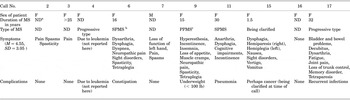
Table 3 shows the available medical characteristics of the 10 patients eligible for PC. With respect to care and nursing conditions, two patients (# 11, 15) were cared for at an intensive care unit at the time of the call due to severe complications such as infections. One patient (# 9) lived in a nursing home. Five of the remaining seven patients living at home were cared for by their spouses (# 4, 6, 7, 16, 17). Two of these (# 6, 17) needed significant assistance with personal hygiene and food intake. Due to financial problems, the family could only afford a nursing service once a week, so that the husbands were providing most of the care. Both husbands were elderly men who were themselves suffering from various ailments.
Medical information about the patients

aND = no data.
bSPMS = secondary progressive MS.
cPPMS = primary progressive MS.
Four informal caregivers expressed that they (caregiver and patient) came to believe that death might be a possible impending outcome of the disease (# 6, 9, 11, 15). The caregivers stated that they felt both practically and emotionally overwhelmed by the implied responsibilities, including advance care planning and decision making. Three caregivers reported their patient's wish for a hastened death, which in two cases had taken the form of concrete suicidal intentions (# 9, 15), including one suicide attempt (# 15).
Provide Information About PC
If a caller's situation was considered to make them eligible for PC, the caller was given a brief description of palliative care. All 10 callers were interested in learning about PC, about what specific PC service might be helpful for their individual concerns, and how they could access it.
Providing Access to PC
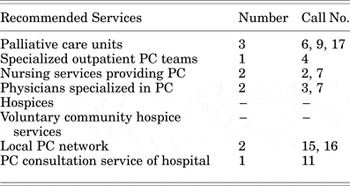
Recommendations for available PC services in the patient's area could be provided in all 10 cases (Table 4).
Recommended palliative care services

Two callers from outside the study setting (# 15, 16) were encouraged to contact their local PC networks to learn more about available PC services in their hometowns. One family (# 11) had to decide between intensive care and PC for the patient, and it was recommended that they seek consultation from the hospital's PC consultation service. Due to the yet limited availability of specialized outpatient PC teams, this service could not be offered to three patients (# 6, 7, 9) who were deemed eligible for it. Alternatively, these patients were encouraged to stay at a PC unit (# 6, 9) or involve a PC physician and a PC nursing service (# 7).
Introduction of the Hotline
Five callers learned about the hotline through the article in the magazine published by the DMSG (# 1–3, 16, 17), and two callers found and read this article online (# 9, 11). Four calls were prompted by our leaflets (# 6, 7, 12, 15). The remaining four calls did not provide an opportunity to ask how callers learned about the hotline.
Office Hours of the Hotline
Six callers called on a Monday (# 1–3, 14, 15, 17), five on a Tuesday (# 6–9, 11), and four on a Thursday (# 4, 12, 16, 18).
Tools and Procedures for Conduct of Calls
Rogers's client-centered communication technique seemed to be particularly helpful for identifying PC needs that were not explicitly addressed by callers (# 2–4, 6). The interview guide in the style of the Calgary Cambridge guideline (Silverman et al., 2005) was a useful tool for the operator to structure and keep track of the course of conversations.
DISCUSSION
To our knowledge, our pilot PC counseling hotline for multiple sclerosis was the first of its kind. What are the possible reasons for the small number of callers? Due to lacking records on the number of (severely affected) MS patients, the number of potential callers could not be estimated in advance. A qualitative study by our department (Golla et al., Reference Golla, Galushko and Pfaff2014) indicated that MS patients do not know what PC is or, if they do, associate it with cancer and dying. Consequently, MS patients may have not felt addressed by the hotline or may have felt reluctant to call. Some studies argue that the language used to introduce PC plays a crucial role as to whether PC is perceived positively (Boldt et al., Reference Boldt, Yusuf and Himelstein2006; McInturff & Harrington, Reference McInturff and Harrington2011). Since we pretested neither the article nor the leaflet, the language employed in these materials may not have been optimally encouraging.
Moreover, the article in the DMSG magazine was only accessible to paying members of that organization. Our leaflets may not have been the optimal choice for introducing the hotline. Wenk and colleagues (Reference Wenk, Alegre and Diaz1993) identified radio as the most powerful channel for introducing an Argentine PC hotline to cancer patients, eliciting 80% of all calls. Broadstock and Hill (Reference Broadstock and Hill1997), testing the impact of informational leaflets on promotion of a cancer helpline through cancer specialists, found that additional calls prompted by these leaflets accounted for only 4% of overall calls.
In contrast to Broadstock and Hill, we did not check whether physicians actually gave the leaflets to their patients. Possible reasons for their not doing so may be a misconception of PC as solely end-of-life care (McInturff & Harrington, Reference McInturff and Harrington2011) or a fear of causing distress in their patients (Fadul et al., Reference Fadul, Elsayem and Palmer2009; Kierner et al, Reference Kierner, Gartner and Bartsch2010). German neurologists do not necessarily consider PC relevant for MS and doubt that PC can meet the complex needs of their patients (Golla et al., Reference Golla, Galushko and Pfaff2014). Some physicians may think that they are already providing good enough symptom management so that additional PC care is not required (Snow et al., Reference Snow, Varela and Pardi2009; Golla et al., 2014). It is, of course, also plausible that some of them did not have any severely affected MS patients.
The fact that informal caregivers called on behalf of the four most compromised patients (# 6, 9, 11 and 15) in our sample implies that severely affected MS patients are often unable to make this call. Our office hours may have posed another barrier to callers, as some days (e.g., on the weekend) and daytimes (e.g., evenings) were not available.
Despite the low number of callers, our pilot feasibility study suggests that the hotline is a valuable service for MS patients and their informal caregivers once they do make the call. Preliminary eligibility for PC could be assessed over the phone and eligible patients (10 of 15) asked for access. This indicates that there was a need for PC among MS patients in this study that could be met by facilitating access through our hotline. If this trend found in our pilot feasibility study could be replicated on a larger scale, a considerable number of patients could benefit from the hotline. Based on this potential, the hotline will be extended to a nationwide scale through a grant from the DMSG.
In order to enhance its availability, the hotline should be advertised on television and/or radio in addition to previous means of introduction. Through such procedures, palliative care may reach a level of normalcy for multiple sclerosis patients, ideally arousing their interest already at an earlier stage in the disease. Palliative care may help prevent the severity of suffering that reportedly provoked some patients' wishes for a hastened death. By evaluating MS patients through a hotline, their quality of life and autonomy may be improved by providing PC services.
FUNDING
This work was supported by the Werner Jackstaedt-Stiftung Foundation (grant no. S134–10.078).
ACKNOWLEDGMENTS
We thank Mrs. Pitschnau-Michel, and Professors Toyka and Hohlfeld from the national office of the German MS Society, DMSG, Hannover, for their continuous support.
CONFLICTS OF INTEREST
The authors state that they have no competing financial interests to declare.
APPENDIX
Glossary of Definitions of Palliative Care Terms According to the German Society for Palliative Medicine (Deutsche Gesellschaft für Palliativmedizin, Reference Fadul, Elsayem and Palmer2009)
-
Specialized outpatient PC Team
-
The goal of the team is to maintain patients' quality of life and autonomy as much as possible, providing a humane life in familiar surroundings (home but also nursing home or hospice) until death. Specialized outpatient PC teams serve patients, their families and healthcare providers when the intensity or complexity of problems caused by the disease requires short-term or long-term attention. This may involve pain and symptom control counseling, and coordination of required healthcare services including comprehensive individualized care and round-the-clock availability of a multi-professional team.
-
Voluntary community hospice services
-
Voluntary community hospice services provide trained volunteers offering individual support (e.g., spiritual support, assistance in daily activities, being there for the family etc.) for severely sick and dying patients and their families.