1. INTRODUCTION
Prepositional passives, henceforth Prep-passives, as illustrated in (1) from English and (2)–(4) from mainland Scandinavian (Danish, abbreviated Da., Norwegian – No. and Swedish – Sw.), have received a lot of attention from both traditional and generative grammarians.
(1) This bed has been slept in.
(2)

(3)
(4)



Regarding the Scandinavian languages, there are conflicting claims in the literature, concerning both the productivity and the grammatical status of Prep-passives. Herslund (Reference Herslund1984) states that they are ungrammatical in his idiolect of Danish. Maling & Zaenen (Reference Maling and Zaenen1985:207) claim that they are ungrammatical in Danish and Swedish ‘or, at best, extremely marginal’, but the recent Danish reference grammar Grammatik over det Danske Sprog (Hansen & Heltoft Reference Hansen and Heltoft2011, henceforth GDS) treats Prep-passives as one of several options for forming the passive in Danish. The Swedish reference grammar Svenska Akademiens Grammatik (Teleman, Hellberg & Andersson Reference Teleman, Hellberg and Andersson1999, henceforth SAG) notes that Prep-passives are sometimes used, primarily in spoken and informal written Swedish (SAG 4:369). Lødrup (Reference Lødrup1991:118) writes: ‘Norwegian has a rather productive pseudopassive (as opposed to the other Scandinavian languages)’,Footnote 1 and Norsk Referansegrammatikk (Faarlund, Lie & Vannebo Reference Faarlund, Lie and Vannebo1997, henceforth NRG) provides a number of examples without mentioning any genre restrictions.
The conflicting reports call for a wider investigation of the use of Prep-passives in contemporary Scandinavian. The articles cited above mainly base their conclusions on constructed data and judgments from a few informants. In order to clarify the situation, we have conducted a corpus study of written Danish, Norwegian and Swedish. We have in addition systematically investigated if there are any differences in the use of Prep-passives between the morphological passive, which we refer to as s-passive, and the periphrastic passive, which we refer to as bli(ve)-passive.Footnote 2 Previous research (Engdahl Reference Engdahl1999, Reference Engdahl2006; Laanemets Reference Laanemets2012, Reference Laanemets2013) has shown that there are considerable differences between Danish and Norwegian on the one hand and Swedish on the other with respect to the use of the two types of passive. This motivates looking more closely at any correlations between the use of Prep-passives and the types of passive.
Although our primary aim is to investigate the use of Prep-passives, we also need to consider passives with particles in order to make the right distinctions with respect to Prep-passives. By particle passives, henceforth Part-passives, we understand passives where the passive participle is followed by a particle which normally carries stress, indicated by a stroke (ˈ), as illustrated by examples (5)–(8). Part-passives are used productively in Danish, Norwegian and Swedish, just as in English.
(5)
(6)
(7)
(8)
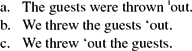

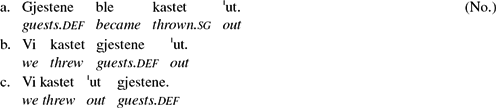
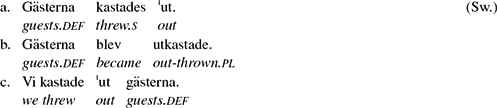
Note that the Swedish example in (8a) is in the s-passive. In periphrastic passives, particles are regularly incorporated in the passive participle in Swedish, as shown in (8b).
How to distinguish prepositions from particles is a much debated issue (see e.g. Emonds Reference Emonds1972, van Riemsdijk Reference van Riemsdijk1978, Toivonen Reference Toivonen2003, Tungseth Reference Tungseth2008). Svenonius (Reference Svenonius2003) uses a number of criteria such as whether the item can carry sentential stress and whether the preposition/particle forms a constituent with the complement which can be preposed. The stress criterion distinguishes the particles in (5)–(8) from the prepositions in (1)–(4), which are all unstressed. Note that the particles are stressed also in the active versions in the (b) and (c) examples in (5)–(8).
In active sentences, the particle follows the object in Danish and precedes it in Swedish, as is well known. In Norwegian both orders are sometimes possible, though under somewhat different conditions (Aa Reference Aa2015). The theoretical implications of this difference between Danish, Norwegian and Swedish have been much discussed (see e.g. Taraldsen Reference Taraldsen1983; Holmberg Reference Holmberg1986; Svenonius Reference Svenonius1996, Reference Svenonius2003; Lundquist Reference Lundquist2014a, Reference Lundquistb). We here restrict our disccussion to the possible impact of particle placement on the availability of Prep-passives.
In addition to Prep-passives with simple verbs, as illustrated above, many languages have Prep-passives formed with complex verbs containing e.g. a nominal argument, as shown for English in (9) and Norwegian in (10). We will refer to this type as V+N Prep-passives.
(9) He was taken advantage of.
(10)

This has implications for the way the corpus searches are carried out, as discussed in Section 3, where we describe our corpus investigation. Common properties of the Prep-passives found in the three languages are presented in Section 4. In addition to genuine Prep-passives, our corpus investigation revealed a large number of confounding examples which may influence the characterization of Prep-passives; these are discussed in Section 5. More language-specific findings are discussed in Section 6, and in Section 7 we conclude by assessing some of the theoretical claims in the light of the larger collection of authentic examples we have gathered.
2. PREVIOUS STUDIES
There is a considerable amount of research on, or related to, Prep-passives. We will limit our survey to studies that bear directly on the mainland Scandinavian languages, but start with a brief overview of English Prep-passives as the research on English provides an important background for other studies.
2.1 English
In English, Prep-passives have probably been used since Middle English (Goh Reference Goh2001) and are described in early reference grammars such as Jespersen (Reference Jespersen1909–49). Ward, Birner & Huddleston (Reference Ward, Birner, Huddleston, Huddleston and Pullum2002) divide Prep-passives in English into two types. In the first type, a particular preposition is required by the verb, see (11), or by the verbal idiom as in (12).Footnote 3
- (11)
a. My mother approved of the plan. (Ward et al. Reference Ward, Birner, Huddleston, Huddleston and Pullum2002:1433)
b. The plan was approved of by my mother.
- (12)
a. They all looked up to her.
b. She was looked up to by them all.
In the second type, the preposition is not selected by the verb, but typically has a locative or instrumental meaning, as shown in (13).
- (13)
a. This bed was slept in by George Washington. (Ward et al. Reference Ward, Birner, Huddleston, Huddleston and Pullum2002:1446)
b. This bed has been slept in.
c. This cup was drunk out of by Napoleon. (Davison Reference Davison1980:44)
Both types of Prep-passives are constrained by a notion of affectedness (Bolinger Reference Bolinger and Makkai1975, Reference Bolinger, Makkai, Makkai and Heilmann1977; Anderson Reference Anderson1977:373f.). The passive sentence is only perceived as felicitous if the passive VP expresses a significant property, or a change in a significant property, of the subject-referent (Ward et al. Reference Ward, Birner, Huddleston, Huddleston and Pullum2002:1466f.).Footnote 4 This condition explains why the structurally similar examples in (14) are hard to make sense of. Footnote 5
- (14)
a. #The river was slept beside. (Ward et al. Reference Ward, Birner, Huddleston, Huddleston and Pullum2002:1446)
b. #A cup was drunk out of by Napoleon. (Davison Reference Davison1980:44)
If George Washington has slept in a bed, as in (13a), the bed acquires historical interest but the fact that someone has slept beside a river, as in (14a), does not affect it in any significant way. But sleeping in a bed affects it (the sheets become rumpled) which is why (13b) might be a relevant comment even if the sleeper is unknown. Similarly, a particular cup used by Napoleon renders this cup historical interest (13c), but this does not hold for an arbitrary cup (14b).
Most theoretical approaches to Prep-passives in English assume some form of lexical reanalysis whereby the verb and the preposition form a unit to which passive can apply, see e.g. Wasow (Reference Wasow1977:351f.), Hornstein & Weinberg (Reference Hornstein and Weinberg1981), Bresnan (Reference Bresnan and Bresnan1982). Evidence in favour of this approach is that it is not possible to form Prep-passives in English if e.g. an adverb intervenes between the V and the P, as shown in (15b), whereas it is possible to front the complement of the preposition in e.g. a relative clause (15c). The following examples are from Bresnan (Reference Bresnan and Bresnan1982:51ff.).Footnote 6
- (15)
a. Everything is being paid for by the company.
b. *Everything was paid twice for.
c. That's something that I would have paid twice for.
Examples like (15b) must be distinguished from examples like (9), where take advantage of is analyzed as a complex verb (see Bresnan Reference Bresnan and Bresnan1982:57f.; Alsina Reference Alsina, Butt and King2009).
Law (Reference Law, Everaert and van Riemsdijk2006:659) combines the reanalysis approach with the assumption that the passive morpheme in English must absorb Case, the Case absorption property. In Prep-passives it is the Case assigned by the preposition which is absorbed by the passive morpheme (Law Reference Law, Everaert and van Riemsdijk2006:660). The only way the complement can get Case is by moving to the subject position where it gets nominative Case. Law argues that this assumption furthermore explains why English does not have impersonal passives, in contrast with the other Germanic languages, as illustrated in (16), from Law (Reference Law, Everaert and van Riemsdijk2006:658).
(16)

Since English passive morphemes must absorb accusative Case, it follows that passives of intransitive verbs, i.e. impersonal passives, are impossible; these verbs do not assign accusative Case at all. The availability of impersonal passives in the other Germanic languages means that passive morphemes in these languages do not need to absorb case, a fact further evidenced by the availability of passive subjects with oblique Case (see Section 2.2 below).
Alsina (Reference Alsina, Butt and King2009), working in Lexical-Functional Grammar (LFG), capitalizes on the similarities between preposition stranding in Prep-passives and in long distance dependencies such as relative clauses, as in (15c) above. Adapting a proposal from Lødrup (Reference Lødrup1991), he provides an analysis which involves structure sharing between the surface subject argument and the complement of the preposition.
Although there are numerous studies about Prep-passives in English, we have not found any corpus studies which report on the frequency of Prep-passives in general or among passive clauses.Footnote 7
2.2 Icelandic
In a seminal article, Maling & Zaenen (Reference Maling and Zaenen1985) show that what looks like Prep-passives in Icelandic is really a case of preposition stranding when an oblique complement has been topicalized in an impersonal passive. This analysis is adopted in Thráinsson (Reference Thráinsson2007), from where we cite the Icelandic examples below (see 2007:262–264).
(17)
(17a) is an active sentence with the expression tala um ‘talk about’, which takes a complement in the accusative case. A passive version with a nominative subject, (17b), is clearly ungrammatical, but the version in (17c), where the first constituent retains the case assigned by the preposition, is grammatical. As is well-known, Icelandic has oblique subjects with both active and passive verbs. Applying the tests for subjecthood used in Zaenen, Maling & Thráinsson (Reference Zaenen, Maling and Thráinsson1985), it is clear that the clause-initial accusative þennan mann ‘this man’ in (17c) does not behave as an oblique subject. For instance, it cannot appear post-verbally in a yes/no question (18) or appear in an ECM construction as in (19).Footnote 8
(18)
(19)


According to Maling & Zaenen (Reference Maling and Zaenen1985) and Thráinsson (Reference Thráinsson2007), the grammatical example in (17c) is therefore to be analyzed as an instance of topicalization in an impersonal passive construction, as in (20a), but without the overt expletive það ‘it, there’. The expletive það is only used in clause-initial position, i.e. Spec,CP, as has been shown by several researchers (see Thráinsson Reference Thráinsson2007: Chapter 6 and references given there).
(20)
Maling & Zaenen (Reference Maling and Zaenen1985:207) further claim that this analysis is appropriate also for apparent Prep-passives in Danish and Swedish.
2.3 Danish
Essentially the same analysis as in Maling & Zaenen (Reference Maling and Zaenen1985) was proposed for Danish by Herslund (Reference Herslund1984) who also considers apparent Prep-passives to be fronted versions of impersonal passives with stranded prepositions. He renders the Danish counterpart to the English Prep-passive in (21a) as in (21b), a fronted version of the impersonal passive in (21c) (see Herslund Reference Herslund1984:50). Note that the fronted pronoun is in the accusative case.
(21)
Herslund (Reference Herslund1984:70) mentions in a footnote that some speakers use and accept sentences as in (22), which involve initial pronouns in the nominative case and which are not interpreted as impersonal passives.
(22)
Herslund comments that these are ungrammatical in his idiolect but that they seem to have been fairly common until the 19th century, citing Mikkelsen (Reference Mikkelsen1911/1975:135). He does not agree with Hansen (Reference Hansen1967:52), who claims that they are expanding.Footnote 9 Herslund also notes that most of the cited examples have the Prep-passive in an infinitival clause following a modal verb, whereas examples with finite verbs, as in (22c) above, are much rarer and considerably less acceptable to him.Footnote 10
Herslund links the absence of Prep-passives in Danish to the lack of what he calls particle movement. By this he means a rule which would move a particle across an object, creating a structure like [v + p] which in turn would be a prerequisite for the reanalysis that gives rise to Prep-passives, as described for English above. As shown in (6b), repeated here as (23a), the stressed particle follows the object in Danish. The order particle–object is ungrammatical, (23b).
(23)
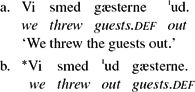
Herslund assumes that the languages which have particle movement, i.e. English, Norwegian and Swedish (see (5), (7) and (9) above), have productive Prep-passives (Herslund Reference Herslund1984:61), contrary to what is the case in Danish.
Given that the object precedes the particle in Danish, the existence of Part-passives is not surprising, (24a). Note, however, that this is only possible in predicative position in Danish, never in attributive position, (24b), whereas it is possible in English, (24c).
(24)
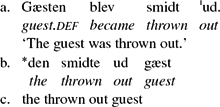
Vikner (Reference Vikner1995:246) also assumes that Prep-passives are ungrammatical in Danish, but the Danish reference grammar GDS (p. 1288) is less dismissive and includes, among the six morpho-syntactic options to form passive in Danish, constructions where the complement of the preposition is promoted to subject status, as exemplified in (25).Footnote 11
(25)
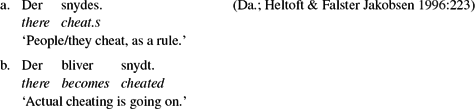
GDS (pp. 1295f.) also brings up the possibility of forming impersonal passives with the expletive der ‘there’ and a prepositional object, as in (26a) below, besides the passive with promoted complement of the preposition, as in (26b). Unlike Herslund (Reference Herslund1984), both passive constructions are considered acceptable in Danish, and seen as two alternatives to the active counterpart in (26c).
(26)
GDS says nothing about the frequency of Prep-passive in contemporary Danish, nor does it mention any constructional restrictions except for remarking that the construction is easiest to form with a modal verb, as illustrated in (25b) and (26d). GDS does not give any examples of V+N Prep-passives, but both Mikkelsen (Reference Mikkelsen1911/1975:135) and Diderichsen (Reference Diderichsen1962:122) provide some examples, see (27) from Diderichsen.
(27)

2.4 Norwegian
As mentioned in the Introduction, Lødrup (Reference Lødrup1991) states that Prep-passive is ‘quite productive’ in Norwegian. He argues that this cannot be due to reanalysis as in English since the presence of intervening adverbs does not affect the construction in Norwegian.Footnote 12 Compare the well-formed Norwegian examples in (28a) with the ill-formed English examples in (15b), repeated here as (28b).
(28)

Instead of reanalysis, Lødrup proposes that the relation between the passive subject and the unexpressed propositional complement is similar to raising to subject and should be analyzed in the same way.Footnote 13 In order to account for the restrictions on Prep-passives, illustrated by the contrasts shown in (29)–(30), Lødrup cites Bolinger's (Reference Bolinger, Makkai, Makkai and Heilmann1977) generalization: ‘the subject in a passive construction is conceived to be the true patient, i.e. to be genuinely affected by the action of the verb’ (1977:67).Footnote 14
(29)
(30)
As discussed above in connection with (13), a bed is affected by someone sleeping in it, which would account for (30a), whereas measure phrases and abstract nouns like those in (30b) and (30c), respectively, cannot be genuinely affected.
The Norwegian reference grammar NRG (pp. 843f.) gives the impression that Prep-passives are possible in general, provided that the prepositional phrase (PP) is selected by the verb (in NRG's terminology ‘is a prepositional object’). If a verb takes both a nominal object and a prepositional object, only the nominal object can become subject, see (31).
(31)
However, if the verb, noun and preposition form a lexicalized expression, as in (10) above, then only the prepositional object can become subject.
(32)
According to NRG, Prep-passives are normally not possible with adverbial PPs, with the exception of certain locatives where it is possible to interpret the action as intentional.Footnote 15
(33)

2.5 Swedish
An early comparative study was carried out by Körner (Reference Körner1948, Reference Körner1949) who investigated the development of Prep-passives in Swedish, with frequent comparisons with Danish, Norwegian and to some extent English, by excerpting novels and newspapers.Footnote 16 He claims that Prep-s-passives (i.e. morphological Prep-passives) are more common in Swedish than in Danish and Norwegian, whereas it is the other way round for Prep-bli(ve)-passives (i.e. periphrastic Prep-passives). Unfortunately, Körner does not give any frequencies for the different types in his material, which means that it is difficult to assess his claim that examples like (34a) constitute the normal type in Swedish literature, whereas (34b) is unusual (Körner Reference Körner1948:132).Footnote 17
(34)
Körner furthermore proposes that the widespread use of periphrastic Prep-passives in Danish and Norwegian has to do with the way participles of particle verbs are formed, as also noted by Hulthén (Reference Hulthén1944:227f.). In Danish and Norwegian, there is a preference for a free-standing particle, just as in the active simple tenses, whereas the particle tends to prefix to the participle in Swedish. Compare Danish in (35) and Swedish in (36), (repeated here from the Introduction, (6) and (8)). As shown in the glossing, the past participle agrees with the subject in Swedish, but not in Danish, or Norwegian.
(35)
(36)


By analogy with free-standing particles like that in (35b), Körner writes, free-standing prepositions become possible and we get examples like (37) and (38) in Danish and Norwegian.Footnote 18 Note the intervening adverb strængelig ‘severely’ in the Danish example.
(37)
(38)
Sundman (Reference Sundman1987:476–483) discusses Körner's arguments for Prep-passives in Swedish being true passives and comes to the conclusion that they are indeed an option in the grammar, but not obligatory since examples can be rephrased with an expletive subject, as shown in (39) (see Maling & Zaenen's proposal for Icelandic in Section 2.2 above).
(39)

The Swedish reference grammar states that Prep-passives are primarily used in spoken language and informal written language (SAG 4:369ff.). It gives a few examples where the preposition is selected, see (40a), but notes that locative adverbials are also possible, see (40b).Footnote 19
(40)
Most of the examples provided are infinitival and SAG writes that Prep-passives in infinitival phrases, as in (40a, b), are considered more acceptable than in tensed clauses. V+N Prep-passives are possible, provided that the object has ‘weak referentiality’, as in (41).
(41)
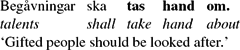
The examples in SAG's main text are all s-passives. In the section on periphrastic passives, SAG comments, in a footnote, that Prep-bli-passives are even more marginal than Prep-s-passives (SAG 4:387). Three authentic examples are given, including (42).
(42)
2.6 Summary of predictions
Here we summarize the different predictions made in previous research, which we will address by our empirical investigation.
Frequencies. Prep-passives should be more frequent and used in a wider variety of contexts in Norwegian than in Danish (Herslund Reference Herslund1984, Lødrup Reference Lødrup1991, NRG). Herslund also predicts more Prep-passives in Swedish than in Danish.
The overall frequency of periphrastic Prep-passives should be higher in Danish and Norwegian than in Swedish, whereas the opposite should hold for s-passives (Körner Reference Körner1948, SAG).
Distribution. The majority of the Danish examples should be infinitival complements of modal verbs (Herslund Reference Herslund1984, GDS). In Norwegian, the majority should involve selected prepositional complements, rather than adjuncts (NRG).
In Swedish we should primarily find Prep-s-passives (Körner Reference Körner1948, SAG). It should be possible to analyze the Prep-passives as impersonal constructions without an overt expletive (Maling & Zaenen Reference Maling and Zaenen1985, Sundman Reference Sundman1987).
Affectedness. If Prep-passives in Scandinavian resemble English Prep-passives, we should expect to find primarily affected subjects, including locative and instrumental subjects (Anderson Reference Anderson1977, Davison Reference Davison1980, Ward et al. Reference Ward, Birner, Huddleston, Huddleston and Pullum2002).
3. CORPUS INVESTIGATIONS
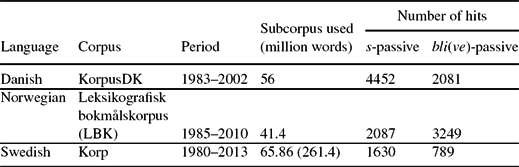
Our empirical investigation of the use of Prep-passives in contemporary Danish, Norwegian and Swedish is based on written language corpora. In our selection of corpora, we wanted to include both newspapers and fictional texts, and we aimed for as high comparability across the three languages as possible. An overview of the materials used is given in Table 1 and the corpora are listed towards the end of the paper.Footnote 20
Overview of corpora used.

The morpho-syntactic annotation of the corpora differs, both with respect to tagset and precision, and the available search options vary somewhat across the search interfaces, which may have affected the results. Simply searching for a passive verb or participle followed by a preposition gives a large number of false hits, e.g. passive verbs followed by locative or temporal PPs. In order to exclude these, we required that the preposition should be followed by a comma or a period, as this is often the case in the examples cited in the literature. Schematically, the search strings we used look as in (43).
- (43)
a. V-PASS {0,2} PREP comma/period
b. lemma BLI(VE) {0,2} P.PART {0,1} PREP comma/period
To find examples with s-passives, we searched for passive verbs followed by up to two words, to allow both for V+N Prep-passives and for inverted subjects and adverbials. In the case of bli(ve)-passives, we limited the search to the lemma BLI(VE) ‘become’, followed by up to two words, a passive participle, possibly followed by an object. The total number of hits is shown in Table 1 above. From these hits, we took a random sample of 600 s-passives and 600 bli(ve)-passives in each language, which we went through and annotated manually.Footnote 21
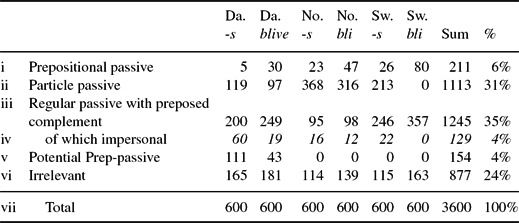
The overview in Table 2 shows that only 211, i.e. 6%, of the 3600 annotated examples qualified as Prep-passives. We will discuss what made up the remaining 94% in Section 5.
Number and percentage of Prep-passives in 1200 randomly selected passive examples in each language.

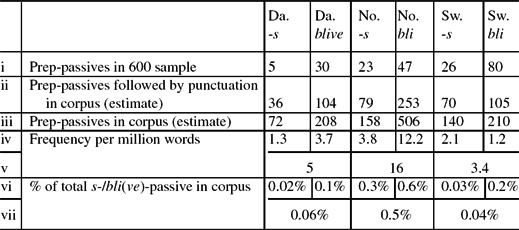
The overall frequency of Prep-passives in our sample is quite low and varies from below 1% for Danish s-passives to 13% for Swedish bli-passives with Norwegian in between. The frequency figures in Table 2 tell us what the relative frequency of Prep-passives is in our random sample of 1200 examples per language. However, given the differences in annotation and precision in the search strings, we cannot use them directly to establish the overall frequency of Prep-passives in Danish, Norwegian and Swedish. But we can use the figures in Table 2 as a base for estimating the frequency in each of the corpora investigated, as shown in Table 3.
Estimated frequencies of Prep-passives in the corpora used.
Starting from the number of actual hits in the 600 sample, we can estimate the number of Prep-passives in the total number of hits (row ii) produced by the search strings, shown in the rightmost column in Table 1. Since we have limited the search by requiring that the preposition should be followed by a comma or a period, we need to add occurrences of Prep-passives which are not followed by comma or period. In each language, we carried out additional searches on frequent Prep-passives without any contextual restrictions and then checked how many of these hits were followed by punctuation.Footnote 22 These lexical searches showed that about half of the Prep-passives were followed by punctuation. We therefore doubled our estimate (row iii) and used that to arrive at the frequency figures shown in rows iv–vii (the Swedish bli-passive is calculated with respect to the larger corpus of 261.4 million words). The frequency of Prep-passives, expressed as occurrence per million words, row v, is quite low. In the absence of comparable figures for English, we do not know how the frequency compares with this language. Comparing our three languages, we find that the prediction that Prep-passives should be more frequent in Norwegian is borne out; they are about three times more common in Norwegian texts (16 per million words, or 16/mw) than in Danish (5/mw) and Swedish (3.4/mw). Herslund's prediction that Prep-passives should be much more infrequent in Danish than in both Norwegian and Swedish is not correct since Danish and Swedish have similar frequencies. If we look at frequency in terms of proportion of passive clauses in the languages, shown in rows vi and vii, we see that Prep-passives constitute a higher proportion of passive clauses in Norwegian than in Danish and Swedish, by a factor of ten.
Table 3 also reveals that Prep-bli(ve)-passives are more common than Prep-s-passives, again by a factor of ten in Danish and Swedish, whereas they are twice as common in Norwegian (row vi). Körner's prediction that Prep-s-passives should be more common in Swedish than in Danish and Norwegian is thus not borne out. Furthermore, the finding that Prep-bli-passives constitute a higher proportion of passive clauses than Prep-s-passives in Swedish is quite surprising and goes against the descriptions in both Körner (Reference Körner1948, Reference Körner1949) and SAG. Although the frequency of Swedish Prep-bli-passives, 1.2/mw (row iv), is lower than for Prep-s-passives, 2.1/mw, this is actually a surprisingly high figure, given that bli-passives in Swedish are much less common than s-passives. Laanemets (Reference Laanemets2012:92) found that only around 3% of the total number of passive clauses in Swedish newspapers are bli-passives (see further discussion in Section 6.3 below).
The rest of the predictions in Section 2.6 will be discussed in Sections 5 and 6.
4. PREPOSITIONAL PASSIVES: COMMON FEATURES
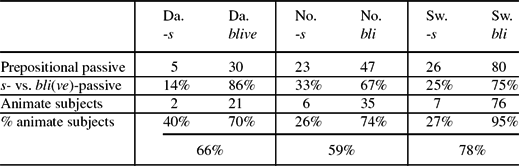
We will now look closer at the 211 examples that meet our criteria for Prep-passives. Previous research on Scandinavian passives has established that animate subjects are more common with bli(ve)-passives than with s-passives, whereas inanimate subjects are more common with s-passives (Engdahl Reference Engdahl1999, Reference Engdahl2006:31; Laanemets Reference Laanemets2012:113ff.). The high proportion of animate subjects in bli(ve)-passives was quite unexpected, given that direct objects of active transitive verbs tend to be inanimate (Dahl Reference Dahl2000, Reference Dahl2008).Footnote 23 We therefore investigated the proportion of animate subjects among the 211 Prep-passives, shown in Table 4.
Prepositional passives: distribution and proportion of animate subjects.
In all three languages, Prep-passives are more common among bli(ve)-passives than among s-passives. The difference is particularly strong in Danish (86% vs. 14%) and Swedish (75% vs. 25%) with Norwegian showing a somewhat more balanced distribution (67% vs. 33%). Note that the Swedish figures are the opposite of what Körner (Reference Körner1948) and SAG predict. Furthermore, it is much more common for Prep-bli(ve)-passives to have animate subjects than for Prep-s-passives. In Swedish, the difference is striking: 95% of the bli-passives have animate subjects, compared with 27% of the s-passives. It appears that Prep-bli(ve)-passives in mainland Scandinavian are most often predicated of animate, mostly human, subjects.
Let us now look at a few typical examples from the corpus search, starting with Prep-bli(ve)-passives.
4.1 Prep-bli(ve)-passive
(44)
(45)
(46)
Overall the Prep-bli(ve)-passives are remarkably similar in Danish, Norwegian and Swedish. The subject is typically an Experiencer who is psychologically affected by the action. In most of the cases the subject is human, but we also find animals, as in (44b, c). The understood Agent is normally another human or a social body. The Experiencer is affected by something the Agent does, or often does not do, as in (44b), (45b, c). The verbs are often verbs of perception, communication or interaction, used to highlight the effect the action has on the passive subject. In (44a), the subject sits down in order to watch and ‘be looked at’. (44b) is a warning against ignoring a dog; it has to be ‘talked to’. In (45a) the subject perceives that s/he ‘is looked at’ and in (45b) the subject is fed up with not being ‘believed’. In (46a) the subject is a person in authority who is used to being ‘listened to’ whereas in (46b) a dictator should beware of being ‘laughed at’.
There are also examples like (47), where the subject is physically affected by the action.
(47)
Some examples with physical contact verbs like ‘spit’ on and ‘tread on’ in (48) should probably be interpreted metaphorically and some of the inanimate subjects of Prep-bli(ve)-passives are assigned desires and feelings which are more suitable for animate referents, see (49).
(48)
(49)
There were only two examples, both in Swedish, where physical affectedness is highlighted (recall (40b) above, from SAG).
(50)
There is one further factor that must be mentioned in connection with the distribution of s- and bli(ve)-passives in the three languages and that is tense. As is well-known, s-passive is used very infrequently in the preterite and the perfect in Danish and practically not at all in Norwegian (Heltoft Reference Heltoft and Thomsen2006; GDS :751ff.; NRG:513).Footnote 24 Instead the bli(ve)-passive is used in these tenses, with all types of subjects. Consequently it is not surprising that we find Danish and Norwegian examples with inanimate subjects like (51), which are all in the preterite tense.
(51)
4.2 Prep-s-passives
Compared with Prep-bli(ve)-passives, we find more variation among the Prep-s-passives, with respect to the type of subject and the types of verbs used. Some representative examples with both inanimate and animate subjects are given in (52)–(54).
(52)
(53)
(54)
Footnote 25Footnote 26 In all three languages, Prep-s-passives often involve coordination, with regular passives or other Prep-passives.Footnote 27 Coordinated s-passives are used regardless of whether the subject is inanimate (52a, b) or animate (53a, 54b). They are also commonly used in the complements of modal verbs, especially in Danish and Norwegian, see (52) and (53). In all three languages, we find more variation among the verbs than in the Prep-bli(ve)-passives. Some verbs are used with both passives, but note that when the Swedish verb lyssna ‘listen’ is used with an s-passive in (54a), the subject is the inanimate noun ideas; compare the bli-passive in (46a) above, where the subject is animate (hon ‘she’). In the Danish example in (52c), the animate subject appears in the complement of the verb ville ‘want’, where s-passive is preferred in Danish (see GDS:795ff.; Laanemets Reference Laanemets2012:172f.).
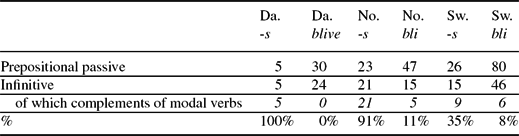
In connection with the Prep-bli(ve)-passives in (44)–(46), we noted that many of them involve a somewhat special type of affectedness, viz. psychological affectedness applying to animate subjects. This does not seem to be as relevant for Prep-s-passives, where other factors such as coordination and presence of modals are more important, as mentioned above. In Table 5, we show the number of Prep-passives used in infinitival phrases and how many of them were used as complements of modal verbs.
Infinitival Prep-passives and co-occurrence with modal verbs.
We mentioned earlier, in Section 2.3, that Herslund (Reference Herslund1984) observed that most Prep-passives occurred in infinitival complements to modal verbs. In Danish, all five Prep-s-passives are indeed infinitival complements of modal verbs. However, Table 5 shows that this only holds true for s-passives in Danish and not for the 30 blive-passives, 24 of which are infinitival but not complements of modals. In Norwegian the majority of the Prep-s-passives occur after modal verbs (91%) compared with only 11% of bli-passives. This preference for s-passives does not apply specifically to Prep-passives but reflects a more general tendency for s-passives to be used with modals, which we find in Danish and Norwegian, but not in Swedish.Footnote 28 According to SAG, infinitival Prep-passives should be more acceptable in Swedish, but we see that tensed examples are almost as frequent as infinitival in our sample.Footnote 29
4.3 Affectedness
Let us now return to the notion of affectedness discussed earlier. We have suggested that a different notion of affectedness is implicated for the Scandinavian data than the notion used to predict well-formedness of Prep-passives in English (see Section 2.1). The majority of the attested examples are bli(ve)-passives with Experiencer animate subjects which are affected in some sense by the action expressed by the verb phrase. This affectedness often amounts to socially relevant perception, as when the subject is, or is not, talked to, listened to, looked at, laughed at, thought of, believed in, etc. as in (44)–(46) above. Some examples involve involved a metaphorically used physical change, as in (2) and (48), but only a couple involve actual physical change, as in (50). In order to investigate whether this psychological affectedness is something typical of Prep-bli(ve)-passives, we compared the proportion of animate subjects in Table 4 above with the figures in Laanemets (Reference Laanemets2012:115) which show the proportion of animate subjects in regular passives in Danish, Norwegian and Swedish newspaper texts. It turns out that the proportion of animate subjects in Prep-bli(ve)-passives is consistently higher than for regular passives.Footnote 30 We take this as a further indication that Prep-bli(ve)-passives in mainland Scandinavian are used typically when a sentient subject is psychologically affected by the action, or the lack of action, as the case may be.
The examples of Prep-bli(ve)-passives and Prep-s-passives in (44)–(54) involve predicates which select a particular preposition. There are very few affected locative or instrumental subjects in our data, as has been described for English, e.g. that beds are affected by someone sleeping in them. We did not find any examples where a Prep-passive is used to express that the subject has undergone a significant change by being handled by a famous person as in the often cited English examples in (13).Footnote 31 Instead we found a few examples like (55) below, where the sound emitted from a physical object is brought out to describe the situation. These actions, of turning a page or walking on a stair, do not affect the passive subjects in any lasting manner.
(55)
4.4 Agent phrases
One shortcoming of our search method was that we did not find any agent phrases, given the restriction that the preposition should be followed by punctuation. In order to compensate for this, we carried out additional searches, using the most common Prep-passives in our 600 sample, as mentioned briefly in Section 3.Footnote 32 In general there were rather few examples with overt agent phrases with af or av ‘by’. The ones we found were very similar to the ones we have already discussed, see (56). Agent phrases are more often used in Prep-bli(ve)-passives than in Prep-s-passives.
(56)
5. DISTINGUISHING PREPOSITIONAL PASSIVES
As shown in Table 2 above, only 6% of our 3600 annotated examples turned out to be genuine Prep-passives. In this section we will look closer at what made up the large number of false hits which also met the criteria in the search string in (43), viz. contained a passive verb or participle followed by a preposition without complement.
We see in Table 6 that a fairly large proportion, 31% overall, of the hits consist of what we have called Part-passives (row ii), see (5)–(8) above. In most of the cases, it is straightforward to separate lexical particles (e.g. op ‘up’, ned ‘down’, ind ‘into’, ud ‘out’), which often have a directional meaning, from prepositions. The problematic cases are items like af ‘by, of, off’, efter ‘after’, i ‘in, into’, med ‘with’, om ‘about’, på ‘on, onto’ and til ‘to’ which are used both as particles and prepositions. Here we need to use additional criteria. In Danish we use the diagnostic that particles follow the object in the active version (compare (23) above). In Swedish, the intonation criterion works well (see Svenonius Reference Svenonius2003). Particles are clearly stressed, form a complex predicate with the verb and are often associated with a special meaning in the lexicon.
Overview of types of false hits.
In Norwegian both the position criterion and the stress criterion must be used with caution as there is considerable dialectal variation.Footnote 33 In doubtful cases, we have checked if the corresponding expression in Danish and/or Swedish involves a particle. The Norwegian example in (57a) is classified as a Part-passive since the parallel Swedish example in (57b) has a clearly stressed particle. In (58a), på is classified as a preposition, since the active Danish example in (58b) has a prepositional complement. The order used with particles is impossible, see (58c).
(57)
(58)

The high overall proportion of Part-passives is mainly due to our Norwegian data, where 684/1200 were Part-passives. Corresponding figures for Danish and Swedish are 216/1200 and 213/1200, respectively. This difference is most likely due to the fact that the tagger used in the Norwegian corpus does not distinguish between prepositions and particles.Footnote 34
The next category, regular passive with preposed complement, is also the largest, making up 35% of the annotated examples (row iii in Table 6). It consists of examples which at first glance look like Prep-passives, since there is no complement following the preposition. However, the missing complement is not realized as a subject, but is fronted and fulfills another grammatical function. These examples are in fact regular passives with subjects distinct from the complement of the preposition. Some examples with s-passives are given in (59). The subject of the passive verb is here given in italics.
(59)
In (59a), the prepositional complement has been topicalized, in (59b) relativized, in (59c) clefted and in (59d) questioned in an embedded interrogative construction. In (60) we show similar preposing constructions and stranded prepositions with bli-passives. In the infinitival clause in (60c), the subject is understood (PRO).
(60)
Given that regular passives with preposing and preposition stranding are quite frequent in all three languages, one may wonder if this affects the use of Prep-passives. The examples in (59) and (60) contain the same characteristics as the genuine Prep-passives in (44)–(56), viz. a passive verb phrase with a preposition without complement, and distinguishing them from true Prep-passives often requires a careful syntactic analysis.Footnote 35 An interesting question is whether the frequent use of examples like (59) and (60) can make Prep-passives appear to be more common in the language than they are, possibly leading to an increase in the use of such passives.
Among the regular passive examples with preposing, we have separated out the impersonal passive constructions, shown in row iv in Table 6. More than a quarter of the regular Danish s-passives with preposing turn out to have an impersonal subject, der. A few typical examples are given in (61).
(61)
Given Herslund's (Reference Herslund1984) proposal that Prep-passives in Danish are really impersonal passives, we will look closer at these examples in Section 6.1.
In (62a, b) we give a couple of Norwegian examples of impersonal passives with preposing and in (62c) a Swedish s-passive example. The expletive subject in both languages is det ‘it’.
(62)
Note that there were no impersonal bli-passives among the Swedish hits, a fact that we return to in Section 6.3. The category Potential Prep-passives, row v in Table 6, is only relevant for Danish and will be discussed in Section 6.1. Finally, the 24% irrelevant examples (row vi) consist of a mixed bag of false hits, for instance regular passives where the prepositional complement appears later, as shown in (63).
(63)
This is especially common in Danish, where clausal complements of verbs and prepositions should be separated with a comma, according to the guidelines for writing correct Danish at the time when the texts in KorpusDK were written (see Retskrivningsordbogen 1986:579f.).Footnote 36 We also coded as irrelevant examples with adverbs like (64a) and where the participle is used as an adjective, as in (64b); note the modifier meget ‘very’.Footnote 37
(64)
6. LANGUAGE-SPECIFIC PATTERNS
6.1 Danish
We will now look closer at the mysterious category Potential Prep-passives in Danish (Table 6, row v), which applies primarily to relative clauses. The reason for having this category is the homography between der used as an expletive subject e.g. in presentational constructions, for example (65a, b), and der used as a relative marker when the subject has been relativized, as in (65c). As we will see, this may give rise to ambiguity. In the following section, we gloss expletive der as there, relative der as that and use DER in ambiguous cases.
(65)
As a relative marker, der alternates with som, which may be used also in non-subject relative clauses, as shown in (66b, c).Footnote 38 Note that som can be omitted in non-subject relative clauses (66b, c), i.e. where there is an overt subject, and that der cannot be used in non-subject relatives (66d).
(66)
In the Danish grammar tradition, it is common to refer to der as a subjektsmarkør ‘subject marker’ which occupies the subject position of the clause, regardless of whether it is an expletive, as in (65a, b) or a relativizer, as in (65c) (see GDS:1518f.; Becker-Christensen Reference Becker-Christensen2012:146). Vikner (Reference Vikner1991), following the generative tradition, makes a distinction. He analyzes expletive der as an XP which appears in subject position, Spec,IP, (65b), or preposed, in Spec,CP, as in (65a). Relative der is analyzed as a head, X0 in C, (65c), just like som. For reasons which will soon be apparent, we will follow Vikner in distinguishing the positions for the expletive and the relativizer, as shown in (67).
(67)
In (67a) we see an example where der is a relativizer in C. In (67b) both positions are filled, which is not surprising if som is a relativizer in C and der an expletive subject in IP. Footnote 39 It is also not surprising that som can be omitted, as in (67c), since there is an overt subject in the relative clause, viz. der. The expletive cannot be omitted, while retaining the presentational reading, see (67d). Finally, (67e) shows that the expletive der is impossible with a definite argument (pengene ‘money’). On this analysis, we thus expect examples with both som and der to be well-formed, provided der can be interpreted as an expletive subject, as in (67b). We also expect examples like (68a) to be ungrammatical since the expletive der is not licensed, see (68b).Footnote 40
(68)
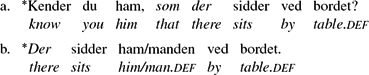
Given the two functions of der, we expect certain passive relative clauses with a single der to be ambiguous. Consider the example in (69a) from our Danish dataset.
(69)
If der is analyzed as a relativizer in C, as in (69b), the example should be classified as a Prep-passive since it is the subject of a passive clause that is relativized. However, if der is analyzed as an expletive, as in (69c), the example should be analyzed as an impersonal passive where the prepositional complement is relativized (compare (67c) above).Footnote 41 In order to determine which is correct, a careful analysis of the whole sentence, including the context, needs to be carried out and even then, there are cases which are hard to determine.
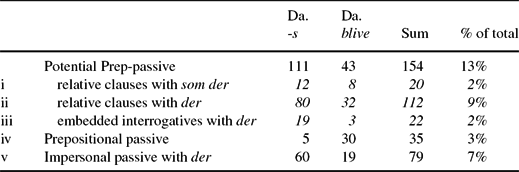
In order to show how often such ambiguities arise, we give a breakdown of the category Potential Prep-passives in our Danish dataset in Table 7 below.Footnote 42 There were 20 examples with som der (row i in the table), exemplified in (70). As predicted, these are unambiguous impersonal passives with an expletive der in subject position.
(70)
Potential Prep-passives in Danish.
There were 112 relative clauses with a single der (row ii in Table 7) which are ambiguous between a Prep-passive analysis and an impersonal passive analysis, as in (69) above. Additional examples are given in (71).
(71)
In addition there were 22 examples with der in embedded interrogatives (row iii in Table 7), as shown in (72). These can also be analyzed as Prep-passives or as impersonal passives.
(72)
Although these examples are structurally ambiguous, this does not appear to affect the interpretation in most cases. Regardless of whether (69a), (71) and (72) are analyzed as a relativized Prep-passive, as in (69b), or as a relativized impersonal passive, as in (69c), the interpretations are very similar, as suggested by the paraphrases given. On both analyses, there is a specific settlement which some unspecified agent or agents are referring to. In the absence of an agent phrase, an overt expletive subject does not make any difference to the interpretation. However, if we add an agent phrase, as in (73), only the Prep-passive analysis in (73b) is available.
(73)
The reason that (73a) is unambiguous is that impersonal passives are seldom used with overt agent phrases in the Scandinavian languages. Indeed, impersonal passives are used primarily when the identity of the Agent is considered irrelevant.Footnote 43
Both the fairly high proportion of ambiguous examples like (69a) in the Danish material and the lack of a clear interpretational distinction between the Prep-passive analysis and the impersonal passive analysis are clearly relevant to the wider issue whether Prep-passives in Danish should be considered a kind of impersonal passive, as Herslund (Reference Herslund1984) suggests.
In this context it is worth mentioning that there were no examples of Prep-passives in our sample where the subject was relativized with som, i.e. there were no examples like (74a). In this respect, Prep-passives behave differently from Part-passives, where we found examples with both der and som, shown in (74b, c).
(74)
In order to see whether the absence of examples like (74a) was accidental, we carried out a small informant study. The informants consistently accepted Prep-passives with der, as in (75a), or som der, as in (75b), and rejected examples with a single som like that in (75c). As for Part-passives, they accepted der or som, but not som der, (75d).
(75)
The absence of relativized Prep-passives with som, and the informants’ lack of acceptance of such constructions, is a further indication that passive relative clauses with a single der are primarily understood as impersonal passives.
As shown in Table 7, a majority of the structurally ambiguous examples are in the s-passive (row ii, iii). There seems to be a general tendency for s-passive to be used in impersonal constructions (row v). Recall in addition that the number of impersonal passives in our samples (Table 6, row iv) is much higher in Danish (n = 79) than in Norwegian (n = 28) and Swedish (n = 22). The high incidence of both real and potential (due to structural ambiguity) impersonal passives in Danish has probably contributed to Herslund's (Reference Herslund1984) conclusion that Prep-passives in Danish are really impersonal passives. Note, however, that the 35 examples which we have categorized as Prep-passives in Danish (see e.g. (44)) cannot be analyzed as impersonal passives.
We end this section on Danish with an observation concerning V+N Prep-passives. There were only three such examples among the 30 Prep-blive-passives, see (76).Footnote 44
(76)
The situation is quite different among the impersonal passives with preposed complements (Table 6, row iv), where almost half have an explicit object: 24 of the 60 impersonal s-passives and nine of the 19 blive-passives. Two examples are given in (77).
(77)
It thus seems that genuine V+N Prep-passives are very uncommon in Danish. Any impression that they occur frequently is probably due to impersonal passives with N arguments and preposed complements, as in (77).
6.2 Norwegian
According to the predictions from previous research, Prep-passives should be more productive in Norwegian than in Danish and Swedish (Lødrup Reference Lødrup1991). In our estimate of the overall frequency, shown in Table 3 above, Norwegian does indeed have the highest frequency – approximately16 Prep-passives per million words. This is three times more than in Danish and Swedish, but admittedly not particularly common. If we look only at passive clauses, the proportion of Prep-passives in Norwegian, 0.5%, is ten times higher than in Danish, 0.06%, and Swedish, 0.04%. Maybe it is this relative difference that lies behind Lødrup's perception that Prep-passives are more productive in Norwegian, although it is unclear if a construction that is used in less than one percent of the passive clauses should be called productive.
Just as in Danish and Swedish, there are more bli-passives (67%) among the Norwegian Prep-passives than s-passives (33%), but the distribution is more even than in Danish and Swedish, see Table 4 above. Two factors probably contribute to this: the strong tendency in Norwegian to use s-passive after modal verbs, see Table 5 above, and the exclusive use of bli-passive in preterite and perfect. Compare the examples in (78), which both use the predicate herse ‘bully’.
(78)
In (78a) the s-passive herses over ‘be bullied’ is in the complement of a modal. Furthermore, it is part of a coordination, surrounded by another Prep-passive, styres med ‘be controlled’, and a regular passive, knuses ‘be crushed’. As mentioned in Section 4, coordination is another context that favours s-passives. The bli-passive in (78b) is expected, since the sentence is in the preterite tense.Footnote 45 The overall proportion of animate subjects in our sample is somewhat lower in Norwegian, 59%, than in Danish, 66%, and Swedish, 78%, see Table 4, but the proportion of animate subjects with bli-passives is considerably higher than with s-passives, just as in Danish and Swedish.
The prediction, from NRG, that the majority of Prep-passives should involve selected prepositional complements is also borne out. Among the 70 examples in our sample, there was only one clear example of a locative subject, viz. the staircase in (55b) above, but it was, not portrayed as being affected by the walking.
Unlike in Danish, there were no examples where it was difficult to say if they should be classified as Prep-passives or impersonal passives. In Norwegian, the relativizer som is distinct from the expletive pronoun det, which means that there is no ambiguity in passive relative clauses. Two examples are shown in (79)–(80). The Danish translations are ambiguous, as shown.
(79)
(80)
Even if the Norwegian examples in (79a) and (80a) are structurally unambiguous, we note that the two types receive very similar interpretations, as shown by the paraphrases provided for the Danish translations.
Ambiguities could arise, in principle, since der can be used both as a relativizer and as an expletive pronoun also in Norwegian. According to NRG (p. 1056), der as a relativizer may be used in conservative Bokmål (the written variety of Norwegian that has been influenced by Danish), especially when preceded by the comparative conjunction som ‘as’, see (81).Footnote 46
(81)
As expletive pronoun, der is mainly used in presentational constructions in certain dialects, by speakers whose language is hardly influenced by Bokmål (Søfteland Reference Søfteland2014). This means that the two functions of der are probably hardly ever used by the same speakers. There were no passive instances like (81) in our data.
V+N Prep-passives, which seem to be quite uncommon in Danish, are more common in Norwegian, both in terms of numbers (n = 13) and in terms of the variation in the N argument. The expression bli lagt merke til ‘be taken notice of’ is most common.Footnote 47
(82)
6.3 Swedish
As already mentioned, there is a clear difference between s-passives and bli-passives in Swedish and we will discuss them in turn.
6.3.1 s-passives
Recall from Section 2.2 that Maling & Zaenen (Reference Maling and Zaenen1985) suggested that their analysis of Icelandic – essentially that apparent Prep-passives are really topicalized impersonal passives without an overt expletive – should be extended to Swedish. Support for this analysis comes from examples like (39), repeated here as (83), which shows that an expletive subject is optional in such sentences. Note that the presence of the expletive det does not make a big difference for the interpretation although it matters for determining whether the initial consitutent is a subject or not.Footnote 48
(83)
In order to test this proposal, we examined the 26 Prep-s-passives and checked whether it was possible to insert an expletive det. We found about ten examples where this seems possible. These fall into two types where the first type is similar to (83), see the examples in (84).
(84)
These examples are all matrix clauses which have in common that it is not possible to determine the grammatical function of the initial phrase by casemarking. Since lexical DPs in Swedish are not casemarked, the initial phrase could be either a subject or complement of the preposition. This also holds for the demonstrative detta in (84c), but we can test whether the initial phrase is a subject by turning the example into a question, as in (85).Footnote 49
(85)
When detta occurs after the finite verb, presumably in Spec,IP, it is impossible to insert an expletive subject, (85b). (85c) shows that the expletive is fine if detta appears in situ. Recall that this test has been used to show that the initial phrase is not a subject in Icelandic, recall the ungrammatical (18) above.
The second type where an expletive det can be inserted consists of certain relative clauses and embedded questions, i.e. precisely the contexts which may give rise to a structural ambiguity in Danish, cf. (69) above.
(86)
(87)
In Swedish, there is no structural ambiguity – (86a) and (87a) are clearly Prep-passives where the subject has been relativized or questioned – but adding an expletive subject, as in (86b) and (87b), does not affect the interpretation in any noticeable way.
The rest of the examples, 16 out of 26, resist insertion of an expletive subject. One common context for Prep-s-passives is in coordinated passive verb phrases, as mentioned in Section 4. Inserting an expletive subject in such coordinations often leads to ungrammaticality, as shown in (88).Footnote 50
(88)
Many Prep-passives are infinitival with an unexpressed subject (PRO), as in (89a). Inserting an overt expletive is impossible, (89b).
(89)
Apart from the type of relative and interrogative examples shown in (86)–(87), inserting an overt expletive subject into an embedded clause rarely works. In (90a) we have an example where a Prep-passive occurs in an embedded clause with clear subordinate clause word order; the sentential adverb verkligen ‘really’ precedes the finite verb. The subject alla stenar ‘all stones’ presumably appears in Spec,IP, which means that there is no available position for an expletive subject.
(90)
Inserting an expletive subject in Spec,IP, as in (90b), is possible but then the prepositional complement must appear in situ. (90c) shows the structure of an embedded topicalization with alla stenar ‘all stones’ in Spec,CP and the finite verb in C. Then it is possible to insert an expletive in Spec,IP, although the matrix word order is not entirely felicitous here, presumably since this is an idiom and topicalizing a part of an idiom is quite marked in Swedish (Sköldberg Reference Sköldberg2004).
Looking at Prep-s-passives in Swedish, we conclude that there are two syntactic constructions in Swedish which can be analyzed as topicalized impersonal passives where the expletive is optional, viz. in topicalized matrix clauses like (84) above and certain relatives and embedded interrogatives, like (86)–(87). However, the remainder of the examples, about 60%, cannot be analyzed as covert impersonal passives. Compared with Danish, the use of clear impersonal passives, i.e. ones with overt expletives, is notably less frequent in Swedish (see Table 6, row iv).
6.3.2 bli-passives
We will now investigate how the impersonal analysis fares with respect to Prep-bli-passives in Swedish. Recall that this is where we found the highest number in our sample: 80 out of the 600 Swedish bli-examples turned out to be Prep-passives.
A large majority of the Prep-bli-passive examples have animate subjects (95%, Table 4) and many of these are pronominal. These consistently appear in nominative case, (91a), not in accusative, as in Icelandic (see (17c) above).
(91)
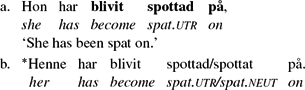
Note that the participle in (91a) agrees with the subject. The version with an initial accusative is ungrammatical regardless of whether the participle is in common gender or neuter gender, as would be expected if it agreed with a covert expletive subject.
We also checked if it was possible to insert an expletive det in the Prep-bli-passives, like we did with the Prep-s-passive examples. The constructed matrix (92a) sounds marginally possible to some speakers, provided that the pronoun is in the accusative, but the impersonal s-passive in (92b) is clearly preferred.Footnote 51
(92)
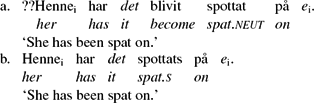
Overall, turning Prep-bli-passives into impersonal passives did not work as well as for Prep-s-passives. This is most likely due to the fact that bli-passive is hardly used at all in impersonal constructions in Swedish. As shown in Table 7, row iv, there were no Swedish impersonal bli-passives with topicalized prepositional complements in our sample, whereas there were 19 Danish and 12 Norwegian examples. We translated some Danish and Norwegian examples into Swedish, to see if they could be expressed as bli-passives. The translations are, if not ungrammatical, strongly dispreferred, as shown in (93)–(94). Instead an impersonal s-passive with overt expletive is used in Swedish, as shown in the c-examples.
(93)
(94)
Given that the examples with overt expletive in the Swedish bli-passives are strongly dispreferred, we conclude that the 80 Prep-bli-passives should not be analyzed as impersonal passives with unrealized expletives.Footnote 52 Instead it seems that they constitute a common type of bli-passive in Swedish. The most common participles are lyssnad på ‘listened to’ (22 occurrences), trampad på ‘trod on’ (8), skälld på ‘scolded’, spottad på ‘spat on’ and tittad på ‘looked at’ (3 each), see (46) and (48).
Most of the verbs used can be directed to both inanimate and animate referents, but when they are used in Prep-passives, the majority of the subjects are animate, see Section 4. As mentioned earlier, previous studies have shown that bli(ve)-passives in general have a higher proportion of animate subjects than s-passives in all three languages (see Laanemets Reference Laanemets2012:113f.). The difference is particularly strong in Swedish, where 84% of bli-passives in Swedish texts have animate subjects, compared with 28.6% of s-passives. Looking now at the Prep-passives in our sample, the difference is even more pronounced: 95% (76/80) of the Prep-bli-passives have animate subjects, compared with 27% (7/26) of the s-passives, see Table 4. It thus seems that Prep-bli-passives in Swedish are almost exclusively used about people and animals which are experiencing an action carried out by another person or social body.Footnote 53
6.3.3 Frequency
The finding that the proportion of Prep-bli-passives is about ten times higher than Prep-s-passives (Table 3, row vi) is surprising and goes against both Körner's (Reference Körner1948) predictions and SAG's description. It is especially surprising in view of the fact that bli-passives overall are less frequent, only 0.3% of all finite verbs in Swedish texts according to Laanemets (Reference Laanemets2012:88), compared with s-passives, which amount to 9.8%.
Another surprising finding is the total absence of Part-passives with bli (Table 6, row ii). According to Körner (Reference Körner1948, Reference Körner1949), we should expect more occurrences of bli-passives with free-standing particles in Danish and Norwegian than in Swedish, where particle incorporation in participles is the standard (see (36b) above).Footnote 54 Nevertheless, the fact that we found no particle passives at all with bli is surprising and raises a suspicion that there is something wrong in the corpus annotation or in the search string used. In order to investigate this, we also searched the Swedish corpus for bli-passives followed by a particle and a comma or period.Footnote 55 Apart from some irrelevant hits, all examples involved kvar ‘left, remaining’, which is tagged both as adverb and as particle, see (95a). In the same sub-corpus, there were five occurrences of incorporated kvar, as shown in (95b).
(95)
It thus seems that the absence of bli-passives with stranded particles in Table 6 correctly reflects the usage in Swedish texts.Footnote 56
7. CONCLUDING REMARKS
Previous research on Prep-passives in the Scandinavian languages has come to rather disparate conclusions concerning the grammaticality and the productivity of the construction. In order to remedy this, we have carried out investigations in comparable text corpora in Danish, Norwegian and Swedish. We have established that Prep-passives are used, albeit rather infrequently. In view of Maling & Zaenen's (Reference Maling and Zaenen1985) analysis of Icelandic as involving not passivization but topicalization in an impersonal passive clause where the expletive subject is not expressed, see (20b), we investigated whether this could be the case also in the mainland Scandinavian languages. We have established that there are examples which must be analyzed as Prep-passives, in all three languages, for instance examples with nominative subjects. Such examples are not found in Icelandic.
An interesting finding, however, is that in some cases it is difficult to tell whether an example should be analyzed as a Prep-passive or as a topicalized impersonal passive with preposition stranding. This is the case with certain relative and interrogative clauses in Danish, where der can be analyzed either as a relativizer or as an expletive subject, see (69). The corresponding Norwegian examples are structurally unambiguous, but they are interpreted in similar ways. In certain Swedish s-passives, it is possible to insert an expletive subject, as would be expected on the impersonal passive analysis, see (84), (86) and (87). The observation that agentless Prep-passives and impersonal passives receive similar interpretations and often can be used interchangeably may explain why some researchers have claimed that Danish does not have Prep-passives, see Herslund (Reference Herslund1984) and Vikner (Reference Vikner1995). In many cases, however, the two construction types are clearly distinct and receive different interpretations, as for instance when there is an overt agent phrase, see (73). Swedish Prep-bli-passives are also not amenable to an analysis as impersonal passives since bli-passive in Swedish is hardly used in impersonal constructions, unlike in Danish and Norwegian.
According to Herslund (Reference Herslund1984), only languages in which particles may precede complements should have Prep-passives, assuming that they arise through reanalysis whereby V+P forms a complex predicate. He predicts that Prep-passives should be less common in Danish, where particles follow complements, than in Swedish, where particles always precede complements, or Norwegian, which allows both orders, see (6)–(8). However, our frequency investigations do not show any correlation between Prep-passives and particle placement. Prep-passives have roughly the same frequency in Danish and Swedish. They are more common in Norwegian, as Lødrup (Reference Lødrup1991) correctly observes. According to our estimates, they are ten times more frequent in Norwegian, but still not very frequent, amounting to around 16 occurrences per million words or 0.5% of all passive clauses (see Table 3).
Prep-passives in Danish, Norwegian and Swedish are remarkably similar. They are primarily used with bli(ve)-passives and the subject is typically an Experiencer who is psychologically affected by the action. The (almost always) understood Agent is normally a human or a social body. The Experiencer is affected by something the Agent does, or often fails to do. We found very few examples where locative or instrumental subjects have been lastingly affected, and none at all where the action was carried out by a famous person, properties which have been suggested as typical of Prep-passives in English.
Prep-passives are also found with the morphological s-passive in all three languages. These have a larger proportion of inanimate subjects, there is more variation among the verbs used and they are often used in coordinations and as infinitival complements of modals (see Table 5). Previous research (Laanemets Reference Laanemets2012) has shown that the latter is a context that favours s-passive in general in Danish and Norwegian. In Swedish, Prep-s-passives are used in all tenses, unlike Danish and Norwegian, where s-passives are only found in the infinitive and the present tense. Thus, to a large extent, the differences we find between the languages in their use of Prep-passives reflect differences in their use of passive in general.
Although genuine Prep-passives are rather uncommon, examples that resemble Prep-passives are considerably more common in all three languages. These typically consist of regular passives with preposing and preposition stranding and are sometimes hard to distinguish from Prep-passives. An interesting issue for future research is whether the recurrent pattern of passive with preposition stranding will lead to an increase in the use of Prep-passives.
ACKNOWLEDGEMENTS
We would like to thank our informants at the LANCHART Centre, University of Copenhagen, and Rune Holmgaard Andersen for their help with judgments. We also thank the audiences at MUDS at Aarhus University, October 2015, Grammar in Focus at Lund University, February 2015 and the Grammar seminar in Gothenburg in March 2015 for comments. In particular we want to thank Maia Andréasson, Anna-Lena Fredriksson, Filippa Lindahl, Benjamin Lyngfelt, Joan Maling, Henrik Rosenkvist, Halldór Sigurðsson, Nuria Yáñez-Bouza and Annie Zaenen for helpful suggestions. The comments from three anonymous NJL reviewers are gratefully acknowledged as well as valuable suggestions from the editor, Marit Julien. This research was partly supported by a Marie Skłodowska-Curie IEF grant to the second author.
CORPORA
Korp: http://spraakbanken.gu.se/korp/
KorpusDK: http://ordnet.dk/korpusdk
Leksikografisk bokmålskorpus: http://www.hf.uio.no/iln/tjenester/kunnskap/sprak/korpus/skriftsprakskorpus/lbk