Introduction: Gunsan as a new wave of heritagization of Japanese colonial architecture
Architectural buildings with the imprint of colonial experiences can be perceived as cultural and economic resources. In Taiwan, Hong Kong, Singapore and Indonesia, for example, colonial sites and buildings are increasingly used not only for urban renewal, but also for tourism development.Footnote 1 They are designated as part of national heritage that is meant to evoke nostalgic feelings and to attract both domestic and international tourists (e.g. the Raffles Hotel in Singapore).Footnote 2 However, South Korea's approach to Japanese colonial architecture has followed a different trajectory. Within Korean national history, any romanticization of the period under Japanese colonial rule (1910–1945) has long been considered taboo, as this period is regarded as one of the most painful and traumatic parts of Korean history. South Korea's official narrative has found no golden age in Japanese colonial rule, and there has been no sense that the Korean nation longs to return to it. However, is the official historical narrative so formidable in South Korea that no other imageries and nostalgia of the colonial past have space to emerge? This paper takes a close look at the heritagization of Japanese colonial architecture in the city of Gunsan to articulate a new wave of colonial heritage-making and its limits. To that end, it also suggests the potential for overcoming the limits for the present and future generations.
Nostalgia represents not only dissatisfaction with the present and future but also a tendency towards escapism from social reality, a yearning for a better, more meaningful and comfortable past.Footnote 3 Although nostalgia is a contradictory emotion (bittersweet), recent academic literature emphasizes positive emotions and affect (sweet) more than their negative counterparts (bitter).Footnote 4 Hence, nostalgia is generally perceived as an attitude towards the past wherein elements of the past are viewed favourably, celebrated, and even glorified. In heritage studies, nostalgia frequently encompasses periods in the past that people have not personally experienced (anemoia). The term “imagined nostalgia,” popularized in art and psychology, aptly indicates such indirect nostalgic emotion evoked by imagination.Footnote 5 Regarding nation-building and heritage, Brigard (Reference Brigard2018) and Jinhua and Chen (Reference Jinhua and Chen1997) connect “imagined nostalgia” with the formation of national nostalgia: nostalgic narratives of nation hark back to an imagined golden age, and the younger generation is thus recruited to support associated policies that would return their nations to a past that they themselves never experienced.Footnote 6 Cronberg (Reference Cronberg2009) links this concept with an imagined, aestheticized and romanticized past: a carefully constructed simulacrum of the past, existing in order for us to create the illusion of pastness.Footnote 7 Cronberg's explanation can be applied to South Korea's “retro and new-tro” syndrome: retro, an abbreviation of “retrospect,” is used as a marketing term to indicate a positive sense of going back to the past; and “new-tro,” a marketing neologism combining the desire for what is “new” with “retro” sentiments.Footnote 8 Retro/new-tro tourism attracts visitors to consume the “imagined” past that deludes people to feel that the time and place seem to have existed before. In both national heritage-making and heritage tourism, imagined nostalgia is linked to positive emotions, such as national pride, comfort and joy.
Unlike the Asian countries discussed above, the treatment of Japanese colonial architecture in South Korea is not conventionally linked to nostalgic feelings. Through both public education and socio-cultural channels (e.g. mass media and literature), the majority of South Koreans are socialized into viewing Japan as a “national foe,” and view this time period as a “shameful” part of the nation's history.Footnote 9 As such, the idealization or romanticization of the Japanese colonial period is not generally accepted in heritage management. Rather, dealing with Japanese colonial architecture has been closely interconnected with the formation of South Korea's official narratives. Some architectural sites such as the Japanese Government-General Building, which had been in use for official and public purposes, were deliberately demolished, reflecting the collective hostility that the general populace felt towards the colonial time period.Footnote 10 Some surviving examples of Japanese architecture such as the Seodaemun Prison History Hall were transformed into museums or memorials for educational purposes which serve to manifest the official narrative that portrays the Japanese as harsh colonizers, and the Koreans as innocent victims who suffered under their rule.Footnote 11 Hence, unlike other colonized nations in Asia that seek to evoke positive nostalgic feelings through their heritagization efforts, in South Korea, Japanese colonial heritage has been used for the opposite effect to evoke counter nostalgia.
The city of Gunsan in South Korea marks the advent of a new wave of heritage-making through colonial architecture. On the one hand, Gunsan's case was the first attempt in South Korea to utilize Japanese colonial heritage a cultural and economic resource that might evoke positive nostalgic feelings, in a way that many other Asian countries have done. However, Gunsan's heritage management also aimed to position it within the South Korean official anti-Japanese narratives to physically document their painful colonial history. Therefore, Gunsan's case underwent difficulties in fulfilling two different purposes, heritage tourism for entertainment on the one hand, and for history education on the other. So, despite the Gunsan Municipal Government's efforts to narrate the city's colonial stories in ways that align with national official narratives on Japanese colonial history, Gunsan's efforts have inadvertently generated feelings of imagined nostalgia – a phenomenon distinct from either nostalgia involving personal memories, or from simple positive romanticization.
This paper takes Gunsan's case to explore how imagined nostalgia has been evoked through the dissonance that has occurred between the commodification of Gunsan's local heritage sites for tourism and long-standing nationalized narratives. In what follows, the concept of imagined nostalgia and its generation will be located through three processes: (1) through the clashes between official colonial history and the means by which colonial daily life is depicted in Gunsan's Modern Cultural Belt; (2) through the interwoven colonial and post-colonial stories presented in the city's Modern Historic Landscape District; and (3) through the commercialized colonial and post-colonial stories articulated by private businesses in Gunsan. Gunsan's new heritage-scape is not the authentic colonial Gunsan, but a recreated one. From the perspectives of tourists, who did not personally experience the colonial past, Gunsan offers an entry point to an imagined or fabricated past that no longer exists, but looks exotic. Amid a boom in South Korean “retro-tourism,” Gunsan has become an inviting tourist attraction where visitors can enter the imagined past and consume an imagined nostalgic atmosphere. It is significant to examine whether Gunsan's imagined past that its new heritage-scape visualizes is associated with either the colonial past linked to uncomfortable national sentiment or the past transcending the historic time and place connected to positive imagined nostalgia. This also discusses how Gunsan's imagined nostalgia can be differentiated from the nostalgia that other Asian cities have cultivated with regards to colonial modernity.
This paper is structured in five sections. Section “Remaking Gunsan the city of modern culture as it was back in the 1930s” gives a historic overview of heritagization that led to Gunsan's rebranding project “City of Modern Culture as it was back in the 1930s.” Sections “The Modern Cultural Belt: clashes between official memories and daily memories during the Japanese colonial period” and “The Modern Historic Landscape District: interweaving painful colonial history and nostalgic post-colonial stories” analyse the ways that imagined nostalgia is generated in the Modern Cultural Belt and the Modern Historic Landscape District, respectively. Section “Commodification of colonial and post-colonial stories” examines other projects led by private sectors that have capitalized on the new narratives and have evoked imagined nostalgia. In order to trace the progress of the project, I carried out ten site visits to Gunsan from 2010 to 2020. In order to address the lack of textured local stories which were not preserved in official government documents, qualitative semi-structured interviews were carried out with a series of stakeholders: three key informants who were involved in the grand project during its execution; a civil officer who planned and oversaw the grand project and two local academics. Informal conversational interviews were conducted with thirty visitors to the city and five local residents who live in the newly-formed old city centre. In its concluding section, the paper suggests that “productive nostalgia” can help to overcome the limit of the current form of Gunsan's heritagization, and to construct Gunsan's diverse local memories and collective identity with greater nuance.
Remaking Gunsan the city of modern culture as it was back in the 1930s
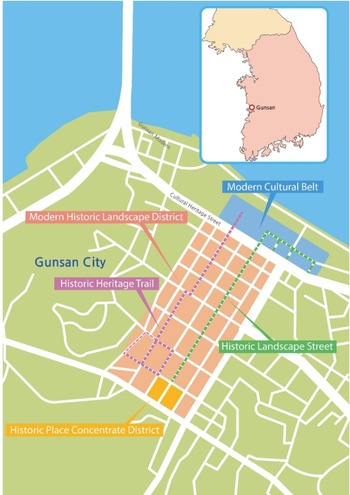
Gunsan, a small port city of 278,505 residents (as of 2015), is situated on Korea's western coast and connected to the Honam Plains: Korea's breadbasket (Fig. 1).Footnote 12 This geopolitical advantage led to the city opening up as a trade port in 1899 prior to Japan's annexation of Korea in 1910, and caused the city to develop rapidly through the colonial period to become an essential hub in the rice trade network Ryu Reference Ryu2016. Japanese colonial authorities constructed vast infrastructural systems, including roads, railroads and harbour facilities, developing Gunsan into a city dominated by Japanese architectural styles. However, this development came with the cost of long-term economic exploitation for the benefit of the Japanese.Footnote 13 As a result, intertwined perceptions of both exploitation and development characterize Gunsan's place in the scholarly and popular imagination, and the city continues to serve as a key example of a well-developed, former colonial city.
Map of Gunsan and the master plan for Gunsan's project, phase two.

After Korea's liberation from Japan in 1945, Gunsan's significance as a hub of colonial commerce faded. Subsequently, Gunsan suffered from an economic recession and a loss of industrial growth.Footnote 14 Gunsan was largely excluded from the government's economic development plans from the 1960s to the 1980s, as successive military dictatorships concentrated economic development efforts on their own native regions in the West.Footnote 15 As an unintended consequence of this long-term neglect, the city's colonial structure and Japanese architectural legacies were left undisturbed. In the 1990s, this specific atmosphere created by remains of Japanese architecture began to attract some visitors, such as film crews, TV directors and photographers to Gunsan who sought “old” settings – although this rise in artistic interest alone was not enough to pull the city out of its long recession.
Gunsan's former centre, having thrived during the Japanese colonial period, was by 1995 in sharp decline. A re-organization of South Korea's administrative districts in 1994 merged the district of Okgu-gun into Gunsan city,Footnote 16 and new shared administrative facilities (e.g. city hall, the main police station) were built on the boundary between Gunsan and Okgu, vacating the former city centre of Gunsan. Deprived of its administrative role, the former centre suffered urban emptiness and a deterioration of the surrounding commercial areas.Footnote 17 The entire city's economy declined as a planned land reclamation initiative, the Saemangeum Seawall Project, hailed as one of the country's most important opportunities for urban regeneration,Footnote 18 foundered in the face of strong opposition from civil environmental organizations before 2010.Footnote 19 Faced with deep economic recession and continual population decline, Gunsan Municipal Government decided to rebrand Gunsan as a modern city via a colonial heritage-making process.
Gunsan's 2009 project “City of Modern Culture as it was back in the 1930s” can be divided into three phases: (1) preparation for the master plan (2001–2008); (2) the formation of a heritage-scape with Japanese colonial buildings (2009–2013) and (3) urban regeneration (2014–2017). In the first phase, the Gunsan Municipal Government incubated several ideas to revitalize the city economy. Borrowing from the successful case of China Town in Inchon, a port city opened in 1883, Gunsan in 2002 made a plan to establish a China Town, reflecting the long history of the city's Chinese community, which dated to the opening of Gunsan port.Footnote 20 However, with the enactment of new “Registered Cultural Heritage” legislation in 2001, Gunsan shifted focus to the neglected Japanese colonial buildings in the former city centre.Footnote 21 The Registered Cultural Heritage legislation constituted “a law for the protection of modern and contemporary heritage that was constructed, produced, and formed more than fifty years [earlier]” – including Japanese colonial architecture.Footnote 22 Although Japanese colonial architecture evoked a painful colonial history, the Korean government now sought to use it as a set of “historic resources and evidences for educational purposes” in order to avoid the repetition of humiliating events from Korean history.Footnote 23 Starting with the designation of Dongguksa Temple – South Korea's sole remaining Japanese-style temple – as Registered Heritage in 2003, a total of eighteen sites built during the Japanese colonial period have been designated as Registered Cultural Heritage to date.Footnote 24 Following a survey of potential registered heritage sites by Cultural Heritage Administration of Korea in 2006, Gunsan's “Art and Creation Belt Zone of Industrial Heritage” project entry into a 2008 national competition run by the Ministry of Culture, Sports and Tourism took first place.Footnote 25 The following year, another project – “the Formation of Modern Historic Landscape” – was also selected in the provincial government's “one project per city” contest (offering support for one interesting project in each city).Footnote 26 Combining these two projects, Gunsan launched the grand project “Remaking Gunsan a city of modern culture” in 2009.
The Gunsan Municipal Government's grand project faced substantial opposition from two quarters. First, scholars at Gunsan National University were at the time of its announcement actively engaged in examining Gunsan's local history from the pre-colonial period to the present, as part of planned 2009 celebrations of the 110th anniversary of the port's opening.Footnote 27 According to an interview on 12 December 2010 with the historian and architect involved in Gunsan's project, their aim was to make clear that Gunsan had held economic and political power of its own before the colonial period. As noted in the Introduction, Gunsan was known in public narratives as a former colonial city that had thrived due to Japanese imperial influence. These scholars repudiated this narrative, endeavouring to prove Gunsan's economic and military significance during the Goryeo Dynasty (918–1392) and Joseon Dynasty (1392–1910), and argued that Gunsan's original significance was on the contrary ruined by the Japanese invasion and subsequent “ruthless rice exploitation.”Footnote 28 They were concerned by the grand project's intention to project Gunsan's identity as a modern city made under Japanese imperial power, and sought to emphasize Gunsan's original identity prior to the Japanese colonial period.
A second source of objections came from within local communities. Although some people favoured the use of Japanese colonial architecture in the city's rebranding and thus supported the Municipal Government's plans anticipating that they would boost tourism and revitalize the city economy, an opposing group objected strongly to the plans, wholeheartedly rejecting the idea of re-inscribing the Japanese colonial legacy into their hometown's new modern identity. During several city revitalization symposia in December 2010, this group insisted that the city government should focus more on the city's pre-colonial Joseon-era identity (1395–1910), possibly by restoring the Okgueupseoung Wall (沃溝邑城), which demarcates the original city boundary. One symposium participant in particular openly lamented the city government's choice to revive shameful and painful colonial memories that ought to have remained hidden.Footnote 29 Yet, despite their efforts, the opposing group's plan received scant support from local communities, and Gunsan's strong drive for economic renewal supported the first phase of the grand plan.
During its second phase (2009–2013), the grand project actively formed a heritage-scape comprising Japanese colonial buildings and newly built museums. The inner port area in Jangmi-dong, once home to a concentration of industrial facilities related to rice transportation – e.g. rice mills, inner harbour floating pier, inner harbour railway – hosted the “Art and Creation Belt Zone of Industrial Heritage,” with a budget of approximately 6.4 million GBP.Footnote 30 This aspect of phase two built on an existing proposal to establish a Gunsan Modern History Museum, developing a “Modern Cultural Belt” concerning modern Gunsan history by restoring two neglected Japanese colonial buildings – former banks – in the area (Fig. 1). These buildings, frequently interpreted in South Korean official narratives to symbolize Japanese exploitation of Gunsan's capital,Footnote 31 were converted into a modern art museum and a modern architecture museum respectively.Footnote 32
Meanwhile, “the Formation of Modern History Landscape,” with a budget of approximately 9 million GBP, focused on the Wolmyeong-dong area.Footnote 33 This area hosted many long-neglected areas of Japanese-style vernacular housing, once the residences of Japanese landowners or officials during the colonial period. With this project, the Gunsan Municipal Government endeavoured not only to restore and renovate this overlooked vernacular housing, but also to create a “historic heritage trail” depicting modern Gunsan history (Fig. 1). The area's reconstruction aimed at helping visitors to experience modern history and culture in Gunsan.
Although these two phases were completed between 2013 and 2015, Gunsan's broader project entered a third phase from 2014 to 2017. The success thus far led to Gunsan's selection as the foremost urban regeneration project nationally, securing funding of 10.3 million GBP from the Ministry of Land, Infrastructure and Transport.Footnote 34 Although visitor numbers at the museum belt area in the inner port boomed, the Modern Historic Landscape in Wolmyeong-dong proved initially less successful.Footnote 35 Hence, this third phase of the urban regeneration project focused on revitalizing the Wolmyeong-dong area, seeking further to connect the Modern Cultural Belt and Modern Historic Landscape.Footnote 36 Yeonghwa-dong, home to a deteriorated old market located between these two areas, was also included in the phase, via initiatives to help young entrepreneurs in their twenties and thirties to establish new businesses in the old market.Footnote 37 Many colonial architectural sites were maintained or restored; empty houses and stores were renovated as guesthouses, cafes or restaurants in the Japanese colonial style, and Gunsan's gastro-venture course was promoted.Footnote 38 Wrapping up all these items, Gunsan devised a slogan – “Time travel back to the 1930s” – and attracted crowds of visitors. The number of tourists surged from 220,000 in 2013 to 1 million in 2016. Gunsan's case is considered one of the most successful urban regeneration projects in South Korea.Footnote 39
The following sections focus on the Modern Cultural Belt and the Modern Historic Landscape District respectively to elucidate the narratives that have been formed and visually represented, in turn addressing how the newly formed Gunsan's heritage-scape unexpectedly generated feelings of imagined nostalgia.
The Modern Cultural Belt: clashes between official memories and daily memories during the Japanese colonial period
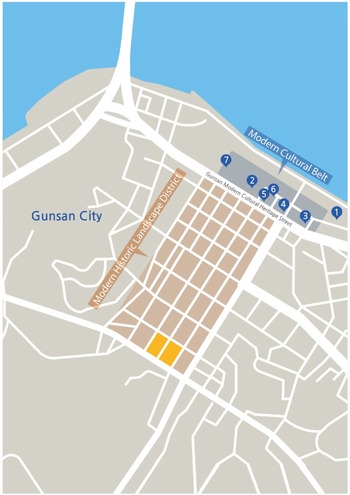
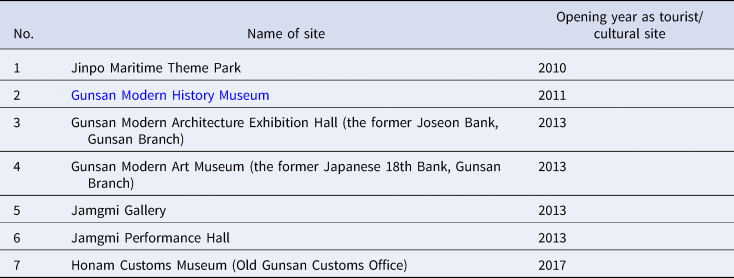
As outlined in the previous section, Gunsan's Modern Cultural Area, comprising seven main components, was formed during the second phase of the city's grand rebranding project, aiming to “construct Gunsan as a city of modern history education to give a lesson for a future generation reflecting from the pains stemming from Japanese colonial rule” (Table 1 and Fig. 2).Footnote 40 Although the Ministry of Culture, Sports and Tourism and the Gunsan Modern History Museum shared management responsibility for this area until 2013, the Gunsan Modern History Museum is solely responsible for the area's management and maintenance.Footnote 41 According to an interview with the museum director on 10 July 2020, it has managed to strengthen its main theme, “Resistance [against the Japanese colonial authorities] and [rice] Exploitation,” which aligns with the official narratives of colonial history in South Korea.
Locations of seven components of the Museum Belt Area. Numbers in circles correspond to the numbers in Table 1.

Seven components of the Museum Belt Area

It is worth noting the year 2008 proved a significant turning point in the perceptions of Gunsan locals towards the city's Japanese colonial buildings. That year, the city's two former colonial banks were designated as Registered Cultural Heritage (numbers 3 and 4, Table 1), and the Gunsan Municipal Government announced that both would be restored and reused as museums. Gunsan locals were quite by the city's declaration.Footnote 42 Before this, most were unaware that these buildings originated during the colonial period. One interviewee recounted a strong memory of locals responding, concerning the former Joseon Bank, “What is the city going to do with trash?” In many respects this is a fair reflection of the building's status. The former Joseon Bank had been reused as a bar from 1982, and was damaged by fire in 1990.Footnote 43 With the building's owner unable to afford either repairs or demolition, it had subsequently stood disused and ignored. The former Japanese 18th Bank, for its part, had been reused as the office of a transportation company since 1963, and its original use had been totally forgotten in accounts of Gunsan's local history.Footnote 44
Intermittent debate had taken place about the demolition of Gunsan's colonial buildings (in particular the Old Gunsan Customs Office in the 1990s and a storage building of the Shimatani Plantation in the early 2000s), aligning with nation-wide debates on the demolition of Japanese Government-General Buildings, perceived as a notorious symbol of brutal Japanese colonial rule.Footnote 45 However, in Gunsan these debates were mostly confined to academic and journalistic circles, and few Gunsan locals had much interest in the Japanese colonial buildings. Instead of having negative feelings towards them as Japanese colonial legacies, they had perceived them as mere shabby buildings, symbolizing Gunsan's economic recession.Footnote 46 From 2008, however, Gunsan locals rediscovered the value of these long-neglected colonial buildings as significant cultural heritage sites that they needed to protect. Although the architectural structures of the two former colonial banks and the Old Gunsan Customs Office were restored according to the instructions of the Cultural Heritage Administration of Korea, the Gunsan Municipal Government and the director of the Gunsan Modern History Museum endeavoured to build up the museums' narratives, and to strike a balance between history, education and tourism.Footnote 47
At the completion of the Modern Cultural Belt in 2013, the two former colonial banks had been converted into museums (Table 1). Now, along with the Gunsan Modern History Museum, three main museums stood together in a row (Fig. 2), their main narratives consolidated in the shared slogan “The nation that forgets its history does not have a future.”Footnote 48 Although the two former banks have been used to display modern and contemporary paintings by Gunsan local artists and modern architecture in Gunsan respectively, their narratives also strongly emphasized a common purpose to inform and remind visitors of Korea's national scars and of the Japanese brutal exploitation not only of Gunsan, but of Korea as a whole.Footnote 49 The sentence “Until the vault was full, our nation was ragged and starved” was repeatedly inscribed in both museums: a phrase that may evoke South Korean visitors' nationalistic sentiments, stemming from anticolonialism.Footnote 50 The climax of such a storyline can be found in the Modern Art Museum's photo exhibition section, which documents Japanese atrocities around three major themes: forced labour, comfort women and rice exploitation: histories that continue to make the international relationship of Japan and Korea problematic. The outdoor exhibitions of both the Jangmi Gallery and Performance Hall reflect a similar focus. The exhibitions concern the main characters and stories of the renowned modern novel Tangnyu (muddy stream in Korean), by local writer Chae Man-Sik (1902–1950) which depicts the Japanese colonial period as dismal, documenting the exploitation of Korean farmers and their miserable lives.Footnote 51
Together, the storylines of the three museums and outdoor exhibition align with the official colonial history that portrays the period as “a form of repression and exploitation which caused increasing social inequality and conflicts, and stimulated anti-Japanese enmity.”Footnote 52 In the ongoing scholarly debates on “colonial modernity,” there are strands which suggest that the changes brought about by Japanese colonialism helped Korea to convert itself into a modern country. However, most South Koreans believe that Japanese colonial rule deprived the Korean nation of the chance to develop its own form of modernization.Footnote 53 The Gunsan Modern History Museum consists of six exhibition halls, narrating Gunsan's local history from an ancient maritime city to the present, via the Okgu farmers' resistance movement against Japanese colonial power.Footnote 54 The local's colonial stories that are represented in these six sections align with the aforementioned official narrative.
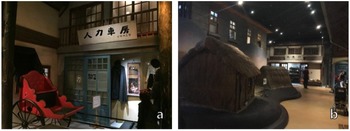
The Modern Life Hall, which manifests Gunsan's colonial daily life, is an exception to the other parts of the Modern Cultural Belt, and has introduced new dynamics negotiated between museum management and visitors' responses. The Modern Life Hall is designed to invite visitors to the Gunsan streets (Yeoungdong) of the 1930s, and the main concept – “time travel to the 1930s”– helps them experience daily life in the pseudo-Gunsan village in the 1930s (see Fig. 3). The author's participant observations found that this section forms visitors' favourite part not only of this museum, but of the entire Belt area, with people of all ages and genders readily enjoying the experience of being in the colonial town. The section depicts nine sites to narrate the painful livelihood of Gunsan's local farmers, who were exploited by the brutal Japanese landowners, as well as Gunsan's popular independence movement: Tomakijip (a makeshift house representing the poor and humble housing of Gunsan farmers, see Fig. 3(b)), shops of Yeongdong Arcade, Midujang (the rice exchange), Inner Harbour, Inner Harbour Warehouse, Gunsan Theatre, Gunsan Station, Impi Station and Yeongmyong School established by American missionaries in 1903.Footnote 55 Although the overall storylines are in a similar vein to the official narratives, this experience-centred exhibition seems to distract visitors from appreciating the painful and traumatic nature of colonial history, and to lead them instead to try and immerse themselves into colonial Gunsan's experiences as much as possible.
Photos of section of experiencing a rickshaw and modern hanbok (a) and Tomakjip (b) in Modern Life Hall.

Although the nine features are intended to deliver a sense of the brutal colonial history that occurred in Gunsan, according to the management of the Gunsan Modern History Museum, it is quite difficult to recognize this message without reading the detailed explanations of panels. Participant observations revealed that few visitors stopped to read these informational signs. They instead engaged in the participatory colonial experiences (trying on the “modern hanbok” Korean traditional clothing or sitting in a rickshaw on display – Fig. 3(a)).Footnote 56 Visitors seemed to enjoy taking photos and uploading them to social networking services (e.g. Instagram and Facebook). The museum intended that this exhibition hall should facilitate visitors' active engagement in “colonial” history for education purposes. However, visitors tended to perceive the hall as providing interesting experiences of the “modern” period, and to happily consume these experiences as part of time travel back to the 1930s: many children ran around in this hall as in a playground. At this point, visitors' experiences might change their perceptions of this space from being somewhere that represents the “colonial” period to instead a representation of the “modern” period, which is understood in relatively neutral terms or even positively. As Kim also points out, “the intertwined exhibition of displaying […] living culture and criticism against Japanese colonialism leads to the generation of the ambiguity of the exhibits’ contents and purpose.”Footnote 57
Considering that this is a public museum, the Modern Life Hall does not intend to display positive aspects of colonial modernity. Nonetheless, it unexpectedly generates positive emotions. Visitors with interesting memories might remember Gunsan's colonial history as an amusing one, in terms quite opposite to those espoused by the official narratives of South Korea's colonial history, and those intended by the museum. Moreover, in blurring “colonial” history and “modern” lifestyles, visitors easily lose the sense of the “colonial” time period, and feel like being in a “foreign country” where “[people in the past] do things differently.”Footnote 58 At this point, visitors appreciate imagined nostalgia for joy and fun.
The Modern Historic Landscape District: interweaving painful colonial history and nostalgic post-colonial stories
Although the Modern Cultural Belt area consists principally of industrial heritage sites, the Modern Historic Landscape District by contrast is characterized by Japanese-style vernacular former housing. As discussed in the section “Remaking Gunsan the city of modern culture as it was back in the 1930s,” this area declined after the Gunsan Municipal Government's relocation in the 1990s and those residents who stayed were typically those unable to afford to move to new apartment complexes in the new city centre (Naun-dong and Susong-dong): they stayed on in this vernacular housing without undertaking any particular maintenance or renovation efforts.Footnote 59 In South Korea in the 1980s and 1990s, high-rise apartment living became a symbol of middle-class status; those who remained in the Japanese housing conversely perceived their residences as a symbol of poverty and inconvenience. However, the grand city rebranding project in which started in 2009 changed their perception: during the project, the old and shabby Japanese housing was repaired and maintained with support from local architects and under instruction from the Cultural Heritage Administration of Korea.Footnote 60 Meanwhile, as this hitherto neglected Japanese housing gained a new image as valuable cultural heritage sought after by tourists from the 2010s, locals began to take pride in their living place.Footnote 61
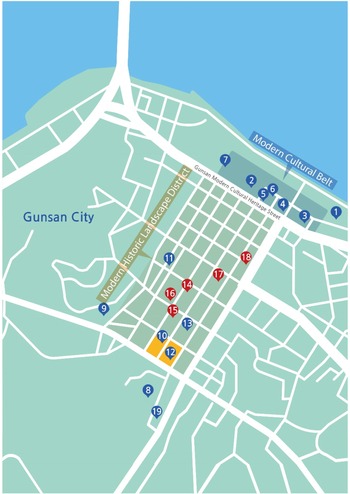
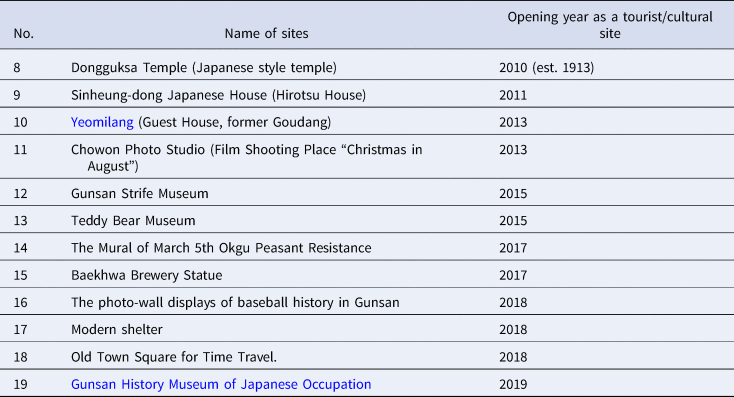
Unlike the Modern Cultural Belt area, the Modern Historic Landscape District has undergone further modifications since 2014 as part of the third phase of the grand plan (an urban regeneration project) (Fig. 4 and Table 2). During this second phase (2008–2013), responsibility for this area passed to the Division of Culture and Art under the Gunsan Municipal Government (apart from Dongguksa Temple; numbers 9–12 in Table 2). The municipality in 2014 established a Division of Urban Regeneration to pursue novel regeneration projects and manage newly formed cultural sites (numbers 14–19 in Table 2). Throughout the process of revitalizing this district, the Gunsan Municipal Government has officially used the word Wondosim (原都心, the original city centre) rather than Gudosim (舊都心, the former city centre).Footnote 62 This can be interpreted as a linguistic strategy suggesting that their grand project did not recover a dead part of the city, but revived Gunsan's original city identity. According to two key informants, the two different municipal divisions named above have seemed to compete with one another to yield greater successes for Gunsan tourism. Therefore, further new projects are continually being commenced (e.g. the formation of a Modern Village (called Mallaengi)), and the web of district narratives seems to become ever more complicated.Footnote 63
Locations of eleven components of the Modern Historic Landscape in addition to those in Figure 3. Blue numbers represent phase two, corresponding to items 1–7 in Table 1 and 8–13 in Table 2, above; red numbers represent sites formed by the Urban Regeneration Project, corresponding to items 14–19 in Table 2.

Eleven components of the Modern Historic Landscape District, phase two and three

Among the eleven main components that form the Modern Historic Landscape, three focus specifically on conveying the painful stories of colonial Gunsan and documenting Gunsan's resistance against Japanese colonial authorities: (12) Gunsan Strife Museum; (14) the Mural of March 5th Okgu Peasant Resistance and (19) Gunsan History Museum of Japanese Occupation. The main narratives of both the Modern Cultural Belt and of these three locations in the Modern Historic Landscape District harmonize with the official narratives of South Korea's colonial period: they portray rice exploitation and resistance against brutal Japanese perpetrators. However, although the Modern Cultural Belt tends to deliver a rather broader, nationalistic colonial history, these three sites in the District endeavour to document Gunsan locals' resistance against colonial Japan. Both the Gunsan Strife Museum (managed by the Division of Culture and Art) and the Mural (painted by a local Gunsan artist who was sponsored by the Division of Urban Regeneration) narrate the March 5th Okgu Peasant Resistance, emphasizing its importance as “the first and [largest-scale] demonstration that took place below the Han River (in Seoul),” right after the March 1st Independence Movement of 1919 (the first nationwide independence movement against colonial Japan, celebrated annually in post-colonial South Korea).Footnote 64 The case of the Gunsan History Museum of Japanese Occupation (managed by the Division of Urban Regeneration) details Korean Buddhism's religious resistance against imperial Japan, drawing on an archival donation from the Dongguksa Temple.Footnote 65 Locating the local colonial narrative in alignment with these national independence narratives, the Gunsan Municipal Government intends hereby to pinpoint Gunsan citizens' loyalty and patriotism during the colonial period.Footnote 66 This can be interpreted as an effort to avoid criticism that Gunsan took advantage of the colonial-era to develop its urban structure and infrastructure.Footnote 67
However, notwithstanding the single-track and consistent local colonial stories presented at these three sites, the District's other components present a complicated web of stories concerning both colonial and post-colonial periods. This section discusses three interesting cases where such stories intertwine: (9) Sinheung-dong Japanese House, (10) Yeomilang (former Goudang) and (11) Chowon Photo Studio.
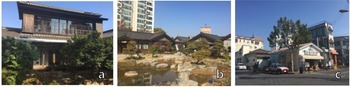
The Sinheung-dong Japanese house (also called Hirotsu House) introduces itself not only as the two-story home of a successful Japanese fabric dealer, Hirotsu, during the colonial period, but also as an attractive film-shooting location used by successful Korean films from the 1990s to the 2000s (e.g. General's Son in 1990; The War of Flower (Tajja in Korean) in 2006; see Fig. 5(a)). Although the Gunsan Municipal Government endeavours to locate this house amid official colonial narratives, noting that it symbolizes the luxurious lives led by upper-class Japanese people during the colonial period while Korean peasants suffered from severe poverty,Footnote 68 data from informal interviews with visitors in 2017, 2018 and 2020 suggest they experienced the site otherwise. Visitors in their fifties and sixties were attracted to the Japanese-style garden and architectural style rather than the painful colonial stories. Those in their twenties and thirties showed high interest in this place as the backdrop of their favourite films that evokes an imagined nostalgia of the movie settings. The dark aspects of colonial history that are officially promoted here tend in practice to be overpowered by the post-colonial stories that this house helps visitors to discover, telegraphing interesting aspects of modern heritage and the hidden stories of the films shot there.
Photos of Sinheung-dong Japanese House (a), Yeomilang (b), and Chowon Photo Studio (c).

Another site with mixed stories, Yeomilang (formerly known as Goudang) is a newly built Japanese-style guest house with a Japanese garden, at the centre of the Modern Historic Landscape District (Fig. 5(b)). When it was opened in 2012, it was named Goudang (古友堂), meaning a place of the comfort that an old friend could give; the name was changed in 2018 following the original leaseholder's departure. It is today one of the most famous and beloved guest houses in Gunsan, providing the experience of staying in a 1930-style room with tatami flooring.Footnote 69 Although this place is a representation of the colonial period, promoted by the current leaseholder as a reminder of the painful colonial past, in practice visitors do not perceive this as a negative space associated with Japanese colonial legacies.Footnote 70 This shows the obvious rupture between what is intended to present (representation of “colonial” history) and how people understand it (post-colonial tourism staying in “modern” heritage).
A third site, Chowon Photo Studio, formed the setting for the 1998 film Christmas in August: the main character, Jeong-Won, was the studio's manager (see Fig. 5(c)). This place does not relate to the colonial story and Japanese architectural style, but was included in the municipal government's grand project in efforts to attract more tourists to the Modern Historic Landscape District. Although not located in the storyline of official colonial narratives, it is one of the most frequently visited places in the District (attracting 440,000 visitors, or 11 per cent of Gunsan's total visitor numbers, as of 2018).Footnote 71 Visitors here commonly said that they felt comfortable in the warm atmosphere of the studio.Footnote 72 As with the aforementioned Sinheung-dong Japanese house, this place seems to evoke an “imagined nostalgia” of a movie setting that helps generate positive emotion.
Visitor numbers at these latter three sites far exceed those at the former three: it can be concluded that the latter three sites might operate more powerfully on visitors' understanding of Gunsan.Footnote 73 Despite the Gunsan Municipal Government's aspiration to boost Gunsan tourism, it has endeavoured to maintain a balance between history education and heritage tourism, as evidenced in its efforts to build museums relating to painful colonial history. However, visitors are in practice much more attracted to the spaces representing daily lives and popular film settings than to official and public places. Compared to the grand narratives of official colonial history, the vernacular Japanese housing represents colonial daily life in a way that is not too serious. The colonial stories related to this Japanese-style housing can be diverse and fragmented, making it hard to construct a singular and unified storyline. In the gaps and cracks among the colonial stories attached to these places, post-colonial stories seem to have been inserted smoothly, and to have settled. The newly formed dynamics between colonial and post-colonial stories blur the official narratives of colonial history, in turn helping visitors settle into a “fake” reality that is newly imagined and created beyond the colonial and post-colonial past and generate imagined nostalgic emotions.
Commodification of colonial and post-colonial stories
The discrepancies between the project's intention and visitors' experiences have exposed cracks in the course of Gunsan's grand project and urban regeneration. This disjoint is furthered by an additional layer of commodification in Gunsan's local narrative formation. As one of the key informants pinpointed, the 2014 starting point of the urban regeneration project was a pivotal moment in accelerating Gunsan's commercialization. We can see this in the cases of the city's Teddy Bear Museum, the Gunsan Hawtu souvenir game, and Gyeongamdong Railway Town that are run not by the Gunsan Municipal Government, but by private sectors, and produce new narrative styles.
The Teddy Bear Museum was opened in 2015 in the middle of the Modern Historic Landscape District, converted from a former church (Fig. 4).Footnote 74 This privately owned three-storey museum invites visitors to take a world tour with Teddy and his friends, following a format typical for such toy museums. However, the top floor offers a special exhibition about Gunsan, occupying three times more space than the museum's display devoted to any single nation. Its three sections represent the Sinheung-dong Japanese-style house in Gunsan, the Saemangeum Seawall and the Port of Gunsan. Unlike the exhibition on the Saemangeum Seawall, the other two exhibitions narrate Gunsan's colonial history, but were created without consultation with the Gunsan Municipal Government.Footnote 75 The Sinheung-dong Japanese-style house section is investigated here as the site of an important new narrative style.
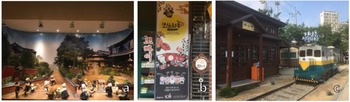
The display panel concerning the Sinheung-dong Japanese-style house offers general and neutrally toned information about vernacular housing, rather emphasizing modern architectural values (e.g. authenticity, modern style), such as “a valuable piece of Korea's construction history.” The display panel description specifies that this house “has been used as a shooting location for a number of famous Korean and TV dramas” since the liberation from Japan. Coinciding with this panel description, a section presents Teddy and his friends across two scenes taken from two films, both representing Korean independence icons and both shot in this two-storey Japanese house (see Fig. 6(a)): (1) General's Son (1990), which dramatized the story of the eponymous Kim Du-han's (1918–1987) twenties (the leader of the Korean political gangsters and politician), and (2) Fighter in the Wind (2004), depicting Choi Bae-dal's (Masutatsu Ōyama or Mas Oyma, 1923–1994) life at the same age (Zainichi Korean karate master). The scene on the right-hand side presents a “historic fight scene” between Kim Du-han and Hayashi (a Japanese yakuza in the film), imitating the climactic scene in what was the first South Korean film to pass the 1 million viewers mark. On the left-hand side, a famous anecdote about Choi Bae-dal is displayed, copying a scene from the film Fighter in the Wind in which he wrestles a bull with his bare hands.
Photos of Gunsan section in Teddy Bear Museum (a), Gunsan Hwatu (b), and Gyeongamdong Railway Town (c) (photographed by author in 2020).

The life stories of both Kim Du-han and Choi Bae-dal have been fictionalized and repeatedly consumed in contemporary South Korean pop-culture (cartoons, films, and dramas), mostly to great commercial success.Footnote 76 They have become characters beloved by the South Korean public, depicted as national heroes who fought against Japanese yakuza and fighters, respectively. Many South Koreans believe that Kim Du-han was a son of General Kim Chwa-chin (1889–1930), one of the most lauded independence activists during the Japanese colonial period, despite some scholars' contention that he was not the General's son.Footnote 77 Thanks in part to K-pop culture, Kim Du-han – although in reality a political gangster – has gained an image as an unofficial national hero who defended Korean vendors against Japanese yakuza groups during the colonial period, an impression rather strengthened by his purported descent from a noted independence activist. Choi Bae-dal, a Korean Japanese martial artist who left for Japan in 1938, is known as a legendary fighter and a creator of Kyokushin Karate. Although the veracity of this story is still debated, many Koreans believe that he removed the horns of forty-seven “Japanese” bulls using his bare hands.Footnote 78 His image is inscribed in South Korean consciousness as a hero who kept his Korean name and identity despite severe discrimination in Japan, and who ultimately became the number one fighter in Japan.
In the Teddy Bear Museum, the Sinheung-dong Japanese-style house is embedded in the context of these rather fictional and unofficial colonial anecdotes. This might help visitors to engage easily with Gunsan's colonial period, but equally can yield a misleading understanding of Gunsan in connection with these images, as these stories are made up – and in any case did not happen in this place. This case presents the potential for over-commercialization to interfere in Gunsan's local colonial history, and leads visitors to construct the “fake” past that is not based on historic facts.
Gunsan Hwatu, a popular souvenir among visitors to Gunsan's tourist shops, further demonstrates the commodification of Korea's colonial past. Hwatu (so-called “flower cards”) are a Korean version of Hanafuda (花札、はなふだ), a style of Japanese gambling cards (Fig. 6(b)). These cards, introduced to Korea in the late nineteenth century, were adapted to reflect Korean styles and are now immensely popular in South Korea. One Gunsan retailer designed a set featuring Gunsan tourist attractions presented in the Hwatu style – this “Gunsan Hwatu” has been sold since 2016. Today four versions with differing colour combinations are sold. Most interestingly, Gunsan Hwatu includes extra cards featuring an historically indiscriminate mix of symbols: Korean independence activists (e.g. Ryu Gwan-sun who is known as a female martyr and a symbol of independence movement against Japanese colonial authorities; and Kim Gu, a political leader of independence movement against the Japanese colonial authorities statesman of pre- and post-independence Korea), pro-Japanese Koreans (Yi Wan-yong, known as the national traitor who signed the Japan–Korean Annexation Treaty), and Itō Hirobumi (the first colonial Resident-General of Korea who was assassinated in 1909 by Korean independence activist Ahn Jung-geun). Adverts promote Gunsan Hwatu as an informative and educational tool for learning about not only Gunsan's historic sites, but also Korea's independence history. Yet, a survey of tourists' blogs about their experiences in Gunsan shows many tourists uploading photos either showing that they bought Gunsan Hwatu as souvenirs, or that they played games with Gunsan Hwatu in the several Gunsan guest houses that provide them in the communal space for entertainment. Despite its creator's intention, Gunsan Hwatu makes a travesty of colonial history.
Although these two cases demonstrate commodified colonial history in tourism and entertainment contexts, the third case we will consider here, of Gyeongamdong Railway Town, exemplifies the autonomous commercialization of Gunsan's local narratives as an extension of imagined nostalgia from the colonial period to the 1970s and 1980s (Fig. 6(c)). Gyeongamdong Railway Town is located about a 10-minute drive from Dongguksa Temple.Footnote 79 It formed during the Korean War when refugees from North Korea built an illegal settlement beside a 2.5-kilometre railway constructed in 1944 to deliver raw materials and products to a Japanese paper company.Footnote 80 In the 1990s, this scenic area attracted many photographers and film directors were drawn to its nostalgic and cosy atmosphere, which evoked memories of the 1970s and 1980s. The train service ceased in 2007, but the area subsequently developed spontaneously as a tourism attraction, independent of Gunsan's grand project and of the urban regeneration in the original city centre. Since 2014, when the famous TV series “One Day Two Nights” visited the railway village, the number of visitors has surged. Although it housed only four retail stores before 2014, today it is filled with retro-themed storefronts ranging from junk sellers to rentals of old school uniforms and coffee shops.Footnote 81 Approximately 20,000 tourists visit this town on weekends, enjoying the imagined nostalgic experience of returning to the 1970s and 1980s.Footnote 82
The success of Gyeongamdong Railway Town can be situated in South Korea's “retro and new-tro fever.”Footnote 83 Many local municipal governments have launched “7080 Retro Tours” that help visitors experience the daily life of the 1970s and 1980s (e.g. Suncheon, Gyeongju, and Mokpo).Footnote 84 Although “retro” marketing targets people in their fifties and sixties, “new-tro” trends are pitched at those in their twenties and thirties. Gunsan today seems to appeal fully to both “retro” and “new-tro” trends, with experiences of imagined nostalgia evoking colonial daily life overlapping with attractions conjuring life in the 1970s and 1980s, and with the post-colonial memories recalled by famous films. These trends reflect the psychological response of South Koreans to escape from “the current hopeless economic recession of South Korea” into a positively framed past.Footnote 85 Therefore, tourists tend to avoid serious educational content, looking instead for fun and entertainment that can help them forget their current difficulties.Footnote 86 The commercialized colonial and post-colonial stories offered in Gunsan by private sector businesses attract such tourists, and guide them to enjoy imagined nostalgia that extends beyond the historic context. Although the Gunsan Municipal Government actively allowed private business to engage in Gunsan's story from the third phase of Gunsan's grand place (2014–present), the consequence is that it has accelerated Gunsan's commodification of Japanese colonial history by instead promoting imagined nostalgia for fun and joy, and in turn, has weakened the official colonial narrative in Gunsan's heritage-landscape.
Conclusion: towards productive nostalgia
Gunsan, a former colonial city that experienced long-term decline and exclusion from national development schemes, has been successfully revived as one of the most attractive tourist destinations in South Korea. The heritagization of colonial architecture in the original city centre paradoxically survived thanks to neglect. In turn, this process has played the most important role in Gunsan's rebranding as a city of modern culture harking back to the 1930s. As Gunsan is widely portrayed as a successful example of city rebranding, other Korean cities (including Daegu and Pohang) have used Gunsan's colonial heritage-making as a benchmark and have imitated its tourism format.
Although colonial heritage elsewhere in Asia has been managed as a significant cultural resource for tourism, South Korea has typically emphasized the use of Japanese colonial heritage principally for educational purposes to strengthen national official narratives of Japanese colonial history. Accordingly, in its first attempt to utilize Japanese colonial heritage, the Gunsan Municipal Government endeavoured to narrate Gunsan's “colonial” stories in alignment with the government's official position. Yet, driven by a desire to boost the local economy through tourism, Gunsan also pursued a strategy treating colonial architecture as a cultural resource, corresponding to a usage common in other Asian countries – although important distinctions between Gunsan's case and those of other Asian cities evoking nostalgia remain. In Gunsan's approach, less serious “modern” stories were implanted throughout the heritagization project. In addition, a “fabricated reality” based on famous film scenes twisted nostalgic feelings. These consequently – and unexpectedly – generated imagined nostalgic feelings.
Initially, the Gunsan Municipal Government positioned the educational contents of its “colonial” past according to the Korean mainstream of Japanese colonial heritage-making. However, visitors have proven more attracted to aspects of the city's heritage sites that depict less serious aspects of the “modern” past. This preference has accelerated the commercialization of the Japanese colonial past at large, as well as Gunsan's specific stories. As commercialized aspects of the heritage attract more attention, and stories of modern daily life and post-colonial stories are emphasized, accounts of Japanese colonialism in Gunsan are correspondingly diluted. Uncomfortable, difficult, and serious stories of Gunsan's colonial past fade from visitors' attention, coded into information signs that are read by few, and the Gunsan landscape of Japanese colonial architecture transforms gradually into a backdrop presenting an “imagined” past that visitors do not know very well or did not even happen but can enjoy as a superficial “time travel” experience, sidestepping any particular historical consciousness but escaping from their present-day cares. At this point, Gunsan's heritage landscape actively generates an imagined nostalgia not for the Japanese colonial past specifically, but for an unknown past that is experienced as exotic, fun, and interesting. Gunsan's imagined nostalgia tends to evoke superficial nostalgic feelings in visitors, yoked to certain images from films, TV drama and entertainment programmes.
It is worth noting how Gunsan's imagined nostalgia can be distinguished from the nostalgia that other Asian cities have cultivated with regards to colonial modernity. The 1930s Shanghai modernist writings exemplified colonial modernity as cosmopolitanism, and the Taiwanese documentary film Viva Tonal (2003) positively depicts the colonial modernity that Japan brought to youth culture, together with a measure of artistic freedom Lee and Li Reference Lee and Li1999; Sang Reference Sang, Sylvia and Deborah2012. In these two cases, colonial modernity is idealized and simplified to evoke nostalgic feelings towards the colonial past, and the domestic viewers accept such an idealized depiction of colonial modernity. To the extent that Gunsan's exhibitions and presentation of colonial architectures evoked positive nostalgia in a superficial way, it looks the same as other Asian cases.
However, Gunsan's imagined nostalgia is located in a slightly different position from other Asian cases. First, Gunsan's imagined nostalgia does not seem to be linked to the colonial modernity that other Asian cases narrates. Rather, Gunsan Municipal Government sought overtly to depict negative aspects of colonial modernity, corresponding to South Korea's semi-official prohibition on romanticizing the colonial past. Such nostalgic emotions are evoked not in the “real” colonial past, but in an imagined past beyond the historic context. Second, Gunsan's nostalgia reflects local's difficulties in forming not only negative colonial heritage for educational purposes, but also interesting modern heritage for cultural/economic resources. It is different from aforementioned Asian cases that do not have particular rejection on their colonial heritage-making as positive economic/cultural resources. As a result, Gunsan's colonial heritage landscape in practice does not clearly narrate either official narratives about the Japanese colonial past, nor the complexity of colonial modernity at the local level. Finally, Gunsan's imagined nostalgia is not a sentiment induced deliberately, but one that emerges inadvertently, from incidental aspects of the heritagization process. In contrast to other Asian cities' nostalgic invocations, nostalgic emotion evoked in Gunsan is an unintended consequence.
The imagined nostalgia that Gunsan's heritage landscape generates is integral to the city's heritage tourism, and reflects a strong commercial character. The imagined nostalgic experience is fleeting, quickly forgotten and does not lead to either true reflection or real engagement with history, whereas visitors' trips to the city could be a springboard to a meaningful encounter with the past. To overcome the limits of such static and superficial nostalgia, I here introduce the concept of productive nostalgia. In recent heritage studies, heritage scholars have emphasized an active and creative role for nostalgia, which they term “productive nostalgia.”Footnote 87 Productive Nostalgia can help individuals orient themselves towards the present and future, and can accompany work motivated by personal, social, cultural, and political goals.Footnote 88 Heritage scholars have thus tried to relocate nostalgia in an active affective-cognitive process, and to investigate the positive effects of nostalgia for forming collective identity and active communication in communities.Footnote 89
In order to transform an imagined nostalgia into a productive one, reflection on the past decade of trial-and-error yields three main considerations for developing Gunsan's heritage henceforth. First, Gunsan Municipal Government needs to investigate local colonial history in depth. Gunsan's heritage resources (industrial heritage and vernacular heritage) can reveal the multiple layers of colonial modernity and thus contribute to a more sophisticated colonial discourse in South Korea more widely. Second, locals' real stories must be incorporated into Gunsan's time-travel narratives, respecting their diversity rather than subordinating it to an overarching grand narrative. By involving locals in Gunsan's new project, lively participation from supportive and critical residents can be encouraged in the construction of local narratives. Third, it is essential to find effective ways of conveying these strengthened colonial and post-colonial stories to visitors. To engage young and elderly visitors alike in the city's narratives, new curational strategies should be introduced. Successful examples might be adopted from the international “Empathy Museum” project, for example by producing recorded audio guides for self-led tours in place of a uniformed audio guide.Footnote 90 Visitors may thus experience more diverse stories attached to heritage sites and museums to foster empathy and understanding, and help build up shared memories and experiences among different generations. Through these efforts, an imagined nostalgia tethered to a poor grasp of history can be transformed into a productive nostalgia that helps not only reshape collective identity and memory, but also bring us into a better anchor to shape the present and future journey. This type of nostalgia can be applied to not only Gunsan's case, but also other Asian cases.
Consent for publication
This paper uses the Revised Romanization of Korean. All subjects gave their informed consent for inclusion before they participated in the study.
Acknowledgments
I am grateful to Dami Kim for her help to produce maps and to the anonymous interviewees, including key informants, for their generous support. In addition, I am indebted to Prof. Ryoko Nakano, to Chi-Hé Elder, and to two anonymous reviewers, each of whom helped this paper improve. This work was supported by the Laboratory Program for Korean Studies through the Ministry of Education of the Republic of Korea and the Korean Studies Promotion Service of the Academy of Korean Studies under Grant [AKS-2016-LAB-2250005]. In addition, this work was supported by the Ministry of Education of the Republic of Korea and the National Research Foundation of Korea (NRF-2020S1A5B5A01042686).