1. Introduction
When viewing language in its most natural setting, viz. face-to-face conversation, it inherently involves both an interactive and multimodal dimension. Despite the tacit agreement on the primacy of dialogue, (psycho)linguists interested in the cognitive underpinnings of language have only recently started to pay systematic attention to the interactive grounding of the language system and its interaction with other semiotic modes. In the broad paradigm of Cognitive Linguistics, this has led to significant adaptations of existing models such as Cognitive Grammar (Cienki, this issue; Langacker, Reference Langacker2001; Verhagen, Reference Verhagen2005) and construction grammar (Fried & Östman, Reference Fried and Östman2005; Goldberg, Reference Goldberg2006). These models have incorporated features of the interactional context in their theoretical modelling and discuss the trade-off between different semiotic channels (most notably the question of (co-speech) gesture; e.g., Cienki & Müller, Reference Cienki and Müller2008; Mittelberg, Reference Mittelberg2007; Sweetser, Reference Sweetser, Gonzalez-Marquez and et al2007; a.o.).
The present paper is intended as a contribution to the cognitive analysis of multimodal interaction. More specifically, we take as a starting point Garrod and Pickering’s (2004, p. 11) programmatic statement on key questions for future research into the cognitive and linguistic mechanisms of dialogic language use. One of these questions, according to the authors, concerns the multimodal analysis of interactive alignment processes in dialogue: “What is the relationship between linguistic and non-linguistic alignment processes?” We approach this question through an empirical analysis of the interrelation between interlocutors’ gaze behaviour and interactionally co-present gestures. More specifically, following up on Gullberg and Kita (Reference Gullberg and Kita2009) and Wang and colleagues (Wang & Hamilton, Reference Wang and Hamilton2014; Wang, Newport, & Hamilton, Reference Wang, Newport and Hamilton2011), we address the question whether a speaker’s visual focus on his own gestures when speaking, and/or an addressee’s focus on that same gesture, has an influence on gestural alignment between the interlocutors. We base our analysis on the InSight Interaction Corpus (Brône & Oben, Reference Brône and Oben2015), a multimodal video corpus consisting of targeted and free-range dyadic interactions, with head-mounted scene cameras and eye-trackers providing a unique ‘speaker-internal’ perspective on the conversation.
In what follows, we briefly review relevant literature on the role of eye-gaze in interactional discourse (Section 2), and on interactive alignment as a key feature in setting up successful communication (Section 3). We then combine these two features (eye-gaze and interactive alignment) into the central research question for the present paper: ‘What is the influence of eye-gaze on multimodal interactive alignment?’ (Section 4). In the methods section (5) we introduce the InSight Interaction Corpus and explain how we measured gaze and gesture behaviour. Finally, we present (Section 6) and discuss (Section 7) the main results of the study, and close with some perspectives for future work.
2. Eye-gaze in interaction
Some early seminal works focused on the role of eye-gaze in interactional settings, inspired by the work on paralinguistic (intonation, volume, pitch) and non-linguistic (gesture, gaze) signalling in conversation analysis. Kendon (Reference Kendon1967), one of the pioneers in multimodal analysis (and more particularly gesture studies), presented a first detailed empirical account of the direction of speakers’ and hearers’ gaze during a face-to-face conversation, based on snapshots of a video-recording (1 frame per 500 ms interval was used as a basis for the analysis) and corresponding transcription of speech. The analysis focused on the role of eye-gaze as an instrument of perception and processing on the one hand, and on its potential as a communicative signal on the other (e.g., for directing attention, managing the organization of the conversation, etc.). The pioneering work by Kendon fostered the interest of researchers across disciplines in the role of gaze behaviour in interactional discourse. In another landmark publication, Argyle and Cook (Reference Argyle and Cook1976) list a range of functions of gaze (cited in Raidt, Reference Raidt2008, p. 49), including the signalling of grammatical breaks, attention or disapproval, providing feedback (cf. also Bavelas Coates, & Johnson, Reference Bavelas, Coates and Johnson2002), etc. In more recent studies, some of these eye-gaze patterns have been studied in more detail and as part of a broader framework, as, e.g., the work on eye-gaze in conversational turn management and information structure by Cassell, Torres, and Prevost (Reference Cassell, Torres and Prevost1999), Jokinen (Reference Jokinen2010), and Novick, Hansen, and Ward (Reference Novick, Hansen, Ward, Bunnell and Idsardi1996).
Despite the detailed empirical analyses presented in the early work on eye-gaze in interaction, these studies typically had to deal with the technological–methodological shortcomings of video-recordings. Although gaze estimations on the basis of video data may be useful for a basic segmentation of the distribution of visual attention (e.g., looking at an interlocutor vs. looking away), they are notoriously coarse-grained and unreliable for more detailed analysis (Kendon, Reference Kendon2004; Streeck, Reference Streeck2008). For instance, video-based analysis does not provide useful information on short fixations (of 200 ms or less), saccades (i.e., fast movements of the eye), and visual scan paths. In order to be able to include this level of detail in the analysis, a different methodological paradigm is needed, viz. eye-tracking. Eye-tracking, or the measuring of gaze points and eye movements during ongoing behaviour, allows for a highly detailed analysis of gaze patterns (see Rayner, Reference Rayner1998, for an overview). With the development of unobtrusive eye-tracking equipment in the last decade, in the form of remote or head-mounted systems, it is possible to measure subjects’ gaze patterns while they are involved in interactive or collaborative tasks. This opens up a vast area of research in (cognitive) interaction studies, including the role of gaze as a directive instrument, the correlation between gaze and gesture, gaze as a disambiguation instrument, interactive alignment in various semiotic channels, etc. In what follows, we provide an overview of some recent work exploring eye-gaze in interaction, using eye-tracking technology.
One of the basic features of interaction is the joint focus of attention of co-participants in the process of establishing the coordinated action that is language use (Clark, Reference Clark1996). One correlate of this basic feature is gaze coordination, or the joint visual focus on relevant aspects of the context (e.g., referents that are the current topic of conversation), also referred to as shared gaze. In a series of experiments, Richardson and colleagues (Richardson, Dale, & Kirkham, Reference Richardson, Dale and Kirkham2007; Richardson, Dale, & Tomlinson, Reference Richardson, Dale and Tomlinson2009) measured the coupling of eye-movements between participants in mediated settings, i.e., with participants viewing a screen rather than a face-to-face setting. The results show a strong tendency towards joint visual attention, as well as an impact of shared background information (common ground) on this coupling. Brennan, Chen, Dickinson, Neider, and Zelinsky (Reference Brennan, Chen, Dickinson, Neider and Zelinsky2008) and Neider, Chen, Dickinson, Brennan, and Zelinsky (Reference Neider, Chen, Dickinson, Brennan and Zelinsky2010) used collaborative visual search tasks for remotely located pairs of people (both wearing head-mounted eye-trackers) to study the relative impact of shared gaze and speech on performance efficiency. The results show that the condition with shared gaze (with participants seeing the gaze cursor generated by the eye-tracker of the other) scored significantly better than (i) solitary search, (ii) a condition with only shared voice, and even (iii) the condition with both shared gaze and shared voice.
A final dimension that needs mentioning in this general overview, as it is of particular relevance to the present study, is the distribution of visual attention across the interactional space of the conversation. Co-participants do not only focus on specific referents that are the current topic of (verbal) communication, or on the speakers and/or addressees (see above). Rather, taking into account the active communicative role that gaze may play as a cue for referent assignment, turn management, etc., we obtain a complex interplay of gaze-as-cause and gaze-as-effect. One much-discussed feature is the so-called gaze cueing effect, which can be defined as the effect that cueing a target (e.g., by looking at it) has on the gaze behaviour of an addressee. Studies on the gaze cueing effect, which date back to early work by Posner, Snyder, and Davidson (Reference Posner, Snyder and Davidson1980), stress its role for joint attention in interaction (Emery, Reference Emery2000; Frischen, Bayliss, & Tipper, Reference Frischen, Bayliss and Tipper2007). Lachat, Conty, Hugueville, and George (Reference Lachat, Conty, Hugueville and George2012) are the first to test the gaze cueing effect in a spontaneous face-to-face setting (rather than in on-screen experiments), however, without the use of the eye-tracking paradigm. Gullberg and Holmqvist (Reference Gullberg and Holmqvist2006) and Gullberg and Kita (Reference Gullberg and Kita2009) focus on one specific case of gaze cueing, using head-mounted eye-trackers, viz. the effect of a speaker focusing on his/her own gesture on the addressee’s gaze behaviour. The studies reveal that a speaker’s gaze at own gestures is a powerful cue for addressees to leave the dominant fixation position (i.e., the face of the speaker) and give overt visual attention to the speaker’s gesture.
3. Interactive alignment: a multimodal approach
At various points in the previous section, it was stressed that efficient communication depends to a large extent on joint (visual) attention and coordination. In fact, coordinated actions in interaction have been observed for a variety of language and bodily parameters, which have been addressed in several disciplines and paradigms. Or, as Richardson et al. (2007, p. 407) aptly put it:
When people talk, they coordinate whose turn it is to speak (Sacks, Schegloff, & Jefferson, Reference Sacks, Schegloff and Jefferson1974). They also implicitly agree upon names for novel objects (Brennan & Clark, Reference Brennan and Clark1996; Clark & Brennan, Reference Clark, Brennan, Resnick, Levine and Teasley1991), align their spatial reference frames (Schober, Reference Schober1993), and use each other’s syntactic structures (Branigan, Pickering, & Cleland, Reference Branigan, Pickering and Cleland2000). Their accents become more similar (Giles et al. Reference Giles, Coupland, Coupland, Giles, Coupland and Coupland1992), they sway their bodies in synchrony (Condon & Ogston, Reference Condon, Ogston, Horton and Jenkins1971; Shockley, Santana & Fowler, Reference Shockley, Santana and Fowler2003), and they even scratch their noses together (Chartrand & Bargh, Reference Chartrand and Bargh1999).
One central effect of coordinated action in dialogue is a high degree of convergence across speakers and their turns. The imitative nature of face-to-face communication has been dealt with in great detail in linguistics and conversation analysis (e.g., Bolinger, Reference Bolinger1961; Carter, Reference Carter1999; Halliday & Hasan, Reference Halliday and Hasan1976; Sacks et al., Reference Sacks, Schegloff and Jefferson1974; Tannen, Reference Tannen1987, Reference Tannen1989), and has been labelled alternatively as ‘accommodation’ (Giles et al., Reference Giles, Coupland, Coupland, Giles, Coupland and Coupland1992), ‘entrainment’ (Brennan & Clark, Reference Brennan and Clark1996), ‘resonance’ (Du Bois, Reference Du Bois2010), ‘convergence’ (Lewandowski, Reference Lewandowski2012), ‘interactive alignment’ (Pickering & Garrod, Reference Pickering and Garrod2004, Reference Pickering and Garrod2006), etc. Rather than presenting an overview of these different accounts (which would be well outside the scope of the present paper), we zoom in on the interactive alignment theory developed by Pickering and Garrod, as it has generated a substantial amount of theoretical and empirical work over the last decade. It focuses on the basic underlying mechanism driving the tendency towards convergence or accommodation, and argues that this is a largely automatic and unconscious process.
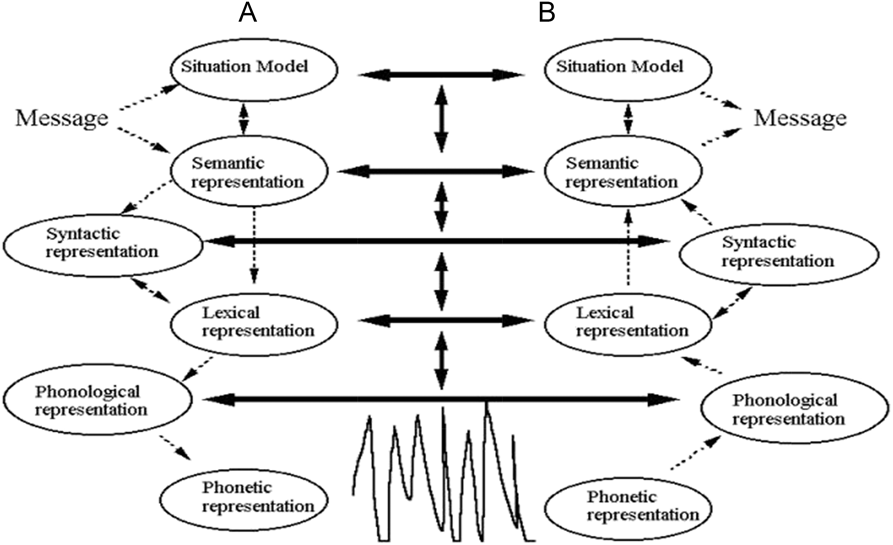
According to the interactive alignment theory, interlocutors are primed to use the linguistic input of immediately preceding utterances they have just processed: “We propose that this works via a priming mechanism, whereby encountering an utterance that activates a particular representation makes it more likely that the person will subsequently produce an utterance that uses that representation” (Pickering & Garrod, Reference Pickering and Garrod2004, p. 173). Alignment is defined as a state in which two or more dialogue partners have an identical (or at least highly similar) representation at a particular linguistic level. Alignment at different levels of linguistic representation enhances alignment of situation models, with similarly constructed situation models being a precondition for successful communication. The theory proposes a layered account of interconnected levels of representation (see Figure 1), with alignment at one level leading to alignment at other levels. The growing body of literature on interactive alignment has uncovered the cognitive reality of the phenomenon, most notably at the lexical and syntactic level (see, e.g., Garrod & Pickering, Reference Garrod and Pickering2009, for an overview of the literature). Some recent work has also focused on aspects of alignment at the level of phonetics (Lewandowski, Reference Lewandowski2012; Lewandowski & Schweitzer, Reference Lewandowski and Schweitzer2010; Szczepek Reed, Reference Szczepek Reed2010) and pragmatics (Roche, Dale, & Caucci, Reference Roche, Dale and Caucci2012).
Interconnected levels of linguistic representation in the interactive alignment model of Pickering and Garrod (Reference Pickering and Garrod2004).

Although the interactive alignment model was construed as a mechanistic model of dialogue in psycholinguistics, and thus focuses primarily on linguistic levels of representation, the basic phenomenon can also be observed in other semiotic channels. Several studies have focused on the strong (and largely unconscious) tendency of dialogue partners towards convergence in non-linguistic behaviour, including gesture (Kimbara, Reference Kimbara2006), posture (Shockley, Richardson, & Dale, Reference Shockley, Richardson and Dale2009; Shockley, Santana, & Fowler, Reference Shockley, Santana and Fowler2003) and eye-gaze (Richardson & Dale, Reference Richardson and Dale2005, cf. references in Section 2). In fact, Garrod and Pickering (2009, p. 296) acknowledge that “interlocutors construct aligned non-linguistic representations. Just as linguistic alignment at one level can enhance alignment at other levels, so non-linguistic alignment can also enhance alignment.”
For the purpose of the present paper, a number of recent studies are of particular interest, as they are instructive for a multimodal approach that also takes into account the temporal dynamics of interactive alignment. Dale, Kirkham, and Richardson (Reference Dale, Kirkham and Richardson2011) studied eye-gaze patterns in a cooperative tangram task. Both participants were given the same set of puzzle pieces, but in a different order, and were asked to arrive at a matching order. A cross-recurrence analysis on the eye-movement data for both participants reveals growing synchronization over time: eye-gaze patterns become more coordinated. McNeill (Reference McNeill, Renals and Bengio2006) presents an exploratory study of the coordination of individual cognitive states in multi-party exchanges. He does so through the study of language, gesture, and gaze as packages of multimodal information (referred to as ‘hyperphrases’) that present a so-called ‘growth point’ or a speaker’s cognitive state, and which are crucial for achieving synchrony between speakers. McNeill explicitly presents his account as a multimodal extension of the interactive alignment model, albeit without buying into the ‘mechanistic’ account of a solely priming-based mechanism.
4. The present study: eye-gaze and multimodal alignment
The present study combines insights from recent work on eye-gaze in interaction (see Section 2) and interactive alignment (see Section 3) to explore the role of eye-gaze in the emergence of alignment at the gestural level. More specifically, we address the question whether gaze cueing by a speaker on his or her own gesture has an effect not only on the gaze behaviour of the interlocutor (Streeck, Reference Streeck1993), but also on the subsequent gesture production by the latter. Do interlocutors who directly focused on a speaker’s gesture exhibit a stronger tendency to use the same (or similar) gestures in subsequent turns than in those cases without direct fixation? We hypothesize that speakers’ and interlocutors’ attention to gesture not only has an effect on the visual attention of interlocutors and information uptake of gestural information (as shown by Gullberg & Kita, Reference Gullberg and Kita2009), but also on gestural alignment across speakers. Drawing on insights from the interactive alignment model, we present an experimental study of the relation between gaze cueing, visual processing, and aligned (gestural) representations.
By linking visual fixation on gestures (on the part of both speakers and addressees) to subsequent gesture production in an interactional setting, we add one important dimension to the study on eye-gaze and information uptake of gesture presented by Gullberg and Kita (Reference Gullberg and Kita2009). Whereas in their study, participants were shown video-recordings of naturally occurring gestures in narratives, after which the information uptake was measured using a drawing task after stimulus presentation, we explore the relationship between visual gesture processing and production in a dialogic setting, using a multimodal dialogue corpus that includes eye-tracking data for both dialogue partners (Section 5).
5. Method
5.1. participants
All of the participants (9 male, 21 female) are students at the University of Leuven and native speakers of Dutch. Each conversational pair was well acquainted before taking part in the experiment, and they were all rewarded with cinema tickets.
5.2. design
All of the data and analyses in this paper are based on the InSight Interaction Corpus (Brône & Oben, Reference Brône and Oben2015). This corpus consists of fifteen recordings of face-to-face conversations that last about 20 minutes each. Both of the participants are wearing head-mounted eye-trackers, and a fixed camera records the interaction from an external perspective. This recording technique results in a video file that simultaneously shows three perspectives on the speech situation (see Figure 2).
Recording configuration of the InSight Interaction Corpus (Brône & Oben, Reference Brône and Oben2015).
5.3. procedure
Each 20-minute conversation in the corpus consists of three types of interaction: a picture description task, a collaborative problem-solving task, and a free conversation on a given topic. For this study we only used the second interaction type, i.e., the targeted collaborative task. In this task, the interlocutors were each shown a video animation. They saw the animation at the same time, but they couldn’t see each other’s animation. The two video animations were identical, except for a few minor details. The goal of the task was to discover those differing details. Once they completed the task, they were shown a new animation (with a total of fifteen animations they had to discuss).
5.4. analysis
Since this paper is mainly concerned with the coupling of and interaction between gesture and gaze in face-to-face interaction, we will zoom in on those two levels, and not focus primarily on the linguistic or prosodic level. More specifically, we single out one type of gesturing and its relation to gaze, viz. depictive gestures that are used by the participants to represent objects that appear in the animation videos. All other gestures, like emblems, beats, metaphoric gestures, etc. are not part of the dataset for the present analysis. With regard to the eye-tracking data, we focus on the cases where, either in the role of speaker or hearer, participants explicitly focus on those depictive gestures. In other words, we included all the cases of interlocutors looking at their own hand gestures and the hand gestures of the other person.
In testing our hypotheses, we compare two factors: the alignment between adjacent representational gestures, and the eye-gaze of the interlocutors on those gestures. The latter is a case of binary measuring results: either there is visual focus on the gesture or there is not. The former, the factor of alignment, is expressed on a more continuous scale: any two gestures can not only be fully aligned or fully non-aligned, they can also be partially aligned. This partial alignment is due to the fact that gesture is multidimensional by nature. Two gestures can, for example, be identical in handshape and finger orientation, but not in velocity and palm orientation. How we dealt with making both gesture and gaze quantifiable factors is clarified in what follows.
5.4.1. Quantifying gaze
Quantifying gaze data is fairly straightforward, albeit time-consuming. For this study we defined six regions of interest (ROI; see Figure 3). On a frame-by-frame basis, we manually tagged the gaze data from the eye-tracker; i.e., for each frame we determined on which ROI the visual focus of the interlocutor was. This was done for each of the interlocutors during the entire interaction.
Regions of interest.
Eye-movements are extremely fast and, unless engaged in specific tasks, the human eye jumps from the one object of focalization to the other at a very high speed. Because we want to test the effect of eye-gaze on gesture production, it was important to establish a threshold for explicit visual focus or minimal fixation duration. In order to regard a gaze event as a fixation, and thus as a cognitive act of perception, it should last at least a predefined number of milliseconds. In the eye-tracking literature there is much debate about a standard minimum fixation duration (Munn, Stefano, & Pelz, Reference Munn, Stefano and Pelz2008), and this duration seems to be highly linked to the specific task of the eye-tracked person. In reading, the minimum fixation duration will typically be shorter, as short as 60 milliseconds, whereas for other tasks this is generally between 150 and 400 milliseconds. For our dataset, we regarded any fixation at a gesture of at least five video frames (or 200 ms) as a genuine fixation (cf. also Gullberg & Kita, Reference Gullberg and Kita2009).
A second issue regarding eye-gaze, apart from determining the minimum fixation duration, is peripheral vision. For our study we can only base our claims on the positive evidence of explicit eye-gaze fixations. It is, of course, always possible that subjects perceived gestures without focusing on them. As is clear from eye-tracking research in sign language (Muir & Richardson, Reference Muir and Richardson2005), signers hardly ever fixate their interlocutors’ hands, while they ‘see’ what their conversational partners are expressing with those hands. The human peripheral vision allows perception without fixation, so we should take care in interpreting our data.
5.4.2. Quantifying gesture
Intuitively, gestures seem to be holistic gestalts of meaningful hand movements (Mittelberg, Reference Mittelberg2007). When annotating gesture, however, the multidimensionality of the phenomenon forces researchers to choose a level of granularity at which to describe the gestures at hand. For this study we were not primarily interested in annotating and transcribing gesture in as much detail as possible, but rather in adopting a measure of comparing two gestures, i.e., of expressing the degree of alignment between any two gestures. For this purpose we used a five-point scale of features to determine how alike two gestures are. The five features that were considered are finger orientation, palm orientation, handedness, gesture type, and handshape. The maximum score for alignment between two gestures was 1, the minimum 0, with every feature counting for 0.2.Footnote 1
The last two features of our annotation for gestural alignment require some further explanation. The annotation of gesture type is borrowed from Streeck (Reference Streeck2008), who proposes a typology of shaping mechanisms for depictive gestures. For example, in representing a door by means of gesture, there are different shaping strategies: one could draw the outlines of the door, use the hand as a token for the object, use the hand to handle as if opening a door (by manipulating a fictional doorknob for instance), etc. Our category ‘gesture type’ corresponds with Streeck’s typology in this respect. For the feature ‘handshape’ we used the gesture annotation grid developed by Bressem (Reference Bressem2008). This notational system is strongly form-based (i.e., it is independent from the speech content) and well trained for co-speech gestures in spontaneous conversations, which made it well suited for our purposes.
6. Results
Before turning to the results on the relation between gaze behaviour and alignment in gesture production, we present two basic observations that are relevant to the interpretation of the data. First, we observe a very strong gaze-cueing effect: 47.6% of the SpeakerGaze+ cases (speakers fixating their own hand gesture) are immediately followed by InterlocutorGaze+ cases (interlocutors fixating that same hand gesture). This means that in nearly half of the cases the gaze cueing is successful.Footnote 2 Second, although the experimental set-up does not allow us to measure a causal link between gaze behaviour and gesture behaviour, we did observe a temporal contingency between the two: for each instance in our dataset, the gaze behaviour precedes the gestural behaviour. We cannot claim that the gestural alignment we measure (see below) happens because of the gaze behaviour, but we do want to stress that at least there is a temporal relation between the two.
6.1. gaze behaviour and gestural alignment
To obtain our final result, we combined the factors InterlocutorGaze and SpeakerGaze, hence creating four possible conditions for which we calculated the average alignment scores. Figure 4 visualises the four conditions and Figure 5 shows the average alignment scores for those conditions (with respective n values of 44, 226, 40, and 44).Footnote 3 Data were analyzed with a 2 × 2 ANOVA test with factors SpeakerGaze(+/–) and InterlocutorGaze(+/–). This revealed a significant main effect of InterlocutorGaze (F(1) = 41.19, p < .001), reflecting higher alignment scores in the InterlocutorGaze+ conditions than their InterlocutorGaze– counterparts (i.e., if interlocutors have focused on the speaker’s hand gesture, they produce more aligned gestures than if they have not focused on the speaker’s gestures). The main effect of SpeakerGaze was not significant.
Four possible conditions when combining the two factors SpeakerGaze and InterlocutorGaze.
Average scores for gestural alignment across two factors: InterlocutorGaze (interlocutor has or has not focused on the speaker’s hand gesture) and SpeakerGaze (speaker has or has not focused on his own hand gesture). Error bars indicate standard error.
However, the InterlocutorGaze effect was qualified by an interaction with SpeakerGaze (F(1) = 10.44, p = .001). Follow-up comparisons indicate that this interaction resulted because the InterlocutorGaze effect was present only in the SpeakerGaze– conditions (p < .001). In the SpeakerGaze+ conditions, there was no such difference (p = .26) between InterlocutorGaze+ and InterlocutorGaze–. In other words, only when speakers don’t fixate their own gestures does it matter for gestural alignment scores whether the interlocutor looks at his partner’s gestures. If the speaker does fixate his own gestures, the gaze behaviour of the interlocutor is no longer associated with higher gestural alignment scores.
7. Discussion and conclusion
The main findings of this paper can be summarised in three points. First, SpeakerGaze alone (i.e., the speaker fixating his own gestures) does not affect gestural alignment. This finding ties in with what Wang and Hamilton (Reference Wang and Hamilton2014) reported in their reaction-time experiment: addressees looking at actors in a video were not faster in copying target gestures if those gestures were fixated by the actor, compared to when they were not fixated. Second, InterlocutorGaze (i.e., the interlocutor fixating the speaker’s gesture) does significantly co-occur with higher scores for gestural alignment, but it only does so in the SpeakerGaze– cases (i.e., when the speaker does not fixate his own gesture). The correlation between fixation behaviour and gesture behaviour is in line with Gullberg and Kita’s (2009) claim that “uptake from speaker-fixated trials with addressee fixation did not differ from speaker-fixated trials without addressee fixation” (p. 277). Third, and somewhat surprisingly, our results differ from Gullberg and Kita’s observation that “addressees were more likely to retain the directional information in gesture when speakers themselves had first fixated the gesture than when they had not” (p. 268). In our findings, there is no correlation between gaze cueing and gestural alignment.
The differences between the findings reported here and those of Gullberg and Kita (Reference Gullberg and Kita2009) might be due to a number of factors, of which we discuss the two most important ones here. First, there is a difference in conversation type: the results in this paper are drawn from eye-tracking participants in face-to-face conversations, whereas Gullberg and Kita start from eye-tracked participants watching videos. Moreover, the specific experimental task is different: targeted collaborative tasks here, versus a story-telling task in Gullberg and Kita. Second, although both studies use mobile eye-tracking to measure visual perception, they differ in how they link perception to the processing of perceived gestures. In other words, they differ in determining the dependent variable: gestural alignment in this paper and information uptake in Gullberg and Kita. The former measures the similarity between the gesture fixated and the subsequent gesture produced (using a five-point similarity scale); the latter measures the directional information retained from the fixated gestures (using drawings that participants made after they watched the target gestures on a video screen).
What appear to be contradictory results may, in fact, be indicative of the many functions of eye-gaze in communication and of the intricate relationship between gaze fixation and cognitive attention. Interlocutors in conversations can fixate their own or their partners’ gestures for many different reasons: disambiguating, gaze cueing, signalling uncertainty, deictic referencing, etc. The eye-tracking device is only able to measure visual fixations without, of course, differentiating between these different conversational functions. The issue with interpreting the data boils down to the following: with measuring gaze data we want to tap into low-level cognitive processes (i.e., the correlation between visual perception and gesture production); however, gaze behaviour is not only driven by low-level but also by high-level processes. Marked events in the ongoing interaction or very local, specific communicative goals will just as well drive the (aligned or not) gesture production. Although there might be an automatic, low-level coupling of perception (looking at gestures) and production (using those same gestures), this can at any time be disrupted by higher-level needs. Moreover, and linked to the issue of peripheral vision (see above), there is no one-to-one relation between fixation and attention. Interlocutors might fixate a gesture without cognitively processing it, and the other way around; they might have processed it without a fixation. These issues are important in linking gaze behaviour (processing) to gesture behaviour (production) in the framework of interactive alignment: we expect gesture production to be influenced by cognitive processing of preceding gestures. However, measuring cognitive processing is only estimated by using gaze fixation, which is a key but not the only factor.
The results presented in this paper are merely a first step towards a more systematic inquiry into the tight coupling of processing and production at the non-verbal level, with a view to developing a genuine multimodal account of interactive alignment. For the first basic empirical analyses discussed here, we necessarily ignored a whole range of parameters that may influence addressees’ (overt) attention to an interlocutor’s gesture or the likelihood of establishing aligned representations at the non-verbal level. McNeill (Reference McNeill, Renals and Bengio2006) and Gullberg and Kita (Reference Gullberg and Kita2009) provide an overview of such factors, including social status, interpersonal stance, speaker information structure, shared common ground, and the physical properties of the gesture. Apart from those factors, also the time difference between the fixation onset and gesture onset, the fixation duration, co-occurring verbal cues, the number of preceding gestures that were or were not fixated, etc. might be parameters with explanatory potential as well. Future work will need to look in more detail into the impact of each of these parameters to provide a more accurate, and fully interactionally grounded account of multimodal alignment.