Introduction
The DSM-5 classification of major depressive disorder (MDD) now requires clinicians to complete an ‘anxiety specifier’ that will in effect distinguish between those depressed individuals whose depression is unaccompanied by anxiety from those with anxious symptoms accompanying their depressive state. It is therefore timely to consider what is known about anxious and non-anxious forms of depressive illness.
For many years, clinicians have been aware that there is an anxious form of depression that has distinctive features from depression without anxiety (Raskin et al. Reference Raskin, Schulterbrandt, Reatig, Crook and Odle1974; Fawcett & Kravitz, Reference Fawcett and Kravitz1983). At the time of the National Institute of Mental Health (NIMH) Collaborative Depression Study, Clayton et al. (Reference Clayton, Grove, Coryell, Keller, Hirschfeld and Fawcett1991) described distinctive features of anxious forms of depression in terms of both family history and course, using a six-item anxiety scale in addition to the usual assessment of depression. Individuals with anxious depression were more likely than those with non-anxious depression to reveal increased familial aggregation among first-degree relatives (FDRs) diagnosed with major depression, unipolar depression and primary depression, and were shown to have a worse prognosis than those with pure depression. In a small family history study, Coryell et al. (Reference Coryell, Endicott and Winokur1992) showed that depressives with panic attacks had more FDRs with phobic disorders than non-anxious depressives, but no excess of FDRs with generalized anxiety disorder (GAD) or panic disorders. Reich (Reference Reich1993) showed that the FDRs of anxious depressives were more likely to be cases of major depression, but showed that they also more often met criteria for alcohol abuse, anxious personality and dramatic personality than pure depressives or controls.
Fava et al. (Reference Fava, Rankin, Wright, Alpert, Nierenberg, Pava and Rosenbaum2000) reported a series of 255 patients with depression and pointed out that a variety of anxiety disorders were co-morbid with the depression in just over 50% of the cases. Social phobia or GAD had preceded the episode of depression in 63% of the cases of depression. In the Sequenced Treatment Alternatives to Relieve Depression (STAR*D) study (Fava et al. Reference Fava, Rush, Trivedi, Nierenberg, Thase, Sackeim, Quitkin, Wisniewski, Lavori, Rosenbaum and Kupfer2003, Reference Fava, Alpert, Carmin, Wisniewski, Trivedi, Biggs, Shores-Wilson, Schwartz, Balasubramani and Rush2004, Reference Fava, Rush and Alpert2008), 46% of the patients studied had anxious depression, and these cases tended be older, more likely to be unemployed, and to have had fewer years in education compared to cases of non-anxious depression. There were also fewer males and fewer ‘never married’. All these studies used short scales to measure current anxiety symptoms. When either major depression or bipolar disorder (BPD) is accompanied by anxious symptoms, the outlook is worse and the probability of suicide is higher (Goldberg & Fawcett, Reference Goldberg and Fawcett2012).
Over the past two decades additional evidence has become available from prospective community cohort studies, partially also including data on the familial aggregation. Wittchen et al. (Reference Wittchen, Kessler, Pfister and Lieb2000, Reference Wittchen, Höfler, Gloster, Craske, Beesdo, Regier, Narrow, Kuhl and Kupfer2010) found in the Early Developmental Stages of Psychopathology (EDSP) cohort that incident anxiety disorders over a period 10 years have an increased odds of secondary depressive disorders, and concluded that anxiety disorders are primary disorders that increase the risk of later depression. Depression, however, can also occur without anxiety (Moffitt et al. Reference Moffitt, Harrington, Caspi, Kim-Cohen, Goldberg, Gregory and Poulton2007b ; Beesdo-Baum et al. 2010a).
Beesdo-Baum et al. (2010b), using matched cumulative lifetime analyses, compared the morbidity patterns in the parents of four groups of probands: those with GAD, depression only, anxiety only, and co-morbid depression and ‘any anxiety disorder’. Those with GAD were allowed to have other co-morbidities but GAD was excluded in the other three groups. Thus ‘anxiety and depressive disorder’ does not mean co-morbid MDD and GAD. This study highlights the importance of examining ‘other anxiety disorders’ (notably panic and phobic disorders) because these were found to be longitudinally associated with depressive disorders as strongly as GAD. These disorders should therefore also be taken into account as familial disorders that may be associated with either anxious or non-anxious forms of depression in offspring.
Given that there is a strong genetic relationship between MDD and GAD (Kendler et al. Reference Kendler, Neale, Kessler, Heath and Eaves1992; Hettema, Reference Hettema, Goldberg, Kendler and Sirovatka2008), and that some structural models using higher-order factor analytic methods group GAD along with distress disorders and not with fear disorders (Krueger Reference Krueger1999; Vollebergh et al. Reference Vollebergh, Iedema, Bijl, de Graaf, Smit and Ormel2001; Slade & Watson, Reference Slade and Watson2006), if these disorders are to be arranged in a hierarchy, MDD+GAD would be above MDD+panic and phobic disorders. It has also been shown that with GAD defined as lasting 6 months (GAD-6), cross-sectionally negative affect is common to both (Goldberg et al. Reference Goldberg, Krueger, Andrews and Hobbs2009), and that each disorder can be followed by the other (Moffitt et al. Reference Moffitt, Harrington, Caspi, Kim-Cohen, Goldberg, Gregory and Poulton2007b ), there are clear grounds for giving GAD the prime position as a co-morbid disorder, but then considering MDD co-morbid with ‘other anxiety disorders’, this time excluding MDD. All these disorders experience anxiety, and there is therefore a need to consider all of them when examining the effects of anxious symptoms on depression.
In summary, prospective longitudinal data confirm that any preceding anxiety disorder seems to be associated with increased risk of depression and a more malignant course, but that a substantial number of cases of major depression do not report any anxiety. The EDSP study can be used to compare the types of parental psychopathology that are associated with three groups of offspring: those with depression without GAD-6, those with depression with ‘other anxiety disorders’, and those with MDD co-morbid with GAD-6.
Given prior findings that a considerable proportion of individuals experience GAD of less than 6 months duration (Ruscio et al. Reference Ruscio, Chiu, Roy-Byrne, Stang, Stein, Wittchen and Kessler2007; Goldberg et al. Reference Goldberg, Krueger, Andrews and Hobbs2009), to produce a group of patients with MDD with as few anxious symptoms as possible it was also necessary to use a definition of GAD with a duration of only 1 month (GAD-1). This would eliminate cases that had in fact had anxious symptoms for between 1 month and 6 months, and so produce a group of depressives that more nearly approached the non-anxious depressives of the studies discussed earlier. By reducing the duration of anxious symptoms to 1 month, the prevalence of ‘co-morbid’ MDD and GAD-1 would increase considerably while that of ‘MDD only’ would decrease (Kessler et al. Reference Kessler, Brandenburg, Lane, Roy-Byrne, Stang, Stein and Wittchen2005; Goldberg et al. Reference Goldberg, Simms, Gater, Krueger, Regier, Narrow, Kuhl and Kupfer2011).
The aim of this study was therefore to describe the familial and personality characteristics of depression of three groups of depressed patients with GAD defined as lasting only 1 month: depression without GAD-1, depression with panic or phobic disorders, and depression with GAD-1. The hypotheses being tested were, first, that anxious depressives would come from parents with a wider range of disorders than non-anxious depressives, second that anxious depressives would have greater scores on harm avoidance than non-anxious depressives, and third that anxious depression would be a more severe form of depression, even if anxious symptoms are ignored. Recognition of these different forms of depression may encourage research into the forms of treatment that are best suited to each form, and may also provide clues to the aetiology of each.
Method
Sample
The prospective longitudinal EDSP study assessed mental disorders and associated risk factors in a representative sample of 3021 adolescents and young adults aged 14 to 24 years at baseline (T0). The study also includes follow-up surveys (T1, T2 and T3), a family history component (T0, T2 and T3) and parent surveys (T1 and T3). Study methods and design and information on representativeness and response rates have been described previously (Wittchen et al. Reference Wittchen, Nelson and Lachner1998b ,Reference Wittchen, Perkonigg, Lachner and Nelson c ).
The baseline sample was selected in 1994 from government registries (greater Munich area, Germany). The study emphasized development by sampling 14–15-year-old individuals at twice the probability and 22–24-year-old individuals at half the probability of 16–21-year-old individuals. Sample weights account for this sampling scheme in the subsequent analyses.
In total, 3021 interviews [response rate (RR) 70.9%] were conducted at baseline (T0). At T1 (range 1.2–2.1 years after baseline), 1228 interviews (RR 88.0%) were conducted among participants aged 14–17 years at baseline. At T2 (range 2.8–4.1 years after baseline), 2548 participants (RR 84.3%) were interviewed; and 2210 (RR 73.2%) were interviewed at T3 (range 7.3–10.6 years after baseline). The overall conditional follow-up RR of 92% (n = 2797) for at least one follow-up assessment compares favourably to other studies (Fergusson & Horwood, Reference Fergusson and Horwood2001; Bittner et al. Reference Bittner, Egger, Erkanli, Costello, Foley and Angold2007). There was no selective attrition from baseline to the 10-year follow-up assessment for participants with any of the disorders considered.
Diagnostic assessment
Face-to-face interviews were conducted by trained clinical interviewers using the computer-assisted Munich-Composite International Diagnostic Interview (DIA-X/M-CIDI; Wittchen & Pfister, Reference Wittchen and Pfister1997). At baseline, the lifetime version of the DIA-X/M-CIDI was used, at follow-up the interval version. All diagnoses were obtained using M-CIDI/DSM-IV algorithms. For the purposes of the current study, the depression exclusion criterion was not applied for the diagnosis of GAD. The impairment criterion for phobias was applied when respondents were aged ⩾18 years (Wittchen et al. Reference Wittchen, Lieb, Schuster, Oldehinkel and Rapoport1999).
Aggregated diagnostic data from T0 to T3 were used to generate three single diagnoses of MDD: ‘MDD and GAD’, ‘MDD and other anxiety disorders’ (comprising panic disorder, agoraphobia, specific phobia and social phobia, but no GAD) and ‘MDD only’ (no GAD and no other anxiety disorder). Consistent with explorations on duration criteria (Beesdo-Baum et al. Reference Beesdo-Baum, Bittner, Pine, Stein, Höfler, Lieb and Wittchen2007, Reference Beesdo-Baum, Winkel, Pine, Hoyer, Höfler, Lieb and Wittchen2011), two definitions of GAD were considered, one with a duration of 6 months (GAD-6) and the other with a duration of 1 month (GAD-1), so as to produce a group of ‘MDD only’ uncontaminated with anxiety lasting between 1 and 6 months.
The test–retest reliability ranged from κ = 0.45 for GAD to κ = 1.00 for panic disorder (Wittchen et al. Reference Wittchen, Lachner, Wunderlich and Pfister1998a ). Inconsistencies in GAD were mainly due to different responses with regard to the 6-month duration; retest reliability of the GAD stem question, asking for anxiety/worry of 1 month or more, however, was good and in the range of other disorders (κ = 0.70). The validity of the DSM-IV/M-CIDI diagnoses compared to independent clinical consensus diagnoses by treating physicians was estimated, with κ ranging from 0.79 for any anxiety disorder including GAD to 0.96 for a major depressive episode (Reed et al. Reference Reed, Gander, Pfister, Steiger, Sonntag, Trenkwalder, Sonntag, Hundt and Wittchen1998).
Parental psychopathology
Parental diagnoses were based on two sources: direct interviews with the parent using the identical diagnostic interview and algorithms as in the offspring, and family history information provided by the offspring. Interviewed parents (n = 1192) underwent the same assessment procedures as their offspring (DIA-X/M-CIDI). Family history items were designed using a modified version of the Family History Research Diagnostic Criteria (FH-RDC) as a model (Merikangas et al. Reference Merikangas, Mehta, Molnar, Walters, Swendsen, Aguilar-Gaziola, Bijl, Borges, Caraveo-Anduaga, Dewit, Kolody, Vega, Wittchen and Kessler1998). At T0, DIA-X/M-CIDI stem questions and questions about treatment were used; at T2 and T3, an extended family history module covered DSM-IV criteria. Parental disorders were aggregated using a priority hierarchy that was determined following examination of agreement patterns between family history report and available parent interview data (Beesdo-Baum et al. Reference Beesdo-Baum, Bittner, Pine, Stein, Höfler, Lieb and Wittchen2007). If direct information was available, it was used. If direct information was not available, family history information from T3, then T2, and lastly T0 was used.
In the current study we considered the same diagnostic hierarchy for parental disorders (either parent) as for offspring disorders, with the exception that mania was considered at the top of the hierarchy, so as to examine relationships outside the confines of MDD and anxiety diagnoses.
Offspring personality characteristics
The German version of Cloninger's 100-item Tridimensional Personality Questionnaire (TPQ; Cloninger, 1997; Lieb et al. Reference Lieb, Isensee, Höfler and Wittchen2002) was used at T3 (available for n = 2181) to assess three distinct dimensions: novelty seeking, reward dependence and harm avoidance. Novelty seeking reflects exploratory activity and aversion to monotony whereas reward dependence is characterized by the maintenance of reward-inducing behaviour and the reduction of punishment-eliciting behaviour. Harm avoidance indicates the tendency towards behavioural inhibition to avoid punishment, novel stimuli and non-reward. The TPQ is based on Cloninger's general theory of personality and is conceptualized to measure stable traits by self-report. Reliability and construct validity of the German version indicate sufficient psychometric properties (Weyers et al. Reference Weyers, Krebs and Janke1995).
Statistical procedures
Data analyses were conducted using Stata Release 12.1 (StataCorp, 2012). Data are weighted by age, sex and geographical location at baseline to match the distribution of the sampling frame; frequencies (numbers) are reported unweighted. For each offspring diagnosis (MDD alone, MDD+other anxiety disorders, MDD+GAD), the association in the form of an odds ratio (OR) with parental history of psychopathology was examined using multinomial logistic regression analyses. In addition, comparisons were made between MDD alone and MDD+other anxiety disorders, and MDD alone and MDD+GAD. Associations with personality characteristics of each disorder were calculated using linear regression analyses. Standardized TPQ scores (mean = 0, standard deviation = 1) were used to reveal standardized mean differences (SMDs). All analyses were adjusted for sex and age.
Results
Prevalence and sample characteristics
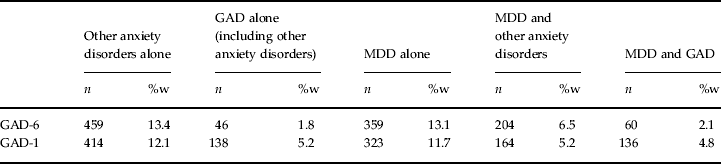
The overall prevalences for the offspring diagnoses are shown in Table 1, for both 1- and 6-month definitions of GAD. The shorter duration of GAD allows the group of MDD alone and MDD+other anxiety disorders to be reduced but the groups with GAD and MDD+GAD to increase.
Prevalences of disorder groups with the duration of generalized anxiety disorder (GAD) set at 6 months (GAD-6) and 1 month (GAD-1) (n = 3021)

MDD, Major depressive disorder; n, unweighted number; %w, weighted percentage.
Other anxiety disorders include panic disorder, agoraphobia, social phobia and specific phobia.
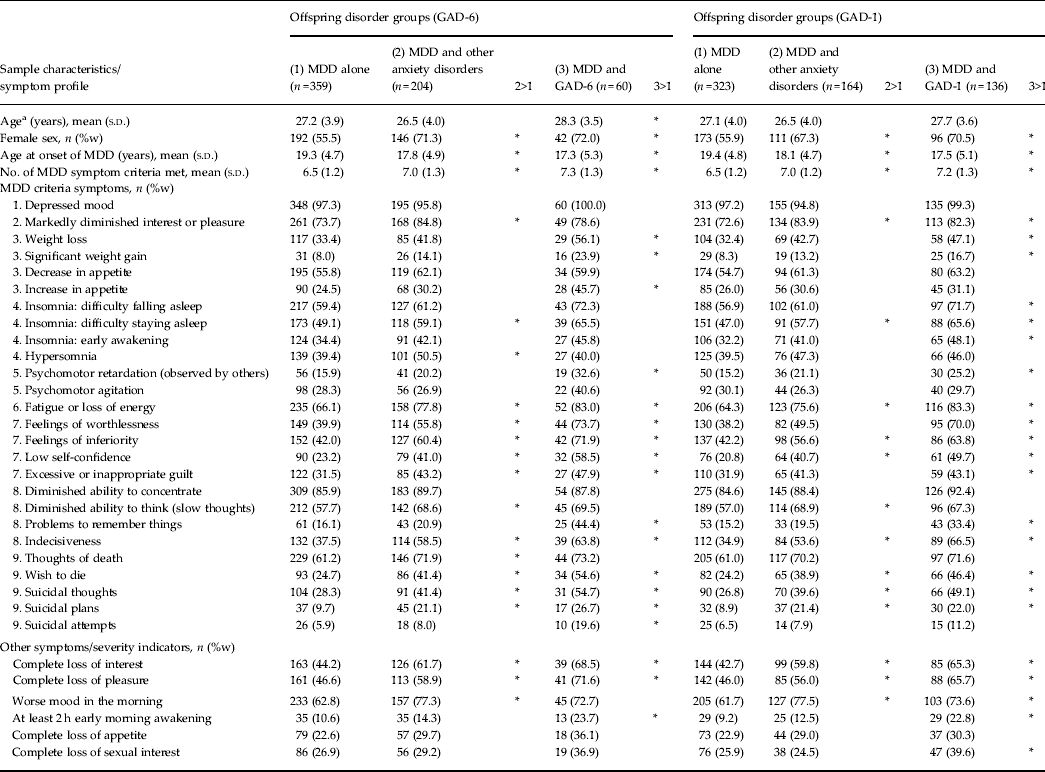
The mean age of the MDD+GAD groups was on average slightly higher (p < 0.05) compared to the MDD+anxiety disorder group for both GAD definitions and compared to the MDD-alone group for GAD-1 (Table 2). Both co-morbid MDD groups had a higher proportion of females, an earlier age at MDD onset and a higher mean number of MDD symptoms than the group with MDD alone (p < 0.05). More than half of the cases in the MDD+GAD groups revealed co-morbidity with other anxiety disorders (GAD-6: n = 40/60, 68.8%; GAD-1: n = 80/136, 57.2%).
Sample characteristics and depression symptom profile in the three diagnostic groups with the duration of generalized anxiety disorder (GAD) set at 6 months (GAD-6) and 1 month (GAD-1) (n = 3021)

MDD, Major depressive disorder; n, unweighted number; %w, weighted percentage; s.d., standard deviation.
Other anxiety disorders include panic disorder, agoraphobia, social phobia and specific phobia.
a Age at last assessment.
* Comparison with MDD alone significant at p < 0.05, from logistic regression, adjusted for sex and age.
The next step was to compare the three groups in terms of the frequencies of depressive symptoms as derived from the M-CIDI depression section (i.e. ignoring the anxiety symptoms that characterized the anxiety diagnoses). Table 2 shows that a broad range of depression symptoms, including severe symptoms such as suicidal ideation and complete loss of interest and pleasure, occur more commonly in the depression plus ‘other anxiety disorders’ group than in the depression-only group (Fava et al. Reference Fava, Alpert, Carmin, Wisniewski, Trivedi, Biggs, Shores-Wilson, Schwartz, Balasubramani and Rush2004). Furthermore, particularly severe symptoms such as early morning waking, weight loss, psychomotor retardation, diurnal variation of mood and guilt are added to the list when considering MDD+GAD-1.
Parental psychopathology
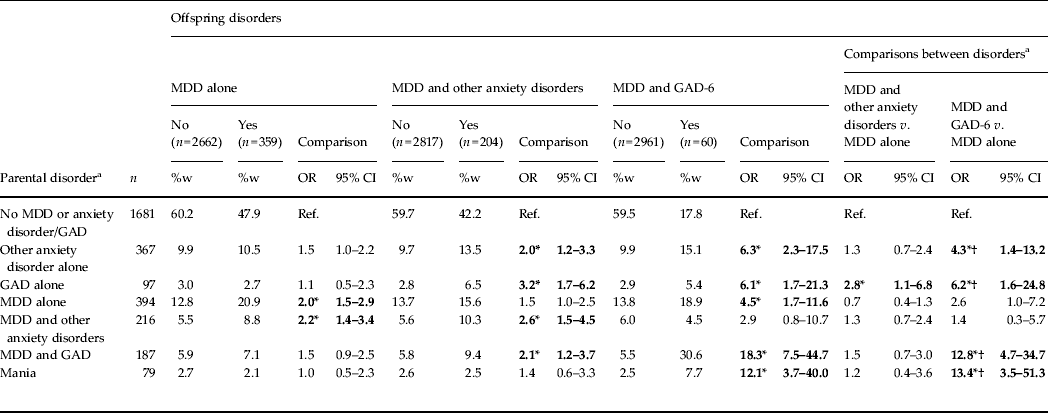
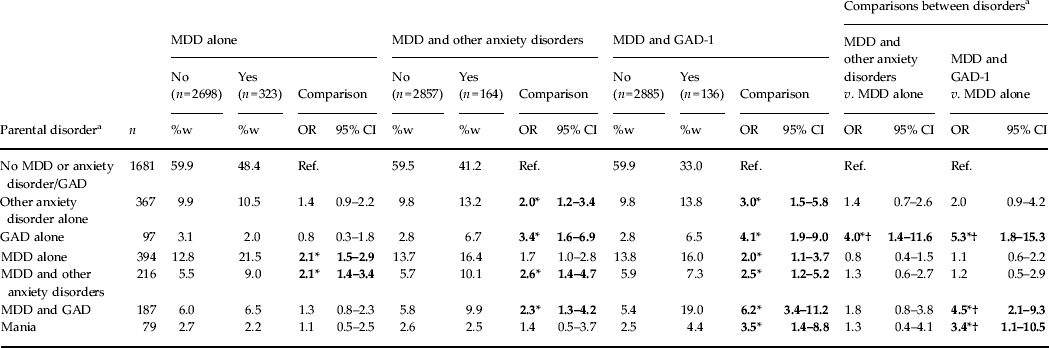
Table 3 shows the frequency of parental diagnoses for the three disorders among offspring (MDD only; MDD+other anxiety disorders, and MDD+GAD) for GAD as defined with a duration of 6 months and for GAD with a duration of only 1 month. The associations indicate that, whereas offspring with MDD alone have higher odds of parents with either MDD alone or MDD+other anxiety disorders, the other two disorders are each associated with a range of anxiety diagnoses. When MDD+other anxiety disorders is compared with MDD alone, only GAD alone (with or without other anxiety disorders) has a significant OR, but when MDD+GAD is compared with MDD alone, not only those with GAD alone but also those with MDD+GAD and mania have significantly raised ORs.
Frequency of and association with parental mental disorders in the three diagnostic groups, with the duration of generalized anxiety disorder (GAD) set at 6 months (GAD-6) and 1 month (GAD-1) (n = 3021) MDD, Major depressive disorder; n, unweighted number; %w, weighted percentage; OR, odds ratio from logistic regression, adjusted for age and sex; CI, confidence interval; Ref., reference. Other anxiety disorders include panic disorder, agoraphobia, social phobia and specific phobia.
a
Parental disorders in mutually exclusive categories, with mania being highest in the hierarchy. * Significant at p < 0.05. † Significant at p < 0.05 when adjusted for depression severity (no. of MDD criteria symptoms).

Given that symptom severity was higher in the co-morbid groups, we additionally adjusted the comparison between the three MDD groups for symptom severity (number of symptom criteria met). All associations remained significant, with the exception that the OR for parental GAD alone was attenuated to non-significance for the comparison of MDD+other anxiety disorders and MDD alone without GAD-6.
Overall, it can be seen that it makes little difference whether GAD is considered with a duration of 6 months or 1 month.
Offspring personality characteristics
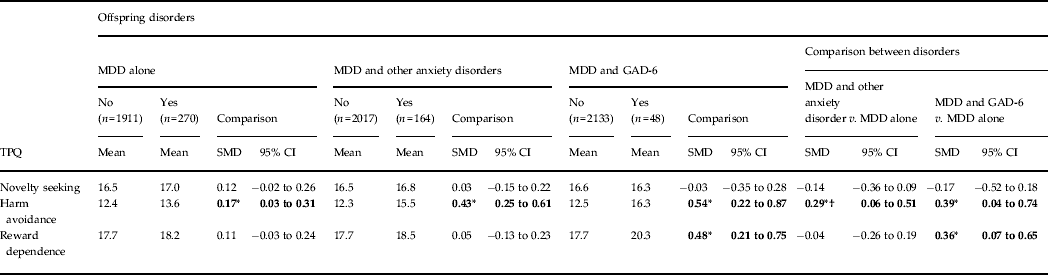
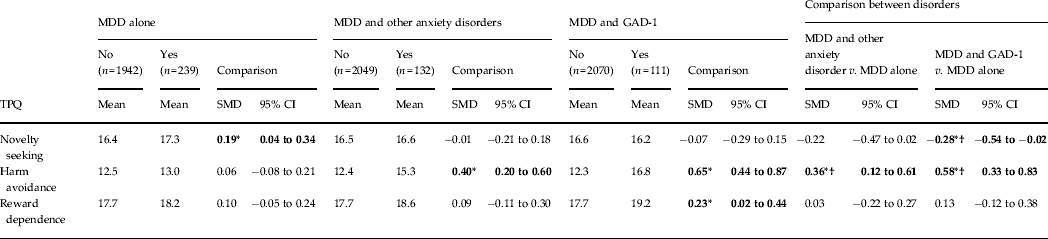
Table 4 shows the mean values for the three groups of offspring on the TPQ, for both the 6- and 1-month definitions of GAD. It can be seen that there is a steady increase in the mean value for harm avoidance from MDD alone to MDD+other anxiety disorders to MDD+GAD-6. The ORs for GAD-6 indicate that, although harm avoidance is associated with increased odds of all three disorders, with both MDD+other anxiety disorders and MDD+GAD have significantly greater ORs than MDD alone. The data are different for GAD-1: MDD alone is now no longer more likely to be harm avoidant, but is more likely to have a high value for novelty seeking. Both of the other groups are more likely to be harm avoidant, but the MDD+GAD-1 group is less likely to be novelty seeking than MDD alone. For both GAD definitions, co-morbid MDD+GAD is more likely to be reward dependent although the comparison with MDD alone is only significant for GAD-6. When the data are additionally adjusted for the severity of MDD, the between-group associations for GAD-6 attenuate to non-significance whereas the other between-group associations remain significant.
Scores and associations for personality characteristics in the three diagnostic groups, with the duration of generalized anxiety disorder (GAD) set at 6 months (GAD-6) and 1 month (GAD-1) (n = 2181) TPQ, Tridimensional Personality Questionnaire; MDD, major depressive disorder; n, unweighted number of participants; CI, confidence interval; SMD, standardized mean difference from linear regression based on standardized scores (mean 0, s.d. = 1), adjusted for age and sex. Other anxiety disorders include panic disorder, agoraphobia, social phobia and specific phobia. Mean values are based on unstandardized scores (standard deviation available upon request). * Significant at p < 0.05. † Significant at p < 0.05 when additionally adjusted for depression severity (number of MDD criteria symptoms).

Discussion
There are several very different, striking findings in this study: first, it is clear that depression without an anxiety diagnosis has fewer depressive symptoms than anxious forms of depression, and when GAD-1 is present the additional symptoms are those associated with more severe forms of depressive illness. In this way non-anxious depression emerges as the mildest form of depression, despite satisfying the criteria for MDD, and depression accompanied by GAD-1 is the most severe form. Depression accompanied by panic or phobic disorders is intermediate in severity between these two, with nine symptoms that did not discriminate between groups 2 and 1 but do discriminate between groups 3 and 1 (Table 2, for GAD-1) One reason why people with MDD+GAD should be more likely to have severe forms of depression than non-anxious depressives is that a longitudinal study (Moffitt et al. Reference Moffitt, Caspi, Harrington, Milne, Melchior, Goldberg and Poulton2007a ) has shown that cases of MDD+GAD are distinguished by having more severe disadvantages in early life than either disorder on its own. They not only have more symptoms, they also have more risk factors.
There are differences between offspring with MDD only and both the other groups in the odds of parental pathology. Offspring with depression alone have higher odds of having parents with MDD alone or MDD with other anxiety diagnoses, whereas offspring with MDD co-morbid with GAD are more likely to have parents with a wider range of diagnoses, including MDD+GAD and mania. These relationships are not affected by whether the duration of GAD is 1 month or 6 months. The association with BPD is seen with anxious forms of depression but not with non-anxious forms. This finding fits in well with the importance of anxiety in both MDD and BPD (Goldberg & Fawcett, Reference Goldberg and Fawcett2012). It is also consistent with the demonstration by Zimmerman et al. (Reference Zimmermann, Brückl, Nocon, Pfister, Lieb, Wittchen, Holsboer and Angst2009) that suggests that MDD is a heterogeneous concept including a large group of subthreshold BPD that is clinically significant and shares similarities with BPD. It is not suggested that there is a causal connection between parental pathology and depression without anxiety; what is demonstrated is an interesting association, open to the possibility that there are either genetic or personality differences in parents whose MDD is with or without anxiety.
There are also important differences in personality associated with MDD when a shorter duration of anxiety is considered for GAD because, compared with the longer duration, those with MDD+GAD are no longer more likely to be harm avoidant but are more likely to have increased mean scores for novelty seeking, whereas the association between co-morbid MDD+GAD and reward dependence is unaffected by the duration of anxiety. If GAD has its longer duration of 6 months, then non-anxious depression is more likely to be more harm avoidant than controls, in that it reflects longer-term anxiety.
The finding that co-morbid cases have greater scores on harm avoidance than MDD alone fits with the demonstration that cases of both GAD and MDD in the New Zealand cohort study had raised scores for negative emotionality relative to controls (Moffitt et al. Reference Moffitt, Caspi, Harrington, Milne, Melchior, Goldberg and Poulton2007a ), and is consistent with the National Co-morbidity study follow-up where only GAD had raised scores on neuroticism, whereas MDD on its own had no such significant elevation relative to controls (Beesdo-Baum et al. Reference Beesdo-Baum, Bittner, Pine, Stein, Höfler, Lieb and Wittchen2007). Thus harm avoidance, which is partly genetically determined, might be implicated in the findings reported; further research is clearly indicated.
These findings complement earlier findings that depression with anxiety has a worse prognosis, is less responsive to treatment and has a higher suicide rate (Goldberg & Fawcett, Reference Goldberg and Fawcett2012). Depression unaccompanied by significant anxiety should be thought of as a milder form of depressive illness with different characteristics in both associated parental pathology and personality. Depression accompanied by panic or phobic disorders is more severe than depression alone, even when the anxious symptoms are not taken into account, and when depression is accompanied by generalized anxiety, this is the most severe form of depression, irrespective of the duration of anxiety. These findings are based on symptom counts of depressive symptoms only, and take no account of the anxiety symptoms that are also present in the co-morbid groups.
At present, depression unaccompanied by anxiety and anxious forms of depression are conflated by our present classifications because each satisfies the requirements for major depression. These differences suggest that further research on the best treatments for each might be fruitful.
From the viewpoint of the clinical meaning of these findings, cases of depression without anxiety are frequently apathetic and with low energy levels whereas those with anxiety have symptoms related to higher alerting. Marked apathy is not included in the CIDI symptom list, and perhaps the depression encountered in a community sample rarely reaches the severity of cases treated by the mental health services, so accounting for the failure of retardation to appear as a characteristic of non-anxious depression. The severe forms of each are different: whereas the former is characterized by apathy and may present as a retarded depression, the latter may present as an agitated depression. Thus, depression without anxiety may respond selectively to alerting medications and activating psychological therapies whereas anxious forms of depression may respond better to sedating antidepressants. From a more theoretical perspective, anxious forms are associated with harm avoidance (or negative emotionality), and these have a wider co-morbidity along with important links to BPD.
The present findings can be considered together with emerging differences between the two disorders in functional (Andreescu et al. Reference Andreescu, Butters, Lenze, Venkatraman, Nable, Reynolds and Aizenstein2009, Reference Andreescu, Wu, Butters, Figurski, Reynolds and Aizenstein2011) and structural neuroimaging (Inkster et al. Reference Inkster, Rao, Ridler, Nichols, Saemann, Auer, Holsboer, Tozzi, Muglia, Merlo-Pich and Matthews2011), in neuropsychiatric and sensory testing (Bruder et al. Reference Bruder, Wexler, Stewart, Price and Quitkin1999; Taylor Cliff et al. Reference Taylor-Clift, Morris, Rottenberg and Kovacs2011; Nelson et al. Reference Nelson, Sarapas, Robison-Andrew, Altman, Campbell and Shankman2012) and the endocrine system (Rao et al. Reference Rao, Vartzopoulos and Fels1989; Meller et al. Reference Meller, Kathol, Samuelson, Gehris, Carroll, Pitts and Clayton1995). These findings, taken together with the data presented earlier, may shed further light on the differences between these two forms of depressive illness.
Limitations
First, the EDSP study did not include a group of depressives without anxious symptoms whereas our group of ‘depression alone’ contains cases of depression with anxious symptoms that have lasted up to 4 weeks. This cannot be avoided with the present dataset, but could readily be addressed in future research. Second, there are limitations imposed by the relatively small numbers of cases of GAD and mania, despite the fairly large population sample.
Conclusions
Despite these limitations, our findings support the view that if current anxious symptoms are considered rather than long-standing anxious symptoms, anxious depression is a more severe form of depression. This remains true even if the anxious symptoms are ignored. The anxiety specifier recommended in DSM-5 is a way of directing the clinician's attention to current anxiety symptoms, as these are indicative of important clues to the risk of suicide, the response to treatment and the likely clinical course. There is also a clear association between MDD+GAD and mania, which is especially marked with longer durations of anxiety.
Acknowledgements
This work is part of the EDSP study and is funded by the German Federal Ministry of Education and Research (BMBF) project nos 01EB9405/6, 01EB9901/6, 01EB0 162 00, 01EB0140 and 01EB0440. The fieldwork and analyses were also partially supported by grants LA1148/1–1, WI2246/1–1, WI 709/7–1 and WI 709/8–1 from the Deutsche Forschungsgemeinschaft (DFG). The principal investigators are H.-U. Wittchen and R. Lieb. Core staff members of the EDSP group are: K. von Sydow, G. Lachner, A. Perkonigg, P. Schuster, M. Höfler, H. Sonntag, T. Brückl, E. Garczynski, B. Isensee, A. Nocon, C. Nelson, H. Pfister, V. Reed, B. Spiegel, A. Schreier, U. Wunderlich, P. Zimmermann, K. Beesdo-Baum, A. Bittner, S. Behrendt and S. Knappe. Scientific advisors are J. Angst (Zurich), J. Margraf (Basel), G. Esser (Potsdam), K. Merikangas (NIMH, Bethesda), R. Kessler (Harvard, Boston) and J. van Os (Maastricht).
Declaration of Interest
None.