INTRODUCTION
The introduction of EU milk quotas resulted in a general decline in dairy farm numbers, while average farm size and milk production per farm increased substantially (van Berkum & Helming Reference Van Berkum and Helming2006). Milk quota constraints, coupled with a higher price for milk, limits the tendencies of more efficient producers to expand scale while creating a dynamic where less efficient producers remain in milk production (Burrell Reference Burrell2004). This has been more evident in some EU countries than others through the method of milk quota transfer regulation. Until recently (2007), Ireland operated an administrative system (targeted at specific groups) of quota transfer, then moved to a quota market transaction system for milk quota transfer with two milk quota exchanges operated annually.
Ongoing EU dairy sector policy reform will result in quota abolition by 1 April 2015, while milk quotas will be expanded between 2008 and 2014 to facilitate this market transition. Milk production deregulation has stimulated an expansion in dairying in other countries through increased productivity and operational scale (Valdes Reference Valdes1994; Rae et al. Reference Rae, Nixon and Lattimore2003). Similarly, the abolition of the EU milk quota has been commonly viewed as beneficial to the Irish dairy industry (van Berkum & Helming Reference Van Berkum and Helming2006; Dillon et al. Reference Dillon, Hennessy, Shalloo, Thorne and Horan2006), while Lips & Reider (Reference Lips and Reider2005) suggest that low cost grass-based milk production in Ireland could increase by 39% in a post-EU milk quota environment.
Milk quota abolition will result in other factors of production on dairy farms constraining overall production, such as land, stock or labour (Hennessy et al. Reference Hennessy, Shalloo and Dillon2005; Shalloo et al. Reference Shalloo, O'Donnell and Horan2007). In a grass-based system, the availability of grazing land at prices that will allow for a return on investment could become a major limitation, as some authors have projected land prices will remain high internationally in future (Kavalov Reference Kavalov2004). Similarly, labour availability can influence the attitudes of farmers towards expansion (Kimhi Reference Kimhi2000; Hennessy Reference Hennessy, Shalloo and Dillon2005). O'Donovan (Reference O'Donovan2008) observed that in comparison with the average industrial wage, which grew by 6·6% per annum during the years 1996 to 2007, family farm income increased by only 1·7% per annum in Ireland. Both Glauben et al. (Reference Glauben, Tietje and Weiss2002) and Giraud & Baker (Reference Giraud and Baker2005) observed that succession is a major force influencing the future decisions of farmers and the reduced comparative remuneration from agricultural careers reduces the likelihood of succession.
As a consequence of growing uncertainty about future market conditions and increased likelihood of milk price volatility associated with reduced EU internal market support, EU dairy farmers must now re-evaluate their farm businesses strategically with regard to scale of production and attitudes to future expansion.
Survey analysis has been acknowledged universally as a suitable mechanism to obtain reliable information across a large number of dairy farmers (McGregor et al. Reference Mcgregor, Willock, Dent, Deary, Sutherland, Gibson, Morgan and Grieve1995; Groves et al. Reference Groves, Biemer, Lyberg, Massey, Nichols and Wakesberg2001; Abildso et al. Reference Abildso, Zizzi, Abildso, Steele and Gordon2007; NBRI 2007). Battershill & Gilg (Reference Battershill and Gilg1997) concluded that in order to improve the understanding of the key farm structural relationships and the strategic and entrepreneurial behaviour of farmers, their future attitudes, objectives and goals should be considered. Farmers' answers to such questions reflect their expectations as entrepreneurs towards the evolution of their environment, which is otherwise difficult to capture (Thomson & Tansey Reference Thomson and Tansey1982) and which is an essential consideration for policy makers deriving a strategic roadmap for the sector.
The objective of the current paper was to survey a large group of Irish commercial dairy farmers to ascertain their future attitudes to dairy farming and to identify the key factors influencing farmers who intend to expand, exit or contract their businesses in the future.
MATERIALS AND METHODS
The design and methodology used in this survey has been outlined in detail in a previous paper using a subset of the current data (O'Donnell et al. Reference O'Donnell, Shalloo, Butler and Horan2008). The survey sample was selected from a complete list of all milk suppliers originating from the largest dairy processor in Ireland. The sample was selected randomly, based on a proportionate representation of suppliers broken down by location within the processor region, system of milk production (i.e. seasonal or all year round calving) and quota size. The respondents were also selected based on a representative proportion, within quota categories, of the entire population. There was a 0·82 response rate with 659 of the 776 suppliers in the sample completing the survey. The sample represents 0·14 of the entire processor population of 4806 suppliers.
A total of 30 key variables describing the existing dairy farms were created from the survey data that included:
11 farm size descriptors: Quota size in 2006, quota change (1998–2006), land area owned (around the parlour), land area rented (around the parlour), total land area fragmented (i.e. land which is not adjacent to the milking platform and therefore cannot be accessed by the dairy herd), total land area rented, number of land parcels fragmented (individual land segments which are not adjacent to the milking platform), number of cows per milking unit, location (branch) and system of production (creamery, liquid and winter).
Four stock variables: dairy cow herd size, number of replacement maiden heifers and heifer calves, dairy cows as a proportion of all livestock, dairy livestock as a proportion of all dairy stock.
Six infrastructural variables: The age (years) of the milking facilities and the milk tank, the capacity of existing animal housing (cow places), the number of additional cows that could be housed with a small investment (i.e. less than €300 per cow), the stocking rate (SR) as dairy cows/ha of dairy grazing platform and for all livestock on the total farm including all land parcels (livestock units (LU)/ha).
Three labour variables: Existence of (a) paid labour on the farm (yes/no), (b) Successor (yes/no/don't know) and (c) Off-farm employment (yes/no).
Two productivity variables: Milk production per cow and per hectare.
Four future outlook/attitudinal variables: Suppliers within the sample were classified according to their stated future intentions for the next 5 years: expansion (respondents who intend to increase their scale of production over the next 5 years), static (those who had no plans to change their system of production), contraction (those planning a reduction in milk production) and exit (those intent on ceasing dairy production). Respondents were also asked which factors most limited expansion (land, quota, labour, milk price, legislation, availability of a successor or other), if they believed that milk quotas should be abolished (yes/no) and how many additional cows they could handle without additional labour.
The sample of respondents was divided into five milk quota categories to analyse the effect of scale on the survey results. Each quota category had 132 respondents based on the total number of responses received (n=659/5). Average quota size (range) was 149 531 litres (0–173 000), 252 250 litres (173 000–268 000), 331 501 litres (268 000–360 000), 413 258 litres (360 000–454 000) and 671 899 litres (454 000–2 100 000) for Q1, Q2, Q3, Q4 and Q5, respectively.
Statistical analysis
The collated continuous survey data (quota size, cow numbers, etc.) were analysed statistically using the generalized linear model described below using the statistical procedures of SAS (SAS Institute Inc., Cary, NC 33) according to the following model:

where R ijkl is the result for the farm of system i in quota category j in location k; S i is the effect of ith system of production (i=1–3); Q j is the quota category (j=1, 2, 3, 4 and 5), L k is the location (k=1–13) and e ijkl is the residual error term. The effects of system, quota category and location were tested for significance using the residual mean square as the error term. Binary variables were analysed using chi-squares.
A subsequent specific regression analysis (PROC REG of SAS; SAS 2002) was carried out to measure the strength of the relationship between individual farm limitations and farmer attitude to expansion. Attitudes to future intentions were treated as the dependent variable, while the independent limitation variables used were categorical with the exception of quota size (litres per farm) and dairy platform SR (cows per grazing hectare). All models included an adjustment variable for location. The model building process involved the construction of a number of simple univariate regression models to determine which variables should be included. In the initial analysis, P<0·25 was specified for relevance for inclusion as independent variables in the final model. The outcome of the analysis was to construct final models that represented the influence of various farm-specific limitations on the attitudes of Irish dairy farmers to expansion. The independent variables were tested for multi-colinearity using the condition number (Fry Reference Fry1999) and no evidence of departures was observed. Co-efficient of determination (adjusted R 2) was used to estimate the proportion of variation explained by each model (Nagelkerke Reference Nagelkerke1991).
RESULTS
Future intentions of respondents
Suppliers within the sample were classified into four categories: Expansion, Remain Static, Contraction or Exit according to their stated future intentions for the next 5 years. When the results of the farmers stated future intentions is broken down by quota category (Q1–Q5); the proportions of farmers intending to expand for Q1, Q2, Q3, Q4 and Q5 were 0·28, 0·47, 0·61, 0·61 and 0·56, respectively, while the proportions intending to remain static were 0·36, 0·27, 0·23, 0·25 and 0·26, respectively. As quota size increased, the proportions of farmers intending to exit generally decreased (0·27, 0·18, 0·08, 0·09 and 0·08 for Q1–Q5, respectively). Finally, 0·09, 0·08, 0·08, 0·05 and 0·10 of farmers within Q1–Q5, respectively, stated that they intended to contract dairy production over the next 5 years.
Characteristics of farmers based on future intentions
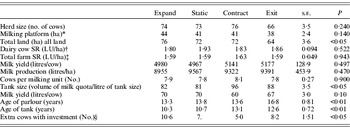
The average quota size for farmers intending to expand, remain static, contract or exit was 368 318, 366 847, 394 789 and 342 486 litres, respectively, while there was no significant difference in either quota increase from 1998 to 2006 or replacement heifer availability for those intending to expand, remain static, contract or exit. Farmers planning to exit milk production have smaller total land area (including external land parcels). Future intentions were also unrelated to both the dairy platform and total stocking densities, while milk productivity (per cow and per hectare) was similar regardless of the future intentions of the farmer.
In terms of infrastructural capacity, Table 1 shows no significant effect of future intention on the existing number of cows per milking unit in the parlour, while those farmers planning to expand already have greater milk storage capacity (P<0·05). The results also show that there was a significant relationship between the age of milking facilities and future intentions, with farmers intending to expand having more modern parlours and tanks. The average age of the parlour (16·8 years) and tank (12·6 years) was significantly older on farms that intended to exit dairy production compared to farms expanding over the next 5 years (13·3 and 10·3 years, respectively). Dairy farms intending to expand in dairy production had more housing that could be converted to dairy housing with a small investment. Conversely, farms that intended to contract in dairy production could convert on average only 5·0 cow places with a small investment. Farmers who intend to expand also tended to have greater existing housing facilities to cater for an expansion of 15 or more cows when compared with those contracting or exiting.
The characteristics of surveyed dairy farmers according to their future intentions

* Milking platform is total land adjacent to the milking parlour.
† Stocking rate adjacent to milking parlour for cows only.
‡ Stocking rate for total farm stock on total land area farmed.
§ The number of extra cows that could be housed with a small investment of less than €300 per cow.
Successor/hired labour/off-farm employment
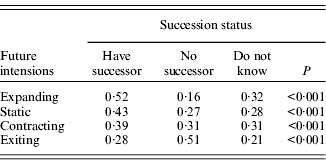
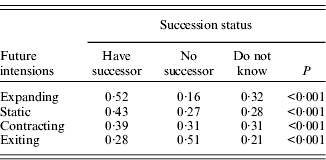
There was a significant relationship between the availability of a successor and future intentions with a larger proportion of those farms with an identified successor intending to expand (Tables 2 and 3). On those farms intending to expand, 0·52 had identified a successor, while only 0·28 of those intending to exit had a successor identified. There was paid labour on 0·55 of farms surveyed. The presence of hired labour on farm had no significant effect on future intentions with 0·53 and 0·12 of respondents intending to expand and exit on farms with hired labour compared to 0·47 and 0·17, respectively, on farms with no hired labour. Off-farm employment, as described within the current survey, refers only to the main operator and does not extend to the spouse. While having no impact on future intentions, the survey showed that 0·15 of farmers have off-farm employment.
Effect of farm succession status on the stated future intentions (proportion) of surveyed farmers
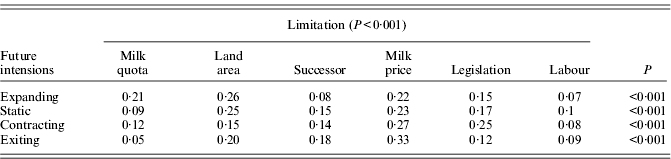
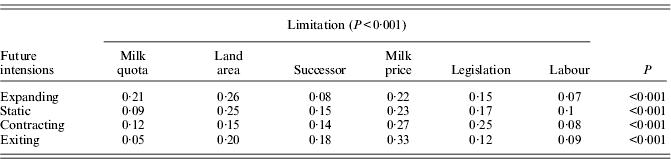
Effect of limitations on the future intentions (proportion) of dairy farmers
Effect of various limitations on farmer attitude to expansion
Respondents were questioned as to what they perceived to be the factor that constrains the future viability of their enterprise. Among farm businesses that intend to expand, chi-square analysis identified land, milk price and available milk quota as the most important constraining factors, while farmers who intend to exit dairying in the next 5 years considered milk price, land base and the availability of a successor as the most limiting factors. Regression analysis was used to describe the strength of the relationship between individual farm limitations and farmer attitude to expansion. Location, availability of a successor and existing milk quota size were identified as the limitations that had the greatest influence from the regression procedure. The final model developed incorporating these key limitation factors had an adjusted R 2 of 0·21, indicating the appropriateness of the final model to the intentions of the surveyed farmers.
Attitudes towards quota
Preliminary results from this survey show that 0·51 of respondents would prefer to have quotas abolished. Of the farmers who intended to expand over the next 5 years, 0·60 wanted quotas abolished. Conversely, of the farmers who intended to remain static, only 0·42 wanted quotas abolished, while 0·36 of farmers who intended to exit dairy production wanted quotas to be abolished. Respondents who wanted quotas to be abolished were subsequently requested to state which year they would like to see quotas abolished (from the possibilities; 2008, 2010, 2012 and 2014). Of farms expanding, 0·65 would prefer to see milk quotas abolished by 2010.
Characteristics of farm expansion
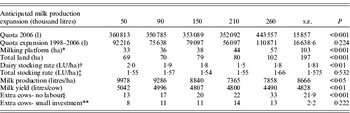
Table 4 categorizes expanding farms based on the level of expansion in production which they intend to achieve over the next 5 years. Farmers planning larger expansion already have larger quotas, although the percentage quota expansion since 1998 is similar for all groups. As the level of planned milk expansion increases, the land area around the milking platform and total land area also increases. The largest expansion is planned on farms with lower dairy grazing platform SRs although total farm SR is similar for all groups. The farms that plan to increase most currently have lower milk yields per cow and are producing relatively lower milk on a per hectare basis. The results reveal that those herds planning the greatest expansion in milk production have greater capacity to manage additional cows with small investments and to increase herd size without additional labour.
Effect of scale of anticipated expansion on the characteristics of surveyed farms

LU=livestock unit.
* Milking platform is total land adjacent to the milking parlour.
† Stocking rate adjacent to milking parlour for cows only.
‡ Stocking rate for total farm stock on total land area farmed.
§ The number of additional cows that could be milked without additional labour.
** The number of extra cows that could be housed with a small investment of less than €300 per cow.
DISCUSSION
Telephone surveys deliver strong response rates while allowing a large sample to be interviewed and realizing reliable and accurate results (NBRI 2007). The distribution of a cover letter containing the questionnaire was designed to strengthen the accuracy, reliability and response rate of the current survey (Greene et al. Reference Greene, Speizer and Wiitala2007). O'Donnell et al. (Reference O'Donnell, Shalloo, Butler and Horan2008), using a subset of the current data, observed that average quota size, SR, milk production per cow and average cow numbers of 305 503 litres, 1·78 LU/ha, 4805 litres and 65 cows, respectively, for the sample were similar to data published for the national specialist dairy farmer (Connolly et al. Reference Connolly, Kinsella, Quinlan and Moran2007), indicating that the survey population is consistent with the national population statistics. The overall level of expected expansion and exit from the industry in the current survey is similar to previously reported findings. Almost half (0·49) of the sample in the current survey stated their desire to expand milk production, while Coleman & Harvey (Reference Coleman and Harvey2004) surveyed 369 dairy farms in the UK in 2002/03 and found that 0·56 stated their intention to increase production. Abare (Reference Abare.2002) reported that 0·43 of surveyed Australian dairy farmers' intended to expand. The current survey reveals that 0·14 of dairy farmers intend to exit milk production over the next 5 years, which is consistent with the current exit rate of 0·03 per annum nationally (DAFRD 2006).
The results of the present study indicate that location, quota size and, in particular, succession are important considerations influencing individual farmers attitude to expansion, while the R 2 of 0·21 from regression procedures indicates that there are multiple interrelating farm-specific factors governing individual farmers' attitude to expansion. The overall efficiency of milk production in Ireland is dependent on the conversion of cheap, high-quality grazed grass to milk products (Dillon et al. Reference Dillon, Crosse, Stakelum and Flynn1995) and regional influences on attitudes to expansion may relate to the differences in the efficiency of pasture-based milk production. Shalloo et al. (Reference Shalloo, Dillon, O'Loughlin, Rath and Wallace2004b) observed significant differences in economic efficiency between regions with 20% higher average production costs in impermeable soil types with high rainfall in comparison with a free draining soil with moderate rainfall, and attributed these increased costs to increased rainfall on an inferior soil type. Similarly, Ryan (Reference Ryan1974) and later Thomasson (Reference Thomasson1979) postulated that herbage production on wetter soils may be depressed by 25% or up to 2 t dry matter (DM)/ha on poorly drained soils in comparison with drier soils. The results of the current study reflect the comparative advantage in milk production within drier regions and suggest that future production can be anticipated to occur to a greater extent within areas of favourable production characteristics.
In line with previous studies (Hadley et al. Reference Hadley, Harsh and Wolf2002), the current survey also shows that smaller farms are more likely to exit dairying. Farmers intending to cease dairy production over the next 5 years have fewer cows and less owned land available on the grazing platform. Lack of viability arising from reduced farm incomes from small-scale farms has been observed to accelerate the level of exit from dairy farming (Bentley & Saupe Reference Bentley and Saupe1990; Breustedt & Glauben Reference Breustedt and Glauben2007). Conversely and consistent with previous studies (Speicher et al. Reference Speicher, Nott and Stoll1978; Bewley et al. Reference Bewley, Palmer and Jackson-Smith2001), the results of the current survey show that farmers planning to expand milk production are larger in terms of average quota, land area around the parlour and cow numbers. Farms planning the largest expansion in milk production are shown to have considerable capacity around the milking platform with moderate SRs and low production per hectare and milk yield in comparison with targets achievable (Shalloo et al. Reference Shalloo, Dillon, O'Loughlin, Rath and Wallace2004b; Horan et al. Reference Horan, Dillon, Faverdin, Delaby, Buckley and Rath2005). The findings also clearly indicate that farmers past behaviour towards quota expansion is not an indicator of future attitudes and intentions, with the findings showing that there was no relationship between farms that had expanded milk production and those that had remained static over the past 8 years.
The survey reveals that the availability of a successor is an important factor influencing the future intentions of dairy farmers. The findings reveal that 0·52 of farmers that intend on expanding have a successor. Further evidence acknowledging the strong relationship between the future intentions of farmers and the availability of a successor is apparent with 0·18 of farmers exiting citing the absence of a successor as a limiting factor. Previous research also supports the significance of a successor on the attitudes and decision making of farmers with respect to farm expansion (Rogers & Salamon Reference Rogers and Salamon1983; Gasson et al. Reference Gasson, Crow, Errington, Hutson, Marsden and Winter1988). Harrison (Reference Harrison1975) found that farms without a successor tended to exhibit lower levels of capital investment and farmed less intensively. Harrison (Reference Harrison1975) found that during the 1970s succession contributed to farm expansion, both in terms of size and intensity of production. Gasson et al. (Reference Gasson, Crow, Errington, Hutson, Marsden and Winter1988) also observed that younger farmers with successors were more likely than older farmers to invest in farm assets, whereas older farmers appear to be more interested in consolidation and security.
Farmers considering their future within dairying must evaluate their current system of production in terms of possible efficiency gains through increased operational scale. Boyle (Reference Boyle2002) and Thorne (Reference Thorne2005) showed that while Ireland had the lowest cash costs of production in Europe, total economic costs were comparably high arising from low productivity. Franks et al. (Reference Franks, Cain and Farrar2002) stressed the importance of labour productivity, grassland management and feeding strategy as avenues to increased operational efficiency as the scale of operations increases. While 0·29 of farmers surveyed stated that they plan to remain static, uncertainty over the future direction of the industry (quota abolition, future milk price, land price and availability) is undoubtedly a contributory factor. Many of these farmers identified land as an influential limiting factor constraining expansion; however, recent research findings suggest that a much higher carrying capacity can be achieved using modern management technologies (Horan et al. Reference Horan, Dillon, Faverdin, Delaby, Buckley and Rath2005; McCarthy et al. Reference Mccarthy, Horan, Dillon, O'Connor, Rath and Shalloo2007). It is hypothesized that milk price volatility within the EU will have a major influence on the confidence and future attitude of the static farmer. Shalloo et al. (Reference Shalloo, Dillon, Rath and Wallace2004a) simulated eight possible scenarios over the period 2004–13 and concluded that dairy farmers who remain static will suffer a 30% loss in real income during the period and therefore must expand their farm businesses to remain profitable.
Similar to previous studies (Hadley et al. Reference Hadley, Harsh and Wolf2002; Coleman & Harvey Reference Coleman and Harvey2004; Lips & Reider Reference Lips and Reider2005; Breustedt & Glauben Reference Breustedt and Glauben2007), the current survey shows that quota removal will result in increased overall levels of milk production generated predominantly from larger herds. When the milk produced from farmers planning to exit is removed from the total milk produced and the increased milk production from those farmers who indicated that they were going to expand is included, the net increase in overall milk production for the survey population is c. 9%, which further demonstrates that dairy farming businesses in Ireland are currently constrained by EU milk quotas. P. Dillon (personal communication) observed that milk quotas have constrained Irish dairy farmers based on the rate of increase in the scale of milk production per farm when compared with competitors in the EU (Denmark and Holland) and worldwide (New Zealand and Australia), since milk quotas were introduced in 1984. Lips & Reider (Reference Lips and Reider2005) postulated that in addition to other regions of competitive advantage within Europe, milk production in Ireland could increase by 39% post-quotas, while Donnellan & Hennessy (Reference Donnellan and Hennessy2007) also revealed that Ireland had capacity to increase milk supply by 20% using the existing resources on dairy farms.
CONCLUSIONS
The results of the current survey indicate that Irish dairy farmers continue to be constrained by EU milk quota and that quota abolition will result in a significant increase in milk production in Ireland, generated predominantly from larger herds. These results underline that the farms most likely to exit were smaller in terms of scale of enterprise. These results also indicate that while multiple interrelating farm-specific factors govern individual farmers' attitude to expansion; succession location, farm size, facility standard and age are the most significant factors affecting future milk production. The existence of a successor on farms to take over the enterprise was cited as one of the most significant factors affecting the future intentions of dairy farmers.