Any city, however small, is in fact divided into two, one the city of the poor, the other of the rich; these are at war with one another.
—Plato Footnote 1
The right of suffrage is a fundamental article in republican constitutions. The regulation of it is, at the same time, a task of peculiar delicacy. Allow the right exclusively to property, and the rights of persons may be oppressed. The feudal polity alone sufficiently proves it. Extend it equally to all, and the rights of property or the claims of justice may be overruled by a majority without property.
—James Madison Footnote 2
As Hillary Clinton officially kicked off her campaign for president on Roosevelt Island in June 2015, she touched on an issue that has become central to U.S. politics—economic inequality: “You see corporations making record profits, with CEOs making record pay, but your paychecks have barely budged. While many of you are working multiple jobs to make ends meet, you see the top 25 hedge fund managers making more than all of America’s kindergarten teachers combined.” Footnote 3 Clinton has also emphasized making it easier for average Americans to vote by making voter registration universal and automatic in the United States. Though these may seem to be separate issue appeals, we argue here that the extent and nature of participation in choosing leaders is closely associated with the distribution of resources in society.
Since ancient times observers have noted that conflict between the “haves” and “have-nots” is a perennial cause of political strife. But for most of human history, the masses had a very limited ability to influence economic policy and outcomes—small groups of relatively wealthy elites governed most societies. In the United States, slavery, Jim Crow, property requirements for voting, and the denial of the franchise to women all contributed to this phenomenon. With the expansion of the mass franchise, the input of broad segments of the public into economic policy-making was institutionalized, coinciding with an era of unprecedented economic equality in the West. Footnote 4 Yet, after just a few decades, we have witnessed the reversal of this “great compression.” In America, it appears that elections have failed to ensure policies and outcomes consistent with the preferences and interests of the many. Footnote 5 Despite growing attention to inequality, our understanding of how mass politics shapes distributional outcomes remains limited.
From a “majoritarian” democracy perspective it may seem obvious that in a representative democracy who votes would matter for these outcomes. In the Downsian model of politics the preferences of the median voter matter, Footnote 6 and if the median voter is poorer, then scholars have argued that we should see more progressive policies and less inequality. Footnote 7 But many recent studies of American politics generally—and the politics of inequality specifically—reject this majoritarian viewpoint. These studies, emerging from what might be called an “elitist” or “oligarchic” conception of democracy, challenge the idea that elections matter very much for policy or distributional outcomes, because policy and distributional outcomes reflect the activities and preferences of powerful organized interests more than the preferences of the mass public, which are largely ignored. Footnote 8 In any case, studies that have considered the question emphasize the similarities between voters and non-voters in the contemporary United States. Footnote 9
While we do not reject the idea that organized groups are powerful determinants of policy outcomes and that voters and non-voters agree on many issues, we consider whether who votes matters for the ideology of government, economic policies, and ultimately distributional outcomes. We agree that wealthy interests can shape policy through lobbying and campaign contributions, and that this limits the mass public’s control over these outcomes. Nevertheless, even with its impediments and difficulties the vote is still a lower cost activity than lobbying or contributing money to politicians, and thus affords greater opportunities for mass control over governments, policies, and economic outcomes than these other channels of influence. One reason we suspect that who votes matters is that fights over who has the right to vote and contests to mobilize different economic segments of the electorate are a staple of legislative and electoral battles throughout the history of Western democracies, especially in the United States, which is the focus of this analysis. Furthermore, as inequality has grown and become more salient, so too have elite attempts to restrict the vote in many U.S. states. Footnote 10 Majoritarian models of democracy assume that the median voter holds sway over outcomes, and political elites must believe this to some degree since they also use their resources to shape who the median voter is—upper income interests try to ensure that the median voter is wealthier. Indeed, we will argue that class bias in voting is to a considerable degree the manifestation of the power of upper- versus lower-class interests in the political process.
Our work draws on insights from both majoritarian and elite-based views of American democracy and provides new evidence of the policy consequences of class bias in electoral participation. Consistent with oligarchic perspectives, political elites try to manipulate who votes. Consistent with majoritarianism, who votes matters. Because wealthier individuals prefer more conservative governments and economic policies and are less concerned about egalitarian outcomes, Footnote 11 we expect that when there is more electoral class bias—that is, the affluent are overrepresented among voters compared with the population at large—governments and economic policies will be more right-leaning and inequality will be higher. We find support for this expectation in an analysis of U.S. states from 1976 to 2006. We show that class bias has real, empirically-verifiable policy consequences. States with less “class-biased” electorates have more liberal governments and economic policies. And these outcomes, in turn, produce less economic inequality. Though our analysis focuses on the United States, our findings have implications for long-running debates in comparative politics about the connections between democracy and inequality. Footnote 12
Elections, Representative Government, and the Income Distribution
Though economic conflict has been a key driver of political divisions in virtually all societies, until recently it has never been much of a fight. Historically, those with few resources had a limited ability to have their views considered in policy formulation as most polities were run by a small group of affluent elites. The growth of representative institutions changed this. Footnote 13 Western representative institutions are built on the idea of individuals within a territorially-defined constituency choosing their representatives, which is intended to ensure some degree of responsiveness. Footnote 14 However, if the act of choosing (via elections) ensures responsiveness, representatives are more likely to be responsive to those that actually choose them, that is, voters. Footnote 15
In the early phase of “democracy” in many affluent countries, the right to vote was intentionally restricted to those citizens with property and wealth. Footnote 16 Universal male suffrage was generally not granted until the late 1800s (or even much later in the U.S. South) and women were not granted the right to vote in some European countries until after World War II. Footnote 17 Soon after mass democracy was introduced, the first mass-based political parties were also created. Footnote 18 Some of these parties developed left-wing ideologies to mobilize lower income groups, Footnote 19 while others used patronage or a combination of both. Footnote 20 The results of these legal changes and mobilization efforts were astonishing. In the mid-1700s not a single American colonist had any formal role in selecting those with ultimate authority over policy in the colonies (the King of England and Parliament), but by the late 1800s nearly 80 percent of the voting-age population was participating in elections to choose the U.S. president. Footnote 21
Why this expansion of the franchise occurred at all has puzzled scholars. It has almost universally been held that the mass franchise would constitute a threat to the wealthy elites who have traditionally controlled most societies. Alexis de Tocqueville argued that expanding the electorate to include the masses would lead to more redistribution. And a fear of the expropriation of the wealth and property of the rich by the poor seems to have at least partly motivated James Madison’s fixation on preventing majorities from wielding too much authority since, as he put it, pure democracy is “incompatible … with the rights of property.” Footnote 22 From the other side of the class divide, early advocates of socialism believed that electoral democracy would lead to the triumph of socialism over capitalism. Footnote 23
Why would the political elites in charge of governments expand the franchise if this were the case? One view is that it was done under duress—elites traded the mass franchise in order to not be killed in violent revolutions. Footnote 24 Not all scholars share this view, however. Ben Ansell and David Samuels argue that rather than reflecting the triumph of the masses over wealthy elites, the expansion of democracy reflected competition among political elites with varying degrees of wealth, with the un-propertied and low-income masses largely on the sidelines. Footnote 25 As we will see, this debate about the origins of mass democracy has parallels to modern disagreements about the role of the mass public in shaping governments, policies and economic outcomes. Regardless of the origins of the mass franchise, it seems clear that broader enfranchisement coincided with the development of more egalitarian policies and outcomes in Western democracies. Footnote 26 But once mass democracy exists, does it matter that in practice the poor often vote less often than the wealthy, particularly in the United States?
Majoritarian Democracy, Elitist Democracy, and Economic Equality
Inequality has grown considerably in most affluent democracies in recent decades, but nowhere has this growth been more rapid than in the United States. This growing economic inequality has sparked a resurgence of interest in the question of whether American politics has shifted away from a political process that is largely shaped by electoral majorities, which in keeping with Martin Gilens and Benjamin Page’s recent study we call “majoritarian democracy,” toward a political system dominated by well-organized political elites, which can be called “elitist democracy.” Footnote 27 On the one hand, in aggregate, over the long term since World War II policy appears to be quite responsive to the preferences of the mass public. Footnote 28 On the other, recent research that focuses on the last few decades suggests that the responsiveness to the mass public has deteriorated and that policy most often reflects the preferences of business interests and the wealthy. Footnote 29 We argue that considering these two views of democracy in America provides a useful framework for understanding how the composition of the electorate affects policy outcomes and economic inequality.
Majoritarian interpretations of American politics place elections at the center of democratic responsiveness and policy formation. If politics is about who gets what, when, and how, Footnote 30 majoritarian perspectives on democracy suggest that the answers to these questions will be different when political leaders are selected by a cross-section of economic groups compared to a small group of wealthy elites. These scholars are in a sense the intellectual heirs of Tocqueville. Most influentially, Anthony Downs propelled the idea that who votes matters by formally explaining that the median voter would determine the policy positions of parties, which it was presumed would then enact such policies. Footnote 31 Using the logic of the Downsian model, Allan Meltzer and Scott Richard formalized the idea that expanding the electorate would lead to increased redistribution, an argument taken up in more recent work. Footnote 32 The reason for this supposed redistribution is simply that the median voter has less income or wealth than the wealthy, and thus the median voter will want to redistribute resources and will be able to through democratic means.
Even within the framework of the majoritarian perspective the redistributive effects of mass voting may not be realized, however. These median voter-inspired models assume that rich and poor have different preferences for the income distribution and that most or all individuals vote, neither of which may be realistic. In the United States the poor are much less likely to vote than the wealthy, so the median voter is wealthier than the median income earner. Though voters and non-voters often have similar preferences, Footnote 33 recent research examining class- or income-based differences show that the poor support redistribution and other egalitarian policy preferences much more strongly than the wealthy. Footnote 34
Some scholars have argued that politicians consider the views of even non-voters because they could be mobilized to vote in the future, and there does seem to be a broad congruence between mass preferences and policy adoption in the decades after World War II. Footnote 35 Research more specifically focused on the question of responsiveness to the preferences of voters and non-voters, however, shows that even if politicians may be responsive to non-voters to some degree, they are more responsive to those who are more likely to vote. Footnote 36 And because the rich are more likely to vote, Jan Leighley and Jonathan Nagler find that non-voters generally prefer more redistribution and have more egalitarian policy preferences, such as greater support for government-provided health insurance and making it easier to form unions. Footnote 37 If politicians respond to voters more than non-voters, this would mean that where the rich vote at much higher rates than the poor—i.e., there is more “class bias” in the electorate—we would expect less liberal governments and economic policies and more inequality.
One other possibility is that policy just does not matter for distributional outcomes, so the preferences of voters do not influence the income distribution. However, a growing body of research, focused on the United States and other affluent democracies shows conclusively that a variety of policies (from higher taxes on the wealthy to a larger safety net to pro-union policies) are associated with more equal income distributions. Footnote 38 In fact, Jacob Hacker and Paul Pierson argue that policy changes are central to understanding the growth of inequality in America. Footnote 39
Indeed, Hacker and Pierson’s work suggests that rather than being controlled by the median voter, it is the fight among organized interests that determines policy outcomes, a point that is echoed in other recent research, which can be called “the elitist” mode of democracy, though calling it democracy may be a stretch. Footnote 40 From this standpoint, although voters technically choose who represents them, it is what happens between elections in the day-to-day policymaking that takes place in Congress, agencies, and elsewhere that determines policy and economic outcomes. From this perspective, to the extent that policy reflects the preferences of lower-income voters, it is not only because these individuals vote, but also because organizations that represent them are active in lobbying and financing campaigns.
The egalitarian economic policies of the New Deal and Great Society eras owed much to the muscle of the union movement. Partly in response, beginning in the 1970s business and the wealthy became heavily mobilized into politics, investing huge sums in lobbying, campaign contributions, and molding public opinion. Footnote 41 According to Hacker and Pierson’s historical account, this upper-class mobilization and the decline of labor unions created a situation where the government became responsive to those with money and less responsive to average Americans. The result of this lack of responsiveness is more conservative policies like a rollback of many New Deal and Great Society policies, including the heavy taxation of wealth, financial regulations, and labor protections creating a new era of growing inequality. Footnote 42
A number of detailed statistical studies support the general view that policymaking institutions are not very responsive to the mass public, but instead cater to organized interests representing business and the wealthy. Analyzing roll-call votes, Larry Bartels demonstrates that senators are responsive mostly to the wealthy, only occasionally to the middle class, and almost never to the poor. Footnote 43 Similarly, Martin Gilens (Reference Gilens2012) shows that Congress is most responsive to affluent voters, and James Druckman and Lawrence Jacobs (Reference Druckman and Jacobs2015) provide evidence suggesting that presidents are most responsive to the wealthy. Footnote 44 With the ability to change policies they do not like, elite actors can exploit institutional structures to stymie policymaking that would benefit the majority, which is easier in countries with numerous veto points like the United States. Footnote 45 Taken to its logical limit, a theory of elite-dominated democracy suggests elite power may become so influential that the mass public will eventually have very little or no effect on the actions of the government and distributional outcomes. In an explicit test of majoritarian and elite-based views of democracy, Gilens and Page find that the preferences of organized business interests trump those of the median voter. In contrast, they do observe that the preferences of Americans at the ninetieth income percentile are often associated with policy outcomes. Footnote 46
Electoral Class Bias: Bridging the Gap between Majoritarianism and Elite Dominance
These “elitist” studies are compelling and seem to cast doubt on majoritarian views of American democracy. It is also possible, however, that these studies have overlooked the importance of elections in our contemporary political system. It is true, as Gilens and Page have found, that the preferences of the wealthy are better represented than those of the public as a whole. But these findings and this literature in general rarely take into account that the average citizen is often different from the average (or median) voter. Additionally, these studies do not typically consider the indirect effects voting may have on policy outcomes. The composition of the electorate not only influences who elected officials pay attention to, but voters more immediately shape the kinds of politicians that end up in office. If, for example, a less biased electorate leads to a relatively more liberal-leaning legislature we would expect to see more policies enacted that are closer to the preferences of those with fewer economic resources, controlling for a given level of influence of business and the wealthy in the interest system. Similarly, it makes sense that a more conservative legislative body would be less responsive to a public that is relatively more supportive of government redistribution.
Furthermore, if voting does not matter for policy outcomes then why has so much effort been expended to deny or roll back voting rights throughout American history? Footnote 47 And why do parties and organized interests invest so much money in mobilizing “their” voters? We take the view that the majoritarian and elitist perspectives are not in as much conflict as it may initially seem. Neither organized interests nor the mass public via voting can determine policy and distributional outcomes. Organized interests constrain what the public can get from government, and vice versa. Political elites try to shape participation precisely because they recognize that electoral results have an essential influence on political, policy, and ultimately, economic outcomes. Business interests and the wealthy have a lot of power in the policy process, but certain policies are more likely to be adopted when certain types of officials are elected. Similarly, organized interests representing different segments of society strive to mobilize their voters precisely to affect who the median voter is. Thus, electoral class bias is in many respects a convenient barometer of the power of upper and lower income groups in the political process.
Though few elites would openly advocate for restricting the vote to the wealthy or propertied as such, there have been renewed attempts to legally restrict the right to vote in America in recent years. If who votes matters, we would expect that governments run by the wealthy might seek to place restrictions on the ability of those with lower incomes to vote, out of fear that they would demand more egalitarian policies, and this is precisely what seems to be taking place. Footnote 48 While there may be principled reasons to support voter identification laws, proponents of these laws in state governments have been remarkably transparent in explaining their support as an effort to reduce turnout among more left-leaning voters. Footnote 49 Felon disenfranchisement laws have been around for a very long time in many states, but with the expansion of mass incarceration a much larger and disproportionately poor proportion of the population is barred from voting as a result of these laws. Footnote 50
But not all states have embraced attempts to limit voting rights. Since 2014, for instance, Hawaii, Illinois, and Vermont have all adopted Election Day, same-day registration policies. In 2015 Oregon and California became the first states to automatically register residents to vote through their respective Departments of Motor Vehicles. Footnote 51 These types of election reforms are important since they have been shown to increase overall voter turnout, particularly among those who do not consistently participate in elections. Footnote 52
In addition to shaping election laws, political elites also shape the electorate with their decisions about which segments of the public to mobilize, and mobilization efforts are especially critical for involving the poor and lower class because they have fewer resources to support autonomous participation in politics. Footnote 53 Left-leaning parties that represent the lower class and labor unions have been the main political mobilizers of lower income groups in affluent democracies. Footnote 54 In the United States, unions have played a critical role in mobilizing lower- and middle-income groups, historically alongside the Democratic Party. Footnote 55 Of course, unions have declined dramatically in recent decades, which is in itself partly a result of attempts by business and the wealthy to weaken labor. Footnote 56 As unions have declined, business and the wealthy have rushed in to fill the resource vacuum created by the decline of organized labor. Mass parties that once mobilized lower-class voters now increasingly focus their mobilization activities on upper income voters, exacerbating existing resource disparities among citizens. Footnote 57 Not surprisingly, then, Leighley and Nagler demonstrate that lower-class voters have become less likely to vote in the United States since the 1960s. Footnote 58 Gilens and Page find that the preferences of the median-income earner are largely ignored in the policy process, and growing electoral class bias means that the median income earner is less likely to vote, making the median voter wealthier. Footnote 59
Thus, the variation that we observe in class bias reflects the differential power and ability of upper- and lower-class interests to mobilize their supporters. Because less-wealthy individuals prefer liberal governments and policies and more egalitarian outcomes, we anticipate that when class bias in voting is lower we will observe such outcomes. As we will show, the electorates in all American states are consistently skewed toward those with higher incomes, giving us a sense of the extent to which those forces mobilizing upper-income interests are more powerful. But the degree to which class bias is present in state electorates varies substantially both across states and within states over time, providing us with the leverage to examine our arguments.
Electoral Class Bias in the American States
Our ultimate goal is to determine whether electoral class bias contributes to variation in economic policy and income inequality. A prerequisite for accomplishing this goal, of course, is to establish that class bias in state electorates evidences meaningful variation. We already know that the wealthy are much more likely to vote than those with fewer resources, Footnote 60 but how much does this participation gap differ across the various political and economic environments of the American states? To this end, we constructed a measure of electoral class bias that captures disproportionate participation rates across income groups, Footnote 61 essentially providing an empirical measure of how much-richer citizens participate in elections relative to others within their state. Footnote 62 Specifically, the metric identifies the difference in the probability that the richest individuals in a state will turn out to vote relative to the probability of the poorest individuals in a state voting. The measure has a theoretical range of -1 to +1, with values above zero meaning that the rich are more likely to vote than the poor and negative values meaning that the poor are more likely to vote than the rich. A value of 0.25, for instance, would mean that the richest citizens in a state are 25 percentage points more likely to vote than the poorest citizens in a state. Full details on the creation of this measure are presented in Appendix A.
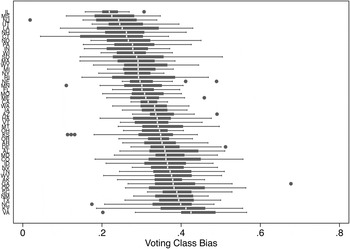
Figure 1 presents a box plot of class bias by state, arrayed from the state with the lowest average class bias during the period between 1976 and 2006 (Illinois) to the state with the highest average class bias (Virginia). The figure illustrates two important points. First, no state has ever had a bias measure at or below 0, indicating that the wealthy are always more likely to vote than the poor in the time period we examine here. This is not surprising given what we know about the determinants of electoral participation, but it is a point that deserves emphasis.
Average class bias by state, 1976–2006

Second, we see that the measure generally fits with our intuitions about the politics of particular states. The states with low levels of bias tend to be in the Northeast or Midwest. Many of the states with high levels are in the South, as one would expect, with New Mexico, Nevada, and Alaska also having high levels. The largest deviation from expectations, in our view, are Mississippi and Louisiana, which we were surprised to see among states with the lowest levels of class bias. This figure shows significant variation across states, as well as significant variation within states over time. However, it is not yet clear whether there is a trend in any direction over time, which would seem to be essential if we expect to find a connection between electoral class bias and economic inequality, which has grown considerably in recent years.
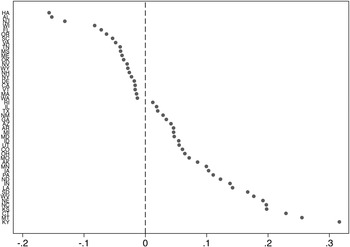
Figure 2 shows the net differences in class bias in the electorate for all 50 states between 1976 and 2006 (the time-frame of analysis). On average there has been a sizable increase in class bias, but we can see that the extent of this increase varies dramatically. Almost half of states (21) actually evidence decreases in class bias during this time period, though more states have had an increase in class bias (29), and the increases have been larger than the decreases overall. Twelve states have had increases greater than 0.1, while only three states have had decreases of this magnitude.
Changes in electoral class bias, by state, 1976–2006

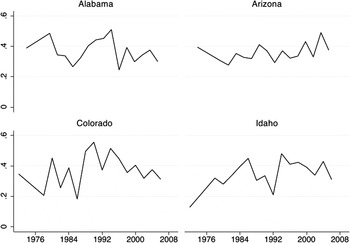
Looking at only the net changes between two time points masks variation over time between the beginning and end of our series for many states. In order to demonstrate the extent of variation in these patterns across states, figure 3 presents our measure of class bias over time from 1972 to 2006 for four states. These states are obviously not representative, but they show some of the different trajectories of class bias in the state electorates. We see that Alabama appears to have experienced a substantial reduction in the class bias of its electorate, while voter bias has grown slowly in Arizona, and Idaho has experienced a large increase class bias. In contrast, Colorado fluctuates over time but ends the time period with about the same amount of class bias that it began with. Footnote 63 But does any of this state-level variation in electoral class bias contribute to variation in economic policy and inequality?
The path of electoral class bias in four states, 1976–2006

Based on this discussion we would expect that where electorates are less biased governments and economic policies will be more left-wing or liberal and distributional outcomes will consequently also be more equal. Thus, in the analysis, we examine three key questions: (1) Does electoral class bias change the ideological composition of state government or ideological content of economic policies? (2) Does electoral class bias dampen the effects of mass opinion on policy outcomes in the states? (3) Does class bias shape distributional outcomes by way of the mechanisms explored in questions (1) and (2)?
Electoral Class Bias, Government Composition, and Policy Responsiveness
In this portion of the analysis we examine the connection between electoral class bias and the ideological composition of state governments, as well as economic policy outcomes. We also focus on the connection between public opinion and policy outcomes as electoral class bias increases. This allows us to assess whether states with less class bias are more responsive to citizen policy attitudes while greater levels of electoral bias lead to less responsive government.
Here, then, two distinct outcomes are considered—the ideological composition of state governments and economic policy outcomes. State government ideology is assessed using an existing measure developed by Berry and colleagues, which they updated through 2006. Footnote 64 This variable has been rescaled by dividing it by 100 to adequately present the coefficients, and we refer to it as Left-Government Power.
To assess economic policy outcomes, we develop a new measure of economic policy liberalism. The state-policy liberalism index consists of four components: (1) each state’s top corporate tax rate, (2) the top marginal income tax rate, (3) the state minimum wage, and (4) the extent of each state’s collective bargaining rights. The top corporate and income tax rates were obtained from the Book of the States and the Tax Foundation website. Footnote 65 State minimum-wage data were collected from the Labor Department website and the Monthly Labor Review published by the Bureau of Labor Statistics, which posts major changes to state labor laws in the January edition of each year. Footnote 66 The measure of state collective-bargaining rights ranges from 0 to 6 with higher values indicating that a state has stronger public sector pro-bargaining provisions. Footnote 67 These policy measures allow us to capture several important aspects of state economic policy that are particularly important for distributional outcomes. Additionally, we are able to measure each policy for every state over the entire time period of our analysis. This allows us to assess both over time and across state differences in state economic policy.
Following previous research using composite measures of state policy, an overall index of economic policy liberalism is created using the four indicators discussed above. Footnote 68 Each policy variable is first standardized to have a mean of 0 and standard deviation of 1, and then the standardized versions of the measures are added together to create the summary index of state economic policy, where higher values indicate that a state’s policies are collectively more liberal. The index has good face validity since each of these policies are central to the larger conflict between liberal and conservative views on the role of government. Footnote 69 The descriptive statistics for the four policy measures and the resulting economic-policy liberalism index are presented in Appendix B.
The key explanatory variables in this portion of the analysis are electoral class bias, which is described above, and a measure of state-level public opinion. We use a new, high-quality measure of state public mood created by Peter Enns and Julianna Koch to measure how liberal the public is in a given state. Footnote 70 This measure is constructed in a manner similar to widely-used measures of national public mood but using state-level survey data. Footnote 71 It is, of course, necessary to account for state liberalism because, regardless of electoral class bias, some states are just more liberal or conservative than others. More importantly, we also include an interaction term between public opinion and electoral class bias. Inclusion of this interaction term allows us to determine whether any relationship between public opinion and government composition or economic policy is conditioned by the level of electoral class bias in a state. For instance, does class bias prevent liberal publics from seeing their policy preferences enacted?
Along with these key explanatory variables, we include a variety of controls—gross state product, the proportion of the population that is non-white, the percentage of the population that is 65 years of age or older, and state union density. Footnote 72 Data for these economic and demographic characteristics were obtained from the U.S. Census Bureau. Further details on all variables used in the analysis are included in Appendix C.
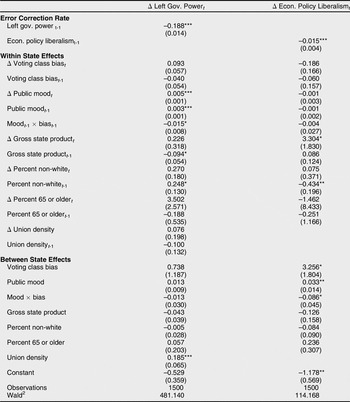
We estimate regression models using a mixed within and between estimator with random effects, developed by Brandon Bartels, to assess the effects of electoral class bias and public opinion on state government ideology and economic policy liberalism. Footnote 73 This approach accomplishes four important goals. First, within- and between-state effects are estimated separately so that each type of effect can be disentangled and substantively interpreted. One will notice that results are reported separately for within-state and between-state variation. Second, the model utilizes random effects which allows us to “control for unobserved heterogeneity” at the state level. Footnote 74 Third, the model allows us to include variables that move slowly over time in our models while at the same time accounting for unit-effects. Finally, the model allows us to estimate error correction models in the within portion of the analysis to account both for autocorrelation and causation that is dispersed over time (further details on this estimation procedure are described in Appendix D). The results are reported in table 1.
Effect of class bias on left-government power and ceconomic-policy liberalism

Notes: Random effects models with robust standard errors in parentheses. The delta symbol (Δ) indicates a first differenced variable and the t-1 subscript indicates that the variable has been lagged by one year. Within state effects represent the overtime effects of each variable while the between state effects represent the average effects of the variables across states. Refer to Appendix D for a detailed discussion of the model estimation.
* p < 0.10, **p < 0.05, ***p < 0.01.
Looking first at the effects of electoral class bias on left government power and economic policy liberalism, we see little in the way of direct effects on these outcomes. The more important effects of electoral class bias appear to be in how it shapes the responsiveness of government to public opinion. For both outcomes (left government power and economic policy liberalism), we see a positive association with the liberalism of public mood. In the first column, the main effect of a shift in public mood to the left is an increase in left government power within a state in both the short and long term. The association between liberal public mood and economic policy liberalism is also positive, but this effect is present across, rather than within, states. The most likely reason that the effects for economic-policy liberalism are present only across states while the effects for left-government power are only within states is that economic-policy liberalism varies little within states while most of the variation in left-government power is within states over time. Simply stated, we find results where there is the most variation to explain. But we need to remember, of course, that the effect of public mood on left-government power and economic policy is expected to be conditional on the degree of electoral class bias present in a state.
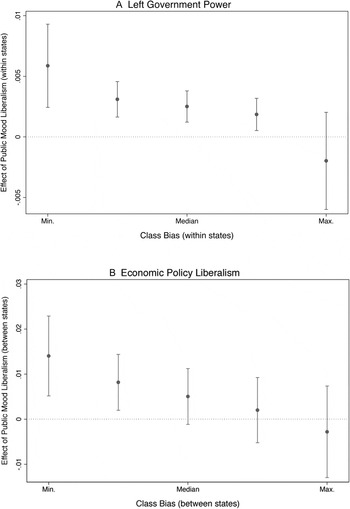
This possibility is accounted for by including interaction terms between the level of electoral class bias in a state and the state’s level of public-mood liberalism. The negative, statistically-significant estimate for the interaction terms between mood and bias indicate that positive effect of public-mood liberalism on both left-government power (within state) and economic-policy liberalism (between states) declines as electoral class bias increases. In figure 4, we chart the effects of public-mood liberalism on both outcomes at varying levels of electoral class bias. The plot demonstrates that when economic class bias is at its observed minimum level, there is a positive and statistically-significant relationship between public-mood liberalism and both left-government power and economic-policy liberalism. But once electoral class bias increases, that positive relationship goes away, with public opinion ceasing to have any observable effect on the composition of government or economic-policy outcomes. In short, electoral class bias changes the relationship between the governed and the government, with government becoming less responsive to the mass public as electoral participation becomes more skewed toward those with higher incomes.
Conditional effect of public mood at varying levels of electoral class bias
Note: Estimates are based on the results presented in table 1.

Government Composition, Economic Policy, and Income Inequality
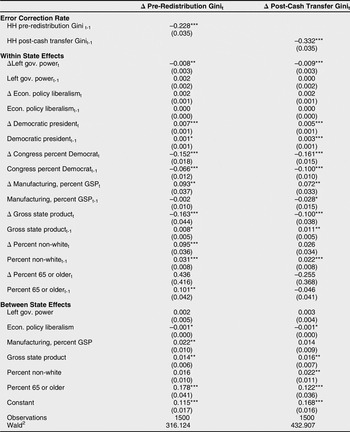
We have seen that electoral class bias changes the nature of the relationship between public opinion and the composition of state governments, as well as the economic policies they embrace, but do these effects translate into divergent distributional outcomes? In table 2, two models are presented that examine whether state government composition (i.e., left-government power) and economic-policy liberalism are associated with distributional outcomes. Left-leaning legislatures are expected to influence income inequality since they have traditionally been one of the most important resources for the lower and middle classes by supporting more redistributive government programs. Footnote 75 For this reason states with more-liberal legislatures are expected to have lower levels of inequality. As discussed, the policies used to create our economic-liberalism index are all forms of redistributive policies and therefore are expected to have a direct effect on the distribution of income. Footnote 76 The same approach described earlier is used to estimate these models where over-time dynamics within the states are accounted for in addition to simultaneously accounting for between-state effects.
Effect of left-government power and economic policy liberalism on income inequality

Notes: Random effects models with robust standard errors in parentheses. The delta symbol (Δ) indicates a first differenced variable and the t-1 subscript indicates that the variable has been lagged by one year. Within state effects represent the overtime effects of each variable while the between state effects represent the average effects of the variables across states. Refer to Appendix D for a detailed discussion of the model estimation.
* p < 0.10, **p < 0.05, ***p < 0.01.
The first model considers household pre-redistribution inequality, while the second analyzes household post-transfer inequality. Examining both types of inequality is important since the states are thought to have a limited influence through redistribution, which makes market conditioning an important mechanism for influencing the income distribution at the state level. If there is a market conditioning mechanism present, we will observe an impact of political variables on distributional outcomes using an income measure excluding government transfers. Post-transfer inequality is also assessed to confirm that any such effects also translate into final distributional outcomes after redistribution occurs. This is important because reducing (increasing) pre-redistribution inequality can reduce (increase) government’s influence via the mechanism of explicit redistribution. Footnote 77 In these models we include the covariates included in the models of government composition and policy (refer to table 1), plus additional control variables that are appropriate in models of income inequality. Since prior research shows that national-level political variables can influence a state’s income distribution, Footnote 78 we control for these factors in the analysis. The first federal government variable is party control of the presidency. To capture partisan effects for control of the White House, we include a straightforward indicator of presidential party affiliation (Democrat = 1). Partisan balance in the U.S. Congress is also accounted for, which is the percentage of congressional seats held by Democrats. Finally, we include the proportion of the gross state product derived from manufacturing (manufacturing GSP) in addition to overall gross state product when modeling income differences.
The results in table 2 show that left-government power and economic-policy liberalism have the anticipated effect on both market and post-redistribution income inequality. Greater levels of government leftism and more liberal public opinion lead to less state income inequality. Consistent with the results showing that class bias influences government leftism over time and policy liberalism across the states, the effect of left-government power on inequality occurs within states and the effect of economic policy occurs between states. This is true for both models of income inequality. We can say that the direct effect of left government power on inequality in the states occurs due to within-state changes in government as indicated by the statistically-significant coefficient on the differenced version of the variable. This suggests income inequality responds immediately to over-time changes in government liberalism. Since the between-state version of the economic-policy liberalism variable is significantly different from zero we can conclude that states with more-liberal economic policies tend to have lower levels of income inequality.
Majoritarian and Elite Perspectives and the Prospects for Equality
Our analysis suggests that who votes has important consequences for government ideology, government responsiveness, and ultimately the income distribution. When political participation in elections becomes more skewed toward the economic elite, elections are less likely to serve as a tool for empowering the masses in the representative and policymaking processes. Where bias is high, the connection between mass public opinion and government composition and policymaking breaks down and the distributional outcomes shaped by who holds elected office and the policies they enact become more skewed in favor of the rich.
While these findings demonstrate the importance of political participation, it is difficult to determine whether they are more supportive of the majoritarian or elite view of American democracy. As our discussion of this literature suggests, elite actors are regularly involved in attempts to restructure the rules that govern elections and they decide which groups to pursue with their voter mobilization (or demobilization) strategies. So while the majoritarian and elite perspectives provide useful frameworks for understanding how the United States has arrived at the political decisions that have allowed economic inequities to expand, it is not easy to clearly distinguish the effect of mass participation on political outcomes independent of elite influence and vice versa.
This is because what happens within elite policy-making institutions and power structures shapes voter mobilization and the likelihood that certain policies will be enacted, while at the same time variation in voter mobilization restricts what elites are able to do in the policy process. When the poor are heavily mobilized into politics, interest groups working on behalf of the wealthy and business do not become impotent, but it certainly places more limits on what they are able to accomplish. In short, mass politics and elite politics both matter for government and policy responsiveness and ultimately income inequality. In contrast with some recent research, our analyses show that mass preferences matter for certain political and policy outcomes, but how much they matter varies along with the extent of class bias in the electorate.
These results are at once troubling and encouraging for proponents of a robust and inclusive mass-based American democracy and a more egalitarian society. Optimistically, our research suggests that the basic institutional structure of American politics is not fundamentally broken since even in the context of policy -making institutions that tend to be dominated by business and the wealthy, the mass public can win in elections, policy debates, and ultimately the “spoils” of economic activity, at least where voting is broader and more inclusive. On the other hand, more pessimistically, it is very clear that political elites in many states are attempting to restrict the right to vote and demobilize poorer voters to prevent this from taking place. Our findings, along with other recent studies, underscore that we cannot so easily separate mass politics from elite politics that takes place in Washington, D.C. or state capitals.
This conclusion, in turn suggests additional questions for researchers and for reformers. Beginning with researchers, our arguments and results indicate the need for more research into how laws, mobilization strategies, demobilization strategies, and other factors influence the decisions of different economic groups to turn out to vote. Though there has probably been as much research into voter turnout as any other question that has been examined, our understanding of how recent changes in the party and interest group system may influence decisions to vote or not to vote remains surprisingly limited. This suggests some fairly obvious directions for future research, like how voter identification laws, eliminating longer periods to vote, and so forth, influence turnout among different income groups. But equally important are questions about how the “side effects” of the growing power of the wealthy and business in the party and interest group systems shapes voter participation. For instance, to the extent that party leaders are preoccupied with the problems of upper-class voters, to what extent does this serve to fuel apathy and demobilize lower-income voters?
Our findings also have important implications for reform efforts to improve the functioning of American democracy. Reformers who wish to limit the influence of business and the wealthy tend to focus on the activities of these elite political actors in areas like lobbying and funding campaigns, which allows them to exert some influence over policy outcomes. Public financing of elections, for example, has become something of a holy grail for many reformers. Yet, the possibility of public financing of elections or limits on campaign contributions has essentially been foreclosed by Supreme Court decisions over the last few decades. And the first amendment guarantees that groups with resources will continue to have ample lobbying opportunities. Our findings indicate that reformers may be better served investing resources in fending off attacks on the right to vote and launching campaigns to expand access to the voting booth. Even in the face of lobbying and campaign funding by upper-income interests, which is more or less universal in the states, expanding the participation of lower-income voters produces important changes in government, public policy, and ultimately “who gets what.”
Supplemental Materials
Appendix A. Measuring Electoral Class Bias
Appendix B. Components of State Policy Liberalism Index
Appendix C. Variable Descriptions
Appendix D. Model Estimation
Appendix E. Replication of Economic Policy Liberalism Analysis
Appendix F. Exogeneity Tests