Introduction
Parasitic lice rely on their hosts to complete all life stages, spending their entire life cycle on a host individual (Price et al., Reference Price, Hellenthal, Palma, Johnson and Clayton2003). Parasitic lice, which have adapted to survive only within the microclimatic conditions provided by their host's body often die within hours or days after becoming separated from the host (Price et al., Reference Price, Hellenthal, Palma, Johnson and Clayton2003). This obligate association limits dispersal opportunities for lice, which normally occur via direct physical contact between individuals during copulation or between parents and offspring during brooding. Over macroevolutionary time scales, the lack of dispersal opportunities also limits the ability of most louse lineages to switch to novel host species. For some chewing lice parasitizing birds, dispersal to a novel host species, which ultimately drives host-switching, could occur via phoresy (lice attaching to hippoboscid flies, which are winged generalist parasites), takeover of nest cavities, or physical contact during intraspecific territorial disputes (Clayton, Reference Clayton1990; Harbison and Clayton, Reference Harbison and Clayton2011). However, survival on novel host species is thought to be low, potentially due to difficulties in escaping host defenses on a novel host (Clayton et al., Reference Clayton, Bush, Goates and Johnson2003; Malenke et al., Reference Malenke, Johnson and Clayton2009).
If parasites are mainly transmitted vertically via close contact between conspecifics, populations of parasites on different host species can differentiate over time to form host specific lineages. If this happens in conjunction with the hosts themselves speciating, then the phylogenies of both host and parasite would be largely congruent (Clayton and Johnson, Reference Clayton and Johnson2003; Hughes et al., Reference Hughes, Kennedy, Johnson, Palma and Page2007). However, if lice colonized a group of hosts after the hosts diverged, or if host-switching of lice between different host taxa is common, then host and parasite phylogenies would differ (Weckstein, Reference Weckstein2004; Banks et al., Reference Banks, Palma and Paterson2006). These two different patterns of cophylogenetic history are ends of a continuum exhibited by lice, which vary both in terms of host specificity and the degree of cospeciation with their hosts. For example, Pectinopygus Mjöberg, 1910 lice and their suliform hosts show strong evidence of cospeciation (Hughes et al., Reference Hughes, Kennedy, Johnson, Palma and Page2007). Conversely, louse genera within the Degeeriella-complex match higher level classifications of their hosts (Johnson et al., Reference Johnson, Weckstein, Witt, Faucett and Moyle2002), but the toucan lice within this complex show no evidence of cospeciation with their hosts (Weckstein, Reference Weckstein2004). Different louse genera codistributed on the same host group often show differing patterns of host specificity and cophylogenetic history. For example, dove body lice in the New World show evidence of cospeciation whereas dove wing lice do not (Clayton and Johnson, Reference Clayton and Johnson2003).
In this study we focus on cophylogenetic patterns in the feather lice (Phthiraptera: Ischnocera: Philopteridae) occurring on kingfishers (Aves: Coraciiformes: Alcedinidae). Kingfishers include 117 species divided into three avian subfamilies: Halcyoninae Vigors, 1825 (equivalent to Daceloninae Bonaparte, 1837; as used by Moyle, Reference Moyle2006), Alcedininae Rafinesque, 1815, and Cerylinae Reichenbach, 1851. Halcyoninae and Alcedininae are limited to the Old World, and Cerylinae occurs worldwide. The monophyly of each of these avian subfamilies is strongly supported by morphological and molecular characters with Alcedininae being sister to Cerylinae + Halcyoninae (Maurer and Raikow, Reference Maurer and Raikow1981; Johansson and Ericson, Reference Johansson and Ericson2003; Moyle, Reference Moyle2006; Andersen et al., Reference Andersen, McCullough, Mauck, Smith and Moyle2017). The cosmopolitan distribution (New and Old Worlds) of Cerylinae is likely the result of two New World invasions (Moyle, Reference Moyle2006; Andersen et al., Reference Andersen, McCullough, Mauck, Smith and Moyle2017). Halcyoninae is mainly restricted to Australia and southern Asia, with a single genus, Halcyon Swainson, 1821, also occurring in Africa. Alcedininae is widespread across the Old World. Moyle (Reference Moyle2006) and Moyle et al. (Reference Moyle, Fuchs, Pasquet and Marks2007) found that the majority of kingfisher genera were not monophyletic, resulting in a substantial taxonomic reorganization. In a phylogeny with almost complete taxon sampling, Andersen et al. (Reference Andersen, McCullough, Mauck, Smith and Moyle2017) identified both Dacelo Leach, 1815 and Actenoides Bonaparte, 1850 as paraphyletic, suggesting additional taxonomic revision is necessary. Furthermore, species level relationships and species limits within some kingfisher taxa are also in a state of flux. For example, 26 species splits have been recognized within the kingfishers since 2013, mostly due to molecular studies supporting the elevation of island subspecies to full species status (Andersen et al., Reference Andersen, Oliveros, Filardi and Moyle2013; Reference Andersen, Shult, Cibois, Thibault, Filardi and Moyle2015).
Kingfishers are known to host three louse genera, Alcedoffula Clay and Meinertzhagen, Reference Clay and Meinertzhagen1939, Alcedoecus Clay and Meinertzhagen, Reference Clay and Meinertzhagen1939, and Emersoniella Tendeiro, Reference Tendeiro1965 (Price et al., Reference Price, Hellenthal, Palma, Johnson and Clayton2003; Johnson et al., Reference Johnson, Shreve and Smith2012; Gustafsson and Bush, Reference Gustafsson and Bush2014). Although many bird species are host to multiple genera of lice, individual kingfishers are typically only infected with a single louse genus, and each of these genera is specific to one or more kingfisher subfamilies. In most of the small number of cases where a kingfisher species is parasitized by two louse species, one is in the genus Alcedoecus and the other is in the genus Emersoniella. Both Alcedoecus and Emersoniella parasitize only Halcyoninae kingfishers, although Emersoniella is less common and is one of the least diverse genera of chewing lice with only seven described species. Furthermore, Emersoniella is known only from Indo-Pacific kingfishers, whereas both Alcedoecus (limited to Halcyoninae) and Alcedoffula (found on Alcedininae and Cerylinae) are geographically widespread. Although lice are known from 54 (46%) of the 117 currently recognized kingfisher species (Price et al., Reference Price, Hellenthal, Palma, Johnson and Clayton2003 and novel host records published here), there are only two instances where both Alcedoffula and Alcedoecus have been collected from the same kingfisher species, and two instances where multiple louse species from the same genus are known from the same host species.
Lastly, based on morphological data, species groups have been proposed for both louse genera. For Alcedoffula, Tendeiro (Reference Tendeiro1967) proposed two species groups based on head and male genitalic morphology, the duplicata and the alcedinis groups. Whereas for Alcedoecus, Tendeiro (Reference Tendeiro1983) proposed two species groups based exclusively on the length of male genitalia, the capistratus and the alatoclypeatus groups. Furthermore, Uchida (Reference Uchida1948) proposed a new genus Halcyonicola based on Docophorus alatoclypeatus Piaget, 1885 as its type species. This genus has been subsequently considered a junior synonym of Alcedoecus (Hopkins and Clay, Reference Hopkins and Clay1952; Tendeiro, Reference Tendeiro1965; Price et al., Reference Price, Hellenthal, Palma, Johnson and Clayton2003).
Here we use DNA sequences from two genes (one mitochondrial and one nuclear) to infer phylogenies for both of the widespread genera of kingfisher lice: Alcedoffula and Alcedoecus. We compare the louse phylogenies with a molecular phylogeny of the kingfishers to reconstruct their cophylogenetic history and we assess the validity of kingfisher louse species groups as proposed by Tendeiro (Reference Tendeiro1967, Reference Tendeiro1983).
Materials and methods
Specimen acquisition
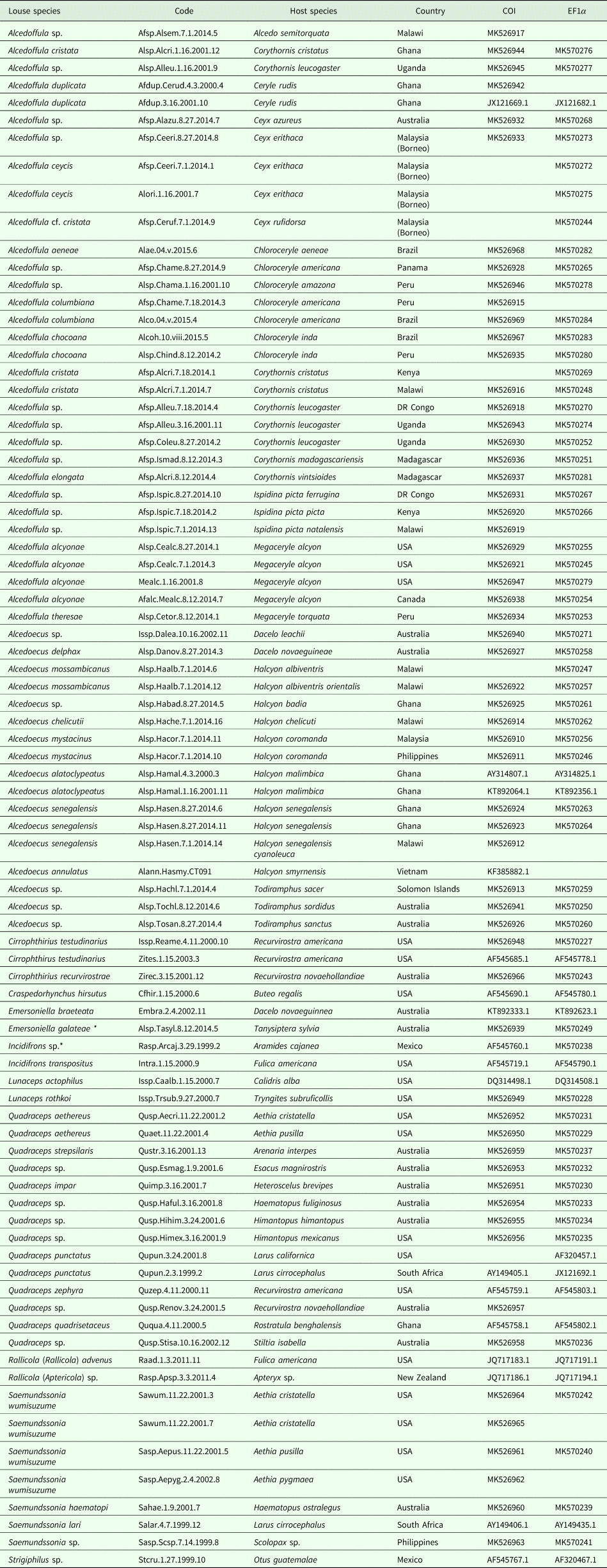
Lice were collected from avian hosts using ethyl acetate fumigation or dust ruffling (Clayton et al., Reference Clayton, Gregory and Price1992; Walther and Clayton, Reference Walther and Clayton1997) and were stored in 95% ethanol at −80 °C until DNA extraction. The authors and their colleagues sampled avian hosts that were collected and prepared as museum voucher specimens, avian hosts that were captured and banded, and dead hosts salvaged and prepared as specimens for deposition in natural history collections. In total, 47 kingfisher lice were included from 11 of the 19 currently recognized genera of kingfishers (Table 1). When possible, lice were sequenced from multiple individuals from each host species (up to 4 specimens per host taxon), particularly in cases of geographically widespread host species or island populations. Furthermore, 34 lice from 9 genera were used as outgroups (see Table 1).
Sample data with Genbank numbers

New host records are denoted by an ‘*’.
Louse identification
Slide mounted voucher specimens were identified using available parasite literature for each louse genus. We compared the morphology of these voucher specimens to those described from the same host (sensu Price et al., Reference Price, Hellenthal, Palma, Johnson and Clayton2003) based on original descriptions or redescriptions published in the taxonomic literature for lice parasitizing kingfishers (Carriker, Reference Carriker1959; Tendeiro, Reference Tendeiro1965, Reference Tendeiro1967, Reference Tendeiro1983; Gustafsson and Bush, Reference Gustafsson and Bush2014). Some specimens used in our dataset could not be positively identified to species based on available literature, reference specimens, or because we only had a specimens of one sex. These individuals are labelled as ‘sp.,’ regardless of their host association. We did not identify louse species based exclusively on host-parasite associations.
Parasite DNA sequencing
DNA was extracted from specimens by cutting a small incision between the head and thorax and a second incision between two abdominal sclerites and then subsequently placing the specimen in digestion buffer. A QIAamp DNA Micro Kit (Qiagen, Valencia, CA) was used for DNA extractions following a modified version of the protocol for total genomic DNA from tissues. Modifications include lengthening the incubation period (step 4) to 36 h, incubating the sample for 10 min at 70 °C (step 6), and decreasing the amount of elution Buffer AE to 50 µL (step 12), which was used to make two elutions into different 1.5 mL collection tubes. After applying Buffer AE to the filter, we incubated the filter for 5 min at 70 °C prior to centrifugation (step 13). After digestion, louse exoskeletons were retained as a voucher, cleared, and mounted on a microslide in balsam following the protocols of Palma (Reference Palma1978).
After extraction, PCR was performed in 25 µL reactions to amplify portions of two genes, the mitochondrial protein coding gene cytochrome oxidase I (COI) and the nuclear protein coding gene elongation factor-1α (EF-1α). Primers L6625 and H7005 (Hafner et al., Reference Hafner, Sudman, Villablance, Spradling, Demastes and Nadler1994) were used for COI and EF1-For3 and EF1-Cho10 (Danforth and Ji, Reference Danforth and Ji1998) were used for EF-1α. PCR conditions follow those from Smith et al. (Reference Smith, Page and Johnson2004) except an annealing temperature of 50 °C was used for EF-1α amplifications. Sequencing reactions were performed using 1 µL of BigDye and then submitted for sequencing on an ABI 3730xl capillary machine at the University of Illinois Keck Center for Comparative and Functional Genomics. Raw forward and reverse strands of each sequence were assembled into contigs in Geneious 8.0.4 (Biomatters Ltd.) and manually adjusted to produce consensus sequences. The resulting consensus sequences were aligned in Geneious using the MUSCLE plugin and exported to Seaview 4.3.0 where they were checked and adjusted by eye (Edgar, Reference Edgar2004; Gouy et al., Reference Gouy, Guindon and Gascuel2010).
Host DNA sequencing
For four host taxa, Halcyon chelicuti (Stanley, 1814), H. albiventris orientalis Peters, 1868, H. senegalensis cyanoleuca (Vieillot, 1818), and Ispidina picta natalensis (Smith, 1831) we extracted DNA from tissues, amplified ND2 and RAG-1 genes, and then sequenced the resulting PCR products. Host DNA was extracted from tissues using a Qiagen DNeasy Blood & Tissue Kit (Qiagen, Valencia, CA) following the manufactures protocols for tissue samples. After extraction, PCR was performed in 25 µL reactions to amplify the ND2 and RAG-1 genes. For ND2 amplifications we used primers L5215 (Hackett, Reference Hackett1996) and H6313 (Johnson and Sorenson, Reference Johnson and Sorenson1998) following the protocol described in Weckstein (Reference Weckstein2005). For sequencing, we also used internal primers ND2Hal and ND2Alc (Moyle, Reference Moyle2006). Two initial PCRs for RAG-1 were performed using the PCR protocol described in (Groth and Barrowclough, Reference Groth and Barrowclough1999). One RAG-1 PCR used primers R7 and R4B and the other used primers R13 and R8 (Groth and Barrowclough, Reference Groth and Barrowclough1999). For sequencing reactions, additional internal primers R9, R10, R11B, and R16 were used to completely sequence the fragment between R13B and R8 and R3E and RagB (5′- TGGCTCCTGGTTATGGAGTGG-3′; designed by R. G. Moyle) were used to sequence the fragment between R7 and R4B. With the exception of RagB, all RAG-1 primers are from Groth and Barrowclough (Reference Groth and Barrowclough1999). PCR products were submitted to Functional Biosciences (Madison, Wisconsin) for Sanger sequencing on an ABI 3730xl machine. Host sequence processing followed the same procedure outlined above for louse DNA sequences. The resulting consensus sequences were combined with the sequences acquired from GenBank and aligned to the data published by Moyle (Reference Moyle2006). Resulting sequences were deposited in GenBank (MK579322-MK579329).
Phylogenetic analysis of kingfisher lice
The two genes were first analyzed separately to evaluate the extent of conflict (if any) between gene trees for the ingroup (i.e. conflicts with posterior probability >0.95). Gene trees were inferred using 40 million generation BEAST runs under the model selected by PartitionFinder 1.1.1 (branchlength = linked; model_selection = AIC; search = greedy) (Drummond and Rambaut, Reference Drummond and Rambaut2007; Lanfear et al., Reference Lanfear, Calcott, Ho and Guindon2012). PartitionFinder selected the models GTR + I + G for COI codon positions 1 and 2, GTR + G for COI codon position 3, TrN + G for EF-1α codon positions 1 and 2, and K80 + G for EF-1α codon position 3 for Alcedoffula and SYM + I + G for COI codon position 1, GTR + I + G for COI codon position 2, GTR + G for COI codon position 3, TrN + G for EF-1α codon position 1, HKY + I for EF-1α codon position 2, and TrN + I + G for EF-1α codon position 3 for Alcedoecus. Although some nodes were in conflict at the 0.98 level between the two gene trees, the conflict was typically limited to relationships among outgroups (potentially due to long branches and sparse outgroup taxon sampling) and the placement of two ingroup taxa [Alcedoffula duplicata (Piaget, 1890) from Ceryle rudis (Linnaeus, 1758) and Alcedoffula chocoana Carriker, Reference Carriker1959 from Chloroceryle inda (Linnaeus, 1766)], both of which were placed on long branches sister to a given clade in the COI gene tree but within this clade in the EF-1α gene tree. Since conflict was limited, we concatenated genes for further analysis.
In the concatenated analysis, each codon position for a given protein coding gene was treated as a separate partition, and each model parameter as above. Phylogenies based on the combined analysis were inferred using Bayesian inference as implemented in BEAST (Drummond and Rambaut, Reference Drummond and Rambaut2007; 40 million generations, sampled every 1000 generations, burnin = 10 000 samples), Maximum Likelihood (ML) as implemented in Garli (Zwickl, Reference Zwickl2006; 10 independent runs, default settings, automated stop criterion = 50 000), and Maximum Parsimony (MP) as implemented in PAUP* (Swofford, Reference Swofford2003; 1000 random addition sequences with TBR branch swapping). To evaluate branch support, we used posterior probabilities as implemented in BEAST, parsimony bootstrap values as implemented in PAUP* with 1000 replicates and 100 random addition sequences per replicate with maxtrees set at 500 due to computational constraints, and ML bootstrap values as implemented in Garli (2.0) with 500 bootstrap replicates on default settings with automated stop criterion = 5000).
Phylogenetic analysis of kingfishers
The host phylogeny was inferred using a 40 million generation BEAST run under the model selected by partitionfinder 1.1.1 (branchlength = linked; model_selection = AIC; search = greedy) (Drummond and Rambaut, Reference Drummond and Rambaut2007; Lanfear et al., Reference Lanfear, Calcott, Ho and Guindon2012). PartitionFinder selected GTR + I + G for each partition, with the exception of RAG1 third positions, for which SYM + G was the best model. We evaluated branch support using posterior probabilities (generated by BEAST) and parsimony bootstrap values generated by PAUP* using 100 replicates with 100 random addition sequences per replicate and maxtrees allowed to automatically increase by 100.
Cophylogenetic history of kingfishers and their lice
We used the louse tree generated from the Bayesian analysis and either the Alcedininae phylogeny inferred by Moyle et al. (Reference Moyle, Fuchs, Pasquet and Marks2007) or the kingfisher phylogeny inferred as noted above (for the other two subfamilies) to conduct statistical tests of cospeciation using Jane4 (Conow et al., Reference Conow, Fielder, Ovadia and Libeskind-Hadas2010). We used Moyle et al. (Reference Moyle, Fuchs, Pasquet and Marks2007) because Ceyx rufidorsa Strickland, 1847, a species for which we had a louse sample, was treated as a synonym of Ceyx erithaca (Linnaeus, 1758) in Andersen et al. (Reference Andersen, McCullough, Mauck, Smith and Moyle2017) and thus was not included in their tree. The topology of both the Moyle et al. (Reference Moyle, Fuchs, Pasquet and Marks2007) and Anderson et al. (Reference Andersen, McCullough, Mauck, Smith and Moyle2017) phylogenies agreed with regard to all taxa in our study. Parasite tips were collapsed to insure that each tree topology only included a single representative of each putative louse species, and terminals from the kingfisher phylogeny that did not include a louse association were removed. Because we found that Alcedoffula contained two distinct monophyletic lineages, which do not parasitize sister kingfisher subfamilies, these two louse lineages and their hosts were analyzed separately in cophylogenetic analyses. These analyses were run using default costs. To assess whether there were more cospeciation events than expected by chance, we generated 1000 random tip mappings and 1000 randomly generated parasite trees in Stats Mode.
Reconstruction of biogeographic history on kingfisher louse trees
Using BioGeoBEARS (Matzke, Reference Matzke2013), we reconstructed the biogeographic history of both Alcedoffula and Alcedoecus. Within BioGeoBEARS, we estimated ancestral-areas using DEC (likelihood interpretations of a dispersal-vicariance model; DIVALIKE) and a Bayesian binary model (BAYAREALIKE). Reconstructions were calculated twice for each method, once including the j (long distance dispersal) parameter and once without. For the lice, we removed outgroup taxa and collapsed tips if COI divergence between terminal taxa was less than 2.5%. We coded geographic range to represent the six major biogeographic regions for which we had sampled kingfisher lice (Ethiopian, Australia, Nearctic, Neotropics, Southeast Asia, and Madagascar). Louse biogeographic region was coded based on where each specimen was collected, not the entire range of the host species as other studies have shown birds with large ranges do not always share the same species of louse across the entire geographic distribution (Catanach and Johnson, Reference Catanach and Johnson2015). Lice collected from hosts on Indo-Pacific Islands were placed in either the Southeast Asia or Australian regions based on whether they were north or south of Wallace's Line, respectively. In all instances, maxareas was set to two. Results from each method were compared using AIC scores.
Results
Phylogenetic analysis of kingfisher lice
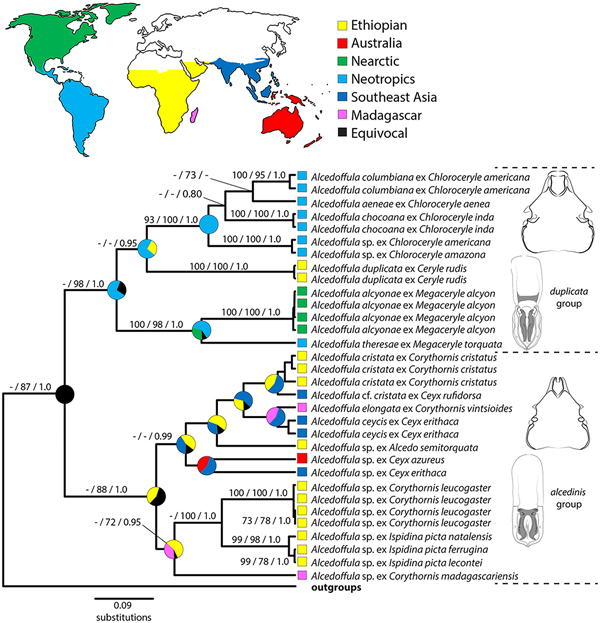
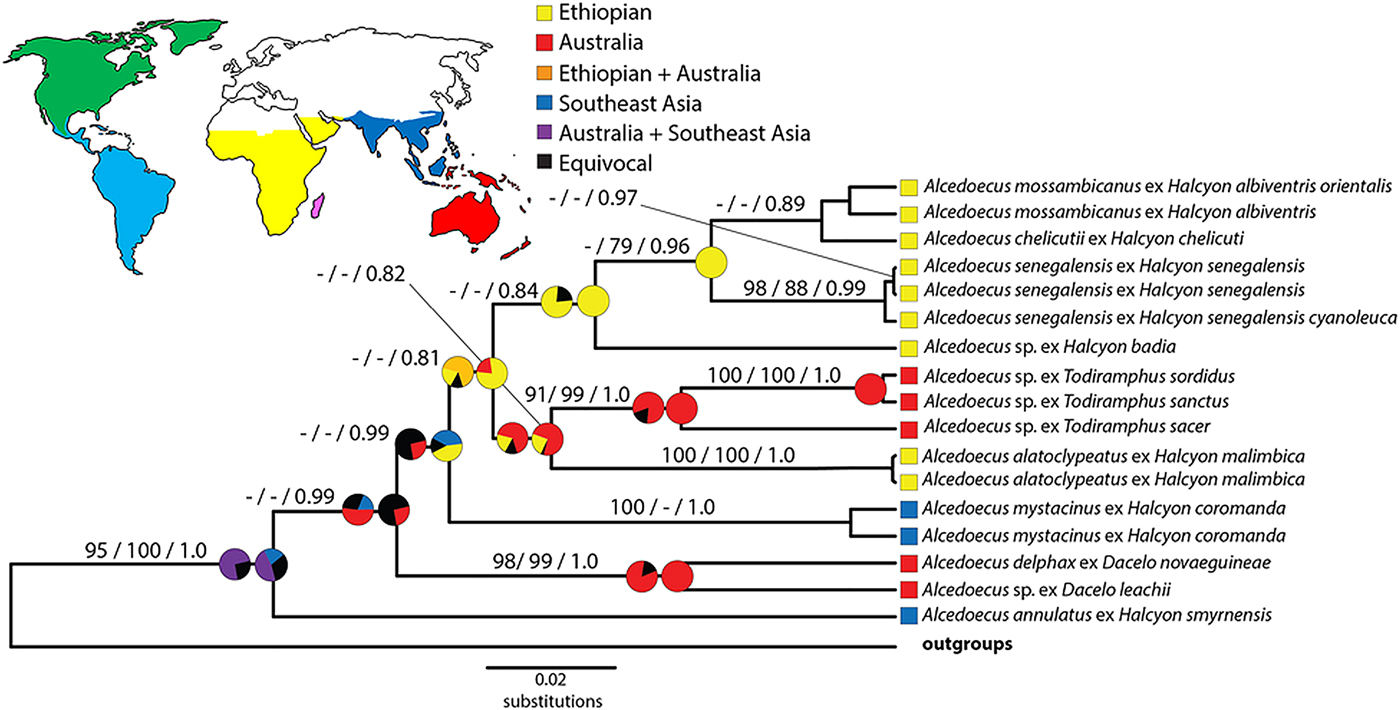
The phylogenies resulting from combined analysis of COI and EF-1α were well resolved and were supported by posterior probability of at least 0.95 at most nodes (Figs 1, 2, and Supplementary Fig. 1). Alcedoffula and Alcedoecus were recovered as reciprocally monophyletic (posterior probability = 1.0 for both clades).
Alcedoffula phylogeny resulting from Bayesian Analysis of EF-1α and COI. Numbers on branches are MP bootstrap values/ML bootstrap values/posterior probabilities. Bootstrap values below 70 and posterior probabilities below 0.80 not shown. Piecharts at nodes show biogeographic reconstruction and tips are coded based on geographic area in which each louse specimen was collected. Head drawings represent the two species groupings proposed by Tendeiro (Reference Tendeiro1967).

Alcedoecus phylogeny resulting from Bayesian Analysis of EF-1α and COI. Numbers on branches are MP bootstrap values/ML bootstrap values/posterior probabilities. Bootstrap values below 70 and posterior probabilities below 0.80 not shown. Piecharts at nodes show biogeographic reconstruction and tips are coded based on geographic area in which each louse specimen was collected. Piecharts on the nodes represent DIVALIKE + J reconstructions and pie charts to the left of the nodes represent BAYAREALIKE + J reconstructions.

Within Alcedoffula (Fig. 1), two well-supported clades (posterior probability = 1.0 for both clades) were recovered and each parasitizes a different kingfisher subfamily. These clades match the two louse species groups, duplicata and alcedinis, proposed by Tendeiro (Reference Tendeiro1967) based on shapes of frontal heads and the mesosome of the male genitalia. The duplicata-group of Alcedoffula parasitizes only Cerylinae and contains two well-supported subclades (both with posterior probability = 1.0). One of these subclades infects New World Megaceryle kingfishers and the other infects both New World Chloroceryle kingfishers and Old World Ceryle rudis (pied kingfisher). Within the subclade infecting New World Chloroceryle kingfishers and Old World Ceryle rudis (Pied Kingfisher), Alcedoffula duplicata, from pied kingfisher, is sister to lice from the New World genus Chloroceryle. Also, two individual Alcedoffula parasitizing green kingfisher [Chloroceryle americana (Gmelin, 1788)] are not each other's closest relatives with respect to the lice infecting the two other Chloroceryle species. One of the green kingfisher lice is sister to a louse collected from Amazon kingfisher [Chloroceryle amazona (Latham, 1790)].
The other clade of Alcedoffula, the alcedinis-group, is found exclusively on the Old World kingfisher subfamily Alcedininae. This clade comprises two subclades, one of which is well supported (posterior probability = 0.95) and includes lice collected from three African kingfisher species, including Corythornis madagascariensis (Linnaeus, 1766), C. leucogaster (Fraser, 1843), and Ispidina picta (Boddaert, 1783). The second subclade is also well supported (posterior probability = 0.99) and comprises lice from African and Asian kingfishers including Corythornis cristatus Pallas, 1764, C. vintsioides Eydoux and Gervais, 1836, Ceyx rufidorsa Strickland, 1847, Ceyx erithaca (Linnaeus, 1758), Ceyx azurenus Latham, 1801, and Alcedo semitorquata Swainson, 1823.
We sampled multiple louse individuals from across the ranges of the African Corythornis (C. madagascariensis and C. leucogaster) and Ispidina picta kingfishers. Lice collected from the same host species were each other's closest relatives in each case (posterior probability = 1.0). For example, we included louse samples collected from all three recognized Ispidina picta subspecies. Although all three were members of a single clade, the louse from Ispidina picta natalensis (Smith 1832) was highly divergent (COI uncorrected p-distance = 3.0%) from lice collected from the other two subspecies, whereas the lice from I. p. picta (Boddaert, 1783) and I. p. ferrugina (Clancey, 1984) were identical to one another. Lice from the host genus Corythornis as a whole are not monophyletic, each species being more closely related to lice from other alcedinine kingfishers.
Within Alcedoecus (Fig. 2), members of which only parasitize the Halcyoninae, the most basal node unites A. annulatus Ansari, 1955 collected from Halcyon smyrnensis Linnaeus, 1758 with all other species of Alcedoecus. The remaining members of the louse genus Alcedoecus form a well-supported clade (posterior probability = 0.99). Within this louse clade, lice from two species of Kookaburra (Dacelo spp.) are sister to a well-supported clade (posterior probability = 0.99) containing lice collected from six species of Halcyon and three species of Todiramphus Lesson, 1827. Lice from Todiramphus form a well-supported clade (posterior probability = 1.0). In all instances where we have sampled Alcedoecus from multiple individual hosts from a single host species, they fall out as sisters in the phylogeny, although not all of these sister relationships were well supported.
Our results (Fig. 2) show that the two species groups proposed by Tendeiro (Reference Tendeiro1983) including those with long genitalia (i.e., A. chelicutii Tendeiro, Reference Tendeiro1965, A. annulatus, A. mossambicanus Tendeiro, 1979) and those with short genitalia (i.e., A. alatoclypeatus, A. senegalensis Tendeiro, Reference Tendeiro1965, A. mystacinus) do not form reciprocally monophyletic groups in our tree.
Phylogenetic analysis of kingfishers
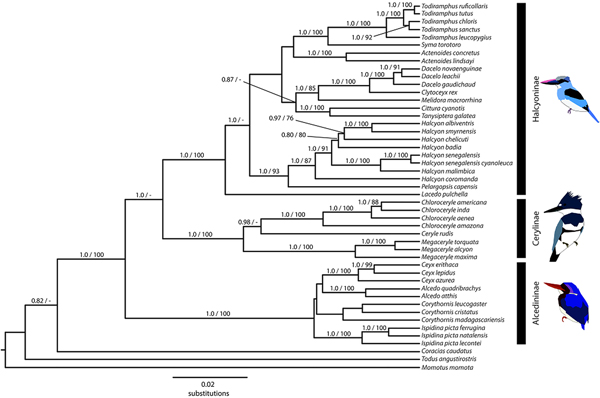
The kingfisher phylogeny recovered the three well-supported subfamilies and all genera with multiple representatives as monophyletic with high levels of statistical support assessed via both bootstrap values and posterior probability (Fig. 3).
Kingfisher phylogeny resulting from Bayesian Analysis of RAG1 and ND2. Numbers on branches are posterior probabilities/maximum parsimony bootstrap values. Bootstrap values below 50 and posterior probabilities below 0.80 are not shown. Thick black bars denote the three kingfisher subfamilies.

Cophylogenetic analysis of kingfishers and their lice
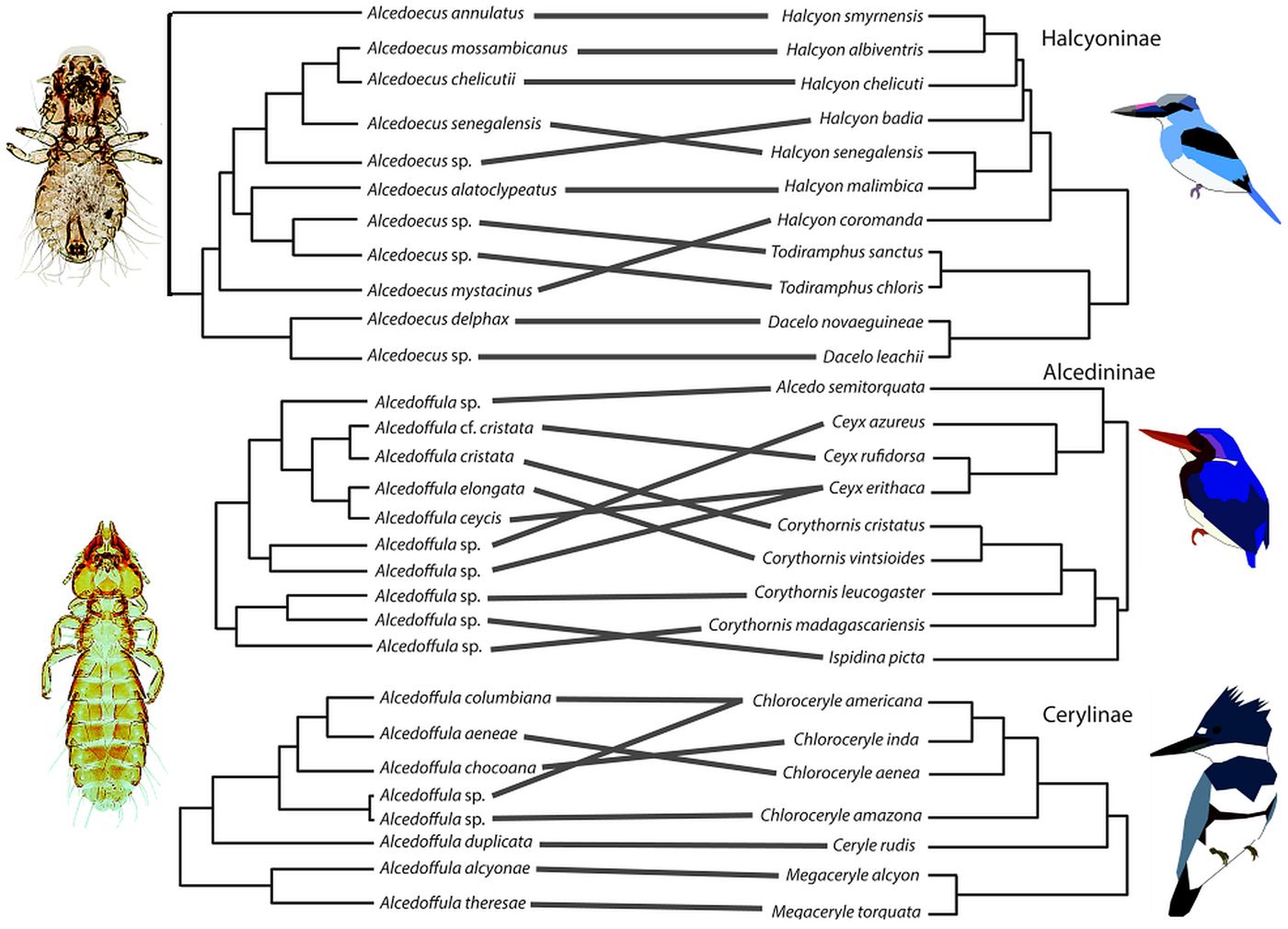
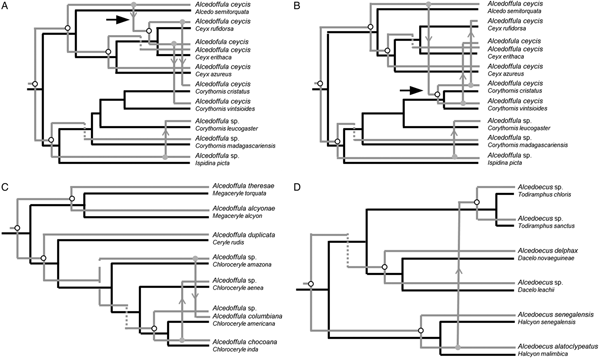
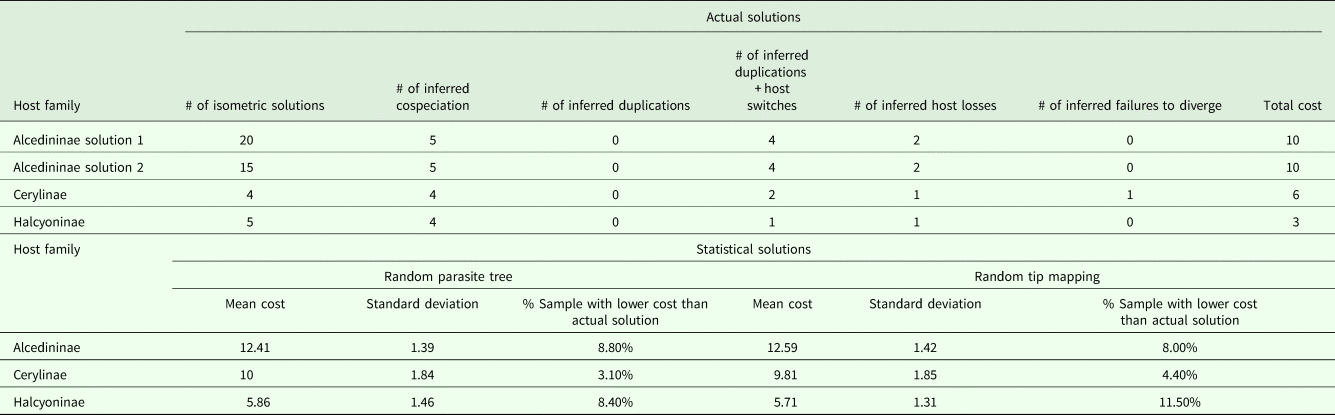
The results of the Jane4 cophylogenetic analyses varied across groups of lice and hosts (Table 2 and Figs 4 and 5). The cophylogenetic analysis of Alcedoffula from cerylinine kingfishers and their hosts consistently recovered four cospeciation events which were significantly more than expected by chance p = 0.01. In contrast, cophylogenetic reconstructions of both Alcedoffula with Alcedininae and Alcedoecus with Halcyoninae showed no evidence for cospeciation between the louse and host phylogenies (both p > 0.21).
Tanglegrams of three host subfamilies and their lice showing links between lice (left) and host (right).

Inferred patterns of cospeciation for Alcedininae (A and B), Cerylinae (C), and Daceloninae (D) and their lice. Dashed lines represent losses, open circles mark nodes of cospeciation and the filled circle indicates duplication coupled with host switching. Large arrows in A and B denote where two equally costly solutions differ in their reconstructions.

Results of Jane analysis by host subfamily (upper) and using the statistical solutions option based on 1000 random samples (lower)

Reconstruction of biogeographic history on kingfisher louse trees
Biogeographic reconstructions using the DIVALIKE + J model had the highest likelihood scores for Alcedoffula whereas both the DIVALIKE + J and BAYAREALIKE + J models had equal likelihood scores for Alcedoecus. Within Alcedoffula, no single geographic region (or pair of regions) was favored in the ancestral state reconstruction of the basal nodes (Fig. 1). We recovered a single South American origin for lice parasitizing Cerylinae, with subsequent colonization of Africa. An African origin was inferred for lice parasitizing Alcedininae, but it is unclear if a single or multiple origins scenario best explain the distribution of lice in Southeast Asia. Lastly, two origins of Alcedoffula from Malagasy host species were also inferred. For Alcedoecus, biogeographic reconstruction inferred an Australian + southeast Asian origin (Fig. 2). However, the other deep nodes in this clade were relatively equivocal, although Australian origins had some support.
Discussion
Phylogenetic analysis of kingfisher lice
Phylogenies for two louse genera, Alcedoffula and Alcedoecus, which broadly parasitize kingfishers provided insights into the evolutionary history and taxonomy of these parasites. A two gene phylogeny recovered both Alcedoffula and Alcedoecus as strongly supported, reciprocally monophyletic clades. Representatives of the Alcedoffula duplicata and the alcedinis species groups form strongly supported reciprocally monophyletic clades in our phylogenetic reconstructions (Fig. 1) and therefore support these species groups proposed by Tendeiro (Reference Tendeiro1967). However, our phylogenetic reconstructions do not support the species groups proposed by Tendeiro (Reference Tendeiro1983) for Alcedoecus, because representatives of the capistratus species group (including A. chelicutii, A. annulatus, A. mossambicanus) and the alatoclypeatus species group (including A. alatoclypeatus, A. senegalensis, A. mystacinus) do not form well-supported reciprocally monophyletic clades.
Although many groups of birds are parasitized by multiple species of lice, typically from different louse genera or subgenera, individual kingfishers are typically parasitized by only a single louse species. The two kingfisher louse genera in this study are generally restricted to particular kingfisher subfamilies, with Alcedoffula parasitizing Cerylinae and Alcedininae and Alcedoecus parasitizing only Halcyoninae. These generic host associations do not exactly mirror the higher level phylogeny of kingfishers (Moyle, Reference Moyle2006; Andersen et al., Reference Andersen, McCullough, Mauck, Smith and Moyle2017) because Alcedininae is sister to a clade made up of Halcyoninae and Cerylinae. Thus, one way to explain this host-parasite association pattern is that Alcedoffula was lost from the ancestor of Halcyoninae and subsequently ‘replaced’ by Alcedoecus.
There are only a few examples in the literature of kingfishers parasitized by a louse from a genus not typical of that kingfisher subfamily, and it is possible that these are examples based on erroneous generic identifications or incorrect host associations because of field contamination. For example, Price et al (Reference Price, Hellenthal, Palma, Johnson and Clayton2003) list two louse species associated with Ceyx erithaca: Alcedoecus orientalis and Alcedoffula ceycis Tendeiro, Reference Tendeiro1967. We sequenced three lice from this host species, which were all identified morphologically as Alcedoffula ceycis. The resulting topology included two distinct lineages of Alcedoffula from Ceyx erithaca; however the relationship between these two louse lineages lacked statistical support. Additional sampling of Ceyx erithaca is needed to determine whether this host species is parasitized by multiple lineages of Alcedoffula (i.e. whether Alcedoffula ceycis comprises multiple cryptic species). Although we sampled multiple Ceyx erithaca host individuals we did not collect any individuals of Alcedoecus orientalis, the original description of which was based on six specimens sampled from a single host individual (Tendeiro, Reference Tendeiro1965). This kingfisher is distributed across the Indian subcontinent, Southeast Asia, and nearby islands. Additional sampling from across the geographic range of this host species may help to determine whether Alcedoecus orientalis has a narrow geographic range or is perhaps a rarer louse species than Alcedoffula ceycis. Secondly, the only record of Alcedoecus on Cerylinae is Alcedoecus nepalensis Tendeiro, Reference Tendeiro1983 on Megaceryle lugubris (Temminck, 1834), an Old World kingfisher species. Megaceryle occurs in both the New and Old Worlds. Tendeiro (Reference Tendeiro1983) suggested that lice from New World Megaceryle kingfishers are both morphologically distinct from other Alcedoffula and more similar to the species within the louse genus Quadraceps Clay and Meinertzhagen, Reference Clay and Meinertzhagen1939 and thus are erroneously placed in the genus Alcedoffula. However, we found that lice from New World Megaceryle are embedded within Alcedoffula (Fig. 1). The presence of an Alcedoecus species on an Old World Megaceryle kingfisher could be the result of a host switch because numerous kingfisher taxa, which traditionally host Alcedoecus, overlap geographically with Megaceryle lugubris. Alternatively, this Alcedoecus record might have resulted from field or laboratory contamination, because Megaceryle maxima (Pallas, 1769), the other Old World Megaceryle species, is parasitized by an Alcedoffula species (Tendeiro, Reference Tendeiro1967; Price et al., Reference Price, Hellenthal, Palma, Johnson and Clayton2003), although different from the species found on New World Megaceryle.
The phylogeny of Alcedoffula collected from Cerylinae broadly resembles the Cerylinae portion of the kingfisher phylogeny published by Andersen et al. (Reference Andersen, McCullough, Mauck, Smith and Moyle2017). Alcedoffula from Megaceryle kingfishers are sister to a clade of lice from the Neotropical Chloroceryle and the African/southern Asian kingfisher Ceryle rudis. Andersen et al. (Reference Andersen, McCullough, Mauck, Smith and Moyle2017) placed Ceryle rudis as sister to the Chloroceryle radiation, which matches our louse phylogeny. However, the branching pattern of Alcedoffula on Chloroceryle kingfishers does not closely match the published Chloroceryle portion of the host tree, although these relationships in the louse tree are not well supported. Lice collected from Chloroceryle americana are paraphyletic, with one louse from Panama placed as sister to lice from Chloroceryle amazona sampled from Peru. All other Chloroceryle americana lice included in our phylogeny are from South America and identified as Alcedoffula columbiana Carriker, Reference Carriker1959. This paraphyly among Chloroceryle americana lice could be the result of geographically specific louse species infecting a single host species (Catanach and Johnson, Reference Catanach and Johnson2015). Catanach and Johnson (Reference Catanach and Johnson2015) found that Old World and New World Buteo lagopus Pontoppidan, 1763 (Accipitriformes, Accipitridae) were parasitized by distantly related lice. Alternatively, a louse straggling event (when a parasite ends up on a non-typical host) from Chloroceryle amazona to Chloroceryle americana could cause this paraphyletic pattern. Additional samples from Central American kingfishers will help determine the origin of this louse paraphyly.
Andersen et al. (Reference Andersen, McCullough, Mauck, Smith and Moyle2017) found evidence for a clade of kingfishers containing Corythornis and Ispidina. Our data set included Alcedoffula from five of the six host species currently placed within these host genera and we found close affinities between lice from Corythornis leucogaster, Corythornis madagascariensis, and Ispidina picta. However, not all lice collected from Corythornis fall out in the same clade. For example, Corythornis cristatus and Corythornis vintsioides, which are sister host species (Andersen et al., Reference Andersen, McCullough, Mauck, Smith and Moyle2017), are parasitized by lice that fall into different louse clades. Furthermore, lice from these host sister species are not recovered as louse sister species. This suggests that something other than host relationships is driving patterns of Alcedoffula louse distribution, although statistical support for relationships within this louse clade are lacking. Although these louse species appear to be host species specific, there is no evidence of codivergence. Instead, host-switching and sorting events were likely more important in structuring the host-parasite associations between Alcedoffula and Alcedininae. It is possible that Alcedoffula colonized Alcedininae after the kingfishers themselves radiated. Furthermore, lice from both Corythornis vintsioides and Corythornis madagascariensis were collected in Madagascar, whereas lice from Corythornis cristatus were sampled from regions overlapping with the sampling of Corythornis leucogaster and Ispidina picta. Thus, the lack of geographically structured clades suggests that recent host-switching among geographically proximate hosts is not the primary cause of the incongruence between host and parasite trees.
In the Alcedoecus tree (Fig. 2), lice from kookaburras form a clade that is sister to all other sampled Alcedoecus with the exception of Alcedoecus annulatus ex Halcyon smyrnensis. This specimen is placed on a long branch and is sister to all other Alcedoecus. Although lice from Halcyon do not form a monophyletic group, the placement of the specimen from Halcyon smyrnensis is surprising. However, we only have COI sequence data for this louse species and thus its placement requires further study.
Where specimens were available, we included samples from multiple individuals of the same host species to determine whether louse lineages are host specific. Within this dataset we included two to four representatives from 11 of the 27 sampled host species. Lice from all but two hosts (Ceyx erithaca and Chloroceryle americana) were each other's closest relatives (posterior probability = 0.95 or greater). Both of these host species are geographically widespread. Ceyx erithaca is widely distributed in Southeast Asia and many surrounding oceanic islands, whereas Chloroceryle americana is a geographically widespread host species that breeds from the southern United States to Argentina (Clements et al., Reference Clements, Schulenberg, Iliff, Roberson, Fredericks, Sullivan and Wood2017).
In several cases, our louse phylogeny also mirrors recently proposed host species splits. For example, Todiramphus chloris (Boddaert, 1783) was recently split into six species (Andersen et al., Reference Andersen, Shult, Cibois, Thibault, Filardi and Moyle2015) and our dataset includes parasite data from two of these host taxa, Todiramphus sacer (Gmelin, 1788) and Todiramphus sordidus (Gould, 1842). These two lice from T. sacer and T. sordidus are 16% divergent from one another in COI sequences and are not each other's closest relatives in the phylogeny. A second example includes Alcedoffula from Corythornis vintsioides and Corythornis cristatus, two kingfisher species which are sometimes treated as conspecific (Moyle et al., Reference Moyle, Fuchs, Pasquet and Marks2007). Our study examined lice from both host taxa, including multiple representatives from Corythornis cristatus from multiple localities in Africa. Our phylogeny recovered a clade containing all lice from Corythornis cristatus but this clade excluded the louse from Corythornis vintisioides. The louse from Corythornis vintisioides had an uncorrected COI p-distance of ~15% from members of the cristatus louse clade, suggesting that these louse taxa may be sufficiently divergent to support Tendeiro's (Reference Tendeiro1967) description of different species of lice from Corythornis vintisioides and Corythornis cristatus. These Alcedoffula species have been retained by Price et al. (Reference Price, Hellenthal, Palma, Johnson and Clayton2003), although our limited samples were morphologically identical, suggesting that the key provided by Tendeiro is of limited use. A revision of the lice from these hosts (and Alcedoffula as a whole) would better define species limits among these taxa and diagnostic morphological features for specimen identification.
Cophylogenetic analysis of kingfishers and their lice
Varying degrees of cospeciation have been found in comparisons of bird and louse phylogenetic trees, ranging from associations which show strong congruence (Hughes et al., Reference Hughes, Kennedy, Johnson, Palma and Page2007) to virtually no similarity between host and parasite trees (Weckstein, Reference Weckstein2004). Here we found the degree of congruence varied not only between the two kingfisher louse genera but also when comparing cophylogenetic histories among the two distinct clades of Alcedoffula and their hosts (Figs 4 and 5). Within Alcedoffula, lice occurring on Cerylinae showed strong evidence of cospeciation with their hosts. In contrast, Alcedoffula from Alcedininae and Alcedoecus from Halcyoninae do not show evidence of cospeciation with their hosts. However, our sampling of louse diversity among the three subfamilies is somewhat uneven. In particular, Cerylinae includes ten kingfisher species distributed in both the New and Old Worlds and we sampled lice from all but two Old World species. On the other hand, the other two subfamilies of kingfishers are more diverse, including many with extremely limited distributions, and therefore lice were only available from a smaller fraction of host species in these subfamilies. Further taxon sampling could result in increased evidence of codivergence between kingfishers and their lice, especially among closely related kingfisher species. This is particularly the case in island archipelagos where one kingfisher lineage invaded an island and then diversified down the island chain, a common pattern in Old World kingfishers (Andersen et al., Reference Andersen, McCullough, Mauck, Smith and Moyle2017).
A second potential explanation for the pattern observed in Alcedoffula is that this genus radiated by extensive host-switching on kingfishers after their hosts already radiated (similar to an escape-and-radiate hypothesis, Ehrlich and Raven, Reference Ehrlich and Raven1964). This hypothesis is consistent with the fact that this louse genus does not occur on a monophyletic host group (the Alcedininae and the Cerylinae are not each other's closest relatives; rather Cerylinae is sister to Halcyoninae). Thus one possibility is that the ancestor of Alcedoffula may have switched onto Cerylinae kingfishers early in this host groups diversification, allowing the lice to cospeciate with the hosts. Three species of Cerylinae kingfisher have overlapping ranges with Alcedininae kingfishers creating the potential for louse transfer between unrelated hosts. If this host switch from cerylinine kingfishers occurred later in alcedinine diversification then this would explain the lack of cospeciation between the alcedinine kingfishers and their Alcedoffula. Divergence time estimation of the lice could further refine this hypothesis.
Reconstruction of biogeographic history on kingfisher louse trees
Andersen et al. (Reference Andersen, McCullough, Mauck, Smith and Moyle2017) inferred an Indomalayan origin of kingfishers as a whole. This finding somewhat conflicts with the biogeographic patterns found in the louse phylogenies inferred here, because no biogeographic reconstruction for the lice favored a strictly Southeast Asian origin, although this region was reconstructed as part of the ancestral range of Alcedoecus.
An Australian + southeast Asian origin was favored for Alcedoecus, the louse genus parasitizing Halcyoninae; however a number of other potential histories were also inferred. Australian lice from Alcedoecus were embedded within large African louse clades. However, one clade of Australian lice from kookaburras is sister to the majority of Alcedoecus, causing the biogeographic reconstruction of Alcedoecus to favor an Australian + southeast Asian origin. This contrasts with relationships in the host phylogeny in which kookaburras are deeply embedded within Halcyoninae, suggesting the kingfishers of Australia originated from Asian stock.
Although the ancestral range reconstructed at the Alcedoffula basal node was equivocal, within lice parasitizing Cerylinae, we inferred a single South American origin. This clade subsequently spread into North America (belted kingfisher lice) and Africa (pied kingfisher lice). This contrasts with the host biogeography inferred by Andersen et al. (Reference Andersen, McCullough, Mauck, Smith and Moyle2017), which is consistent with an Old World origin and two subsequent New World invasions as inferred for Cerylinae. Moyle (Reference Moyle2006) and Andersen et al. (Reference Andersen, McCullough, Mauck, Smith and Moyle2017) both recovered Australian alcedinine kingfishers embedded deeply within African and Asian alcedinine kingfishers. This arrangement is similar to our biogeographic reconstruction of Alcedoffula from Alcedininae which inferred an African origin of the clade, followed by potentially two southeast Asian invasions. One of these lineages later colonized Australia.
Similar to their kingfisher hosts, biogeographic reconstruction revealed multiple biogeographic transitions across Wallace's Line suggesting that this typically strong biogeographic barrier was not extremely important for kingfishers or their associated chewing lice. Although other examples of avian clades dispersing across Wallace's Line exist (i.e. Cuckooshrikes in the family Campephagidae (Jønsson et al., Reference Jønsson, Irestedt, Fuchs, Ericson, Christidis, Bowie, Norman, Pasquet and Fjeldså2008), this is the first formal analysis of the impact of Wallace's Line on chewing lice.
Author ORCIDs
Therese Catanach, 0000-0003-3850-1196.
Supplementary material
The supplementary material for this article can be found at https://doi.org/10.1017/S0031182019000453
Acknowledgements
We thank Terry Galloway (Manitoba, Canada) for providing louse specimens. Gabriela Escalante assisted with lab work. We thank John Bates and Shannon Hackett at The Field Museum (Chicago, IL) for providing additional bird tissue samples. We also thank Stuart Elsom, Doug Wechsler, and Rick and Nora Bowers for their contributions to the Academy of Natural Science VIREO bird image collection which we used as models for making our kingfisher illustrations. We thank three anonymous reviewers who provided helpful suggestions that improved the manuscript.
Financial support
This work was supported in part by NSF grants DEB-1503804 to JDW, DEB-1050706, DEB-1239788, and DEB-1342604 to KPJ, and DEB-1557053 to RGM.
Conflicts of interest
None
Ethical standards
All banding, collecting, and salvaging was conducted with appropriate IACUC approvals, collecting permits, and following applicable import/export requirements.