Introduction
Theory of mind (ToM), or the ability to mentalize, is a multifaceted, higher-order social cognitive process. ToM involves ascribing distinct mental states to oneself and others, and includes making inferences using an understanding of others’ intentions and emotions (Premack & Woodruff, Reference Premack and Woodruff1978; Leslie et al. Reference Leslie, Friedman and German2004; Frith & Frith, Reference Frith and Frith2008). In schizophrenia, ToM deficits have been well documented, are among the social cognitive deficits with the largest effect size, make an impact on functioning, and do not appear to be moderated by factors such as gender, age or phase of illness. Two meta-analyses have shown large ToM deficits in chronic schizophrenia patients compared with controls: d = 1.25 (Sprong et al. Reference Sprong, Schothorst, Vos, Hox and Van Engeland2007); and g = 0.96 (Savla et al. Reference Savla, Vella, Armstrong, Penn and Twamley2013). In addition, a growing number of studies has confirmed the existence of ToM deficits in first-episode psychosis (FEP) (Inoue et al. Reference Inoue, Yamada, Hirano, Shinohara, Tamaoki, Iguchi, Tonooka and Kanba2006; Bertrand et al. Reference Bertrand, Sutton, Achim, Malla and Lepage2007; Kettle et al. Reference Kettle, O'Brien-Simpson and Allen2008; Koelkebeck et al. Reference Koelkebeck, Pedersen, Suslow, Kueppers, Arolt and Ohrmann2010; Achim et al. Reference Achim, Ouellet, Roy and Jackson2012; Mazza et al. Reference Mazza, Pollice, Pacitti, Pino, Mariano, Tripaldi, Casacchia and Roncone2012; Mazza, Reference Mazza, Catalucci, Pino, Giusti, Nigri, Pollice, Roncone, Casacchia and Gallucci2013), A recent meta-analysis found that the ToM impairment in FEP was comparable with chronic patients (d = 1.00; Bora & Pantelis, Reference Bora and Pantelis2013). What seems to be fairly certain for both chronic psychosis and FEP is that a ToM deficit is present and that the magnitude is large.
Although first-episode schizophrenia patients show disturbances across a range of ToM tasks, several methodological features of prior assessment methods may limit their validly in assessing this construct (Horan et al. Reference Horan, Nuechterlein, Wynn, Lee, Castelli and Green2009). Many of the ToM tasks used in schizophrenia were designed for studies of normal or abnormal (e.g. autism) child development, using stimuli that might be developmentally inappropriate for adults with schizophrenia. Furthermore, ToM tasks that use written social vignettes make considerable demands on cognitive processes such as verbal ability and memory, which are known to be disrupted in schizophrenia (Nuechterlein et al. Reference Nuechterlein, Barch, Gold, Goldberg, Green and Heaton2004). These tasks require subjects to make reflective, logical inferences about others’ mental states in clearly defined social problem-solving situations, which have been described as explicit mentalizing (Frith, Reference Frith2004). However, social interactions are often ambiguous and dynamic, relying on our ability to rapidly apprehend others’ fluctuating intentions and emotions from contextual cues (Klin, Reference Klin2000). This type of processing occurs in a largely automatic, non-reflective manner, and has been described as implicit mentalizing (Frith & Wolpert, Reference Frith and Wolpert2004). In contrast, some paradigms use simple geometric shapes that display motion patterns resembling meaningful ‘interactions’ to capture one's tendency to spontaneously attribute human intentions to non-human objects (Heider & Simmel, Reference Heider and Simmel1944). The current study used a Social Animations Task (SAT) that was designed to assess implicit aspects of mentalizing across diverse age groups (Abell et al. Reference Abdel-Hamid, Lehmkämper, Sonntag, Juckel, Daum and Brüne2000; Castelli et al. Reference Castelli, Happé, Frith and Frith2000, Reference Castelli, Frith, Happé and Frith2002).
ToM deficits are present in chronic and first-episode patients alike, suggesting the presence of a trait marker in schizophrenia patients (Green et al. Reference Green, Bearden, Cannon, Fiske, Hellemann, Horan, Kee, Kern, Lee, Sergi, Subotnik, Sugar, Ventura, Yee and Nuechterlein2012). An important issue is whether this rather large ToM deficit is a trait marker that is present in acutely ill patients and then during subsequent periods when patients' symptoms are remitted. One review of chronic patients suggested that the presence of the ToM deficit during remission, in the first-degree relatives of patients and in high-risk patients was an indication that ToM can be considered a stable endophenotype worthy of genetic research (Martin & Tesser, Reference Martin and Tesser2013). Despite this apparent stability, ToM can be related to symptoms. In fact, two longitudinal studies of chronic patients found that ToM improved over time (Drury et al. Reference Drury, Robinson and Birchwood1998; Mizrahi et al. Reference Mizrahi, Korostil, Starkstein, Zipursky and Kapur2007). However, studies have found that the deficit is present in FEP patients even when they were remitted (Inoue et al. Reference Inoue, Yamada, Hirano, Shinohara, Tamaoki, Iguchi, Tonooka and Kanba2006; Bertrand et al. Reference Bertrand, Sutton, Achim, Malla and Lepage2007; Sprong et al. Reference Sprong, Schothorst, Vos, Hox and Van Engeland2007). These FEP studies were cross-sectional or had concluded that the ToM deficit is a trait-marker simply because the deficit was not correlated with symptom severity and was present in loosely defined ‘stable’ patients. Additional longitudinal studies are needed that use operationally defined remission criteria. Clarifying further whether ToM is a trait has important scientific implications for understanding the developmental nature and course of the ToM deficit in schizophrenia.
In his influential theory, Frith (Reference Frith1992) proposed that positive symptoms can occur in schizophrenia patients because of deficits in ToM mentalizing capacity. Patients’ faulty awareness of other's intentions might explain paranoid and referential delusions. Although less fully elaborated, negative symptoms such as social withdrawal may be associated with an inadequate ability to mentalize about others’ intensions, e.g. indirect requests from the boss. Several studies of chronic schizophrenia patients support the association of ToM with negative and positive symptoms, but the results have been inconsistent (Brüne, Reference Brüne2005; Harrington et al. Reference Harrington, Langdon, Siegert and McClure2005). Studies of FEP have linked ToM with negative symptoms (Mazza et al. Reference Mazza, Catalucci, Pino, Giusti, Nigri, Pollice, Roncone, Casacchia and Gallucci2013) and positive symptoms (Koelkebeck et al. Reference Koelkebeck, Pedersen, Suslow, Kueppers, Arolt and Ohrmann2010), suggesting the deficit is associated with symptom severity. However, other studies suggest that ToM was not related to symptoms (Inoue et al. Reference Inoue, Yamada, Hirano, Shinohara, Tamaoki, Iguchi, Tonooka and Kanba2006; Bertrand et al. Reference Bertrand, Sutton, Achim, Malla and Lepage2007). Additional research in FEPs is therefore warranted.
There is abundant evidence that neurocognition is related to functioning (Green et al. Reference Green, Kern, Braff and Mintz2000). In addition, social cognition, and ToM deficits in particular have been directly linked to poor role functioning (Vauth et al. Reference Vauth, Rusch, Wirtz and Corrigan2004; Couture et al. Reference Couture, Penn and Roberts2006; Fett et al. Reference Fett, Viechtbauer, Dominguez, Penn, van Os and Krabbendam2011; Schmidt et al. Reference Schmidt, Mueller and Roder2011). In fact, some higher-order cognitive skills (reasoning and problem solving) have been associated with specific higher-level social cognitive functions, such as ToM (Bell et al. Reference Bell, Fiszdon, Greig and Wexler2010; Abdel-Hamid et al. Reference Abell, Happe and Frith2009). Indeed, schizophrenia patients appear to be at a disadvantage for any social or role functioning situation, e.g. employment that requires ToM or mentalizing abilities (Mazza et al. Reference Mazza, Catalucci, Pino, Giusti, Nigri, Pollice, Roncone, Casacchia and Gallucci2013). Given that social cognition deficits (ToM) and neurocognition are related, sorting out which of these constructs is more critical for influencing functioning is important. Considering the relationships between these constructs, does ToM play a role in mediating the relationship between neurocognition and functioning? Knowing more about the mediating role of ToM in relationship to neurocognition in FEP can help identify pathways by which neurocognition and ToM influence functioning.
ToM has often been found to be related to neurocognition, negative symptoms and role functioning in chronic schizophrenia patients (Vauth et al. Reference Vauth, Rusch, Wirtz and Corrigan2004; Couture et al. Reference Couture, Penn and Roberts2006; Fett et al. Reference Fett, Viechtbauer, Dominguez, Penn, van Os and Krabbendam2011). In addition, ToM has also been found to play an important mediating role between neurocognition, and symptoms and outcome. In one study of chronic patients, negative symptoms were found to play this mediation role (Mehta et al. Reference Mehta, Thirthalli, Subbakrishna, Gangadhar, Eack and Keshavan2013). However, much less is known about these associations in FEP. Even less is known about the temporal relationship between relevant constructs such as ToM, symptoms and functioning. Very few studies have addressed these issues in FEP, and those that have have yielded inconsistent results.
This study aimed to determine in FEP at baseline and 6 months follow-up: (1) whether ToM deficits exist in patients compared with healthy controls on a measure of implicit mentalizing; (2) if ToM deficit is a trait marker as evidenced by the deficit's presence during periods of operationally defined symptom remission; (3) whether the deficit is related to the presence of symptoms, neurocognition, and functioning; and (4) whether ToM acts as a mediator of the relationship between neurocognition and functioning or negative symptoms act as a mediator of the relationship between ToM and functioning.
Method
Subjects
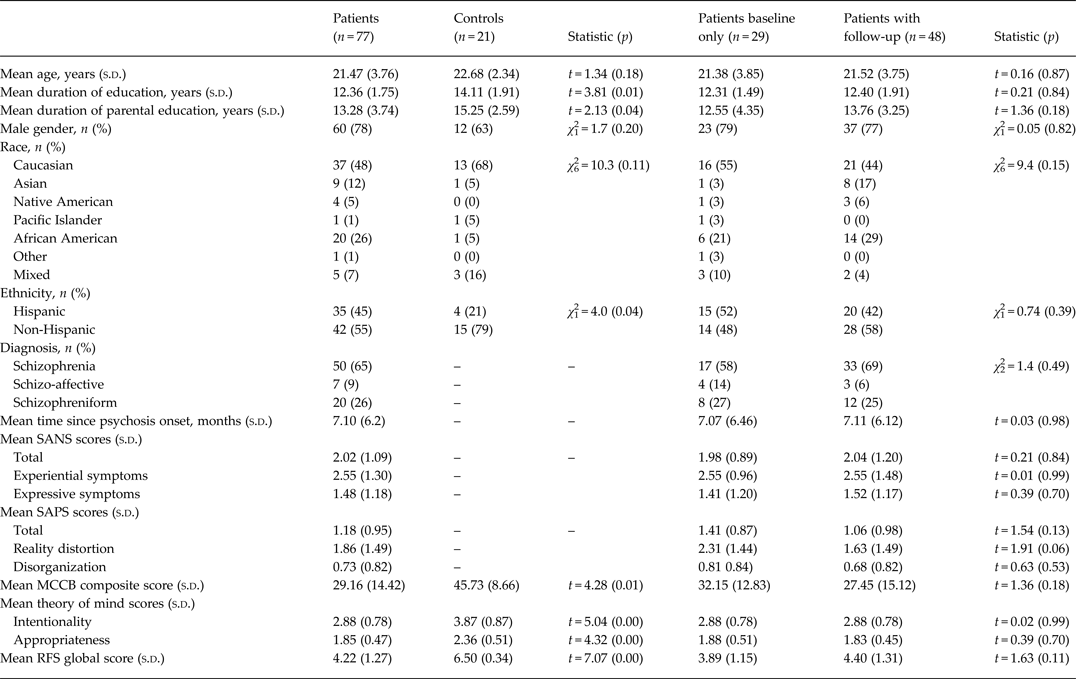
The sample consisted of 77 recent-onset schizophrenia patients and 21 healthy controls who were demographically comparable and who participated in a National Institute of Mental Health (NIMH)-funded project focusing on the early course of schizophrenia (see Table 1; for additional information, see Nuechterlein et al. Reference Nuechterlein, Subotnik, Turner, Ventura, Becker and Drake2008b ). All patients had an initial onset of psychosis within 2 years of study entry. In fact, most patients had a very recent psychosis onset (mean = 7.1 months) and 87% were experiencing a first episode of psychosis. All patients met Diagnostic and Statistical Manual of Mental Disorders, 4th edition (DSM-IV) criteria for either schizophrenia, schizo-affective disorder depressed type, or schizophreniform disorder based on the Structured Clinical Interview for DSM-IV (SCID). Exclusion criteria were: (1) evidence of a neurological disorder; (2) evidence of significant and habitual drug abuse or alcohol dependence in the 6 months prior to hospitalization or of substance use that triggered the psychotic episode; and (3) estimated intelligence quotient <70.
Sample differences at study entry for recent-onset schizophrenia patients (n = 77) and healthy controls (n = 21)

s.d., Standard deviation; SANS, Scale for the Assessment of Negative Symptoms; SAPS, Scale for the Assessment of Positive Symptoms; MCCB, MATRICS Consensus Cognitive Battery; RFS, Role Functioning Scale.
All patients were enrolled in the Aftercare Research Program, an out-patient clinic that provides antipsychotic medication (starting with oral risperidone at baseline) and offers individual case management, group therapy focused on practical life skills, and family education. All patients were considered eligible to enter the study when they were on a stable out-patient dose of oral risperidone for at least 3 weeks.
Healthy controls received extensive screening with the SCID, and symptom rating scales to verify the absence of major Axis I and Axis II diagnoses, current psychopathology, family history of psychosis, lifetime dependence, abuse or excessive use in the past 6 months of alcohol or substances. All participants gave written informed consent prior to data collection.
Procedures
Assessments of ToM (using the SAT), positive and negative symptoms, neurocognition, and role functioning were conducted at baseline. Raters who were trained to criterion levels of reliability (Ventura et al. Reference Ventura, Green, Shaner and Liberman1993) conducted all of the diagnostic and symptom assessments for the patients and controls. The identical assessment battery and procedures were repeated at 6 months.
Measures
ToM
SAT
The SAT was designed to assess implicit aspects of mentalizing (Abell et al. Reference Abdel-Hamid, Lehmkämper, Sonntag, Juckel, Daum and Brüne2000; Castelli et al. Reference Castelli, Happé, Frith and Frith2000, Reference Castelli, Frith, Happé and Frith2002). Administration and scoring procedures followed those described by Horan et al. (Reference Horan, Nuechterlein, Wynn, Lee, Castelli and Green2009). Briefly, subjects were told that the task was designed to learn about how people perceive movement. They were informed that they would be shown a series of animations and asked to provide a description of how they perceived or interpreted the movements after each animation. Each animation lasted 34–45 s and featured a big red triangle and a small blue triangle moving around on a white background. Two practice animations were administered to familiarize subjects with the task and to ensure that they comprehended the instructions.
A total of 12 animations were shown: four animations for each of the three different conditions: ToM, goal directed and random. The scripts (i.e. type of interaction intended by the developers of the task) underlying the ToM interactions involved one agent coaxing, seducing, mocking or surprising another. The goal-directed and random conditions serve as control conditions that also involve triangles moving in a self-propelled manner, but do not depict interactions that involve complex mental states. The scripts underlying the four goal-directed interactions involved one agent chasing, fighting, dancing or leading another. In the random animations the triangles moved in a non-interactive, non-contingent manner. After each scene, the experimenter always asked the same neutral question: ‘What was happening in this animation?’ On no occasion was feedback given, but subjects were generally praised for their descriptions. The stimuli were presented in an intermixed, random order. All responses were digitally recorded and transcribed for scoring.
The verbal descriptions given after each animation were coded by raters who were blinded to the subject's diagnosis along three different dimensions: (1) ‘appropriateness’: how accurately the descriptions capture the events depicted in the animations, as intended by the underlying scripts, rated from 0–3; (2) ‘intentionality’: the degree to which purposeful movements and mental states are described, rated 1–5; and (3) ‘length’: a word count of the response. Prior to scoring the transcripts, three raters were trained by one of the co-authors (W.P.H.) who was trained by the developer of the scoring system. Independent scores from three raters on a subset of eight existing transcripts were obtained, with an interrater reliability intra-class correlation of 0.88.
Symptom assessment
Scale for the Assessment of Negative Symptoms (SANS)
The SANS (Andreasen, Reference Andreasen1982) is a 25-item measure that is widely used to assess two negative symptom domains: (1) expressive symptoms, which consist of affective flatting (blunted affect) and alogia, and (2) experiential symptoms, which consist of avolition and apathy, and asociality. The SANS total score was the mean of global ratings from each of these two negative symptom domains, excluding attention (Blanchard et al. Reference Blanchard, Mueser and Bellack1998).
Scale for the Assessment of Positive Symptoms (SAPS)
The SAPS (Andreasen & Olsen, Reference Andreasen and Olsen1982) is a 35-item measure that is widely used to assess positive symptom domains. The total SAPS included the mean of hallucinations, delusions, bizarre behavior, formal thought disorder, and inappropriate affect. The mean of the global ratings for SAPS reality distortion included hallucinations and delusions, and for SAPS disorganization included bizarre behavior, formal thought disorder, and inappropriate affect.
Neurocognition
MATRICS Consensus Cognitive Battery (MCCB)
Neurocognition was assessed using the MCCB (Nuechterlein et al. Reference Nuechterlein, Green, Kern, Baade, Barch, Cohen, Essock, Fenton, Frese, Gold, Goldberg, Heaton, Keefe, Kraemer, Mesholam-Gately, Seidman, Stover, Weinberger, Young, Zalcman and Marder2008a ). The current study included a neurocognitive composite score for six of the seven MATRICS domains of cognitive functioning (Nuechterlein et al. Reference Nuechterlein, Barch, Gold, Goldberg, Green and Heaton2004): verbal learning; visual learning; working memory; reasoning and problem solving; speed of processing; and attention/vigilance. We did not include the MCCB social cognition subtest because of the overlap with the ToM construct. The age- and gender-corrected T-score was used for these analyses.
Global functioning
Role Functioning Scale (RFS)
The RFS (Green & Gracely, Reference Green and Gracely1987; Goodman et al. Reference Goodman, Sewell and Cooley1993) was used as the functional outcome measure for the following domains: independent living; work productivity; family relationships; and social relationships. Ratings were based on a semi-structured interview using standardized probe questions. The items on the RFS are anchored so that higher scores reflect decreasing reliance on agency-related support and increasing independence in community functioning. We used the global score, which consists of the mean score of the four individual domains.
Data analysis
Data analyses were conducted in five steps: First, group differences on demographic characteristics, neurocognition and functioning at baseline were examined with t tests for continuous variables and χ 2 tests for categorical variables. Second, group differences on the baseline SAT were evaluated with t tests. Third, the stability of SAT scores in the patient group was evaluated by: (a) comparing baseline and follow-up scores in the patient group using within-group t tests and Pearson correlations; and (b) comparing the patients’ follow-up scores with the controls’ baseline scores using independent-sample t tests. At 6 months, we compared remitted patients with controls at baseline using independent-sample t tests. Fourth, bivariate relationships between ToM scene inappropriateness and intentionality scores, symptoms, neurocognition, and role functioning within the patient group were examined with Pearson correlations; these were computed separately for scores at the baseline and follow-up assessments. Goal-directed intentionality and appropriateness, and random responses were examined as well, but they were not the primary variables of interest.
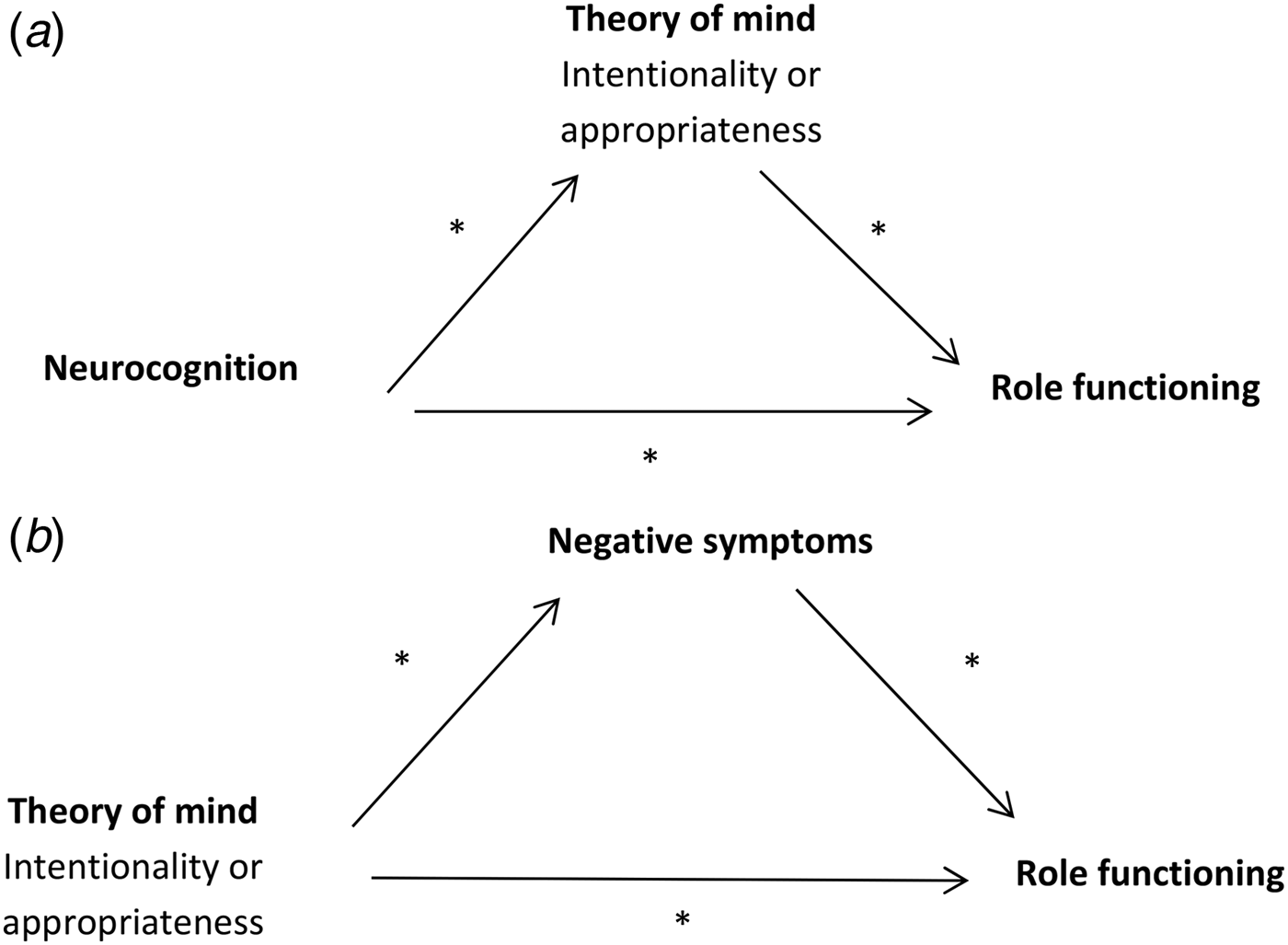
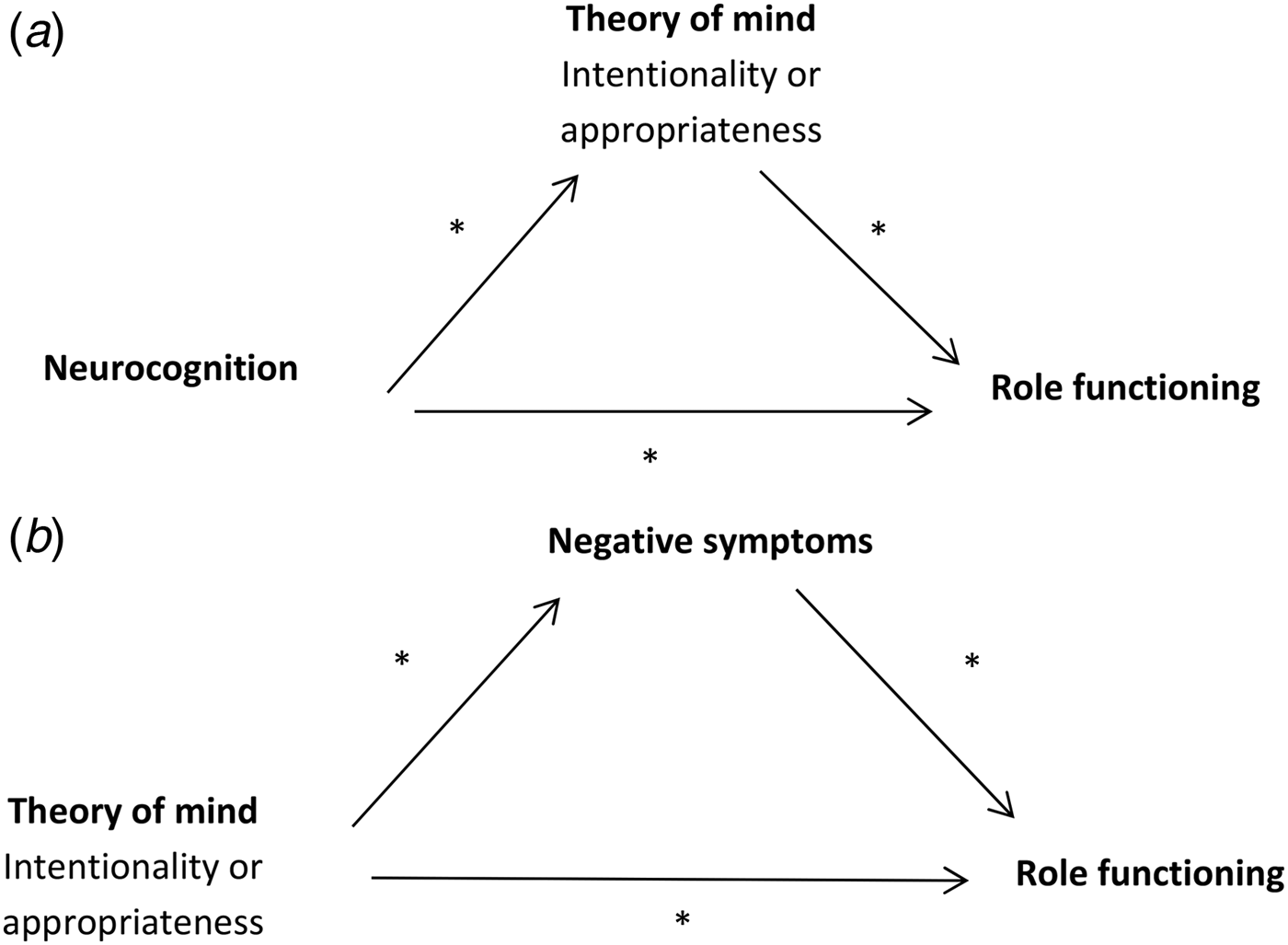
Finally, where there were significant relationships among the variables of interest, mediation analyses (model 1) were used to evaluate whether the relationship between neurocognition and functional outcome was mediated by ToM (Fig. 1a ). We also examined (model 2) the indirect effect of ToM on role functioning through the mediator, negative symptoms (Fig. 1b ). We examined these relationships cross-sectionally at baseline and at 6 months. For longitudinal analyses, we examined neurocognition at baseline in relationship with ToM and functioning at 6 months, and, second, ToM at baseline in relationship with negative symptoms and functioning at 6 months. We followed the well-established procedures and conceptual understanding provided by Baron & Kenny (Reference Baron and Kenny1986) using the Sobel test (Preacher & Hayes, Reference Preacher and Hayes2004) for indirect effects.
(a) Model 1. Examination of theory of mind intentionality or appropriateness as a potential mediator of the relationship between neurocognition and role functioning using the Sobel test. (b) Model 2. Examination of negative symptoms as a potential mediator of the relationship between theory of mind intentionality or appropriateness and role functioning using the Sobel test. * p < 0.05.
Ethical standards
All procedures contributing to this study comply with the ethical standards of the relevant national and institutional committees on human experimentation, and with the Helsinki Declaration of 1975, as revised in 2008.
Results
Group comparisons on demographic characteristics
There were no statistically significant group differences between patients and controls on key demographic variables such as age, gender and race (Table 1). Due to group differences in parental education and ethnicity, all subsequent analyses comparing patients with controls statistically controlled for these variables. Although the groups differed on patient education, that variable was not controlled because the lower level observed in patients may be viewed as a consequence of the disorder (Meehl, Reference Meehl1969). The patients who did versus did not have follow-up SAT data did not differ on key variables such as age, gender, education, race or clinical characteristics (Table 1). However, there was a non-significant tendency for the patients without follow-up SAT scores to have somewhat higher levels of SAPS reality distortion.
Group comparisons on ToM variables at baseline
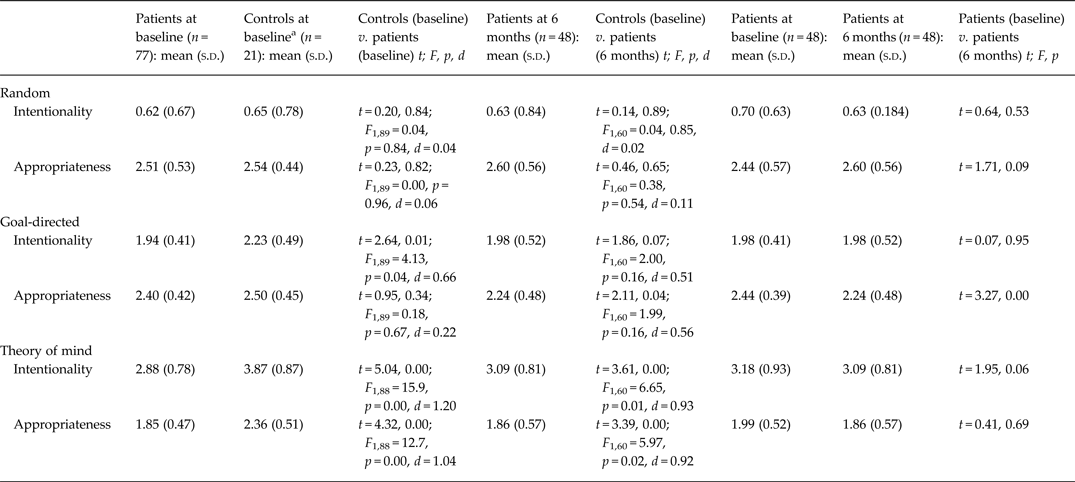
The SAT scores at baseline were significantly lower in patients than healthy controls for both of the primary domains of interest, ToM intentionality and ToM appropriateness (Table 2). Effect sizes of the group differences for the ToM intentionality and ToM appropriateness scores are comparable with previous studies of chronic psychosis and FEP (Table 2). Goal-directed intentionality was significantly lower in patients, but not goal-directed appropriateness. There were no statistically significant differences on any of the random scenes control condition scores.
Cross-sectional group differences between patients at baseline (n = 77) and 6 months (n = 48) compared with controls at baseline only (n = 21) in SAT responses

SAT, Social Animations Task; s.d., standard deviation.
a Healthy control scores at baseline were used in comparisons with patients at baseline and patients at 6 months. Also, for the comparisons between patients and controls we controlled for parental education and ethnicity.
Stability of ToM performance in the patient group
We examined the mean levels of the ToM intentionality and ToM appropriateness for patients who meet operational criteria for symptom remission (Nuechterlein et al. Reference Nuechterlein, Miklowitz, Ventura, Gitlin, Stoddard and Lukoff2006) (≤3 on all three Brief Psychiatric Rating Scale positive symptoms) at 6 months (n = 31) compared with healthy controls at baseline, controlling for parental education and ethnicity. These patients still showed a ToM deficit at the 6-month assessment point compared with controls for ToM intentionality [F 1,46 = 4.82, p = 0.03, mean (controls) = 3.85, mean (patients) = 3.19] and ToM appropriateness [F 1,46 = 4.23, p = 0.04, mean (controls) = 2.35, mean (patients) = 1.97].
Using Pearson correlations we found that the baseline scores for ToM scenes were moderately correlated with those assessed at the 6-month point (for intentionality: n = 48, r = 0.57, p < 0.01; for appropriateness: n = 48, r = 0.41, p < 0.01). In contrast, the MCCB test–retest reliability was very high (n = 45, r = 0.94, p < 0.00). There was trend that was not quite statistically significant indicating that the patients’ ToM intentionality worsened over the 6-month period (t 47 = −1.95, p = 0.06), but appropriateness did not worsen (t 47 = −0.41, p = 0.69).
Correlations of ToM with neurocognition, symptoms and role functioning
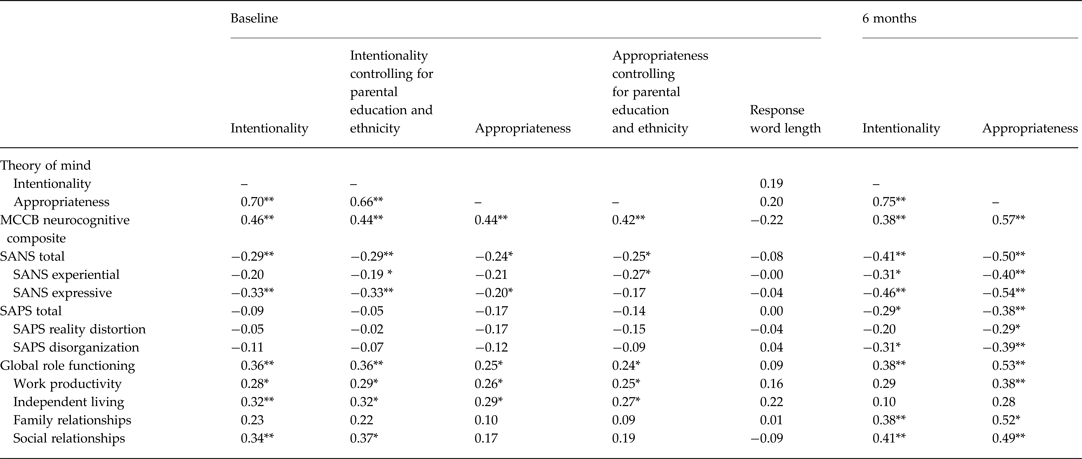
At baseline, both ToM intentionality and appropriateness were significantly related to neurocognition, negative symptoms and role functioning (Table 3). At baseline, ToM intentionality was significantly related to the individual domains of functioning including: independent living, work or school functioning, and social functioning. ToM appropriateness was also significantly related to work or school functioning and social functioning.
Cross-sectional correlations between neurocognition, theory of mind, negative symptoms, positive symptoms, and functioning in first-episode patients at baseline (n = 77) and 6-month follow-up (n = 48)

MCCB, MATRICS Consensus Cognitive Battery; SANS, Scale for the Assessment of Negative Symptoms; SAPS, Scale for the Assessment of Positive Symptoms.
* p < 0.05, ** p < 0.01.
At the 6-month follow-up point, this pattern of correlations was similar to baseline in direction and magnitude for intentionality and appropriateness (Table 3). In addition, these ToM variables were significantly related to positive symptoms at 6 months. At the 6-month assessment, ToM intentionality was again significantly related to social functioning and family relationships (n = 45). ToM appropriateness was significantly related to work or school functioning, social functioning and family relationships. We also found that ToM intentionality (r = 0.34, p = 0.02) and appropriateness (r = 0.31, p = 0.04) at baseline were significant predictors of functioning at 6 months.
Mediation analyses
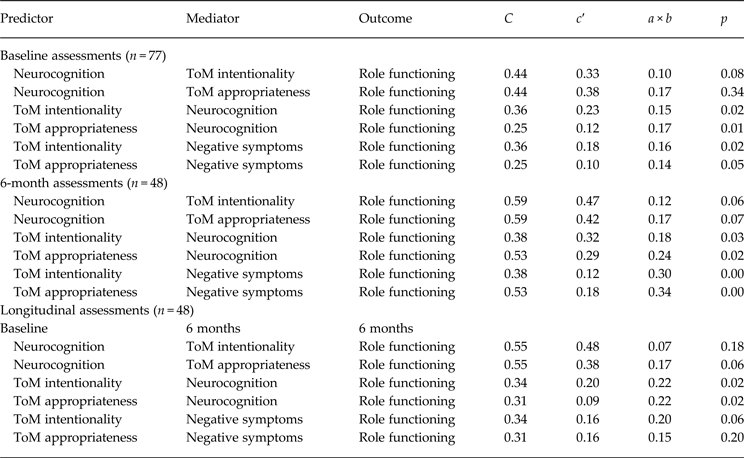
Consistent with a wealth of research, we found that at baseline (cross-sectionally) neurocognition was significantly related to role functioning (r = 0.44, p < 0.01), cross-sectionally at 6 months (r = 0.59, p < 0.01), and longitudinally from neurocognition (baseline) was related to global functioning (6 months) (r = 0.55, p < 0.01). Given these significant correlational relationships, we were interested in whether ToM was a mediator of this well-replicated finding (Fig. 1a ; model 1). At baseline, ToM intentionality, but not appropriateness, showed a non-significant trend toward mediating the relationship between neurocognition and role functioning (Sobel z = 1.73, p = 0.08). Cross-sectionally at 6 months, the relationship between neurocognition and global functioning also showed a non-significant tendency to be mediated by ToM intentionality (Sobel z = 1.87, p = 0.06). Longitudinal analysis again indicated that ToM showed a non-significant tendency to mediate the cross-sectional relationship between neurocognition (baseline) and ToM appropriateness (6 months) and global functioning (6 months) (Sobel z = 1.87, p = 0.06).
While our hypothesis was that ToM is a mediator of the relationship between neurocognition and role functioning (Fett et al. Reference Fett, Viechtbauer, Dominguez, Penn, van Os and Krabbendam2011; Schmidt et al. Reference Schmidt, Mueller and Roder2011), we also examined the alternative mediation model in which neurocognition is the mediator. At baseline and cross-sectionally at 6 months, neurocognition was a significant mediator of the relationship between ToM intentionality and role functioning (Sobel z = 2.32, p = 0.02; Sobel z = 2.17, p = 0.03, respectively) and between ToM appropriateness and role functioning (Sobel z = 2.47, p = 0.01; Sobel z = 2.41, p = 0.02, respectively). Longitudinal analysis again indicated that neurocognition was a significant mediator of the relationship between both of the ToM variables at 6 months and role functioning (6 months) (intentionality: Sobel z = 2.38, p = 0.02; appropriateness: Sobel z = 2.35, p = 0.02, respectively).
We also examined whether negative symptoms were a mediator of the relationship between ToM and global functioning (Fig. 1b ). In addition, we found that baseline level of negative symptoms mediated the relationship between both domains of ToM and role functioning (Fig. 1b ; model 2) (intentionality: Sobel z = 2.39, p = 0.02; appropriateness: Sobel z = 1.97, p = 0.05). The cross-sectional analyses at the 6-month point also showed that negative symptoms were a significant mediator of the relationship between ToM and role functioning (outcome) (Table 4). Longitudinal analysis again indicated that negative symptoms were a significant mediator, for ToM intentionality (baseline) as the predictor and role functioning (6 months) (Table 4). In addition, there are a couple of noteworthy non-significant tendencies in these mediation analyses (Table 4).
Tests of mediation using the Sobel test (standardized values)

Values are standardized regression coefficients.
C, Predictor relationship, c′, predictor relationship after controlling for mediator, a × b, indirect path; ToM, theory of mind.
Discussion
As predicted for our primary variables of interest, recent-onset schizophrenia patients had significantly lower ToM intentionality and ToM appropriateness scores than did comparable healthy controls. Further, the two groups did not differ significantly in the scores for the random control condition. Not only do patients have compromised ToM abilities compared with controls, but also the deficit is moderately stable and present even in remitted patients. Consistent with findings from chronic patients, the ToM deficit appears to be moderately trait-like. Although correlated cross-sectionally with symptoms, it is present even during periods of symptom remission. We found that at baseline and 6 months later, ToM was significantly related to neurocognition, negative symptoms and role functioning. At 6 months, the ToM deficit was also related to positive symptoms (disorganization and reality distortion). Finally, we extend the finding that ToM is related to work and school functioning, rather than only social functioning, at both time points.
Cross-sectionally at baseline and at 6 months, the relationship between neurocognition and role functioning showed a non-significant tendency to be mediated by ToM intentionality. These results extended to longitudinal analyses only for ToM appropriateness, not ToM intentionality. These directional tendencies are consistent with research on chronic patients showing that social cognitive (ToM) deficits can play a mediating role in the relationship between neurocognition and functioning (Ventura et al. Reference Ventura, Hellemann, Thames, Koellner and Nuechterlein2009). While three of six mediation models yielded non-significant tendencies (p = 0.06–0.07) toward mediation by ToM, these results suggest that larger samples are needed to detect this level of mediation. The alternative mediation model, in which neurocognition mediates the relationship between ToM and functioning, yields even clearer evidence for mediation in the current study. However, we believe that social cognition (in this study ToM) as a mediator of the relationship between neurocognition and functioning makes the most sense conceptually. This is because various neurocognitive processes are likely to contribute to social cognition and then, in turn, to role functioning. However, the strength of this model might not be as apparent when social cognition is represented by only a single test of one component. In contrast, neurocognition in this study was represented by a composite score from nine tests representing six components. Thus, the strength of the alternative mediation models may have been determined partially by the robustness of measurement of the underlying constructs.
In contrast, negative symptoms were a significant mediator of the relationship between ToM intentionality and role functioning, cross-sectionally at baseline, at 6 months, and showed a nearly significant longitudinal mediation effect from baseline to 6 months. This is consistent with the importance of negative symptoms in predicting functioning. For the relationship between ToM appropriateness and functioning, negative symptoms were a mediator in cross-sectional analyses at both time points, but not in longitudinal analyses. Our findings support the hypothesis of an indirect path from ToM through negative symptoms to make an impact on role functioning.
The effect size of the ToM deficit we found was remarkably similar to that reported in a recent meta-analysis in FEP (Bora et al. Reference Bora, Yucel and Pantelis2009; see Table 2). Clearly FEPs are less likely than controls to attribute social meaning to animations depicting complex interactions involving mental states. The generally lower appropriateness rating in patients compared with controls indicates that their narratives are less accurate in describing the underlying scripts of the animations. Although Frith & Wolpert (Reference Frith and Wolpert2004) speculated that the mentalizing impairments of schizophrenia patients are limited to explicit tasks, the current findings suggest that in FEP the impairments extend to implicit aspects of mentalizing as well. Our results are largely consistent with those of another study that also examined first-episode schizophrenia patients using the SAT (Koelkebeck et al. Reference Koelkebeck, Pedersen, Suslow, Kueppers, Arolt and Ohrmann2010). Koelkebeck and colleagues found that schizophrenia patients used mental state attribution less frequently for ToM animation scenes (intentionality) and were generally less accurate in describing the underlying scripts of the animations than controls (appropriateness). The consistency of findings from the current study with Koelkebeck et al. on FEPs, along with studies of chronic patients using the same SAT procedures (Russell et al. Reference Russell, Reynaud, Herba, Morris and Corcoran2006; Horan et al. Reference Horan, Nuechterlein, Wynn, Lee, Castelli and Green2009), suggests that the impairment is present very early in the illness. This early developmental disadvantage provides some explanation for why many patients fail to achieve adult social and employment milestones.
Further, the association between ToM and the severity of negative symptoms found here is consistent with a large literature in chronic patients (Ventura et al. Reference Ventura, Wood and Hellemann2013), and supports these associations in first-episode patients. This contrasts with some first-episode studies (Bertrand et al. Reference Bertrand, Sutton, Achim, Malla and Lepage2007) that did not find associations with symptoms. The positive symptom correlates with ToM found at 6 months are consistent with Frith's theoretical model (Frith, Reference Frith, David and Cutting1994; Frith & Wolpert, Reference Frith and Wolpert2004), although that model did not specify that this relationship might change over time. The link between ToM and reality distortion reflects that impairment in ToM leads to incorrect attributions of the mental states of others. This could include the misattribution of threatening intentions (paranoia) especially if others make ambiguous statements or incomplete answers to questions. These types of associations could explain the link between reality distortion and ToM hyper-mentalizing, i.e. attributing higher levels of intentionality than are contextually appropriate. In addition, we found that ToM abilities were related to disorganization at 6 months. Perhaps this is because comprehensible speech involves the ability to have a coherent inner dialog and to monitor one's own thoughts (self-mentalizing). In addition, disorganization of thought would make the process of forming ToM meta-representations of one's own thoughts or the thoughts of others difficult.
We note that the relationship between ToM and positive symptoms is present at 6 months, but not at baseline, which is counterintuitive. We believe that at baseline there are many acute and transient psychotic symptoms that may be influenced by factors other than ToM deficits. Although several of the patients went into remission by 6 months, others had a persistent form of psychosis that was still present at 6 months. We hypothesize that for those patients who are still experiencing psychotic symptoms at 6 months, ToM is a factor influencing the maintenance of their psychotic symptoms. Thus, we believe that the relationship of ToM and positive psychosis at 6 months may reflect emergence of an underlying relationship after acute episode effects have resolved.
ToM appears to be a multi-dimensional and complex subdomain of the social cognition construct that could partially explain the links between social cognition and functioning. As has been previously theorized, poor ToM ability impedes having intuitive thoughts about the mental states of others and appears to be counterproductive to social engagement. Our results suggest that ToM deficits not only interfere with social functioning, but also extend the association in FEP to work and school functioning. Part of being successful at work involves interacting with co-workers. The workplace can involve communication within teams or co-worker dyads. Even in a situation where an employer is assigning work one-to-one with an employee, several ToM abilities could play a role in the comprehension of those instructions. In addition, ToM deficits interfere with a patient's ability to participate in non-work-related social activities with co-workers. Again, these findings parallel what is known in chronic patients about how ToM is linked to functioning and indicates that the social cognitive deficits are present early, and have an adverse impact on various components of social and work functioning.
Although studying ToM by using the Animations Task in first-episode patients at two points in time has several advantages over prior cross-sectional studies that primarily focused on chronic schizophrenia patients, this approach has some limitations. First, not all of the patients who were assessed at baseline were available for follow-up. Second, we refer to ‘theory of mind’ throughout the paper, but in fact had only one test of this construct which might not have captured all of the variance in ToM. Although the stimulus materials in this task are non-verbal and relatively brief, the response format makes verbal and cognitive demands that could make an adverse impact on schizophrenia patients’ performance. Also, this study used a neurocognitive composite score and did not examine relationships with individual neurocognitive domains. In addition, our patient and healthy control groups differed significantly on parental educational and ethnicity, which might be related to ToM performance. However, the results remained the same or were even stronger when these two background variables were statistically controlled. Additionally, because the analyses were correlational, the causal direction of hypothesized associations has not been established. The selection of variables that are considered as ‘cause’ and which are an ‘effect’ is purely theoretical.
The current study sought to address methodological issues in the assessment of ToM by examining the performance of rigorously defined recent-onset schizophrenia patients using the SAT. The magnitude of the effect size of the ToM deficit was large and comparable with studies of chronic and FEPs, and was present even in remitted patients, indicating the presence of a trait marker. Correlations with symptoms, neurocognition and functioning were moderate in size and consistent across two time points. The effects of ToM were extended to include work and school outcomes and were mediated by negative symptoms to influence role functioning.
Acknowledgements
This research was supported in part by National Institute of Mental Health grants MH37705 (principal investigator K.H.N.) and P50 MH066286 (principal investigator K.H.N.), and supplemental support from an investigator-initiated grant from Janssen Scientific Affairs, LLC. The authors would like to thank the following research associates who worked on data collection: Sarah Wilson, Robin Kite, Rachel Wood, Sharon Birman, Jackie Hayata and Lilian Medina.
Declaration of Interest
J.V. has received funding from the Posit Science Corporation, and Genentech, Inc.; he has served as a consultant to Posit Science Corporation, and Boehringer-Ingelheim GmbH. K.H.N. has received funding from Janssen Scientific Affairs, LLC, Posit Science Corporation, and Genentech, Inc.; he has served as a consultant to Genentech, Inc. and Otsuka America Pharmaceutical, Inc. K.L.S., has been a consultant to Otsuka America Pharmaceutical, Inc. A.E., D.G.-D., W.P.H. and G.S.H. have no financial conflicts of interest to disclose.