INTRODUCTION
African savannas in general and Tanzanian ones in particular support a unique species richness and diversity of ungulates (East Reference EAST1984, McNaughton & Georgiadis Reference MCNAUGHTON and GEORGIADIS1986). Coexistence of these species is facilitated by differences in body size, mouth morphology and digestive tracts (Bell Reference BELL1971, Jarman Reference JARMAN1974). Foraging is further affected by behaviour such as group size, group type and vigilance and by external factors such as tree density and size, influencing competitive pattern, time spent foraging and biting rate and height (Dalerum et al. Reference DALERUM, LANGE, SKARPE, ROOKE, INGA and BATEMAN2008, Fortin et al. Reference FORTIN, BOYCE, MERRILL and FRYXELL2004, Fritz & de Garine-Wichatitsky Reference FRITZ and DE GARINE-WICHATITSKY1996, Illius & Fitzgibbon Reference ILLIUS and FITZGIBBON1994). We did not record these factors, but noticed that most trees were taller than giraffe height, about 5 m, allowing animals to select browsing height depending on bite availability.
The savannas are categorized into dystrophic savannas with broad-leaved trees and infertile soils and eutrophic savannas with fine-leaved trees and nutrient-rich soils (Barnes Reference BARNES1982, du Toit & Cumming Reference DU TOIT and CUMMING1999, Huntley Reference HUNTLEY, Huntley and Walker1982, Peter Reference PETER and Campbell1996, Scholes Reference SCHOLES1990). The fine-leaved savanna has palatable spinescent trees with twice-pinnate leaves (Grubb Reference GRUBB1992, McClanahan & Young Reference MCCLANAHAN and YOUNG1996, Owen-Smith & Cooper Reference OWEN-SMITH and COOPER1987a). The broad-leaved savannas have non-spinescent trees with once-pinnate leaves with high concentrations of carbon-based secondary metabolites, deterring browsers (Coley et al. Reference COLEY, BRYANT and CHAPIN1985, Herms & Mattson Reference HERMS and MATTSON1992, Stamp Reference STAMP2003). The fine-leaved savanna has high densities of medium-sized to small herbivores, which need the high nutrient level, while the broad-leaved savanna has low densities of large-bodied herbivores, tolerating a lower nutrient concentration (Bell Reference BELL1971, Reference BELL, Huntley and Walker1982; du Toit & Cumming Reference DU TOIT and CUMMING1999, du Toit et al. Reference DU TOIT, MOE, SKARPE, Skarpe, du Toit and Moe2014, Fritz et al. Reference FRITZ, DUNCAN, GORDON and ILLIUS2002, Jarman Reference JARMAN1974). The physical and chemical leaf traits have, however, been shown to vary more within the local sites than between sites, with weak relationships with soil and climate (rainfall) suggesting that other factors, like herbivory and fire, might be important in explaining variability in the traits (Wigley et al. Reference WIGLEY, SLINGSBY, DÍAZ, BOND, FRITZ and COETSEE2016).
The tree defence traits influence animal bite size, handling time and biting rate, and hence intake rate (Gross et al. Reference GROSS, SHIPLEY, HOBBS, SPALINGER and WUNDER1993, Owen-Smith & Cooper Reference OWEN-SMITH and COOPER1987a, Reference OWEN-SMITH and COOPERb; Spalinger & Hobbs Reference SPALINGER and HOBBS1992). Spines may slow down biting rate when the animal has to handle and chew twigs with spines (Cooper & Owen-Smith Reference COOPER and OWEN-SMITH1986, Owen-Smith Reference OWEN-SMITH1992, Pellew Reference PELLEW1984a). However, biting rate may increase when animals pick leaves or take small twig bites avoiding the spines (Cooper & Owen-Smith Reference COOPER and OWEN-SMITH1986, Sebata & Ndlovu Reference SEBATA and NDLOVU2010, Wilson & Kerley Reference WILSON and KERLEY2003a). The picking of relatively small leaves from mainly spinescent species is fast, whereas the larger leaves from broad-leaved trees might offer more to chew which slow down the handling time and biting rate (Gross et al. Reference GROSS, SHIPLEY, HOBBS, SPALINGER and WUNDER1993, Lucas et al. Reference LUCAS, TURNER, DOMINY and YAMASHITA2000).
Differences in browsing height between animal species, sexes and ages reduce overlap in resource use, provided trees are tall enough, and might be accentuated due to scramble competition (Illius & Gordon Reference ILLIUS and GORDON1987, Makhabu Reference MAKHABU2005, Stokke & du Toit Reference STOKKE and DU TOIT2000). Small browsers feeding selectively on high-quality food may displace large-sized species forcing them to feed at higher levels (Stokke & du Toit Reference STOKKE and DU TOIT2000).
We recorded biting rate (bites per minute) in relation to animal size, tree spinescense, leaf size and browsing height. The height where the largest number of bites were taken was understood as the optimal browsing height for the animal. Although browse studies have been done in nutrient-rich and nutrient-poor savannas, the striking difference between these two systems has rarely been pointed out. We studied browsing by differently sized species, elephant, Loxodonta africana, giraffe, Giraffa camelopardalis and impala Aepyceros melampus, in nutrient-rich Serengeti and nutrient-poor Mikumi National Parks in Tanzania. Our response variable was biting rate, and we expected it to (1) follow animal size, in that large animals take large bites and, hence, have lower biting rate than a small animal. We further expected (2) the effect of spines to reduce biting rate most for giraffe, second for impala, and least for elephant. Biting rate would (3) be higher with small leaves than with large leaves for impala and giraffe which pick leaves, and biting rate would (4) be highest below the height of optimal browsing (maximum browsing frequency).
METHODS
Study areas
The study was conducted in Serengeti and Mikumi National Parks. These are well-known nutrient-rich and nutrient-poor savannas, respectively (Backéus et al. Reference BACKÉUS, PETTERSSON, STRÖMQUIST and RUFFO2006, Lyaruu Reference LYARUU1997, Sinclair & Arcese Reference SINCLAIR and ARCESE1995). Time allowed fieldwork only in these two areas. Serengeti is located in northern Tanzania at1o–3o30′S, 34o–36oE. Soils are volcanic and have high nutrient availability (Ruess & Seagle Reference RUESS and SEAGLE1994, Sinclair et al. Reference SINCLAIR, MDUMA, HOPCRAFT, FRYXELL, HILBORN and THIRGOOD2007). Rainfall is bimodal, with long rains falling from March to May and short rains from November to December, and most areas receive 600–800 mm y−1 (Norton‐Griffiths et al. Reference NORTON‐GRIFFITHS, HERLOCKER and PENNYCUICK1975, Sinclair et al. Reference SINCLAIR, MDUMA, HOPCRAFT, FRYXELL, HILBORN and THIRGOOD2007). The southern part of the Park is open shortgrass plains with Acacia tortilis and the north is woodland with Acacia robusta, A. drepanolobium (Sinclair et al. Reference SINCLAIR, MDUMA, HOPCRAFT, FRYXELL, HILBORN and THIRGOOD2007).
Mikumi is in eastern Tanzania between 7°00′–7°50′S, 37°00′–37°30′E. The Park has one long rainy season, from November to May and rainfall varying geographically from 750–850 mm y−1 (Vedeld et al. Reference VEDELD, JUMANE, WAPALILA and SONGORWA2012), thus similar to much of Serengeti. The Park is characterized by nutrient-poor soils. The Mkata floodplain along Mkata River has black cotton soil with Capparis tomentosa and Philenoptera violacea (Lyaruu Reference LYARUU1997). The dominating miombo woodland has Julbernadia globiflora, Brachystegia spp. and Combretum spp. growing on leached, sandy soils poor in nutrients (Backéus et al. Reference BACKÉUS, PETTERSSON, STRÖMQUIST and RUFFO2006).
Study species
Our study species were elephant, giraffe and impala. These species were selected due to their availability in our study sites and their differences in body size, feeding mode and digestion type (Table 1). The elephant, as a bulk feeder, uses the trunk to remove big branches and twigs with and without leaves, but can also pick small fruits and browse with the mouth (Barnes Reference BARNES1982, Codron et al. Reference CODRON, LEE-THORP, SPONHEIMER, CODRON, GRANT and DE RUITER2006, Owen-Smith Reference OWEN-SMITH1992). Giraffe feeds by stripping leaves with the tongue from the terminal segment of the shoot, picking leaves between spines, or biting shoots (Dagg Reference DAGG2014, Milewski & Madden Reference MILEWSKI and MADDEN2006). Impala feeds mostly by picking leaves even when they feed on spineless plants, but can also strip leaves and bite shoots (Cooper & Owen-Smith Reference COOPER and OWEN-SMITH1986).
Body size, feeding mode and digestion type of elephant, giraffe and impala. The animals were recorded in Mikumi and Serengeti National Parks, Tanzania. The information was obtained from literature, and the references are given as ‘source’.

Data collection
Data were collected in 2014 for a total of 4 mo; 2 mo at each site. In Serengeti data were collected in April–May (wet season) and August–September (dry season) and in Mikumi in May–June (wet season) and September–October (dry season). The data were collected between 07h00 and 15h00, 6 d wk−1. We drove along all accessible roads in our study areas (~140 km d−1). The car was stopped for observation when elephant, giraffe or impala were sighted browsing within about 50 m from the road. We selected the mature animal closest or most visible in a group for observation. As we did not recognize the animals individually, the same animal might have been observed more than once. The number of bites, i.e. sequential plucking events of plant parts, was recorded and the time the animal spent feeding on each tree was recorded using a stopwatch. Maximum recording time was 15 min, but most observations were terminated before that when the animal stopped browsing.
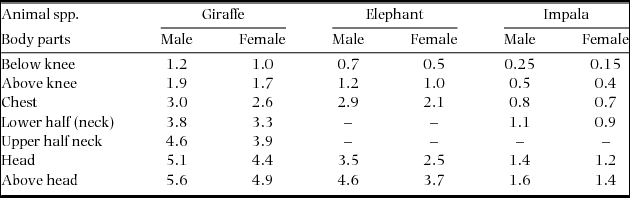
Other information recorded included plant species browsed (in order to get plant traits such as spinescence and leaf size) and browsing height. Browsing height was recorded in relation to the animal body, and were converted into metres by using information from the literature (Table 2). Spines and leaf size was determined from literature (Palgrave Reference PALGRAVE2002, Ross Reference ROSS1975). The dataset from Serengeti had a total of 420 feeding observations of which 140 were elephant (six wet season and 134 dry season), 226 were giraffe (106 wet season and 120 dry season) and 54 were impala (10 wet season and 44 dry season). The dataset from Mikumi had a total of 264 feeding observations in which 13 were elephant (seven wet season and six dry season), 154 were giraffe (86 wet season and 68 dry season) and 97 were impala (17 wet season and 80 dry season).
Browsing height (m) by elephant, giraffe and impala recorded in Mikumi and Serengeti National Park, Tanzania. The heights were recorded in relation to the level of body parts at which an animal was browsing, and later converted into metres by using information from Estes (Reference ESTES1991) and Skinner & Chimimba (Reference SKINNER and CHIMIMBA2005).

Statistical analyses
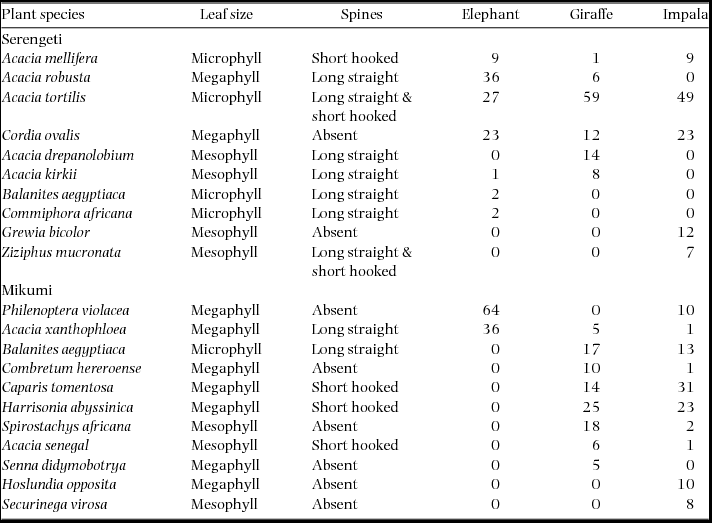
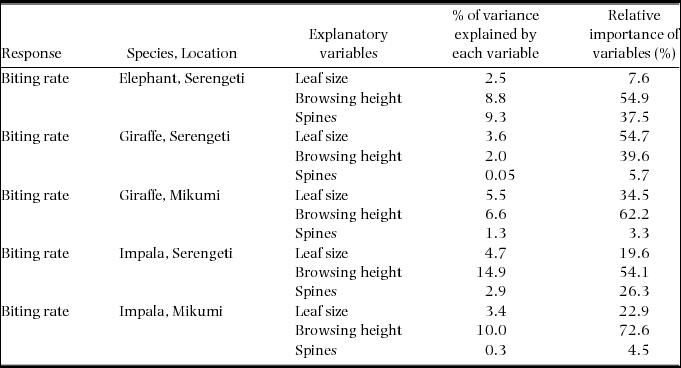
The analyses were carried out separately for the herbivore species and the two sites. Browsing frequency of each plant species was calculated as percentage of the total observed browsing frequency by each herbivore species. Percentage of bites taken at each browsing height class was calculated for each tree species and area. Biting rate was determined as the number of plucking actions min−1. Plant leaves were grouped into three categories according to their length as microphyll (leaf length < 2.5 cm), mesophyll (leaf length 2.6–5.0 cm) and megaphyll (leaf length > 5.1 cm) (Ellenberg & Mueller-Dombois Reference ELLENBERG and MUELLER-DOMBOIS1967, Fosberg Reference FOSBERG1961) (Table 3). Statistics were done in R version 3.2.5. Biting rate was our response variable while spinescence (present-absent), leaf size and browsing height were predictor variables. The response variable was tested for normality, and logarithmic transformation of the response variable was applied for elephant and impala in Serengeti and giraffe in Mikumi to meet conditions for normality. All our predictor variables were categorical, thus no transformation was needed. We ran linear models with all three predictors and used drop1 function for backward selection procedures where one variable was dropped at each step based on a P value of 0.05 (Crawley Reference CRAWLEY2007, Zuur et al. Reference ZUUR, IENO, WALKER, SAVELIEV and SMITH2009). Relative importance of all categorical predictors included in the model was calculated by using the function calc.relimp, available in relaimpo library in R (Grömping Reference GRÖMPING2006). The variance explained by each predictor variable in the model was calculated as percentage of total sum of square of the model. Bonferroni's pairwise comparison of means was applied where a categorical variable with more than two levels was significant. We did not compare seasons due to few browsing data for the mixed feeders; elephant and impala, in the wet season. Also we did not have enough data to carry out some of the analyses for elephant in Mikumi.
Leaf size and spine characteristics of plant species browsed by elephant, giraffe and impala in Mikumi and Serengeti National Park, Tanzania. Leaf data were obtained from literature. The values in the table are browsing frequency on each plant species by each herbivore species, in percentage of all browsing by the species. Plant nomenclature follows Palgrave (Reference PALGRAVE2002).

RESULTS
We studied biting rate by elephant, giraffe and impala based on plant species indicated in Table 3. Cordia ovalis was the main spineless species browsed in Serengeti. In Mikumi, there was more balance in browsing between species with and without spines. Most species in Mikumi had megaphylls while species in Serengeti had microphylls. Biting rate was lowest in elephant (mean ± SE = 4.3 ± 0.5 bites min−1), intermediate in giraffe (17.7 ± 0.3 bites min−1) and highest in impala (25.6 ± 0.6 bites min−1).
Biting rate by elephant
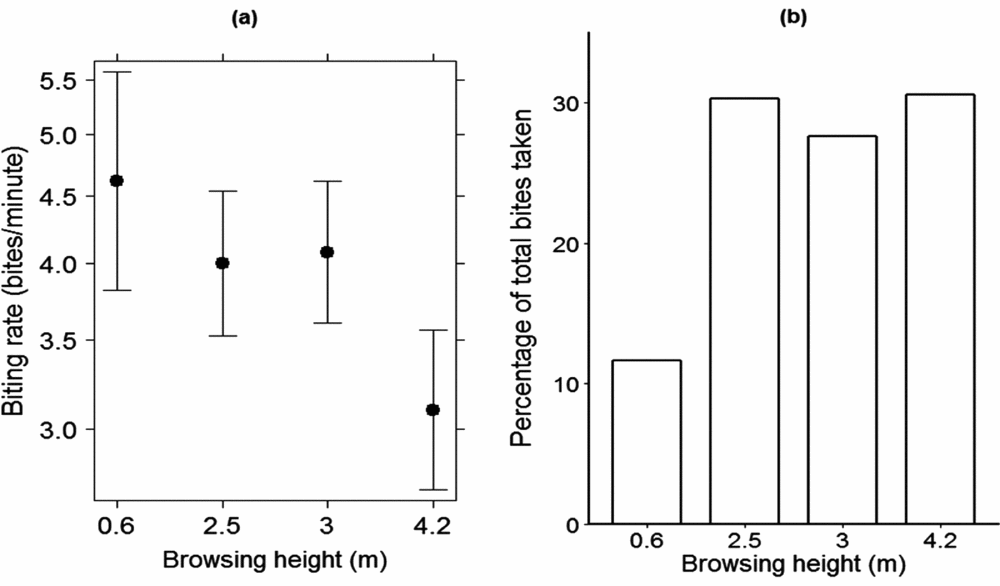
Biting rate by the elephant in Serengeti was higher in tree species without spines compared with those with spines (F1,135 = 10.7, P = 0.001). Mean (± SE) biting rate was 4.7 ± 0.7 bites min−1 in species without spines and 3.8 ± 0.5 bites min−1 in species with spines. Biting rate was not affected by leaf size (F1,134 = 0.8, P = 0.351). Biting rate differed with browsing height (F3,135 = 4.7, P = 0.004, Figure 1a), where biting rate was highest when browsed at 0.6 m and lowest when browsed at 4.2 m. Most bites were taken at heights of 2.5–4.2 m (Figure 1b). Elephant data in Mikumi were too few for analyses. Relative importance of each predictor variable is given in Table 4.
Biting rate by elephant in the Serengeti, Tanzania, as affected by browsing height. Mean biting rates are shown as the middle point, while error bars above and below the mean show 95% confidence interval. Biting rate decreased with increasing height (a). Percentage of total number of bites taken at different heights was lowest at low height (b).

Relative importance given as percentage contribution of each predictor variable from all possible orderings of the predictors for each species. Values are from our study in Mikumi and Serengeti National Park, Tanzania.

Biting rate by giraffe
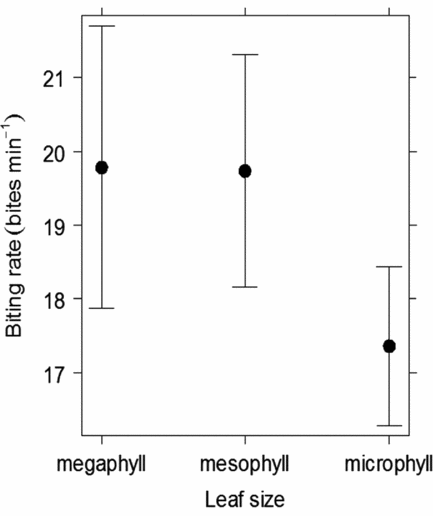
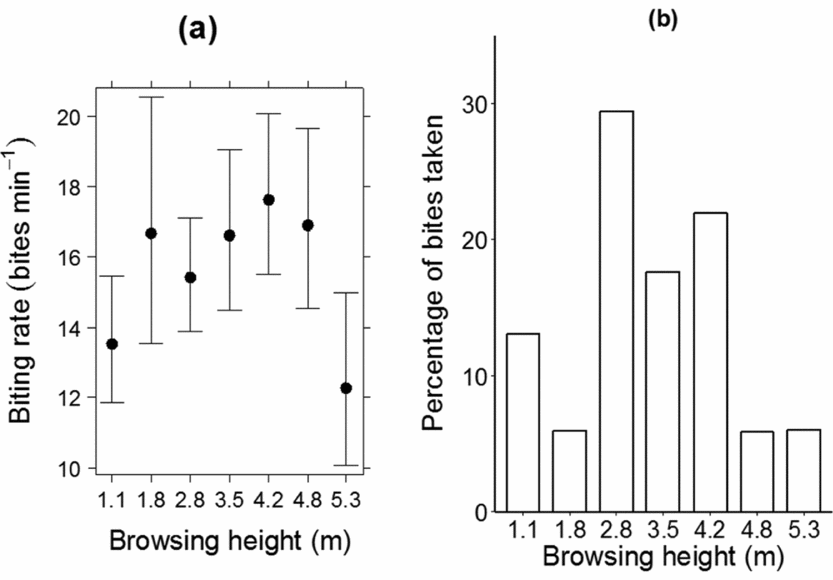
In Serengeti, biting rate by giraffe did not differ with spines (F1,218 = 0.1, P = 0.829) and browsing height (F4,219 = 1.2, P = 0.316). About 93% of total bites were taken between 3.5–4.8 m. Biting rate differed with leaf size (F2,223 = 4.2, P = 0.015), where biting rate was lowest in microphyll and higher and about similar in megaphyll and mesophyll (Figure 2). In Mikumi giraffe biting rate did not differ with spines (F1,144 = 0.5, P = 0.492). Biting rate did not differ with leaf size (F2,145 = 2.7, P = 0.061). Mean biting rate was 16.7 ± 0.7 (mean ± SE) bites min−1 in megaphyll, 17.4 ± 1.0 bites min−1 in mesophyll and 19.5 ± 1.1 bites min−1 in microphyll. Bonferroni's pairwise comparison showed that biting rate was different only between microphyll and megaphyll (P = 0.021). Biting rate differed with browsing height and was highest at 4.2 m and lowest at 5.3 m (F6,147 = 2.7, P = 0.017, Figure 3a). Bonferroni pairwise comparison showed that biting rate at other heights was not different. Most bites were taken at 2.8–4.2 m height, followed by 1.1 m (Figure 3b). Relative importance of each predictor variable is given in Table 4.
Biting rate by giraffe in Serengeti, Tanzania. Means are shown as middle points while error bars above and below the mean show 95% confidence interval. Biting rate was about the same in mega- and mesophyll and lowest in microphyll.

Biting rate by giraffe in Mikumi, Tanzania, as affected by browsing height. Mean values are shown as the middle point while error bars above and below the mean show 95% confidence interval. Biting rate peaked at 4.2 m (a). Percentage of total bites taken peaked at 2.8 m (b).

Biting rate by impala
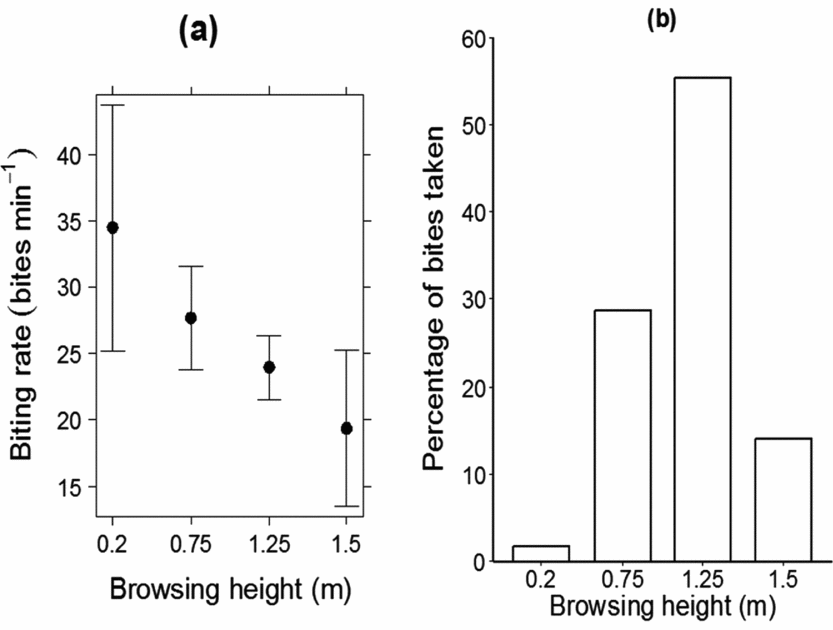
Biting rate by impala in Serengeti tended to differ with spines (F1,52 = 3.2, P = 0.078), where biting rate was higher when spines were absent (mean ± SE) = 25.8 ± 1.4, compared with when spines were present (mean ± SE) = 21.4 ± 1.2. Biting rate did not differ with leaf size (F2,47 = 0.6, P= 0.567) or browsing height (F3,49= 1.5, P = 0.239). About 57% of all bites were taken at 1.25 m height. In Mikumi, biting rate did not differ with spines (F1,90 = 1.5, P = 0.225) or leaf size (F2,91= 1.2, P = 0.318). Biting rate, however, differed with browsing height (F3,93= 3.5, P = 0.019, Figure 4a). Pairwise comparison of means showed that biting rate was different only when browsed at 0.25 m and 1.5 m high (Bonferroni's adjusted P = 0.045). About 55% of all bites were taken at 1.25 m high (Figure 4b). Relative importance of each predictor variable is given in Table 4.
Biting rate by impala in Mikumi, Tanzania, as affected by browsing height. Mean biting rates are shown as the middle point while error bars above and below the mean show 95% confidence interval. Biting rate decreased with browsing height (a). Percentage number of bites at different heights peaked at 1.25 m (b).

DISCUSSION
The data supported some of our predictions. Biting rate followed body size, as larger animals generally took larger bites, as shown by Gross et al. (Reference GROSS, SHIPLEY, HOBBS, SPALINGER and WUNDER1993), which was not compensated by faster handling time. Contrary to our expectation, elephant responded to plant spinescence by lower biting rate, while spines had no effect on giraffe and impala. Giraffe responded to leaf size in opposite ways in Serengeti, where biting rate was higher in megaphyll and mesophyll than in microphyll, and Mikumi where it was higher in microphyll than in megaphyll. Biting rate by elephant in Serengeti and impala in Mikumi was highest at the lowest browsing height and lowest at the highest browsing height. Biting rate for these two species was highest where a very small proportion of bites were taken. Biting rate by giraffe in Mikumi tended to increase with browsing height, peaking at 4.2 m.
Spines reduced biting rate by elephant and impala in Serengeti but had no effect on giraffe in both sites and impala in Mikumi. The effect of spines can be obvious to elephant, a branch or twig eater, which has to handle and chew the spiny material. That elephant feeds on thorny species and prefer acacias is well known (MacGregor & O'Connor Reference MACGREGOR and O'CONNOR2004, Pellew Reference PELLEW1983, Shannon et al. Reference SHANNON, PAGE, SLOTOW and DUFFY2006, Stokke Reference STOKKE1999) but it has been supposed that its large body size makes it immune to the effect of the thorns (Cooper & Owen-Smith Reference COOPER and OWEN-SMITH1986). Our finding that thorns seemingly slowed down its biting rate makes the selectivity for twigs of the palatable and nutritious thorny species important and energetically perhaps costly (Holdo Reference HOLDO2003, Owen-Smith & Chafota Reference OWEN-SMITH and CHAFOTA2012). Giraffe did not show a difference between biting rate on thorny and non-thorny species either in Serengeti or in Mikumi. Giraffe selects the small outmost shoots, which might be soft, or browse outside the outmost spine pair (Owen-Smith Reference OWEN-SMITH1992, Pellew Reference PELLEW1984a, Reference PELLEWb). Its narrow muzzle, flexible upper lip and long tongue enable it to strip off twigs or select individual leaves or leaf clusters between thorns (Gurevitch et al. Reference GUREVITCH, SCHEINER and FOX2006, Milewski et al. Reference MILEWSKI, YOUNG and MADDEN1991, Pellew Reference PELLEW1983). However, Mahenya et al. (Reference MAHENYA, NDJAMBA, MATHISEN and SKARPE2016) found giraffe to have higher biting rate in species with spines. Spines tended to slow down biting rate by impala in Serengeti but not in Mikumi. In nutrient-rich Serengeti the non-spinescent species had about the same palatability as the spiny ones, and spines, seemingly, slowed down biting rate. In nutrient-poor Mikumi the non-spinescent species were largely the broad-leaved ones, having comparatively large and fibrous leaves requiring time to chew, hence, being at least as slow to eat as leaves from spiny species (Cunningham et al. Reference CUNNINGHAM, SUMMERHAYES and WESTOBY1999, Hanley et al. Reference HANLEY, LAMONT, FAIRBANKS and RAFFERTY2007). The Serengeti result agrees with Cooper & Owen-Smith (Reference COOPER and OWEN-SMITH1986) and Fritz & de Garine-Wichatitsky (Reference FRITZ and DE GARINE-WICHATITSKY1996) who found biting rate to be slower on spinescent species than on non-spinescent species from a nutrient-rich or mixed nutrient-rich and nutrient-poor savanna. However, Belovsky et al. (Reference BELOVSKY, SCHMITZ, SLADE and DAWSON1991) and Laca et al. (Reference LACA, SHIPLEY and REID2001) suggest that small herbivores with small mouth parts are good in removing small leaves between spines and thus should be little affected by spines. The reason for the discrepancy between animal species might be whether the animal actually crops and chews spiny material, when biting rate is slow, or whether it selects leaves and shoot tips without spines, when it is fast. Spines do not prevent browsing, but straight thorns reduce the accessibility of twig bites and hooks reduce leaf stripping, turning browsing towards picking of leaves between the spines (Cooper & Owen-Smith Reference COOPER and OWEN-SMITH1986, Gowda Reference GOWDA1996, Skarpe et al. Reference SKARPE, BERGSTRÖM, DANELL, ERIKSSON and KUNZ2012).
Only giraffe responded to leaf size, but in opposite ways in Serengeti and Mikumi. In Serengeti biting rate was higher in megaphylls and mesophylls than in microphylls and in Mikumi it was higher in microphylls than in megaphylls. The difference might, again, be due to the contrast between the nutrient-rich browsing tolerant species in Serengeti, and the nutrient-poor defended species in Mikumi. Also the microphyll in Mikumi, Balanites aegyptiaca, gives a faster biting rate than the microphyll in Serengeti. Spines may reduce leaf accessibility (Cooper & Owen-Smith Reference COOPER and OWEN-SMITH1986, Sebata & Ndlovu Reference SEBATA and NDLOVU2010, Wilson & Kerley Reference WILSON and KERLEY2003b). Thus, in Serengeti the cropping and handling of relatively large leaves should be faster than picking small leaves between spines. In nutrient-poor Mikumi the microphylls are comparatively palatable whereas the larger leaves should be well-defended with fibre and carbon-based secondary compounds (Coley et al. Reference COLEY, BRYANT and CHAPIN1985, Hanley et al. Reference HANLEY, LAMONT, FAIRBANKS and RAFFERTY2007, Laca et al. Reference LACA, SHIPLEY and REID2001, Stamp Reference STAMP2003) slowing down the handling time thus reducing biting rate.
Elephant biting rate in Serengeti decreased with browsing height and was highest at about 0.6 m high and lowest at 4.2 m. Bites were taken from about 0.6 m and most bites were taken between 2.5 and 4.2 m high. This is higher than in most other studies such as Jachmann & Bell (Reference JACHMANN and BELL1985) 1–2 m; Stokke & du Toit (Reference STOKKE and DU TOIT2000) 1.0–1.5 m; O'Kane et al. (Reference O'KANE, DUFFY, PAGE and MACDONALD2011) about 2 m and Makhabu (Reference MAKHABU2005) about 1 m, but agrees with Augustine & McNaughton (Reference AUGUSTINE and MCNAUGHTON2004). Smaller browsers significantly reduce leaf biomass, leaf density and twig growth rate (Augustine & McNaughton Reference AUGUSTINE and MCNAUGHTON2004, Woolnough & du Toit Reference WOOLNOUGH and DU TOIT2001) in the lower parts of the canopies and may, thus, displace large-sized species with high daily intake requirement, forcing them to feed at higher levels to get larger bites (du Toit Reference DU TOIT1990, Illius & Gordon Reference ILLIUS and GORDON1987, Stokke & du Toit Reference STOKKE and DU TOIT2000, Woolnough & du Toit Reference WOOLNOUGH and DU TOIT2001). The higher biting rate at lower height might be due to smaller bite size and quick handling of the bite. Biting rate by giraffe in Serengeti did not differ with browsing height. However, about 93% of all bites taken were at 3.5–4.8 m high. In Mikumi, most bites were taken at 2.8–4.2 m high followed by 1.1 m high, with highest biting rate at 4.2 m and lowest at 5.3 m. Our records of browsing heights are higher than Makhabu (Reference MAKHABU2005), 2.0–2.5 m, Young & Isbell (Reference YOUNG and ISBELL1991), 2.5 m, O'Kane et al. (Reference O'KANE, DUFFY, PAGE and MACDONALD2011), 2.0 m and du Toit (Reference DU TOIT1990) 2.5–3 m, which might suggest that the giraffe was pushed up in browsing height by competition from other species. The giraffe, particularly females, feeds fastest with the neck bent or horizontal (Simmons & Scheepers Reference SIMMONS and SCHEEPERS1996) which should be around 2.0–2.5 m. We expected biting rate to decrease with browsing height due to larger bite size higher in the canopy (Woolnough & du Toit Reference WOOLNOUGH and DU TOIT2001). None of the sites had many middle-sized browsers such as greater kudu, Tragelaphus strepsiceros, but the elephant was common and could have forced the giraffe to browse high, not by consuming the most nutritious tissue but by reducing total browsable biomass (Woolnough & du Toit Reference WOOLNOUGH and DU TOIT2001).
Biting rate by the impala was not affected by browsing height in Serengeti, but decreased with browsing height in Mikumi. Impala in Mikumi browsed mostly from 0.75 m high, peaking at head level 1.25 m. Impala browsing at head level may benefit from larger bite size while leaf biomass below this height is smaller (Augustine & McNaughton Reference AUGUSTINE and MCNAUGHTON2004, Woolnough & du Toit Reference WOOLNOUGH and DU TOIT2001) resulting in smaller bite size and faster biting rate. To have most bites taken at 1.25 m high suggests that impala browsing is driven from below (Woolnough & du Toit Reference WOOLNOUGH and DU TOIT2001) possibly by dik dik, Madoqua kirkii (Augustine & McNaughton Reference AUGUSTINE and MCNAUGHTON2004, Kartzinel et al. Reference KARTZINEL, CHEN, COVERDALE, ERICKSON, KRESS, KUZMINA, RUBENSTEIN, WANG and PRINGLE2015). A browsing height of 0.6-0.8 m for impala is given by Makhabu (Reference MAKHABU2005) and O'Kane et al. (Reference O'KANE, DUFFY, PAGE and MACDONALD2011), who worked in areas basically without smaller mammal browsers than impala.
In summary, we found plant traits to differ between nutrient-rich and nutrient-poor savanna, and this to lead to different responses by impala, giraffe and elephant in the different types of savanna. However the traits were not measured locally, thus we did not account for intra-site variability in the traits. We believe, however, that there is greater contrast between the volcanic soils of Serengeti and related volcanic systems on the one hand and the sandy soils of Mikumi and many southern African savannas on the other. We found that bite rate largely increased with decreasing body size of the species, being highest in impala and lowest in elephant. We further found that the elephant actually responded to spines with decreased biting rate, as it has to chew and handle the spiny branches. In nutrient-rich Serengeti spinescent and spineless trees were about equally palatable, resulting in a decrease in biting rate with spinescence for impala. The conditions were the same regarding leaf size, where megaphyll and mesophyll gave higher bite rate than microphyll for giraffe in Serengeti, while in Mikumi microphyll gave higher bite rate than megaphyll. The different plant chemistry in nutrient-rich and nutrient-poor savanna does not only shape animal communities, leading to high density of elephant in nutrient-poor and lower in nutrient-rich savannas, and many impala in nutrient-rich and fewer in nutrient-poor. It also influences animal's foraging, and can lead to opposite patterns in the two types of savanna.
ACKNOWLEDGEMENTS
We acknowledge Tanzania National Park Authority for allowing us to conduct research in Serengeti and Mikumi National Parks. The study was funded by Hedmark University College and Norwegian State Educational Loan Fund.