The mortality caused by cardiovascular disease in Russia is three to five times higher than the average in the European Union, and almost 60% of deaths in the country are due to cardiovascular disease.Reference Petrukhin and Lunina 1 The socio-medical issues determined by cardiovascular disease require early preventative approaches applied at younger ages. Among the various causes of cardiovascular disease, environmental and genetic factors account for the development of cardiovascular disease.Reference Polonikov, Vialykh and Churnosov 2 Therefore, the early identification of people at high risk for cardiovascular disease, including genetic aspects, is of great importance.
Impaired flow dynamics and shear stress activate pro-atherogenic cell signalling pathways, including generation of reactive oxygen species.Reference Hulsmans, Van Dooren and Holvoet 3 The imbalance between excessive reactive oxygen species generation and defective responses of antioxidant enzymes induces oxidative stress. Oxidative stress underlies arterial stiffening, which is known to be responsible for the development of cardiovascular disease.Reference Hulsmans and Holvoet 4 , Reference Li, Horke and Forstermann 5
Recently, for the early detection of cardiovascular disease risk, the cardio-ankle vascular index has been used as an easy and non-invasive measure.Reference Shirai, Utino, Otsuka and Takata 6 – Reference Shirai, Hiruta and Song 8 The cardio-ankle vascular index reflects an arterial stiffness state and has a specific advantage of being independentof blood pressure changes when the cardio-ankle vascular index is measured.Reference Shirai, Utino, Otsuka and Takata 6 – Reference Shirai, Hiruta and Song 8 We have previously reported that the cardio-ankle vascular index levels are higher in young Russians than in young Japanese, suggesting a cardiovascular disease risk burden in Russians at a younger age.Reference Sorokin, Kotani, Bushueva, Taniguchi and Lazarenko 9 The cardio-ankle vascular index levels may be affected by genetic factors, such as variations in antioxidant-related genes. Thus, the present study aimed to investigate the association between the cardio-ankle vascular index and antioxidant-related gene polymorphisms in young Russians.
Methods
Patients
The patients were a part of the study conducted at the Kursk State Medical University in Kursk, Russia, for young students, as reported previously.Reference Sorokin, Kotani, Bushueva, Taniguchi and Lazarenko 9 In the present study, a total of 89 Russians (mean age, 21.6 years) were examined. All recruited patients were relatively healthy and had no known history of cardiovascular, cerebrovascular, kidney, or liver diseases and were voluntarily recruited from local medical students. This study was approved by the Ethics Committee of Kursk State Medical University, and each participant gave their informed consent.
Measurements of atherosclerotic variables
Smokers were defined by a self-reported habit of current smoking. The body mass index was measured as weight (in kilograms) divided by height (in metres) squared in each patient while wearing light clothing without shoes. The heart rate, systolic blood pressure, diastolic blood pressure, ankle-brachial index, and cardio-ankle vascular index levels were measured using the VaSera VS-1500N vascular screening system (Fukuda Denshi Co. Ltd, Tokyo, Japan).Reference Shirai, Utino, Otsuka and Takata 6 – Reference Sorokin, Kotani, Bushueva, Taniguchi and Lazarenko 9 In brief, these indices were measured in the morning after 10 minutes of rest with cuffs applied to the bilateral upper and lower extremities with the patient in the supine position. The cardio-ankle vascular index was estimated from the brachial and ankle pulse wave forms using appropriate cuffs for each patient’s arm according to the manufacturer’s instructions. The stiffness parameter was calculated by the following formula: cardio-ankle vascular index=In (Ps/Pd)×2p/ΔP×PWV,Reference Polonikov, Vialykh and Churnosov 2 where Ps is the systolic blood pressure, Pd the diastolic blood pressure, p the blood viscosity, ΔP the Ps−Pd, and PWV the pulse wave velocity from the aortic origin to the ankle via the femoral artery. The obtained data were automatically analysed using the VaSera(R) Data Management software program (version: V10-01, Fukuda Denshi Co. Ltd, Tokyo, Japan).
Selection of genes
We used the following criteria for selecting candidate genes based on the guidelines for genetic association studies:Reference Cooper, Nussbaum and Krawczak 10 enzymes should be expressed in the cardiovascular system; enzymes should play a key role in the regulation of cellular redox-homoeostasis enzymes and should be involved in both pro-oxidant and antioxidant redox-regulation pathways; the minor allele frequency should be ⩾5%; and polymorphisms should be reported to be functionally significant. According to the criteria, 15 genes, consisting of 13 single nucleotide polymorphisms and 2 deletion polymorphisms (glutathione S-transferase theta 1 and glutathione S-transferase mu 1), were selected for the present study.
The gene polymorphisms, as expressed in gene symbols (gene name, polymorphic site ID) were as follows: CYBA (cytochrome b-245; alpha polypeptide; 640A>G; rs1049255), MPO (myeloperoxidase; −463G>A; rs2333227), FMO3 (flavin-containing monooxygenase 3; E158K; rs2266782), NQO1 (NAD(P)H dehydrogenase, quinone 1; P187S; rs1800566), GPX1 (glutathione peroxidase 1; P198L; rs1050450), GPX4 (glutathione peroxidase 4; C718T; rs713041), CAT (catalase; −844A>G; rs769214), PON1 (paraoxonase 1; Q192R; rs662), PON2 (paraoxonase 2; S311C; rs7493), GCLM (glutamate-cysteine ligase, modifier subunit; −588C>T; rs41303970), GCLC (glutamate-cysteine ligase, catalytic subunit; −129C>T; rs17883901), TXNRD1 (thioredoxin reductase 1; C>G; rs1128446), GSTP1 (glutathione S-transferase pi 1; I105V; rs1695), GSTM1 (glutathione S-transferase mu 1; expressor/deletion; no ID), and GSTT1 (glutathione S-transferase theta 1; expressor/deletion, no ID).
DNA extraction and genotyping
Genomic DNA was isolated from peripheral blood samples using the phenol/chloroform procedure. Genotyping of deletion polymorphisms in the GSTM1 and GSTT1 genes was carried out using a multiplex polymerase chain reaction assay as described previously.Reference Abdel-Rahman, el-Zein, Anwar and Au 11 Polymorphism rs2266782 of the FMO3 gene and polymorphism rs7493 of the PON2 gene were genotyped using polymerase chain reaction followed by restriction-fragment length polymorphism analysis.Reference Sachse, Ruschen and Dettling 12
The polymorphisms rs1049255, rs2333227, rs662, rs1695, rs1800566, rs1050450, rs713041, rs769214, rs41303970, rs17883901, and rs1128446 were genotyped with a TaqMan Single Nucleotide Polymorphism Genotyping Assay (Applied Biosystems, Foster City, CA, United States of America) on the CFX96TM Real-Time PCR Detection System (Bio-Rad Laboratories, Hercules, CA, United States of America). The genotyping results were calculated by two independent investigators blinded to the patient’s case/control status, and the re-genotyping of ~5% of randomly selected samples yielded 100% reproducibility.
Statistical analysis
Differences between the groups were assessed by t-tests, one-way analysis of variance (with Tukey’s multi-comparison tests), or χ2/Fisher’s exact tests, as appropriate. When adjusting for confounders, we applied all the measured variables – age, gender, smoking, body mass index, heart rate and blood pressure – using general linear models. Values of p<0.05 were considered to be statistically significant.
Results
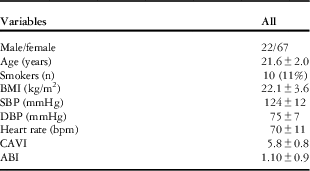
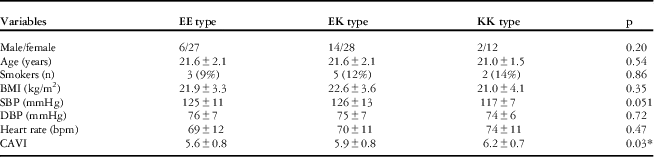
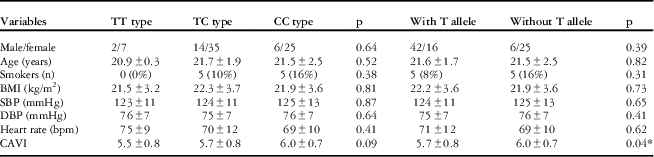
The clinical characteristics of the study patients are summarised in Table 1. The distributions for all genotype frequencies were in Hardy–Weinberg equilibrium. Among the 15 antioxidant-related genes, significant associations were observed only between polymorphisms in the FMO3 and the GPX4 genes and the cardio-ankle vascular index levels (Tables 2 and 3). Higher cardio-ankle vascular index levels were seen in carriers with the KK-genotype of FMO3 polymorphism characterised by amino acid substitution of glutamic acid by lysine at position 158 (E158K) than in the non-carriers (p=0.03). The differences remained significant even after adjusting for age, gender, smoking, body mass index, heart rate, and blood pressure (p<0.01). Similarly, higher cardio-ankle vascular index levels were seen in CC-homozygotes of GPX4 polymorphism identified as T>C transition at the 718th position located in the 3' untranslated region of the mRNA (C718T) compared with the non-carriers. The differences remained significant even after adjusting for age, gender, smoking, body mass index, heart rate, and blood pressure (p=0.02).
Clinical characteristics of the young Russian patients.

ABI=ankle-brachial index; BMI=body mass index; CAVI=cardio-ankle vascular index; DBP=diastolic blood pressure; SBP=systolic blood pressure
Data are presented as the means±standard deviation or patient numbers
The association between rs2266782 polymorphism and the CAVI.

BMI=body mass index; CAVI=cardio-ankle vascular index; DBP=diastolic blood pressure; SBP=systolic blood pressure
*p<0.05
The KK-genotype patients showed a significantly higher CAVI level than the EE-genotype patients in particular (p=0.03; multi-comparison test)
The difference in CAVI levels among the three genotypes remained significant after an analysis that adjusted for all the variables (p<0.01)
The association between the allele of rs713041 polymorphism and the CAVI.

BMI=body mass index; CAVI=cardio-ankle vascular index; DBP=diastolic blood pressure; SBP=systolic blood pressure
*p<0.05The patients without the T allele (CC-genotype) showed a significantly higher CAVI level than those with the T allele (TT- and TC-genotype)
The difference in the CAVI levels among the groups with and without the T allele remained significant after an analysis that adjusted for all the variables (p=0.02)
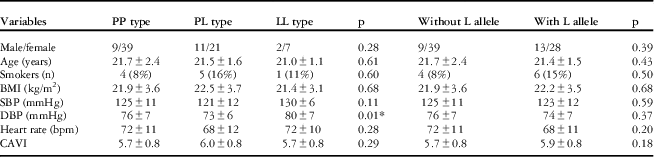
We did not observe significant associations between the cardio-ankle vascular index levels and the other gene polymorphisms (data not shown). Although carriers with the LL-genotype of GPX1 polymorphism, characterised by amino acid substitution of proline by leucine at position 198 (P198L), had higher diastolic blood pressure levels than those without this genotype, the polymorphism did not affect the cardio-ankle vascular index level (Table 4).
The association between the allele of rs1050450 polymorphism and the CAVI.

BMI=body mass index; CAVI=cardio-ankle vascular index; DBP=diastolic blood pressure; SBP=systolic blood pressure
*p<0.05
The LL-genotype patients had significantly higher DBP levels than the PL-genotype patients in particular (p=0.02; multi-comparison test)
Simultaneously measured by the vascular screening system, the mean ankle-brachial index level of the study patients was 1.10±0.9. Significant difference in the ankle-brachial index levels was found in PON1 polymorphism (p=0.02); lower ankle-brachial index levels were seen in QR-heterozygotes of PON1 polymorphism than in carriers of the QQ-genotype (1.13±0.10 in the QQ-genotype [n=52], 1.06±0.90 in the QR-genotype [n=32], 1.10±0.16 in the RR-genotype [n=5]), but this significance was neglected (p>0.05) after adjusting for age, gender, smoking, body mass index, heart rate, and blood pressure. We did not observe significant associations between the ankle-brachial index levels and other measured gene polymorphisms (data not shown).
Discussion
The present study found that rs2266782 and rs713041 polymorphisms were associated with arterial stiffening, as measured by the cardio-ankle vascular index. Young Russians with the KK-genotype of FMO3 and CC-homozygotes of GPX4 showed higher cardio-ankle vascular index levels. Although the association between antioxidant-related genes and the cardio-ankle vascular index has not yet been reported, the data from this study may accelerate research on the involvement of specific antioxidant-related genes in atherosclerosis and strategic planning for the prevention of cardiovascular disease.
Flavin-containing monooxygenase 3 is one of the hepatic microsomal enzymes involved in the antioxidant system. Although the physiological role of flavin-containing monooxygenase 3 is incompletely understood, it plays a role in the metabolism of drugs, xenobiotics, and other chemicals.Reference Hisamuddin and Yang 13 The most investigated flavin-containing monooxygenase 3 gene polymorphism, rs2266782, was found to have a considerable difference in the frequency of single and multiple alleles and genotypes among ethnic populations.Reference Cashman, Zhang, Leushner and Braun 14 , Reference Bushueva, Solodilova, Churnosov, Ivanov and Polonikov 15 The clinical manifestation of human flavin-containing monooxygenase 3 variations underlies the condition of trimethylaminuria, or “fish odour syndrome”, which is caused by trimethylamine accumulation.Reference Hernandez, Addou, Lee, Orengo, Shephard and Phillips 16 Trimethylamine is a gas derived from dietary choline through the action of gut flora with further conversion by plasma trimethylamine-N-oxide.Reference Bennett, de Aguiar Vallim and Wang 17 In addition, flavin-containing monooxygenase 3 exhibits the highest specific activity in oxidising trimethylamine to trimethylamine-N-oxide.Reference Shih, Wang and Lee 18 In a population study, trimethylamine-N-oxide levels were found to be associated with atherosclerosis.Reference Wang, Klipfell and Bennett 19 These observations support our results that carriers of the KK-genotype of rs2266782 polymorphism had significantly higher cardio-ankle vascular index levels. Of note, patients with the KK-genotype had lower blood pressure compared with individuals with other genotypes of rs2266782 polymorphism, suggesting the cardio-ankle vascular index as a sensitive cardiovascular disease predictive tool.
Over-expression of the GPX4 gene reduces the levels of oxidised phospholipids and cholesterol hydroperoxides, as well as proinflammatory lipid peroxides generated by lipoxygenase and cyclooxygenase, thereby reducing vascular oxidative stress and atherosclerotic progression.Reference Seiler, Schneider and Forster 20 In the present study, we selected a well-known T>C transition at nucleotide +2650 belonging to the 3' untranslated region of the mRNA and we found that carriers of the C-allele of rs713041 polymorphism had higher cardio-ankle vascular index levels. This transition is located upstream of the selenocysteine insertion sequence element, which is essential for selenocysteine insertion and is functional in the synthesis and action of glutathione peroxidase 4.Reference Maiorino, Bosello and Ursini 21 Moreover, the C-allele plays a regulatory role in leukotriene biosynthesis, leading to increased levels of 5-lipoxygenase total products in lymphocytes,Reference Villette, Kyle and Brown 22 resulting in a higher inflammatory response and atherogenesis.Reference Serhan 23 These findings may explain the higher cardio-ankle vascular index levels observed in carriers of the C-allele. In addition, another study reported that increased serum selenium levels in carriers with the TT-genotype led to a decreasing trend in DNA damage.Reference Karunasinghe, Han and Zhu 24 This may be partly associated with the results of the present study that patients without the T-allele showed a significantly higher cardio-ankle vascular index level than those with the T-allele.
Glutathione peroxidase 1 is a ubiquitous antioxidant enzyme, whose deficiency has been shown to promote endothelial dysfunction and abnormal structural changes in the vasculature and myocardium.Reference Prabhakar, Morokuma and Musaev 25 It is a cytosolic isoform of glutathione peroxidase and is expressed in vascular endothelial cells. A clinical study reported that hypertensive patients exhibited enhanced glutathione-related antioxidant defence systems, and an absence of alterations in the glutathione peroxidase activity in the patients was thought to be due mechanisms for preventing nitrate stress maintaining lower blood pressure levels.Reference Rybka, Kupczyk and Kedziora-Kornatowska 26 Furthermore, the erythrocyte GPX1 activity and genotypes may serve as independent predictors of cardiovascular disease.Reference Espinola-Klein, Rupprecht and Bickel 27 Among all, the broadly investigated GPX1 gene polymorphism is rs1050450, which has been associated with increased carotid intima-media thickness levels and the prevalence of cardiovascular disease or peripheral artery disorder in Japanese patients with type 2 diabetes mellitus.Reference Hamanishi, Furuta and Kato 28 In the present study, although rs1050450 polymorphism was not associated with the cardio-ankle vascular index levels, the finding of higher diastolic blood pressure in LL-homozygotes of rs1050450 polymorphism may be in accordance with these previous studies.Reference Espinola-Klein, Rupprecht and Bickel 27 , Reference Hamanishi, Furuta and Kato 28
From these findings, we propose a hypothetical relationship between imbalance in the antioxidant enzyme activity of some genes and the arteriosclerotic process in young people. Mechanical vascular stimulation caused by increased pulsatile shear and pressure magnifies endothelial dysfunction and deteriorates vasoconstriction.Reference Glagov, Zarins, Masawa, Xu, Bassiouny and Giddens 29 Flow disturbance through endothelial mechanosensors leads to the activation of intra-cellular signalling pathways, resulting in reactive oxygen species generation.Reference Ando and Yamamoto 30 The induced reactive oxygen species is involved in modulating the activity of specific transcription factors including nuclear factor-kappa B and activator protein-1. As a result, the nuclear factor-kappa B pathway affects the expression of targeted genes culminating in functional changes at the cellular level. Finally, these changes promote oxidative stress, inflammation, thrombosis, vasoconstriction, arterial re-modelling, and atherosclerosis.
Some studies have previously examined the association between antioxidant-related genes and indices related to arterial stiffening; however, their findings are inconclusive – for instance, functional variants of the GPX1 gene were reported to be associated with increased carotid intima-media thickness levels in Japanese patients with type 2 diabetes mellitus.Reference Hamanishi, Furuta and Kato 28 Common genetic variants of nicotinamide adenine dinucleotide phosphate oxidase, which is a major source of vascular reactive oxygen species, did not influence aortic stiffness, as measured by pulse wave velocity, in healthy young adults.Reference Vlachopoulos, Xaplanteris and Baou 31 The present study also showed significant associations between only two gene polymorphisms and the cardio-ankle vascular index, although showing no significant associations between the other gene polymorphisms and the cardio-ankle vascular index levels. The significance of antioxidant-related gene polymorphisms and arterial stiffness may be modified by different study populations and disease states.
The importance of the cardio-ankle vascular index application in normotensive healthy patients in our study was determined by the early detection of the pathological arterial re-modelling that can originate before a consistent rise in blood pressure. Thus, the combination of the cardio-ankle vascular index with the genomic risk estimation should be considered in normotensive individuals as a preventive clinical tool for sub-clinical arterial stiffening or pathological ageing evaluation.
There are some limitations associated with this study. This study was conducted with a small sample size and a cross-sectional design. We did not analyse the blood data because the patients were young and relatively healthy, although additional results on lipid and glycemic profiles could be of high value. Nonetheless, the relationship between the in vitro antioxidative levels – as measured in the laboratory – and the polymorphisms is of interest and should be addressed in future studies.
In summary, the present study revealed a significant association between rs2266782 and rs713041 polymorphisms and arterial stiffness, as measured by the cardio-ankle vascular index, in young Russians. In particular, pathways utilised by the antioxidant enzymes may be responsible for early arterial stiffening in the Russian population.
Acknowledgements
The authors express their sincere gratitude to all the study participants for their time and patience.
Financial Support
This research received no specific grant from any funding agency, commercial, or not-for-profit sectors.
Conflicts of Interest
None.
Ethical Standards
The authors assert that all procedures contributing to this work comply with the ethical standards of the relevant national and institutional committees on human experimentation and with the Helsinki Declaration of 1975, as revised in 2008.