Questions are special speech acts. Speakers ask questions to elicit specific pieces of information from hearers, who are expected to provide the requested information. If they are cooperative, hearers follow Grice's Maxim of Quantity and provide no less and no more information than is requested (Grice, Reference Grice, Cole and Morgan1975). Identifying the requested information would seem to be a simple task since questions usually overtly express some information, making it given, and also grammatically identify the requested information (Clark & Haviland, Reference Clark, Haviland and Freedle1977). For example, the question “Who is chasing the dog?” contains the given information that someone is chasing the dog, and the requested information is to find who that someone is. Since the proposition expressed in the sentence minus the wh-word (i.e. X is chasing the dog) is taken to be shared knowledge at the time the question is asked (Lambrecht, Reference Lambrecht1994), there is no need to express it again in the answer. Therefore, an appropriate answer would be to simply provide X's identity in an informative manner, no more and no less. That is to say, an appropriate answer to the question “Who is chasing the dog?” would be simply “The pig”.
There is very little research on young children's question answering and whether they provide the appropriate information required by the question. Mostly, studies that have investigated children's informativeness in question answering have focused on how children express the nominal referent in their answer, for example, depending on whether or not this referent was already given in the question. Thus, Campbell, Brooks and Tomasello (Reference Campbell, Brooks and Tomasello2000) asked children two different types of questions, one using a full noun for the target referent and one not: “What did X do?” and “What happened?”. Campbell et al. found that even two-year-old children chose appropriate referring expressions depending on whether the target referent was mentioned in the question or not. That is, they gave more full noun references in response to the general question than to the specific question, to which children tended to respond with more pronouns and null references. Wittek and Tomasello (Reference Wittek and Tomasello2005) found similar results for two-year-old German children when asking them two types of questions, one that contained the target referent “Where's X?” and one that did not “What do we need?”.
The results of both of these studies suggest that young children provide information that is not given in the question in an informative way in their answers (i.e. as lexical nouns), and that they express information as given information when it has already been mentioned in the question (i.e. as pronouns or null reference). However, these studies investigated children's choice of referring expressions for single noun phrases only and their manipulation was simply whether the target referent was already mentioned in the question or not. Thus, these studies did not take into consideration what other information, apart from the target referent, was required by the question. For example, the questions “What did X do?” and “What happened?” (as applied by Campbell et al.) ask for more information than simply the target referent, specifically the action which this referent performed – but this was not analyzed.
Matthews, Lieven, Theakston and Tomasello (Reference Matthews, Lieven, Theakston and Tomasello2006) shed some light on children's expression of action information in their question answering. Their focus was again mainly on referring expressions (nominals) depending on whether the target referent was previously mentioned prior to a “What happened?” question. However, additionally, they analyzed children's answers in terms of their linguistic constructions. Those revealed that three- and four-year-old children gave more lexical noun + verb responses when the target character was not mentioned prior to the question, but they gave more pronoun + verb responses when it was mentioned. Two-year-old children gave more single noun responses when the referent was not previously mentioned than when it was. Thus, all three age groups chose a particular type of referring expression depending on whether or not the character had been mentioned. However, with respect to the action, it appears that the two older age groups almost always provided a verb in their answers and independent of condition – as required by the question – whereas two-year-olds expressed the verb less often when the target character was not previously mentioned.
Salomo, Graf, Lieven and Tomasello (Reference Salomo, Graf, Lieven and Tomasello2011) investigated children's expression of verb phrases in their answers to questions that asked in particular for a predicate: “What's X doing?” while watching transitive events (e.g. a frog washing a duck). They found that three- and four-year-old children provided a verb in 99·4% of their answers, and additionally, they chose an appropriate referring expression in their answer for the patient of that verb depending on whether this patient was accessible for the questioner or not. Similarly, in a study by Salomo, Lieven and Tomasello (Reference Salomo, Lieven and Tomasello2010), even two-year-olds showed a very high rate of verb answers (69% to 97%) to the same question type (“What's X doing?”).
Although one might conclude from these studies that three- and four-year-old children provide verb answers when it is required by the question type, whereas two-year-olds are somewhat less successful, we cannot really compare the studies since they differ greatly in their methods. Matthews et al. (Reference Matthews, Lieven, Theakston and Tomasello2006) applied a “What happened?” question while children were watching intransitive events, whereas both studies by Salomo et al. used a “What is X doing?” question for transitive events.
The current study investigated children's ability to provide appropriate information in their answers to questions but systematically varied question type and transitivity. We used three types of question that differed in their focus domain and in the degree of given information (presupposition) they contained. We followed Lambrecht's (Reference Lambrecht1994) distinctions of focus structure and adopted his account of question–answer pairs.
1. Argument-focus question. When a question asks for a single nominal, the answer has an argument focus. The question Q1 presupposes that someone is pushing the dog and the answer needs to identify who that someone is, i.e. the missing argument. Presupposed information does not need to be expressed in the answer (as in A1a) but can be dropped (Lambrecht, Reference Lambrecht1994), as shown in answer A1b.
Q1: Who is pushing the dog?
A1a: The pig is pushing the dog.
A1b: The pig.
2. Predicate-focus question. When a question asks for a comment or predicate, the answer has a predicate focus. The question Q2 presupposes that there is a pig who is doing something. The answer to that question is supposed to identify what the pig is doing and possibly to whom. Therefore, answer A2a is a correct answer to Q2. However, A2b is more appropriate since the presupposed information is not expressed in the answer.
Q2: What is the pig doing?
A2a: The pig is pushing the dog.
A2b: Pushing the dog.
A2c: Pushing.
A2d: The dog.
In most contexts A2c is not an appropriate answer, even though it has predicate focus, since the obligatory patient of the transitive verb is missing. A2d is not appropriate in any normal context since no predicate is expressed in the answer. Thus, a predicate-focus question requires a full predicate consisting of a verb and, in the case of transitivity, additionally of the patient of that verb.
3. Sentence-focus question. When a question asks for a whole proposition, its answer has a sentence focus. The question expresses no specific information about the event, and so the answer should express the whole event. Answer A3a is the only appropriate answer to the question Q3 in the context of a pig pushing a dog. All the remaining answers (A3b, A3c, A3d) are inappropriate in the sense that they do not have a sentence-focus structure since parts of the proposition are missing.
Q3: What is happening?
A3a: The pig is pushing the dog.
A3b: Pig is pushing.
A3c: Pig and dog.
A3d: Pushing the dog.
The current study thus presented young children at three different ages with all three types of these questions – and varied their transitivity as well – to investigate the development of children's ability to provide pragmatically appropriate answers based on the given and requested information in the question. Argument-focus questions targeted the subject/agent of the action; predicate-focus questions targeted the verb/action in intransitives and the verb and object/patient in transitives; and sentence-focus questions targeted subject and verb in intransitives and for subject, verb and object in transitives.
STUDY 1: EXPERIMENT
METHOD
Participants
Fifty-four monolingual German-speaking children of three ages participated. There were eighteen two-year-olds (M = 2 ; 06·13, range = 2 ; 04·15–2 ; 07·27; 8 boys, 10 girls); eighteen three-year-olds (M = 3 ; 06·00, range = 3 ; 04·09–3 ; 7,29; 10 boys, 8 girls), and eighteen four-year-olds (M = 4 ; 06·08, range = 4 ; 04·14–4 ; 07·23; 7 boys, 11 girls). Three additional children (1 two-year-old and 2 four-year-olds) participated but were excluded from the analysis because of the unintelligibility of their speech (n = 2) or due to fussiness (n = 1).
Materials and design
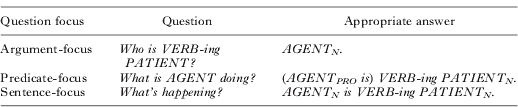
Children were asked a question while they were watching a video clip. We used three types of questions: argument-focus questions (Wer VERB-t? ‘Who is VERB-ing?’), predicate-focus questions (Was macht X? ‘What is AGENT doing?’), and sentence-focus questions (Was passiert? ‘What's happening?’). The corresponding video events for these questions involved intransitive as well as transitive actions, for a total of six experimental conditions in a within-subject design. Each child received three trials in each of the six conditions, resulting in eighteen trials per child.
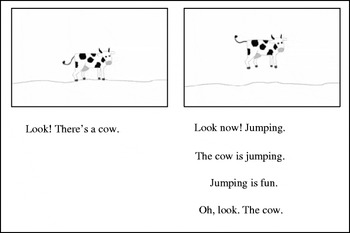
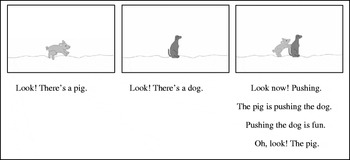
Short video clips were created as stimuli (using Macromedia Flash) showing nine intransitive (e.g. a cow jumping; a monkey waving; a tiger falling over) and nine transitive (e.g. a pig pushing a dog; a crocodile biting a mouse; a giraffe hitting a dinosaur) actions.Footnote 1 For each of the eighteen scenes we created two types of clips: (1) familiarization clips; and (2) test clips. The video portion of the clips was the same for familiarization and test; but the soundtrack differed. The main difference was that the test scenes had no soundtrack and the child was asked to describe them. The familiarization clips introduced the child to the needed vocabulary (a prerecorded voice labelled and commented on the scene using child-directed speech). The video clips were shown to children on a 12” Macintosh iBook in full screen mode using Quick Time Player. An example for an intransitive and a transitive scene is shown in Figures 1 and 2.
Example of familiarization phase (video and audio) for an intransitive event.

Example of familiarization phase (video and audio) for a transitive event.

As illustrated in the figures, in the familiarization phase the characters were labelled individually (while a still picture of each was presented for five seconds), followed by the labelling of the action in the infinitive form. In addition, so as to not suggest to the children that simple labelling is sufficient when describing scenes, the labels were also used in three larger constructions for each item: the first construction (e.g. The pig is pushing the dog) describes the whole event and is, therefore, an appropriate answer to a sentence-focus question (e.g. What's happening?). The second construction (e.g. Pushing the dog is fun) focuses on the verb phrase of the scene accounting for the answer to a predicate-focus question (e.g. What's the pig doing?). And finally, the last utterance focuses on the agent of the event (e.g. Oh look! The pig), marking the answer to an argument-focus question (e.g. Who is pushing the dog?). The whole video clip for the intransitive conditions was 30 seconds long while the clip for the transitive conditions lasted 35 seconds (due to the labelling of the additional character).
The clips that were used in the test phase were the same as in the familiarization phase, but with no soundtrack, lasting for 15 seconds each. The eighteen clips presented to the children were combined into three groups of six clips each (in the familiarization phase as well as in the test phase). This was done in order not to confront the children with eighteen trials in a row. For the familiarization phase, the six clips within each group appeared in a fixed order (intransitive and transitive events appeared in turn) and were the same for each child. However, the order in which the three groups were presented to the children at test was counterbalanced within each age. The test clips were counterbalanced for order of clips within each transitivity group and question type. In each group each of the six conditions occurred once.
Procedure
The study took place in a quiet room in the children's preschools. The session started with a marble game which the experimenters (E1 and E2) played with the children in order to make them comfortable. After some time, E1 stated that she had to finish her homework for school and, therefore, could not join the game any longer. She went to the other side of the room opposite to the child and E2 (so she could not see the notebook screen later on), sat on a table and started reading and writing.
For the familiarization phase, E2 told the child that she had brought some great films that they could watch together. Before she started to play the film she asked E1 whether she wanted to watch the films too. Unfortunately, E1 had not finished her homework yet, and therefore could not watch with them. The child and E2 sat in front of the notebook watching the first group of video clips. After watching the videos, E2 and the child played with a toy for several minutes before the test phase started.
For the test, E2 told the child that since the videos were so much fun they could just watch them again, and this time E1 should see them as well. However, when E2 and the child asked E1 to join them she still had to finish her homework. She was very sad that she could not watch all these fun films and emphasized that to the child. Finally she asked the child if she could tell her a bit about the films. E2 agreed that this was a good idea and made it clear to the child that since E1 was on the other side of the room and behind the computer screen, she could not see the films. E1 asked the test question each time at the moment when a new clip started. In the case where the child did not respond, E1 repeated her question several times as long as the clip was still running. She gave the same kind of feedback (Wow, that sounds like fun or I wish I could see that too or What a great film!) no matter what the child's response. The same procedure was repeated two more times for the remaining two groups of films. In between, E2 and the child played with a small toy (e.g. a spinning top, a sort of wheel of fortune) in order to give the child a break from watching videos.
Coding
Everything the children said in response to the questions was included in the coding. This decision was made because the younger children especially often had false starts where they started their answer, suddenly stopped and then rephrased their answers.
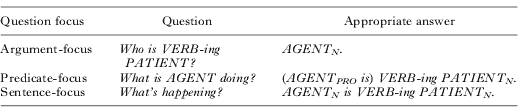
The answers were coded in terms of informativity. We applied three categories: appropriate answer, too much information, and too little information. An appropriate answer was defined as an answer that contained all the information that the question asked for, but no more. That is to say, things that had already been mentioned in the question, and therefore were given information, did not need to be mentioned in the answer again in an informative manner (e.g. as lexical noun phrases), but rather they needed to be marked as given information (e.g. as pronouns or null references). Information that had not been stated in the question needed to be expressed informatively (e.g. as a lexical noun or expression of the action). The form of appropriate answer for each of the six conditions is shown in Tables 1 and 2.
Appropriate answers in the three intransitive conditions

Appropriate answers in the three transitive conditions
Since we were mainly interested in whether children expressed the elements involved (agent, verb and – in the case of transitive events – patient) as given or new information, the order/structure of the elements in the answers was not important for this analysis. That is, answers to sentence-focus questions such as “The pig is pushing the dog” as well as “There is a pig … oh, and a dog … the pig is pushing it”, were both coded as being appropriate answers since they both provide all the information asked for in the question. However, these kinds of fragments occurred in only twenty-five answers, which accounts for less than 3% of all answers. If an answer was not appropriate, the possibilities were that the children gave either too much or too little information. Too much information meant that children expressed information that was already given in the question as new information in the answer, such as: “What's the cow doing?” – “The cow is jumping” or “Who is pushing the dog?” – “The pig is pushing”, and therefore provided more information than required. On the other hand, children could also provide too little information, that is to say, for the addressee there were some piece(s) of information missing, and therefore s/he was not able to complete the whole proposition. For example, if the question was “What's happening?” and children simply answered “The cow”, the action that the cow was performing would be missing in the child's answer, and therefore this answer was coded as providing too little information. Similarly, if the answer to the predicate-focus question “What's the pig doing?” in the transitive condition was simply “Pushing”, the answer would be coded as providing too little information as well, since the patient of the action was not expressed.
Unintelligible answers (n = 13), utterances that were not related to the question (n = 18), trials in which children started talking before the question was finished (n = 7), and trials in which children were not attentive (n = 2) were excluded from the analysis. Two further trials were excluded due to experimenter error. In order to assess inter-observer reliability, a random sample of four children in each age group were coded by a second coder (about 22% of the data). The two coders agreed in 100% of the trials.
RESULTS
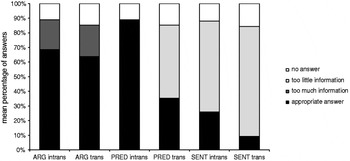
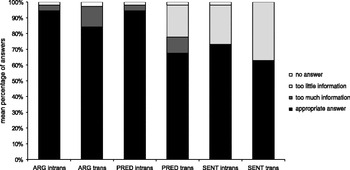
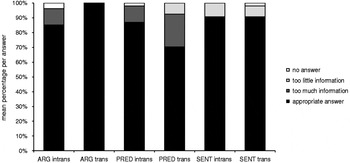
Figures 3, 4 and 5 present the basic results for each age group. Separate analyses were done for each response type (appropriate information, too little information, too much information) using mean proportions.
Mean percentage of answers for all conditions that were categorized as being appropriate, as providing too much information, as providing too little information, and no answers for the two-year-old children.

Mean percentage of answers for all conditions that were categorized as being appropriate, as providing too much information, as providing too little information, and no answers for the three-year-old children.

Mean percentage of answers for all conditions that were categorized as being appropriate, as providing too much information, as providing too little information, and no answers for the four-year-old children.

(a) Appropriate answers
A 3 (age) × 3 (question type) × 2 (transitivity) repeated measures ANOVA was performed with the mean proportion of appropriate answers as the dependent variable. There was a main effect for each variable, that is, for age (F(2, 49) = 17·007; p < 0·001), question type (F(2, 98) = 23·090; p < 0·001), and transitivity (F(1, 49) = 36·921; p < 0·001). But these three main effects must be interpreted in the light of the interaction effects – interaction between age and question type (F(4, 98) = 11·709; p < 0·001), interaction between age and transitivity (F(2, 49) = 9·660; p < 0·001), and interaction between question type and transitivity (F(2, 98) = 14·453; p < 0·001). Each age group was analyzed separately in a 3 (question type) × 2 (transitivity) repeated measures ANOVA.
For two-year-olds, the ANOVA revealed a significant interaction of question type and transitivity (F(2, 30) = 8·343; p < 0·001) and main effects for question type (F(2, 30) = 33·248; p < 0·001) and transitivity (F(1, 15) = 23·189; p < 0·001). Post-hoc pairwise comparisons revealed that children provided more appropriate answers to argument-focus questions (M = 0·708; SD = 0·088) and predicate-focus questions (M = 0·641, SD = 0·066) than to sentence-focus questions (M = 0·177, SD = 0·051, p < 0·001 in both cases). Transitivity plays a major role in predicate-focus questions in the sense that intransitive events are easier than transitive ones, while for the other two question types transitivity did not influence children's answers with respect to informativity.
The ANOVA for the three-year-old children revealed main effects for question type (F(2, 34) = 4·844; p = 0·014) and for transitivity (F(1, 17) = 16·106; p = 0·001). Again, post-hoc pairwise comparisons revealed that children found sentence-focus questions more difficult and they provided fewer appropriate answers (M = 0·680, SD = 0·087) than in response to argument-focus questions (M = 0·893, SD = 0·039, p = 0·026) and predicate-focus questions (M = 0·810, SD = 0·054, p = 0·064).
For four-year-olds the ANOVA showed an interaction of question type and transitivity (F(2, 34) = 6·226; p = 0·005), as well as a main effect for question type (F(2, 34) = 3·617; p = 0·038). Sentence-focus questions were no longer the most difficult question type (M = 0·907, SD = 0·031) but children performed equally well with them as with argument-focus questions (M = 0·926, SD = 0·031). The main effect of question type results from the fact that children provided fewer appropriate answers when responding to predicate-focus questions (M = 0·787, SD = 0·06) than they did when answering argument-focus questions (p < 0·05).
Altogether, it appears that two-year-old children do not give appropriate answers because they provide too little information, while the four-year-olds sometimes provide too much, and the three-year-olds do a mixture of both. In the following analyses, we look at the provision of too much as well as too little information in more detail.
(b) Too much information
Children gave too much information in answers to argument-focus questions and predicate-focus questions. A 3 (age) × 2 (question type) × 2 (transitivity) repeated measures ANOVA with the mean proportion of answers that provided too much information as the dependent variable revealed no main effects. There were, however, interactions for question type and age (F(2, 49) = 8·000; p = 0·001), and a tendency for question type, age and transitivity (F(2, 49) = 2·826; p = 0·069). Two-year-old children gave too much information in answers to argument-focus questions, while the older two age groups also gave too much information in predicate-focus questions, especially for transitive events.
When children gave too much information in their answers, the most frequent pattern across age and across the four affected conditions was that children often answered with the whole proposition, e.g. “Who is jumping?” – “The cow is jumping”; “Who is pushing the dog?” – “The pig is pushing the dog”; “What is the monkey doing?” – “The monkey is waving”.
(c) Too little information
Answers that contained too little information were possible with predicate-focus questions (transitive) and sentence-focus questions (intransitive and transitive). A one-way repeated measures ANOVA with the mean proportion of answers that provided too little information as the dependent variable revealed an effect for age (F(2, 50) = 23·386; p < 0·001). Two-year-old children much more often gave too little information in their answers than the three-year-olds and four-year-olds (LSD post-hoc tests: p < 0·001 for both). Four-year-olds rather rarely gave too little information in their answers and did better than the three-year-old children (p = 0·018). Comparing these three conditions using a one-way repeated measures ANOVA for each age group showed that the two-year-old children as well as the four-year-olds performed similarly in all three conditions, while there was a tendency for the three-year-olds to differentiate between conditions (F(2, 34) = 2·651; p = 0·085). Thus, it seems that the two-year-old children struggle and give too little information as soon as they are required to provide more than one element in their answer – no matter what question type or transitivity. The three-year-olds provide too little information especially in their answers to transitive sentence-focus questions, that is, the question which requires most elements (i.e. three), while they perform better when only two elements are required. The four-year-olds hardly ever provide too little information, and if they do, this appears equally across conditions.
Looking in more detail at those answers that contain too little information, we found that the main problem with answers to predicate-focus questions in the transitive event was that the children at all ages did not express the patient in an informative way, that is, as a lexical noun. While the four-year-olds often expressed the patient as a pronoun – which is uninformative as well – the two younger age groups most often dropped the patient altogether and answered the question with a single verb only (e.g. “What is the pig doing?” – “Pushing”). When too little information was given for the sentence-focus question in the intransitive scene, this was mainly due to the fact that children at all age groups most often expressed the agent only (“What is happening?” – “The cow”), although single-verb answers occurred as well (“What is happening?” – “Jumping”), but this was less frequent and occurred mainly in the two younger age groups. Sentence-focus questions in transitive scenes elicited too little information especially in the two younger age groups, with the main problem being that children's answers in both age groups are either noun phrases (for agent or for patient) or single verbs, but utterances containing both hardly ever occurred (e.g. “What is happening?” – “The pig”, “The dog” or “Pushing”).
In sum, there seems to be a developmental pattern for children's answers that contain too little information: the two-year-old children struggled as soon as they needed to provide more than one element and they performed equally poorly in all three conditions. The three-year-olds did well with the two-element answers (predicate transitive and sentence intransitive) but had more problems when three elements needed to be expressed (sentence transitive). The four-year-olds had few problems in providing sufficient information, and in the few cases where they provide too little, it did not matter what kind of question was being asked or whether the corresponding event was intransitive or transitive.
Children's ability to produce the requisite constructions
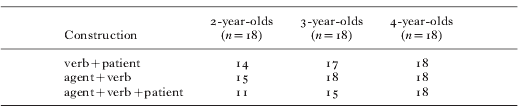
One possible reason why the younger children provide too little information is that they might not be able to produce multiword utterances. Therefore, in a further analysis we determined whether the children who took part in our study were able to produce multiword utterances of the kind that are required in the answers to the questions, that is, verb + patient (answer to predicate-focus question for transitive event), agent + verb (answer to sentence-focus question for intransitive event), and agent + verb + patient (answer to sentence-focus question for transitive event). Children who produced at least once an answer that showed these particular patterns were considered to be able to produce these constructions. The results for this analysis are given in Table 3.
Number of children in each age group who were able to produce the required constructions
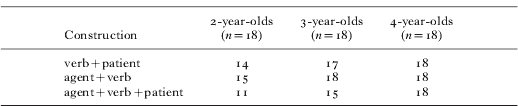
The data show that although in the two younger age groups not all children provided the required constructions, most of them were able to do so. Overall, when relating these numbers to the numbers of appropriate answers for transitive predicate-focus-questions, and intransitive and transitive sentence-focus questions, it seems that although most children were able to produce a certain construction, they did not always use it when it was required by the question.
An additional analysis for the two-year-olds using only those children who were able to produce all three of the required constructions (n = 11) reveals the same result as above: children provided appropriate answers to argument-focus questions and intransitive predicate-focus questions, whereas sentence-focus questions appeared to be most difficult.Footnote 2 Thus, limitation of production skills does not seem to be the major problem children have with questions requiring them to answer with multiple elements.
DISCUSSION
When answering questions we found that the number of appropriate answers developed with age; that is, older children gave more appropriate answers than younger children. Furthermore, question types differed in their difficulty, with sentence-focus questions being most difficult, and questions about transitive events being more difficult than questions about intransitive events.
Four-year-old children almost always gave appropriate answers. The only ‘mistake’ they made was that they sometimes provided too much information in their answers to predicate-focus questions which asked about transitive events; that is, they repeated part of the given information from the question. In some contexts, this repetition is not wholly inappropriate, but in the current experimental contexts adults would leave the extra information out.
Children in the two younger age groups gave more appropriate answers when questions required one element in the answers (i.e. both types of argument-focus questions, and predicate-focus questions for intransitive events) than when they required multiple elements (i.e. predicate-focus questions for transitive events and both types of sentence-focus questions). This might not be considered very surprising, since from a sentence production perspective it is of course easier to produce one-word utterances than multiword utterances. But several lines of evidence argue that the limitation of production skills is not the major problem children have with questions requiring them to answer with multiple elements (although it may, of course, play some role).
First, for the two-year-olds, not only the number of requested element(s) influence how appropriately they answered a question (i.e. the more elements the more difficult to answer), but in addition, the type of question was important. That is, when one element was required, children interestingly sometimes provided too much information in argument-focus questions but not in intransitive predicate-focus questions. Furthermore, when two elements were required, as in transitive predicate-focus questions and intransitive sentence-focus questions, two-year-olds performed slightly better with predicate-focus questions. Because all argument-focus questions were subject wh-questions, we are unable to determine children's ease of supplying patients when these are the sole element required.
Second, in our study, in order to score an appropriate answer it was not necessary for the children to produce sophisticated syntactic utterances, but it was sufficient to provide single labels in succession. That is, a child could answer a sentence-focus question by saying: “There is a crocodile … And there is a mouse, too … oh, the crocodile is biting!” An utterance like this was scored in the same way as the more adult-like way of saying “The crocodile is biting the mouse”. That is, the child could simply produce three utterances in a row and would still be considered informative. And third, we analyzed the grammatical constructions the children produced on at least one occasion, and this showed that the large majority of children of all ages were capable in principle of producing constructions of the type required by the questions. And in addition, even when we include only those young children in our analysis who are able to produce the requested constructions, we find the same result.
A more likely reason for children's greater ability to deal with questions that require only one element in their answer focuses on their pragmatic skills. Children at all ages showed some skill in differentiating between given and requested information. But it might be that in questions which require only a one-element answer all the other elements involved in the event (apart from the requested one) are given in the question. That is, there is only one remaining element that has not been mentioned in the question, and so it is very likely that the questioner wants this one. This relates very nicely to findings from previous studies in which children do not express arguments that were already mentioned in the question informatively in their answers (Campbell et al., Reference Campbell, Brooks and Tomasello2000; Matthews et al., Reference Matthews, Lieven, Theakston and Tomasello2006; Wittek & Tomasello, Reference Wittek and Tomasello2005). More evidence comes from corpus studies which have similarly found that children are very sensitive to the discourse availability of referents expressing arguments that are discourse-given as pronouns or null referents and arguments that are discourse-new as lexical noun phrases (e.g. Allen, Reference Allen2000; Clancy, Reference Clancy and Clark1993, Reference Clancy, Sohn and Haig1997, Reference Clancy, du Bois, Kumpf and Ashby2003; Guerriero, Oshima-Takane & Kuriyama, Reference Guerriero, Oshima-Takane and Kuriyama2006; Hughes & Allen, Reference Hughes, Allen, Bamman, Magnitskaia and Zaller2006; Narasimhan, Budwig & Murty, Reference Narasimhan, Budwig and Murty2005; Serratrice, Reference Serratrice2005). In the case of question-answering, however, it seems that when there is more than one element that has not been mentioned in the question, as for example in transitive predicate-focus questions (e.g. “What is the crocodile doing?” – appropriate answer “(It is) biting the mouse”), children might be less certain which of the unmentioned elements is required (in this case “biting” and “mouse”). With sentence-focus questions this might be even less clear because in this case the questioner does not make clear what she knows already – making the ‘blame assignment’ especially difficult. Related to this, when there is given information in the question (argument-focus and predicate-focus questions) it provides children with a starting point (MacWhinney, Reference MacWhinney1977), but sentence-focus questions give them no starting point. Furthermore, the processing load may be reduced by the scaffolding provided in the argument-focus and predicate-focus questions. These questions provide not only a lexical starting point but also, in part, the word order that the child can mirror in the response. This kind of scaffolding is available to a lesser extent in the transitive predicate-focus questions and totally unavailable in the sentence-focus questions. That the younger children may be using this kind of scaffolding is suggested by their responses to the argument-focus and intransitive predicate-focus questions where the children often provide too much information by repeating part of the information in the question.Footnote 3
A further explanation might be that young children are simply more familiar with questions that require one-element responses than with those that require more. That is, it might be that caretakers most frequently ask questions that can be answered very simply. In order to investigate the possibility that frequency in the input is a major factor, we conducted a corpus study in which we analyzed the types of questions that mothers ask their young children.
STUDY 2: CORPUS STUDY
The aim of this study was to determine how frequently different types of questions occur in children's language input. We know from previous studies that about one-third of parents' speech to their children are questions (Cameron-Faulkner, Lieven & Tomasello, Reference Cameron-Faulkner, Lieven and Tomasello2003). However, in order to interpret the results of our experiment, it would be important to know what kind of information mothers are asking for and at what frequencies, in terms of argument-, predicate- and sentence-focus questions.
Participants
The data consist of four high-density corpora for four children – one German-speaking child (a boy) and three English-speaking children (two girls, one boy).Footnote 4 Children and their mothers were recorded in daily activities in their home one hour per day. The most typical activities during recording were playing with toys and having a snack. The English-speaking children and their mothers were recorded for one hour per day, five days per week for six weeks when the children were 2 ; 0 and when they were 3 ; 0. The recordings for the German child were made when the child was between the ages of 2 ; 0 and 5 ; 0. During the first year of the study, the recordings were made five times a week. After the age of 3 ; 0, the child was recorded five times a month. Research assistants transcribed all the tapes in SONIC CHAT format (MacWhinney, Reference MacWhinney2000; for further details of data collection and transcription see Abbot-Smith & Behrens, Reference Abbot-Smith and Behrens2006; Dabrowska & Lieven, Reference Dabrowska and Lieven2005; Lieven, Salomo & Tomasello, Reference Lieven, Salomo and Tomasello2009).
All questions that the mothers asked were identified in the corpora. In addition to questions containing unintelligible parts, we excluded the following types of questions: questions consisting of a single “yes?”, “no?”, “what?”, vocative (e.g. “Annie?”, “Honey?”), and suggestive questions (“What about X?”). The final sample of questions used in this study consisted of 11,360 questions. An overview of the number of questions for each child at the two age points is given in Table 4.
Numbers of questions in children's input

Coding
Questions were first coded for two main categories: (1) confirmative questions and (2) wh-questions, and second for subcategories in each of these.
(1) Confirmation questions. We considered three types of confirmative questions: yes/no-questions, tag questions and alternative questions. In yes/no-questions the whole proposition is given in the questions and it is the answerer's task to either confirm or to negate this proposition. For example, the question “Do you like olives?” can be seen as a sort of request in the sense of “Either you like olives or you don't. Tell me!” Similarly, tag questions (e.g. “You are a clever girl, aren't you?”) require the answerer to confirm or negate the proposition. This type of question usually consists of a statement/proposition (e.g. “You are a clever girl”) followed by an interrogative fragment, called a tag (e.g. “Aren't you?”). Tags at the end of a question are used to ask for confirmation, meaning something such as “Am I right?” or “Do you agree?” Thus, although it is in general possible to answer with either “yes” or “no”, the speaker expects the answerer to rather confirm than to disconfirm the statement. In alternative questions (e.g. “Do you want juice or milk?”) the questioner gives the answerer two (or more) alternatives to choose from, in the sense of “Juice or milk? Which one?” The answerer is expected to answer by selecting one of the two options, thus “juice” or “milk”. In sum, confirmation questions are questions that already contain all of the lexical elements that might be needed in an answer, and the child's task is simply to identify them.
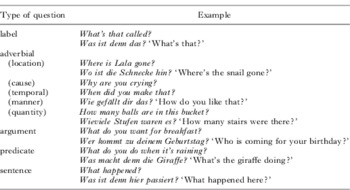
(2) Wh-questions. Wh-questions on the other hand are questions with a lexical gap. That is, the speaker is missing a piece of information and in the question the speaker puts a wh-word in place of this missing piece. The answerer is expected to provide this missing piece in the answer. Thus, we assume that wh-questions and their answers have a referential givenness/newness connection. We distinguish several types of wh-questions. For the purpose of the current analysis we restrict these to five types: questions asking for a label, for an adverbial utterance, for an argument, for a predicate, and for a whole event/sentence. Labelling questions are questions which the mother used in order to elicit labels of certain objects or persons from the child (“Who's that?”, “What's that called?”). Adverbial questions are questions that ask for a location (“Where's the cat?”), for a cause (“Why are you crying?”), for a temporal utterance (“When is Daddy coming back?”), for manner (“How do you feel?”), and for quantity (“How many cookies did you eat?”). Furthermore, we distinguished the three question types that we investigated in our experimental study: argument-focus questions, predicate-focus questions and sentence-focus questions. An overview of the wh-question types and examples for English and German can be found in Table 5.
Types of wh-questions and examples

In order to assess inter-observer reliability, 10% of the data of each child at both age points was coded by a second coder. The coders agreed in 96·3% of the cases, leading to a Cohen's kappa of κ = 0·95.
RESULTS AND DISCUSSION
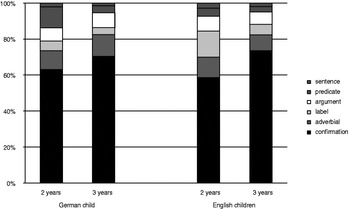
The different question types used by mothers, and their frequencies, are shown in Figure 6. By far the most frequent child-directed question type is confirmative questions, ranging from 58·6% to 73·5%. That is, about two-thirds of the time, the children's task when answering questions is to confirm or disconfirm a proposition, but no additional lexical information needs to be provided. Next most frequent are questions that ask for a single lexical item in the answer, that is specifically argument-focus questions and label questions, which comprise around 15% of the questions children have addressed to them.
Types of questions and their frequencies in children's input.

Of clear importance for interpreting our experiment are the findings from the corpus with regard to sentence-focus and predicate-focus questions. Children hear sentence-focus questions, that is, questions that require a whole proposition in their answer, very rarely, ranging only from 1·6% to 2·9% of the questions that children hear. Similarly, predicate-focus questions do not occur very often in mothers' speech either, ranging from 2·9% to 11·6% of the questions they produce. Thus, the question types from our experiment that required more than one lexical item in their answer are addressed to children only very rarely and so they have little practice with them.
These results suggest that although children have to answer many questions every day, most often they do not need to provide any lexical information, since the majority of questions addressed to them are confirmative questions. Furthermore, even when they are asked questions with a lexical gap, very often these questions ask for a single lexical item only. Sentence-focus questions and predicate-focus questions are relatively rare in children's input.
CONCLUSION
The main result of our experimental study was that although young children are generally skilful at answering many questions appropriately, before about four years of age they struggle to give adult-appropriate types of answers to some types of questions. Specifically, they struggle when the pragmatically appropriate answer requires more than one element. This does not seem to be primarily due to grammatical skills, although they may play a role, because most children produced on at least one occasion the required grammatical constructions, and because children's responses were scored only for the information given, even if this was done across utterances. Also, the youngest children performed differently on some types of questions that required the same level of grammatical skill to answer.
The most likely explanation for the younger children's struggles with the multi-element questions is two-fold. First is the limitation in their pragmatic skill for identifying the specific elements of information needed when this involves multiple elements (perhaps based on their lesser amount of experience in identifying what is known and unknown to others in various contexts), and second is their relative lack of experience with questions involving this requirement. What children do have experience with, and can manage very skilfully, is when the adult asking a question focuses on one element of needed information. The child's response then focuses on that element, either uttering it by itself or using it as the focus of the sentence in her response. When more than one element is needed, it is not only more difficult to identify what is needed but also to formulate a coherent response. And, to repeat, the corpus study established that at least Western, middle-class parents tend to structure the vast majority of their questions to young children so that they do not need to deal with multiple elements simultaneously. Whether this is natural adult behaviour, or whether it is an adaptation to children's perceived struggles with more complex questions, is a question for future research.
It is actually surprising how good even two-year-old children are at identifying given and new or needed information. The fact that we have here identified some limitations in these skills may help us to discover more precisely how the full range of skills develops and under what conditions children can successfully use them.
APPENDIX: LIST OF ALL VIDEO CLIPS USED IN THE STUDY