Introduction
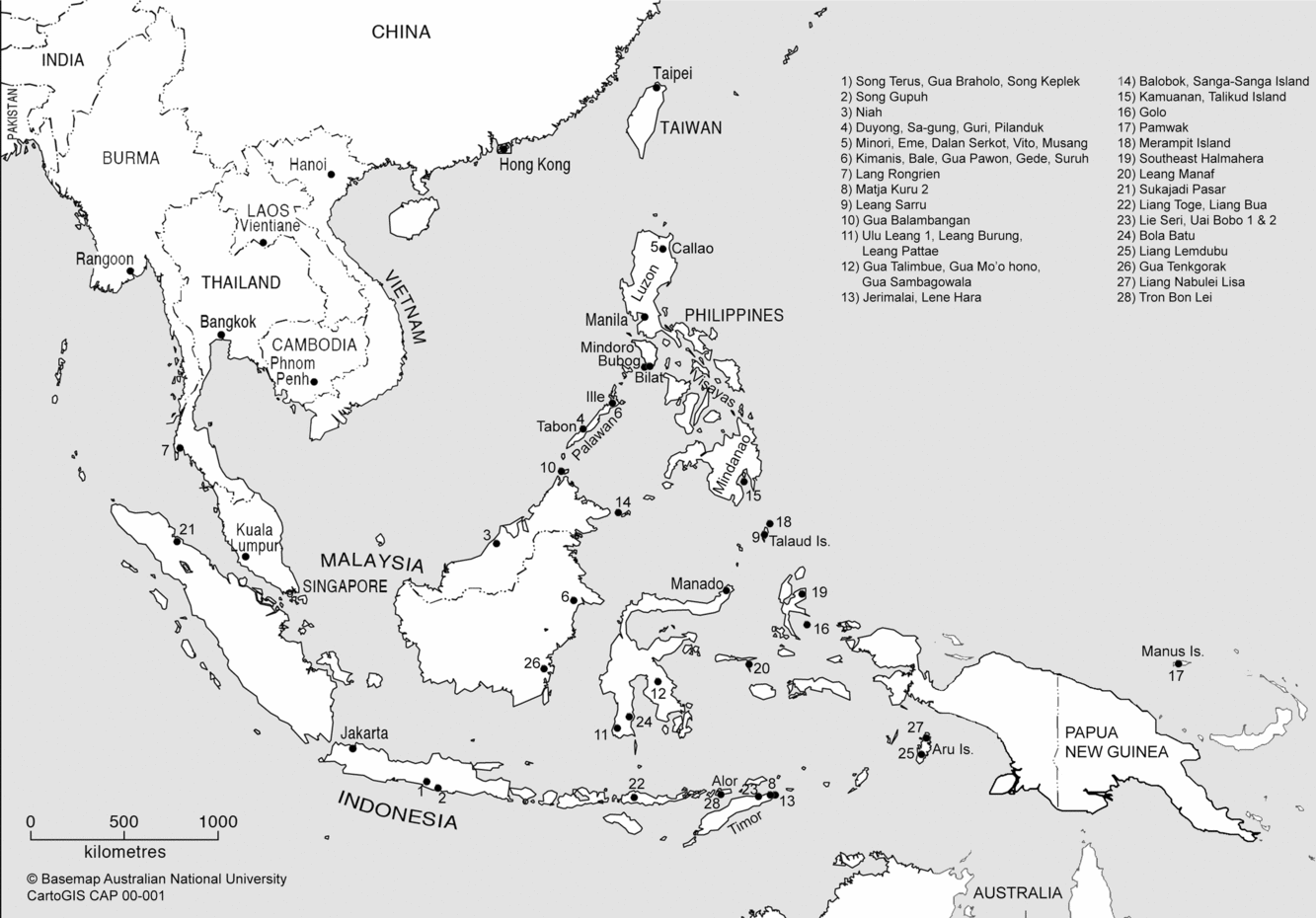
The Philippine archipelago consists of 7107 islands within latitudes 4°30′ to 21°12′N and longitudes 119° to 127°E, and lies at a geographically strategic location at the northeastern margins of Island Southeast Asia (ISEA; Fig. 1). With its close proximity to Borneo and Taiwan, and long Palawan coastline bordering the southern margins of the South China Sea, the Philippines has likely acted as a conduit for the movements of people, material culture and ideas between the islands of Southeast Asia throughout prehistory.
Geographical location of the Philippines and relevant sites. (1) Song Terus, Gua Braholo, Song Keplek; (2) Song Gupuh; (3) Niah; (4) Duyong, Sa'gung, Guri, Pilanduk; (5) Minori, Eme, Dalan Serkot, Vito, Musang; (6) Kimanis, Bale, Gua Pawon, Gede, Suruh; (7) Lang Rongrien; (8) Matja Kuru 2; (9) Leang Sarru; (10) Gua Balambangan; (11) Ulu Leang 1; (12) Gua Talimbue, Gua Mo'o hono, Gua Sambagowala; (13) Jerimalai, Lene Hara; (14) Balobok; (15) Kamuanan, Talikud Island; (16) Golo; (17) Pamwak; (18) Merampit Island; (19) Southeast Halmahera; (20) Leang Manaf; (21) Sukajadi Pasar; (22) Liang Toge, Liang Bua; (23) Lie Seri, Uai Bobo 1 and 2; (24) Bola Batu; (25) Liang Lemdubu; (26) Gua Tenkgorak; (27) Liang Nabulei Lisa; (28) Tron Bon Lei.

The dominant hypotheses for the movements of Austronesian-speaking populations from Taiwan to the Philippines after c. 4500–4000 cal. bp, bringing with them pottery, domestic animals and possibly cereal agriculture for the first time (Bellwood Reference Bellwood1997; Reference Bellwood2005; Reference Bellwood2017; Simanjuntak Reference Simanjuntak2008; Thiel Reference Thiel1987; Reference Thiel1990), and the earlier Nusantao Network model by Solheim (Reference Solheim1975; Reference Solheim, Glover, Suchitta and Viliers1992), are both good examples of proposed connectivity between the Philippines, surrounding islands and the Mainland in the later Holocene. Dispersal from the Philippines, east into the Pacific (Skoglund et al. Reference Skoglund, Posth and Sirak2016; Valentin et al. Reference Valentin, Detroit, Spriggs and Bedford2015) and possibly south and west further into ISEA, laid the foundations for the contemporary geographic distributions of many of the human populations and their languages across the Indo-Pacific region today (Bellwood Reference Bellwood2017). Less well understood is Philippine prehistory from the final stage of the Pleistocene to the end of the Mid Holocene (considered here to be the period c. 14,000–4000 bp). This period covers the end of the last glaciation and the climatic changes associated with Holocene warming and the profound effects this had on sea levels and the environment. For instance, it has been argued that rising sea levels, the inundation of low-lying coastal plains and estuaries and the splitting up of Sundaland at the end of the Pleistocene resulted in increased human mobility (Esselstyn et al. Reference Esselstyn, Oliveros, Moyle, Peterson, McGuire and Brown2010; Heaney Reference Heaney1993; Oliver & Heaney Reference Oliver and Heaney1996) and likely encouraged extensive maritime activity (Oppenheimer Reference Oppenheimer2003; Soares et al. Reference Soares, Trejaut and Loo2008), technological innovation and social change (Bulbeck Reference Bulbeck2008; Piper Reference Piper, Oxenham and Buckley2016; Rabett & Piper Reference Rabett and Piper2012).
In this paper, we review the current Philippine archaeological record from this period in the context of our developing understanding of human adaptation to the increasingly wet and humid conditions of the Holocene and the technological, cultural and social changes that were occurring across ISEA. Here we focus on cultural materials made of stone, bone and shell, and the emergence of burial practices, lines of evidence where recent research has significantly improved our understanding of technological innovation, regional interaction and the spread of new ideologies.
Almost all materials and data on Philippine prehistory from the Late Pleistocene to Mid Holocene and associated environmental and cultural reconstruction have been interpreted from archaeological investigations in caves and rock-shelters. No open sites from this period are currently known. In addition, most of the research has focused on easily accessible islands and locations where the political climate is stable, such as Palawan, Luzon and, more recently, Mindoro. Other regions of this diverse archipelago (e.g. Mindanao, the Sulu Archipelago, Panay, Cebu and Bohol) remain relatively unexplored. Nevertheless, it is becoming clear that islands in the Philippine archipelago were integrated into technological and social networks that were emerging during the Terminal Pleistocene and Early Holocene across various parts of ISEA, and long before the appearance of early farming populations in ISEA and the Pacific.
Environmental change and human subsistence strategies
At the end of the Last Glacial Maximum (LGM), c. 19,000 bp, increasing temperatures caused the retreat of glaciers and, consequently the rise of sea levels. Between 14,600 and 14,300 bp, a period corresponding to Meltwater Pulse 1A, the sea rose by as much as 5.33 m per 100 years, from c. –80 to –64 m (Hanebuth & Stattegger Reference Hanebuth and Stattegger2005; Hanebuth et al. Reference Hanebuth, Stattegger and Grootes2000; Reference Hanebuth, Stattegger and Bojanowski2009). At the beginning of the Holocene sea level stood at c. –48 m, and Borneo remained connected to Sumatra and Peninsular Malaysia (Cranbrook 2000; Voris Reference Voris2000). By 9000 bp the sea level was still at c. –20 m, but all the islands of ISEA had separated. The oceans continued to rise until 7000 bp, when the Mid Holocene transgression caused inundation of many low-lying landscapes and the expansion of mangrove forests in coastal areas of Sundaland (Allen et al. Reference Allen, Gosden and White1989; Berdin et al. Reference Berdin, Siringan and Maeda2003; Woodroffe et al. Reference Woodroffe, Thom and Chappell1985). The tropical rainforests expanded and the montane and sub-montane forests that had extended to lower altitudes during the glacial period retreated to more or less their present altitudinal distributions (Flenley Reference Flenley1996).
The transition from the more open-woodland and savannah landscapes that dominated parts of the Sunda Shelf during the Late Pleistocene to closed tropical rainforests in the Holocene is also recorded in locally hunted vertebrate faunas. For instance, at Song Terus, Song Gupuh and Gua Braholo in Java, Late Pleistocene hunting focused on large ungulates such as cervids and cattle. In Borneo, the wild pig Sus barbatus was the primary target of hunters. After c. 14,000 bp there is a significant change, and considerably more arboreal animals typical of tropical rainforests appear in the archaeological record (Amano et al. Reference Amano, Moigne, Ingicco, Sémah, Due Awe and Simanjuntak2016; Morwood et al. Reference Morwood, Sutikna and Saptomo2008; Piper & Rabett Reference Piper and Rabett2009; Reference Piper, Rabett, Dennell and Porr2014; Rabett & Piper Reference Rabett and Piper2012; Semáh & Semáh Reference Sémah and Sémah2012). In the Philippines, Palawan Island is located on the northeastern fringes of the tropical rainforest zone and has similar environments to other islands on the Sunda Shelf. During the LGM the predominant ecosystems were open grassland/woodland vegetation (Bird et al. Reference Bird, Taylor and Hunt2005; Reference Bird, Boobyer, Bryant, Lewis, Paz and Stephens2007). Only from the Early Holocene onwards was this replaced by the dense rainforest characteristic of the island today. During the earliest phases of cave occupation in the Terminal Pleistocene, the inhabitants principally hunted two species of deer within open woodland. By the Early Holocene, deer populations appear to have been in decline, perhaps partly as a result of hunting pressure, but also due to closure of the rainforests and a shrinking landmass. By c. 4000 bp both species of deer were all but extinct on Palawan and the dominant prey was the forest-adapted Palawan bearded pig, Sus ahoenobarbus (Fox Reference Fox1970, 50; Heng Reference Heng1988; Ochoa & Piper Reference Ochoa, Piper and Monks2017; Piper et al. Reference Piper, Ochoa, Robles, Lewis and Paz2011).
Beyond Palawan, the Philippine islands lie to the east of the rainforest zone and have probably always been more seasonal than the Sunda Shelf, with marked dry and wet seasons, as several palaeoenvironmental studies for this region have proposed (Allen et al. Reference Allen, Gosden and White1989; Berdin et al. Reference Berdin, Siringan and Maeda2003; Woodroffe et al. Reference Woodroffe, Thom and Chappell1985). And unlike the majority of islands within the Wallacean region (except Sulawesi) which have impoverished terrestrial vertebrate faunas, and have possessed no large-bodied mammals since the Late Pleistocene, the Philippines are inhabited by a variety of endemic pigs and at least two species of deer and several extant and extinct Bovinae (Croft et al. Reference Croft, Heaney, Flynn and Bautista2006). This is reflected at Callao Cave, where the inhabitants predominantly hunted deer within an open woodland environment around 60,000–50,000 years ago, along with pig and an extinct species of Bovinae (Mijares et al. Reference Mijares, Détroit and Piper2010). Mostly pig, along with tamaraw (Bubalus mindorensis), a bovine endemic to Mindoro, are also recorded from Late Pleistocene and Early Holocene contexts at Bubog on Ilin Island (Pawlik et al. Reference Pawlik, Piper and Faylona2014). Thus, in addition to the abundant coastal resources, these large mammal taxa, as well as larger lizards (Varanus sp.), provided significant terrestrial/inland resources for mobile forager populations throughout prehistory.
Probably the best stratified evidence for changing coastal environments from the Terminal Pleistocene to Mid Holocene in the Philippines comes from Bubog 1 on Ilin Island. Here, accumulation of a human-derived shell midden between c. 33,000 and 4000 cal. bp records the transition from mangrove swamp forest in the Late Pleistocene and Early Holocene through sandy-bottomed shallow seas, and eventually to open lagoon conditions by c. 6000 cal. bp (Pawlik et al. Reference Pawlik, Piper and Faylona2014). A variety of reef and pelagic fish remains appearing throughout the layers of the shell midden at Bubog 1, and in deposits below the midden (Boulanger Reference Boulanger2015; Boulanger et al. in press), has indicated that local communities were also employing several strategies to hunt fish from at least 30,000 years ago, if not earlier. The varieties of fish caught were similar to those recorded to the south along the stable or uplifted coastlines of the Talaud Islands, Timor Leste and Alor (O'Connor et al. Reference O'Connor, Barham, Spriggs, Veth, Aplin and St. Pierre2010; Ono et al. Reference Ono, Soegondho and Yoneda2010; Samper Carro et al. Reference Samper Carro, O'Connor, Louys, Hawkins and Mahirta2016), but the technologies employed by the local Ilin inhabitants were different (see below).
As the sea levels rose at the end of the Pleistocene, many low-lying landscapes were inundated. This is particularly evident on Palawan, where marine encroachment and the submergence of lowland environments are recorded from the Mid Holocene onwards. At Ille, a cave site more than 15 km inland during the Pleistocene, middens of mangrove shell accumulated between 7300–5500 cal. bp (Szabó et al. Reference Szabó, Swete Kelly, Peñalosa and Paz2004; Table 1), and at Duyong Cave to around 8000 cal. bp (Fox Reference Fox1970). Another large mollusc accumulation at Sa'gung rock-shelter remains undated, but is probably also of Mid Holocene age (Kress Reference Kress and Paz2004; Robles et al. Reference Robles, Piper, Ochoa, Lewis, Paz and Ronquillo2015).
Radiocarbon dates of pre–Neolithic sites in the Philippines. WK = The University of Waikato, New Zealand Radiocarbon Dating Laboratory; ANU/S-ANU = Australian National University Radiocarbon Dating Laboratory; UCLA = University of California, Los Angeles, Institute of Geophysics; SUA = University of Sydney Radiocarbon Laboratory; OxA = Oxford Radiocarbon Accelerator Unit; GaK = Gakushuin University Radiocarbon Laboratory; AA = University of Arizona NSF Radiocarbon Laboratory. Calibration of samples with Calib 7.0.4 (Stuiver & Reimer Reference Stuiver and Reimer1993). The local ΔR (marine reservoir correction) is –14±76 14C years bp, derived from three pre–1950 shell samples from the Philippines (Southon et al. Reference Southon, Kashgarian, Fontugne, Metivier and Yim2002).

Technologies in stone, bone and shell
Lithic technologies
Taken at face value, lithic technologies appear to have remained remarkably uniform from the Late Pleistocene to Mid Holocene in ISEA, until the introduction of fully ground stone-tool technologies at c. 4500–4000 cal. bp (Mijares Reference Mijares2002; Reference Mijares2007; Patole-Edoumba et al. Reference Patole-Edoumba, Pawlik and Mijares2012; Pawlik Reference Pawlik2010; Reference Pawlik2012; Reference Pawlik, Kaifu, Izuho, Ono, Sato and Goebel2015; Pawlik et al. Reference Pawlik, Piper and Faylona2014). In the Philippines flaked stone tools were generally manufactured using rather simple production techniques, applying direct percussion without elaborate core preparation. There is no convincing evidence for the deliberate manufacture of formal tools and advanced knapping technologies such as blade core preparation and blade production. Excavated in the 1960s, Tabon Cave, Palawan, has a chronological sequence of stone artefact manufacture representative of typical Southeast Asian lithic technologies. Fox (Reference Fox1970, 17f.), estimated the age of the lithic deposits labelled as Flake Assemblages I-A–V to between 50,000 bp and 8500 bp, with 14C dates on associated charcoal available for Flake Assemblage IV, III and I-B (Table 1; Fox Reference Fox1970, 40–44).Footnote 1 The lithic assemblage from the nearby Duyong Cave is somewhat later and associated with a single 14C date of 8326–7432 cal. bp (UCLA 286), and extends the artefact record from the Tabon region into the Mid Holocene. Although Fox (Reference Fox1970, 54) described the c. 200 artefacts from Duyong as a ‘small-flake-and-blade assemblage’, a re-assessment of the assemblage identified no actual blades, or the core preparations required to produce true blades (Patole-Edoumba Reference Patole-Edoumba2002; Pawlik & Ronquillo Reference Pawlik and Ronquillo2003). Instead, both the Tabon and Duyong assemblages are characterized by short production sequences, resulting in simple flake tools for immediate, expedient use (Fox Reference Fox1970, 40–44; Patole-Edoumba Reference Patole-Edoumba2002; Patole-Edoumba et al. Reference Patole-Edoumba, Pawlik and Mijares2012). A technological comparison with assemblages recovered from several other Holocene caves and rock-shelters in central Palawan, such as Guri and Pilanduk (Fox Reference Fox1970; Reference Fox and Ikawa-Smith1978; Kress Reference Kress1979; Pawlik & Ronquillo Reference Pawlik and Ronquillo2003), suggests continuation of identical traditions from the Late Pleistocene into the Holocene, without any obvious innovation. Similar simple unretouched flakes have been identified in Ille Cave, northern Palawan, dating to the Terminal Pleistocene and Early to Mid Holocene (Lewis et al. Reference Lewis, Paz and Lara2008; Pawlik Reference Pawlik2012; Reference Pawlik, Kaifu, Izuho, Ono, Sato and Goebel2015; Szabó et al. Reference Szabó, Swete Kelly, Peñalosa and Paz2004), in Late Pleistocene deposits at Callao Cave in Northern Luzon, dated on charcoal to c. 30,000 cal. bp (Reference MijaresMijares 2007), and at the nearby Minori (Mijares Reference Mijares2002) and Vito (Fuentes Reference Fuentes2015) Caves, dating to c. 5500–5000 cal. bp and 4800–4500 cal. bp, respectively.
Use-wear and residue analyses undertaken in recent years on Philippine lithic materials have, however, illustrated some interesting technological features that suggest complex use-contexts existed by the Terminal Pleistocene that are not evident in the basic production attributes of flakes. For example, some of the unretouched chert flakes from Ille Cave dating between 14,000 and 12,000 bp appear to have been the hafted tips of composite projectile technologies (Pawlik Reference Pawlik2012). The age of these artefacts is comparable to the earliest recorded projectile points in bone recovered from Niah Cave in Borneo (Rabett & Piper Reference Rabett and Piper2012). Early evidence for hafted lithic projectile points, together with notched flakes used for plant processing, has also been observed in Leang Sarru, Sulawesi, dating to between 35,000 and 8,000 bp (Fuentes et al. submitted; Ono et al. Reference Ono, Soegondho and Yoneda2010).
Residues of tree resins on the implements from Ille are also similar in morphology to the resinous adhesives applied to the composite artefacts from Niah (Barton et al. Reference Barton, Piper, Rabett and Reeds2009; Pawlik Reference Pawlik2012). Simple flakes were also used to process red pigments and resins (Pawlik Reference Pawlik2012), and to work with resinous wood or pieces of tree resin (Reynolds et al. Reference Reynolds, Barker, Barton and Barker2013, 155). Interestingly, also in Ille, a mixture of red pigment and resin was used as appliqué on Conus shell discs dated to 4800–4200 cal. bp (Basilia Reference Basilia2011). Traceological analyses on selected lithics from Tabon Cave (Xhauflair & Pawlik Reference Xhauflair and Pawlik2010) and several caves in the Peñablanca formation of northern Luzon such as Minori (Mijares Reference Mijares2002), Callao, Eme, Dalan Serkot (Mijares Reference Mijares2008) and Vito (Fuentes Reference Fuentes2015) have all shown flexible function of simple flakes and their use in the working and processing of a variety of different materials such as bone, wood, bamboo and other plant materials, as well as meat and other soft tissues.
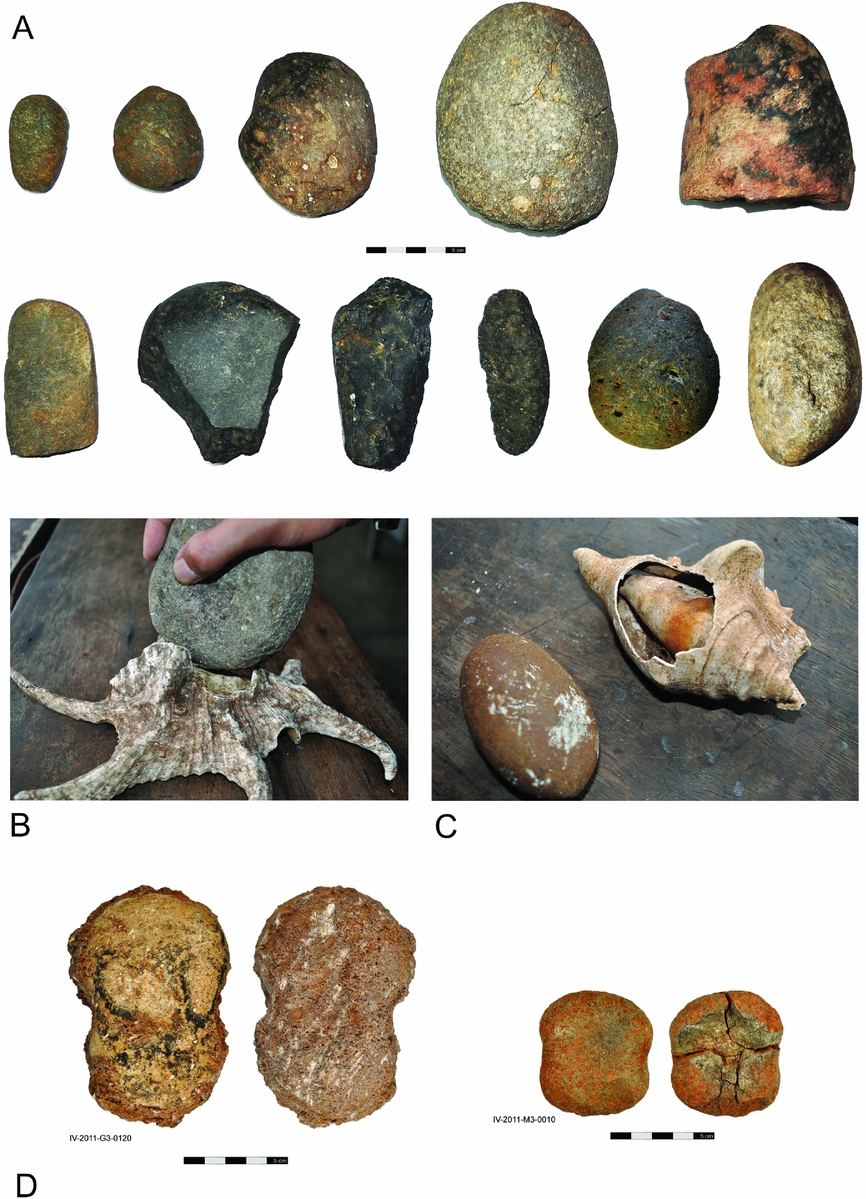
Another good example of the multiple use/re-use of simple stone implements is at Bubog 1. From the Early Holocene onwards, the inhabitants used locally available beach-rounded igneous pebbles as hammerstones to break open large marine shells such as Strombus, Trochus and Lambis (Fig. 2; Pawlik et al. Reference Pawlik, Piper and Faylona2014). When broken, those hammerstone fragments with sharp edges were reused to work hard organic materials such as wood, bone and bamboo (Fuentes & Pawlik Reference Fuentes and Pawlik2015). In addition to the pitted surfaces resulting from repetitive impact, some hammerstones display a characteristic ‘waisted’ modification produced through flake removal to provide notches to attach fishing nets (Fig. 2D), illustrating that the same large pebbles and fragments thereof were used for various and successive complex tasks, despite their simple design. While flaked chert artefacts were absent throughout the shell midden deposits at Bubog 1, they appeared in smaller numbers in the layers underneath, dated to before c. 30,000 bp. In Bilat Cave on Mindoro, just 7.5 km from Bubog 1, chert flakes found below dense shell midden deposits are associated with a radiocarbon date on charcoal of 13,754–13,561 cal. bp (S-ANU 49206).
(A) Pebbles used as hammerstones and broken fragments; (B) assumed application on Lambis lambis shell; C) modern hammerstone, used by inhabitants from Bubog, Ilin Island; D) hammerstones with waisted modification used as netsinkers, from Ilin Island.

Patterns of human mobility have also been recorded in lithic repertoires. For example, small fragments of obsidian débitage were recovered from Bubog 1 dating to c. 11,000 bp and c. 30,000 bp. Portable X-ray fluorescence analysis of the samples from Bubog demonstrated a chemical match with 11,000–9000-year-old obsidian flakes from Ille Cave. No obsidian sources are known on Mindoro and Ilin Island, or Palawan, and Neri et al. (Reference Neri, Pawlik, Reepmeyer, Mijares and Paz2015) considered the appearance of obsidian on these islands as evidence of possible long-distance interaction across the Philippines, and perhaps as far as Melanesia, from where obsidian was already being sourced and traded by the end of the Pleistocene.
Some characteristic lithic technologies that emerge during the Terminal Pleistocene across ISEA for processing plants are currently absent from the Philippine archaeological record, including pounders, mortars and grinding stones (Barker et al. Reference Barker, Lloyd-Smith and Barton2011; Rabett Reference Rabett2012, 200; Simanjuntak & Asikin Reference Simanjuntak and Asikin2004). The absence of these implements is hard to reconcile, in that several plants that require considerable processing such as Canarium and yams as well as several woody vines have been identified in the archaeological records of Bubog and Ille Caves dating to this period (Carlos Reference Carlos2010; Carlos et al. submitted; Pawlik et al. Reference Pawlik, Piper and Faylona2014). It is possible that some of these plant-processing tools were made from organic materials and have disappeared from the archaeological record, but this does not really explain the complete absence of a lithic technology so common throughout the rest of ISEA.
Shell technologies
The shell adze is a common implement found throughout the Pacific region after c. 3500 bp (e.g. Bellwood Reference Bellwood1997; Bellwood et al. Reference Bellwood, Nitihaminoto, Irwin, Gunadi, Tanudirjo and Bartstra1998; Fox Reference Fox1970; Glover Reference Glover1986; O'Connor et al. Reference O'Connor, Spriggs and Veth2006; Pawlik et al. Reference Pawlik, Piper, Wood, Lim, Faylona, Mijares and Porr2015; Spriggs Reference Spriggs1989; Reference Spriggs1997; Szabó Reference Szabó2005; Szabó & Summerhayes Reference Szabó, Summerhayes, Sand, Bedford and Burley2002). Prior to this date shell adzes have a much more restricted geographic distribution from the southern Philippines across northern Wallacea as far as Manus Island in Melanesia (Spriggs Reference Spriggs1997). The adzes were manufactured using flaking and grinding from a single fold section of the shell body (mostly Melanesia) and/or hinge (mostly Philippines) of the giant clam (Hippopus or Tridacna). Diagnostic wear traces and abrasion patterns at the adze's butt indicate that they were hafted (Pawlik et al. Reference Pawlik, Piper, Wood, Lim, Faylona, Mijares and Porr2015). The oldest adzes appear to have been produced in the Moluccas at Golo Cave, where they have been dated by association with charcoal samples to between 13,000 and 11,000 bp (Bellwood et al. Reference Bellwood, Nitihaminoto, Irwin, Gunadi, Tanudirjo and Bartstra1998). Similar Tridacna shell adzes produced on ‘old shell’ (authors’ observations) have been recovered from archaeological deposits in Pamwak Cave on Manus Island in the Admiralty Islands, also dated through stratigraphic association to c. 10,000–7000 bp (Spriggs Reference Spriggs1989; Reference Spriggs1997, 59). Other examples have been recorded on Merampit Island, Southeast Halmahera and Leang Manaf on Sanana dated directly to 4580–4267 cal. bp (OZD-771) and 7564–7247 cal. bp (OZD-772) respectively (Tanudirjo Reference Tanudirjo2001), and in the Sepik region of New Guinea where an adze was directly dated to 5548–5052 cal. bp (no code: Swadling & Hide Reference Swadling, Hide, Pawley, Attenborough, Golson and Hide2005, 291).
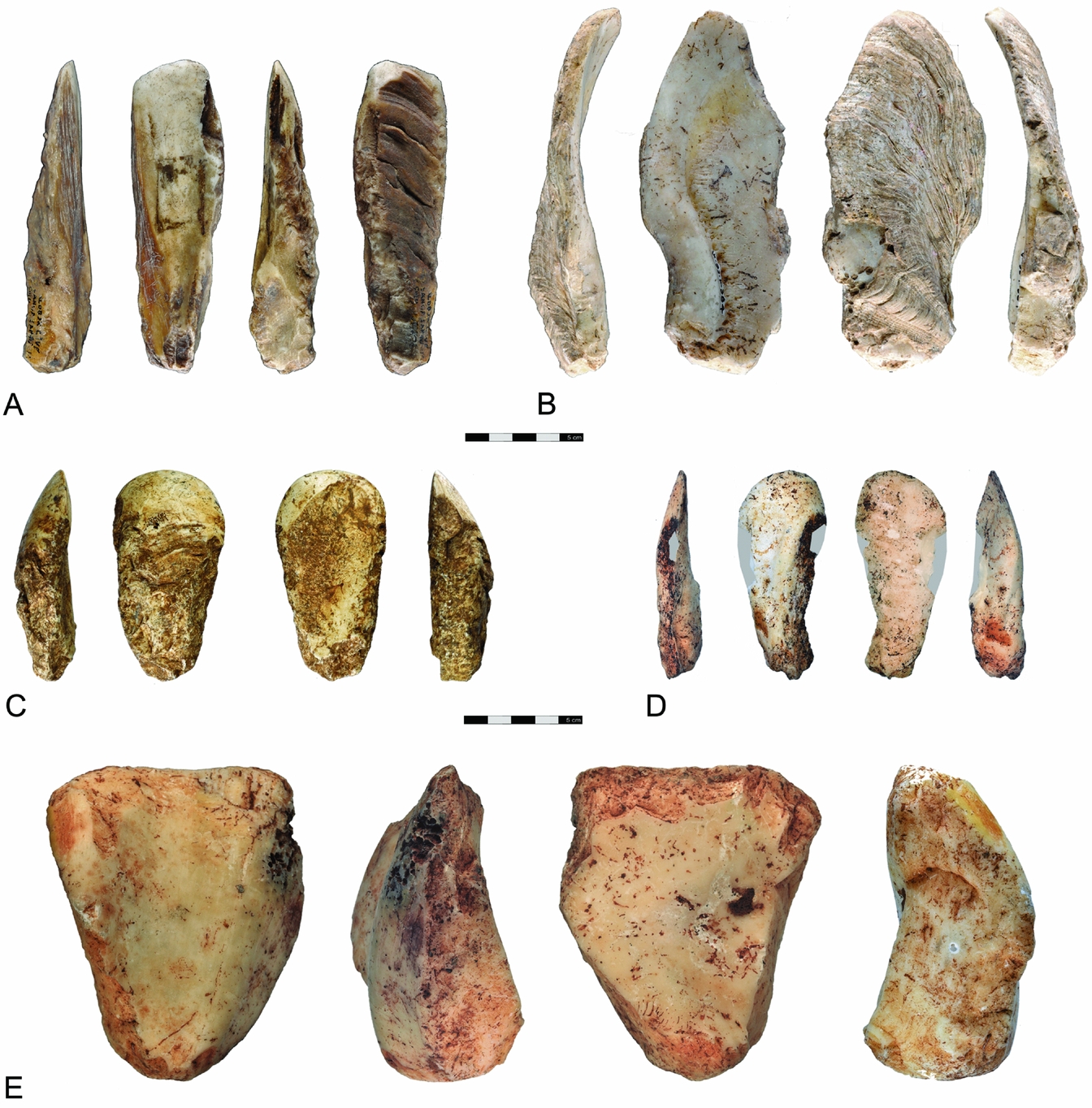
In the Philippines Tridacna adzes have been recovered at several locations from within aceramic deposits, but dating has been a problem (Pawlik et al. Reference Pawlik, Piper, Wood, Lim, Faylona, Mijares and Porr2015). At Balobok rock-shelter, direct dating of a shell adze (Fig. 3A) has indicated that it was manufactured at or after 4143–3970 cal. bp (S-ANU-41826). This is significantly younger than the dates of 7497–6743 cal. bp and 8590–8200 cal. bp (no lab codes) on undefined marine shell samples purportedly recovered from the same stratigraphic layers during excavation of the rock-shelter in 1969–70 (Spoehr Reference Spoehr1973), or the shell sample dated to 7497-6743 cal. bp (GaK) recovered during the re-excavation of the adze layer in 1992 (Ronquillo et al. Reference Ronquillo, Santiago, Asato and Tanaka1993). However, a unilaterally flaked Tridacna fragment or ‘gouge’ from Balobok that was considered by the excavators to represent an unfinished adze preform (although its morphology barely supports this assumption: Fig. 3B) was directly dated by the authors to 9404–9139 cal. bp (S-ANU-41827). Either the ‘gouge’ was produced on old shell, or it was misidentified in the younger strata and potentially belonged to an earlier occupation.
Tridacna adzes and modified artefacts, from: (A, B) Balobok; (C) Bubog 1; (D) Bilat; (E) Bubog 2.

At Bubog 1, a Tridacna adze (Fig. 3C) was directly dated to 7550–7250 cal. bp (S-ANU-35132). Here, the security of the date is enhanced by the known recovery location within a well-dated and stratigraphically secure context that brackets its manufacture between c. 11,000 and 6000 bp (Pawlik et al. Reference Pawlik, Piper, Wood, Lim, Faylona, Mijares and Porr2015). Another shell adze recovered from a somewhat less secure context at Bilat Cave (Fig. 3D) produced a direct date of 7414-7285 cal. bp (S-ANU-41829). The date is close to that of the Bubog 1 adze, and this increases confidence that it was not manufactured on old shell, and is also very likely of Mid Holocene age. The recent identification of a Tridacna adze preform from Bubog 2 (Fig. 3E) indicates that adzes were being manufactured locally. The preform was recovered from stratified deposits that support its direct date of 9115–8899 cal. bp (S-ANU 49209).
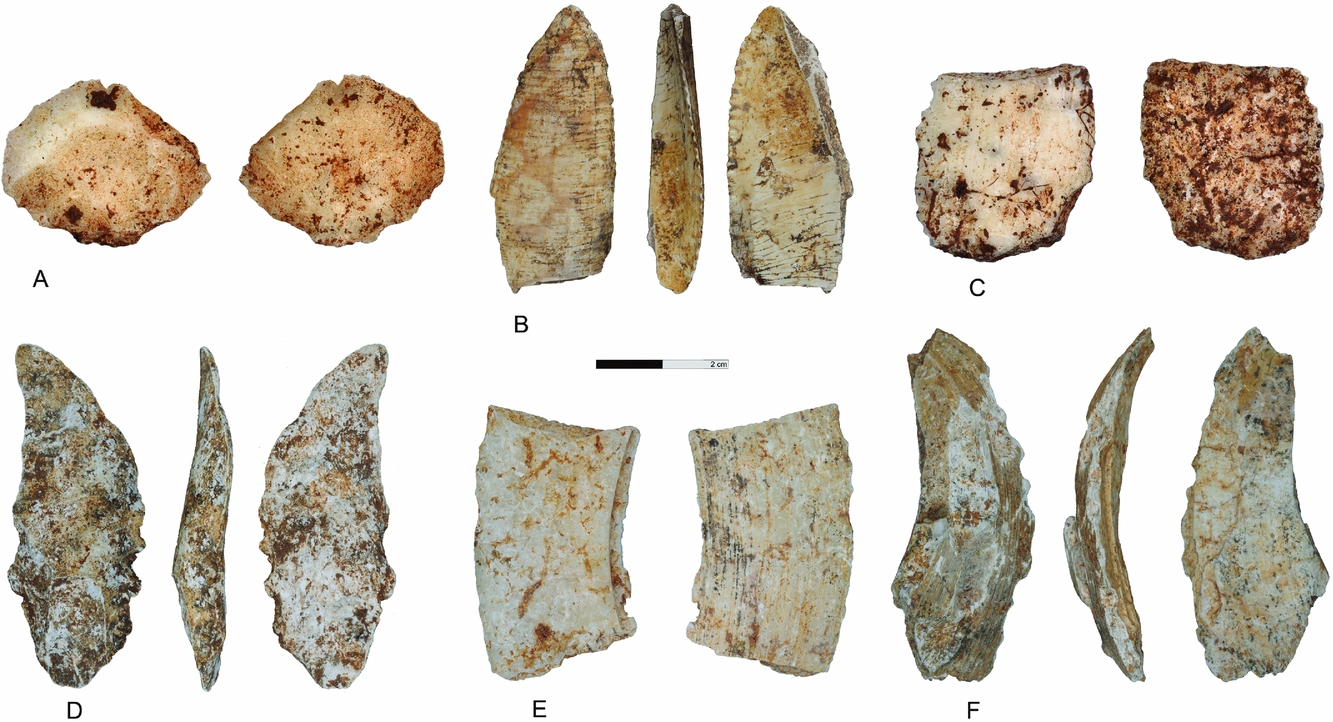
At the Bubog sites Tridacna also appears to have been deliberately worked to produce elongated flakes from at least the Mid-Holocene onwards (Fig. 4A–D). Edge wear analysis indicates that these flakes had been utilized for similar tasks as the pebble fragments found on the site. At Kamuanan Cave on Talikud Island in Davao del Sur, southeastern Mindanao, flaked Tridacna and other large shells were also found in aceramic deposits (Solheim et al. Reference Solheim, Legaspi and Neri1979, 111). Three samples were directly radiocarbon dated, two producing dates of 7964–7588 cal. bp (SUA-256) and 7620 uncal. bp (SUA-257, no standard deviation indicated). Since the samples were partly fossilized and showed significant recrystallization, the dates were considered as too old (Solheim et al. Reference Solheim, Legaspi and Neri1979, 116–17). A third sample of non-fossilized shell artefact from the site was subjected to two runs and returned dates of 4202–3691 cal. bp and 4489–3984 cal. bp (SUA-258, same lab code for both dates).
Flaked shell artefacts made of Tridacna and Geloina coaxans shells from Ilin Island: (A, B, C) flaked Tridacna artefacts from Bubog 2; (D) Tridacna flake from Bubog 1; (E, F) Geloina coaxans flakes from Bubog 1.

The only other sites where shell flakes are known to have been utilized for various tasks are Golo Cave on Gebe Island, where the opercula of Turbo marmoratus were deliberately knapped from c. 30,000 bp onwards (Szabó et al. Reference Szabó, Brumm and Bellwood2007), and in Timor Leste at Jerimalai in Late Pleistocene and Holocene layers (O'Connor Reference O'Connor, Kaifu, Izuho, Goebel, Sato and Ono2015).
From the lowest shell midden layer 9 at Bubog 1 numerous valves of the bivalve Geloina (erosa) coaxans exhibit striking damage to the umbo, and flaking and denticulation of the shell margins suggestive of their use for scraping and sawing, and as chisel-like implements (Fig. 4E–F). Visible serration, scarring and rounding of edges probably resulted from longitudinal and transverse motion activities on different middle and harder contact materials (Benz Reference Benz2016). Similar damage and breakage to modern Geloina shells was achieved during experimental research conducted by the authors, suggesting the Bubog valves may have been employed as chisel-like implements or wedges, perhaps to split organic materials such as bamboo. What the analytical research at Bubog has demonstrated is that shells appear to have played a greater role than simply as ‘scrapers’. Tools made of marine shell have the capacity to complement and even substitute for lithic tools, at least for some activities. Direct AMS dates on two Geloina shell tools from the base of the shell midden returned ages of 28,802–28,113 cal. bp and 31,139–30,591 cal. bp, respectively (S-ANU 48438 and S-ANU 48439), while direct AMS dates on Conus and Strombus shells from the same stratigraphic horizon provided ages of between 31,000 and 33,000 cal. bp (S-ANU 53625, 53626 and 53632: Table 1).
Shell ‘scrapers’ have been recorded in the Hoabinhian shell middens of northern Sumatra, such as Sukajadi Pasar (Bronson & Glover Reference Bronson and Glover1984). Mangrove shell ‘scrapers’ have also been recorded in the Mid-Holocene deposits of Kimanis Cave in Kalimantan (Arifin Reference Arifin2004), at unspecified but potentially Early to Mid Holocene dates in Bale, Pawon, Gede and Suruh in the northern limestone massif of Tuban in East Java (van Heekeren Reference van Heekeren1957; Willems Reference Willems1939), and at Song Gupuh (Morwood et al. Reference Morwood, Sutikna and Saptomo2008), Song Keplek (Simanjuntak & Asikin Reference Simanjuntak and Asikin2004), Gua Braholo and Liang Toge in central Java (Prasetyo Reference Prasetyo and Simanjuntak2002). They have also been recorded at Taolean sites in southwestern Sulawesi, such as Leang Burung, Leang Pattae, Ulu Leang and Bola Batu (Bulbeck Reference Bulbeck, Pasveer and Keates2004), and at Liang Bua on Flores (van den Bergh et al. Reference van den Bergh, Meijer and Rokhus2009) and Lie Seri and Uai Bobo 1 and 2 on Timor (Glover Reference Glover1986). At Golo Cave limpet shells were used for a variety of tasks on hard and soft materials from around 30,000 years ago (Szabó & Koppel Reference Szabó and Koppel2015). This suggests that the use of shell for a variety of utilitarian tasks likely dates back to the Late Pleistocene in ISEA and was a technology transferred across the region during initial colonization, before 45,000 years ago.
Osseous technologies
The discovery of osseous artefacts in 20 caves and rock-shelters in east Java during the early twentieth century led van Heekeren (Reference van Heekeren1957, 85) to argue that the ‘Sampung Bone Industry’ (as he termed it) represented new technological innovation introduced to the region during the Early Holocene. More recent research has produced patchy evidence for osseous implements in the Late Pleistocene, suggesting that bone technologies arrived with some of the first modern human populations to reach Southeast Asia, but were not ubiquitously distributed and did not contribute significantly to forager implement repertoires, until the Early Holocene (Rabett Reference Rabett2012, 150–51; Rabett & Piper Reference Rabett and Piper2012). Early examples of bone artefacts have been recorded at Lang Rongrien in Krabi Province, Thailand at c. 42,000 bp (Anderson Reference Anderson1990; Reference Anderson1997), in the ‘Tabuhan’ layers of Song Terus dating to between 80,000 and 30,000 bp (Kusno Reference Kusno2009) and at Matja Kuru 2 in East Timor, where the base of a hafted point was recorded dating to c. 34,000 bp (O'Connor et al. Reference O'Connor, Robertson and Aplin2014).
From the Early Holocene onwards, there is broad geographic expansion of bone implement manufacture across ISEA and a diversification of their use into a range of activities including cutting, whittling and perforating, and possibly as digging points. It is during this period that hafted composite projectile technologies seem to emerge in any numbers for the first time at sites like Niah Cave (Rabett Reference Rabett2005; Rabett & Piper Reference Rabett and Piper2012). The abrupt appearance of bone implements in long archaeological sequences after 12,000 bp is attested at Gua Balambangan, Pulau Island (Majid et al. Reference Majid, Ignatius, Tjia and Koon1998; Rabett & Piper Reference Rabett and Piper2012), in Java at Gua Braholo (Simanjuntak & Asikin Reference Simanjuntak and Asikin2004), Song Gupuh (Morwood et al. Reference Morwood, Sutikna and Saptomo2008) and Song Keplek (Forestier Reference Forestier2000; Simanjuntak & Asikin Reference Simanjuntak and Asikin2004). In southern Sulawesi, bone implements considered typical of the ‘Toalean’ culture have been recovered from Ulu Leang 1 and other sites in Mid Holocene contexts, dating to between 8000 and 7000 bp (Olsen & Glover Reference Olsen and Glover2004). Completely different forms of implements, many manufactured from suid incisors, have also been recorded at Gua Talimbue, Gua Mo'o hono and Gua Sambagowala in the Walandawe area of Southeast Sulawesi dating from the Mid Holocene onwards (Aplin et al. Reference Aplin, O'Connor, Bulbeck, Piper, Marwick, St. Pierre, Aziz and Langley2016).
In the Philippines, bone technology is relatively scarce in the Pleistocene and Early Holocene, but a fishing gorge (Fig. 5A) from Bubog 1 was recovered from deposits below the basal shell midden layer dated by several radiocarbon dates on shell to between c. 33,000 and 28,000 cal. bp (Table 1). Another bone point and potential fishing gorge fragment were found in the shell midden's Mid Holocene Layer 5, with an associated date on Conus shell of 5890–5521 cal. bp, together with a heavily fragmented modified bone artefact and a modified suid canine with wear traces (Fig. 5B–D). Ille Cave has also produced three bone artefacts, including a pig fibula utilized as an awl with an associated date of 6661–6481 cal. bp (Lewis et al. Reference Lewis, Paz and Lara2008). A worked bone artefact has also been recovered from Balobok rock-shelter on Sanga-Sanga Island in the Sulu Sea, poorly dated to the early Mid Holocene (Bautista Reference Bautista2001; Ronquillo et al. Reference Ronquillo, Santiago, Asato and Tanaka1993), but probably significantly younger (see below). As with many other locales in ISEA, bone technologies in the Philippines appear to have been rare and relatively limited in their repertoire of use, but it was a technology that was available to local forager communities.
Modified bone artefacts from Bubog 1: (A) fishing gorge, Layer 10; (B) polished bone point, Layer 5; (C) bone tool fragment, Layer 5; (D) modified pig canine tooth, Layer 5.

Emergence of social networks and ideologies
The involvement of the Philippines in a wider socio-cultural sphere across Island Southeast Asia is suggested by artefactual evidence, e.g. obsidian flakes found in Palawan and Mindoro, but can also be found in the appearance of organized burial at the end of the Pleistocene. Although anatomically modern humans have been present in Island Southeast Asia since between 73,000 and 63,000 bp (Westaway et al. Reference Westaway, Louys and Awe2017), no clear evidence for deliberate burial is present in ISEA prior to c. 20,000 bp (Oxenham et al. in press). So far, a single adult female who was dismembered, wrapped and buried under a large limestone block at Liang Lemdubu in the Aru Islands on the fringes of the Sahul Shelf is the only individual that clearly dates to this early period at c. 21,000–16,000 cal. bp (Bulbeck Reference Bulbeck, O'Connor, Spriggs and Veth2006a).
It is from the Terminal Pleistocene/Early Holocene transition onwards that burials start to increase in geographic distribution and number and various new ideologies associated with death spread across ISEA (Piper Reference Piper, Oxenham and Buckley2016). On Aru Island, juvenile and adult skeletal material was recovered from Liang Nabulei Lisa, Aru, dated by several samples on different organic materials to c. 12,000–10,000 cal. bp (O'Connor et al. Reference O'Connor, Spriggs and Veth2006, 129–32). The commingling of burnt and unburnt incomplete skeletal remains of the individuals was considered consistent with secondary burial (Bulbeck Reference Bulbeck, O'Connor, Spriggs and Veth2006b, 163–70). In the Lesser Sundas an incompletely excavated inhumation from Tron Bon Lei Cave, Alor, has been dated by a rotating fish hook found around the neck and an associated fragment of charcoal to between 11,500 and 10,500 cal. bp (O'Connor et al. Reference O'Connor, Mahirta, Hawkins, Kealy, Louys and Wood2017).
Although flexed burials predominate on the Sunda Shelf, a variety of complex burial practices emerged in this region during the Early Holocene. At Niah Cave, for instance, individuals were buried in tightly flexed or seated positions, sometimes after being decapitated. Secondary burial included the interment of disarticulated unburnt inhumations and cremations (Rabett et al. Reference Rabett, Barker, Barton and Barker2013). No grave goods have been recorded in any of these burials, but a rhinoceros radius seems to have been utilized as a ‘pillow’ with one flexed inhumation (Cranbrook 1986; Rabett et al. Reference Rabett, Barker, Barton and Barker2013). The burials are considered to date from the Early Holocene onwards. There appears to be no chronological ordering of the various burial practices utilized at Niah, with primary and secondary burial traditions overlapping both spatially and chronologically (Lloyd-Smith Reference Lloyd-Smith2012). This would imply that the same forager group or different groups utilizing the cave entrance for burial had various and overlapping traditions that reflected complex ideologies and cultural traditions orientated around death, burial and the afterlife.
At Gua Braholo, evidence of complex burial practices, including disarticulation and deliberate bone breakage, was recorded (Détroit Reference Détroit, Simanjuntak, Pojoh and Hisyam2006, 194). A supine burial with leg flexion (BHL-1) was dated by associated charcoal to between 12,000 and 10,500 cal. bp, while a secondary burial, where the skull, mandible and pelvis appear to have been selected for interment within a container, was dated by associated charcoal to between c. 10,000 and 9500 cal. bp (Détroit Reference Détroit, Simanjuntak, Pojoh and Hisyam2006, 194). At Gua Pawon (PAW), Bandung, West Java, PAW1 and PAW2 were incomplete burials stained red with haematite and dated by associated charcoal to c. 6800–6200 cal. bp. Direct dating on two flexed inhumations returned dates of 8454–7784 cal. bp (PAW3) and 11,262–10,251 cal. bp (PAW4: Noerwidhi Reference Noerwidhi, Piper, Matsumura and Bulbeck2017; Yondri Reference Yondri2005). PAW3 had a rock placed on the chest.
Flexed burials have been recovered from Song Keplek (SK4) dating to c. 5300–4900 cal. bp (Beta 69689) and Song Terus 1 at c. 10,400–9900 cal. bp (no lab code). The individual from Song Terus had been interred in an alcove with several limestone blocks placed to delineate the burial. A complete Javan Lutung skull, partial burnt bovine vertebral column and several other fragments of monkey skull were associated with the burial (Détroit Reference Détroit, Simanjuntak, Pojoh and Hisyam2006, 188–92). In Borneo two flexed burials probably dating to the Terminal Pleistocene or Early Holocene were excavated at Kimansi (Arifin Reference Arifin2004), and an isolated undated flexed inhumation was recorded within occupation deposits at Gua Tenkgorak dated by stratigraphic association to c. 6000 bp (Widianto & Handini Reference Widianto and Handini2003).
Currently, the earliest burials in the Philippines have been recorded at Ille Cave. These consist of cremations, the best studied of which is Burial 758 with direct dates on bone collagen of 9260–9006 cal. bp (OxA-16020) and 9425–9280 cal. bp (OxA-15982) (Lewis et al. Reference Lewis, Paz and Lara2008). Burial ritual appears to have included skinning and dismemberment before the remains were placed in a pouch-like container and buried (Lara et al. Reference Lara, Lewis, Paz and Solheim2013). Another three of the cremation burials from Ille are dated between 8500 and 7500 cal. bp (Lara et al. Reference Lara, Lewis, Paz, Ronquillo, Oxenham and Buckley2016).
At Bubog 1, a tightly flexed inhumation was identified under a rock overhang. The individual was directly dated on tooth enamel to 4848–4652 cal. bp (S-ANU 41027). Dates on apatite are consistently found to be up to 500 14C years younger than expected due to the presence of unremoved contaminants (Zazzo Reference Zazzo2014; Zazzo & Saliège Reference Zazzo and Saliège2011). The date on enamel from Bubog 1 must therefore be regarded as a minimum age and a date of around 5000 cal. bp for the burial seems likely. The burial was aceramic and no grave goods or artefacts were associated with the interred body, but the burial pit appears to have been deliberately underlain and covered with limestone slabs (Pawlik et al. submitted).
In general, grave goods are rarely recovered from burials older than 4500 cal bp. An exception appears to be an incompletely excavated inhumation from Tron Bon Lei Cave, Alor, dated to between 11,500 and 10,500 cal. bp, that has rotating fish hooks around the neck (O'Connor et al. Reference O'Connor, Mahirta, Hawkins, Kealy, Louys and Wood2017). After 4500 cal. bp, the deliberate inclusion of material culture in burials emerges in the Philippines: for example, at Duyong Cave in Palawan, Philippines, where a flexed inhumation was recovered in association with a fully ground stone adze, four Tridacna adzes, and several Conus shell ornamental discs, but no pottery (Fox Reference Fox1970, 63, figs 19a,b; Szabó Reference Szabó2005, 283). A reassessment of the date of the Duyong burial, and especially in relation to the incorporation of a fully ground stone adze, a type of implement absent from the Philippine archaeological record before the late Holocene, suggests a date of 4500–4000 cal. bp (Pawlik Reference Pawlik2006; Pawlik et al. Reference Pawlik, Piper, Wood, Lim, Faylona, Mijares and Porr2015). Four flexed burials from Sa'gung rock-shelter that also contained ground stone adzes as well as crocodile tooth pendants and Conus shell necklaces (Kress Reference Kress and Paz2004) also likely date to this general period, or later. Two poorly preserved individuals at Ille Cave (nos. 874 and 727) were also interred with a variety of shell artefacts manufactured from Tridacna, Conus and Turbo marmoratus. In Burial 874, two direct dates on a fragment of Tridacna ‘artefact’ and a perforated Conus disc produced dates of 4386–4125 cal. bp (AA-92542) and 4419–4236 cal. bp, respectively (WK-30657). Two more direct assays on a fragment of Turbo marmoratus and another Conus disc from Burial 727 returned dates of 4608–4415 cal. bp (WK-30656) and 4787–4525 cal. bp (AA-92543) respectively (Table 1). No pottery was reported from either of these burials (Lewis et al. Reference Lewis, Paz and Lara2008; Paz & Vitales Reference Paz and Vitales2008). The introduction of material culture into graves follows a similar pattern observed on the Mainland of Southeast Asia and perhaps indicates the arrival of new ideologies (incorporation of material culture in graves) that were initially integrated with old traditional methods of burial (flexion). After c. 3500 cal. bp, burial traditions across ISEA change markedly with the introduction of the supine extended inhumation, sometimes in formalized cemeteries (Lloyd-Smith et al. Reference Lloyd-Smith, Barker, Barton and Barker2013; Matsumura et al. Reference Matsumura, Hung, Nguyen, Zhao, He, Chi, Piper, Matsumura and Bulbeck2017; Oxenham et al. in press).
At present, the authors are unaware of any clear evidence of pre-Neolithic burials on Luzon, despite numerous cave and rock-shelter sites having been surveyed, and 11 sites having been systematically excavated in the Peñablanca region (Lloyd-Smith Reference Lloyd-Smith, Boyle, Rabett and Hunt2014; Mijares Reference Mijares2007; Thiel Reference Thiel1990). Perhaps the earliest known indication for burials appears at Musang Cave where 78 bone fragments from at least two adults were excavated (Thiel Reference Thiel1990). However, the bodies do not appear to have been buried, but rather came from a heavily disturbed area of the cave scattered within the upper levels of the excavation. A possible association with a radiocarbon date of 4891–4240 cal. bp (GaK-7043) must be regarded with caution.
The Philippines in regional context
The Late/Terminal Pleistocene archaeological record from the Philippines suggests that local foraging communities in ISEA were already well adapted to a variety of landscapes and environments where they hunted a diversity of large and small mammals and reptiles, foraged along coastlines and processed several economically useful plants. The successful adaptation to maritime and coastal environments was achieved through a variety of technological innovations and cultural developments, which consequently provided the capacity for the establishment of an ISEA-wide maritime network and long-distance interaction disseminating technological innovation, probably hand-in-hand with the expansion of social and cultural ideologies.
The Philippine archaeological record provides useful evidence that suggests some of the sophisticated coastal and marine resource procurement strategies that were being employed on the isolated islands in the Lesser Sundas during this period (O'Connor et al. Reference O'Connor, Ono and Clarkson2011) were also likely well developed and applied more broadly across ISEA, where former Pleistocene coastlines have been lost to Holocene sea-level rise.
Traceological analyses on lithic implements have also shown that techniques of hafting and the manufacture of projectile technologies were being utilized by c. 12000 bp. The occurrence of a projectile technology during this period is comparable with the initial appearance of similar range weaponry at other locales in ISEA such as Leang Sarru in northern Sulawesi. Niah Cave, where projectile points were manufactured in bone, rather than stone, illustrates the ability to transfer technological knowledge across manufacturing media (see also Szabó et al. Reference Szabó, Brumm and Bellwood2007). In fact, the local inhabitants of Mindoro and Palawan appear to have had well-developed tool technologies in stone, bone and shell, with a variety of implements utilized in a range of hunting/fishing strategies, and plant and animal processing activities. For example, the presence of fishing gorges, a technology used to capture carnivorous fishes at Bubog, suggests the inhabitants of Ilin possessed complex fishing technologies from at least 30,000 bp onwards, that also included the manufacture and maintenance of nets as the recovery of several net sinkers made of igneous pebbles with waisted modification suggests. These are different fishing strategies to those observed in locales to the east, such as Timor Leste, where the sites of Jerimalai and Lene Hara have produced evidence for the manufacture of shell fishhooks dating from 23,000 bp onwards (O'Connor & Veth Reference O'Connor and Veth2005; O'Connor et al. Reference O'Connor, Ono and Clarkson2011; Reference O'Connor, Mahirta, Hawkins, Kealy, Louys and Wood2017). Thus, Philippine forager communities appear to have developed fishing technologies that do not seem to have been present elsewhere in Southeast Asia at this early date. The geographical variations in fishing strategies identified across Wallacea could imply that marine fishing had a common origin, prior to human migration across eastern ISEA. Some of the differences we observe in the technologies and techniques employed in the Philippines and the areas around Timor and Alor are perhaps local innovations and adaptations that emerged following island dispersal, and developed to deal with the diverse marine ecosystems encountered across the region.
The knowledge and skill to manufacture implements from a variety of osseous materials appears to have entered Southeast Asia with the earliest anatomically modern humans to inhabit the region (Rabett & Piper Reference Rabett and Piper2012). The earliest record of bone artefacts in the Philippines is currently from Bubog 1 and dates to c. 32,000 bp, and potentially earlier. This is commensurate with some of the earlier records of bone technology across other regions of Southeast Asia in the Late Pleistocene. By the Early Holocene there appears to have been a marked increase in the manufacture of osseous implements and a diversification in use context, again tied to local innovation. Local communities across ISEA applied the knowledge of how to manufacture a range of bone implements to satisfy local requirements (Rabett & Piper Reference Rabett and Piper2012)—as appears to be the case in the Philippines with the production and utilization of bone fishing gorges.
Some authors have argued that the general paucity of formal stone tool types in prehistoric Southeast Asia reflects the significance of organic industries, with wood and bamboo being used in preference to stone (e.g. Dennell Reference Dennell2009; Mijares Reference Mijares2002; Narr Reference Narr1966; Pope Reference Pope1989; Schick & Zhuan Reference Schick and Zhuan1993; Solheim Reference Solheim1970; Xhauflair Reference Xhauflair2014; Xhauflair et al. Reference Xhauflair, Pawlik and Gaillard2016). However, no tools made of bamboo and/or wood have been identified in the prehistoric archaeological record of ISEA prior to the Late Holocene, and for reasons of preservation such ‘vegetal industries’ will probably always remain hypothetical (Pawlik Reference Pawlik2012). Another ideal raw material, mollusc shell, has received much less attention than it has probably deserved, and technological innovation in this medium has been hiding in plain sight. The earliest possible evidence for the use of shell as a tool in the Philippines is suggested by the presence of several modified valves of the mangrove shell Geloina (erosa) coaxans in Bubog 1 with direct dates on two of those shell tools of 28,802–28,113 cal. bp (S-ANU 48438) and 31,139–30,591 cal. bp (S-ANU 48439). These tools appear potentially to have served a number of functional uses as scrapers, chisels and saw-like implements (Pawlik et al. Reference Pawlik, Piper and Faylona2014). Another method of producing implements from shell appears to have been the reduction of Tridacna/Hippopus valves to produce sharp-edged flake tools. These are recorded from at least 9000 bp onwards at Bubog 1 and Bubog 2 (Pawlik et al. Reference Pawlik, Piper and Faylona2014).
Implements made of shell have been recorded comparably early as Bubog 1 at sites such as Golo Cave, where the opercula of Turbo marmoratus were flaked and utilized for similar purposes, rather than the valves of large clams (Szabó et al. Reference Szabó, Brumm and Bellwood2007), and at Jerimalai in Timor Leste (O'Connor Reference O'Connor, Kaifu, Izuho, Goebel, Sato and Ono2015). Although it is likely that flaked shell implements were in use across ISEA, but have been missed during analysis of shell assemblages, it is also possible that this technology developed alongside other shell industries in the Wallacean region. The evidence from Golo Cave, where the flaking of Turbo marmoratus opercula is recorded in association with numerous stone artefacts (as is also the case in the Philippines), suggests that the production of flaked shell implements was not simply a response to limited stone resources, but something that was practised alongside lithic tool manufacture.
Refined dating and the recovery of edge-ground shell adzes and adze preforms from secure archaeological contexts on Mindoro and Palawan have demonstrated that this technology is likely an Early to Mid Holocene innovation. The earliest evidence for these types of implements appears to be in Melanesia or the Moluccas from c. 11,000–10,000 bp, before spreading to the Philippine archipelago (Pawlik et al. Reference Pawlik, Piper, Wood, Lim, Faylona, Mijares and Porr2015). The rather restricted geographic distribution of shell adzes, between the southern Philippines in the west and the islands of Melanesia to the east, perhaps indicates contact across the northern fringes of Wallacea was well established several thousand years prior to the dispersal of Austronesian voyagers from the Philippines to Near Oceania and the establishment of the Lapita Cultural Complex along the same latitude (Pawlik et al. Reference Pawlik, Piper, Wood, Lim, Faylona, Mijares and Porr2015; Reepmeyer et al. Reference Reepmeyer, O'Connor, Mahirta and Kealy2016). Inter-island connectivity between Philippine islands and perhaps across the northern fringes of Wallacea is possibly supported by the recovery of obsidian from Bubog 1 and Ille on Mindoro and Palawan that might have its origins in Near Oceania (Neri et al. Reference Neri, Pawlik, Reepmeyer, Mijares and Paz2015; Reepmeyer et al. Reference Reepmeyer, Spriggs and Anggraeni2011).
The absence of implements manufactured from shell in Luzon might simply be a relict of archaeological investigation rather than a real absence of evidence. All cave sites investigated so far have been at inland locations, while all the records of shell technologies have been recorded along the coast. Future research at coastal sites might yet produce evidence of shell technologies in Luzon.
Concrete evidence for the deliberate interment of the dead appears sporadically on both the mainland and in the islands of Southeast Asia from about 20,000 years ago (Oxenham et al. in press), but it is from the Early Holocene onwards that various new ideologies associated with death spread across ISEA (Piper Reference Piper, Oxenham and Buckley2016). In the Philippines, burials prior to 4500 bp have only been recorded in the southern islands of Palawan, Mindoro and the Sulu Sea. The earliest known burials are from Ille Cave and consist of a complex secondary mortuary practice that included skinning and dismemberment of the body before cremation and interment (Lara et al. Reference Lara, Lewis, Paz and Solheim2013; Reference Lara, Lewis, Paz, Ronquillo, Oxenham and Buckley2016). Lloyd-Smith (Reference Lloyd-Smith2012) argued that secondary burial was more common along the eastern margins of the Sunda Shelf and into Wallacea, and that this might suggest closer interaction between populations occupying these islands, as does the distribution of shell adzes and some of the other technologies in shell.
The emergence and geographic spread of complex burial traditions implies maritime mobility and connectivity between communities inhabiting the mainland and the archipelagos of the region, as well as the general regional acceptance of belief systems that potentially incorporated conviction in an afterlife and meaning of ‘place’ for both the living and dead (Bulbeck Reference Bulbeck2008; Lloyd-Smith Reference Lloyd-Smith2012; Lloyd-Smith et al. Reference Lloyd-Smith, Barker, Barton and Barker2013; Oxenham et al. in press; Piper Reference Piper, Oxenham and Buckley2016). Different interconnected communities developed their own unique identities and ways of perceiving the world (Lloyd-Smith Reference Lloyd-Smith2012) and this is reflected in the diversity of mortuary practices observed across Island Southeast Asia in the Early and Mid Holocene.
By c. 4500 cal. bp, new ideologies were emerging in ISEA. This is evident in the flexed burial at Duyong Cave, which is associated with material culture for the first time. The grave goods include edge-ground shell adzes, a fully polished stone adze and several Conus disc beads, but no pottery. Indirect dating and stratigraphic association, as well as the direct date of a similar shell adze from Balobok, suggest that the burial dates to around 4500–4000 bp. At Ille Cave, two burials (unreported burial position) directly dated on shell ornamentation and artefacts also contain no pottery, but were interred around 4500 bp. This could imply early contact and social, cultural and ideological exchange between islander foragers and mainland Neolithic populations, where the inclusion of material culture in burials begins shortly before 4000 cal. bp (see Bellwood Reference Bellwood1997; Reference Bellwood2017; Piper et al. in press). The tradition of flexed burial was retained, but the inclusion of local (shell tools and ornaments) and exotic (polished stone adzes) artefacts was incorporated into new developing ideologies and ritual.
Several caves and rock-shelters have been excavated in Peñablanca in northern Luzon, but as yet no flexed and/or cremated burials have been reported. While it is possible that caves were not considered as burial locations by the populations that inhabited this region, the absence of pre-Neolithic burial, and artefacts in bone and shell on the island of Luzon, perhaps indicate that the northern Philippines were less connected with emergent island interactions than those to the south during Late Pleistocene and Early Holocene. Future research in this area should therefore be directed at identifying coastal sites and on the mobility of those foragers to shed more light on this anomaly.
Conclusion
During the Terminal Pleistocene and Early Holocene, the Philippine archipelago was inhabited by broad-spectrum inland and coastal foraging communities capable of employing a wide range of hunting and gathering strategies within rapidly changing woodland and rainforest environments. Fishing technologies appear to have been well developed and diverse and included the production of nets with sinkers and lines with baited fishing gorges. These methods of catching fish vary from equally early strategies observed in Timor and Alor, perhaps implying in situ innovation across the Wallacean region following initial dispersal from ISEA. Terrestrial hunting repertoires appear to have included range weaponry from the Terminal Pleistocene onwards, consistent with evidence of similar modes of capturing arboreal prey observed in other regions of ISEA. The possible introduction of some plants might also have altered economic strategies and increased aboriculture/vegeculture and manipulation of the environment.
The ‘simple’ stone technologies ubiquitously distributed and characteristic of ISEA appear to be deceptive in the simplicity of their manufacture. Traceological analyses on Philippine lithic materials are demonstrating that unelaborate lithic flakes could be employed in a broad range of tasks. Some implements appear to have been deliberately manufactured as components in complex composite tool technologies. Artefact repertoires from the Late Pleistocene onwards appear also to have included implements produced from bone and shell, suggesting that the core techniques of manufacturing in these media probably entered ISEA with the earliest modern human populations. Increasing diversity in the range of artefacts produced in bone, stone and shell from the Terminal Pleistocene to the Early Holocene recorded in the Philippines appears to be a combination of local innovation and the development of artefact repertoires that best suited the range of tasks and challenges that local communities faced, and the dispersal of knowledge and technologies through inter-island communication and contact. Some of these interaction spheres appear to have been relatively broad and incorporated communities from across ISEA, whereas others were much more geographically distinct (see also Bulbeck Reference Bulbeck2008). The appearance of composite tool technologies with similar functions produced in stone and bone suggests the transference of knowledge between manufacturing raw materials, as is also observed with shell.
The diversification of subsistence strategies, material culture and technology seems to have been blended with new ideologies focusing on concepts of the living, the dead and an afterlife, manifest in the requisite of burial. The emergence of a variety of complex burial traditions that included various forms of flexion, seating, secondary interment and cremation would imply the development of local and regional variations on the ideological themes associated with burial and burial ritual.
The emergence of burial and the embedded ideologies imply that a diversity of intangible social and cultural information was transmitted between island communities along with the more tangible evidence in material culture exchange.
On current evidence, early foragers of the southern Philippines (Palawan, Mindoro, Davao and the Sulu archipelago) engaged in open seafaring, and appear to have been extensively integrated into exchange networks already developing across ISEA at the end of the Pleistocene, and especially with islands to the south and east in Wallacea, where they shared material culture and where particular social, cultural and cosmological ideologies were transmitted and adopted to a greater or lesser geographic extent by different interconnected forager communities. Connectivity between populations is also evident in the dissemination of information and ideas manifested in numerous innovations, including pelagic fishing and the procurement of obsidian. Widespread maritime networks that appear to have extended across Southeast Asia, from the Mainland to Melanesia, were likely well established long before the diaspora of Austronesian-speaking people, and perhaps early farming communities even took advantage of the knowledge of those pre-existing connections for their voyages into ISEA, and on to the Pacific.
Acknowledgements
This work was funded by the University of the Philippines System Enhanced Creative Work and Research Grant (ECWRG 2016-2-032). The research of Philip Piper was funded through the Australian Research Council Grant DP140100384. We would also like to acknowledge the four reviewers, whose comments significantly improved the quality of this manuscript.