Introduction
Hearing rehabilitation is a challenge to the otologist and audiologist, and imposes increasing demands on the healthcare budget. The bone-anchored hearing aid (BAHA) is a bone conduction hearing device that includes a titanium fixture permanently implanted into the mastoid bone of the skull and an external percutaneous sound processor. The sound processor is attached to the fixture by means of a skin-penetrating abutment. The surrounding skin needs to be hairless in order to keep the implant site clean, and different techniques are used to achieve this. The most common include using a split skin graft or a thinned pedicle flap. The BAHA bypasses the middle ear and directly stimulates the cochlea. It is recommended for individuals with a variety of otological conditions (Table I). Bone-anchored hearing aids can now be fitted as a one-stage procedure, under local anaesthetic, which avoids a general anaesthetic and the (unnecessary) delayed attachment of the abutment.
Otological conditions suitable for BAHA treatment

BAHA = bone-anchored hearing aid
After more than a decade's experience with the BAHA in Glasgow, we used satisfaction and quality of life questionnaires to assess our patient population.
The objective of this cross-sectional study was to ascertain the usefulness of the BAHA to our patients, and to assess its impact on their quality of life. Comparisons were made with the previously used conventional air conduction aid, and with no aiding. Surgical techniques and complications were also assessed.
Patients and methods
The Entific Medical Systems questionnaire was used to assess patient satisfaction. This questionnaire has previously been evaluated.Reference Hakansson, Liden, Tjellstrom, Ringdahl, Jacobsson and Carlsson1–Reference Badran, Bunstone, Arya, Suryanarayanan and Mackinnon6 Its questions target specific issues such as: daily usage and functional value of the BAHA; comparisons with previous, conventional aid; BAHA failures; and BAHA repairs and skin care.
The Glasgow Benefit Inventory was used to assess quality of life changes.Reference Robinson, Gatehouse and Browning7 It is a subjective, patient-orientated, post-interventional questionnaire especially developed to evaluate ENT surgical and therapeutic procedures. The 18 questions are based on a five-point Linkert scale. The Inventory is scored as a total score and then according to three subscales: 12 questions relating to general factors; three questions relating to social support issues; and three questions concerning physical health.
The total Glasgow Benefit Inventory score for each patient was calculated and then averaged to give equal weight to each question; 3 (no change) was then subtracted from the total and the result multiplied by 50 to produce a benefit score. All these scores ranged from −100 to +100. The same analysis was used for each of the subscales.
Both questionnaires were sent by post to 60 adult patients who had undergone BAHA implantation sequentially over 10 years (between 1996 and 2006) in Glasgow. The programme started earlier in the 1990s, and the first 23 patients were evaluated and their benefit reported in 1994.Reference Browning and Gatehouse8 Patients were fitted with a range of processors over this period, including analogue processors (BAHA Classic and Compact; Cohlear Europe Ltd, Addlestone, UK) and latterly digital processors (BAHA Intenso and Divino; Cohlear Europe Ltd, Addlestone, UK). All patients had worn their BAHA for at least six months; this avoided an initial ‘honeymoon’ bias and also precluded reporting of initial difficulties with fitting and maintenance.
Data relating to surgical techniques and complications were obtained from clinical record files.
Results
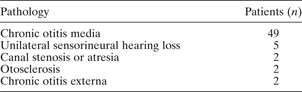
Sixty adult patients were identified who had been fitted with a BAHA in Glasgow between 1996 and 2006. The otological cause for their hearing impairment varied, but was predominantly chronic otitis media (Table II). Thirty-eight questionnaires were returned, equating to a response rate of 63 per cent. The age range of the respondents was 21–82 years, with a mean age of 55 years. The male-to-female ratio was 1.3:1.
Ear pathology resulting in BAHA implantation

BAHA = bone-anchored hearing aid usage.
Usage and functional value
Thirty-three respondents (88 per cent) reported using their BAHA seven days per week (Figure 1). Thirty-two respondents (85 per cent) reported using their BAHA for more than eight hours per day (Figure 2). Respondents' overall satisfaction was excellent, with a median score of 10 out of 10 (Figure 3).
Patients' daily bone-anchored hearing aid usage.

Patients' hourly bone-anchored hearing aid usage.

Patients' overall satisfaction with their bone-anchored hearing aid (scored out of 10).

In terms of functional value, 35 respondents reported that their BAHA performed very well or excellently when talking to one person (91 per cent). However, only 17 respondents (44 per cent) reported that their BAHA performed very well or excellently when talking in a group of people.
Comparisons with previous, conventional aid
Twenty-nine respondents (75 per cent) found their BAHA generally better than their previous, conventional aid. Twenty-six respondents (68 per cent) reported infections to be better when using a BAHA compared with a conventional aid. Thirty-one respondents (82 per cent) found speech comprehension, along with sound comfort, to be better with their BAHA than with a conventional hearing aid. Twenty-six respondents (68 per cent) reported that their BAHA looked better cosmetically and was easier to handle than a conventional hearing aid.
Bone-anchored hearing aid repairs and skin care
Twenty-eight respondents (75 per cent) reported that their BAHA needed to be repaired one or more times. Twenty-five respondents (66 per cent) reported finding it easy to look after the skin around the BAHA, with five respondents (13 per cent) finding it difficult. Respondents reported two fixture failures requiring re-implantation.
Quality of life
On direct questioning in the Entific Medical Systems questionnaire, 27 respondents (71 per cent) reported that their BAHA improved their quality of life.
The Glasgow Benefit Inventory data were not distributed normally and so median values were calculated. Figure 4 presents a summary of the results of the Glasgow Benefit Inventory, and also shows the results of the three individual subscales. The data are displayed as box and whisker plots, and in each group the median and 25th and 75th percentiles are displayed. The median total Glasgow Benefit Inventory score was +33.3. The median general score was +42, the median physical score was +11 and the median social score was +23.
Glasgow Benefit Inventory total and subtype scores. The horizontal line in each box marks the median score.

Surgical technique and complications
Fifty-eight patients (97 per cent) were fitted with a BAHA as a one-stage procedure. Twenty-eight patients (46 per cent) had a thinned pedicle flap for the surrounding skin, and 32 patients (32 per cent) had a split skin graft. Seventeen patients (28 per cent) reported soft tissue problems, including infection, partial flap necrosis and soft tissue thickening. Seven patients (11 per cent) required soft tissue revision surgery, while two (3 per cent) suffered loosening of the abutment which required reattachment.
Discussion
The BAHA was pioneered in Sweden by Anders Tjellström and his associates during the 1980s. Since then, BAHA implantation has become an effective management technique for hearing impaired patients for whom an air conduction hearing aid, with its associated ear mould, is not appropriate.
However, BAHA funding is still not universally available within the National Health Service in Scotland. Funding is organised locally, and the Scottish Department of Health does not audit the numbers of departments with funding. There is only one previously published report from a Scottish BAHA programme.Reference Browning and Gatehouse8 This reported the initial experience of the first 23 patients implanted with BAHAs in Glasgow in the early 1990s. These early patients were generally happy with their BAHA, but a notable 31 per cent of patients, who had previously used an air conduction aid, reverted to using solely their air conduction aid post-BAHA implantation.
During the last 10 years, patients have benefited from advances in BAHA technology and surgical implantation techniques. Our current data on reported usage and benefits supports this. We expect the benefits of BAHAs to be enhanced in the future as more patients are fitted with digital processors. Most patients currently using a BAHA have an analogue aid. In accordance with the Department of Health's good practice guidance document, all patients should now be fitted with digital hearing aids.9
Audiology budgets must therefore plan for the fitting and follow up of new digital BAHA users, and for the conversion of current analogue BAHA users to digital aids. Given the high unit cost of a BAHA (approximately £3000), decisions about candidature for such devices can have a major impact on the hearing aid element of the audiology budget. Problems currently arise if a BAHA patient moves to an area in which the local audiology department does not have funding for BAHAs, as there is no money to maintain the patient's aid.
We undertook a cross-sectional study of patients fitted with BAHAs in Glasgow between 1996 and 2006, in order to assess their usage and benefit.
There was a 63 per cent response rate to the questionnaires distributed, which is significant and adds value to the results.
The Entific Medical Systems questionnaire was sent to patients to evaluate their day to day BAHA usage, along with the BAHA's functional value, the patient's overall satisfaction, and wear and tear issues. The questionnaire incorporated important comparisons with the previously worn, conventional aid, especially relating to ear infections, speech comprehension, sound comfort and cosmesis. The questionnaire had previously been used by the Birmingham BAHA programme to evaluate a group of paediatric patients, and also by the Chester programme to evaluate adult patients.Reference Powell, Burrell, Cooper and Proops3, Reference Badran, Bunstone, Arya, Suryanarayanan and Mackinnon6
A high degree of satisfaction was reported by our patients, with a median score of 10 out of 10. This result is comparable to published findings from other centres.Reference Hakansson, Liden, Tjellstrom, Ringdahl, Jacobsson and Carlsson1–Reference Badran, Bunstone, Arya, Suryanarayanan and Mackinnon6, Reference Dutt, McDermott, Burrell, Cooper, Reid and Proops10, Reference Lustig, Arts, Brackmann, Francis, Molony and Megerian11
All patients had been using their BAHA for over six months, to obviate any initial enthusiasm bias. Despite this, the reported usage rates were very high. Eighty-eight per cent of our patients reported using their BAHA seven days per week. This is comparable to the 81 per cent and 93 per cent reported by other programmes.Reference Dutt, McDermott, Jelbert, Reid and Proops4, Reference Badran, Bunstone, Arya, Suryanarayanan and Mackinnon6 Eighty-five per cent of our patients reported using their BAHA for more than eight hours per day. This is comparable to the 78, 87 and 90 per cent rates reported by other programmes.Reference Tjellstrom and Hakansson2, Reference Dutt, McDermott, Jelbert, Reid and Proops4, Reference Wazen, Caruso and Tjellstrom12 We found usage patterns to be the same in patients who had recently been fitted with a BAHA, compared with those who had been fitted years previously.
Ninety-one per cent of our patients reported that their BAHA functioned very well or excellently when talking to one person. This fell to only 44 per cent for good function in a group situation. Badran et al. reported a similar drop of 85 to 45 per cent.Reference Badran, Bunstone, Arya, Suryanarayanan and Mackinnon6 This poor BAHA function in group situations is explained by having a unilateral, analogue aid. Results will hopefully improve in patients fitted with digital aids in the future. Bilateral BAHA implantation has been performed by other programmes on carefully selected patients, and improved speech intelligibility has been reported.Reference Dutt, McDermott, Burrell, Cooper, Reid and Proops10
Seventy-five per cent of our patients reported their BAHA to be generally better than their previous, conventional aid. Sixty-eight per cent reported a reduction in ear infections after they had stopped wearing a conventional aid, allowing ventilation of the external auditory canal. This result is significant and infers a reduction in demand on ENT departments and primary care practitioners. Similar infection improvement rates, of 63 and 67 per cent, have been reported by other groups.Reference Hakansson, Liden, Tjellstrom, Ringdahl, Jacobsson and Carlsson1, Reference Badran, Bunstone, Arya, Suryanarayanan and Mackinnon6
• This study assessed the quality of life of patients fitted with a bone-anchored hearing aid (BAHA) in Glasgow over a 10-year period
• Usage and satisfaction rates were very high, with a relatively high Glasgow Benefit Inventory score
• Most patients reported their BAHA to be cosmetically superior and easier to handle than their previous, conventional aid
• Funding for BAHA implantation is not universally available within the National Health Service in Scotland, or within the UK as a whole
It is notable that 68 per cent of our patients reported finding their BAHA cosmetically superior and easier to handle than their previous, conventional aid. An important reason for patients refusing any kind of hearing aid is the perception that the aid is unsightly. Bone-anchored hearing aids are available in different colours to aid camouflage and can be hidden completely by hair in patients who are not balding; many patients value these aspects highly. Easier handling is particularly beneficial for some older or less dexterous patients.
Seventy-five per cent of patients reported that their BAHA required one or more repairs. However, only 14 per cent required repairs more than twice. This is important data for planning audiology budgets.
The Glasgow Benefit Inventory questionnaire provides a measure of patient benefit (i.e. change in health status) from ENT procedures, in this case BAHA implantation and use. Following the cochlear implantation validation study by Robinson et al. (score +40), the Glasgow Benefit Inventory was recommended for evaluating hearing aid devices.Reference Robinson, Gatehouse and Browning7 We found that BAHA use resulted in improved patient benefit and a significant improvement in patient health. The first validation study using the Glasgow Benefit Inventory to assess BAHA use was performed by Arunachalam et al. Reference Arunachalam, Kilby, Meikle, Davison and Johnson13 Their median general (+34), social (+21) and physical (+10) scores were lower than our values (+42, +23 and +11, respectively), which is reassuring for the Glasgow programme. Our results confirm positive outcomes in terms of BAHA usage and improved quality of life, and this helps to justify the financial demands of the BAHA programme. Our data will assist future budget planning and support requests for new BAHA programme funding in Scotland as a whole.