The genus Amaranthus comprises over 70 species, including species both native and nonnative to the United States. However, only a select few are problematic in US crop production systems. Redroot pigweed (Amaranthus retroflexus L.), Powell amaranth (Amaranthus powellii S. Wats.), spiny amaranth (Amaranthus spinosus L.), smooth pigweed (Amaranthus hybridus L.), common waterhemp [Amaranthus tuberculatus (Moq.) Sauer], and Palmer amaranth are the most common of these problematic species (Bensch et al. Reference Bensch, Horak and Peterson2003; Gossett and Toler Reference Gossett and Toler1999; Grichar Reference Grichar1994; Hager et al. Reference Hager, Wax and Bollero2002; Knezevic et al. Reference Knezevic, Weise and Swanton1994; Massinga et al. Reference Massinga, Curie, Horak and Boyer2001; Moolani et al. Reference Moolani, Knake and Slife1964; Schweizer and Lauridson Reference Schweizer and Lauridson1985; Toler et al. Reference Toler, Guice and Murdock1996). Redroot pigweed, Powell amaranth, spiny amaranth, and smooth pigweed are monoecious (male and female structures on the same plant), while common waterhemp and Palmer amaranth are dioecious (male and female structures on separate plants) (Bryson and DeFelice Reference Bryson and DeFelice2010). Although all of these species are broadly distributed and troublesome in row-crop production, few have been as detrimental in recent history as Palmer amaranth.
Palmer amaranth has a tendency to develop resistance to herbicides. Currently, Palmer amaranth is resistant to six herbicide sites of action worldwide (Heap Reference Heap2016), including glyphosate. The first case of glyphosate-resistant Palmer amaranth was reported in Georgia in 2005 (Culpepper et al. Reference Culpepper, Grey, Vencill, Kichler, Webster, Brown, York, Davis and Hanna2006). Since then, glyphosate-resistant Palmer amaranth has spread to 23 other states, including Michigan (Heap Reference Heap2016). Glyphosate-resistant Palmer amaranth biotypes require from 1.5 to 115 times the rate of glyphosate to achieve 50% control as do susceptible plants (Norsworthy et al. Reference Norsworthy, Griffith, Scott, Smith and Oliver2008; Steckel et al. Reference Steckel, Main, Ellis and Mueller2008). In addition to resistance to single herbicide sites of action, there are several populations with resistance to multiple herbicide sites of action (Heap Reference Heap2016). One of the most prevalent forms of multiple resistance is resistance to glyphosate and ALS-inhibiting herbicides. Populations of Palmer amaranth resistant to both glyphosate and ALS inhibitors have been identified in eight states, including Michigan (Heap Reference Heap2016; Nandula et al. Reference Nandula, Reddy, Koger, Poston, Rimando, Duke, Bond and Ribeiro2012; Sosnoskie et al. Reference Sosnoskie, Kichler, Wallace and Culpepper2011). In Michigan, there are four confirmed resistance profiles in Palmer amaranth, ranging from single site of action glyphosate (Group 9) or ALS-inhibiting (Group 2) herbicides, to multiple herbicide sites of action glyphosate plus ALS inhibitors, within a single population. In addition to these populations, there is a population in Michigan with confirmed resistance to three different herbicide sites of action: glyphosate plus ALS inhibitors plus atrazine (Group 5) (Kohrt et al. Reference Kohrt, Sprague, Nadakuduti and Douches2016). Herbicide resistance in Palmer amaranth poses significant challenges for the development of management strategies.
With the limited number of effective herbicide options available for Palmer amaranth control in soybean, planting corn may provide farmers the greatest opportunity to manage this weed. Herbicides that control herbicide-susceptible and glyphosate- and ALS-resistant Palmer amaranth in corn include photosystem II inhibitors (Group 5), glufosinate (Group 10), long-chain fatty acid inhibitors (Group 15), and 4-hydroxyphenylpyruvate dioxygenase (HPPD)-inhibiting (Group 27) herbicides (Geier et al. Reference Geier, Stahlman and Frihauf2006; Johnson et al. Reference Johnson, Chahal and Regehr2012; Norsworthy et al. Reference Norsworthy, Griffith, Scott, Smith and Oliver2008; Schuster et al. Reference Schuster, Al-Khatib and Dille2008; Stephenson et al. Reference Stephenson, Bond, Landry and Edwards2015). The success of the previously described management strategies is primarily due to the susceptibility of the Palmer amaranth populations to specific herbicide sites of action. However, when managing Palmer amaranth populations resistant to three herbicide sites of action, management strategies need to be based on the use of effective herbicides. These strategies will likely need to include multiple herbicide applications, due to Palmer amaranth’s prolonged emergence and rapid growth rate (Horak and Loughin Reference Horak and Loughin2000; Keeley et al. Reference Keeley, Carter and Thullen1987; Sellers et al. Reference Sellers, Smeda, Johnson, Kendig and Ellersieck2003). Palmer amaranth is a relatively new problem in the major corn producing regions of the United States; the majority of research has focused on management of multiple-resistant Palmer amaranth in cotton, soybean, and peanut (Ward et al. Reference Ward, Webster and Steckel2013). Therefore, the objectives of this research were to 1) evaluate the effectiveness of several PRE herbicides applied alone and in combination with atrazine, as well as commercially available herbicide premixes; 2) evaluate the effectiveness of POST applied herbicides; and 3) develop and evaluate one- and two-pass herbicide programs for the control of multiple-resistant Palmer amaranth in field corn.
Materials and Methods
Three separate field experiments were conducted in 2013 through 2015 in a commercial corn production field in Barry County, Michigan (42.702467°N, 85.524992°W) with a Palmer amaranth population resistant to glyphosate, ALS-inhibiting herbicides, and atrazine (Kohrt et al. Reference Kohrt, Sprague, Nadakuduti and Douches2016). Treatments were arranged in a randomized complete block design with four replications. Plot size for each treatment was 3 m wide by 10 m long. The soil type was a combination of Oshtemo sandy loam and a Boyer loamy sand composed of 73%, 15%, and 12% sand, silt, and clay, respectively, with a pH of 7.0% and 2.2% organic matter. Field preparation included fall chisel plowing followed by two passes of a soil finisher in the spring. Corn was planted at 67,950 seeds ha−1 in 76-cm rows. Corn hybrid and planting and herbicide application dates are presented in Table 1. Precipitation and temperature data were obtained from a nearby weather station operated by Michigan State University (Michigan State University Enviro-weather 2016).
Planting dates, hybrids, and herbicide application dates for pre-emergence herbicide, postemergence herbicide, and herbicide program experiments to control multiple-resistant Palmer amaranth in field corn in Barry County, MI (2013 to 2015). Abbreviations: PRE, pre-emergence application; POST, postemergence application; EPOS, early postemergence application.

a Company information: DKC 48-12, Dekalb, Monsanto Company, St. Louis, MO; P0157 AM, Dupont Pioneer, Johnston, IA.
Evaluation of PRE Herbicides
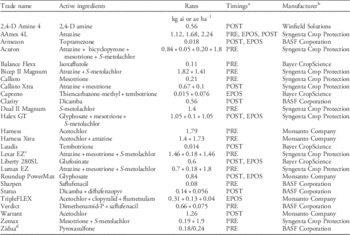
Individual PRE herbicides and herbicide mixtures were applied to the soil surface after planting (0 to 2 d) using a CO2-pressurized backpack sprayer calibrated to deliver 187 L ha−1 at a pressure of 207 kPa through 11003 AIXR flat-fan nozzles (TeeJet®, Spraying Systems Co., Wheaton, IL 60187) (Table 1). Herbicide product information and treatments for this experiment are presented in Tables 2 and 3, respectively. A nontreated control was included as a comparison.
Herbicide product, application rates and timings, and manufacturer information for herbicide treatments used for Palmer amaranth control in field corn in Barry County, MI (2013 to 2015).

a Abbreviations: PRE, pre-emergence application; POST, postemergence application; EPOS, early postemergence application.
b Manufacturer information: Winfield Solutions, LLC, St. Paul, MN, www.winfield.com; Syngenta Crop Protection, LLC, Greensboro, NC, www.syngenta.com; BASF Corporation, Research Triangle Park, NC, www.basf.com; Bayer CropScience, Research Triangle Park, NC, www.cropscience.bayer.com; Monsanto Company, St. Louis, MO, www.monsanto.com.
c The Lexar EZ (atrazine+mesotrione+S-metolachlor) rate was lowered to 0.73+0.09+0.73 kg ai ha−1 when mesotrione was applied POST in the programs experiment to stay within the maximum allowed mesotrione rate per season.
d The Zidua application rate was 0.18 kg ai ha−1 in 2013 and increased to 0.24 kg ai ha−1 for 2014 and 2015.
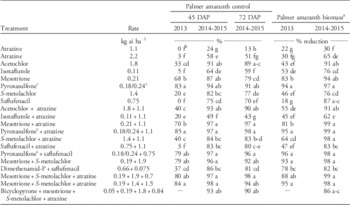
Effect of pre-emergence corn herbicides on the control and biomass of multiple-resistant Palmer amaranth 45 and 72 days after planting (DAP) for 2013 and 2014-2015 in Barry County, MI.

a Palmer amaranth biomass was collected 45 DAP in 2013 and 60 DAP in 2014 and 2015. Biomass reduction was calculated as y=100 – ((sample dry weight / nontreated control dry weight) * 100).
b Means followed by the same letter within a column are not statistically different at α = 0.05.
c The pyroxasulfone rate was increased to 0.24 kg ai ha−1 for 2014 and 2015 from 0.18 kg ai ha−1 in 2013.
Corn injury and Palmer amaranth control were evaluated at 30, 45, 60, and 72 d after planting (DAP). Evaluations were based on a scale of 0% to 100%, with 0% being no control and 100% indicating complete control. Aboveground Palmer amaranth biomass was harvested from two 0.25-m−2 quadrats, 45 DAP in 2013 (June 30) and 60 DAP in 2014 (July 18) and 2015 (July 13). Palmer amaranth biomass was dried at 60 C for approximately 1 wk, after which it was weighed and percent biomass reduction was calculated using equation 1.
 $$y\,{\equals}\,\left( {100\,{\minus}\,\left( {{{{\rm sample\ dry\ weight}} \over {{\rm nontreated\ control\ dry\ weight }}} {\times}100} \right)} \right)$$
Evaluation of POST Herbicides
POST herbicide treatments were applied when Palmer amaranth was between 7.5 and 10 cm tall, using the equipment described above (Table 1). Herbicide product information and treatments for this experiment can be found in Tables 2 and 4, respectively. A nontreated control treatment was included in this experiment as a comparison. Crop injury and weed control were evaluated 7 and 14 days after treatment (DAT) on a scale of 0% to 100%, with 0% representing no control and 100% indicating plant death.
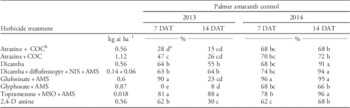
Effect of postemergence corn herbicides on the control of multiple-resistant Palmer amaranth 7 and 14 days after treatment (DAT) in Barry County, MI.

a Means followed by the same letter within a column are not statistically different at α=0.05.
b Adjuvant information: COC=crop oil concentrate at 1% (v/v) (Herbimax, Loveland Products Inc., Loveland, CO), AMS=ammonium sulfate at 2% (w/w) (Actamaster, Loveland Products Inc., Loveland, CO), NIS=non-ionic surfactant at 0.25% (v/v) (Activator 90, Loveland Products Inc., Loveland, CO), MSO=methylated seed oil at 1% (v/v) (SuperSpread, Wilbur-Ellis Co., San Francisco, CA).
Evaluation of Herbicide Programs for Palmer Amaranth Control in Corn
The herbicide programs evaluated consisted of 1) two POST herbicide applications, early POST (EPOS) followed by (fb) POST; 2) PRE fb POST applications; and 3) one-pass EPOS options. The herbicide programs examined are listed in Table 5, and herbicide product information can be found in Table 2. Spray grade ammonium sulfate (AMS) (Actamaster, Loveland Products, Inc., Loveland, CO) at 2% (w/w) was added to all EPOS and POST herbicide treatments. Herbicide applications were made using the equipment described above.
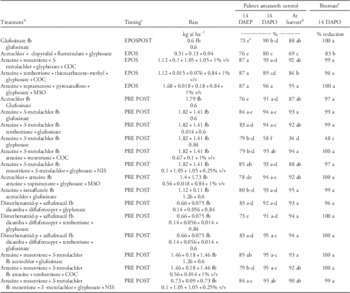
Evaluation of herbicide programs for the management of multiple-resistant Palmer amaranth in corn for 2013 to 2015 in Barry County, MI.

a Palmer amaranth biomass reduction was calculated as y=100 – ((sample dry weight / nontreated control dry weight) * 100).
b Adjuvant information: COC, crop oil concentrate at 1% (v/v) (Herbimax, Loveland Products Inc., Loveland, CO); NIS, nonionic surfactant at 0.25% (v/v) (Activator 90, Loveland Products Inc., Loveland, CO); MSO, methylated seed oil at 1% (v/v) (SuperSpread, Wilbur-Ellis Co., San Francisco, CA). All treatments contained AMS, ammonium sulfate at 2% (w/w) (Actamaster, Loveland Products Inc., Loveland, CO).
c Abbreviations: EPOS, early postemergence; PRE, pre-emergence; POST, postemergence; 14 DAEP, 14 days after early postemergence treatment (27 to 38 days after pre-emergence treatment, and at the time of postemergence treatment); 14 DAPO,14 days after the postemergence treatment.
d Weed control was evaluated just prior to corn harvest.
e Means followed by the same letter within a column are not statistically different at α=0.05.
PRE herbicides were applied to the soil surface after planting (0 to 2 d) and POST herbicides were applied when the majority of plots had Palmer amaranth at 7.5 cm (Table 1). The one-pass EPOS applications were made when Palmer amaranth was 5 to 7.5 cm in height.
Corn injury and Palmer amaranth control were evaluated 14 d after the EPOS (DAEP) and POST (DAPO) and at harvest. Evaluations were based on the scale of 0% to 100% described above. Aboveground Palmer amaranth biomass was harvested from two 0.25-m−2 quadrats 14 DAPO. Palmer amaranth biomass was dried at 60 C for approximately 1 wk and weighed, and percent biomass reduction was calculated using Equation 1.
Statistical Analysis
Statistical analysis was conducted using SAS 9.4 (SAS Institute, Cary, NC). Each experiment was analyzed separately. Assumptions of normality of residuals and homogeneity of variances were confirmed using PROC UNIVARIATE, and analysis of variance (ANOVA) was conducted using PROC MIXED. The statistical model included herbicide treatment and year as fixed effects and replication as a random effect for the PRE and POST herbicide experiments. Data were combined over years when there was not a treatment by year interaction. For the herbicide programs experiment, the statistical model included herbicide program as a fixed effect and replication and year as random effects in the model. Levene’s test for homogeneity of variances indicated that the variance was unequal between years for this experiment. Therefore, data was analyzed using the REPEATED statement and the GROUP=option. GROUP=year was used to compensate for differences in variance and the degrees of freedom were adjusted for unequal variances with DDFM=SATTERTH option in the MODEL statement. For all experiments, treatment means were considered significantly different at an alpha level of 0.05. Lettering of the means to distinguish differences among treatments was assigned using the macro PDMIX800 for PROC MIXED (Saxton Reference Saxton1998).
Results and Discussion
Evaluation of PRE Herbicides
Little to no corn injury was observed with any of the PRE herbicide treatments (data not shown). Overall Palmer amaranth control from the PRE herbicide treatments was lower in 2013 than it was in 2014 or 2015. This may have been due to the higher amounts of rainfall within 10 d of planting and the PRE applications. In 2013, 9.3 cm of rain fell, compared with 1.7 and 1.6 cm in 2014 and 2015, respectively, within this time frame. Therefore, the 2013 results are presented separately from the combined 2014 and 2015 results. The rainfall in 2013 may have accelerated herbicide dissipation and increased leaching of some of the herbicides below the Palmer amaranth germination zone, resulting in lower control in 2013 as compared with that seen in 2014 and 2015.
Atrazine at 1.1 and 2.2 kg ai ha−1 failed to control Palmer amaranth (Table 3). Palmer amaranth control and biomass reduction was among the lowest with atrazine in 2013 with both rates, and even though 2.2 kg ai ha−1 provided slightly better control 72 DAP and higher biomass than 1.1 kg ai ha−1 of atrazine in 2014 and 2015, Palmer amaranth control was only 51% and thus unacceptable. Atrazine applied PRE has generally been an effective tool for Palmer amaranth control in corn. Johnson et al. (Reference Johnson, Chahal and Regehr2012) reported that atrazine PRE at 1.68kgaiha−1 controlled Palmer amaranth >98% at 8 wk after application. After the failure to control this population with atrazine in 2013, greenhouse testing confirmed that this population was resistant to PRE atrazine (resistance factor=112-fold).
Overall Palmer amaranth control from the PRE-only herbicide treatments was inconsistent in the three years of this experiment. Palmer amaranth control was more consistent and long-lasting in 2014 and 2015 than it was in 2013. Of the 20 PRE herbicide treatments examined, there were 10 treatments that provided similar levels of Palmer amaranth control (89% to 98%) 72 DAP in 2014 and 2015 (Table 3). Pyroxasulfone was the most consistent at controlling Palmer amaranth of the Group 15 herbicides applied alone. At 45 DAP, pyroxasulfone at 0.18kgaiha−1 provided 83% control of Palmer amaranth, and was among the treatments with the greatest control in 2013 (Table 3). The addition of atrazine at 1.1kgaiha−1 to any of the single active ingredients tested did not improve Palmer amaranth control over that provided by the single active ingredient alone, with the exception of mesotrione 72 DAP in 2014 and 2015 (Table 3). Others have reported synergistic responses from the addition of atrazine to mesotrione applied POST to atrazine-resistant velvetleaf (Abutilon theophrasti Medik.) and redroot pigweed (Woodyard et al. Reference Woodyard, Hugie and Riechers2009). In all years, the combination of mesotrione and S-metolachlor alone, tank-mixed with atrazine or tank-mixed with bicyclopyrone and atrazine provided similar levels of Palmer amaranth control as did pyroxasulfone applied alone (Table 3). However, none of these treatments provided complete control for the entire growing season, and all would likely need an effective POST herbicide treatment for season-long control. Relying on a single herbicide site of action (i.e., pyroxasulfone, Group 15) for Palmer amaranth control will increase the selection pressure for additional resistances. Tank-mixing herbicides with other herbicide sites of action (i.e., saflufenacil, Group 14), while not always the most consistent, may help reduce selection pressure on the single herbicide site of action.
Evaluation of POST Herbicides
Corn was not injured with any of the POST herbicide treatments (data not shown). Due to a significant year by treatment interaction, Palmer amaranth control results are presented separately by year. The majority of the POST herbicide treatments in 2013 failed to provide adequate Palmer amaranth control 14 DAT. Topramezone was the only herbicide that provided greater than 85% control (Table 4). Control with all others was less than 65%. In 2014, four of the eight herbicide treatments evaluated provided greater than 90% control 14 DAT. These treatments included topramezone, dicamba, dicamba plus diflufenzopyr, and glufosinate.
Palmer amaranth control was lowest with glyphosate, atrazine at 0.56 and 1.12kgaiha−1, and 2,4-D amine, in both years of the study (Table 4). Glyphosate and atrazine applied POST have historically provided excellent Palmer amaranth control (Bond et al. Reference Bond, Oliver and Stephenson2006; Jhala et al. Reference Jhala, Sandell, Rana, Kruger and Knezevic2014; Norsworthy et al. Reference Norsworthy, Griffith, Scott, Smith and Oliver2008). The failure to effectively control Palmer amaranth in both years of this experiment illustrates the resistance in this population to both atrazine and glyphosate. While this population was not tested for resistance to 2,4-D, the lower control observed with 2,4-D amine was most likely due to an ineffective dose. Miller and Norsworthy (Reference Miller and Norsworthy2016) reported similar Palmer amaranth control results when 2,4-D choline was applied at similar acid equivalent rates in 2,4-D–resistant soybean. Palmer amaranth control was greatest when 2,4-D choline was applied at 1.1kgaeha−1, twice the amount that can be applied in corn.
Palmer amaranth population densities at the time of application may help explain the differences in Palmer amaranth control between 2013 and 2014. Palmer amaranth populations were 10-fold greater in 2013, 484 plants m−2 compared with 43 plants m−2 in 2014. The relatively poor control of Palmer amaranth in 2013 with several of the POST herbicides could be attributed to a lack of spray coverage and possible plant stresses associated with higher Palmer amaranth populations. Previous research has shown that the lack of spray coverage can lead to inconsistent control of annual weeds, particularly with contact herbicides like glufosinate (Eubank et al. Reference Eubank, Poston, Nandula, Koger, Shaw and Reynolds2008; Steckel et al. Reference Steckel, Wax, Simmons and Phillips1997). The higher levels of control observed with some of the treatments in 2014 may have been somewhat inflated due to the lower Palmer amaranth population. Farmers who rely on a single POST herbicide application will most likely be faced with Palmer amaranth population densities similar to what was observed in 2013. Topramezone provided the most consistent control over the two years, however, it was not completely effective. Results suggest that an effective PRE herbicide will be needed to reduce Palmer amaranth populations prior to a POST application.
Evaluation of Herbicide Programs for Palmer Amaranth Control in Corn
None of the herbicide programs examined resulted in significant corn injury (data not shown). Palmer amaranth control was 87% 14 DAEP with three of the five EPOS herbicide treatments (Table 5). Each of the effective treatments contained an HPPD-inhibiting herbicide. Previous research showed that topramezone, tembotrione, and mesotrione POST can effectively control Palmer amaranth (≥90%) (Jhala et al. Reference Jhala, Sandell, Rana, Kruger and Knezevic2014; Norsworthy et al. Reference Norsworthy, Griffith, Scott, Smith and Oliver2008; Schuster et al. Reference Schuster, Al-Khatib and Dille2008; Stephenson et al. Reference Stephenson, Bond, Landry and Edwards2015). Palmer amaranth control from the PRE herbicides at the time of the POST application ranged between 73% and 85%. All POST treatments, with the exception of glyphosate alone, following a PRE herbicide application provided greater than 90% Palmer amaranth control 14 DAPO. Palmer amaranth control was 58% and biomass was reduced only 48% when glyphosate was applied POST following a PRE application of S-metolachlor plus atrazine. The EPOS treatment of acetochlor plus clopyralid plus flumetsulam plus glyphosate also failed to provide a high level of Palmer amaranth control and only reduced biomass 83% at 14 DAPO. At harvest, these programs only provided 34% and 69% Palmer amaranth control, respectively. Additionally, at harvest the EPOS program of atrazine plus tembotrione plus thiencarbazone-methyl plus glyphosate provided slightly lower control (83%) than several of the other programs evaluated. Due to the resistance profile of this Palmer amaranth population, tembotrione would have been the sole component of this treatment contributing to Palmer amaranth control. Tembotrione is a highly effective HPPD inhibitor for management of Palmer amaranth, and a synergistic response has been reported when tembotrione is applied in combination with atrazine in atrazine-resistant Palmer amaranth (Kohrt and Sprague Reference Kohrt and Sprague2016). However, the lower level of Palmer amaranth control at harvest with this treatment was most likely due to lack of the addition of a residual herbicide to control later-emerging Palmer amaranth.
The majority of EPOS programs provided similar Palmer amaranth control as did the PRE fb POST programs. The EPOS programs that provided the greatest Palmer amaranth control all contained an HPPD-inhibiting herbicide plus atrazine for POST control and a Group 15 herbicide (e.g., S-metolachlor, pyroxasulfone) for residual Palmer amaranth control. However, due to Palmer amaranth’s extended emergence pattern and rapid growth, relying on a one-pass EPOS program may not be the most consistent long-term strategy, especially when managing a multiple-resistant Palmer amaranth population. If the EPOS program fails to control Palmer amaranth, options for rescue treatments become extremely limited. The two-pass POST programs of glufosinate (EPOS) fb glufosinate (POST) provided control comparable to several of the PRE fb POST and EPOS programs, controlling 88% of Palmer amaranth at harvest (Table 5). While this program provided good Palmer amaranth control, it would increase selection pressure for glufosinate resistance from the repeated application of a single herbicide site of action.
We conclude that one of the most effective and consistent management strategies to control multiple-resistant Palmer amaranth is a PRE fb POST herbicide program approach. While some of the PRE and POST-only treatments provided effective control of Palmer amaranth, complete, season-long control was not achieved. Herbicide programs that contained effective herbicide sites of action both PRE and POST were among the most consistent programs. Strategies should include at least one effective herbicide site of action PRE and two effective foliar sites of action POST, plus a soil residual herbicide, to control Palmer amaranth for the entire growing season.