Introduction
Global health system can be defined as an assembly of various members whose primary purpose is to “promote, restore, and maintain health” (Reference Szlezák, Bloom and Jamison1). Translating knowledge into action is one of the biggest challenges of the global health system (2).
With the evolution of technological space, there is a concurrent accelerated development of health technologies accompanied by rising costs of health care. Scientific innovations have increased exponentially over the past years in the dental profession (Reference Guven3). The ultimate goal is to provide the best possible dental care for patients. However, this is becoming increasingly cumbersome due to a virtual “information explosion” on new therapies, techniques, and materials; increased consumer understanding of treatment possibilities and therapeutic outcomes; and changing sociodemographic patterns (Reference Kao4). One of the primary reasons associated with the high costs of dental service delivery is the rapid development of dental-related technologies. However, there is still concern regarding the real-world health benefits of these new technologies (Reference Probst, Cavalcante, Vanni, Silva and Pereira5).
Health technology assessment (HTA) can help to solve this problem by providing critical information to policy makers on various aspects of health technologies. HTA is a multidisciplinary process that uses explicit methods to determine the value of a health technology at different points in its lifecycle. The purpose is to inform decision making in order to promote an equitable, efficient, and high-quality health system (Reference O’Rourke, Oortwijn and Schuller6). A wide array of institutions, agencies, universities, hospitals, governmental and nongovernmental organizations carry out HTA and have been generating reports to supplement health decision-making processes (Reference Chamova and Stellalliance7).
Technology assessment is well established in medicine for numerous medical interventions. However, they have just started to flourish in dentistry and numerous dental technologies might still require good quality evidence generation (Reference Guven3).
Since the 1980s, economic analysis and systematic reviews (SRs) have been increasingly available for dental research. However, these need to be systemized and presented in a format understandable to policy makers, which is the primary purpose of HTA (Reference Tonmukayakul, Calache, Clark, Wasiak and Faggion8). Hence, it can be a useful tool to translate this increasing amount of evidence into accurate health decisions. However, no such data assessing dentistry-related HTAs is available. To the best of our knowledge, there are no studies that review various dimensions of dentistry-related HTA reports, hence, our main objective was to identify HTA reports that assess technologies pertaining to oral health and understand how organizations are synthesizing them.
With this background, this review aims to assess HTAs related to dentistry in the past decade and to map the geographical extension and scope the methodological practices and limitations. This review is intended to educate researchers, policy makers, and key stakeholders, who can further utilize the evidence gaps present and shed light on possible action areas.
Methodology
Study design
It was our intention to conduct a systematic search of the HTA and published literature database, map out the characteristics and range of methodologies used and examine reported challenges and limitations. Hence, a scoping review approach was selected to meet our objectives. The purpose of this scoping review was to give an update on current developments with the intention to scope the recent use of HTA in dentistry. Critical appraisal and quality assessment of reports were not included. A study protocol was developed including a search strategy and databases by three authors (S.B., V.M., and P.C.). This is available on request from the corresponding author. This scoping review was conducted in accordance with the Preferred Reporting Items for Systematic reviews and Meta-Analyses extension for Scoping Reviews (PRISMA-ScR) checklist (9) and was developed using the methodological framework proposed by Arksey and O’Malley (Reference Arksey and O’Malley10) and modifications made by Joanna Briggs Institute (Reference Peters, Godfrey and Khalil11).
Inclusion and exclusion criteria
A framework consisting of population, concept, and context was agreed upon for the systematization of the evidence. The inclusion criteria were technology assessments written in English language only, published in a time frame of January 2010 to December 2020 and full text articles intended as an HTA related to dentistry. This time period was selected because the concept of HTA is relatively new in dentistry, and dental technology has seen a remarkable growth in the past decade. Only reports classified as full HTA, mini-HTA, rapid review, or “others” by the criteria given in the classification devised by Merlin et al. were considered eligible for the review (Reference Merlin, Tamblyn and Ellery12). The exclusion criteria were unpublished literature, guidelines, only abstracts or editorials, and assessments that were either not empirical or yet published.
Population
There were no restrictions regarding key demographic factors in the population (like age, gender, etc.).
Concept
This scoping review could identify potential trends and origins of technology assessments related to dental disease, diagnostic equipment and methods, treatment measures including medicine and surgeries, public health programs, and so forth. It could also identify and map the methodological rigor and outcomes.
Context
The purpose of HTA agencies is to deliver information to policy makers about the development, dissemination, and use of health technologies (Reference Novaes and Soárez13). Reports were considered only if technologies were applied in this context and were pertinent to dentistry and its domains.
Search strategy
Study selection was performed using EndNote program (EndNote X8, Thomson Reuters, New York, NY, USA). Search strategy and data collection were performed by two authors (S.B. and R.G.). All searches were done in a time period of 1 month (August to September 2021). The initial search was done without any limitations regarding language or time period. The last search was run on 24 September 2021. The selection of HTA reports was divided into two main sources:
Comprehensive search of INAHTA database
International Network of Agencies for Health Technology Assessment (INAHTA) Database provides access to bibliographic information about ongoing and published HTAs commissioned or undertaken by HTA organizations worldwide. To build a robust search strategy, Medical Subject Headings (MeSH) (“dentistry”) and other keywords (“oral health,” “oral diseases,” and “dental”) were used. A total of 460 reports were identified.
Search of electronic databases
A systematic search of the literature for keywords using PubMed and Google Scholar was performed. The following keywords were used in different combinations: “biomedical technology assessment,” “health technology assessment,” “HTA,” “oral health,” “oral diseases,” “dentistry,” and “dental.” Boolean operators and free text searching were used. All references were then crosschecked for additional papers. Manual searching of various HTA organizations’ websites for full reports through INAHTA database was further done to enhance the search process. Complete search strategies performed for PubMed and INAHTA databases are elaborated in Supplementary Table 1.
Charting of data
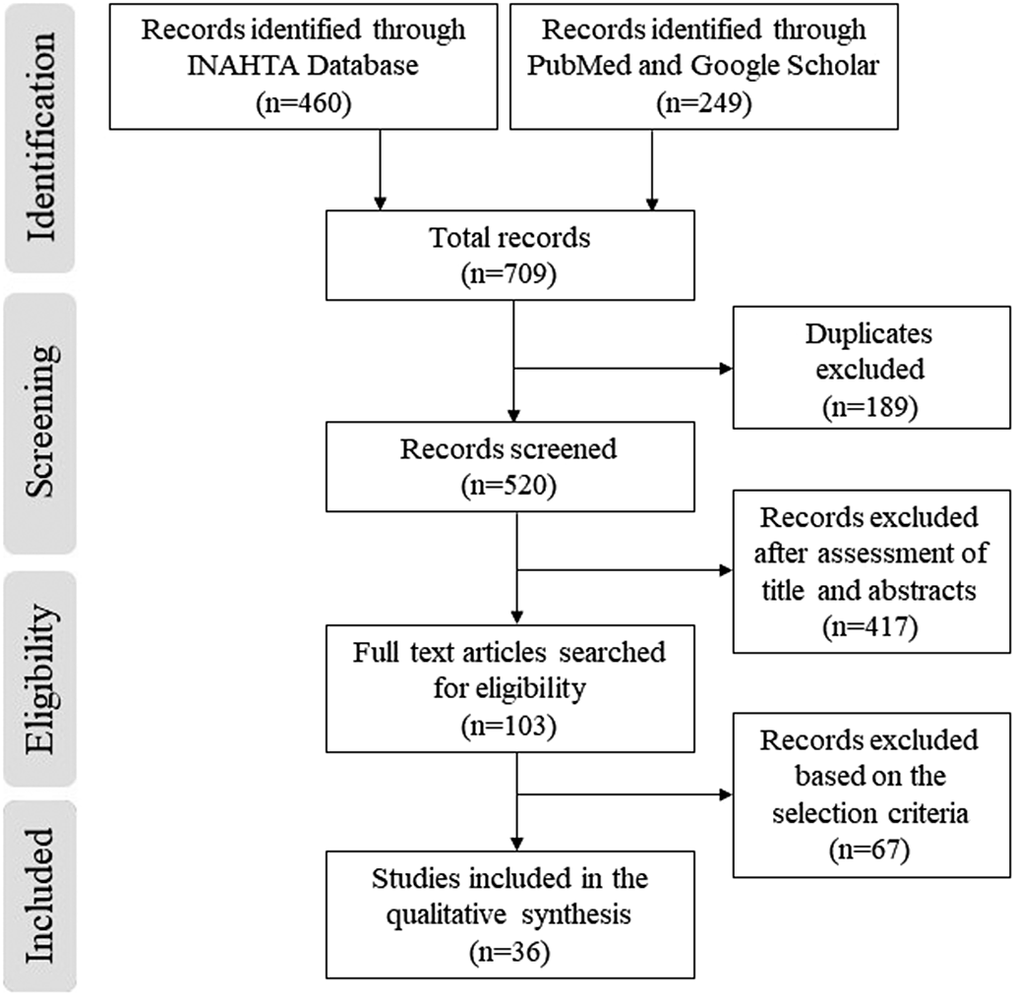
After collection from the databases, the reports were screened for eligibility, followed by the application of aforementioned inclusion and exclusion criteria. The two-phase process is depicted in Figure 1. In the first phase, titles and abstracts of articles were independently screened by two authors (S.B. and R.G.). In the second phase, review of full text articles was done by same authors for eligibility and final inclusion in the study. Discrepancies were resolved by consensus and discussion with a third author (V.M.) whenever necessary.
PRISMA flow diagram.

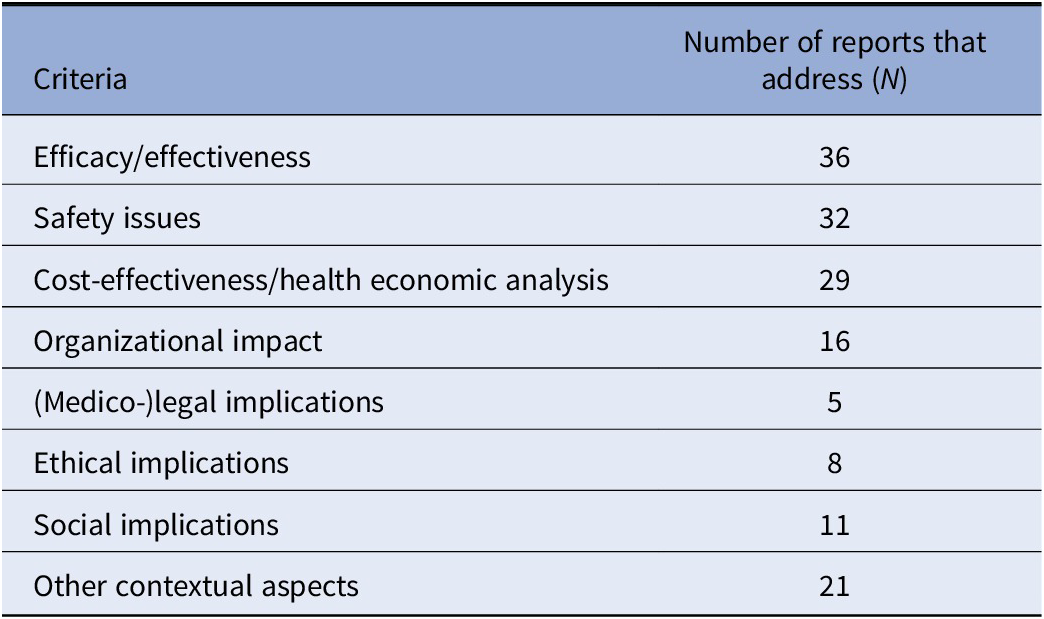
The reports were then classified as either full HTA, mini-HTA, rapid review, or “others” according to the criteria given by Merlin et al. (Reference Merlin, Tamblyn and Ellery12) One reviewer (S.B.) independently extracted and recorded data on a self-designed data sheet validated by a team of public health experts. This comprised a total of eight charting dimensions including general and specific attributes of an HTA report: (i) year of publication, (ii) name of the HTA organization, (iii) country of origin, (iv) type of health technology assessed, (v) dental specialty to which it belongs, (vi) methodological characteristics, (vii) key findings, and (viii) limitations or recommendations. To identify the aspects studied in the purview of these assessments, methodological criteria were further divided into (i) efficacy/effectiveness, (ii) safety issues, (iii) cost-effectiveness or economic analysis, (iv) (medico-)legal implications, (v) ethical implications, (vi) social implications, and (vii) other aspects such as patient, practitioner or stakeholder perspectives, organizational aspects, access, acceptability, and other contextual issues. A checklist comprising these criteria (Supplementary Table 3) was formed which was partly adapted from INAHTA Checklist (Version 3.2, 2007) (14) and subsequently validated by a team of public health experts and one HTA specialist. A map considering a number of HTAs by country was also created using the tool “infogram.com.”
The key characteristics of selected reports were tabulated such as title, country, year of publication, methodology, key findings, limitations, and/or recommendations. Some aspects of data analysis were not prespecified in the protocol and were consecutively planned after data extraction. Thereafter, a subanalysis of articles was conducted independently by three authors (S.B., P.C., and K.R.) to extract further details such as trends in topics and research gaps, if any. Furthermore, discrepancies were discussed with the author (A.Y.B.) and consensus was reached.
Bassani et al. (Reference Bassani, Pereira and Page15) conducted a review to evaluate the epidemiological and reporting characteristics of SRs in dentistry indexed within PubMed in 2017. Reporting characteristics of SRs were evaluated and grouped by dental specialties. A post hoc analysis comparing this and the current study was done after the review process. The purpose was to understand how policy needs (HTAs) differ from the research realm (SRs). Results were tabulated by one reviewer (S.B.) and analyzed with the help of other reviewers (V.M. and A.Y.B.).
Results
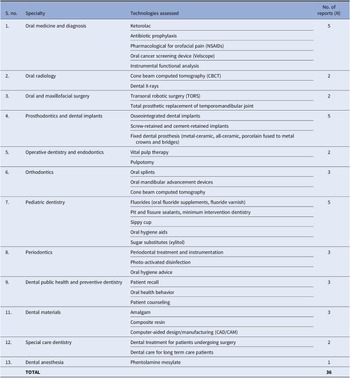
A total of 709 articles were initially identified through the literature search. After removing duplicates, 520 articles were screened for eligibility. Study screening based on titles and abstracts resulted in exclusion of 417 records. The remaining 103 records were submitted to full-text analysis. Finally, thirty-six articles met the inclusion criteria and were included. Results showed that HTA has been conducted in various specialties of dentistry as shown in Table 1. Maximum number of reports were related to “prosthodontics and dental implants” (N = 5), oral medicine and diagnosis (N = 5), and pediatric dentistry (N = 5).
Distribution of HTA reports on the basis of specialties of dentistry

Note: Single report may have assessed more than one technology and vice-versa.
Abbreviation: NSAID, nonsteriodal anti-inflammatory.
Various health technologies assessed are also summarized in Table 1. Preventive dental caries treatment (such as pit and fissure sealants, fluoride varnish, fluoride supplements, and oral hygiene advice) was most commonly assessed (N = 4) followed by fixed dental prosthesis (N = 3). It was noted that one health technology, that is, pit and fissure sealants, was done by three different agencies (Deutsche Agentur für Health Technology Assessment, DAHTA; United States Preventive Services Task Force, USPSTF; and National Institute of Health Research, NIHR).
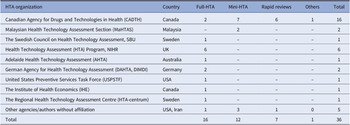
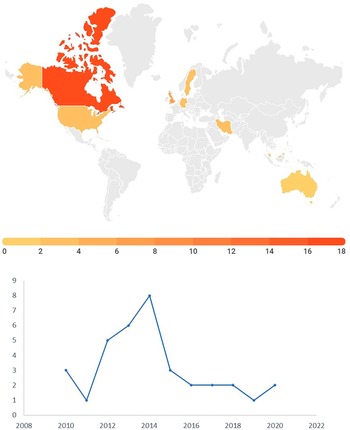
Furthermore, when these reports were categorized according to the criteria given by Merlin et al. (Reference Novaes and Soárez13), it was found that most of the studies were full HTA (N = 16), followed by mini-HTA (N = 12), rapid reviews (N = 7) and only one report was “others.” The one report categorized as “others” was a rapid response report by Canadian Agency for Drugs and Technologies in Health (CADTH) which did not assess safety issues, which is required for it to be categorized as a rapid review (Reference Merlin, Tamblyn and Ellery12). Mapping of the various reports by their country of origin indicated most assessments were conducted by CADTH, Canada (N = 16) followed by NIHR HTA, UK (N = 6) (Table 2). The infographic map considering the countries of origin of the reports along with a time trend graph according to the publishing year is illustrated in Figure 2. It was found that most reports were published in the year 2014 (N = 8).
HTA reports by organizations, countries of origin, and type of reports

Abbreviations: DAHTA, Deutsche Agentur für Health Technology Assessment; DIMDI, Deutsches Institut für Medizinische Dokumentation und Information; NIHR, National Institute of Health Research; SBU, Swedish Agency for Health Technology Assessment and Assessment of Social Services; UK, United Kingdom; USA, United States of America.
Map considering the number of HTAs by country of origin (darker color—higher number of HTAs) along with a time trend graph.

A table was created depicting the summary of the various reports in a detailed format (Supplementary Table 2); scoping the title, methodology, key findings, limitations, and recommendations. After inspection of the methodology, it was found that the majority (N = 31) of them were systematic evaluations including individual SRs and/or meta-analysis. Only five assessments were individual randomized control trials which were then assembled into HTA reports. In twenty-four reports, there were significant findings or the technology was reported to be favorable. Some assessments reported inconclusive or no available evidence regarding the technology (N = 12). Almost all reports had some form of limitations or recommendations. The most common limitation reported was lack of or inconclusive evidence (N = 27) out of which ten assessments had limited evidence for cost-effectiveness analysis, twelve had limited data on clinical effectiveness, one had limited evidence for safety analysis, and the rest for contextual aspects. No studies were included for assessment in two reports. Time restraints were reported as limitations in two reports. There was poor generalizability of results or geographical applicability issues in fifteen reports. Recommendations from these varied reports included the need for conducting HTA for a broader population, better clinical decision making, further economic evaluations with better fitting models, further post-marketing surveillance, and increased patient awareness.
Table 3 shows the frequency of addressal of methodological criteria. All reports described characteristics and efficacy/clinical effectiveness while cost-effectiveness was assessed in thirty reports and safety issues were assessed in thirty-three reports. Only a few reports addressed legal, ethical, and social implications (see Supplementary Table 3 for the detailed checklist).
Methodological criteria that are addressed in the reports with their frequency

Detailed comparison with the descriptive results drawn from the review conducted by Bassani et al. for SRs in dentistry and the current study are tabulated in Supplementary Table 4.
Discussion
After the extensive literature search, we can conclude that this is the first attempt at a scoping review for dentistry-related HTAs. The scoping review identified thirty-six HTA reports assessing a total of twenty-eight dental health technologies produced by nine HTA organizations from eight countries.
Commonly assessed dental health technologies
The majority of health technologies assessed were preventive treatments (including caries prevention and general oral hygiene advice) followed by fixed dental prostheses. This could be because economic evaluations of oral health interventions were centered around clinical interventions and not the preventive aspects of dentistry in the previous decade (Reference Morgan, Mariño, Wright, Bailey and Hopcraft16). It has been demonstrated to the policy makers, dental practitioners, and the public that a shift of focus toward preventive dental care can be more cost-effective both for the patient and the healthcare ecosystem (Reference Pitts, Mazevet and Mayne17). This could be a possible explanation for the recent trend in assessment of preventive health technologies. The specialty of “prosthodontics and dental implants” largely relies on technologies, and hence, invites larger quantity of technology assessments (Reference Baba18). The time trend shows a peak of publications during 2012–2014. Many publications in this time period were generated by CADTH. Since 2010, CADTH has become more transparent, increased stakeholder engagement, invited patient engagement, and hence, increased production of HTAs and rapid reviews (19).
The search for an HTA
The search process under the purview of this study, particularly from electronic databases, generated a large number of reviews, such as SRs. During the screening process, a large amount of literature was identified which claimed to be an HTA, but were usually a SR and/or meta-analysis with economic analysis. Hence it becomes a laborious task to identify appropriate HTAs (Reference Kristensen, Husereau and Huić20). Furthermore, only a few methodologically sound HTA were extracted from electronic databases. This indicates a need for reports to be indexed in these databases. Duplication of assessments (e.g., those for pit and fissure sealants) indicates a lack of collaboration between various organizations. Nevertheless, these needed to be performed in the respective countries, but a more collaborative approach can lead to generalizable assessments. It was also indicated that there should be a separate comprehensive HTA database for dentistry, so that an assessment can be easily commissioned within the dental community.
Quality of HTA
Full and mini HTAs were the most common type of HTA product reviewed. This is an excellent indicator of the comprehensiveness of assessments being published. Although, this is in contrast to previously done reviews on HTAs for other medical fields such as the review by Ascef et al. (Reference Ascef, Lopes and de Soárez21), wherein rapid reviews were the most common type. It is due to the increasing demand and need for faster HTA generation (Reference Kristensen, Husereau and Huić20). As there was no such review done previously, we are unable to comment on the evolution of quality of dental-related HTAs. However, we can theorize that abundance of full and mini HTAs in our review is due to the mostly nonurgent topics dealt such as sealants, fluoride therapy, splints, fixed dental prosthesis, check-ups, and recall intervals. In our study, rapid reviews were done for topics such as ketorolac for odontogenic pain, antibiotics prophylaxis, cancer risk with X-rays, and special care dentistry. These topics are relatively more urgent or cater to vulnerable populations and hence, might be selected for rapid assessments. Nevertheless, more rapid reviews are still needed for certain critical topics such as dental infections and oral and maxillofacial trauma.
Most assessments have mentioned the need for higher quality data to demonstrate better patient outcomes. Systematic searches conducted in numerous reports tend to yield no results (e.g., “Sippy Cup”). In many, critical appraisal demonstrated either studies conducted in resource-poor settings or availability of only low-evidence observational studies, insufficient quality trials, or errors in design or biases. This led to inconclusive findings and need for trials with better external validity.
These reports have indicated a scarcity of resources or data to conduct a proper economic evaluation. Comprehensive health economic evaluations and cost-impact studies of these technologies can lead to better budgeting. After reviewing the methodology, we discovered only few vigorous HTA reports despite them being full HTAs, primarily due to failures in the critical appraisal (N = 6), restricted systematic search process, and an insufficiency of consideration of economic aspects like budget impact. In 27.7 percent full HTAs, cost impact was one of the objectives, but systematic search yielded scarce literature (N = 10). Furthermore, in some assessments, there was limited geographical applicability of economic evidence. For optimization of these methodological processes, it is critical for researchers and policy makers to recognize the value of HTA. If more researchers are aware of the dearth of economic evidence, they will be urged to carry out economic analyses. In “resource-poor” countries, such reforms may add value to utilization and further need for innovation. Nevertheless, budgetary allocation will have to be done. For countries with a consolidated HTA network system, incorporation of efficient mechanisms such as machine learning can be done to accelerate the process, as mentioned in the top ten challenges for HTA production by INAHTA (Reference O’Rourke, Werkö, Merlin, Huang and Schuller22). Assessments under the purview of the study are unable to cover all contextual issues, such as, social, legal, and ethical issues. These are usually considered optional (14). However, they are essential for a well-rounded assessment. Exclusion of these context-dependent aspects will leave decision makers with evidence from clinical studies as the principal source of evidence and HTAs would be less likely to be utilized (Reference Stephens, Handke and Doshi23;Reference Garrido, Gerhardus, Røttingen and Busse24). A well-conducted HTA is needed to enhance clinical decision-making, patient satisfaction and outcomes, practice guidelines and hence, build a robust healthcare system (Reference Pfadenhauer, Rohwer and Burns25).
Country-wise implications
It is evident from this review, that most of HTAs are being generated in developed nations such as Canada and the UK. It is important to note that these countries have publicly funded systems and integrated HTA processes, which encourage a greater focus on prevention to curb costs of treatment. Although patients in developing countries are bound to gain massively for oral health through utilisation of emerging technologies, only a few assessments belonged to these countries. Possible reasons for this include paucity of knowledge, training, and capacity building for establishing an efficient HTA process (Reference Babigumira, Jenny, Bartlein, Stergachis and Garrison26).
It was also noted, that an HTA may not reflect relevancy in that particular country. Moreover, global applicability of HTAs seems to be a matter of concern.
Research versus policy realm
Comparing our findings with those of Bassani et al. shows considerable differences with respect to how SRs were performed in dentistry in contrast to HTAs. First and foremost, the number of SRs included in their review in 1 year (2017) was much higher (N = 495) as compared to ours, despite our time period of 10 years. This is a clear indication for researchers, organizations, and governments to start HTA processes to catch up with the research world. Most common countries for SRs were Brazil and USA, while in our study, they were Canada and the United Kingdom. Most studies belonged to ‘Prosthodontics and Implants’ in both studies, while the second most common specialty for SRs was “operative dentistry and endodontics.” In our study, this specialty was not assessed intensively. Definitely, more assessments are needed for this as it is a crucial operative specialty. Safety issues, economic evaluations and contextual aspects were included in a considerable number of HTAs as compared to SRs. Perhaps, this is because of the methodological criteria for an HTA to include these parameters (Reference Merlin, Tamblyn and Ellery12). Risk of bias/quality check was also performed at a higher frequency in HTAs. Risk-of-bias assessment is a central component of both SRs and HTAs, but insufficient empirical evidence exists on the validity of such assessments for SRs (Reference Viswanathan, Patnode and Berkman27). Additionally, limitations were reported more regularly in HTAs than SRs. There is no doubt that generation of robust SRs would lead to a faster and efficient translational research process, and hence, may help in pushing the policy agenda as well (Reference Lavis, Davies and Oxman28).
Implications
The knowledge generated from an HTA can contribute to healthcare according to the hierarchy of decision-making: Macro- (policy), Meso- (institutional), and Micro- (clinical) levels (Reference Battista and Hodge29). Through this scoping review, our aim was to prompt a critical reflection and to give a direction to policy makers, decision makers, and stakeholders to recognize dental-related HTAs to partly or fully respond to a policy question. In a review by Drummond et al. (Reference Drummond and Weatherly30), certain barriers at the policy level were highlighted such as existence of different perspectives toward the standing of an HTA, unsuitable language, and unviability of the reports. This review should be beneficial for HTA organizations to amend methods for rigorous and transparent assessments. Clinicians should be aware of the information generated by HTAs to make an evidence-based decision. Although, this requires a thorough understanding of its concepts (Reference Hofmann, Lysdahl and Refolo31). We also intend that oral health researchers upgrade HTA processes through generating stronger evidence and establish pathways for high-quality assessments in the future.
Limitations
The main limitation of this scoping review was the source of literature which relied predominantly on the INAHTA database. Most of the literature generated from common medical research databases such as PubMed were nonempirical assessments. There were other kinds of assessments such as early HTAs available from this source, which were not eligible for this review. Furthermore, because only English language reports were included in this review, we might have excluded reports generated from non-English speaking countries. Due to design limitations of the current study being a scoping review, critical appraisal and quality checks were not part of the study. Despite our best attempts to include only structured HTAs, it is possible that low-quality HTAs may have been included.
Conclusion
HTAs have been largely conducted for dental prosthetics and most technologies were related to preventive dentistry. Most of these reports were generated in developed countries, which are funded by various HTA organizations. Currently, only a few organizations are producing HTAs for oral health. There is a general lack of evidence and resources available for these assessments. Functional, appropriate, and evidence-based information provided through HTA on a regular basis will enable decision makers to have enough data to make decisions on the future use of new technology, modify existing policies and accelerate its translation into practice. We can conclude from our findings that there exist gaps between research, translational research, and health policy paradigms in the field of dentistry.
Abbreviations
- CADTH,
-
Canadian Agency for Drugs and Technologies in Health
- DAHTA
-
Deutsche Agentur für Health Technology Assessment
- HTA
-
health technology assessment
- INAHTA
-
International Network of Agencies for Health Technology Assessment
- MeSH
-
Medical Subject Headings
- NIHR
-
National Institute of Health Research
- PRISMA-ScR
-
Preferred Reporting Items for Systematic reviews and Meta-Analyses extension for Scoping Reviews
- LBI-HTA
-
Ludwig Boltzmann Institute for Health Technology Assessment
- SR
-
systematic review
- USPSTF
-
United States Preventive Services Task Force
Supplementary material
To view supplementary material for this article, please visit https://doi.org/10.1017/S0266462322003312.
Funding statement
This research received no specific grant from any funding agency, commercial or not-for-profit sectors.
Conflict of interest
The authors declare that they have no conflict of interest.