The management of patients hospitalized with severe coronavirus disease 2019 (COVID-19) has changed considerably over the course of the pandemic. Reference Anesi, Jablonski and Harhay1,Reference Kurtz, Bastos and Dantas2 Early on, many experts advocated early intubation for hypoxemic patients rather than intubation-sparing modalities, such as high-flow nasal cannula (HFNC) and noninvasive positive pressure ventilation, for fear of generating aerosols and increasing risks for healthcare workers. Reference Papoutsi, Giannakoulis, Xourgia, Routsi, Kotanidou and Siempos3 With time, however, many institutions evolved to favor intubation-sparing modalities, reserving intubation for patients with more severe disease. Simultaneously, the use of medications associated with better outcomes, including dexamethasone, remdesivir, and tocilizumab, has increased. Little is known, however, about the impact of these changes on the incidence and precipitants of ventilator-associated events (VAEs) in patients with COVID-19. We evaluated changes in incidence rates and clinical triggers for VAE in 4 hospitals during the first COVID-19 wave versus the second COVID-19 wave in Massachusetts.
Methods
We retrospectively identified all adult patients with COVID-19 requiring mechanical ventilation (defined as spending any portion of a day on the ventilator) in 2 quaternary academic hospitals and 2 community hospitals in eastern Massachusetts during the first and second waves of the pandemic (ie, March–August 2020 and November 2020–January 2021). VAEs were identified using Centers for Disease Control and Prevention criteria applied to data extracted from participating hospitals’ electronic health record systems. Briefly, VAEs are defined by ≥2 days of sustained increases in ventilator settings (rise in daily minimum positive end expiratory pressure of ≥3 cm H2O and/or rise in the absolute fraction of inspired oxygen of ≥20%) after ≥2 days of stable or decreasing ventilator settings. 4 We calculated VAE rates for each calendar month and compared incidence rates per 100 episodes of mechanical ventilation and per 1,000 ventilator days during the first wave versus the second wave using 2-sample tests of proportions.
We then compared the conditions precipitating VAEs in the first wave versus the second wave. We reviewed 100 randomly selected COVID-19 patients from the first wave and all VAEs from the second wave. We assessed whether VAE causes differed for early versus late VAEs (ie, ≤7 vs >7 days after intubation). Precipitating conditions were adapted from prior research. Reference Kerlin, Trick and Anderson5 All records were reviewed by one intensivist (J.W.), and interrater reliability, which was reviewed by a second intensivist (C.R.), was high. Reference Weinberger, Rhee and Klompas6 Statistical analyses were performed using R version 4.0.2 software (https://www.R-project.org/, R Foundation for Statistical Computing, Vienna, Austria).
Results
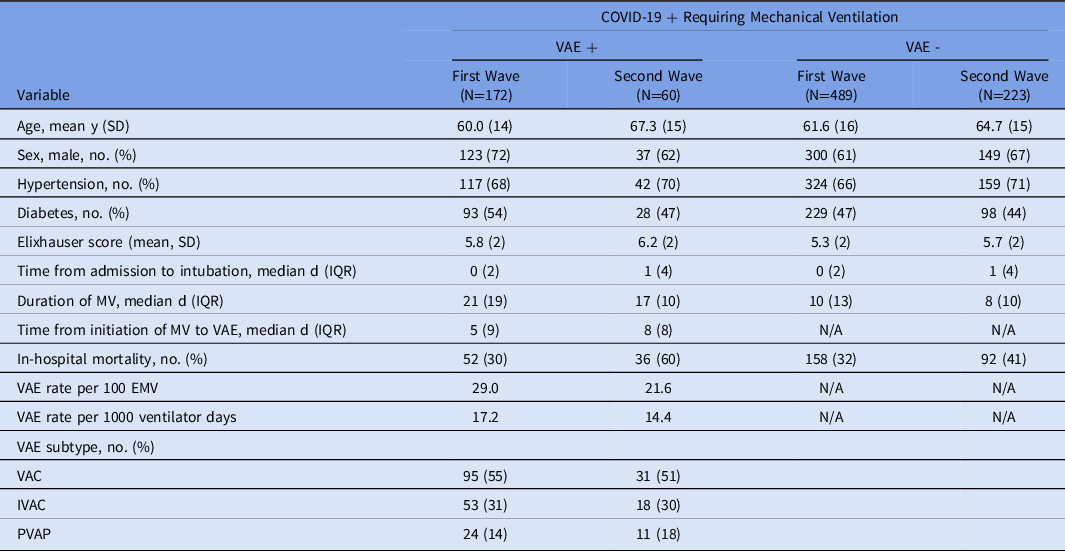
The demographics and characteristics of ventilated COVID-19 patients are shown in Table 1. The first wave included 628 COVID-19 patients who underwent 661 episodes of mechanical ventilation over 11,178 ventilator days. Overall, 192 VAEs corresponded to 29.0 VAEs per 100 episodes and 17.2 per 1,000 ventilator days. During the second wave, 267 COVID-19 patients underwent 283 episodes of mechanical ventilation over 4,245 ventilator days. Also, 61 VAEs corresponded to 21.6 VAEs per 100 episodes and 14.4 per 1,000 ventilator days.
Demographics and Characteristics of Mechanically Ventilated COVID-19–Positive Patients With and Without a VAE during the First Versus Second Waves of the Pandemic
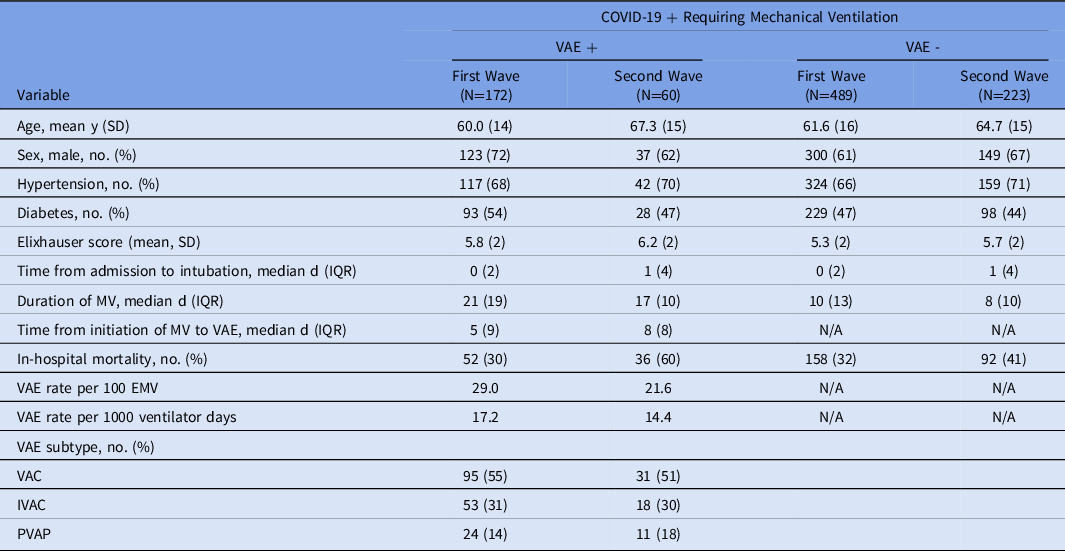
Note. N corresponds to the number of episodes of mechanical ventilation. IQR, interquartile range; SD, standard deviation; VAE, ventilator-associated event; MV, mechanical ventilation; EMV, episodes of mechanical ventilation; VAC, ventilator-associated complication; IVAC, infection-related ventilator-associated complication; PVAP, possible ventilator-associated pneumonia.
The VAE rate per 100 episodes of mechanical ventilation was higher during the first wave versus the second wave (29.0 vs 21.6; P = .02), but the rates per 1,000 ventilator days were similar (17.2 vs 14.4; P = .22). Percentages of noninfectious VAEs (VAC alone) and potentially infectious VAEs (IVAC plus) were also similar: VAC alone (55% first wave vs 51% second wave; P = .47) and IVAC-plus (45% in the first wave vs 49% in the second wave; P = .47).
Among COVID-19 patients with VAEs, the interval from admission to intubation was shorter during the first wave versus the second wave (median, 0 vs 1 days; P < .01), whereas the duration of mechanical ventilation was longer (median, 21 vs 17 days; P = .04). Times from initiation of mechanical ventilation to VAE were similar in both waves (median, 5 vs 8 days; P = .10). Unadjusted mortality was lower among COVID-19 patients with VAEs during the first wave versus the second wave (30% vs 60%; P < .01) and for ventilated COVID-19 patients without VAEs during the first wave versus the second wave (32% vs 41%; P = .02).
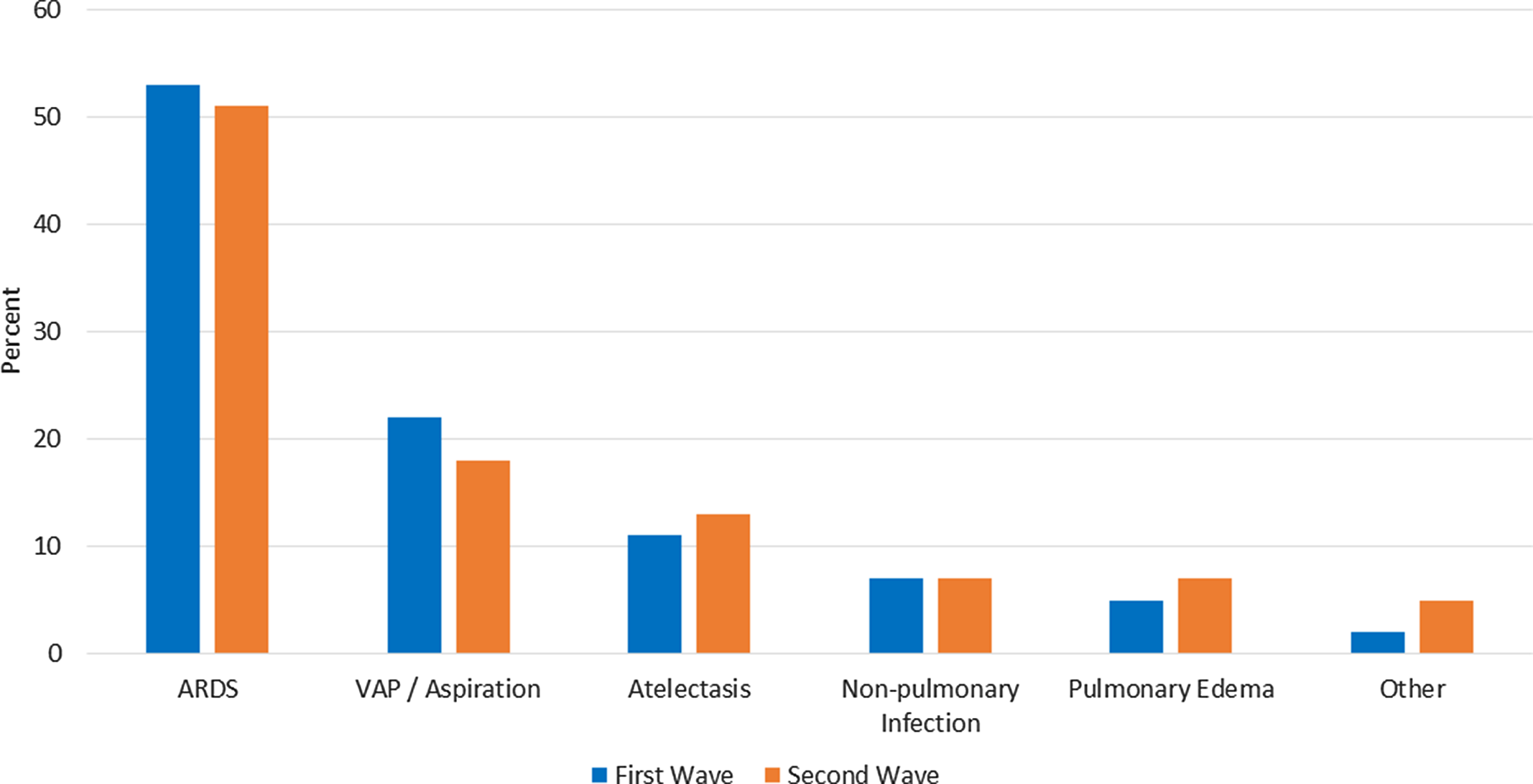
Acute respiratory distress syndrome (ARDS; 53% vs 51%) and VAP (22% vs 18%) were the most common events leading to VAE during the first wave versus the second wave (Fig. 1). More VAEs occurred during the first 7 days of intubation in the first wave versus the second wave (58% vs 40%; P =.02), but the causes of early VAEs were similar.
Clinical event leading to VAE among COVID-19 patients stratified by the first pandemic wave versus the second wave.

Discussion
We report on changes in the incidence, causes, and outcomes of VAEs in COVID-19–positive patients during the first wave versus the second wave of the pandemic. The VAE incidence per 100 episodes of mechanical ventilation decreased but the rate per 1,000 ventilator days remained stable. In-hospital mortality rates of ventilated COVID-19 patients with and without VAEs was higher in the second wave. In both waves, the rate of VAE was higher compared to prepandemic cohorts. ARDS was the most common cause of VAEs in both COVID-19 waves, whereas before the COVID-19 pandemic most were caused by pneumonia and pulmonary edema. Reference Weinberger, Rhee and Klompas6,Reference Cocoros and Klompas7
The higher mortality rate among COVID-19 patients with VAEs during the second wave versus the first wave (60% vs 30%) may reflect the preference to defer intubation whenever possible during the second wave in favor of HFNC or noninvasive ventilation. Noninvasive ventilation and HFNC were used sparingly at our institutions and many others during the first wave for fear of aerosol generation and healthcare worker exposure, but their use rapidly expanded over time based on local experience and increasing evidence of safety and efficacy. Reference Papoutsi, Giannakoulis, Xourgia, Routsi, Kotanidou and Siempos3,Reference Mellado-Artigas, Ferreyro and Angriman8 As a result, invasive ventilation was reserved for a much sicker segment of the COVID-19 population. This finding is supported by the longer average interval between admission and intubation in the second wave versus the first wave. Likewise, progression to intubation despite the use of evidence-based therapeutics (eg, remdesivir, dexamethasone, and tocilizumab) may have further selected for severely ill patients. Notably, however, VAEs per episode of mechanical ventilation were less frequent in the second wave. This finding may reflect changes in ventilation strategies and the increased use of anti-inflammatory medications mitigating the risk of progressive ARDS triggering VAEs.
The causes of VAEs among COVID-19–positive patients were similar between the first wave and the second wave, and progressive ARDS was the most common trigger in both waves. Fewer VAEs occurred within 7 days of intubation during the second wave. This finding may also be attributable to advances in therapeutics or increasing resumption of VAE prevention best practices such as minimizing sedation, low-tidal-volume ventilation, conservative transfusion thresholds, and mobilizing patients. Reference Cocoros and Klompas7 Improved therapeutics may forestall or blunt the severity of ARDS and thus precipitate fewer ARDS-related VAEs. Reference Investigators, Gordon and Mouncey9,Reference Tomazini, Maia and Cavalcanti10
This study had several limitations. We focused on 4 hospitals in eastern Massachusetts alone, potentially limiting generalizability. However, many of the therapeutics and practice changes that occurred in these hospitals were widespread. We identified a primary clinical event leading to VAE in each case via manual chart review but may have missed additional complications (eg, pulmonary embolisms, which are common in severe COVID-19) if they were undiagnosed by medical teams. Our analysis did not provide insight into which specific clinical factors most affected changes in VAE epidemiology nor did it include granular data on severity-of-illness, whether it has changed over time, or its association with VAE risk. These are important topics for future research.
In conclusion, VAE rates per 100 episodes of mechanical ventilation decreased among COVID-19 patients over the first 2 waves of the pandemic, whereas rates per 1,000 ventilator days remained stable. The most common cause of VAEs in both waves was progressive ARDS, in contrast to historical series where most VAEs have been caused by pneumonia and fluid overload. These observations underscore the ongoing need to optimize VAE prevention strategies with increased emphasis on minimizing and mitigating ARDS in patients with COVID-19.
Acknowledgments
The Centers for Disease Control and Prevention and National Institutes of Health had no role in the design and conduct of the study; collection, management, analysis, and interpretation of the data; preparation, review, or approval of the manuscript; or the decision to submit the manuscript for publication.
Financial support
This work was funded by the Centers for Disease Control and Prevention (grant no. 6U54CK000484-04-02) and by the National Heart Lung and Blood Institute of the National Institutes of Health (grant no. T32HL007633).
Conflicts of interest
All authors report no conflicts of interest relevant to this article.